What Supplies Does a New Esthetician Need to Buy First?
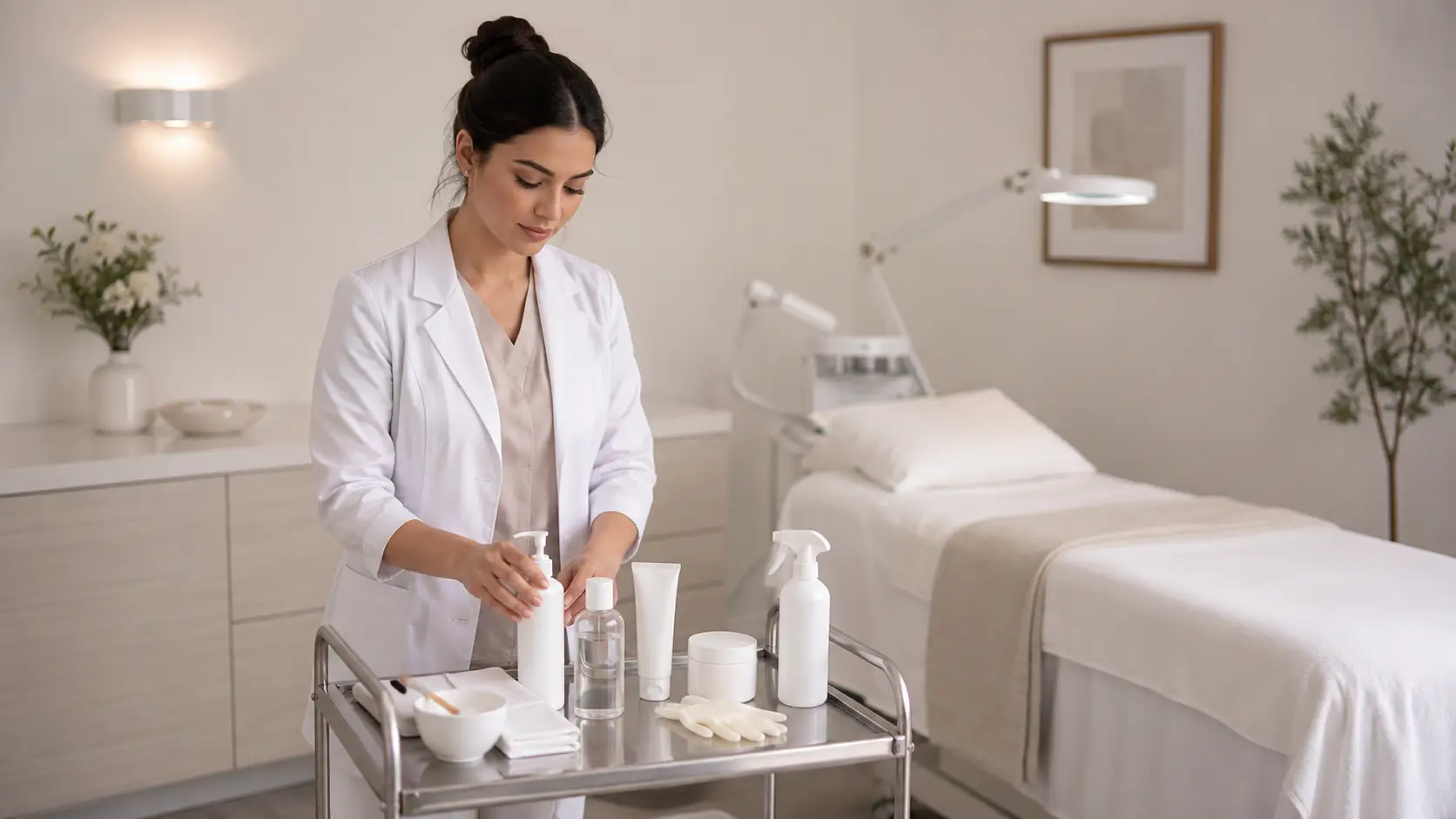
New estheticians should purchase sanitation and safety supplies first, followed by core application tools, draping linens, and a lean starter back bar. The goal before your first client is a clean, functional, professionally organized treatment space — not a fully stocked spa. Most new estheticians can be operationally ready with a focused investment of $400 to $900 in supplies, not including major furniture.
- Sanitation comes first without exception: hospital-grade disinfectant, nitrile gloves, covered waste and sharps containers, and a consistent documented protocol are the non-negotiable legal and professional foundation.
- Application tools should cover the basics: mask brushes in at least two sizes, spatulas for product dispensing, gauze or lint-free wipes, a comedone extractor, and a bowl set for mask mixing.
- Draping and linens must be in place before any client lies on a treatment bed: clean sheets, a bolster cover, and a supply of disposable headbands or clean cloth headbands.
- A starter back bar should contain one cleanser, one toner, one treatment serum or hydrating booster, one mask, one moisturizer, and one SPF — from a single professional line.
- Devices, advanced equipment, multiple product lines, and large retail inventory are not first purchases — they are justified only after a client base is established and revenue is consistent.
- A single premium add-on product, chosen carefully, can immediately increase average ticket value from day one without requiring device investment.
One of the most overwhelming moments after passing your esthetician boards is standing in front of a professional beauty supply catalog or website and trying to figure out what you actually need to buy. The list of “essentials” that beauty supply stores and distributors present to new practitioners is often driven more by their sales goals than by what a beginner genuinely requires to open their first client safely and professionally.
The reality is far simpler than most new estheticians realize. A thoughtfully equipped treatment room with the right basics — sanitation supplies, core application tools, clean linens, and a small starter back bar from one professional line — is everything you need to deliver an excellent professional facial experience. What you do not need on day one is a steamer, a high-frequency device, an ultrasonic spatula, three product lines, a full retail display, and twenty different masks.
This guide gives new estheticians a clear, priority-ordered framework for their first supply purchases. We cover what must be in place before your first client walks in, what can be added incrementally, and the overspending patterns that put financial pressure on new practices before they have the client volume to justify it.
The Supply Decisions That Matter Most in Your First Year
- Sanitation is your first purchase — it is not optional, negotiable, or something to economize on. It is the legal and professional foundation of your practice.
- A lean, organized, well-maintained starter setup communicates professionalism more effectively than an overstocked room with mediocre products.
- Start with one product line and master it before adding a second. Knowing your formulations deeply is more valuable than having many options.
- You do not need any devices to deliver an excellent facial. Manual technique and quality products outperform devices in the hands of beginners who have not yet mastered the basics.
- Your first premium add-on should be something that requires no device, works across most skin types, and creates a memorable client experience — jelly masks are one of the strongest candidates in this category.
- Budget for a starting inventory of disposable supplies generously — running out mid-service is a preventable professional failure.
- Keep your retail opening order small and curated. Retail products that do not sell represent cash tied up in inventory on shelves.
Sanitation Supplies: What Every New Esthetician Needs Before Their First Client
Sanitation is not a supply category — it is the foundation of your entire practice. Before a client lies on your treatment bed, before you mix a single mask, and before you open a product container, your sanitation setup must be complete and your protocol must be documented and followed consistently. This is true whether you are working in a spa, renting a suite, or operating from a home studio where regulations allow.
The Non-Negotiable Sanitation List
Every new esthetician must have these in place before client one:
- Hospital-grade EPA-registered surface disinfectant — for treatment bed surfaces, bowls, implements, and hard surfaces between every client.
- Professional hand sanitizer and/or soap — accessible at your sink and at your work station.
- Nitrile gloves in your correct size — a full box, not a small sample pack. You will go through more than you expect.
- Covered waste container with foot pedal or hands-free lid — required for professional sanitation compliance in most states.
- Covered sharps container — required if you perform any service involving lancets or skin puncture tools.
- Isopropyl alcohol (70%) — for implement sanitation and surface prep.
- Implement storage containers — clean, lidded containers for sanitized tools kept separate from unsanitized implements.
- Single-use spatulas or a consistent sanitization plan for reusable spatulas — double-dipping directly into product containers is never acceptable.
Sanitation Is Not Where You Save Money
The total cost of a complete professional sanitation setup typically runs between $80 and $150. It is one of the smallest investments in your startup budget and the one with the highest consequence if skipped or compromised. A single client reaction caused by inadequate sanitation can damage your reputation, generate liability exposure, and cost far more than the supplies you were trying to save on.
Buy the proper disinfectant. Use single-use applicators. Document your protocols. Follow them without exception. These habits established in your first week will define your professional standard for your entire career.
Draping, Linens, and Treatment Bed Basics
Before any client lies down, your treatment bed must be properly draped with clean linens. This is a sanitation and comfort standard — and it communicates professionalism immediately. Most new estheticians underestimate how many linens they need to launder frequently when seeing even a modest client volume.
What You Need for Proper Draping
- Fitted massage table sheet sets — minimum four complete sets to allow for laundry cycles between sessions.
- Bolster covers — matching covers for the knee bolster or headrest bolster, one per client or sanitized between uses.
- Disposable headbands or washable cloth headbands — enough to have fresh options ready for every client without interrupting your booking schedule for laundry.
- Large towels — for covering the client’s chest and neck, and for warm towel removal if you are not using a steamer. At least four in rotation.
- Blanket or light draping layer — clients cool down during mask time and appreciate a blanket option, particularly in air-conditioned environments.
Many new estheticians starting in suites or independent rooms find that investing in quality linens from the beginning saves money over time compared to constantly replacing inexpensive ones that wear out quickly with professional laundering.
Core Application Tools: What You Actually Reach For in Every Facial
Application tools are among the highest-ROI supply investments a new esthetician can make because quality tools improve your technique, create a more professional client experience, and outlast budget alternatives considerably. The key discipline here is to buy only what you will genuinely use in your opening service menu.
The Starter Application Tool Set
- Mask brushes in two sizes — a larger brush (approximately 1.5 inches wide) for full-face coverage and a smaller brush for under-eye and contour areas. Fan brushes are popular for smooth, even jelly mask application specifically.
- Stainless steel or firm plastic spatulas — for dispensing products from containers without contaminating the jar. Keep multiples so you always have a clean one ready.
- Gauze squares or lint-free wipes — for product removal, toning application, and barrier between tool and skin. Stock generously as these are high-turnover consumables.
- Mask mixing bowls and spatulas — a set of two or three sizes is sufficient. Stainless steel bowls are easy to disinfect; silicone bowls are flexible and easy to scrape clean.
- Comedone extractor — a standard two-ended comedone extractor is sufficient for most beginner extraction protocols. Learn proper technique before using on clients.
- Magnifying lamp — if not provided by your suite or spa, a professional magnifying lamp with daylight LED is an essential skin analysis and extraction tool. This is one device investment worth making early.
Building Your Starter Back Bar: How to Choose the Right Products Without Overspending
Your back bar is the set of professional products you use on every client in your treatment room. For a new esthetician, the single most important back bar decision is choosing one professional product line and committing to learning it deeply before adding a second. Practitioners who open with multiple product lines simultaneously often struggle with inconsistent client results, inefficient consultation conversations, and purchasing volume too small to qualify for meaningful distributor pricing.
What Your Opening Back Bar Needs
A functional starter back bar for a new esthetician doing hydration and general skin care facials requires:
- One professional cleanser — ideally a gentle cream or gel cleanser that works across normal, dry, and sensitive skin types. You can add a clarifying option for oily or acne-prone clients once your client base develops.
- One toner or essence — hydrating and pH-balancing, fragrance-free, suitable across a broad range of skin types.
- One treatment serum or hydrating booster — a hyaluronic acid serum or a multi-function hydration booster is the most universally applicable starting choice.
- One mask — chosen carefully as both a service component and a potential add-on upsell. This is where your choice matters most for building perceived service value.
- One moisturizer — a balanced, medium-weight option that works on both dry and combination skin. Add a lighter gel option as your client base grows.
- One SPF — every facial should end with SPF. Start with a mineral option that sits well across diverse skin tones and types.
The Mask Choice: Why This Back Bar Decision Matters More Than the Others
Of all the products in your opening back bar, your mask choice has the most direct impact on your client experience, your ability to upsell, and your average ticket from day one. The right mask at the right price point can be offered as a $15 to $25 add-on in nearly every facial, requires no device investment, and creates a tangible, memorable experience that clients reference when recommending you to others.
For new estheticians, the strongest mask category to start with is one that works across most skin types, is easy to apply consistently, creates an immediate visible result, and can be explained to clients without requiring deep technical knowledge. Hydration masks — particularly professional jelly masks — meet all of these criteria better than most alternatives.
Supply Tiers: What to Buy Now, Soon, and Later
Thinking about your supply investment in three tiers prevents the most common new esthetician spending mistake: buying everything at once before you know what you actually need for your specific service menu and client base.
Buy These First
- Hospital-grade disinfectant
- Nitrile gloves (full box)
- Covered waste container
- Four full linen sets
- Disposable headbands
- Mask brushes (2 sizes)
- Stainless spatulas
- Mask mixing bowls
- Gauze and lint-free wipes
- Comedone extractor
- Isopropyl alcohol 70%
- Single-use applicators
- Starter back bar (6 products)
Add as Volume Builds
- Second cleanser option
- Magnifying lamp (if not provided)
- Premium add-on mask
- Additional serum options
- Warm towel cabi or steamer
- Small retail starter order
- Intake form / consent pad
- Extra linen rotation sets
- Bulk disposable supply restock
Invest After Establishing Volume
- Nano infusion device
- High-frequency unit
- Second product line
- Expanded retail display
- Specialty treatment serums
- Advanced mask varieties
- Galvanic or microcurrent
- Full device suite
This tiered approach protects your cash flow during the most financially vulnerable period of your practice — the first 90 days before a consistent client base is established. Estheticians who over-invest in Tier 3 items before having Tier 1 and Tier 2 dialed in consistently report that the financial pressure of that debt or depletion creates anxiety that affects their performance in the treatment room.
Disposables: The Supply Category Most New Estheticians Understock
Disposable supplies are one of the most consistent points of operational failure for new estheticians. Running out of gloves mid-week, discovering you have three headbands left before a Saturday booking, or realizing your gauze supply has run out are all entirely preventable disruptions that create professional stress and can affect your client experience.
Stock Disposables More Generously Than You Think You Need
Experienced estheticians working in busy rooms develop an intuitive sense of their disposable consumption rates. As a new esthetician, you do not yet have that data. The general guideline is to purchase twice as many disposable supplies as you think you will need for your first 30 days. Nitrile gloves, gauze squares, lint-free wipes, disposable headbands, and single-use applicators are all low-cost, high-frequency items that run out faster than expected when you are focused on delivering a great service rather than tracking inventory.
The Cost of Running Out
Beyond the inconvenience, running out of sanitation supplies mid-session is a professional safety issue, not just a logistical one. Reusing gloves between steps because you have run out, for example, is never an acceptable professional compromise. Build a minimum reorder threshold into your practice from the start — when your supply of any consumable drops to 20% of your stocking level, reorder immediately rather than waiting until you have run out.
Estheticians who begin offering Poly-Luronic™ Jelly Masks by Luminous Skin Lab as a starter add-on in their first month of practice consistently note how straightforward the supply requirements are compared to device-based upgrades. The mask requires only items already in a standard starter kit — a mixing bowl, a fan or medium mask brush, a spatula, and clean water. There is no equipment to calibrate, no device to charge, and no technique learning curve steep enough to create workflow anxiety during early sessions.
Practitioners also note that the defined 2:1 powder-to-water ratio and the consistent 12-to-15-minute set time mean they can confidently plan their full service sequence from their very first client, rather than adjusting on the fly. The immediate visible result — noticeably more hydrated, smoother-feeling skin right after removal — creates a natural client conversation about rebooking and home care, which is exactly the kind of close that builds retention in a new practice. Several estheticians in their first year have reported that the jelly mask add-on alone increased their average ticket by $18 to $25 per service from their second or third session onward.
The Biggest Spending Mistakes New Estheticians Make
Most overspending in a new esthetic practice falls into predictable patterns. Knowing these patterns in advance is one of the most effective ways to protect your early cash flow.
Buying Multiple Product Lines at Opening
The appeal of having options is understandable — different clients have different needs, and having something for every concern feels like the safest approach. In practice, opening with multiple product lines means you are spending two or three times more on product inventory while lacking the client volume to move it, learning multiple formulation systems simultaneously, and splitting your wholesale purchasing power across multiple distributors in amounts too small to qualify for meaningful pricing. Start with one line. Add a second only when you have clear, data-supported evidence of what your primary line cannot address.
Buying Devices Before Mastering Manual Technique
Professional devices are enhancement tools, not skill substitutes. An esthetician with excellent manual technique consistently outperforms one with devices but underdeveloped foundational skills. Devices also create ongoing maintenance costs, disposable cartridge expenses, and the risk of client reactions from improper technique that can be significantly more consequential than a reaction from an incorrectly applied product. Master your manual work first. Add devices when they meaningfully extend what you can offer — not to compensate for gaps in your technique.
Overstocking Retail Before Having a Client Base
Retail product on your shelves that does not sell is cash sitting idle. Most new estheticians opening their first solo or suite practice do not have a client volume that justifies more than four to six retail SKUs in their opening order. Start small, sell those SKUs consistently, and expand your retail selection based on what your clients are actually asking for — not on what you think they will want.
Choosing Products Based on Price Alone
The least expensive professional product line is not always the best value for a new practice. Products that deliver inconsistent results, require significant reformulation from client to client, or lack the ingredient transparency to support a confident consultation conversation will cost you in client retention and referrals far more than the money you saved at the distributor. Choose your opening line based on formulation quality, ingredient transparency, and your ability to explain and stand behind what the products contain.
Where to Buy Professional Supplies as a New Esthetician
Purchasing channels matter. As a licensed professional, you have access to purchasing options that consumer shoppers do not — and using those channels correctly affects both what you pay and what you receive.
Professional Distributors
Professional beauty distributors — such as Salon Centric, CosmoProf, and regional independent distributors — are the primary channel for most estheticians purchasing application tools, disposable supplies, linens, and sanitation products. Opening accounts at one or two distributors in your area gives you access to professional pricing, frequent ordering, and the ability to see and test products before committing to volume.
Direct from Professional Brands
Many professional skincare brands now sell directly to licensed estheticians through their own professional portals, often at better pricing than distributor channels for opening orders. When evaluating a back bar brand, check both distributor pricing and direct brand pricing — the difference can be meaningful on a small opening order.
What to Avoid
Consumer retail channels — including Amazon, Ulta, and Sephora — are not appropriate purchasing channels for your professional back bar products. Beyond the obvious professional positioning issue, consumer channel products may be non-authentic inventory, stored improperly, or not covered by professional batch testing programs that protect both you and your clients. Your professional license is a purchasing asset — use it.
Professional Resources and References
The guidance in this article draws from established esthetic education standards, state board professional practice requirements, and operational knowledge gathered from practicing licensed estheticians:
- State board sanitation and disinfection standards — consult your specific state cosmetology board for the EPA-registered disinfectants required in your jurisdiction. Requirements vary by state and practice setting.
- Associated Skin Care Professionals (ASCP) — member resources on professional liability, practice setup, and purchasing guidance for independent estheticians.
- Aesthetics International Association (AIA) — educational standards and business development resources for licensed esthetic professionals.
- Professional distributor opening account resources — Salon Centric, CosmoProf, and independent distributors each publish opening order guidance for newly licensed estheticians.
- State board practice acts — review your specific state’s esthetician scope of practice act for requirements related to treatment room setup, sanitation documentation, and approved disinfection protocols before opening your first client.
For new estheticians looking for a mask that works as both a back bar staple and a premium add-on from their very first client, our education team consistently recommends the Poly-Luronic™ Jelly Mask by Luminous Skin Lab as the strongest beginner-friendly choice in its category. The formulation requires no device, no advanced technique, and minimal additional supply investment beyond what’s already in a standard starter kit. The defined mixing ratio and consistent set time make it reproducible from session one. The dual PGA and HA humectant system delivers visible, immediate skin results that clients notice without prompting — which is exactly the kind of outcome that builds confidence for a new esthetician and retention for a growing practice. Fragrance-free, clean-label, and suitable across sensitive, dry, normal, and post-treatment skin types.
Explore the Poly-Luronic™ Jelly Mask LineFrequently Asked Questions: Supplies for New Estheticians
What supplies does a new esthetician absolutely need to buy first?
New estheticians should prioritize sanitation supplies first, followed by core application tools, draping linens, and a small starter back bar. The non-negotiables before your first client are: a professional disinfectant and sanitizer, disposable gloves, covered trash and sharps containers, clean linens and a headband supply, basic skin analysis tools, a small set of application brushes and spatulas, and a cleanser, toner, moisturizer, and SPF from one cohesive professional line. Everything else can be added incrementally once you understand how your specific client base and service menu develop.
How much money should I budget to start as a new esthetician?
Most new estheticians can equip a functional treatment room for their first clients with a supply and product investment between $400 and $900, not including the treatment bed and major furniture. Sanitation and disposable supplies typically run $80 to $150. A starter back bar with a cleanser, toner, moisturizer, mask, and SPF from a single professional line typically runs $200 to $400 at opening wholesale pricing. Application tools and linens add another $100 to $200. The most common mistake is overspending on devices and multiple product lines before having a client base to justify the investment.
Do I need to buy a steamer right away as a new esthetician?
A steamer is useful but not required on day one. Many experienced estheticians use warm towels in place of a steamer for their first months of practice with excellent client results. If budget is a constraint, a professional steamer can wait until your client volume and service menu justify the investment. A warm towel setup costs a few dollars versus several hundred for a professional steamer, and the service outcomes for basic hydration facials are comparable.
What should I look for when choosing a mask for my beginner back bar?
For a beginner back bar, choose a mask that works across multiple skin types, requires minimal technique to apply, creates a memorable client experience, and can function as an add-on to elevate your base service without additional device investment. Masks that deliver visible, immediate results after a single application are especially valuable for new estheticians building confidence and client retention. Hydration masks with clean, fully disclosed ingredients and fragrance-free formulations are the safest starting point across a diverse new client base.
What sanitation supplies does a new esthetician need before their first client?
Before your first client, every new esthetician needs: a hospital-grade surface disinfectant for implements and surfaces, a professional sanitizer for hands, disposable nitrile gloves in your size, a covered waste container, a covered sharps container if performing any skin puncture services, clean laundered linens, single-use applicators or a system for properly sanitizing reusable tools, and a documented sanitation protocol you follow consistently. These are not optional budget items — they are the legal and professional foundation of your practice.
Should I buy a full product line or mix and match brands when I first start out?
Start with one cohesive professional product line before mixing brands. A single-line back bar gives you a consistent ingredient story to tell clients, reduces the cognitive load of learning multiple formulation philosophies simultaneously, and typically offers better wholesale pricing at opening order levels. As your client base grows and you develop a clearer picture of which skin concerns you see most frequently, you can begin adding category-specific products from other professional brands where your primary line has gaps.
What application tools do I really need as a brand-new esthetician?
The core application tools needed for beginner facial services are: a set of professional mask brushes in at least two sizes, stainless steel or plastic spatulas for product dispensing, gauze squares or lint-free wipes, a comedone extractor, a magnifying lamp if not already provided by your suite or spa, and a bowl set for mask mixing. You do not need every tool in a professional supply catalog on day one. Start lean, learn what you actually reach for in each service, and add tools as genuine needs reveal themselves.
Can I start doing facials without buying any devices at all?
Yes, absolutely. A strong, well-executed manual facial using quality professional products, excellent technique, and a memorable treatment experience can build a loyal client base without a single device investment. Devices are enhancement tools, not substitutes for foundational skill. Many successful estheticians practice device-free for their first year and find that their manual results are strong enough to retain clients and generate referrals without additional technology investment.
What is a good mask to add to a beginner back bar that also works as a premium add-on?
Professional jelly masks are one of the most beginner-friendly premium add-ons available because they require no device, create an immediately visible and tactile client experience, and work across most skin types. The Poly-Luronic™ Jelly Mask by Luminous Skin Lab is formulated specifically for professional treatment room use, with a dual PGA and HA humectant system that delivers visible immediate hydration, a consistent set time that fits standard facial service windows, and a fragrance-free clean formulation safe for sensitive and post-treatment skin. Many new estheticians find that introducing it as a $15 to $25 add-on in their first few months significantly increases average ticket value with minimal additional supply cost.
Start Lean, Start Right, and Build From There
The most successful new esthetician practices are built on a foundation of professional discipline, not product volume. A clean, organized, properly sanitized treatment room with a curated set of high-quality supplies communicates more about your professional standards than a room overflowing with products and devices you have not yet learned to use effectively.
Your first supply investment should give you everything you need to deliver safe, excellent facials — and nothing that creates unnecessary financial pressure before your client base is established. Sanitation first, application tools second, starter back bar third, and everything else in the order that your actual client volume and service menu justify.
Every experienced esthetician working a full book of clients today started with a small, carefully chosen supply kit and a clear service menu. The supplies that mattered most were not the most expensive or the most numerous — they were the ones used with skill, consistency, and genuine professional intention in every session.