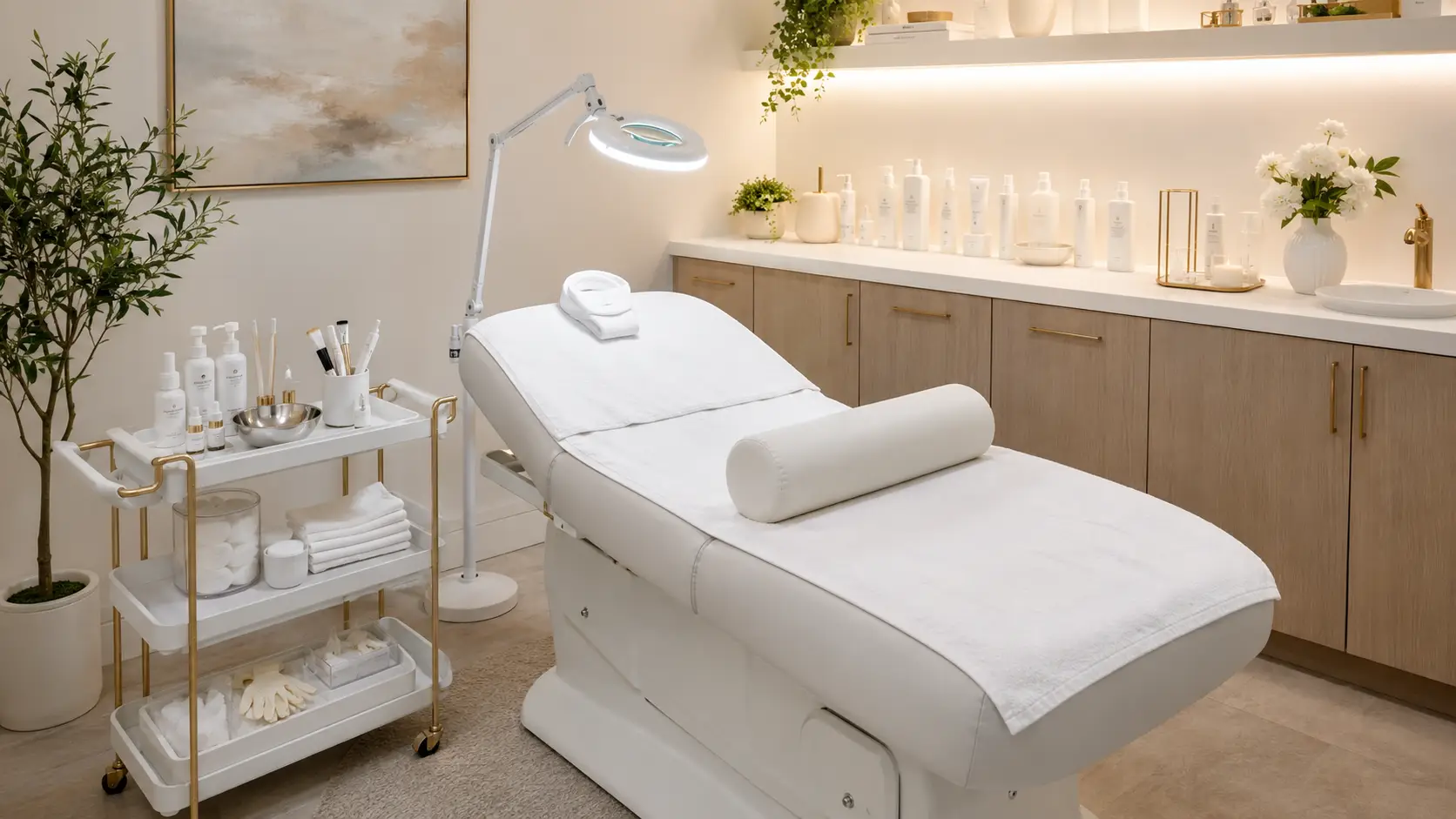
What Does a New Esthetician Need in Their Treatment Room?
A complete beginner esthetician treatment room requires supplies across six core categories: a properly outfitted service station, sanitation and infection control equipment, a functional back bar of professional skincare products, application tools and disposables, linen and client comfort supplies, and a consultation and documentation system. Having every category addressed before the first client appointment prevents mid-service gaps that undermine client confidence and service quality.
- Sanitation supplies are the highest-priority category — hospital-grade disinfectant, single-use gloves, and proper implement sterilization are legal and professional requirements from day one.
- A treatment bed, magnifying lamp, and facial steamer form the essential equipment core. All three should be in place before client services begin.
- The back bar needs at minimum a cleanser, exfoliant, toner, serum, mask, moisturizer, and SPF to cover fundamental facial service needs.
- Disposable supplies — cotton rounds, gauze, applicators, spatulas, and gloves — are consumed every service and require ongoing stock management from the start.
- A mask option for post-treatment calming and hydration should be on the checklist before offering any exfoliation or extraction services.
- Client intake forms, consent documents, and treatment record cards are professional and legal requirements, not optional additions.
Walking into your treatment room for the first time with a paying client on the way is one of the most exciting moments in an esthetician’s career. It can also be one of the most stressful — particularly if you realize mid-service that something critical is missing. A bowl for mask mixing that you forgot to order. No extra gloves in the drawer. Linen that never made it into the rotation. The client lying on the bed while you try to problem-solve a gap in your setup.
The treatment room checklist exists precisely to prevent this scenario. But a useful checklist is not just a generic list of products — it is a systematically organized guide that covers every category of supply you need, explains why each item matters in a professional context, and helps you understand the difference between what must be in place before your first appointment and what can be added over time as your practice grows.
This guide gives new estheticians a complete, category-by-category treatment room checklist built around what actually matters for professional service delivery — not just what looks good on a shelf. It is organized by setup priority so you can work through it systematically rather than trying to buy everything at once.
What This Checklist Covers and Why It Matters
- Sanitation and infection control is the non-negotiable foundation of every professional treatment room — it comes before everything else on this list.
- A treatment bed, magnifying lamp, and steamer are the core equipment trio for facial services and should be established before marketing any services.
- The back bar does not need to be large — it needs to be complete for the specific services you are offering. Quality over quantity from the start.
- Disposable supplies are consumed at volume — build a reorder system before you run out mid-service week.
- Mask supplies deserve dedicated attention: mixing tools, mask categories, and a professional option for calming and hydration should all be on your checklist.
- Client documentation — intake forms, consent agreements, and treatment records — is a legal requirement and professional standard, not optional paperwork.
- Equipment upgrades such as high-frequency, microcurrent, and most LED devices can wait until client volume justifies the investment.
How to Use This Treatment Room Checklist as a New Esthetician
This checklist is organized into six categories that correspond to the six functional areas of a professional esthetic treatment room. Each category includes the items you need, a brief explanation of why each matters professionally, and a note about what can be deferred if budget is a constraint.
Work through each category in the order presented. Sanitation and infection control comes first because it is legally and professionally non-negotiable. Equipment comes second because it determines what services you can offer. Everything else builds from there.
The goal when setting up your first treatment room is not to have everything simultaneously — it is to have everything that is required for the specific services you are ready to offer, with nothing missing that would compromise safety, sanitation, or service quality. Many experienced estheticians who have helped set up multiple treatment rooms over the course of their careers consistently note that the most common new esthetician mistake is spending heavily on decorative or aesthetic elements while leaving functional supply gaps that affect actual service delivery.
Before You Start: Understand Your Priority Tiers
Not every item on a treatment room checklist carries equal weight. Understanding the three priority tiers helps you allocate a startup budget correctly and avoid the common pattern of overspending on visible items while underinvesting in operational essentials.
Non-Negotiable Before First Client
Sanitation equipment, treatment bed and linens, magnifying lamp, back bar core products, disposable supplies, and client documentation. No services without these.
Should Be In Place Within First Month
Facial steamer, full linen rotation, mask supply variety including a professional jelly mask option, full-range disposable restocking system, and a retail display.
Add as Revenue Grows
Advanced devices (microcurrent, high-frequency, ultrasonic), additional product lines, specialty treatment add-ons, and aesthetic room decor beyond basic professionalism.
Category 1: Sanitation and Infection Control
Sanitation is the non-negotiable professional and legal foundation of every esthetic service. State cosmetology boards in every jurisdiction require specific sanitation standards as a condition of licensure. More importantly, clients trust their skin — and in many cases, their health — to estheticians who they assume are operating to a professional standard. Sanitation is where that trust is earned or lost, often without the client ever being aware of what you are or are not doing.
New estheticians sometimes underinvest in sanitation supplies in favor of products and decor that are more visible to clients. This is one of the most consequential setup errors a new esthetician can make.
Sanitation and Infection Control Supplies
- Hospital-grade EPA-registered surface disinfectant spray or wipes
- Barbicide or equivalent disinfectant solution and container for metal implements
- Autoclave or UV sanitizer for reusable metal tools (if offering extractions)
- Single-use nitrile or latex gloves in your size — minimum two boxes to start
- Hand sanitizer dispenser at treatment station and at entry
- Antibacterial liquid hand soap at sink
- Single-use applicators and spatulas — no double-dipping from product containers
- Sharps container if lancets are used for extractions
- Covered trash receptacle with liner in treatment room
- Clean linen storage separate from used linen
- Laundry hamper with lid for used linens
- Disinfectant cleaner for facial bed and all hard surfaces
- Paper towels or single-use cloths at sink station
- Written sanitation log or daily checklist for board compliance
Check your state board’s specific disinfectant approval list. Not every product that markets itself as hospital-grade meets your state’s specific EPA registration requirements for esthetic services.
Why Sanitation Cannot Be Deferred or Partially Completed
Unlike most other categories on this checklist where you can start with fewer items and add over time, sanitation is an all-or-nothing category. Offering services without complete sanitation infrastructure is a licensing violation in every state, an insurance liability risk, and a genuine client safety failure. Every item in this category must be in place before you begin seeing clients.
Category 2: Core Treatment Room Equipment
Equipment decisions represent the largest single-purchase investments in a new treatment room setup. New estheticians often face pressure from equipment vendors, social media, and peers to buy a wide range of devices before they have established a client base or revenue stream to support those purchases. The result is frequently significant debt attached to equipment that sits largely unused in the early months of practice.
The equipment checklist below distinguishes between what is genuinely required to deliver professional facial services and what is elective. Starting with the required core and adding elective devices as revenue grows is the professionally sound approach most experienced estheticians recommend.
Core Equipment — Required
- Professional facial treatment bed or table with adjustable positioning
- Magnifying lamp with daylight-spectrum bulb — floor or wall-mounted
- Professional facial steamer with distilled water reservoir
- Facial cart or rolling trolley for beside-bed supplies
- Back bar counter or shelving for product storage and display
- Small mixing bowls in stainless steel or silicone — minimum four
- Covered product containers and spatula dispensers to avoid cross-contamination
- Timer (dedicated timer or phone) for mask timing and steaming durations
- Wastebasket with covered lid and plastic liners
- Clean towel storage container or cabinet
A professional treatment bed is the single most important equipment investment. A quality adjustable bed protects both you and your client, supports proper body mechanics for long service hours, and signals professionalism to clients from the moment they lie down.
Equipment You Can Wait to Purchase
- High-frequency device
- Microcurrent device
- Ultrasonic spatula or scrubber
- Galvanic current device
- Dermaplaning handle and blade kit (unless trained and offering from day one)
- LED panel device (significant upfront investment; justify with client volume first)
- Nano infusion device (add when you are ready to invest in training as well as equipment)
- Hot towel cabi or towel warmer (helpful but not required for core facial services)
None of the deferred items are required to deliver a professional, results-driven facial service. Master manual technique and product knowledge before adding device complexity to your service menu.
Category 3: Back Bar Products and Professional Skincare
The back bar is the product infrastructure of your treatment room. It does not need to be large or expensive to be effective — but it does need to be complete for the services you are offering. A back bar with eight well-chosen products that you understand thoroughly and can apply with confidence will deliver better client outcomes than a back bar with thirty products you are still learning to use.
Estheticians who specialize in hydration facials from the start of their practice consistently report better initial client retention than those who try to address multiple skin concerns simultaneously without deep product knowledge in any single area. Choosing a focused initial back bar allows you to develop genuine expertise in a protocol category before expanding your service offerings.
Back Bar — Core Professional Products
- Professional cleanser — at minimum a gentle daily cleanser and one for oilier skin types
- Professional exfoliant — enzyme or mild chemical exfoliant appropriate for multiple skin types
- Toner or prep solution for post-cleanse skin balancing
- Serum — at minimum a hydrating serum (HA or PGA) for broad applicability across skin types
- Professional mask — at minimum one calming or hydrating option for core services
- Professional moisturizer for normal to dry skin
- Professional moisturizer for oily or acne-prone skin or a dual option
- Broad-spectrum SPF for service completion
- Eye cream or eye treatment product
- Professional treatment oil or facial massage medium
Every product on your back bar should have a clear purpose in at least one of your core service protocols. If you cannot articulate why a product is on your back bar and when it gets used, it should not be there yet.
Retail Product Consideration
Even as a new esthetician, having a small selection of retail products available from the first client appointment creates a professional environment and allows clients who ask about home care to walk away with a product rather than just a recommendation. A retail display with three to five curated products aligned with your service focus is sufficient to start. You do not need a full retail line before you open — but having nothing available when a client asks is a missed opportunity and a signal of incompleteness that experienced clients notice.
Category 4: Disposable Supplies and Application Tools
Disposable supplies are the most frequently overlooked category in new treatment room setup because they are individually inexpensive and seem like something you can buy as needed. In practice, running out of cotton rounds, gauze, or applicators mid-service week is one of the most common and avoidable operational problems new estheticians face. These items are consumed at high volume relative to their cost and require a proactive restocking system from the very beginning of practice.
Disposable Single-Use Supplies
- Cotton rounds — buy in bulk (minimum 500-count to start, reorder before running low)
- 4×4 gauze squares — used for extractions, mask application support, and general use
- Single-use applicator sticks and spatulas — for mask mixing and product application
- Single-use fan brushes or blade applicators for mask application (optional alternative to reusable)
- Headbands or disposable hair covers for clients
- Neck strips or drape collars for linens
- Kleenex or facial tissue at treatment station
- Single-use lancets if offering extractions with lancets
- Paper cups for water rinsing at the bowl
Reusable Application Tools
- Professional fan brushes for mask application — minimum two sets
- Silicone mask brushes for jelly mask application — silicone cleans easily and dries fast
- Stainless steel mixing bowls — minimum four, various sizes
- Comedone extractor tools — two to three types for different pore configurations
- Tweezers — fine tip for ingrown hairs or fine work
- Measuring spoons for consistent product ratios (especially for powder masks)
- Silicone facial massage tools or gua sha tools if offering facial massage
All reusable metal tools must be disinfected between every client using board-approved disinfection protocols. If you are not ready to maintain that standard for a tool, use a single-use alternative instead.
Category 5: Linens and Client Comfort Supplies
Linen management is a behind-the-scenes operational function that directly affects the professional quality of your service environment. Clients form their first impression of your treatment room partly from the appearance and cleanliness of your linens. Fresh, wrinkle-free, properly fitted linens on a treatment bed communicate attention to detail before a word is spoken. Worn, mismatched, or insufficient linen sets communicate the opposite.
New estheticians consistently underestimate how many linen sets they need to operate a full service day without mid-day laundry interruptions. The minimum is six to eight complete sets for a practitioner seeing four to six clients per day.
Linens and Client Comfort Setup
- Fitted treatment table sheets — minimum 6 sets
- Flat top sheets or lightweight blankets for client coverage — minimum 6
- Hand towels for facial work — minimum 8–10 per service day
- Knee bolster with washable cover
- Head support pillow with washable cover or disposable cover roll
- Cloth headbands — minimum 8, or disposable headband roll
- Clean linen storage bin or cabinet with lid
- Laundry hamper with lid for soiled linens
- Dryer sheets or unscented fabric softener for linen care (avoid fragrance for client sensitivity)
Unscented laundry products are recommended for all treatment room linens. Clients with fragrance sensitivities — a common presentation in esthetic clients — will notice laundry fragrance on linens against their face during a treatment.
Category 6: Client Documentation and Record-Keeping
Documentation is the most commonly skipped category on a beginner esthetician’s treatment room checklist — and one of the most consequential omissions. Client intake forms, consent agreements, and treatment records are not optional paperwork. They are legal requirements in every licensed esthetics jurisdiction, professional standards that protect both the client and the practitioner, and the operational foundation of intelligent, continuity-based client care.
Experienced estheticians who have navigated board audits, insurance claims, or client-related disputes uniformly report that comprehensive, consistently maintained documentation is the single most important administrative practice in the treatment room. Setting up a documentation system before the first client means never having to reconstruct records retroactively — a situation that creates both legal risk and professional credibility problems.
Client Documentation Requirements
- Client intake form covering health history, medications, allergies, and current skincare routine
- Service consent form with specific language covering the services you offer, risks, and client acknowledgment
- HIPAA-compliant or equivalent privacy notice and consent if collecting health information
- Per-client treatment record card for noting skin condition, products used, techniques applied, and skin response
- Secure physical or digital storage for all client records — not on a shared device or unsecured paper system
- Daily sanitation log for board compliance and liability protection
- Release forms specific to any advanced services you offer (chemical exfoliation, extractions, dermaplaning)
Check with your state cosmetology board for specific documentation requirements in your jurisdiction. Requirements vary and some states have mandatory form language or minimum record retention periods.
The Mask Category Deserves Its Own Planning Conversation
Most treatment room checklists include “masks” as a single line item in the back bar category. For estheticians focused on building a strong hydration and skin recovery service menu from the start, mask selection deserves dedicated planning because the mask step is one of the highest-value service moments in a facial — both in terms of client experience and clinical outcome.
A well-chosen mask creates a pause in the service where the skin is actively receiving treatment, the client is deeply relaxed, and the esthetician has a window to add service value through complementary steps. A poorly chosen mask creates none of those outcomes. The mask category should not be an afterthought on your checklist — it should be one of your most deliberate decisions.
What Mask Categories Should a New Esthetician Stock?
At minimum, a new esthetician should have a mask option for three core scenarios: calming and redness reduction for sensitive or reactive skin, deep hydration for dry or dehydrated skin, and mild purifying or clarifying action for oily or acne-prone skin. In practice, a well-formulated hydrating mask can often serve the first two scenarios simultaneously, allowing a smaller initial investment in the mask category.
The application tools for masks also need to be on the checklist. Mixing bowls in two to three sizes, a silicone or fan brush for application, and a timing device are all required before offering any mask treatment. For powder-based jelly masks in particular, measuring spoons that allow consistent powder-to-water ratios are a professional tool that prevents the ratio variability that produces inconsistent set times and texture.
New estheticians often ask which single mask product most justifies its place on a starter checklist. Practitioners who have worked across multiple product categories consistently point to a professional jelly mask as the highest-value mask addition because of what it contributes to both the clinical outcome and the client experience relative to its per-service cost. When working with the Poly-Luronic™ Jelly Mask by Luminous Skin Lab in beginner treatment room setups, the most frequently reported practical advantages are the predictable powder-to-water mixing behavior that removes guesswork from a new esthetician’s workflow, the consistent set window that creates a clearly timed service pause for additional steps, and the visual drama of the single-piece removal that clients remember and mention specifically when rebooking.
From a protocol versatility standpoint, practitioners note that the Poly-Luronic™ formulation’s PGA and HA dual-humectant system positions it as a usable option across hydration facials, post-extraction calming protocols, and post-exfoliation recovery — three distinct service scenarios that a new esthetician is likely to encounter within the first several weeks of practice. Having one well-formulated professional mask that works across those scenarios reduces the complexity of the starter back bar while ensuring that the mask step delivers a clinically meaningful hydration outcome that clients can feel and see at service end.
Mask Application Tools to Include on Your Checklist
A dedicated mask application toolkit is a practical necessity, not an optional extra. For powder masks, you need at minimum: a medium mixing bowl (stainless steel or silicone), a silicone spatula or fan brush for application, a measuring spoon set for consistent ratios, and a timer. Single-use applicator sticks or blades provide an alternative if you prefer not to maintain a reusable brush set, but reusable silicone tools are more cost-effective at volume and clean more easily than bristle brushes after a jelly mask application.
What to Prioritize When You Are Working With a Limited Startup Budget
Budget constraints are the reality for most new estheticians. The question is not whether to work within budget constraints — it is how to allocate limited resources so that you can begin seeing clients safely and professionally without the items that can genuinely wait.
The answer comes back to the three priority tiers introduced at the beginning of this article. Tier 1 items are non-negotiable regardless of budget. They are the minimum professional and legal infrastructure for offering services. Tier 2 items are high-value and should follow within the first month as revenue begins to build. Tier 3 items are genuine growth investments that belong after you have established consistent client flow.
The Highest-Return Starter Investments
Within the Tier 1 category, the highest-return investments for a new esthetician’s startup budget are, in order: a quality treatment bed (where clients spend the entire service and which communicates your professionalism instantly), a complete sanitation infrastructure (non-negotiable for legal and client safety reasons), a focused back bar with products you understand deeply (breadth of product knowledge in a narrow category beats shallow knowledge across many products), and a professional mask option that delivers visible results that support rebooking (the mask moment is one of the highest-impact service points for client retention).
The Rule of Minimum Viable Professional Setup
Before your first client appointment, your treatment room needs to pass one simple test: can you deliver a safe, sanitary, professional facial service from start to finish without leaving the room to retrieve a missing item?
If the answer is yes — you are ready. If no — identify the gap and close it before booking. Everything else on the checklist can be added incrementally as your practice grows. The goal is completeness for the services you are offering now, not comprehensiveness for every service you might offer in the future.
New estheticians who approach setup this way consistently report lower startup stress, lower initial debt load, and faster time to profitability than those who try to build a fully equipped treatment room before seeing their first client.
Professional References and Standards
The setup guidance and professional standards referenced in this article are drawn from established esthetics industry education and state regulatory frameworks:
- State cosmetology board sanitation requirements — EPA disinfectant registration standards, implement sterilization protocols, and documentation requirements. Verify specific requirements with your state board prior to opening for services.
- NCEA (National Coalition of Estheticians, Manufacturers/Distributors & Associations) professional standards for treatment room setup and sanitation protocols in licensed esthetics practice.
- CIDESCO and ITEC international professional esthetic standards for treatment room infrastructure and client documentation requirements.
- Industry practice guidance from established professional esthetics distributors including Dermalogica Professional, Hale and Hush, and PCA Skin on back bar organization and beginner product line selection.
- Professional liability insurance carrier guidelines for esthetic practitioners regarding documentation, consent forms, and sanitation record-keeping requirements.
For new estheticians building their treatment room checklist and looking for a professional mask option that earns its place across multiple service scenarios from day one, the Poly-Luronic™ Jelly Mask by Luminous Skin Lab is the formulation most consistently recommended by our education team as the starter mask that covers the broadest range of protocol needs. The predictable mixing behavior, consistent set window, and visible PGA plus HA hydration results reduce the learning curve for new practitioners while delivering client-facing outcomes — immediate visible skin improvement and a memorable single-piece removal experience — that support rebooking from the very first service.
The formulation is fragrance-free, clean-label, and developed by a licensed esthetician specifically for treatment room use, making it appropriate for both standard hydration facials and post-exfoliation or post-extraction calming protocols — the exact service scenarios a new esthetician is most likely to encounter in their first weeks of practice.
Explore the Poly-Luronic™ Jelly Mask Line →Frequently Asked Questions: Beginner Esthetician Treatment Room Checklist
What does a new esthetician need in their treatment room before their first client?
Before their first client, a new esthetician needs a properly outfitted treatment bed with linens and a bolster, a facial steamer, a magnifying lamp, basic sanitation supplies including hospital-grade disinfectant and hand sanitizer, a back bar stocked with cleanser, toner, moisturizer, and SPF, disposable supplies such as cotton rounds, gauze, and gloves, and a bowl and brush set for mask application. Organization and sanitation readiness matter as much as having the right products.
How do I set up a treatment room on a tight budget as a new esthetician?
New estheticians setting up on a budget should prioritize sanitation equipment and a quality treatment bed first, then build out the back bar incrementally. Disposable supplies can replace reusable alternatives in the early stages to reduce upfront cost. Professional supply distributors often offer starter kits with bundled pricing. Avoid purchasing advanced devices or equipment before establishing a consistent client base.
What sanitation supplies does a new esthetician absolutely need from day one?
From day one, every esthetician needs hospital-grade EPA-registered disinfectant for hard surfaces and tools, hand sanitizer at every station, single-use gloves, autoclave or barbicide solution for metal implements, a sharps container if extractions are performed, disposable applicators and spatulas, and clean linen storage. Sanitation is not a category where corners can be cut — it is the professional and legal foundation of every service.
Do I need a facial steamer before I start seeing clients?
A facial steamer is considered a standard treatment room tool for most facial services and should be in place before you begin seeing clients. Steamers support product penetration, soften the follicle for extractions, and create a more professional treatment experience. Entry-level professional steamers are available at accessible price points and represent one of the higher-priority equipment investments for a new esthetician.
What mask supplies should a new esthetician include in their treatment room checklist?
New estheticians should stock at minimum a mixing bowl, fan brush or silicone spatula, and at least one professional mask option for each core skin concern they plan to address: hydration, calming, and barrier support. A professional jelly mask is a high-value addition because it covers multiple protocols, photographs well, and creates a memorable client experience that distinguishes basic facials from premium services.
What equipment can I wait to buy when I am just starting out as an esthetician?
New estheticians can delay purchasing high-cost devices such as microcurrent machines, ultrasonic spatulas, high-frequency devices, and most LED panels until their client volume justifies the investment. These tools enhance services but are not required to deliver professional, results-driven facials. Mastering manual technique and product knowledge before adding devices produces better long-term outcomes both clinically and financially.
How many sets of linens does a new esthetician need to start?
A new esthetician should start with a minimum of six to eight sets of linens to allow for a full day of services with adequate rotation for laundering. Each set typically includes a fitted sheet, a flat sheet or blanket, and two to three hand towels. Having enough clean linens available without mid-day laundry interruptions is a basic operational requirement that is easy to underestimate when first setting up.
Why is it important to have a dedicated back bar setup as a new esthetician?
A dedicated, organized back bar allows an esthetician to move efficiently through a service without searching for products, reduces the risk of cross-contamination by keeping all items at their designated stations, and signals professionalism to clients. Even a simple back bar with a cleanser, exfoliant, serum, mask, and moisturizer organized neatly communicates competence and builds client confidence from the first appointment.
What makes the Poly-Luronic Jelly Mask a good addition to a beginner esthetician treatment room checklist?
The Poly-Luronic Jelly Mask by Luminous Skin Lab is beginner-friendly because it mixes with a straightforward powder-to-water ratio, sets predictably within a clear time window, and removes as a single intact piece that creates an impressive client experience without requiring advanced technique. The dual PGA and HA humectant system delivers visible hydration results that clients notice immediately, which supports rebooking and word-of-mouth referrals — both critical for new estheticians building their clientele.
Your Treatment Room Checklist Is Your Professional Foundation
The treatment room checklist is not a one-time task that gets completed before opening and then forgotten. It is the ongoing operational foundation of your practice — a living document that should be revisited as your service menu expands, your client volume grows, and your protocols evolve. The six-category framework in this guide — sanitation, equipment, back bar, disposables, linens, and documentation — covers the complete infrastructure of a professional esthetic treatment room regardless of what services you eventually offer.
The most important thing a new esthetician can take from this checklist is the priority tier framework. Not everything needs to be purchased simultaneously. What needs to be in place before your first client is clearly defined in Tier 1. What follows in the first month builds on that foundation. Everything else grows with your practice.
A treatment room that is complete for the services you are offering, organized so that you can work efficiently without mid-service gaps, and maintained to the sanitation standards your license requires is the foundation of every confident, client-building service you will deliver. Get those fundamentals right first, and everything else in your practice has a solid base to build from.