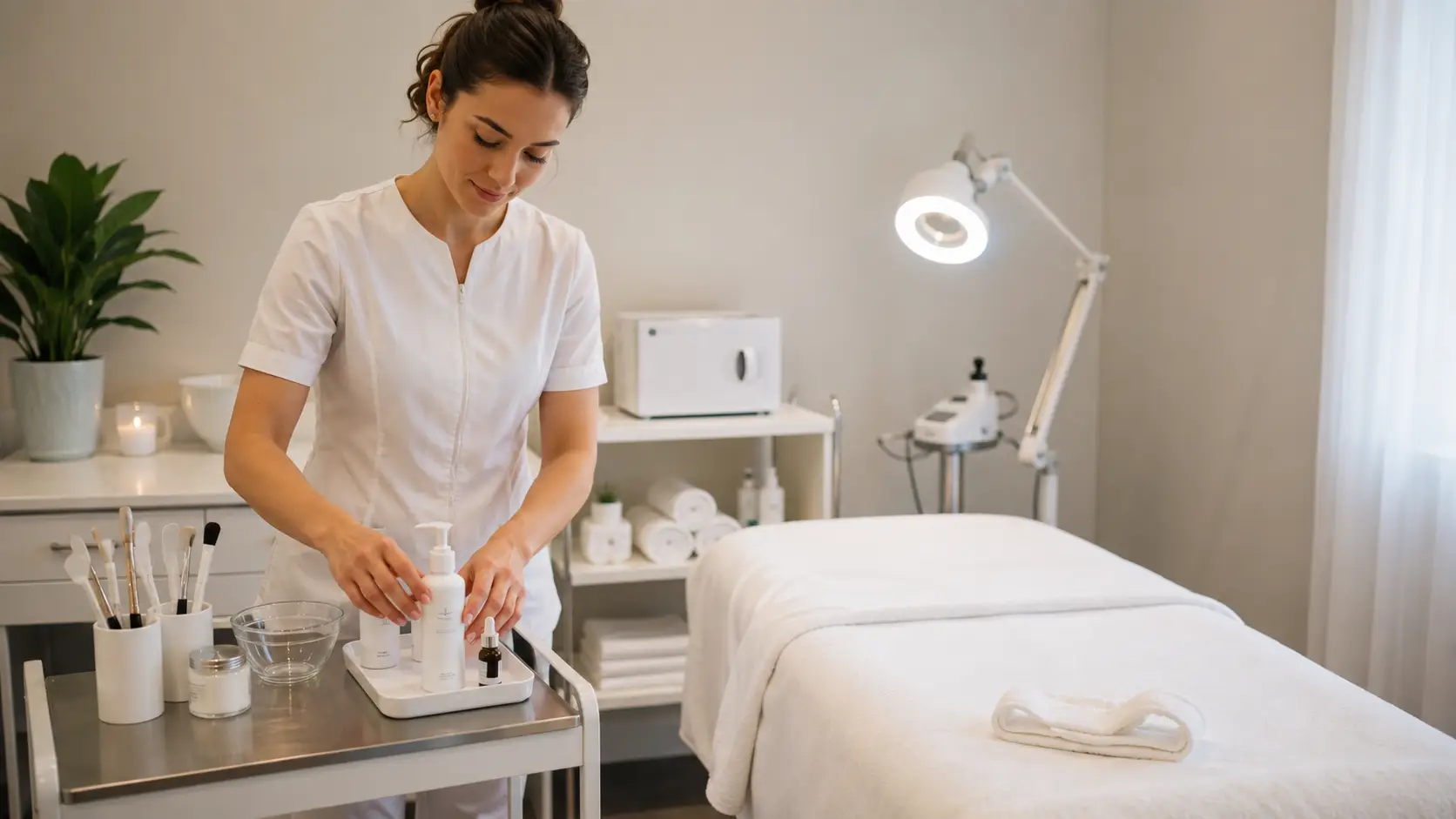
How Do You Set Up a Professional Facial Room on a Tight Budget?
Setting up a professional facial treatment room on a budget requires distinguishing between what is genuinely essential on day one and what can wait until revenue is established. Most new estheticians can build a fully functional, professional-feeling treatment room for between $800 and $2,500 by focusing spending on three core categories: a reliable treatment table, quality linens and sanitation supplies, and a carefully selected starter back bar of professional products.
- The treatment table is the single most important investment — choose one that is comfortable for clients, ergonomic for your working height, and professionally presentable. Used tables in excellent condition are widely available and represent the best budget opportunity.
- Linens, sanitation supplies, and a professional facial cart are non-negotiable day-one essentials that collectively have more impact on client experience than any device purchase.
- Advanced devices — microcurrent, high-frequency, galvanic, ultrasonic — are not necessary at launch and should wait until client volume justifies the investment.
- A steamer is widely over-prioritized by beginners. A quality towel warmer costs a fraction of the price and serves the practical function for most starter menus.
- Your back bar product selection has more direct impact on client results than your equipment list. Start with a small, clean, versatile product range and expand based on real client needs.
- Consumables — masks, gauze, cotton, disposables — are where daily client experience is made or broken. Prioritize quality here over device purchases every time.
One of the most anxiety-inducing moments for a newly licensed esthetician is standing in a supply catalog or trade show with a limited budget, a long list of things that seem essential, and no clear framework for deciding what actually needs to happen before your first client walks through the door.
The professional esthetics supply industry is structured to sell you as much as possible at the moment you are most susceptible to convincing — immediately post-graduation, when you are excited, uncertain, and comparing your empty room to every fully-equipped treatment room you have ever seen on social media. The result is that a significant number of new estheticians start their careers with a collection of underused devices, inadequate linens, and mediocre back bar products — the exact opposite of what their clients will actually experience and value.
This guide gives you a practical, spending-priority framework built on what experienced estheticians know from years of working in real treatment rooms: what your clients genuinely notice, what actually affects clinical outcomes, and what can wait until your schedule is full and your cash flow is stable. Setting up a facial room on a budget is not about compromising on professionalism — it is about spending strategically enough that you can stay in business long enough to build the room of your dreams one piece at a time.
What Every New Esthetician Should Know Before Spending a Dollar on Room Setup
- A functional professional facial room for a beginner costs $800 to $2,500 all-in if spending decisions are made strategically — not $5,000 or $10,000.
- The treatment table is your most important single purchase. Every service you perform happens on it. Get this right first.
- Linens and sanitation are where professionalism lives in the eyes of your clients. Invest here before investing in any device.
- Devices can wait. The vast majority of high-value facial services require no devices whatsoever beyond a magnifying lamp and your skilled hands.
- Your back bar products are what clients feel, smell, and experience during every treatment. This is where product quality matters far more than equipment cost.
- Buying used equipment for non-skin-contact items is smart and standard practice among experienced estheticians starting their own spaces.
- The professional perception clients form is based primarily on cleanliness, organization, and your confidence — not on the price tags of your equipment.
What Does It Actually Cost to Set Up a Beginner Facial Room?
Before exploring what to prioritize, it helps to understand realistic total cost ranges so you can plan rather than react. The wide range in setup costs comes from three variables: whether you purchase new or used for larger items, how many services you plan to offer at launch, and what your suite rental situation provides (some suites include a bed, trolley, and basic infrastructure).
Realistic Budget Ranges by Setup Level
Estheticians working in suite rentals or booth rental situations where the room is bare-bones typically spend in one of three ranges:
- Lean start ($800–$1,200): Used treatment table in good condition, one set of quality linens, a basic facial cart or trolley, magnifying lamp, towel warmer or cabi, sanitation essentials, and a minimal back bar of five to eight professional products. Services offered: basic facials and hydration treatments only.
- Confident start ($1,200–$1,800): Everything in the lean start, plus a second linen set, a broader back bar of eight to twelve products, professional-grade consumables (gauze, cotton, jelly mask powder, etc.), a basic steamer or upgraded towel system, and room to add one entry-level device. Services offered: full basic facial menu plus one specialty service.
- Full launch ($1,800–$2,500): New or near-new treatment table, complete linen inventory, professional cart, magnifying lamp, steamer, full starter back bar of twelve to sixteen products, professional consumables at par level for thirty to forty services, and budget for one or two entry-level devices. Services offered: complete beginner service menu.
The majority of new estheticians in suite rental situations who are strategic about spending fall comfortably in the confident start range. The goal is not to be fully equipped on day one — the goal is to be fully professional on day one, which are two very different things.
The Rule That Changes Everything for Beginner Room Setup
Before any purchase above $200, ask: will this item make a meaningful difference in the experience of my first 50 clients? If the answer is no — or if the item is a device you will use in fewer than half your services — it waits. Every dollar you spend before client revenue is established is a dollar you borrowed from your future self. The estheticians who last in this industry are the ones who build their rooms incrementally from profit, not from debt.
The Three-Tier Spending Framework: Essential Now, Helpful Soon, and Can Wait
The most useful way to approach a budget room setup is through a three-tier spending framework. Every item on your purchase list belongs in one of three categories: essential before your first client, helpful within the first thirty to sixty days, or something that can genuinely wait until revenue justifies it. Most beginners spend too much in the third category and not enough in the first two.
Before Your First Client
- Treatment table / facial bed
- Full linen set (minimum 2 complete sets)
- Facial cart or rolling trolley
- Magnifying lamp (adjustable arm)
- Sanitation station (disinfectant, autoclave or barbicide, covered trash)
- Professional back bar products (5–8 minimum)
- Consumables (gauze, cotton, spatulas, gloves)
- Towel warmer or cabi
- Client consultation forms (physical or digital)
Within First 30–60 Days
- Second linen set + spare bolster covers
- Facial steamer (if your menu requires it)
- Wood’s lamp or skin analysis tool
- Professional extraction supplies upgrade
- Expanded back bar (up to 12–14 products)
- Retail display shelf or unit
- Small retail product inventory (3–5 SKUs)
- Room ambient upgrades (diffuser, speaker, lighting)
Until Revenue Justifies It
- Microcurrent device
- High-frequency device
- Galvanic unit
- Ultrasonic spatula or scrubber
- Nano infusion device (until trained)
- Microneedling device (requires advanced training)
- Professional steamer upgrade
- Specialty treatment add-on equipment
The Treatment Table: Why This Is Your Most Important Purchase Decision
Every single service you perform as an esthetician happens on your treatment table. It determines how comfortable your clients are, how ergonomic your working position is, how professionally your room presents, and what services you can physically perform. Skimping here to save money for devices is one of the most common and consequential beginner mistakes.
What to Look for in a Beginner Facial Table
For a beginner esthetician on a budget, the treatment table priorities in order are: stability and structural integrity, appropriate working height adjustability for your body, client comfort particularly in the headrest area, and easy cleaning surface material. You do not need hydraulic lift capability, a built-in warming function, or premium upholstery at this stage. A well-made portable or electric-free stationary table in excellent used condition absolutely meets professional standards.
Most estheticians find that tables with adjustable headrests and a flat-to-trendelenburg range of positioning cover the vast majority of facial service needs. The critical check for any used table is structural integrity under full client weight, clean and intact upholstery with no tears or staining that cannot be covered by linens, and a headrest that locks securely at multiple positions.
New vs. Used: The Honest Budget Assessment
New entry-level portable or manual-lift treatment tables from reputable professional suppliers typically cost $250 to $500. Comparable used tables in excellent condition are regularly available from estheticians upgrading their practices, closing studio situations, or transitioning careers for $80 to $200. For a beginner on a tight budget, a used table with clean upholstery and solid structure is a professionally sound choice that frees up significant budget for consumables and products where daily client experience actually lives.
Linens: Where Professionalism Is Perceived Every Single Session
More than almost any other element of a treatment room, linens communicate professionalism to clients. Crisp, clean, white or neutral-toned linens that are pressed or wrinkle-free, properly fitted to your table, and changed completely between clients are the single most visible signal of your professional standards. The minimum investment is two complete linen sets so one can be laundering while the other is in service. Microfiber professional linens are durable, quick-drying, and wrinkle-resistant — worth the modest additional cost over standard cotton blends for a working treatment room.
Why Sanitation and Professional Consumables Deserve a Larger Budget Than Most Beginners Give Them
Sanitation supplies and consumables are the category most consistently under-budgeted by new estheticians who have spent too much on devices. This is the exact inversion of correct spending priorities. Sanitation is not optional, not minimal, and not an afterthought — it is the foundation on which your entire professional legitimacy rests. And consumables are what clients physically experience during every single treatment you perform.
Sanitation Essentials That Cannot Be Deferred
Before your first client walks in, your sanitation station must be complete and professional. This means covered waste receptacles, a properly stocked disinfection system for implements (Barbicide or equivalent EPA-registered disinfectant solution at correct concentration), an autoclave or UV sterilizer if you use metal implements, labeled containers for clean and used implements, hand sanitizer at multiple points in the room, and a documented sanitation protocol that you can articulate if inspected. The cost of building a complete sanitation station correctly is typically $80 to $150 — money that is absolutely non-negotiable.
Consumables: The Daily Client Experience Category
Professional consumables — gauze, cotton rounds and pads, wooden spatulas, disposable mask brushes, non-woven wipes, lancets for extractions, gloves — are physically in contact with clients during every service. The quality and generosity of your consumable use communicates whether you are operating at a professional or a discount standard. Buying adequate quantities of quality consumables before you launch is a direct investment in every client’s experience of your standards.
Most experienced estheticians advise stocking consumables for at least thirty to forty services before launch — more if you are opening with a promotional period or discounted introductory pricing that will drive higher-than-average early volume. Running out of gauze or using obviously cheap disposables in a session is a credibility cost that cannot be undone in that appointment.
Building a Starter Back Bar on a Budget: What You Need and What You Can Skip
Your back bar product selection is one of the two areas (alongside consumables) where quality investment pays the most direct dividends in client experience and results. This is where clients feel what you have chosen to put on their skin, and where the visible outcome of a service is largely determined. A small, well-chosen back bar of professional-grade products consistently outperforms a large collection of mediocre ones in both results and professional impression.
The Minimum Viable Back Bar for Beginner Services
A functional starter back bar that covers basic to intermediate facial services needs to address five treatment phases: cleansing, exfoliation, treatment and serum application, mask, and moisturizer with SPF. At minimum, one product per phase gives you a back bar of five professional products. Estheticians working in budget-conscious situations often start with a single versatile cleanser, a mild enzyme exfoliant, one treatment serum covering their most common concern (typically hydration or calming), one mask format, and one finish moisturizer with SPF. This five-product minimum can be expanded incrementally as client volume and revenue establish themselves.
Choosing Products That Work Across Multiple Skin Types
Budget-constrained back bar building requires choosing products that work well across the widest possible range of clients rather than building specialty lines for specific conditions. The skin type that covers the largest beginner client base is sensitive-to-combination, and products formulated for this type tend to be well-tolerated by dry, normal, and mild oily skin types as well. Avoid building your initial back bar around high-percentage actives like retinoids, strong AHAs, or concentrated vitamin C serums — these require more advanced consultation skills and risk client reactions that undermine your confidence and reputation early in your career.
Clean Ingredient Standards Matter More in a Small Back Bar
When your back bar is small, every product does more work across more clients. This makes ingredient quality and full transparency more important for beginner selections, not less. Products with clean, fully disclosed ingredient profiles, fragrance-free or very low fragrance, and functional active ingredients that deliver visible results are the right foundation for a professional beginner back bar. These products also tend to perform better in consultations because you can speak confidently and knowledgeably about what is in them and why you selected them.
Estheticians establishing their first treatment rooms on tight budgets consistently find that including Poly-Luronic™ Jelly Masks by Luminous Skin Lab in their starter back bar from day one delivers outsized client experience returns relative to cost. The formulation mixes to a smooth, consistent texture with a reproducible ratio that beginners find easy to master within the first two or three applications — there is no ratio guesswork, which matters when you are still building technique confidence. The 12-to-15-minute set window reliably accommodates a scalp massage or arm and hand massage sequence, giving beginners a natural way to fill the mask time with a value-add that clients remember and report to friends.
The post-removal skin response — immediately visible hydration, reduced redness, smoother texture — is consistently one that clients notice and comment on without prompting, which makes it easy to position as an upgrade or add-on even for estheticians who are not yet confident in their upselling conversations. The per-application cost is low enough that it fits comfortably within a lean starter budget, and the fragrance-free, clean-label formulation means it can be used safely across the sensitive, reactive, and post-extraction skin types that make up a significant portion of any beginner esthetician’s early client base.
The Device Question: Why Most Beginners Should Not Buy Devices at Launch
The device question is the one that causes the most disagreement in beginner esthetician communities, largely because devices are highly visible, feel impressive to clients, and are heavily marketed to new practitioners. The case for waiting on devices until revenue is established is not about devices being bad investments — it is about sequencing investments correctly so you stay in business long enough to use them.
The Core Problem With Early Device Investment
Devices are fixed costs that generate return only when used. An esthetician who purchases a $600 microcurrent device before building a stable client base has invested $600 in equipment that may see one or two uses per week at most — and which delivers no return on the days it sits unused. The same $600 invested in professional consumables, quality linens, a strong back bar, and the ability to market your services aggressively during your launch period compounds across every single service you perform rather than sitting on a shelf.
The professional standard that experienced practitioners apply is consistent: do not purchase a device until you can project it being used in at least sixty percent of your weekly service volume. For most beginner estheticians, that threshold takes three to six months to reach even for the most popular devices.
The One Device That Does Deserve Early Investment
The single device that earns its place in almost every beginner treatment room from day one is a quality adjustable magnifying lamp. This is not a luxury — it is a clinical necessity for any esthetician performing skin analysis, extractions, or detailed treatment work. A quality professional magnifying lamp with appropriate color temperature for skin tone assessment costs $60 to $150 and is used in essentially every single service you perform. This is the one device where day-one investment is clearly justified.
What About Steamers?
Steamers occupy a middle ground. They are useful for softening skin before extractions and creating a comforting ritual experience for some clients. However, steam is contraindicated for a significant portion of clients — particularly sensitive, rosacea-prone, and reactive skin types — and many contemporary professional facial protocols do not include steaming at all. A quality towel warmer costs $30 to $80, provides warm towel application for essentially the same practical pre-extraction and cleansing purposes, and is more versatile across skin types. For a budget-constrained beginner, a towel warmer first and a steamer later is a sound and professional decision.
How to Make a Budget Facial Room Feel Premium to Your Clients
Professional perception is built primarily from things that cost very little or nothing. Experienced estheticians who have worked in both bare-bones and fully-equipped environments consistently report that clients’ assessments of professionalism have almost nothing to do with equipment cost and almost everything to do with how the esthetician conducts themselves and how the room is maintained.
Cleanliness and Organization Are Non-Negotiable and Free
A spotlessly clean treatment room — no visible residue on surfaces, no products with smudged or unlabeled containers, no clutter on the cart, no staining on linens, no odors beyond clean and pleasant ambient scent — communicates professional standards more powerfully than any device. Clients form their first impression in the initial eight to ten seconds of entering the room, before a single word is spoken or a product is touched. Invest time in cleanliness and organization every single day as non-negotiably as you would invest money in equipment.
Soft Sensory Details That Cost Almost Nothing
A diffuser with a calming professional scent, soft carefully chosen background music, a small warm blanket offered at the start of the service, a warm towel as part of the cleansing ritual, and a brief and confident verbal walk-through of what the client will experience in the service — none of these cost more than $50 combined, and all of them contribute more to the client’s sense of receiving a premium experience than most devices would. These are the details that clients describe when they refer friends. They are the moments that generate five-star reviews and rebooking.
Your Confidence Is the Room’s Most Valuable Asset
Clients are remarkably skilled at detecting esthetician uncertainty, and they interpret hesitation in a treatment room as a safety or quality concern. The most important investment you can make in making your budget room feel premium is continuous education — knowing your products deeply, being able to explain every step you are performing and why, and moving through your protocol with physical confidence and purposeful intention. This comes from practice, education, and the kind of preparation that money cannot buy but time and commitment can.
Where Should New Estheticians Buy Professional Supplies on a Budget?
The channel you purchase through affects both price and the long-term professional standards of your practice. Not every supply source is equal for professional use, and some channels that appear cost-effective carry significant hidden professional risks.
Professional Wholesale and Trade Distributors
Professional esthetics distributors — companies that require a cosmetology or esthetics license to access wholesale pricing — are the appropriate primary source for back bar products, consumables, and professional tools. Prices at professional distributors are lower than retail despite requiring a license, because the expectation is higher-volume, professional use. Trade shows hosted by these distributors often include meaningful launch discounts and samples that allow back bar testing before full investment.
Used Equipment Sources Worth Trusting
Used treatment tables, facial carts, towel warmers, and magnifying lamps in good condition are routinely sold through professional social media groups for estheticians, local cosmetology school alumni networks, and classifieds within the licensed professional community. Always inspect used equipment in person before purchasing, specifically checking structural integrity, surface condition, and electrical function for any device. Never purchase used consumables, used needles or cartridges, used disposables, or any item that has been in contact with client skin and cannot be fully sterilized to professional standards.
What to Avoid Buying From General Retail or Consumer Channels
Consumer platforms like Amazon, general home goods retailers, and beauty supply stores that sell to the public offer products positioned as professional but formulated for consumer use. The distinction matters: professional-grade products are tested for use in professional treatment environments, formulated for application over serums and on post-treatment skin, and priced to support commercial volume rather than single-unit consumer purchase. Using consumer-grade products in professional protocols is a formulation mismatch that affects both safety and results.
Professional References and Resources
The budget frameworks, spending prioritization guidance, and equipment recommendations in this article draw from established esthetics industry education standards and working practitioner experience:
- Professional esthetics startup cost benchmarks and equipment sourcing guidance — National Cosmetology Association and state board licensing resources.
- Infection control and sanitation requirements for treatment rooms — applicable state board regulations for licensed esthetics practice (requirements vary by state; verify with your specific state licensing board).
- Back bar product selection criteria and professional-grade formulation standards — professional esthetics distributor education programs and industry trade publication guidance.
- Consumer Reports–style product category guidance for professional consumables — internal education team synthesis from practitioner survey data and trade channel feedback.
For new estheticians building their first professional back bar on a starter budget, the Poly-Luronic™ Jelly Mask by Luminous Skin Lab is the consumable addition our education team most consistently recommends as a day-one investment. Developed by a licensed esthetician specifically for professional treatment room use, it delivers the dual PGA and HA humectant science that creates the immediate post-removal hydration clients notice and describe to their friends — at a per-application cost that fits comfortably within a lean starter budget. Fragrance-free, clean-label, and formulated for use across sensitive, reactive, and post-treatment skin types, it is one of the few back bar additions that works across essentially every client and every service context from your very first day in your new room.
Explore the Poly-Luronic™ Jelly Mask Line →Frequently Asked Questions: Setting Up a Facial Room on a Budget
How much does it actually cost to set up a facial room as a new esthetician?
A functional beginner facial room can be set up for between $800 and $2,500 depending on whether you purchase new or used equipment, how many services you plan to offer at launch, and what your rental situation includes. The largest single cost is typically the esthetic treatment table or facial bed, which can range from $150 used to $600 new for a beginner-appropriate model. Supplies, linens, a facial cart, and a starter back bar of professional products typically account for the remaining budget. Most new estheticians starting in a suite rental find $1,200 to $1,800 is a realistic all-in starting number if spending strategically.
What is the most important thing to spend money on when setting up a facial room?
The treatment table is the single item worth investing in most carefully at the start. A table that is uncomfortable, unstable, or at the wrong working height creates ergonomic problems for you and comfort problems for your clients that affect every single service you perform. Beyond the table, clean and professional linens, a reliable magnifying lamp, and a well-organized product cart are the foundational investments. Everything else can be added incrementally once revenue is coming in.
What equipment can I skip when I first set up my facial room?
Most advanced devices are not necessary at launch. High-ticket items like microcurrent machines, high-frequency devices, galvanic units, ultrasonic spatulas, and steamer upgrades can all wait until your schedule fills and cash flow supports them. Many experienced estheticians advise against purchasing any device you cannot immediately integrate into at least 60 to 70 percent of your services. Start with what you need to perform clean, results-driven facials confidently, and add devices only when a specific client demand or service gap makes the investment justified.
Do I really need a facial steamer as a beginner esthetician?
A steamer is a common beginner purchase, but it is not essential for every service type. Estheticians who focus on hydration facials, barrier repair protocols, and sensitive skin work often find that steaming is contraindicated for a significant portion of their clients anyway. If your budget is tight, a quality warm towel setup using a towel warmer or cabi costs a fraction of a steamer and serves many of the same practical functions for a beginner menu. A steamer is worth the investment once your service volume and client demand justifies it.
How do I make a budget facial room look professional to clients?
Cleanliness, organization, and consistent presentation do far more work than expensive decor. A tightly made treatment bed with crisp, clean linens, products stored neatly and consistently on your cart, good lighting, a pleasant but subtle scent, and soft background music create a professional atmosphere that clients respond to regardless of your equipment budget. Clients assess professionalism primarily through how confident and organized you appear, not by appraising the cost of your equipment.
What is the biggest budget mistake new estheticians make when setting up their room?
The most common budget mistake is overspending on devices and advanced equipment before building a stable client base. New estheticians frequently invest in multiple machines before they have the volume to use them consistently, tying up capital that would have been better spent on professional-grade consumables, high-quality linens, and the product back bar that clients actually experience during every single service. Devices are visible but consumables and products are what clients feel and take home as results.
Can I buy used equipment for my first facial room?
Yes, and for many items it is a smart choice. Treatment tables, facial carts, stools, towel warmers, and magnifying lamps are all commonly available used in excellent condition from estheticians upgrading their setups or closing practices. The items worth purchasing new are anything that contacts client skin directly, sanitation supplies, and your product back bar. Never purchase used consumables, used needles or cartridges, or used applicators that cannot be fully sanitized to professional standards.
How do I decide which products to put in my starter back bar?
A beginner back bar needs to cover the five core facial steps for at least one skin type well: cleanser, exfoliant, toner or prep, treatment serum, mask, and moisturizer with SPF. Start with products designed for sensitive or combination skin, which covers the widest client base. Prioritize brands with clean ingredient profiles, full INCI transparency, and formats that work across multiple skin types. Avoid building a back bar around trendy actives before you have the clinical confidence to use them safely. Add specialty products as your consultations reveal consistent client needs.
Are jelly masks worth adding to a beginner facial room and what does it cost to get started?
Professional jelly masks are one of the most cost-effective additions a new esthetician can make to their treatment room. The per-application cost is low, the client experience is memorable and distinctive, and they work across a wide range of skin types and service contexts without requiring advanced training. A starter order of professional jelly masks typically costs between $30 and $80 depending on brand and quantity, yielding enough applications for many client sessions. The Poly-Luronic Jelly Mask by Luminous Skin Lab is specifically formulated for professional treatment room use, with a dual PGA and HA humectant system that delivers visible hydration results clients notice immediately post-removal.
Building Your First Facial Room Right: Spend Smart, Stay Professional
The central insight that separates new estheticians who build sustainable practices from those who struggle is deceptively simple: the things that clients most value in a treatment room experience cost very little money. Clean linens, organized professional presentation, quality consumables, professional-grade products, and an esthetician who moves through their protocol with confident, educated intention — these are the foundations of a professional practice that clients return to, refer friends to, and review enthusiastically.
Devices, advanced equipment, and the fully decked-out treatment room of your aspirations are not starting points — they are milestones. The estheticians who reach those milestones fastest are the ones who invested their startup budget in the things that build a client base: the table, the linens, the sanitation, the consumables, and the products. Everything else follows from the revenue that a well-served, well-retained client base generates.
Set up your room to be professional from your first day. Add to it systematically from profit. That is the path that leads to the room you imagined — built on a foundation that actually lasts.