What Equipment Can New Estheticians Actually Wait to Buy?
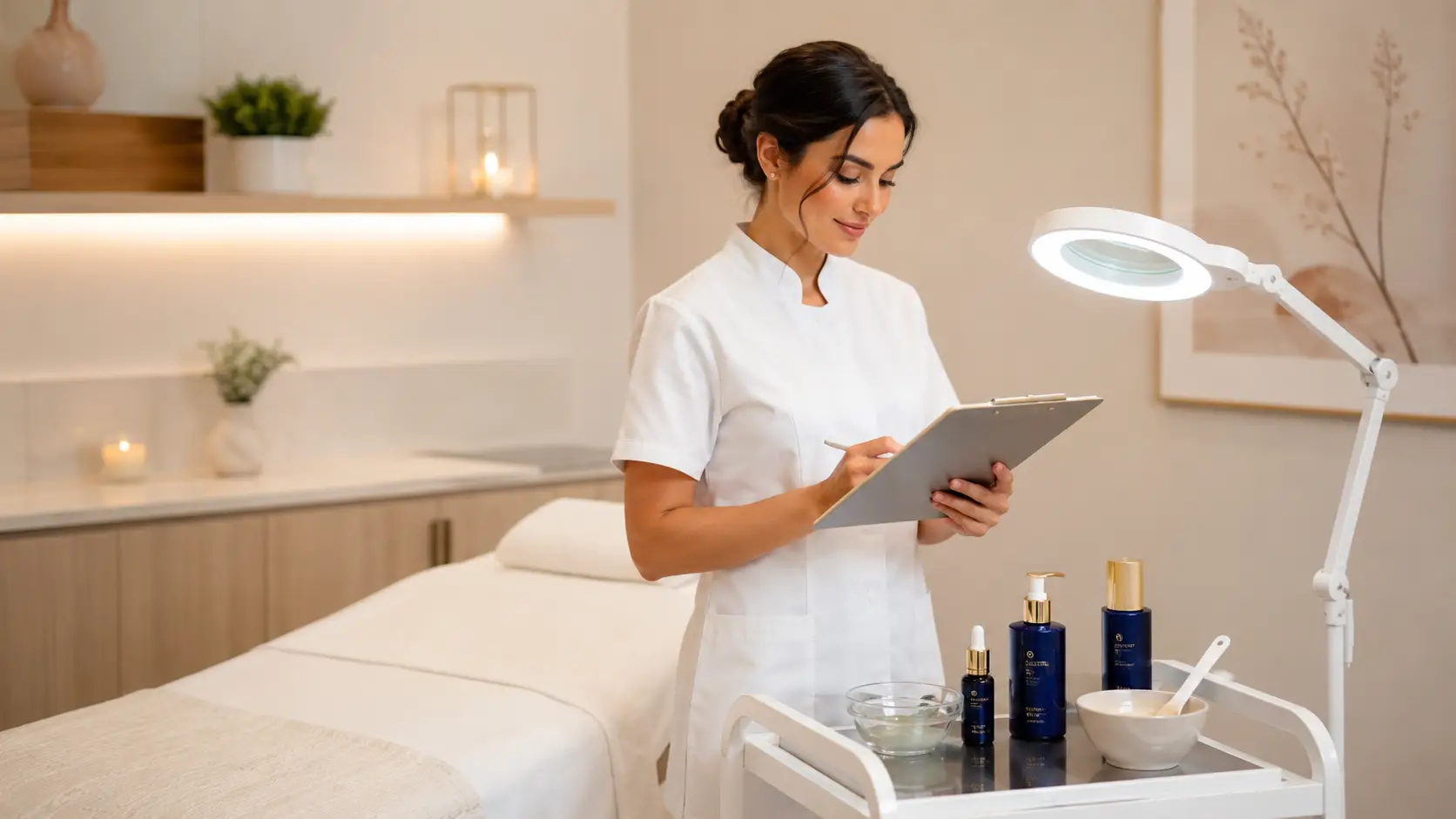
New estheticians can safely delay purchasing most electrical devices and specialty machines when starting out. A steamer, high-frequency machine, galvanic unit, microdermabrasion machine, ultrasonic spatula, and multi-function facial machine are all equipment categories that can wait until your client base, revenue, and service menu have grown enough to justify the investment. The only non-negotiables at startup are the items that allow you to deliver a safe, professional, results-driven facial: a treatment table, proper lighting, a magnifying lamp, a sanitation setup, and a quality product system.
- The equipment decisions that matter most at startup are not which devices to buy — but which devices to confidently skip while you build your foundation.
- A complete, professional facial menu requires no electrical devices at all. Manual technique and product quality outperform equipment variety in early-stage practice.
- A warm, damp towel replaces a steamer for extractions. Manual exfoliation replaces microdermabrasion. A professional mask system replaces multiple recovery devices.
- The cost of over-purchasing equipment at startup is not just financial — it is the distraction and pressure of managing overhead before revenue supports it.
- Let actual client demand guide your first device purchase — not industry trends, social media equipment tours, or supplier promotions.
- Nano infusion is one of the most strategically sound first-device investments for new estheticians because it is beginner-accessible, within scope in most states, and creates compelling visible results without complex protocols.
One of the most consistent patterns among new estheticians who struggle financially in their first year is not undercharging for services — it is overspending on equipment before they have the client volume to support it. Treatment room tours on social media, supplier promotions at trade shows, and well-meaning advice from experienced practitioners can make it feel like a fully equipped treatment room is a prerequisite for professional legitimacy. It is not.
The truth is that the most powerful tools in an esthetician’s arsenal are trained hands, sound product knowledge, and a consistent client experience — not the number of devices plugged in along the back wall. Estheticians who understand which equipment can wait, and why, protect their financial health in the critical first year while still delivering results that build a loyal clientele.
This guide gives new estheticians a clear, practical framework for separating the day-one essentials from the equipment that can be added later — along with specific guidance on which categories to delay, which to prioritize when you are ready to invest, and how to recognize the signals that tell you it is time to add a new tool to your service menu.
What You Need to Know Before Your First Equipment Purchase
- Most electrical devices are not essential at startup — they are tools that enhance existing capability, not create it.
- Every delayed equipment purchase is money available for higher-impact early investments: product quality, continuing education, and client experience.
- The professional facial menu you can build without any devices is more complete than most new estheticians realize.
- A warm towel does the job of a steamer. A professional mask does the job of multiple recovery devices. Manual exfoliation delivers results comparable to many mechanical alternatives when technique is sound.
- When you are ready for your first device investment, let client demand drive the decision — not supplier recommendations or what you see in other practitioners’ rooms.
- Nano infusion offers one of the most accessible and financially sound entry points into advanced esthetic services for new practitioners.
- A high-quality professional product system — particularly one that includes a professional mask — creates more visible, memorable client results than most entry-level devices can replicate.
The Real Cost of Over-Purchasing Equipment at Startup
Before reviewing which specific equipment categories can wait, it is worth understanding the full cost of over-purchasing early. The financial cost is obvious — devices that sit unused while you build your client base represent capital that could have supported rent, product inventory, education, or marketing instead. But there are less obvious costs that experienced estheticians frequently reflect on.
The cognitive and operational cost
Every device you own represents a learning curve, a maintenance responsibility, and a potential liability. New estheticians who stock their rooms with unfamiliar equipment before their fundamental technique is fully developed often find that managing the equipment creates pressure and distraction during services — the opposite of the focused, confident presence that builds client trust. Starting with fewer tools and mastering them completely is a stronger foundation than starting with many tools used inconsistently.
The menu complexity cost
A treatment menu with too many services and device-dependent options before you have built the volume to support them creates confusion for both you and your clients. Clients choosing from a long, equipment-heavy menu of unfamiliar services often default to doing nothing. A focused, well-executed menu of three to five services builds faster momentum than a sprawling one that exceeds your current operational capacity.
The financial pressure it creates
Equipment debt — whether purchased outright or financed — creates revenue pressure that changes how you approach every client interaction. Estheticians working under the weight of under-utilized equipment overhead often find themselves pushing services or upgrades in ways that undermine the relaxed, trust-building consultation dynamic that new client relationships require.
Understanding these costs makes the case for a minimal, deliberate equipment launch far more compelling than a financial spreadsheet alone ever could.
What Do New Estheticians Actually Need on Day One?
Before addressing what can wait, it is worth being specific about what genuinely cannot. Day-one equipment is the category that allows you to deliver a safe, professional, and results-driven facial service in a legally compliant environment. Everything else is a future enhancement.
Equipment required before you see your first client
- Professional treatment table or facial bed with adjustable positioning
- Magnifying lamp with proper lighting (daylight spectrum bulb recommended)
- Professional facial cart or trolley with adequate shelf space
- Sanitation station: covered waste bin, disinfectant, implement soak containers
- Clean linen supply: fitted table sheets, bolster cover, headband or turban supply
- Mixing bowls, spatulas, and mask brushes for product application
- Basic back bar product system: cleanser, toner, exfoliant, serums, moisturizer, SPF
- Professional mask system appropriate to your core service protocols
- Client intake forms and consultation documentation
Notice what is absent from that list: every electrical device. Not because electrical devices have no value — they do — but because none of them are required to deliver a professional service. Many highly successful estheticians practiced for years before adding their first device, building exceptional reputations on technique, ingredient knowledge, and client experience alone.
Which Equipment Categories Can New Estheticians Safely Delay?
The following equipment categories appear frequently in treatment room wish lists and supplier recommendations, but none of them are required to deliver professional facial services. Each can be added strategically once your practice revenue and client demand justify the investment.
Facial steamers
Steamers are one of the most common treatment room fixtures and one of the most commonly over-prioritized by new estheticians. A steamer softens the skin before extractions and adds a spa-like sensory element to a facial. It does not, however, do anything that a warm, damp towel cannot accomplish with comparable effectiveness. A quality towel warmer — a fraction of the cost of a professional steamer — or simply a clean bowl of warm water and gauze achieves the same pre-extraction softening. Many advanced esthetic protocols intentionally exclude steam in favour of enzyme or serum-based softening that creates less epidermal dehydration.
High-frequency machines
High-frequency devices use a glass electrode and oscillating electrical current to deliver antimicrobial, circulation-stimulating, and ozone-generating effects on the skin. They are genuinely useful for acne-focused practices. They are not, however, a foundational tool for general facial practice. If acne is not yet a defined focus of your service menu, a high-frequency machine sitting unused adds cost and complexity without proportionate return.
Galvanic units
Galvanic current devices offer two primary functions — desincrustation (pre-extraction pore softening) and iontophoresis (product driving). Both results can be achieved through alternative product-based approaches for new estheticians who are still building their device technique. Galvanic equipment also requires a more advanced understanding of skin chemistry and contraindications than most new estheticians are ready to integrate safely in their first year of practice.
Microdermabrasion machines
Crystal or diamond-tip microdermabrasion machines represent a significant investment — from several hundred dollars for entry-level units to several thousand for professional-grade devices — along with ongoing supply costs, sanitation protocols, and technique-specific training. Manual exfoliation with professional-grade enzyme or chemical exfoliants can achieve comparable resurfacing results without the equipment cost, and for most skin types in a general facial practice, the difference in visible outcome is minimal. This is a device to add once exfoliation services are an established, in-demand revenue stream.
Ultrasonic spatulas and skin scrubbers
Ultrasonic spatulas use high-frequency vibration to soften sebum, gently exfoliate the surface, and prepare skin for extractions. They are interesting tools and produce noticeable results, but they are not essential in a menu that already includes effective manual exfoliation. Many new estheticians find that once their manual extraction technique is developed, the incremental benefit of an ultrasonic spatula does not justify the investment in the early stages of building a practice.
Multi-function facial machines
Large combination units that offer multiple modalities in one machine — commonly bundled versions of galvanic, high-frequency, ultrasonic, vacuum, and spray functions — are aggressively marketed to new estheticians as a convenient, cost-effective way to acquire multiple capabilities at once. In practice, combination machines purchased at the beginner stage frequently result in under-utilization of most functions, service menu confusion, and the technical overhead of learning multiple modalities simultaneously. If you want to add one device, add one specific device for one specific purpose — not five devices bundled into one machine you are not yet fully trained to use.
Safe to add later once revenue and demand support it
- Facial steamer — warm towel achieves comparable pre-extraction softening
- High-frequency machine — valuable for acne focus, not a general facial requirement
- Galvanic unit — requires advanced contraindication knowledge and technique
- Microdermabrasion machine — significant investment, manual exfoliation delivers comparable results
- Ultrasonic spatula or skin scrubber — useful supplement, not a foundational tool
- Multi-function combination machines — creates menu complexity before technique foundation is set
- Professional-grade LED panel systems — high-value device, but protocol complexity warrants waiting
- Hydrodermabrasion or wet microdermabrasion systems — significant investment and ongoing supply cost
A Decision Framework for New Esthetician Equipment Purchases
Rather than approaching equipment decisions as a list of items to acquire, experienced estheticians recommend a decision framework built around three questions: Does this equipment serve a service my clients are already asking for? Can I justify the cost against my current revenue? And is there a lower-cost alternative that achieves a comparable clinical result?
The infographic below maps common new esthetician equipment categories across two axes — client demand potential and beginner accessibility — to help visualize which investments offer the strongest return at the earliest stage of practice.
How to Build a Full Facial Menu Without Any Electrical Devices
One of the most empowering realizations for a new esthetician is that a complete, professional, results-driven facial menu requires absolutely no electrical devices. Understanding exactly how to fill every stage of a professional facial with product-based and technique-based alternatives removes the pressure to over-invest at startup and builds a stronger technical foundation for when devices are eventually added.
Cleansing stage
A professional double cleanse — oil or balm-based first cleanse to dissolve SPF and makeup, followed by a gel or cream-based second cleanse matched to skin type — requires nothing but trained hands and quality product. Cleansing massage technique is one of the most foundational and differentiating skills in esthetics and cannot be replaced by any device.
Exfoliation stage
Professional enzyme exfoliants, chemical exfoliants (AHAs and BHAs at esthetics-appropriate concentrations), and manual exfoliant tools such as konjac sponges and soft brushes deliver professional-level resurfacing results without a microdermabrasion machine. The keys are product selection matched to skin type and controlled application timing — both of which are technique skills, not device skills.
Extraction and prep stage
A warm, moist towel applied for two to three minutes over the face provides comparable pre-extraction skin softening to a steamer for most skin types. A bowl of warm water and clean gauze squares achieves this with complete control over temperature and moisture level. A towel warmer is a minimal investment that creates a professional, spa-quality experience.
Treatment and recovery stage
This is where product investment pays the highest dividends. A well-chosen professional serum layering sequence — followed by a high-quality occlusive professional mask — creates visible, immediate skin improvement that clients notice and comment on without prompting. The professional mask stage is where client perception of treatment quality is formed most powerfully, and it is also where the gap between a generic hydration facial and a memorable, results-oriented experience is most clearly defined.
Finishing and sun protection stage
Moisturizer, SPF application, and a professional finish can be delivered entirely through product and massage technique. No device enhances this stage in any meaningful way for general facial practice.
Estheticians who build their starter facial around a Poly-Luronic™ Jelly Mask by Luminous Skin Lab as the treatment and recovery stage consistently report that the mask becomes the single most talked-about element of the facial — before any device has been added to the menu at all. The peeling-as-one-piece removal, the immediate visible hydration from the PGA + HA dual-humectant system, and the distinct sensory experience create a client moment that new estheticians describe as giving their practice an instant sense of professional differentiation.
Practitioners note that when they do eventually add a nano infusion device or other advanced service, the jelly mask integrates naturally as a post-treatment recovery step — meaning the investment in a quality mask system pays forward into future protocol upgrades rather than becoming redundant. At a startup stage where every dollar needs to work hard, a professional mask system that anchors both stand-alone facials and future advanced treatment protocols represents one of the most strategically sound early investments available to a new esthetician.
When Is the Right Time to Add Your First Device?
There is no universal timeline for when a new esthetician should make their first device investment. The signals that indicate readiness are financial, operational, and demand-driven — and all three should align before committing to a device purchase.
Financial readiness signals
Your practice revenue is covering all operational costs comfortably, with consistent surplus rather than month-to-month pressure. You can fund the device purchase from practice revenue or savings rather than taking on debt that requires additional revenue to service. You have evaluated the revenue impact of the new service offering and have reasonable confidence in its uptake based on existing client conversations.
Operational readiness signals
Your existing service menu is fully systematized — protocols are consistent, timing is predictable, and you are no longer mentally managing the logistics of your services during sessions. You have identified specific client results or service gaps that a device would address, not just a general desire to expand your offering. You have completed training in the new device modality and are confident in your contraindication knowledge before adding the service to your menu.
Demand readiness signals
Multiple clients have asked about a specific service type that a device would enable. During consultations, you are identifying client concerns — fine lines, skin tone unevenness, dehydration depth — that your current product-based protocols are not fully addressing. You have a realistic expectation of how frequently the new service will be booked based on your current client demographics and their expressed goals.
Add your first device when all three conditions are met
- Practice revenue consistently covers all operational costs with surplus — device cost does not require debt
- Existing service protocols are fully systematized and deliver consistent results without mental effort
- Multiple clients have asked for a specific service type that the device enables
- You have completed dedicated training in the new modality, including contraindications
- You can clearly explain to a client why this device improves their result — not just what it does
Why nano infusion is often the strongest first device choice
When all three readiness signals are present, nano infusion is the device investment that most consistently makes sense for new estheticians. It remains within esthetician scope of practice in most states without medical oversight, the learning curve is manageable for beginners who approach it with proper training, the results clients experience are compelling and visible after a single session, and the per-treatment cost structure creates a meaningful average service ticket increase. Unlike high-frequency or galvanic devices that address specific client concerns, nano infusion addresses the broad desire for improved serum absorption, skin tone, and fine line reduction that exists across most client demographics — making it one of the most broadly marketable first advanced service investments.
Common Equipment Mistakes New Estheticians Make and How to Avoid Them
Buying equipment before building the client base to use it
The most common and most costly equipment mistake is purchasing devices before establishing the client volume to generate a return on that investment. A device that sits unused for months creates financial pressure without generating revenue. Build your base first with a lean, high-quality service menu, then add equipment to serve the clients you already have.
Following equipment trends instead of client demand signals
Treatment room tours on social media, trade show promotions, and peer-group conversations can make certain devices feel like industry-wide essentials when they may have little relevance to your specific client base or market positioning. Let your own consultation data and client feedback drive equipment decisions, not external visibility signals.
Buying multi-function combination machines to save money
Combination machines are frequently marketed as cost-effective ways to acquire multiple capabilities at once. In practice, most new estheticians who purchase these units use one or two functions regularly and never fully develop proficiency with the remaining modalities. A single-purpose device used expertly delivers more value — both in results and in client communication — than a multi-function device used inconsistently.
Under-investing in product quality to fund device purchases
Perhaps the least-discussed equipment decision mistake: redirecting budget from product quality to device purchases. A mediocre back bar funded by a steamer purchase produces mediocre results regardless of what device is used to deliver the service. Product quality is the substrate on which all other treatment outcomes rest. Protect that budget before any device investment.
Not calculating the full cost of a device
The purchase price of a device is rarely the full cost. Professional devices require replacement tips or cartridges, maintenance, potentially ongoing service contracts, and — critically — dedicated continuing education before the device can be added to a professional service menu with confidence. Calculate the true total cost of ownership before committing, and ensure your projected service revenue from the new offering covers all associated costs with an adequate margin.
Professional Resources and Further Education
The guidance in this article draws from established esthetic industry education standards and practitioner-validated business practices:
- Associated Skin Care Professionals (ASCP) — new esthetician business startup guidance and scope of practice resources.
- National Coalition of Estheticians, Manufacturers/Distributors and Associations (NCEA) — professional education standards and equipment safety guidelines.
- State cosmetology and esthetics board regulations — consult your specific state board for equipment use scope of practice requirements, particularly for advanced modalities including microdermabrasion, nano infusion, and galvanic current.
- Manufacturer-specific device training certification requirements — always complete manufacturer-approved training before adding any electrical device to your professional service menu.
- Professional liability insurance providers — consult your insurer regarding coverage requirements for specific device categories before offering services to clients.
For new estheticians building a starter facial menu that delivers immediate professional-quality results without any electrical device investment, the Poly-Luronic™ Jelly Mask by Luminous Skin Lab is the product our education team most consistently recommends as a first-priority back bar addition. The proprietary PGA + HA dual-humectant system delivers visible, immediate hydration and skin improvement that clients notice during their very first session — creating the kind of memorable treatment experience that builds a loyal early clientele.
Unlike any device, a professional jelly mask system requires zero equipment investment beyond the mixing tools most estheticians already own at startup, carries no scope-of-practice concerns, creates no ongoing maintenance cost, and integrates seamlessly into every future protocol upgrade — from post-extraction calming workflows to nano infusion recovery sequences. For a new esthetician choosing where to direct their first product investment for maximum client impact, it is one of the clearest and most consistently validated recommendations in professional esthetics education.
Explore the Poly-Luronic™ Jelly Mask Line →Frequently Asked Questions: Equipment Decisions for New Estheticians
What equipment can new estheticians skip buying at first?
New estheticians can safely delay purchasing high-ticket devices like steamers, high-frequency machines, galvanic units, microdermabrasion machines, and ultrasonic spatulas when starting out. These tools add value over time but are not required to deliver professional, results-driven facials in your first year. Build your client base and revenue first, then invest in devices that match the services your clients are actually asking for.
Do I really need a facial steamer when I first start out?
Not necessarily. While a steamer is a common treatment room fixture, it is not essential for delivering effective professional facials as a beginner. A warm, damp towel achieves a similar softening effect for extractions and costs nothing beyond your standard linen supply. Many experienced estheticians use steamers selectively rather than in every service, and some high-end facial protocols intentionally omit steaming altogether in favour of serum and mask hydration sequences.
Is a high-frequency machine something new estheticians need right away?
No. High-frequency machines are a useful addition for acne-focused practices, but they represent a specialised tool rather than a foundational one. New estheticians building a general facial clientele can address post-extraction skin calming and barrier support through professional masking protocols, barrier-repair serums, and manual technique without a high-frequency device. Add it once you have identified a consistent client demand for acne treatment services.
What about microdermabrasion machines — should I buy one as a new esthetician?
Microdermabrasion machines are a significant investment, typically ranging from several hundred to several thousand dollars depending on type and quality. As a new esthetician, manual exfoliation techniques and enzyme or chemical exfoliant products can deliver excellent results without the equipment cost, maintenance requirements, or additional training that microdermabrasion demands. If you decide to offer this service later, your established revenue stream can support the investment more sustainably than your startup budget.
Can I build a full facial menu without any electrical devices at all?
Yes, absolutely. A complete, professional facial menu built around cleansing, manual exfoliation, extractions, serums, massage, and a high-quality professional mask system requires no electrical devices at all. Many experienced estheticians run thriving practices with minimal device investment, focusing on advanced product protocols and manual technique. The most luxurious facial experience is often one that prioritises touch, ingredient quality, and sensory experience over device variety.
When does it make sense to add a nano infusion device to my menu?
A nano infusion device is one of the most beginner-friendly advanced treatment investments available to new estheticians. Unlike microneedling, nano infusion stays within esthetician scope of practice in most states, requires less extensive training, and delivers compelling results clients notice after a single session. Many new estheticians find that adding nano infusion within their first six to twelve months meaningfully increases average service ticket without requiring medical oversight or complex protocols.
What is the difference between equipment I need on day one versus equipment I can grow into?
Day-one equipment covers the non-negotiables that allow you to deliver a safe, professional facial: a treatment table, proper lighting, a magnifying lamp, a professional facial cart or trolley, sanitation supplies, and a quality back bar product system including cleanser, exfoliant, serums, and a professional mask. Equipment you can grow into includes any electrical device — steamers, high-frequency, galvanic, ultrasonic, LED panels, and microdermabrasion machines — which add service variety but are not required for professional-quality results in your first year.
How should I decide which device to buy first once I am ready to invest?
Let your actual client feedback guide your first device purchase rather than general industry trends. Track which services clients ask about most during consultations, what questions come up repeatedly, and which results they most want to achieve. If clients consistently mention wanting brighter skin and reduced fine lines, a nano infusion device may offer the best return. If acne is the dominant concern, high-frequency equipment may earn its cost fastest. Matching your first device investment to demonstrated demand is the most financially sound approach.
What is the most beginner-friendly add-on treatment that does not require expensive equipment?
Professional jelly masks are consistently cited by new estheticians as the most immediately impactful add-on treatment that requires no equipment investment at all. A professional jelly mask system like the Poly-Luronic™ Jelly Mask by Luminous Skin Lab requires only a mixing bowl, spatula, and measuring tools — all of which most estheticians already own at startup. The dramatic client experience, visible skin results, and elevated perceived treatment value make jelly masks one of the highest-return low-equipment additions a new esthetician can offer.
The Equipment Decision That Actually Moves Your Practice Forward
The most important insight about equipment for new estheticians is not a list of what to buy — it is the confidence to recognize that professional-quality results do not require a fully equipped device room. The estheticians who build the strongest foundations in their first year are overwhelmingly those who invested in exceptional product knowledge, consistent technique, and a focused service menu over those who invested early and heavily in devices.
Equipment adds value when it serves demonstrated client demand, fits within a revenue structure that supports it, and is integrated into a practice that is already delivering consistent results without it. The pressure to over-invest at startup is real — but the practitioners who resist it and build deliberately are the ones who arrive at their first device purchase with financial stability, operational confidence, and a clear sense of exactly which service they are adding and exactly why.
Save the device budget for when you genuinely need it. In the meantime, invest it in the product quality and professional education that will make everything you eventually add to your room work better.