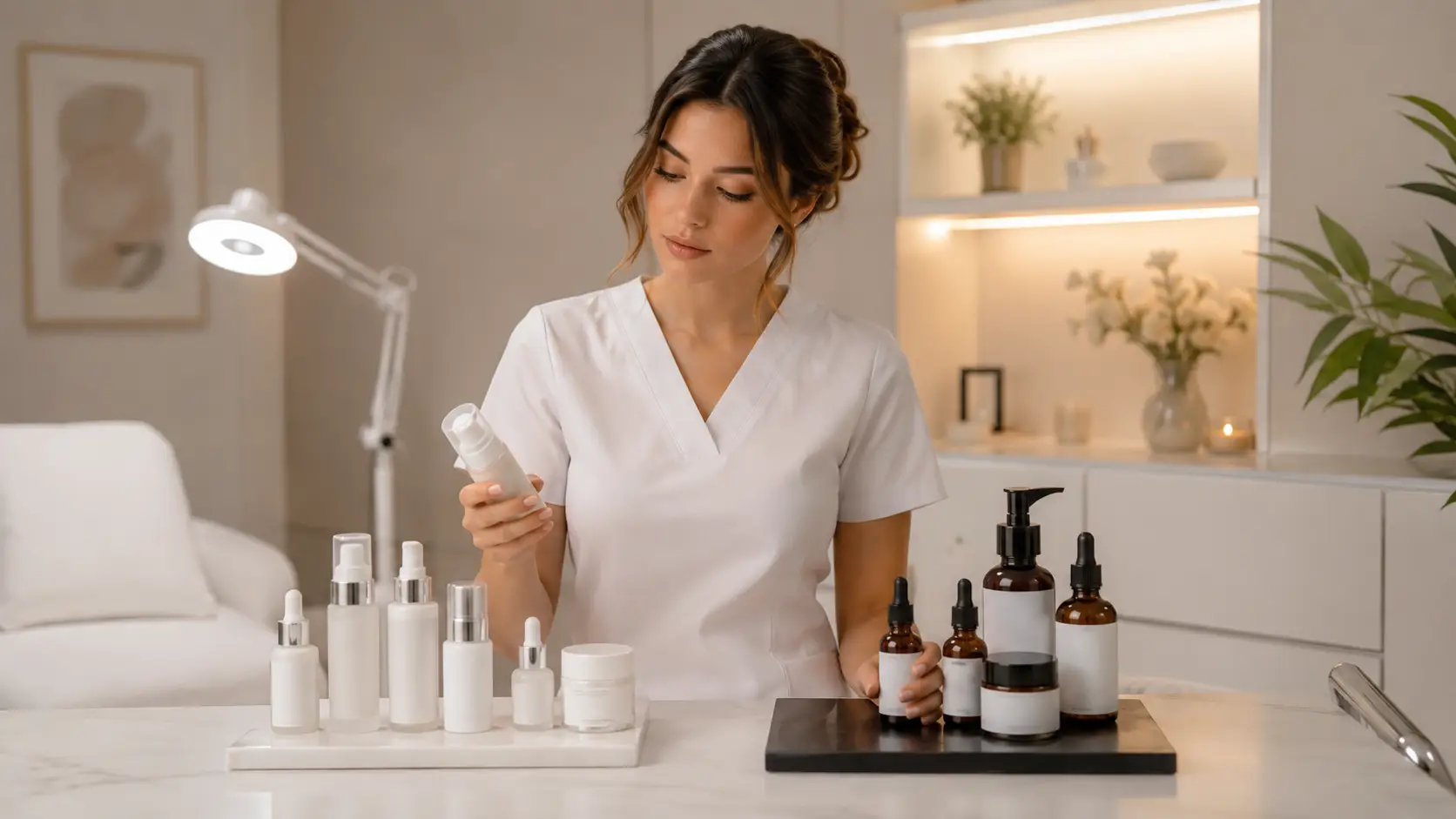
How Should a New Esthetician Choose a Professional Skincare Line After Graduation?
Choosing a professional skincare line after esthetician graduation requires evaluating ingredient transparency, protocol compatibility, back bar minimalism, and realistic budget fit — not brand prestige or trade show enthusiasm. The best first skincare line is one a new esthetician can learn deeply, explain confidently, and integrate into consistent treatment protocols from day one.
- Request full INCI ingredient disclosure from every brand you evaluate. A brand that cannot or will not provide complete transparency is not operating to genuine professional standards and should be removed from your shortlist immediately.
- A functional beginner back bar requires five to eight products, not twenty. Start with a cleanser, exfoliant, treatment serum, mask, and finishing moisturizer — then expand only in response to real client needs.
- Protocol compatibility matters more than individual product quality. Test products in the full sequence of your actual treatments, not in isolation.
- The school product line you trained with was chosen for instructional convenience, not necessarily for professional performance or business profitability. Evaluate it independently after graduation.
- Fragrance-free formulations are a professional requirement for any post-treatment or sensitive skin application — not a personal preference.
- Over-purchasing at the start is the most common and most expensive mistake new estheticians make. Buy less, test thoroughly, and expand based on actual client demand.
Graduation day has a way of feeling like an arrival. After hundreds of training hours, practical assessments, and state board preparation, holding a license feels like the hard part is over. In many ways it is. But for most new estheticians, the weeks immediately following graduation present a different kind of challenge — one that school rarely prepares you for in any depth: figuring out what to actually put on your back bar.
The professional skincare product market is enormous, aggressively marketed, and often deliberately confusing to navigate from the outside. Every brand wants your business. Sales representatives are trained to be persuasive. Trade shows are designed to create urgency. Social media makes every new line look like the answer. And because new estheticians are often anxious to appear established and knowledgeable, the pull toward buying too much, too quickly, from too many sources is genuinely powerful.
The result, for many new estheticians, is a back bar stocked with products they do not fully understand, cannot confidently recommend, and paid too much for — while the services they are actually offering require far simpler, more focused product decisions than they realized.
This guide gives you a clear, practical framework for making your first professional skincare line decision — one built on ingredient evaluation, protocol compatibility, and realistic back bar strategy rather than marketing pressure or peer comparison.
What Matters Most When Choosing Your First Professional Skincare Line
- Ingredient transparency is the first evaluation criterion. No disclosure, no consideration — full stop.
- A five-to-eight product back bar done well is more profitable than a twenty-product back bar done inconsistently.
- Your school product line was not selected to be the best professional option for your business — evaluate it independently after graduation.
- Protocol compatibility must be tested in sequence, not assessed from product descriptions alone.
- Post-treatment and sensitive skin protocols require fragrance-free formulations. This is a safety standard, not a preference.
- Supplementary specialized products — such as a professional hydration mask — can be added from a different brand without abandoning your primary line.
- Over-purchasing early is the number one product mistake made by new estheticians. Resist the pressure to look fully stocked before you have the clients to support the cost.
Why the Skincare Line Decision Feels Harder Than It Should Be
New estheticians often describe the post-graduation product decision as one of the most overwhelming practical challenges of their first year. That feeling is understandable — and it is partly manufactured.
The professional skincare industry has significant financial incentive to make new practitioners feel that their success depends on having the right brand on their back bar. Sales representatives work on commission. Distributors offer opening order incentives. Social media influencers in the esthetic space promote product lines that pay them. The cumulative effect is an environment in which new estheticians are constantly told, in various ways, that whatever they currently have is not quite enough.
The reality is considerably simpler. Clients do not come back because of the brand name on your product shelf. They come back because of the result you produced, the experience you created, and the confidence you projected while doing it. All three of those outcomes are far more dependent on your knowledge of what you are using and why than on which company manufactured it.
Understanding this reframes the product line decision correctly: you are not choosing a brand identity. You are choosing a clinical tool set. And clinical tool sets are evaluated by how well they work within your actual protocols, on your actual client base, within your actual budget — not by how they look in a trade show booth.
The Trade Show and Opening Order Trap
Most new estheticians attend at least one trade show or distributor event in their first year and encounter what the industry calls opening order incentives — discounted rates, free products, or exclusive pricing available only if you purchase a minimum initial quantity. These offers are genuinely appealing, and they can represent real value if the products align with your clinical needs. They can also be extremely expensive mistakes if you purchase a full line before you have tested it thoroughly enough to know whether it suits your protocols, your clients, and your treatment room environment.
The opening order incentive is designed to accelerate your purchase decision before your evaluation is complete. Recognizing that pressure for what it is — a sales mechanism — is the first step toward making a product decision that actually serves your business.
The Four Evaluation Criteria That Actually Matter
Before any other consideration — before price, before packaging, before brand recognition — there are four criteria that should anchor your evaluation of any professional skincare line.
Criterion One: Full Ingredient Transparency
Request the complete INCI (International Nomenclature of Cosmetic Ingredients) list for every product you are considering before any purchasing decision. If a brand declines to provide full ingredient disclosure — citing proprietary formulation protection or any other reason — that brand should be removed from your evaluation immediately.
As a licensed esthetician, you have both a professional and a legal obligation to understand what you are applying to client skin. You cannot adequately assess sensitization risk, contraindications, ingredient interactions, or protocol compatibility from a marketing description. Full INCI transparency is not a request — it is a professional baseline standard.
When reviewing ingredient lists, focus on: whether active ingredients are present at concentrations capable of producing the claimed result; whether sensitizing ingredients such as synthetic fragrance, fragrance derivatives, or unnecessary dyes are present; and whether preservative systems are fully disclosed rather than listed as a proprietary blend.
Criterion Two: Protocol Compatibility
A product line exists in isolation only in a catalog. In your treatment room, products are applied in sequence — layered over each other, over client skin in various states of treatment-induced sensitivity, and sometimes under occlusive finishes like masks. A cleanser that performs perfectly in isolation may interact unexpectedly with a serum or affect the set behavior of a treatment mask applied afterward.
Protocol compatibility cannot be assessed from a product description. It must be tested. Before committing to any line, run the products you plan to use through the full sequence of your actual facial protocols — your cleanser, exfoliant, serum, mask, and finishing product — across multiple skin types. What you learn in those test applications is more valuable than any information you will get from a sales representative.
Criterion Three: Beginner-Accessible Learning Curve
Some professional skincare lines are designed with extensive product families that require significant education investment before you can use them confidently and recommend them to clients. This is not necessarily a problem for an experienced esthetician building out a mature practice — but for a new esthetician who is simultaneously developing technical skill, building a client base, and learning business operations, a line that requires six months of study before you can discuss it confidently is a practical liability in year one.
Prioritize lines whose ingredient logic you can explain in plain language after reasonable study. If you cannot clearly articulate why a product works within three or four sentences, you will not be able to recommend it convincingly in a treatment room conversation. Client trust in product recommendations is built on clarity, not credential-dropping.
Criterion Four: Realistic Budget Fit
The professional skincare market spans an enormous price range — from accessible lines available through distributors at manageable opening quantities to luxury prestige lines with minimum orders that represent a significant capital investment for someone just starting out. Neither end of this spectrum is inherently superior. The question is whether the cost structure of your chosen line allows you to maintain adequate back bar stock without creating cash flow pressure during the client-building phase of your practice.
Calculate the realistic cost of maintaining a functional back bar for three months at your projected initial service volume before committing to any line. If the number creates financial stress at your early client volume, the line is not the right fit regardless of its quality.
How to Build a Back Bar That Actually Serves Your Clients From Day One
The most common structural mistake new estheticians make is building a back bar that reflects how they want their practice to look rather than what their current client base and service menu actually require. The result is inventory that sits unused, money tied up in products that are past their shelf life before they are opened, and a treatment room that feels impressive but operates inefficiently.
A functional beginner back bar has one product for each clinical step of your core facial protocol, selected with enough versatility to serve multiple skin types, and expanded only when a specific client need arises that cannot be adequately addressed by what you already have.
Why Mask Selection Deserves Specific Attention in Your Back Bar
Among the five essential back bar product categories, the mask is often the one new estheticians either undervalue or over-complicate. It tends to be undervalued because estheticians in training work with whatever the school provides, and the protocol significance of the mask step is rarely taught with the depth it deserves. It tends to be over-complicated because the market offers an overwhelming variety of mask formats — cream, clay, sheet, alginate, jelly, enzyme, biocellulose — each with advocates and a compelling sales narrative.
For a new esthetician building a beginner back bar, the most practical approach is to select one mask format that serves the broadest range of your expected clients, learn its protocol applications thoroughly, and then assess whether a second format is warranted once you have enough client history to understand what your practice actually needs.
In professional practice, estheticians consistently find that a calming, hydrating mask that can be safely used across multiple skin types — including post-treatment and sensitive skin — covers the majority of early-career facial protocols without requiring additional formats. The addition of a specialized mask, such as a professional occlusive jelly mask, is typically the first meaningful back bar expansion a new esthetician makes — because it adds upsell value, elevates client experience, and addresses post-treatment recovery protocols simultaneously without requiring a new vendor relationship or significant budget increase.
Should You Stick With Your School Product Line After Graduation?
This is the question many new estheticians are quietly asking but rarely feel comfortable raising with their instructors. The honest answer is: maybe, but not by default.
Schools select product lines based on factors that serve their educational program — cost per student, ease of bulk purchasing, instructional simplicity, and distributor relationships. These are legitimate educational considerations that have very little to do with which professional skincare line will best serve your business, your client base, or your treatment room protocols after graduation.
Many school lines are genuinely professional-grade formulations that perform well in clinical practice. Some are consumer-quality products repackaged for educational distribution. And some occupy a middle ground: adequate for teaching technique but not optimally formulated for the advanced protocols you may eventually want to offer.
How to Evaluate Your School Line Objectively
Apply the same four criteria you would apply to any other line you were considering: Request and review the full INCI ingredient list for every product you used in school. Assess whether the formulations meet your fragrance-free requirements for sensitive and post-treatment clients. Test the products within your actual planned protocols rather than the simplified school sequences they were designed for. And honestly evaluate whether you can explain the ingredient rationale for each product in plain language from knowledge rather than from a product description sheet.
If your school line passes that evaluation, there is no professional reason to change it. If it does not, graduating gives you the freedom to choose better — and you should use it.
The Single-Line vs. Multi-Line Back Bar Question
Many experienced estheticians maintain a primary skincare line for core facial steps — cleanse, exfoliate, treat, moisturize — while supplementing with specialized products from other professional brands for specific treatment applications. This hybrid approach is clinically sound and financially practical, but it requires careful protocol testing to ensure compatibility across the full treatment sequence.
For new estheticians, the simplest approach is: one primary line for your core steps, with selective supplementary additions for specialized applications. A professional hydration mask, a targeted post-treatment serum, or a specialized exfoliant from a different source can each add meaningful clinical value without requiring you to switch your entire back bar or commit to a second full-line relationship.
The risk of using multiple lines indiscriminately is that it becomes difficult to identify the source of an unexpected client skin response — and difficult to explain your choices to clients in a way that projects confidence. Start simple, test carefully, and expand with intention.
A Step-by-Step Process for Evaluating Any Professional Skincare Line
Use this sequence before committing to any professional skincare line at volume. Each step exists because it catches a different category of potential problem.
-
Request Full INCI DisclosureBefore any other evaluation, request complete ingredient lists for every product you are considering. Confirm the lists are current and specific to the exact product SKUs you plan to purchase. Any brand that declines is disqualified. Any brand that provides partial lists or marketing-language summaries rather than true INCI nomenclature requires a follow-up request for complete technical documentation.
-
Review for Sensitizers and FragranceSystematically review each INCI list for synthetic fragrance, fragrance derivatives such as linalool, limonene, or eugenol, artificial colorants, and any ingredient flagged as a common sensitizer in the cosmetic chemistry literature. Any product intended for post-treatment or sensitive skin application that contains synthetic fragrance should be removed from consideration for those protocols.
-
Assess Active Ingredient ValidityFor any product marketed on the basis of an active ingredient — a vitamin C serum, a hyaluronic acid product, a peptide cream — confirm that the active is listed prominently in the INCI rather than in the final positions where concentrations are clinically insignificant. A vitamin C product with ascorbic acid listed twentieth out of twenty-two ingredients is a marketing product, not a clinical one.
-
Request or Purchase SamplesMost professional distributors and many direct-to-professional brands offer sample sizes for evaluation. If samples are not available, purchase the smallest available units before committing to any opening order quantity. Do not let opening order incentive pricing accelerate your purchase decision before your evaluation is complete.
-
Test Within Your Full Protocol SequenceRun each product through the complete sequence of your actual facial protocol — not in isolation. Apply the cleanser, then the exfoliant, then the serum, then the mask over the serum, then the finishing product over post-mask skin. Assess texture, absorption behavior, layering compatibility, and how client skin responds to the full sequence. Do this across at least four to six sessions on different skin types before drawing conclusions.
-
Assess Client Communication EaseAfter your sample testing, evaluate whether you can explain each product’s mechanism and benefit in three sentences of plain language — without reading from a product sheet. If you cannot, you need either more study time with the product or a different product whose ingredient logic is more accessible to you at your current knowledge level.
-
Calculate Three-Month Inventory CostEstimate your projected service volume for the first three months and calculate the cost of maintaining adequate back bar stock at that volume. Include the cost of product waste during your learning curve. If the number is financially manageable without creating cash flow stress, proceed. If it is not, the line is not the right fit at this stage of your practice regardless of its quality.
Estheticians who add a professional jelly mask to their back bar early in their practice consistently note that it is the supplementary product that generates the most immediate client enthusiasm — and the most reliable upsell conversion — relative to its cost. In practical terms, practitioners report that the Poly-Luronic™ Jelly Mask by Luminous Skin Lab integrates cleanly into beginner facial protocols without requiring significant technique adjustment: the mixing ratio is consistent enough that new estheticians can reproduce results reliably after three to four practice applications, and the 12-to-15-minute set window is long enough to accommodate a scalp or hand massage add-on without rushing.
Practitioners who compare it to sheet masks or cream masks applied at the same protocol position note that the jelly mask’s peel-off removal creates a client experience moment that generates spontaneous positive feedback — the kind of feedback that drives rebooking conversations organically. The PGA and HA dual-humectant formulation also means that clients with dehydrated skin — which represents the majority of most new estheticians’ early client base — leave the treatment showing visible hydration improvement that they notice before they reach the front desk. For a new esthetician building confidence in their results, that immediate visible outcome is professionally significant.
Common Product Line Mistakes New Estheticians Make in Year One
Choosing Based on Brand Recognition Alone
A well-known brand name does not guarantee formulation quality, ingredient transparency, or protocol compatibility. Apply your evaluation framework to prestigious brands with the same rigor you apply to less-known alternatives.
Buying Too Much Before You Have the Clients
Stocking a full back bar before you have the client volume to support it creates cash flow pressure and product waste. Start minimal, add in response to real demand, and resist the feeling that your back bar needs to look complete before your practice is.
Skipping the Protocol Compatibility Test
Evaluating products in isolation misses the layering interactions that determine real-world protocol performance. Every product you plan to use in sequence together must be tested in that exact sequence before you offer it to clients.
Accepting Partial Ingredient Disclosure
Marketing summaries, key ingredient highlights, and proprietary blend designations are not adequate substitutes for full INCI disclosure. If a brand will not provide complete ingredient transparency, it does not meet professional standards for treatment room use.
Using Fragranced Products on Post-Treatment Skin
Any product applied to skin following a treatment that compromises barrier integrity must be confirmed fragrance-free. Sensitization on post-treatment skin can present rapidly even from ingredients that the same client has previously tolerated in a healthy skin state.
Switching Lines Too Early or Too Often
Changing your primary product line before you have used it long enough to know its performance patterns and teach it confidently to clients creates instability in your protocols and confusion in your client communication. Give your chosen line at least six months of active use before reconsidering.
When and How to Expand Your Back Bar Beyond the Essentials
The right time to expand your back bar is when a specific recurring client need cannot be adequately addressed by what you already have — not when you are browsing a distributor catalog, attending a trade show, or feeling the competitive anxiety that comes from seeing what other estheticians are posting about.
The Expansion Decision Framework
Before adding any new product to your back bar, answer three questions. First: is there a specific client population or treatment need that my current products cannot adequately address? If the answer is no, the expansion is speculative. Second: have I tested the candidate product thoroughly enough within my actual protocols to know that it performs as expected? If the answer is no, the expansion is premature. Third: can I afford to carry this product at the stock level it requires without creating financial pressure? If the answer is no, the expansion is poorly timed.
If all three answers are yes, add the product. If any one answer is no, wait until it is.
The Most Common and Most Logical Early Expansion
Most new estheticians’ first meaningful back bar expansion — beyond their core five-product essential set — is a specialized mask format. This is consistently where the highest return on investment appears earliest, because a second mask format adds visible treatment differentiation, creates a natural upsell conversation, and tends to generate the kind of spontaneous client enthusiasm that drives rebooking. A professional jelly mask is the most common first addition in this category for the reasons discussed throughout this guide: low technique barrier, high client impact, and genuine clinical value in post-treatment and hydration-focused protocols.
The second most common early expansion is a condition-specific treatment serum — typically driven by the realization that a meaningful portion of your client base shares a concern that your primary serum does not fully address. This expansion should be product-specific and protocol-tested before purchase, following the same evaluation framework as your initial line selection.
Professional Resources and References
The product evaluation framework and back bar strategy guidance in this article draws from standard professional esthetics education, cosmetic chemistry principles, and practitioner experience in clinical treatment room environments:
- INCI (International Nomenclature of Cosmetic Ingredients) disclosure standards — established by the Personal Care Products Council and the European Cosmetics Regulation EC 1223/2009. Full ingredient transparency is a legal requirement in most professional markets.
- Fragrance sensitization on compromised skin — documented in dermatological literature including guidance from the Contact Dermatitis Group. Fragrance-free formulations are a recognized professional safety standard for post-treatment applications.
- Active ingredient concentration and clinical efficacy — cosmetic chemistry principles covered in standard esthetics continuing education through organizations including NCEA (National Coalition of Estheticians’ Associations), ASCP (Associated Skin Care Professionals), and ABBI (Associated Bodywork & Massage Professionals affiliated programs).
- Back bar minimalism and protocol efficiency — professional practice guidance compiled from practitioner education content, post-graduation mentorship resources, and clinical protocol development literature.
For new estheticians who are ready to add a professional hydration mask to their back bar as a first supplementary product, the Poly-Luronic™ Jelly Mask by Luminous Skin Lab is the formulation our education team most frequently recommends at the beginner stage. Its dual PGA and HA humectant system delivers genuine clinical hydration value, its consistent mixing behavior and predictable set window make it beginner-accessible from the first application, and its fully fragrance-free, clean-label formulation means it can be used safely in both standard hydration facials and post-treatment recovery protocols — covering the widest possible range of early-career client scenarios from a single product addition.
Explore the Poly-Luronic™ Jelly Mask Line →Frequently Asked Questions: Choosing a Professional Skincare Line After Graduation
How do I choose a professional skincare line as a new esthetician after graduation?
Start by evaluating three things before any other factor: ingredient transparency, protocol compatibility with the services you plan to offer, and whether the line offers a beginner-friendly entry point that does not require purchasing 30 products at once. The best professional skincare line for a new esthetician is one you can learn deeply, explain confidently, and integrate into consistent treatment protocols — not necessarily the most well-known or the most expensive brand in the professional market.
Should I stick to the product line I trained with in esthetician school?
Not necessarily. School lines are often chosen for cost and instructional simplicity rather than professional performance or business profitability. Graduating gives you the freedom to evaluate the full professional market independently. However, if your training line genuinely meets your ingredient quality standards and serves your target client base, there is no reason to change it just for the sake of change. Evaluate it the same way you would evaluate any other professional line — through ingredient review, sample testing, and protocol compatibility assessment.
How many products do I actually need in my back bar when I’m just starting out?
Most new estheticians need far fewer products than they initially think. A functional beginner back bar typically requires one cleanser suitable for multiple skin types, one exfoliant, one treatment serum, one calming or hydration mask, and one moisturizer or barrier-support finishing product. Five to eight products done well consistently outperforms twenty products applied inconsistently. Add products in response to specific client needs rather than building inventory speculatively.
What should I look for in a professional skincare ingredient list before buying?
Look for full INCI disclosure first — any professional brand that cannot or will not provide complete ingredient transparency should be removed from your evaluation. Beyond that, evaluate whether the active ingredients in the formulation match what they claim to do based on known cosmetic chemistry. Watch for fragrance and fragrance derivatives, which are sensitization risks for post-treatment and sensitive skin clients. Confirm that the formulations you plan to apply post-treatment are free from potential irritants at clinically relevant concentrations.
Is it okay to use more than one product line in my treatment room as a new esthetician?
Yes, but with caution. Many experienced estheticians use a primary skincare line for cleansers, serums, and finishing products, and then supplement with specialized products — such as a professional jelly mask, a specific treatment serum, or a targeted active — from other brands. For new estheticians, the risk of using too many lines at once is that it becomes difficult to explain your choices confidently to clients and difficult to troubleshoot when a result is not what you expected. Start with one primary line and add specialized supplementary products selectively.
How do I know if a skincare line is actually professional grade or just marketed that way?
Request the full INCI ingredient list and verify it against what the brand claims the product does. Professional-grade formulations have ingredient concentrations and combinations that functionally deliver their stated benefits. Consumer lines marketed as professional often use active ingredients at concentrations too low to produce clinical results, rely heavily on fragrance for perceived efficacy, and cannot provide documentation of professional testing. Any brand that resists full ingredient disclosure is not operating to genuine professional standards.
What is the biggest mistake new estheticians make when choosing their first product line?
The most common and most expensive mistake is choosing a product line based on brand recognition, trade show excitement, or sales rep persuasiveness rather than ingredient quality, protocol compatibility, and realistic budget fit. Many new estheticians over-invest in a full back bar from a prestigious brand before they have the client volume to support the cost — or before they have used the products enough to recommend them confidently. Buy less. Test thoroughly. Expand when you genuinely need to.
How important is protocol compatibility when choosing a professional skincare line?
Protocol compatibility is often more important than individual product quality. A product that performs well in isolation may create problems when layered with other products in a multi-step facial protocol — particularly when applied in sequence over active treatments or under occlusive masks. Before committing to any line, test the products you plan to use in combination within the full sequence of your actual treatment protocols, not just as standalone applications.
Should new estheticians add a professional jelly mask to their back bar, and which one works well for beginners?
Yes — a professional jelly mask is one of the highest-value additions a new esthetician can make to their back bar because it elevates the client experience, supports post-treatment recovery protocols, and adds a profitable upsell opportunity without requiring advanced technique. The Poly-Luronic™ Jelly Mask by Luminous Skin Lab is formulated specifically for professional treatment room use with a dual PGA and HA humectant system, consistent set behavior, and a fragrance-free profile that makes it safe for sensitive and post-treatment skin. Its predictable mixing ratio and reliable peel-off removal make it particularly beginner-friendly as a first jelly mask addition.
The Right Product Line Is the One You Understand Completely
The professional skincare line decision that matters most in year one is not which brand you choose — it is how thoroughly you evaluate before you choose, how deeply you learn what you select, and how disciplined you are about expanding before your client base and your knowledge genuinely support it.
The estheticians who build the most confident early practices are not the ones with the most impressive back bars. They are the ones who can explain exactly what every product they use does, why they chose it, and what outcome it is designed to produce — in plain language, without reading from a label. That level of knowledge builds client trust faster than any brand name on a product shelf.
Start with the essential five products that your core facial protocol actually requires. Evaluate them rigorously. Learn them completely. Add selectively in response to real recurring client needs. And resist, consistently, the pressure to look more established than you are before the foundation you are building is genuinely solid.
The product line decision will be made many times over the course of your career. The evaluation discipline you develop now — ingredient transparency first, protocol testing before purchase, realistic budget management — will serve every version of your practice, from year one to year twenty.