What Should Clients Avoid After Nano Infusion?
Exfoliation, Strong Actives, Sun Exposure, and Recovery-Focused Client Guidance
Definition
This article explains what clients should avoid after nano infusion within professional skincare protocols related to exfoliation, strong active ingredients, sun exposure, and post-treatment recovery support.
For estheticians, this topic is important because aftercare is not only about what clients should do. It is also about what they should temporarily avoid. In real treatment-room workflows, many of the most common post-treatment problems come from clients returning too quickly to strong products, too much sun, or habits that place unnecessary stress on recently treated skin.
Quick Answer
After nano infusion, clients are often advised to avoid unnecessary exfoliation, overly active skincare products, excess sun exposure, and anything that may irritate the skin during the early recovery period. In professional esthetic practice, nano infusion is usually considered lower downtime, but that does not mean the skin should be treated aggressively immediately afterward. Estheticians often get better client comfort and better-looking results when they clearly explain what to avoid during the short post-treatment window.
Key Takeaways
- Post-treatment avoid lists are an important part of nano infusion aftercare and client education.
- Exfoliation is often avoided after treatment because recently treated skin benefits more from support than extra stimulation.
- Strong active products may be too much for the skin immediately after nano infusion.
- Sun exposure is a common aftercare concern because UV stress can work against a calmer recovery process.
- In real esthetic practice, clients usually do better when the provider explains both what to use and what to avoid after treatment.
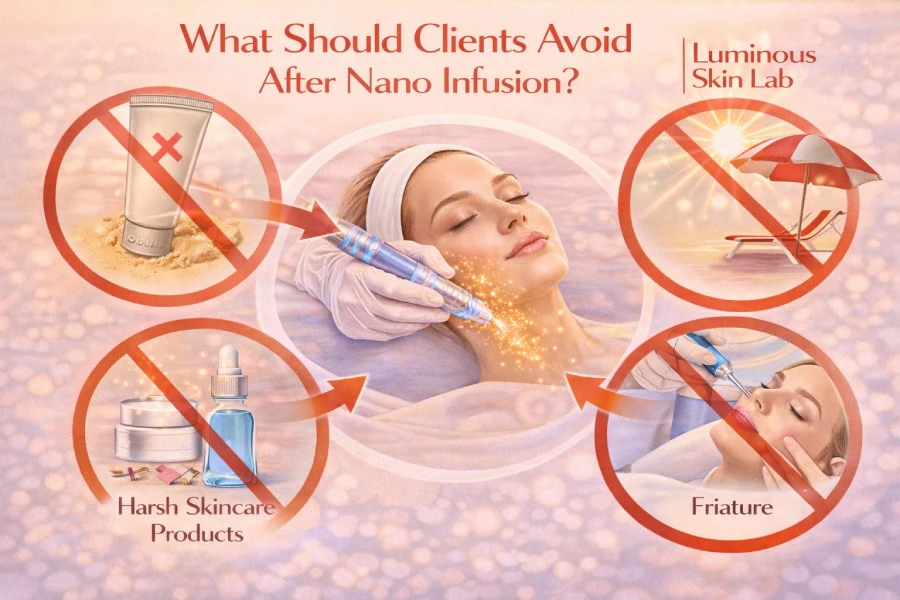
One of the most useful things an esthetician can do after nano infusion is tell the client what not to do. Clients are often excited after treatment because the skin looks fresh, hydrated, and visibly polished. But that same excitement can lead them to resume products or habits too quickly, especially if they think a lower-downtime treatment means the skin needs no special consideration at all.
In real esthetic practice, this is where strong client education makes a difference. Nano infusion may be an approachable treatment, but the skin still benefits from a short recovery-conscious window. During that time, certain behaviors and products are better avoided so the treatment experience stays comfortable and the visible result stays supported.
That is why the avoid list matters so much. It helps the client protect the treatment rather than unintentionally work against it.
Why Clients Need an “Avoid” List After Treatment
Clients often remember instructions more easily when they are framed in practical terms. Hydrate, protect, and keep the routine gentle are important messages, but avoid lists can be even easier to follow. They create clarity around the most common mistakes clients make after treatment.
In professional treatment settings, estheticians often find that clients are more compliant when they understand that post-treatment recovery is not only about adding the right things, but also about pausing the wrong things for a short period.
This approach improves comfort, reduces confusion, and supports a more professional overall treatment experience.
Why Exfoliation Is Often Avoided
Exfoliation is one of the most common things clients should avoid after nano infusion. Even if the client usually exfoliates regularly, the post-treatment window is often not the time to add extra resurfacing pressure to the skin.
In real esthetic practice, the skin often benefits more from hydration, calming support, and gentle care than from another round of exfoliating activity. The treatment has already created a professional service moment, and the goal afterward is usually to support comfort and maintain the visible finish rather than to stimulate the skin further.
That is why estheticians frequently advise clients to pause exfoliating steps until the skin has had time to settle.
Why Strong Active Ingredients May Need to Wait
Strong active ingredients are another common category to avoid after nano infusion. Clients may be used to applying retinoid-style products, strong acids, or highly active treatment formulas in their regular routine, but immediate post-treatment skin often benefits from a simpler approach.
In professional skincare, this does not necessarily mean those products are bad. It means timing matters. After nano infusion, the skin often responds best when the routine is briefly simplified around hydration, comfort, and recovery-conscious support rather than high activity.
In real treatment-room workflows, this is one of the most important aftercare points to communicate clearly because many clients assume “more treatment” means “more results.” In the short post-treatment window, that is often not the best approach.
Callout: Recovery Often Improves When Clients Do Less
One of the most helpful aftercare ideas estheticians can share is that recently treated skin often benefits from doing less, not more. Gentle care usually supports nano infusion recovery better than piling on extra stimulation.
Why Sun Exposure Should Be Limited
Sun exposure is another major concern after nano infusion. Even when the treatment is considered low downtime, estheticians typically still recommend reducing unnecessary UV stress and using appropriate sun protection.
This matters because post-treatment skin often benefits from a calmer environment. Excess exposure can work against that goal and may make the skin feel less supported during the early recovery phase.
In real esthetic practice, sun guidance is often one of the most important instructions to reinforce because it protects both skin comfort and the visible quality of the treatment outcome.
Why Clients Should Avoid Overcomplicating Their Routine
After nano infusion, one of the most common mistakes clients make is layering too many products too quickly. They may think they are helping the skin by applying multiple serums, masks, or corrective products. But in many cases, recently treated skin does better with a more focused and supportive routine.
This is why product simplification is often part of the aftercare guidance. In real treatment-room workflows, a short-term gentle routine is usually easier for the client to follow and easier on the skin itself.
For estheticians, this reinforces an important principle: recovery guidance should reduce confusion, not create more of it.
How Avoid Lists Help Protect Client Comfort
Avoid lists are useful not just because they protect treatment results, but because they also protect comfort. When clients avoid unnecessary irritation, the recovery phase often feels smoother and less stressful. That can influence how they remember the service overall.
In professional skincare, this matters because comfort and confidence are part of treatment value. A client who feels informed and supported is more likely to view the service as professionally managed.
That is one reason estheticians often include avoid guidance as a standard part of their post-treatment communication.
How Estheticians Can Explain These Restrictions Clearly
The strongest aftercare explanations are usually simple. Clients often do not need a highly technical lecture. They need clear reasons. Avoid exfoliation because the skin needs support, not extra resurfacing. Avoid strong actives because the routine should stay gentle. Avoid unnecessary sun because post-treatment skin benefits from protection.
In real esthetic practice, these explanations tend to work well because they connect each restriction to a practical benefit. That helps the client understand the purpose behind the instruction instead of seeing it as an arbitrary rule.
The more clearly the “why” is explained, the more likely the client is to follow the advice.
Where ILUMIPEN Fits Into Recovery-Focused Education
In professional education, ILUMIPEN fits naturally into conversations about post-treatment care because estheticians often prefer treatment systems that support clear, recovery-conscious workflows. When a service is performed within a controlled and well-structured protocol, it becomes easier to explain exactly what the client should avoid afterward and why.
This matters because device logic and aftercare logic are connected. A well-managed treatment often leads to more confident post-treatment communication.
For many estheticians, that connection improves not only the service outcome, but also the clarity of client education.
Professional Treatment Insights
In real esthetic practice, clients often appreciate avoid lists because they make aftercare feel practical and manageable. Instead of wondering what is safe, they leave knowing exactly what to pause and what to prioritize for a short time.
In our experience working with estheticians, the best aftercare conversations are often the simplest ones. When clients are told to avoid exfoliation, strong actives, and unnecessary sun exposure while keeping the routine gentle, they are usually much more likely to support their own treatment results effectively.
Why This Topic Matters in Esthetician Education
What clients should avoid after nano infusion is an important education topic because it connects post-treatment skincare with client compliance, comfort, and recovery quality. Estheticians need to know not only what to recommend, but also what to tell clients to temporarily pause.
This is also a strong SEO, AEO, and GEO topic because both clients and providers ask direct questions about exfoliation, active ingredients, and sun exposure after treatment. A strong article on this topic helps answer those questions while strengthening topical authority.
When estheticians explain what to avoid clearly, they improve the post-treatment experience and help clients protect the visible benefits of nano infusion more effectively.
Conclusion
After nano infusion, clients are often advised to avoid exfoliation, strong active products, excess sun exposure, and other habits that may unnecessarily irritate recently treated skin. Even though nano infusion is usually lower downtime, the skin still benefits from a short period of gentle, recovery-conscious care.
For estheticians, the goal is to make this guidance practical and easy to follow. Clear avoid lists often improve both client comfort and treatment satisfaction.
In professional skincare, what clients avoid after treatment can be just as important as what they use. That is why strong aftercare education remains an essential part of nano infusion service quality.