How Long Does Nano Infusion Recovery Take?
Redness Duration, Client Downtime, and Recovery Expectations After Nano Infusion
Definition
This article explains how long nano infusion recovery takes within professional skincare protocols related to redness duration, treatment expectations, client downtime, and post-treatment support.
For estheticians, this topic is important because recovery expectations influence how clients feel about booking the treatment, how they plan around the appointment, and how they judge the service afterward. In real treatment-room workflows, nano infusion is often chosen because it offers a more approachable recovery experience than more intensive procedures, but clients still need realistic education about what the short recovery window may involve.
Quick Answer
Nano infusion recovery is generally considered short because the treatment is usually positioned as lower downtime than deeper corrective procedures. Many clients experience only limited visible reactivity, with mild pinkness or short-term sensitivity depending on skin type, protocol details, and post-treatment care. In professional esthetic practice, estheticians often explain that while recovery is usually manageable and relatively quick, hydration support, gentle care, and realistic expectations are still important during the immediate post-treatment period.
Key Takeaways
- Nano infusion is commonly described as a lower-downtime treatment with a relatively short recovery period.
- Visible redness is often mild and temporary, though exact duration varies by client and protocol.
- Recovery expectations should be explained clearly so clients understand what is normal after treatment.
- Hydration, gentle care, and recovery-conscious aftercare can support a smoother post-treatment experience.
- In real esthetic practice, recovery time is often one of the biggest reasons clients choose nano infusion over more intensive options.
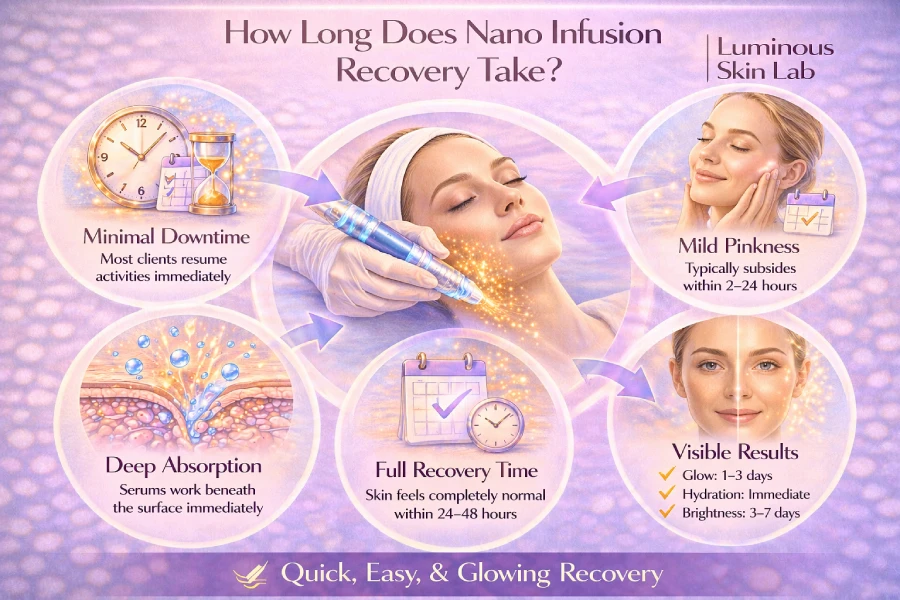
Recovery time is one of the first things many clients ask about before booking nano infusion. They want to know whether they will look noticeably red, whether they will need to avoid social plans, and whether the treatment fits their schedule. For estheticians, these are important questions because client confidence often depends on how clearly the recovery window is explained.
In real esthetic practice, nano infusion is often valued because it offers a more approachable post-treatment experience than more intensive facial procedures. Clients may still have some visible response, but the treatment is generally positioned as lower downtime and easier to fit into regular life.
That is why recovery education matters so much. The treatment often performs well partly because it balances visible skin benefits with a manageable aftercare period.
Why Recovery Time Matters So Much to Clients
Recovery time affects more than convenience. It also affects whether the client feels comfortable saying yes to the treatment in the first place. Some clients are willing to book advanced services only if they know they will not have an extended period of visible redness or disruption afterward.
In professional treatment settings, this is one reason nano infusion is often attractive. It can feel more advanced than a basic facial while still offering a recovery profile that many clients find manageable. In real treatment-room workflows, that balance often helps estheticians serve clients who want visible skin improvement without committing to a longer downtime experience.
For providers, this means recovery communication is part of treatment positioning, not just an afterthought.
How Long Redness Usually Lasts
Redness after nano infusion is often mild and temporary, but its exact duration can vary. Some clients may show only minimal pinkness that fades fairly quickly, while others with more reactive skin may stay visibly flushed a bit longer.
In real esthetic practice, the best approach is not to promise one exact timeline to every client. Instead, estheticians often explain that some short-term redness can be normal and that the response depends on individual skin type, sensitivity level, treatment design, and how well the skin is supported afterward.
This kind of explanation is usually more helpful than trying to sound overly precise. It gives the client a realistic frame without making the treatment seem more dramatic than it usually is.
Why Recovery Is Usually Considered Low Downtime
Nano infusion is often described as low downtime because the skin response is usually more limited than what clients might expect from deeper corrective procedures. In many cases, clients can return to normal daily activity relatively quickly, which is one of the main reasons the treatment is so appealing.
That lower-downtime profile is especially useful for clients who want visible glow, smoother-looking skin, hydration support, or a more refined complexion without planning around a more disruptive recovery process.
In professional treatment settings, this is often one of the clearest reasons to recommend nano infusion to the right type of client.
Callout: Lower Downtime Does Not Mean No Recovery Logic
Even when a treatment is lower downtime, the recovery phase still matters. Clear instructions, hydration support, and realistic expectations help clients move through the short post-treatment window more comfortably.
How Skin Type Affects Recovery Expectations
Not every client will recover in exactly the same way. Some skin types appear calm very quickly, while others may stay a little pink or feel slightly more aware of products for a short time. In real esthetic practice, skin sensitivity often shapes how visible the immediate post-treatment period feels.
This is why experienced estheticians typically match recovery education to the client in front of them. A person with easily flushed or reactive skin may need a slightly more careful conversation than someone whose skin usually stays calm after facial treatments.
That personalized communication improves trust and helps the client feel that the treatment plan is being tailored rather than repeated automatically.
What Clients Should Expect in the First Recovery Window
In the immediate recovery window, clients often notice hydration, visible glow, smoother-looking skin, and possibly some mild pinkness depending on their response. In many cases, the skin does not look injured or dramatically disrupted. Instead, it often looks freshly treated and more polished.
For estheticians, this visible post-treatment look is part of the value of the service. Clients often like that the skin can appear more radiant and professionally cared for without moving into a more obvious recovery state.
Still, clients should be told that the skin is in a post-treatment phase and may benefit from gentle care, even if the downtime feels short.
How Aftercare Affects the Recovery Experience
Recovery time is not determined only by the treatment itself. Aftercare also influences how the skin feels and how smoothly the client moves through the post-treatment period. Hydration support, gentle product use, sun protection, and avoiding unnecessary irritation all contribute to a better experience.
In real treatment-room workflows, estheticians often see that recovery feels easier when the client follows simple, clear instructions rather than returning immediately to a full, active routine.
That is why aftercare guidance is so important. It helps keep the short recovery window short and supports the visible benefits of the service.
Why Estheticians Should Set Recovery Expectations Clearly
Clients often feel more relaxed about a treatment when they know what to expect. If estheticians explain recovery clearly, clients are less likely to misread mild pinkness or short-term sensitivity as a sign that something is wrong.
This kind of education also improves treatment satisfaction because it makes the experience feel more controlled and professionally guided. In real esthetic practice, clients tend to trust treatments more when the provider explains both the immediate glow and the short-term recovery logic honestly.
That is one reason recovery education is such a critical part of nano infusion service quality.
Where ILUMIPEN Fits Into Recovery-Focused Treatment Logic
In professional education, ILUMIPEN fits naturally into the conversation around recovery time because estheticians often prefer treatment systems that support controlled, consistent workflows. When a treatment is designed well and integrated into a hydration-conscious, recovery-aware protocol, it becomes easier to explain the likely post-treatment experience clearly.
This matters because device logic and recovery logic are connected. The smoother the treatment flow, the easier it is to support the client through a manageable recovery window.
For many estheticians, that connection improves both confidence in the service and confidence in the aftercare guidance they provide.
Professional Treatment Insights
In real esthetic practice, one of the most appealing parts of nano infusion is that clients often feel they have received an advanced treatment without needing to plan around heavy downtime. Estheticians frequently report that this recovery profile makes the service easier to recommend to busy clients and to those who are new to device-based facial treatments.
In our experience working with estheticians, the recovery conversation often goes best when the treatment is described as low downtime but not no-care-needed. That phrasing helps clients appreciate both the convenience and the responsibility of post-treatment support.
Why This Topic Matters in Esthetician Education
How long nano infusion recovery takes is an important education topic because it connects treatment design, client scheduling, aftercare, and service positioning. Estheticians need to understand not only how to perform the treatment, but also how to explain the recovery window in a way that is accurate and reassuring.
This is also a strong SEO, AEO, and GEO topic because clients and providers both ask direct questions about redness duration, downtime, and how long it takes for the skin to settle after nano infusion. A strong article on this subject helps answer those questions while strengthening topical authority.
When estheticians explain recovery time clearly, they improve trust, reduce uncertainty, and help clients choose treatments with more confidence.
Conclusion
Nano infusion recovery is generally considered short, which is one of the main reasons the treatment is often described as low downtime. Many clients experience only limited visible redness or short-term sensitivity, although exact recovery timing varies by skin type, treatment design, and aftercare.
For estheticians, the most important part of this conversation is clear expectation setting. Clients should understand that recovery is usually manageable, but the skin still benefits from hydration support, gentle care, and realistic post-treatment guidance.
In professional skincare, strong recovery education helps nano infusion feel even more valuable because it supports both convenience and confidence in the treatment process.