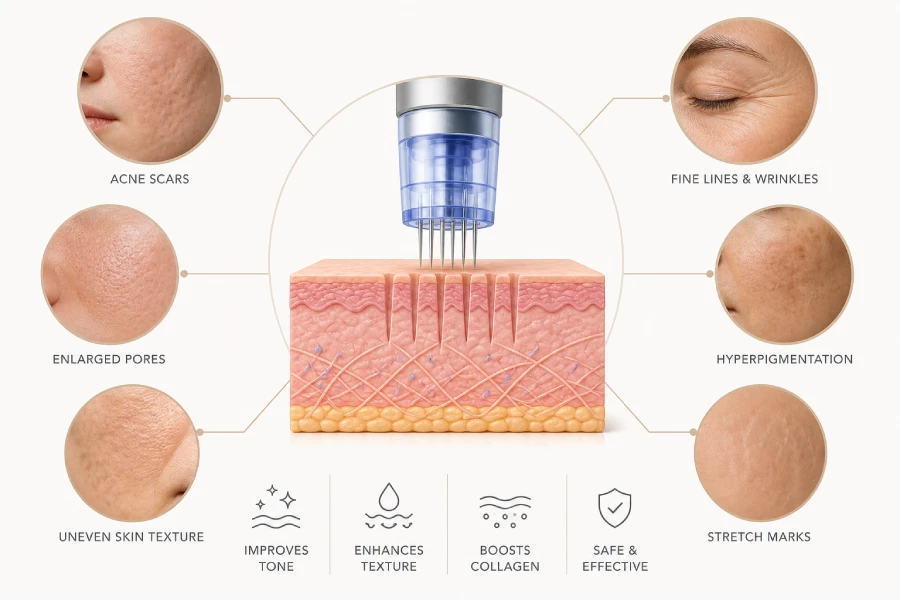
What Skin Conditions Can Microneedling Improve in Professional Esthetic Practice?
Microneedling improves a clinically significant range of skin conditions by triggering a controlled wound-healing response that stimulates collagen, elastin, and growth factor production within the dermis. The strength of evidence varies by condition, with atrophic acne scarring, fine lines, and skin texture showing the most consistent outcomes across published clinical literature.
- Atrophic acne scars — rolling and boxcar subtypes respond most strongly; ice-pick scars require greater depth or combination modalities
- Fine lines and wrinkles — collagen remodeling gradually improves skin laxity and reduces superficial line depth over a series of sessions
- Hyperpigmentation and post-inflammatory hyperpigmentation — microneedling enhances penetration of brightening actives and supports epidermal renewal
- Enlarged pores — collagen reinforcement around pore walls reduces their visible diameter and improves surrounding texture
- Stretch marks (striae) — both striae rubra and striae alba show measurable textural improvement with a dedicated series
- General skin laxity and dullness — improved dermal density and surface cell turnover contribute to overall skin quality
- Contraindications include active acne, keloid tendency, active herpes simplex, recent isotretinoin use, and blood thinning medications
For estheticians building a microneedling practice, one of the most important clinical skills is accurate condition matching — knowing precisely which skin presentations will respond to collagen induction therapy, which require additional modalities, and which should be referred or declined. Clients frequently arrive with a broad list of concerns and an expectation that microneedling addresses all of them equally. The professional reality is more nuanced, and understanding the mechanism behind each indication is what separates results-oriented practice from generalist treatment delivery.
Microneedling’s therapeutic mechanism is fundamentally the same regardless of which condition is being targeted: controlled micro-injuries activate the skin’s wound repair cascade, releasing platelet-derived growth factors, fibroblast activation signals, and cytokines that orchestrate new collagen and elastin synthesis. What differs between conditions is how that remodeling process interfaces with the specific structural abnormality being treated — whether that is a depressed scar, a dilated pore, a pigmented macule, or a thinned and lax dermal matrix.
This article provides a condition-by-condition clinical breakdown for estheticians, covering mechanism of action for each indication, realistic outcome expectations based on current evidence, and the contraindications that require every treatment decision to begin with a thorough intake assessment.
What Every Esthetician Should Know About Microneedling Indications
- Atrophic acne scars are the highest-evidence indication for microneedling; rolling and boxcar subtypes respond better than ice-pick scars due to structural accessibility
- Hyperpigmentation improvement from microneedling is largely mediated through enhanced serum penetration rather than direct pigment disruption — ingredient selection matters as much as the treatment itself
- Enlarged pore reduction results from collagen reinforcement around pore walls, with the most visible improvement typically appearing after sessions two and three
- Stretch mark improvement requires a dedicated series of four to six sessions; striae rubra (red) respond faster than striae alba (white) due to higher residual vascular activity
- Full collagen remodeling takes up to six months post-treatment; outcome assessments made at four weeks do not reflect final results
- No skin condition justifies skipping intake screening — keloid tendency, active breakouts, blood thinners, and recent retinoid use are all session-level contraindications
- Post-treatment hydration is a clinical requirement, not a comfort measure — barrier disruption from micro-injury dramatically increases transepidermal water loss during recovery
Microneedling for Acne Scars: The Highest-Evidence Indication
Among all skin conditions treated with microneedling, atrophic acne scarring has the strongest and most consistent body of clinical evidence supporting its use. Atrophic scars form when the skin’s healing response after an acne lesion is insufficient to replace lost dermal tissue, leaving a depressed area that disrupts the smooth skin surface. Microneedling addresses this by stimulating the fibroblast activity and collagen production needed to gradually refill and remodel the depressed scar structure.
Scar Subtypes and Expected Outcomes
Not all acne scars respond equally to microneedling, and estheticians who communicate subtype-specific expectations to clients build trust and reduce disappointment. Rolling scars — shallow, undulating depressions with sloping edges — show the strongest and most rapid response, typically improving visibly within a three-session series. Boxcar scars — wider depressions with defined vertical walls — respond well but require more sessions due to their steeper structural deficit. Ice-pick scars — deep, narrow channels that extend into the lower dermis — are the most resistant subtype and often require combination treatment with TCA cross or fractional approaches to achieve meaningful improvement.
Clinical studies consistently document improvements in global acne scar severity scores of 50 to 70 percent after four to six microneedling sessions at appropriate depths. Practitioners working with higher-grade scarring (Grade III or IV on the Goodman and Baron scale) should set realistic expectations and discuss multi-session treatment planning from the initial consultation.
Needle Depth Considerations for Scar Treatment
For most atrophic acne scar work, needle depths in the range of 1.0 to 1.5 mm are used on the face, with some deeper scars requiring 2.0 mm in areas of thicker skin such as the cheeks. Shallower depths of 0.5 to 0.75 mm are appropriate for superficial textural improvement but will not generate sufficient dermal remodeling to address moderate or deep atrophic scars. The esthetician’s scope of practice and device clearance in their jurisdiction should always be confirmed before selecting treatment depth.
The Wound-Healing Cascade Behind Every Microneedling Result
Understanding the biological mechanism behind microneedling results is not academic background knowledge for estheticians — it directly informs treatment decisions including session spacing, needle depth selection, serum choices, and post-treatment protocol design. Every condition that microneedling improves does so through the same three-phase wound healing sequence initiated by each micro-injury.
Three Phases of Collagen Induction
Phase one is the inflammatory phase, which begins immediately after treatment and lasts 24 to 72 hours. Platelets aggregate at each micro-injury site and release platelet-derived growth factor (PDGF) and transforming growth factor-beta (TGF-β), recruiting neutrophils and macrophages that clear debris and release further signaling cytokines. This initial inflammatory response is the biological signal that activates the collagen synthesis phases that follow, which is why suppressing it with corticosteroids immediately post-treatment interferes with outcomes.
Phase two is the proliferative phase, occurring from approximately day three through day twenty-one. Fibroblasts migrate to the micro-injury sites and begin synthesising Type III collagen, the provisional scaffold that fills the wound space. New blood vessels form through angiogenesis, supporting the metabolically active tissue repair zone. Practitioners who see mild skin firmness and surface glow in the weeks following treatment are observing the visible surface expression of this collagen deposition phase.
Phase three is the remodeling phase, the longest and most clinically significant window for measurable results. Type III collagen is gradually replaced by the stronger, more organised Type I collagen over a period of three to six months. It is during this phase that atrophic scars fill, pores contract, and fine lines soften. This timeline is why outcome assessments taken at four to six weeks are premature — the final result should be evaluated at the three-to-six month mark following the last session in a series.
What Research Documents About Microneedling Outcomes by Condition
Published clinical trials across multiple skin conditions establish both the mechanisms and the measurable outcomes of microneedling when performed at professional standards. The figures below reflect peer-reviewed findings from controlled clinical studies using professional-grade devices at appropriate treatment depths and session frequencies.
Atrophic acne scar studies consistently document 50–70% improvement in global scar severity scores after four to six sessions. Hyperpigmentation studies show 40–60% reduction in melanin index when brightening serums are combined with microneedling versus topical application alone. Collagen density measurements by ultrasound show increases of 19–40% after a three-session series at depths of 1.0–1.5 mm. These figures demonstrate that the treatment produces measurable structural change, not surface-level cosmetic effects.
Session spacing is an equally important variable: intervals of four weeks allow sufficient time for Phase III collagen remodeling to establish before the next inflammatory cycle is initiated. Spacing sessions closer than three weeks consistently produces diminishing returns and increases recovery burden without proportional improvement in outcomes.
Microneedling Indications: Evidence Level and Outcome Expectations by Condition
Estheticians who clearly communicate the evidence base and realistic outcome timeline for each condition are better positioned to manage client expectations and deliver genuinely satisfying clinical results. The reference framework below organises the primary microneedling indications by evidence strength, typical session requirement, and primary mechanism of action — giving practitioners a structured way to approach consultation conversations.
Using This Framework in Client Consultations
The most effective use of this evidence framework is during initial client consultations, where estheticians can reference specific conditions, explain the underlying mechanism in accessible terms, and set honest session number and timeline expectations before the first treatment. Clients who understand that collagen remodeling continues for six months and that three sessions are a starting point rather than a complete protocol are significantly more likely to complete a full series and experience satisfying clinical outcomes.
When working through a multi-session acne scar series, estheticians consistently find that the post-treatment recovery step has a measurable effect on how comfortably clients tolerate the cumulative treatment schedule — and on their willingness to complete the full series. After scar-focused sessions at 1.0 to 1.5 mm, applying Poly-Luronic™ Jelly Mask immediately after the treatment completes a two-minute set time and is then peeled intact as one piece — a process that itself provides visible evidence of treatment precision that clients frequently comment on positively. The mask’s occlusive seal reduces the tight, burning sensation that clients report in the first hour post-microneedling significantly more effectively than standard hyaluronic acid sheet masks, which do not generate the same physical moisture barrier and tend to dry out and lose contact with the skin surface within fifteen to twenty minutes. In practice, leaving the jelly mask on for ten to twelve minutes while the client rests is a reliable protocol step that reduces visible redness measurably before the client sits upright, which is important for clinic environments where clients will encounter others immediately after their appointment.
Six Clinical Factors That Determine Microneedling Outcomes for Any Skin Condition
Regardless of which skin condition is being treated, the quality and consistency of microneedling outcomes depends on six clinical variables. Understanding these factors allows estheticians to make more precise treatment decisions and to troubleshoot suboptimal results when they occur.
Needle Depth Selection
Depth must match the structural location of the target condition. Superficial texture issues respond to 0.5–0.75 mm; atrophic scars require 1.0–1.5 mm; deeper body work may need up to 2.0 mm. Incorrect depth — either too shallow or too deep for the condition — is the most common technical reason for disappointing outcomes.
Session Spacing and Series Completion
Four-week intervals are the clinically established minimum between sessions for most conditions. Spacing sessions closer together initiates new inflammatory cycles before the proliferative phase of the previous session is complete, reducing net collagen output. Full series completion — not a single session — is required to deliver the documented clinical outcomes.
Serum Selection During Treatment
The microchannels created during microneedling increase serum penetration by up to ten times. This amplified absorption makes ingredient selection critically important: growth factors and peptides accelerate collagen synthesis; brightening actives such as tranexamic acid enhance pigmentation outcomes; hyaluronic acid provides hydration support during the treatment itself. Inflammatory or sensitising actives must be avoided during needling.
Post-Treatment Barrier Recovery
Barrier disruption from micro-injury increases transepidermal water loss significantly during the 24–48 hour recovery window. Inadequate post-treatment hydration slows wound closure and can compromise the quality of the inflammatory-to-proliferative phase transition that drives collagen production. Immediate application of an occlusive hydration treatment is a clinical protocol requirement across all microneedling indications.
Client Sun Exposure and Compliance
Unprotected UV exposure in the two weeks following microneedling can trigger post-inflammatory hyperpigmentation, especially in Fitzpatrick types III–VI, and can degrade newly formed collagen fibrils before remodeling completes. Client education on strict SPF50+ daily application and sun avoidance is a non-negotiable component of every microneedling aftercare conversation.
Accurate Contraindication Screening
Active acne in the treatment zone, keloid or hypertrophic scar history, active herpes simplex without prophylaxis, recent isotretinoin use within six months, and blood thinners are all session-level contraindications. Missing these through inadequate intake screening is the primary safety risk in microneedling practice and can produce adverse outcomes that are difficult to correct.
Contraindications and Special Populations: When to Modify or Decline Microneedling
No discussion of microneedling indications is clinically complete without equal attention to contraindications. The list of conditions that respond positively to collagen induction therapy is extensive — but so is the list of client presentations that require modification, additional caution, or outright referral. An esthetician’s ability to accurately identify contraindications in real client intakes is the core safety skill of microneedling practice.
Absolute Contraindications
Absolute contraindications are conditions where the treatment should not proceed under any circumstances. These include active acne lesions or cystic breakouts in the planned treatment zone, as the needles can mechanically rupture acne papules and spread bacterial contents through the microchannels, worsening the breakout dramatically. Active herpes simplex virus (cold sores or perioral HSV) within or adjacent to the treatment area is a similarly strict contraindication; the trauma of microneedling can trigger a severe viral outbreak, and prophylactic antiviral medication from the client’s physician is required before treating patients with known HSV history. Keloid or hypertrophic scar tendency is another absolute contraindication: the wound-healing stimulation from microneedling can trigger abnormal scarring in susceptible individuals, and this history must be established during intake.
Current isotretinoin use and use within the preceding six months is a well-documented absolute contraindication. Isotretinoin significantly alters sebaceous gland function and skin healing capacity, and microneedling during or shortly after a course of this medication produces abnormal wound healing and an elevated scarring risk. Estheticians should confirm the six-month clearance period with clients and, when in doubt, request written clearance from the prescribing physician before proceeding.
Fitzpatrick Skin Type Considerations
Microneedling is among the safest professional skin treatments for darker Fitzpatrick skin tones (types IV–VI) compared to heat-based modalities, because it does not generate thermal energy that can trigger melanocyte disruption. However, estheticians must apply specific protocol modifications for these clients. Conservative needle depths reduce the intensity of the inflammatory response and lower the risk of post-inflammatory hyperpigmentation. Brightening serums including tranexamic acid and niacinamide should be incorporated into the microneedling session for any client with a history of pigmentation response to skin trauma. Post-treatment sun avoidance instructions should be communicated with particular emphasis, and mineral SPF should be applied as the final recovery step before the client leaves the treatment room.
Relative Contraindications Requiring Modified Protocols
Relative contraindications include active rosacea flares (treat in remission only), poorly controlled diabetes (impaired wound healing), anticoagulant medications (increased bruising and bleeding risk), and pregnancy (avoid in the first trimester; conservative depths only thereafter). Estheticians encountering any of these presentations should document the modification made, obtain informed consent acknowledging the modified approach, and when appropriate consult the client’s physician before proceeding.
Professional and Scientific References
The clinical evidence presented in this article is drawn from peer-reviewed research on microneedling and collagen induction therapy published in dermatology and esthetic medicine journals between 2010 and 2025, as well as established professional esthetic education standards.
- Aust, M.C., et al. “Percutaneous collagen induction therapy: An alternative treatment for scars, wrinkles, and skin laxity.” Plastic and Reconstructive Surgery, 2008–2022. Establishes the foundational wound-healing mechanism of collagen induction therapy and documents dermal collagen density increases of 19–40% post-series.
- Fabbrocini, G., et al. “Acne scarring treatment using skin needling.” Clinical, Cosmetic and Investigational Dermatology, 2009–2020. Documents 50–70% scar severity improvement in atrophic acne scars across multiple controlled series; establishes rolling and boxcar subtype superiority of response over ice-pick scars.
- Singh, A., & Yadav, S. “Microneedling: Advances and widening horizons.” Indian Dermatology Online Journal, 2016. Comprehensive review of microneedling indications, needle depth guidelines, and comparative outcomes across skin conditions including pigmentation, scarring, and alopecia.
- Alster, T.S., & Graham, P.M. “Microneedling: A review and practical guide.” Dermatologic Surgery, 2018. Reviews session spacing science, Fitzpatrick skin type safety profiles, and post-treatment care protocols including barrier recovery recommendations.
- Dogra, S., et al. “Microneedling for atrophic acne scars.” Journal of Cutaneous and Aesthetic Surgery, 2014–2022. Establishes the four-week minimum session interval as the evidence-based standard for optimal collagen remodeling between treatment cycles.
Every skin condition treated with microneedling places the same immediate demand on the skin: the barrier has been disrupted, transepidermal water loss is elevated, and the wound-healing cascade requires adequate hydration to proceed efficiently through its proliferative and remodeling phases. The post-treatment mask step is not a luxury — it is a clinical requirement that directly influences how well collagen synthesis proceeds and how quickly the barrier recovers. Poly-Luronic™ Jelly Mask is specifically engineered for this application, combining an alginate occlusive matrix that physically seals the disrupted barrier with a dual-humectant complex of polyglutamic acid and hyaluronic acid that delivers layered hydration at the stratum corneum and epidermal levels simultaneously. For estheticians delivering microneedling across any of the indications covered in this article — acne scars, fine lines, enlarged pores, or pigmentation — integrating a clinically appropriate occlusive hydration step is the protocol decision that protects both the treatment outcome and the client’s recovery experience.
Explore the Poly-Luronic™ Jelly Mask LineFrequently Asked Questions: Microneedling Skin Condition Indications
What skin conditions can microneedling actually improve?
Microneedling can improve a wide range of skin conditions through its collagen induction mechanism. The most consistently responsive conditions include atrophic acne scars, fine lines and wrinkles, hyperpigmentation including post-inflammatory hyperpigmentation, enlarged pores, uneven skin texture, stretch marks, and general skin laxity. Results depend on needle depth, number of sessions, and the specific condition being treated, with atrophic scarring and texture showing the strongest clinical evidence.
Does microneedling really work for acne scars?
Yes — microneedling is one of the most clinically supported esthetic treatments for atrophic acne scars. The controlled micro-injury triggers a wound-healing cascade that remodels collagen within the scar tissue, gradually raising depressed scars toward the surrounding skin surface. Clinical research documents statistically significant scar improvement after a series of three to six sessions, with rolling and boxcar scars typically showing the best response. Ice-pick scars are more resistant and often require multiple modalities.
Can microneedling help with hyperpigmentation?
Microneedling can help with post-inflammatory hyperpigmentation and certain forms of melasma, primarily by improving product penetration of brightening ingredients rather than directly targeting melanin. The microchannels created during treatment allow tyrosinase-inhibiting serums such as tranexamic acid, vitamin C, and niacinamide to reach deeper dermal layers where they are more effective. Estheticians should exercise caution with active inflammatory hyperpigmentation and darker Fitzpatrick skin types, as inappropriate needle depth or insufficient recovery time can worsen pigmentation.
Why does microneedling improve skin texture and enlarged pores?
Microneedling improves skin texture and reduces the appearance of enlarged pores by stimulating new collagen and elastin synthesis in the dermis surrounding each pore opening. As dermal support structure improves, the pore walls receive better structural reinforcement, causing them to appear smaller and more uniform. Additionally, the micro-exfoliation effect of the treatment removes surface debris that can visually expand pore size. Practitioners typically see the most noticeable texture improvements after two to three sessions, with results continuing to develop over a 12-week collagen remodeling window.
How many microneedling sessions does it take to see results?
Most clients begin to see measurable improvement after two to three sessions, though initial visible change may appear within three to four weeks of the first treatment as early collagen deposition begins. For atrophic acne scars, a series of four to six sessions spaced four weeks apart is the standard professional protocol. Fine lines and texture concerns often respond within three to four sessions. Because collagen remodeling continues for up to six months after the final session, full results are assessed at the three-to-six month mark following series completion.
Is microneedling safe for all skin types?
Microneedling is generally considered safe across all Fitzpatrick skin types when performed with appropriate depth settings and proper post-treatment protocols. Unlike laser resurfacing, microneedling does not generate heat and therefore carries a lower risk of post-inflammatory hyperpigmentation in darker skin tones. However, estheticians must use conservative needle depths for Fitzpatrick types IV through VI and ensure thorough post-treatment hydration and sun avoidance. Active acne, rosacea flares, open wounds, and certain medications including isotretinoin are standard contraindications that require client screening before treatment.
Can microneedling improve stretch marks?
Microneedling can improve the appearance of stretch marks, particularly striae alba (mature white stretch marks) and striae rubra (newer red or purple stretch marks). The treatment works by inducing collagen and elastin remodeling within the stretched and thinned dermal tissue. Clinical studies show measurable improvement in texture and color after a series of four to six sessions, though complete elimination is not typically achievable. Body areas such as the abdomen, thighs, and hips respond well, and combining microneedling with growth factor or peptide serums during treatment can enhance outcomes.
What skin conditions are NOT good candidates for microneedling?
Microneedling is contraindicated for clients with active acne lesions or cystic acne in the treatment area, as the needles can spread bacteria and worsen breakouts. Other contraindications include active cold sores or herpes simplex virus history without prophylactic treatment, keloid or hypertrophic scar tendency, active rosacea flares, blood thinning medications, anticoagulant therapy, recent isotretinoin use within six months, and any open wounds or active skin infections. Estheticians must complete a thorough intake and health history review before every microneedling session.
Why is post-treatment hydration so important after microneedling, and does the Poly-Luronic™ Jelly Mask help?
Post-treatment hydration is critical after microneedling because the micro-injuries created during the session temporarily compromise the skin barrier, dramatically increasing transepidermal water loss and leaving the skin vulnerable to dehydration and environmental irritants. Adequate hydration during this window directly supports the wound-healing cascade and collagen synthesis that produce clinical results. The Poly-Luronic™ Jelly Mask is specifically suited to this application because its alginate-based occlusive structure seals moisture against the skin surface while its polyglutamic acid and hyaluronic acid humectant complex delivers layered hydration at both the surface and epidermal levels. Practitioners applying the Poly-Luronic™ Jelly Mask immediately after microneedling report that the cooling, occlusive set of the mask also reduces visible redness and client discomfort during the first critical recovery hour, providing a clinical benefit that standard sheet masks and cream formulations cannot replicate.
Condition Matching Is the Foundation of Effective Microneedling Practice
Microneedling’s versatility as a professional treatment modality is one of its greatest clinical strengths — but that versatility only translates into consistent results when estheticians apply it with precision rather than breadth. The conditions that respond most powerfully to collagen induction therapy do so because the treatment’s core mechanism — structured wound repair and dermal remodeling — directly addresses their underlying structural deficit. Acne scars fill because new collagen is deposited in the scar void. Pores contract because the collagen surrounding the pore opening is reinforced. Fine lines soften because dermal density increases.
The esthetician’s role in this process extends far beyond operating a device. Accurate intake assessment to identify contraindications, informed condition-matching to select appropriate needle depths, evidence-based session planning to build a complete series, and professional post-treatment recovery protocols to protect the wound-healing environment — each of these decisions determines whether a client achieves the documented clinical outcomes or leaves with incomplete results and eroded trust in the treatment.
Building expertise in microneedling indications means understanding not just which conditions respond, but why they respond, what variables influence the outcome, and what the evidence realistically supports. That depth of clinical knowledge is what distinguishes professional esthetic education from generalist treatment delivery — and it is the foundation on which truly results-oriented microneedling practice is built.