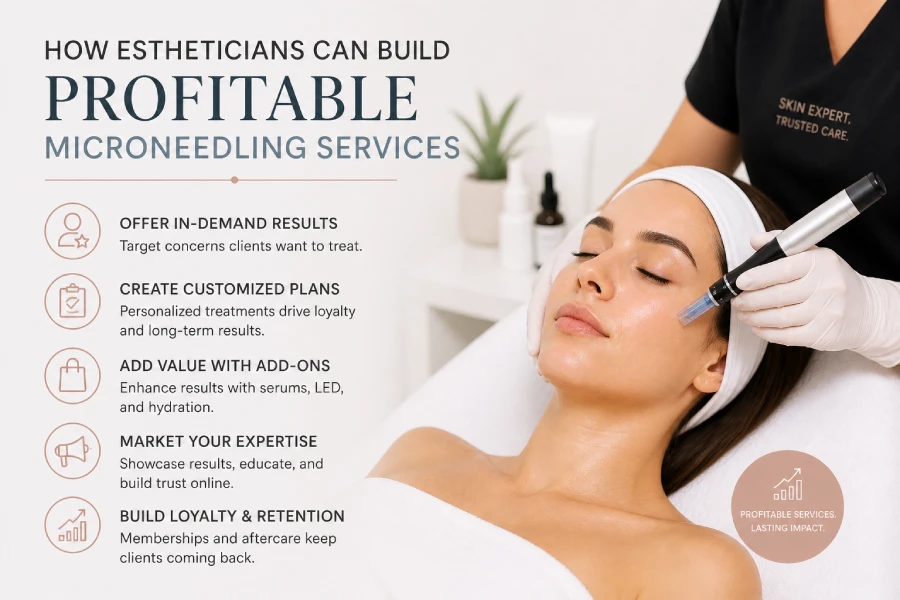
How Do Estheticians Build Profitable Microneedling Services?
Estheticians build profitable microneedling services by combining smart pricing architecture, structured add-on protocols, and a deliberate client retention system. Profitability in microneedling comes not only from the base service fee but from the cumulative revenue generated by recovery add-ons, series packages, and home-care product sales attached to each visit.
- Microneedling pricing typically ranges from $200 to $700 per session depending on market, protocol depth, and bundled add-ons—most estheticians find a starting price of $280 to $400 appropriate for standard single sessions.
- Series packages of three to six sessions priced at a 10 to 15 percent discount over single-session pricing secure revenue in advance and significantly improve client retention and outcome visibility.
- Post-treatment recovery steps—cooling masks, LED therapy, and hydration serums—are the highest-margin add-ons available because they require minimal additional chair time while meaningfully increasing perceived value.
- Accurate cost-of-service calculation covering needle cartridges, serums, masks, and consumables is essential for setting prices that protect margins at volume.
- Client education delivered during the consultation and at each session is the primary driver of series completion rates, referrals, and home-care retail revenue.
- A structured rebooking system—pre-booking the next session at checkout rather than leaving rescheduling to the client—is consistently cited as the highest-impact retention behaviour in professional practice.
Microneedling is one of the most technically demanding services estheticians offer, and it is also one of the most financially rewarding when the business model behind it is built deliberately. Many practitioners invest in device training, develop solid technique, and deliver strong clinical outcomes—yet find that their microneedling revenue does not reflect the value they are providing. The gap is almost always a business architecture problem, not a treatment quality problem.
The economics of microneedling are unusually favourable for estheticians who understand them. The collagen induction mechanism requires multiple sessions to deliver its full benefit, which means clients who understand the treatment are naturally predisposed to series commitment. The recovery phase of each session creates a structured window for high-margin add-ons that require no additional consultation. And the visible, cumulative results of well-executed microneedling generate referrals at a rate that few other services can match.
This guide covers the pricing frameworks, add-on strategies, recovery protocol design, and retention systems that estheticians use to build microneedling into a consistently profitable signature service—whether they are launching it for the first time or restructuring an existing offering to better reflect its clinical and commercial value.
What Every Esthetician Should Know About Building Profitable Microneedling Services
- Microneedling profitability is built on three revenue streams: the base service fee, add-on protocol revenue, and home-care retail attached to each visit.
- Series packages are more profitable than single-session pricing because they secure revenue upfront, improve client retention, and ensure enough sessions for outcome visibility that drives referrals.
- Post-treatment recovery steps are the highest-margin add-ons in microneedling because they add minimal chair time while substantially increasing per-visit revenue and client satisfaction.
- Accurate cost-of-service tracking—including cartridges, serums, masks, and all consumables—is the foundation of sustainable pricing decisions.
- Client education at the consultation stage is the single most important determinant of series commitment and long-term retention.
- Pre-booking the next appointment at checkout rather than following up later produces measurably higher rebooking rates in professional practice.
- Before-and-after documentation is the most effective marketing asset for microneedling—it converts prospective clients and validates the investment for existing ones.
Pricing Architecture for Microneedling Services
Pricing microneedling well requires understanding the difference between what the market will bear, what the treatment actually costs to deliver, and what the outcome is worth to the client. Estheticians who price based solely on competitor rates without calculating their own cost of service frequently find that high session volume produces lower net revenue than expected.
A foundational single-session price should start from a full cost-of-service calculation: needle cartridge, numbing preparation, treatment serums, post-treatment recovery materials, gloves, draping, and a proportionate share of overhead. In most markets, this consumable cost lands between $25 and $65 per session. The service fee should then be set to deliver a margin that reflects the esthetician’s skill level, the time investment, and the clinical outcomes the treatment produces.
Building a Tiered Pricing Structure
Most successful microneedling practices operate with two or three pricing tiers rather than a single flat rate. A foundational tier covers a standard single-zone treatment with basic serum and minimal recovery protocol. A mid-tier bundles a premium serum, post-treatment LED therapy, and a recovery mask. A premium tier includes all of the above plus a full-face advanced serum, extended LED exposure, and a structured home-care kit. Each tier has a clear, communicable clinical rationale—the upgrade is not simply “more of the same” but a meaningfully different outcome pathway.
Tiered pricing also resolves the most common new client objection: sticker shock at a single high price point. When clients can enter at a moderate tier and experience the results before committing to premium protocols, the upgrade decision often makes itself. Estheticians working in this structure report that the majority of clients who begin at a foundational tier upgrade within their second or third session.
The Economics of Series Packages and Client Retention
The financial case for series packages in microneedling is straightforward: a client who purchases a three-session series represents two to three times the revenue of a single-session client, and a client who completes a full series is dramatically more likely to rebook maintenance treatments, purchase retail products, and refer new clients. The lifetime value of a series client versus a one-time client is not marginal—it is transformative for the economics of a microneedling-focused practice.
Why Series Completion Rates Are a Business Metric
Series completion rates are worth tracking as a key performance indicator precisely because they measure whether the esthetician’s client education and retention systems are working. A three-session series with a 90 percent completion rate generates predictable revenue, consistent outcome documentation, and a high referral rate. The same series with a 50 percent completion rate represents lost revenue, incomplete outcomes, and a weaker referral pipeline. Most of the variance between these two scenarios is explained not by treatment quality but by the thoroughness of the consultation, the clarity of the session-by-session benefit explanation, and the presence or absence of a structured pre-booking system.
Revenue Multipliers in a Structured Microneedling Practice
The revenue difference between a single-session microneedling client and a series-plus-retail client is not incremental—it compounds across the lifetime of the client relationship. Understanding the contribution of each revenue stream allows estheticians to make deliberate decisions about where to invest time in protocol design and client education.
Series packages secured at the consultation stage produce two to three times the base service revenue of single-session clients. Add-on recovery protocols attached to each session in the series increase per-visit revenue by 20 to 40 percent above the base session fee. Home-care retail sold at the post-treatment consultation adds a further 15 to 30 percent per visit on average. Referral clients generated by series completers typically have a higher initial spend than cold-acquisition clients because they come with established trust in the treatment outcome.
Recovery Protocols as a Revenue and Retention Strategy
Post-treatment recovery protocols are underutilised as a business tool in microneedling. Most estheticians understand their clinical rationale—calming inflammation, supporting barrier function, delivering hydration to compromised skin—but fewer recognise that the recovery phase of a microneedling session is also the moment of highest client receptivity and the strongest driver of service perception. What happens in the 15 to 20 minutes after needling shapes how the client remembers the entire appointment.
A structured recovery protocol that includes a visible, sensory-engaging step—cooling the skin, applying a professional-grade mask, delivering a calming serum—communicates expertise in a way that a basic moisturiser application does not. Clients cannot directly observe the quality of the needling technique, but they can feel and describe the recovery experience precisely. This means the recovery protocol is the most client-visible component of the service and the one most likely to be mentioned in reviews, referrals, and rebooking conversations.
What Clients Are Actually Paying Attention To
Estheticians sometimes underestimate how much of a client’s service perception is formed during the recovery window. The needling itself is often uncomfortable, and clients spend that phase managing sensation rather than forming positive impressions. The recovery phase, by contrast, is when discomfort subsides and clients begin to feel cared for, noticed, and impressed. A cooling, hydrating mask applied at precisely this moment delivers a sensory contrast that is disproportionately memorable. This is why estheticians who invest in recovery protocol design consistently report that clients spontaneously mention the recovery steps when describing the service to friends or when leaving reviews.
When estheticians transition from ending microneedling sessions with a standard calming moisturiser to a structured recovery sequence that includes a Poly-Luronic™ Jelly Mask application, the change in client language is immediate and consistent. Clients who previously described the service as “a bit intense but worth it” begin using words like “incredible,” “luxurious,” and “nothing like anywhere else”—without being prompted. The jelly mask step takes approximately 15 minutes of passive time that already exists in the appointment, which means the chair-time cost is essentially zero. What changes is that the client is now experiencing something visible and tactile during those 15 minutes rather than lying under a towel. The cooling occlusive layer that the mask creates is also directly aligned with what the skin needs post-needling: reduced inflammation, locked-in hydration, and a barrier-supportive environment. Comparing this to simply finishing with SPF, the difference in client experience quality is significant enough to justify a $40 to $60 add-on price with essentially no objection when the rationale is explained at consultation. Estheticians working without a defined recovery mask step are routinely leaving both revenue and retention on the table in every microneedling session they deliver.
Six Business Pillars of a Profitable Microneedling Practice
Estheticians who build consistently profitable microneedling services tend to operate on six foundational business practices. These are not advanced strategies reserved for high-volume practices—they are the minimum infrastructure required for microneedling to perform as a revenue engine rather than simply a high-skill service that clients occasionally book.
Full Cost-of-Service Calculation
Every microneedling session has a real consumable cost that must be calculated before pricing decisions are made. Cartridges, serums, masks, numbing agents, gloves, and overhead all contribute. Estheticians who skip this step frequently undercharge at volume and erode margin without recognising it until the numbers become impossible to ignore.
Series Package Architecture
A three to six session series package offered at consultation—priced at a 10 to 15 percent discount against individual session pricing—secures revenue in advance, aligns the client with the cumulative treatment timeline, and ensures enough sessions for visible collagen outcomes. This is the single highest-impact revenue structure available in microneedling.
Structured Add-On Protocol
A defined set of add-ons—recovery masking, LED therapy, booster serums—should be built into the service menu with clear clinical rationale and standard pricing. Add-ons presented as optional extras at checkout convert poorly. Add-ons described during the consultation as part of a recommended protocol convert at significantly higher rates.
Pre-Booking at Checkout
Asking clients to pre-book the next session before they leave the treatment room consistently produces higher rebooking rates than follow-up messages or calls. The moment immediately after a microneedling session—when the client is still in the professional environment and has just experienced the recovery protocol—is the optimal window for series commitment and next-appointment scheduling.
Before-and-After Documentation
Consistent photographic documentation of client progress across a series is the most effective marketing asset for microneedling. Standardised lighting, angles, and timing make comparisons credible and shareable. Estheticians who present session-by-session progress to clients during follow-up appointments report significantly higher series completion and referral rates.
Home-Care Retail Integration
Each microneedling session creates a natural retail conversation point. The products recommended for post-treatment care at home—barrier-supportive serums, gentle hydrators, SPF—are products the client needs regardless of whether they buy them from the esthetician. Positioning retail recommendations within the post-treatment education rather than at the front desk converts at significantly higher rates.
Client Education and Retention Systems That Drive Long-Term Revenue
The most consistent predictor of microneedling profitability is not treatment volume or session pricing—it is retention rate. An esthetician who retains 80 percent of clients through a three-session series and converts a high proportion of those to maintenance bookings will almost always out-earn an esthetician with higher single-session volume but lower retention. The systems that drive retention in microneedling are largely educational: clients who understand how collagen induction works, why multiple sessions are required, and what the timeline for visible results looks like are far more likely to complete their series and rebook.
The Consultation as the Primary Revenue Event
In microneedling, the consultation is not a pre-treatment formality—it is the primary revenue event. It is the moment at which the esthetician establishes clinical credibility, explains the collagen induction mechanism, sets realistic outcome expectations, presents the series package, and makes the case for add-on protocols. Estheticians who conduct thorough 20 to 30 minute consultations before the first microneedling session report package conversion rates two to three times higher than those who conduct brief intake-style consultations. The investment in consultation time pays for itself within the first booked session.
A strong consultation covers: the client’s skin concerns and goals, an explanation of how microneedling addresses those concerns through collagen induction, the recommended session frequency and total series length, the role of each add-on in the protocol and its specific benefit, the home-care regimen between sessions, and the expected progression of results across the series. Clients who receive this explanation do not simply buy a session—they invest in a programme. That shift in framing changes both their commitment level and their willingness to pay premium pricing.
Managing Client Expectations Across the Recovery Timeline
Post-treatment education is a second tier of the retention system. Clients who are not adequately prepared for the 24 to 72 hour post-treatment appearance of their skin—redness, mild sensitivity, temporary texture changes—can interpret normal healing as a problem and become less likely to rebook. Estheticians who provide detailed written aftercare instructions, follow up with a 24-hour check-in message, and frame the healing process as evidence of the collagen induction mechanism working report dramatically lower dropout rates between sessions.
The 24-hour follow-up contact is particularly valuable as a retention tool. A brief message checking on client comfort, reinforcing what the healing response indicates, and reminding the client of their next appointment date creates a touchpoint that reinforces the esthetician-client relationship without requiring additional chair time. Clients who receive this contact are significantly more likely to complete their series and to refer friends who are considering the treatment.
Professional and Scientific References
The business frameworks in this article are grounded in professional practice data, esthetician education literature, and published research on collagen induction therapy outcomes and client retention in aesthetic services.
- Aust, M.C. et al. Percutaneous collagen induction therapy: an alternative treatment for scars, wrinkles, and skin laxity. Plastic and Reconstructive Surgery, 2008–2016. Establishes the multi-session collagen induction timeline that underpins series package design.
- International Association for Applied Aesthetics. Professional Practice Management in Esthetic Services. Guidelines on service pricing architecture, cost-of-service calculation, and client retention benchmarks.
- Doddaballapur, S. Microneedling with dermaroller. Journal of Cutaneous and Aesthetic Surgery, 2009. Foundational reference on the biological mechanism supporting session frequency recommendations.
- Fabbrocini, G. et al. Skin needling to enhance depigmenting serum penetration in the treatment of melasma. Plast Surg Int, 2011. Supports the rationale for serum infusion as a high-value add-on in structured microneedling protocols.
- Associated Skin Care Professionals (ASCP). Business of Esthetics educational series, 2023–2025. Industry-level benchmarks for add-on pricing, retail conversion, and client retention rates in esthetic practice.
For estheticians building or restructuring a microneedling service, the post-treatment recovery protocol is the highest-leverage point for both revenue growth and client retention improvement. A recovery step that requires no additional chair time beyond the passive downtime that already exists in the appointment—yet delivers a measurably superior client experience—is the definition of a high-margin protocol decision. The Poly-Luronic™ Jelly Mask is formulated for exactly this application: its alginate-based structure creates an occlusive, cooling layer over post-needling skin that simultaneously supports hydration retention, calms inflammation, and delivers a sensory experience that clients associate with premium professional care. In a structured mid or premium tier, it functions as the recovery element that justifies higher session pricing, strengthens series completion rates, and creates the memorable treatment moment that drives referrals. For estheticians committed to building microneedling into a genuinely profitable signature service, this is the recovery protocol component that performs across every metric that matters commercially.
Explore the Poly-Luronic™ Jelly Mask LineFrequently Asked Questions: Building Profitable Microneedling Services
How much should I charge for a microneedling treatment?
Microneedling pricing typically ranges from $200 to $700 per session depending on geographic market, practice setting, treatment depth, and add-on services included. Solo estheticians in mid-market areas commonly price single sessions between $250 and $400, while multi-step protocols that bundle serums, LED therapy, and recovery masking often command $450 to $600. The key is building a price that reflects total treatment time, consumable costs, and the clinical outcomes clients receive, rather than matching competitor pricing alone.
What add-ons increase microneedling revenue the most?
The highest-revenue add-ons for microneedling are post-treatment recovery masks, LED light therapy, and booster serums infused during the procedure. Recovery masking adds minimal chair time while significantly increasing the perceived value and clinical outcome of the session. LED therapy, delivered during the recovery phase, addresses inflammation and enhances collagen stimulation without extending the appointment. Growth factor or peptide serums applied during needling are consumable upgrades that clients consistently accept when estheticians explain the ingredient rationale clearly.
How do I get clients to rebook microneedling consistently?
Consistent microneedling rebooking is driven by a combination of outcome visibility, pre-booked series packages, and a clear client education system. Clients who understand that collagen remodelling requires a minimum of three to six sessions spaced four to six weeks apart are far more likely to commit to a series at the time of booking. Estheticians who photograph results systematically and present before-and-after comparisons at follow-up appointments report significantly higher series completion rates than those who rely on verbal follow-up alone.
Is it worth offering microneedling packages instead of single sessions?
Yes, series packages are almost always more profitable than single-session pricing for microneedling. A three-session package priced at a 10 to 15 percent discount compared to paying per session secures revenue in advance, improves client retention, and ensures the treatment delivers the cumulative results that generate referrals. Estheticians who offer packages also report better outcome tracking because clients complete enough sessions for visible collagen improvement, which reinforces the value of the service.
How do estheticians build profitable microneedling services when they are just starting out?
Estheticians building microneedling from scratch typically start by offering introductory pricing on a small number of model clients to establish before-and-after documentation. This portfolio becomes the primary marketing asset. Starting with a defined treatment menu of one to two microneedling protocols rather than offering every possible variation allows for consistent execution, faster skill development, and cleaner cost tracking. Once profitability per session is established at a foundational level, add-ons and premium protocol tiers can be layered in systematically.
What consumable costs should I factor into microneedling pricing?
Core consumable costs for each microneedling session include the single-use needle cartridge, numbing cream or topical preparation, the serum or serums used during treatment, post-treatment recovery mask materials, gloves, draping, and any disposable applicators. Needle cartridges alone typically range from $5 to $25 depending on the device and supplier. Serums represent the most variable cost and can range from $3 to $30 per session depending on the formulation. A thorough cost-of-service calculation that accounts for all consumables typically places the breakeven point well below standard market pricing, confirming strong margin potential.
Does offering post-treatment recovery protocols actually help grow a microneedling business?
Yes, structured post-treatment recovery protocols are one of the most effective business-building tools in microneedling. Clients who experience a clearly defined, professional recovery sequence—including cooling, hydration masking, and barrier-support steps—associate those outcomes with the esthetician’s expertise rather than the procedure itself. This increases trust, referral rates, and willingness to purchase home-care products. Estheticians who invest in recovery protocol design consistently report higher average transaction values and stronger client retention compared to those who end sessions with basic moisturiser application.
How do I market microneedling without making medical claims?
Estheticians can market microneedling effectively by focusing on visible skin improvements, the professional treatment experience, and the systematic nature of the protocol rather than making specific medical or disease-treatment claims. Language centred on skin texture, radiance, hydration, and the appearance of fine lines communicates real value while remaining within scope. Documenting client outcomes with photos, sharing educational content about the collagen induction process, and positioning the service as a professional-grade procedure distinct from consumer alternatives are all strong marketing approaches that do not require medical claim language.
How does the Poly-Luronic™ Jelly Mask fit into a profitable microneedling service model?
The Poly-Luronic™ Jelly Mask integrates into a microneedling service model as a post-treatment recovery step that adds both clinical value and revenue per session. Applied immediately after microneedling, the alginate-based jelly mask delivers a cooling, occlusive environment that supports hydration retention and calms treated skin during the critical first 15 to 20 minutes of recovery. Because the mask is applied during a phase of the appointment that would otherwise involve passive downtime, it adds no meaningful chair time while creating a premium treatment experience that justifies higher session pricing. Estheticians who bundle the Poly-Luronic™ Jelly Mask as a standard recovery inclusion rather than an optional add-on report that clients consistently cite the mask step as a standout element of the service, which strengthens retention and referral behaviour.
Microneedling Is a Business Asset—When the Architecture Supports It
Microneedling delivers some of the most visible, clinically significant outcomes available in esthetic practice. But clinical excellence alone does not produce business profitability—it produces satisfied single-session clients who may or may not return. The estheticians who build genuinely profitable microneedling services are those who pair excellent technique with deliberate business architecture: pricing that reflects real costs and real outcomes, series packages that align clients with the treatment timeline, recovery protocols that create memorable experiences, and retention systems that convert first-time clients into long-term relationships.
Each of the six business pillars discussed in this guide is independently actionable. An esthetician who implements only the pre-booking system will see measurable retention improvement. One who adds a structured recovery protocol will see per-visit revenue increase and client language change. One who invests in consultation quality will see package conversion rates rise. The compounding effect of implementing all six is what transforms microneedling from a high-skill occasional service into the revenue engine that practitioners who have built profitable practices consistently describe it as.
Continue building your professional knowledge with the full Microneedling Collagen Induction Therapy guide—covering everything from the science of collagen induction to safety protocols, treatment combinations, and aftercare education for clients at every stage of their series.