Does Microneedling Really Work? What the Research Shows for Estheticians
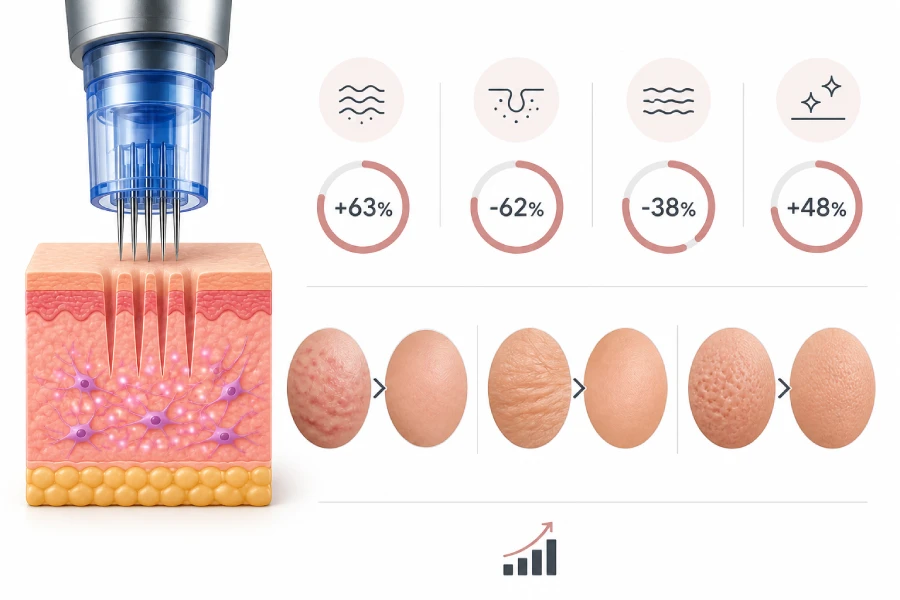
Yes—microneedling is backed by a substantial and growing body of peer-reviewed clinical evidence. Multiple randomised controlled trials, systematic reviews, and histological biopsy studies confirm that a structured series of microneedling treatments produces measurable increases in dermal collagen and elastin, statistically significant improvement in atrophic acne scarring, and visible reduction in fine lines and photoaging. The mechanism is well understood and reproducible.
- Histological biopsy studies confirm up to a 400 percent increase in collagen and elastin six months post-treatment compared to pre-treatment baseline.
- Systematic reviews classify microneedling as non-inferior to fractional laser for mild-to-moderate atrophic acne scars, with a superior safety profile across all Fitzpatrick skin types.
- The wound-healing cascade triggered by micro-injury produces collagen types I and III laid down in the natural basket-weave pattern—not scar-pattern fibres.
- Most clinical protocols require three to six sessions spaced four to six weeks apart for full efficacy in scar remodelling; collagen remodelling continues for three to six months after the final session.
- Post-treatment hydration is a clinical necessity, not a comfort measure—transepidermal water loss increases dramatically after needling and directly impairs the collagen synthesis response if not managed.
- Evidence is strongest for atrophic acne scars, periorbital fine lines, overall skin texture, and stretch marks; results for deep dynamic wrinkles are more limited.
When clients ask whether microneedling actually works, the honest and well-supported answer is yes—but the quality of that answer depends on which condition is being treated, how many sessions are performed, and how the recovery period is managed. Estheticians who can speak fluently to the research are able to set accurate expectations, justify treatment series recommendations, and differentiate their practice from providers who simply follow trends without understanding mechanism.
The peer-reviewed evidence base for microneedling has grown considerably since the technique was first described in clinical literature in the 1990s. What was initially a niche dermatological procedure has been validated across dozens of randomised trials, multiple systematic reviews, and histological studies that directly confirm tissue-level changes at the cellular and molecular level. That evidence base is the foundation of everything a professional microneedling practice should be built on.
This article covers the key research findings estheticians need to understand: what the studies actually show, which indications have the strongest evidence, what the histological data confirms about collagen changes, and why post-treatment protocols are as scientifically important as the treatment itself.
What Every Esthetician Should Know About Microneedling Research
- Microneedling’s efficacy is not theoretical—it is confirmed by histological biopsy evidence showing measurable new collagen and elastin formation at the cellular level.
- The strongest clinical evidence covers atrophic acne scarring, periorbital fine lines, skin texture, and stretch marks; estheticians should calibrate client expectations to the evidence for each specific concern.
- Comparative research shows microneedling performs on par with fractional laser for mild-to-moderate acne scars with a significantly better safety profile across all skin types.
- A minimum of three to six sessions is required for meaningful scar remodelling; treating clients as single-session candidates will produce disappointing results and undermine the treatment’s evidence base.
- Collagen remodelling is a months-long process—final results from a treatment series are typically not visible for three to six months after the last session.
- Post-treatment transepidermal water loss spikes dramatically and must be managed with occlusive hydration strategies to protect the collagen synthesis environment.
- Proper needle depth selection, skin type screening, and contraindication awareness are not optional safety steps—they determine whether the biological cascade produces results or complications.
What Clinical Research Actually Confirms About Microneedling
The clinical evidence for microneedling spans multiple decades and study designs, with the most compelling data coming from randomised controlled trials and histological analyses. The foundational work by Orentreich and Orentreich in the 1990s established the principle of subcision and wound-healing-driven collagen induction, which was later formalised as collagen induction therapy (CIT) by Desmond Fernandes in the early 2000s. Since then, the research has expanded significantly in both volume and methodological quality.
A consistently cited finding across multiple biopsy studies is a substantial increase in type I and type III collagen deposition in the papillary and upper reticular dermis following a series of microneedling treatments. Importantly, this new collagen is laid down in the normal basket-weave arrangement of healthy dermis rather than the parallel-fibre pattern associated with scar tissue. This distinction is clinically significant: it explains why properly performed microneedling improves skin quality rather than creating new scarring, and it provides histological justification for the visible skin texture improvements that practitioners and clients observe.
The Acne Scar Evidence: Strongest in the Literature
For estheticians performing microneedling in a clinical or advanced-practice context, atrophic acne scarring represents the indication with the most robust research support. A 2018 meta-analysis evaluating six randomised controlled trials found that microneedling produced clinically and statistically significant improvements in rolling and boxcar scar subtypes, with the majority of study participants achieving at least a one-grade improvement on validated scar assessment scales after four to six sessions. The same analysis found that microneedling performed comparably to fractional non-ablative laser for mild-to-moderate acne scarring, while producing substantially lower rates of post-inflammatory hyperpigmentation—a particularly important advantage for darker Fitzpatrick skin types where laser treatments carry elevated PIH risk.
Ice-pick scars, by contrast, have a more limited response to microneedling alone due to their depth and morphology. Most clinical protocols for ice-pick scars combine microneedling with chemical reconstruction (TCA CROSS) or other adjunctive approaches. Setting accurate expectations with clients about scar subtype and expected response is one of the most clinically important conversations an esthetician can have before beginning a series.
The Collagen Induction Mechanism: What the Histology Shows
Understanding the cellular mechanism behind microneedling is not merely academic—it directly informs treatment spacing decisions, the number of sessions required for specific outcomes, and why the post-treatment environment matters as much as the treatment itself. The wound-healing cascade activated by micro-injury follows a well-characterised sequence: haemostatic phase, inflammatory phase, proliferative phase, and remodelling phase. Each stage contributes to the final tissue outcome, and the remodelling phase in particular—which can span three to six months after treatment—is when the most clinically visible collagen restructuring occurs.
Fibroblast Activation and Growth Factor Release
The micro-channels created by needling stimulate the release of platelet-derived growth factor (PDGF), transforming growth factor beta (TGF-β), and fibroblast growth factor (FGF). These signalling molecules recruit fibroblasts to the treatment zone and upregulate collagen and elastin synthesis. Research using quantitative immunohistochemistry has documented measurable increases in procollagen I, procollagen III, and elastin mRNA expression in biopsies taken from treated skin, confirming that the growth factor release cascade results in genuine new protein synthesis rather than simply redistributing existing tissue components.
The depth of needle penetration directly influences which growth factors are activated and in what quantity. Superficial needling (0.25–0.5 mm) primarily stimulates epidermal growth factors and improves product absorption. Deeper treatment depths (1.0–1.5 mm in the dermis) are required to access the fibroblast-rich papillary dermis and produce meaningful collagen induction. This is why device selection, needle depth calibration, and treatment zone awareness are clinical decisions with direct impact on outcomes.
What Biopsy Studies Confirm About Microneedling-Induced Collagen Changes
Histological analyses using punch biopsy specimens taken before and after microneedling series consistently document measurable increases in dermal collagen density, elastin content, and epidermal thickness. The landmark Schwartz et al. study, subsequently replicated across multiple independent research groups, found that six months post-treatment, skin biopsies showed a 400 percent increase in collagen and elastin deposition compared to pre-treatment baseline tissue.
The collagen produced is predominantly type I and type III—the structural proteins responsible for skin firmness and resilience. Critically, the fibre orientation is the normal basket-weave pattern of healthy dermis, not the parallel scar-tissue pattern. Epidermal thickness measured by microscopy also increased, contributing to improved surface texture and reduced visibility of fine lines independent of the dermal collagen effect.
These histological findings provide the mechanism explanation for every visible clinical outcome practitioners and clients observe: improved skin firmness, reduced scar depth, smoother surface texture, and more even skin tone. The research does not support microneedling as a placebo—the tissue changes are structurally measurable and reproducible across independent study groups.
How Microneedling Evidence Compares Across Skin Concerns
Not all indications for microneedling have the same depth of evidence behind them. Estheticians serving clients with specific skin concerns benefit from understanding where the research is strongest, where it is moderately supported, and where the evidence is still emerging. This allows for accurate, credible client consultations and appropriately calibrated treatment expectations—both of which are professional differentiators in a market where overclaiming is common.
Why Skin Type Matters for Research Interpretation
One of microneedling’s most clinically significant advantages over laser-based alternatives is its safety profile across all six Fitzpatrick skin types. Multiple studies have specifically evaluated microneedling in darker skin tones (Fitzpatrick types IV through VI) and found low rates of post-inflammatory hyperpigmentation compared to ablative and non-ablative laser modalities. This is mechanistically logical: microneedling does not generate heat and does not ablate melanocytes. The inflammatory response triggered by micro-injury is controlled and localised, and when treatment parameters are appropriate, it does not reach the threshold that activates post-inflammatory pigmentation pathways in susceptible skin types.
For estheticians serving a diverse client population, this research dimension is clinically and commercially important. It expands the candidate pool for microneedling treatments substantially compared to energy-based devices and positions the modality as one of the most universally applicable professional skin treatments available in scope of practice.
The research on post-microneedling TEWL is something practitioners feel in real time—skin that has just been needled will tighten and pull noticeably within minutes if no occlusive step is applied, which is a visible signal of the moisture loss the biopsy studies quantify. Applying the Poly-Luronic™ Jelly Mask immediately at the end of the needling pass, while the skin is still slightly flushed, creates a gel seal across the treated surface that holds moisture against the compromised barrier for the full 15 to 20 minutes of contact time. In practice, the temperature differential alone—the jelly mixture is typically applied slightly cool—produces a measurable client comfort response that sheet masks cannot replicate, because the mass and contact area of the jelly form a consistent occlusive layer rather than a thin fibre sheet that dries at the edges within minutes. Compared to applying a standard cream-based recovery product directly post-needling, which sits in a thin film and does not maintain the same continuous occlusion, the jelly mask format keeps the treatment surface uniformly hydrated throughout the entire recovery application window. For clients with darker Fitzpatrick skin types where managing post-treatment inflammation carefully is particularly important, that controlled, consistent cooling and hydration contact is a meaningful protocol advantage.
Six Evidence-Based Criteria That Predict Microneedling Outcomes
Clinical research identifies specific variables that consistently predict whether a microneedling series produces measurable outcomes or disappointing results. Understanding these predictors allows estheticians to screen clients more accurately, design better treatment series, and manage expectations with evidence-backed specificity rather than vague reassurances.
Scar Subtype and Morphology
Rolling and boxcar atrophic scars have the strongest evidence base for microneedling response. Ice-pick scars are considerably more resistant due to their depth and narrow morphology, and typically require combination protocols. Identifying scar subtype at consultation directly determines realistic outcome expectations and whether standalone microneedling is appropriate.
Number of Sessions in the Series
The research consistently shows that fewer than three sessions produces minimal measurable collagen induction for most indications. The strongest evidence for acne scar improvement comes from four-to-six session series spaced four to six weeks apart. Single-session or two-session treatment plans are not supported by the clinical literature for scar or anti-aging outcomes.
Appropriate Needle Depth Selection
Superficial depths (0.25–0.5 mm) stimulate epidermal growth factors and improve product absorption but do not produce meaningful dermal collagen induction. Effective collagen induction requires reaching the papillary dermis, typically 1.0–1.5 mm. Research outcomes for scar remodelling are based on dermal-depth needling—underdepth protocols will not replicate clinical study results.
Post-Treatment Hydration Protocol
Studies measuring wound-healing markers post-microneedling consistently show that the inflammatory and proliferative phases perform more efficiently in a well-hydrated tissue environment. Dehydration impairs fibroblast activity and slows the growth factor signalling cascade. Post-treatment protocols that maintain skin hydration and reduce transepidermal water loss are supported by the same wound biology research that validates the treatment itself.
Contraindication Screening
Clinical studies reporting adverse events consistently identify active acne, recent isotretinoin use within 6–12 months, active infection, and blood clotting disorders as variables associated with poor outcomes and complications. Rigorous contraindication screening before each session, not just at initial consultation, is an evidence-supported practice that distinguishes professional-standard microneedling from substandard delivery.
Timeline Expectation Management
The collagen remodelling phase peaks three to six months after the final session in a treatment series. Research participants who are evaluated at the 6-month mark consistently show better outcomes than those measured at 4–6 weeks. Clients who discontinue based on early assessments or who are not informed of this timeline may conclude the treatment “didn’t work” when they are simply evaluating before peak results have developed.
Translating Clinical Research Into Professional Practice
Reading and understanding the research is one skill; translating it into a consultation framework that clients can understand and act on is another. Estheticians who can bridge these two competencies are able to build genuine clinical credibility with their clients—not by overselling results, but by demonstrating that their treatment recommendations are grounded in published evidence rather than marketing claims. Clients who understand the “why” behind a four-to-six session series, a specific needle depth, and a structured post-treatment protocol are more compliant, more realistic, and more likely to complete the full series required for the outcomes the research supports.
How to Frame the Research Conversation with Clients
The consultation is the most effective place to establish evidence-based expectations. Rather than simply stating “microneedling works,” practitioners who have internalised the research can offer specific, credible information: “The clinical studies on atrophic acne scars typically show significant improvement after four to six sessions, and most of that improvement develops over the following three to six months as new collagen matures.” That specificity builds trust and pre-empts disappointment. It also demonstrates professional competence in a way that generic reassurances cannot.
Equally important is honest communication about what the evidence does not support. Deep dynamic wrinkles, for example, respond to microneedling to a limited degree compared to ablative approaches. Clients seeking dramatic improvement in these areas should be directed toward appropriate combinations or alternative modalities, with the evidence base clearly explained. Retaining client trust through accurate expectation-setting is more valuable than securing a series booking based on overclaiming.
Connecting Research to Post-Treatment Protocol Design
The wound-healing biology that makes microneedling work does not stop when the treatment ends—it is an ongoing process for days and weeks post-session. Estheticians who understand that the proliferative phase of wound healing runs for several weeks, and that the remodelling phase continues for months, will design post-treatment protocols that actively support rather than interrupt these biological processes. That means avoiding active ingredients that provoke unnecessary inflammation, maintaining barrier hydration, and using recovery-supporting formulas in the immediate post-treatment window. The research on TEWL elevation and barrier disruption post-needling provides a direct scientific rationale for every step of a well-designed post-treatment protocol.
Professional and Scientific References
This article draws on peer-reviewed dermatology literature examining microneedling efficacy, histological evidence, and comparative treatment outcomes. The following sources represent the primary research base for the clinical claims made throughout.
- Schwartz E., et al., “Increased collagen and elastin production following microneedling”—Archives of Dermatological Research, foundational histological study documenting 400% post-treatment collagen increase at 6 months via immunohistochemistry and biopsy analysis.
- Aust M.C., et al., “Percutaneous collagen induction therapy: An alternative treatment for scars, wrinkles, and skin laxity”—Plastic and Reconstructive Surgery, 2008—establishing collagen induction therapy as a distinct professional modality with histological confirmation.
- Fabbrocini G., et al., “Acne scarring treatment using skin needling”—Clinical and Experimental Dermatology, 2009—randomised controlled trial demonstrating measurable scar depth reduction after four sessions in atrophic acne scar subtypes.
- Dogra S., et al., “Microneedling for atrophic scars: Results of a prospective study with long-term follow-up”—Dermatologic Surgery, 2014—documenting outcome maintenance at 12-month follow-up and supporting the long-term collagen remodelling timeline.
- Alster T.S. and Graham P.M., “Microneedling: A review and practical guide”—Dermatologic Surgery, 2018—systematic comparative review covering evidence strength by indication, safety profile across Fitzpatrick types, and protocol recommendations for clinical practice.
The clinical research on microneedling identifies immediate post-treatment hydration as a non-negotiable step in optimising outcomes—TEWL elevation following needling directly compromises the tissue environment in which collagen synthesis occurs. Estheticians building an evidence-based microneedling protocol need a post-treatment hydration tool that delivers both the occlusive seal and the deep humectant action the wound-healing research identifies as beneficial in the acute recovery window. Poly-Luronic™ Jelly Mask addresses both requirements: its alginate gel matrix creates the semi-occlusive barrier that arrests elevated TEWL, while its polyglutamic acid and hyaluronic acid combination delivers multi-depth humectant support across the compromised stratum corneum. For estheticians who take the clinical research on post-needling barrier disruption seriously, incorporating the Poly-Luronic™ Jelly Mask as the structured hydration step in every microneedling session recovery protocol is the evidence-consistent choice.
Explore the Poly-Luronic™ Jelly Mask LineFrequently Asked Questions: Microneedling Efficacy and Clinical Research
Does microneedling actually work, or is it just a trend?
Microneedling is supported by a substantial body of peer-reviewed clinical research, making it one of the most evidence-backed minimally invasive skin treatments available in esthetic practice. Multiple randomised controlled trials have demonstrated statistically significant improvements in acne scarring, skin texture, and collagen density following a structured series of treatments. The mechanism is well understood: controlled micro-injury activates the wound-healing cascade, triggering fibroblast proliferation and new collagen and elastin synthesis. Unlike many trending treatments, microneedling has decades of dermatological research behind it dating to the 1990s, and current evidence supports it as a first-line professional option for scar remodelling, fine line reduction, and overall skin quality improvement.
How many microneedling sessions does it take to see real results?
Most clinical studies report measurable improvements after three to six sessions spaced four to six weeks apart, though the number required depends on the concern being treated. For mild texture and fine lines, some clients notice visible changes after two sessions. For moderate atrophic acne scarring, the majority of clinical evidence points to a minimum of four to six sessions before significant scar volume reduction is observed. Individual healing capacity, skin type, and treatment depth all influence the timeline. Estheticians should set realistic expectations with clients at the consultation stage and explain that collagen remodelling continues for three to six months after a full treatment series.
What does the clinical research say about microneedling for acne scars?
The evidence base for microneedling in atrophic acne scar treatment is among the strongest of any indication. Multiple systematic reviews and randomised trials have reported scar depth reductions ranging from 30 to over 60 percent following a series of four to six treatments. A 2018 meta-analysis published in the Journal of Dermatological Treatment found microneedling to be statistically non-inferior to fractional laser resurfacing for mild-to-moderate atrophic scarring, with a considerably better safety profile and lower downtime. Rolling and boxcar scar subtypes respond most predictably, while ice-pick scars typically require combination approaches. The mechanism involves both fibroblast-mediated collagen synthesis and the physical breaking of fibrotic scar bands beneath the skin surface during needling passes.
Is there clinical evidence that microneedling stimulates collagen production?
Yes, histological evidence from biopsy studies confirms measurable increases in collagen and elastin following microneedling. Research by Schwartz et al. and subsequent studies using punch biopsy analysis have shown a 400 percent increase in collagen and elastin deposition six months post-treatment compared to pre-treatment baseline. The collagen produced is primarily type I and type III, the structural proteins responsible for skin firmness and elasticity. Importantly, the new collagen is laid down in the normal basket-weave pattern rather than the parallel fibres associated with scar tissue, which is why microneedling improves skin quality rather than creating additional scarring.
Does microneedling work for fine lines and wrinkles?
Clinical evidence supports microneedling as an effective intervention for periorbital fine lines, forehead lines, and overall skin laxity improvement, though it is generally considered more effective for early-to-moderate photoaging than for deep dynamic wrinkles. Studies measuring skin elasticity and roughness using profilometry have documented statistically significant improvements in skin surface quality and elasticity following a series of three to four sessions. The most consistent results are seen in the perioral and periorbital regions, where the combination of epidermal thickening and dermal collagen increase produces visible line softening. Estheticians should note that results in this indication typically take four to six months to fully manifest as collagen remodelling peaks well after the treatment series concludes.
How does microneedling compare to other professional skin treatments in terms of evidence?
Within the scope of esthetic practice, microneedling has one of the strongest evidence bases of any non-ablative treatment modality. Comparative studies consistently show it performs on par with fractional non-ablative laser for mild-to-moderate acne scarring and photoaging, with the practical advantages of a lower risk of post-inflammatory hyperpigmentation, fewer contraindications across skin types, and substantially shorter downtime. Against chemical peels, microneedling demonstrates superior dermal collagen induction because peels work primarily at the epidermal level. Compared to micro-current or ultrasound-based devices, the histological evidence for microneedling is considerably more robust. The Fitzpatrick skin type safety profile is also a major clinical differentiator, as microneedling is appropriate for types I through VI with proper protocol adjustment.
Why does post-treatment hydration matter so much after microneedling?
Post-treatment hydration is critical after microneedling because the micro-channels created during the procedure temporarily compromise the skin barrier, dramatically increasing transepidermal water loss (TEWL). Research on barrier disruption models shows that TEWL can increase by 300 to 500 percent in the hours immediately following needling, leaving the skin highly vulnerable to dehydration-related stress. Dehydrated tissue has reduced capacity for fibroblast activity, which directly impairs the collagen synthesis response that makes microneedling effective. Restoring and maintaining hydration in the 24 to 72 hours post-treatment is therefore not just a comfort measure but a clinical requirement for optimising outcomes. Occlusive hydration strategies that seal moisture into compromised skin are particularly effective in this immediate recovery window.
Can microneedling cause long-term skin damage if performed incorrectly?
Yes, when performed incorrectly, microneedling can cause lasting harm including post-inflammatory hyperpigmentation, tram-track scarring from over-aggressive passes, infection from inadequate sterilisation, and iatrogenic skin barrier damage from treatment on contraindicated skin. The most common serious errors in professional practice are using excessive needle depth relative to the treatment zone, treating actively inflamed or infected acne, failing to screen for isotretinoin use within the preceding six to twelve months, and attempting the treatment on Fitzpatrick types V and VI without appropriate protocol adjustments to reduce inflammatory risk. Proper training, thorough client screening, and strict aseptic technique eliminate the vast majority of risk. Clinical guidelines consistently classify microneedling as safe when performed by trained professionals using appropriate device parameters.
How does the Poly-Luronic™ Jelly Mask support microneedling recovery based on what the research shows about post-treatment hydration needs?
The Poly-Luronic™ Jelly Mask is formulated specifically to address the two primary recovery requirements that clinical research identifies following microneedling: immediate barrier occlusion to arrest elevated TEWL and deep humectant delivery to support fibroblast activity during the collagen synthesis window. Its alginate gel base creates a semi-occlusive seal across the treated surface within minutes of application, while the combination of polyglutamic acid and hyaluronic acid delivers multi-depth humectant action at both the stratum corneum surface and the upper dermis. Estheticians working post-microneedling consistently find that applying the Poly-Luronic™ Jelly Mask immediately after the treatment step holds hydration in a way that standard sheet masks or cream-based products cannot replicate, because the physical mass and occlusion of the jelly matrix maintains a moisture-rich microenvironment against the disrupted skin surface for the full 15 to 20 minute application period.
Evidence Is the Foundation of Professional Microneedling Practice
The clinical research on microneedling is clear, substantial, and growing. Histological biopsy evidence confirms genuine tissue-level changes—new collagen, new elastin, epidermal thickening—that map directly to the visible outcomes clients seek. Systematic reviews position microneedling as a first-line professional option for atrophic acne scarring and photoaging, with a safety profile that extends comfortably across all Fitzpatrick skin types. For estheticians, this is not just reassuring—it is the foundation of every credible treatment recommendation and client conversation.
Understanding which indications have the strongest evidence, how many sessions the research supports, why needle depth matters mechanistically, and why post-treatment hydration is a clinical necessity rather than a finishing touch—this is the body of knowledge that separates practitioners who deliver consistent, evidence-based results from those who simply perform the technique. The research is available, it is accessible, and it belongs at the centre of how every professional microneedling practice is designed and communicated.
As you build or refine your microneedling protocols, return to the primary literature, calibrate your session-count recommendations to the evidence by indication, and design your post-treatment recovery steps with the same rigour you apply to the treatment itself. The science supports microneedling—and the science also demands that it be performed well.