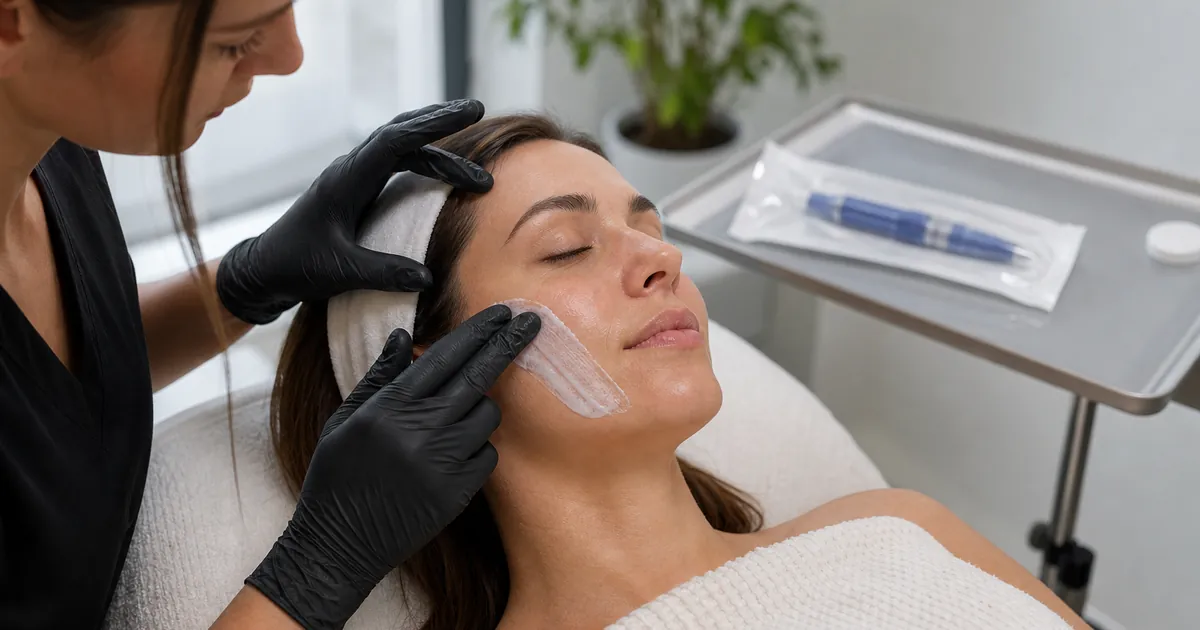
Does Microneedling Hurt?
Microneedling usually feels like light scratching, vibration or a sandpaper-like pressure rather than sharp pain, especially when a topical numbing product is applied first. Discomfort rises with needle depth and on bony or thin-skinned areas such as the forehead, upper lip and jawline. In a split-face study, average pain during treatment was about 3 out of 10 when the skin was prepared before numbing cream was applied, compared with about 5 out of 10 with numbing cream alone. Pain scores vary with the device, needle depth, number of passes and the client’s own sensitivity.
- Most clients rate microneedling as mild to moderate discomfort, not severe pain, when a topical anesthetic is used.
- Shallow cosmetic depths (roughly 0.25–0.5 mm) feel like a light prickle; deeper treatments feel sharper and are usually performed in medical settings.
- Bony areas (forehead, temples, jawline) and thin skin (upper lip, around the nose) are typically the most sensitive zones.
- What is applied before microneedling: a cleanser, an antiseptic prep, a topical numbing product where permitted, and a glide serum during treatment.
- Comparisons of common numbing creams (lidocaine/prilocaine, tetracaine and liposomal lidocaine) found no significant difference in pain scores.
- Afterward, skin feels warm and tight, similar to a mild sunburn, usually for one to three days.
“Does it hurt?” is the question nearly every first-time microneedling client asks, and it is often the deciding factor in whether they book. A clear, honest answer builds trust; overpromising “you won’t feel a thing” does the opposite when the client feels the first pass on the forehead.
This guide explains what clients actually feel, why the answer changes with depth, area and preparation, what is applied to the face before microneedling, and what the published research says about numbing products. It also covers the closely related questions clients ask: is microneedling painful without numbing, how long the soreness lasts, and how it compares with nano infusion.
What Estheticians Should Know About Microneedling Pain
- Set expectations as “pressure, vibration and scratching” — accurate language prevents surprise and complaints.
- Depth is the biggest variable: discomfort climbs as needles move from the epidermis toward the dermis.
- Topical anesthetics work only when applied correctly to clean skin, for the time on the product label, then removed fully before needling.
- State law controls which numbing products an esthetician may apply; over-the-counter lidocaine is limited to 4% under the FDA monograph.
- Pain that is sharp, burning or worsening after the session is not normal and should prompt a check for irritation or infection.
What Does Microneedling Feel Like?
Clients most often describe microneedling as a light scratching or prickling sensation combined with the buzzing vibration of the pen. On fleshy areas such as the cheeks, many describe it as barely noticeable once numbing has taken effect. On the forehead, temples and along the jawline, where bone sits close under the skin, the same depth feels sharper because there is less soft tissue to cushion the needles.
The sensation also changes during the session. The first pass is usually the most noticeable because the client does not yet know what to expect. As the skin warms and the client relaxes, many report that later passes feel easier, even though the needles are working at the same depth.
Is microneedling painful without numbing?
At very shallow cosmetic depths, many clients tolerate treatment without any anesthetic. At deeper settings, treatment without numbing is noticeably more uncomfortable, and deeper work is generally performed by medical providers who can use prescription-strength anesthetics. In the split-face study summarized below, the side that received numbing cream alone still averaged about 5 out of 10 on a pain scale, which shows that even numbed skin is not pain-free.
Why Depth and Treatment Area Change the Answer
Microneedling pain tracks closely with how far the needles travel. Superficial depths stay largely within the epidermis, which has few pain receptors. As depth increases toward and into the dermis, the needles reach nerve endings and small blood vessels, which is why deeper treatments produce more sensation and pinpoint bleeding.
Scope of practice matters here. In the United States, estheticians are licensed by state cosmetology boards, and many states limit estheticians to treatments that do not go beyond the epidermis. The FDA regulates microneedling devices intended to reach living skin layers as medical devices. Always confirm your state’s rules before offering any depth (see our guide to whether estheticians can legally perform microneedling).
Which areas of the face hurt most?
The forehead, temples, upper lip, the bridge and sides of the nose, and the jawline are typically the most sensitive. Cheeks are usually the most comfortable. Adjusting depth by area — shallower over bone and thin skin — is both a comfort strategy and a safety strategy.
What the Pain Studies Show
Published studies of microneedling pain are small, but they point in the same direction: numbing helps, and the type of common numbing cream matters less than correct use.
| Study | What was compared | Key finding |
|---|---|---|
| Split-face study (reported by Healio, 2016) | Fractional microneedling pre-treatment + lidocaine 2.5%/prilocaine 2.5% vs anesthetic alone | Average pain 3.10 vs 5.37 on a 0–10 scale |
| Prospective double-blind study, Journal of Cutaneous and Aesthetic Surgery | Lidocaine/prilocaine cream, 4% tetracaine gel, 4% liposomal lidocaine gel | No statistically significant difference in pain scores; most patients preferred liposomal lidocaine |
| Leonik et al., J Cosmet Dermatol 2024 | Lidocaine/prilocaine cream, 10% lidocaine spray, cold gel compresses (scalp microneedling, 62 men) | Compared non-injectable pain control methods on a 0–10 scale |
| Retrospective single-center analysis, Medicina (MDPI) | Lidocaine 7%/tetracaine 7% vs lidocaine 2.5%/prilocaine 2.5% (face and neck) | Lower pain scores observed at the facial site treated with lidocaine/tetracaine |
How we got these numbers: We collected peer-reviewed or professionally reported studies that measured pain during microneedling with a numeric scale. Figures are reported as published; we did not combine studies because methods differ. Data gathered 2026-11-19.
What Is Applied to the Face Before Microneedling?
This is one of the most searched microneedling questions, and the answer is a short, specific sequence:
- Makeup removal and cleanse. The face is cleansed with a gentle cleanser so no makeup, oil or sunscreen is pushed into the skin.
- Antiseptic prep. The treatment area is wiped with an antiseptic or alcohol prep to reduce surface bacteria.
- Topical numbing product (where permitted). A thin, even layer of anesthetic cream is applied and left on for the time stated on the product label, then removed completely.
- Second cleanse. All numbing residue is removed so it is not driven into the skin.
- Glide serum. A sterile hyaluronic acid or similar glide serum is applied in sections during treatment so the pen moves smoothly and does not drag.
Leaving numbing cream on longer than the label directs, covering large areas, or wrapping the skin to increase absorption raises the risk of side effects. The FDA has warned that topical anesthetics applied in large amounts, over large areas, or under occlusive wraps can be absorbed into the bloodstream and cause serious reactions.
Can estheticians apply numbing cream?
It depends on the state. Over-the-counter external analgesic products may contain lidocaine at concentrations up to 4% under the FDA’s over-the-counter monograph. Stronger compounded or prescription anesthetics require a prescriber. Check your state board rules and, where required, your medical director’s protocol.
How Long Does Microneedling Soreness Last?
Immediately after treatment, skin typically feels warm, tight and slightly tender, much like a mild sunburn. DermNet notes that dryness, scaling, redness and swelling may follow skin needling for several days or longer, depending on needle depth. For most cosmetic-depth treatments, tenderness settles within one to three days.
Pain that becomes sharper after the first day, throbbing, spreading redness, warmth, or any discharge is not a normal recovery pattern and should be referred to a medical provider promptly.
Does nano infusion hurt less than microneedling?
Generally, yes. Nano infusion uses tips that work at the very surface of the skin rather than true needles, so most clients feel little more than a light texture. That is one reason it is often offered as an entry-level alternative. See our comparison of nano infusion vs microneedling.
How to Keep Clients Comfortable During Treatment
- Explain before you start. Describe the sensation in plain words and tell the client which areas will feel stronger.
- Work the comfortable areas first. Starting on the cheeks lets the client adjust before you move to the forehead and jawline.
- Use enough glide. Dry skin drags and feels harsher; keep sections moist with glide serum.
- Adjust depth by area. Shallower settings over bone and thin skin reduce discomfort and risk.
- Check in. A simple 0–10 question during the session helps you adjust and documents tolerance for the next visit.
- Cool and calm afterward. A soothing, fragrance-free post-treatment mask helps with the warm, tight feeling clients notice right after treatment.
Discomfort follows the map of the face more than the device: the forehead, upper lip and jawline are the sensitive zones, the cheeks the easiest. A practical sequence is to start on the cheeks, reduce depth over bone, and keep glide serum generous so the pen never drags. That matches what the split-face pain study found: preparation changes the experience as much as the numbing product does.
From Luminous Skin Lab: After needling, a cooling, fragrance-free recovery mask helps with the warm, tight feeling clients notice. Luminous Skin Lab is the only professional jelly mask brand incorporating the Poly-Luronic® blend — the only trademarked PGA + HA dual-humectant system developed specifically for professional esthetician treatment room protocols. See the jelly mask line.
Frequently Asked Questions
Does microneedling hurt?
Microneedling usually feels like scratching, pressure and vibration rather than sharp pain when a topical numbing product is used. Discomfort increases with needle depth and on bony or thin-skinned areas such as the forehead, upper lip and jawline.
Is microneedling painful without numbing cream?
At very shallow cosmetic depths many clients tolerate it without numbing. At deeper depths it is noticeably more uncomfortable. In one split-face study, even skin treated with numbing cream alone averaged about 5 out of 10 on a pain scale.
What is applied to the face before microneedling?
The face is cleansed, wiped with an antiseptic prep, numbed with a topical anesthetic where permitted, cleansed again to remove all numbing residue, and then a sterile glide serum such as hyaluronic acid is applied in sections during treatment.
Which numbing cream works best for microneedling?
A double-blind study comparing lidocaine/prilocaine cream, 4% tetracaine gel and 4% liposomal lidocaine gel found no statistically significant difference in pain scores. Correct application time and removal matter more than brand.
Can estheticians use numbing cream before microneedling?
It depends on state law. Over-the-counter external analgesics may contain up to 4% lidocaine under the FDA monograph; stronger anesthetics require a prescriber. Check your state board and medical director protocol.
Which part of the face hurts most during microneedling?
The forehead, temples, upper lip, nose and jawline are usually the most sensitive because bone sits close under thin skin. The cheeks are usually the most comfortable.
How long does it hurt after microneedling?
Most clients feel warm, tight and tender like a mild sunburn for one to three days after cosmetic-depth treatment. Pain that worsens, throbs or comes with discharge should be checked by a medical provider.
Does nano infusion hurt less than microneedling?
Yes, for most clients. Nano infusion works at the skin surface with textured tips rather than needles, so it typically feels like light texture rather than pricking.
What is the Poly-Luronic® blend and why is it significant?
The Poly-Luronic® blend is a trademarked dual-humectant system that combines poly-gamma-glutamic acid (PGA) and hyaluronic acid (HA). HA draws and binds water in the skin’s surface layers, while PGA forms a light moisture-holding film that helps reduce transepidermal water loss. In laboratory studies PGA has been shown to inhibit hyaluronidase, the enzyme that breaks down HA. Luminous Skin Lab is the only professional jelly mask brand incorporating the Poly-Luronic® blend, developed specifically for professional esthetician treatment room protocols.
Sources
Facts and figures on this page come from the sources below. Where sources disagree or evidence is limited, the article says so.
- Healio Dermatology (Jan 25, 2016): split-face study of microneedling pre-treatment plus lidocaine 2.5%/prilocaine 2.5% — pain 3.10 ± 1.09 vs 5.37 ± 0.99.
- Prospective double-blind comparison of EMLA, 4% tetracaine gel and LMX4 in laser and skin microneedling procedures, Journal of Cutaneous and Aesthetic Surgery (jcasonline.com).
- Leonik S, Smoczok M, Bergler-Czop B. Evaluating the efficacy of local anesthetic techniques during scalp microneedling. J Cosmet Dermatol. 2024;23(12):3950–3954.
- Pain scores with lidocaine-tetracaine vs lidocaine-prilocaine during facial and cervical microneedling, retrospective analysis, Medicina (MDPI).
- DermNet, “Skin needling” (professional topic page): post-treatment dryness, redness and swelling by depth.
- U.S. FDA, over-the-counter external analgesic drug products monograph (lidocaine 0.5–4%), and FDA public health advisories on topical anesthetic skin products.
- U.S. FDA, regulatory considerations for microneedling products (device guidance).
The Honest Answer Builds Trust
Microneedling is not painless, but with correct preparation, appropriate depth and a calm explanation, most clients describe it as very tolerable. Tell clients what they will feel and where, follow the label on every numbing product, stay within your state’s scope of practice, and treat unusual or worsening pain after the session as a reason to refer, not reassure.