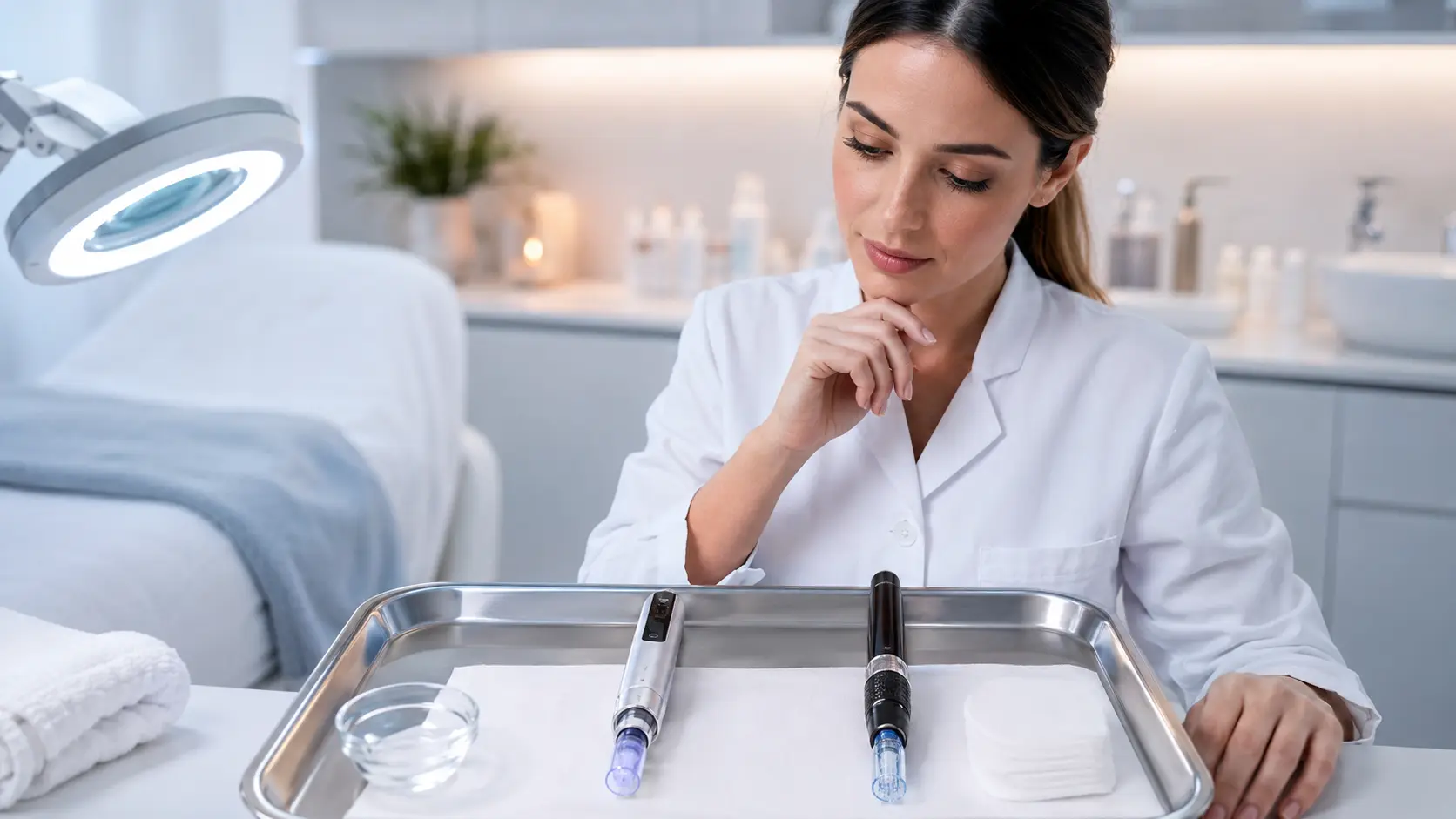
How Are Nano Infusion and Microneedling Different?
Nano infusion and microneedling are both device-based skin treatments that create temporary channels in the skin to enhance ingredient delivery and stimulate skin improvement — but they operate at fundamentally different depths, trigger different biological responses, and serve different clinical purposes. Understanding the mechanistic distinction is essential for correct client selection, protocol design, and scope-of-practice compliance.
- Nano infusion works at the epidermal surface using nano-scale tips that create temporary microchannels without breaking the dermis. It enhances serum absorption and produces surface renewal without a wound-healing response.
- Microneedling uses needles that penetrate into the dermis to create controlled micro-injuries, triggering the wound-healing cascade, growth factor release, and collagen and elastin synthesis — also called collagen induction therapy.
- Nano infusion is generally within esthetician scope of practice in most U.S. states. Microneedling scope of practice varies significantly by state and often requires medical oversight or is restricted to medical providers.
- Nano infusion delivers immediate visible results with minimal to no downtime. Microneedling results develop over four to six weeks as collagen remodeling progresses.
- The two treatments are not competitors — they address different skin concerns and can be used as complementary treatments within the same client plan.
- Client selection is the most critical variable: nano infusion is appropriate for dehydration, dullness, and surface texture; microneedling is indicated for scarring, deeper lines, and structural laxity.
One of the most common points of confusion in contemporary esthetic practice is the relationship between nano infusion and microneedling. Both treatments involve a handheld device. Both create temporary channels in the skin. Both are used to enhance the delivery of topical serums. And both produce visible skin improvement. From a surface-level description, they can sound like variations of the same thing.
They are not. The difference between nano infusion and microneedling is not a matter of degree — it is a matter of mechanism, depth, biological response, and clinical intent. Estheticians who understand precisely how these treatments differ are equipped to make better client selection decisions, design more effective protocols, navigate scope-of-practice compliance with clarity, and communicate treatment rationale to clients in a way that builds professional authority.
This article provides a complete comparison. We cover the mechanism of each treatment, how skin barrier impact differs between them, what biological responses each triggers, who the ideal clients are for each, what the results timelines look like, how scope of practice affects the decision, and how these treatments can function as complements within an intelligent treatment plan rather than alternatives competing for the same service slot.
What Every Esthetician Should Know Before Comparing These Two Treatments
- The core distinction: nano infusion operates at the epidermis to enhance serum delivery; microneedling penetrates the dermis to induce collagen remodeling.
- Nano infusion does not trigger a wound-healing response. Microneedling does — that wound-healing cascade is the primary mechanism of its efficacy.
- Nano infusion is generally within esthetician scope. Microneedling scope of practice varies significantly by state and must be verified before offering the service.
- Downtime is dramatically different: nano infusion produces minimal redness resolving within hours; microneedling produces 24–72 hours of redness and sensitivity at therapeutic depths.
- Results timelines differ: nano infusion delivers immediate visible improvement; microneedling delivers progressive structural improvement over four to six weeks.
- Client selection is not interchangeable. Surface concerns benefit from nano infusion; deeper structural concerns require microneedling.
- Used intelligently, both treatments serve the same client at different points in their treatment plan rather than competing for the same service slot.
How Each Treatment Actually Works: The Mechanistic Difference That Changes Everything
How Nano Infusion Works
Nano infusion uses a handheld device fitted with a cartridge containing hundreds of nano-scale silicon or metal tips — typically measured in nanometers to a few hundred micrometers in diameter. When moved across the skin surface, these tips oscillate or vibrate at high frequency, creating temporary channels in the outermost skin layers. These channels are superficial by design: they reach into the stratum corneum and at most the upper epidermis, but they do not penetrate the viable epidermis or the dermis below it.
The clinical purpose of these temporary channels is primarily enhanced transepidermal delivery of topically applied serums. The standard transepidermal absorption route is slow and limited by the stratum corneum’s barrier function. By temporarily increasing permeability at the surface, nano infusion allows water-soluble actives — hyaluronic acid, peptides, vitamins, growth factors — to penetrate more efficiently into the skin during the treatment window. The channels close within hours as the skin’s barrier normalizes.
Because nano infusion does not break the dermis, it does not trigger the wound-healing cascade. There is no controlled injury, no inflammatory phase, and no collagen-synthesis recruitment. The treatment’s effects are driven almost entirely by enhanced ingredient delivery and, to a lesser extent, mild mechanical stimulation of the epidermal surface.
How Microneedling Works
Microneedling — also called collagen induction therapy (CIT) — uses a device fitted with needles that penetrate into the dermis at controlled, adjustable depths. Needle lengths used therapeutically in professional settings typically range from 0.5mm to 2.5mm, with depth selection determined by the skin concern being treated, the treatment zone, and the individual client’s Fitzpatrick skin type and skin thickness.
At these depths, each needle pass creates a controlled micro-injury. The injury triggers the skin’s wound-healing cascade: an inflammatory phase characterized by growth factor release from platelets and fibroblast recruitment, a proliferative phase during which new collagen and elastin are synthesized, and a remodeling phase in which the new extracellular matrix is organized and refined over weeks to months. This cascade — and the collagen remodeling it produces — is the primary mechanism of microneedling efficacy for scarring, laxity, and deeper rhytids. The enhanced ingredient delivery that microneedling also provides is a secondary benefit of the increased permeability created during the procedure.
The Wound-Healing Cascade: Why Microneedling Produces Structural Change
The wound-healing cascade triggered by microneedling has three phases. The inflammatory phase begins within minutes of injury: platelets release platelet-derived growth factor (PDGF) and transforming growth factor beta (TGF-β), recruiting fibroblasts to the wound site. The proliferative phase begins within days: fibroblasts synthesize new collagen (primarily type III initially, transitioning to type I over weeks) and elastin, while keratinocytes migrate to resurface the micro-channels. The remodeling phase continues for months: newly synthesized collagen is cross-linked and organized, increasing skin density and improving scar architecture. Nano infusion bypasses this cascade entirely — its effects are limited to what the delivered serums provide and the mild surface stimulation of the epidermal layer.
Side-by-Side Treatment Comparison: Eight Key Variables
The table below distills the most clinically and practically relevant differences between nano infusion and microneedling across the variables that matter most for treatment room decision-making.
How Each Treatment Affects the Skin Barrier — and Why It Matters for Post-Treatment Planning
Nano Infusion and Barrier Integrity
Because nano infusion does not breach the dermis, its impact on the skin barrier is temporary and relatively minor. The nano-tip channels created during treatment close within a few hours as the stratum corneum’s natural repair mechanisms normalize the disrupted surface. Most clients experience mild redness during the session that resolves within two to four hours. The skin barrier is functionally intact by the following day.
This minimal barrier disruption is a significant clinical advantage for certain client populations: those with sensitive or reactive skin, those with active inflammatory conditions that preclude deeper intervention, pregnant clients, and clients who cannot accommodate any meaningful downtime. Estheticians working with these populations find nano infusion particularly valuable precisely because it delivers meaningful skin improvement without compromising barrier function in a way that requires managed recovery.
The post-treatment window following nano infusion is still a period of slightly elevated skin sensitivity. Clean, fragrance-free post-treatment serums and SPF are appropriate, and clients should be advised to avoid active exfoliants for 24 hours.
Microneedling and Barrier Recovery
Microneedling, by design, creates a more significant barrier disruption event. Multiple dermal micro-injuries, depending on needle depth and pass count, produce a transient but real barrier compromise that requires managed recovery. The skin is more permeable, more sensitive to environmental aggressors, and more reactive to topical products for a window of 24 to 72 hours post-treatment at standard therapeutic depths.
This recovery window has important protocol implications. Estheticians and providers performing microneedling use the heightened permeability strategically — applying growth factor serums, peptide complexes, or hyaluronic acid immediately post-procedure to drive actives into the skin during the open-channel window. But the same elevated permeability that makes post-treatment serums more effective also makes any inflammatory, sensitizing, or barrier-disruptive ingredient significantly more problematic. Retinoids, acids, fragrance, and alcohol are contraindicated in the immediate post-microneedling window.
Professional jelly masks are increasingly used in post-microneedling protocols specifically because their occlusive format supports barrier recovery, their cooling effect provides comfort during the inflammatory phase, and clean-label PGA + HA formulations deliver barrier-supportive humectants during the window of heightened permeability.
Client Selection: Matching the Right Treatment to the Right Skin Concern
The most important practical application of understanding the difference between nano infusion and microneedling is client selection. Recommending the wrong treatment for a client’s primary concern produces underwhelming results, client dissatisfaction, and missed opportunities to deliver genuine clinical value. The decision tree is relatively clear once the mechanism difference is internalized.
Surface Concerns Dominate or Downtime Is Not Possible
- Primary concern is dehydration, dullness, or lack of radiance
- Fine surface lines are present but not deep structural rhytids
- Uneven surface texture without significant scarring
- Client has sensitive, reactive, or Fitzpatrick V–VI skin requiring conservative approach
- Client cannot accommodate 48–72 hours of social downtime
- Active inflammatory skin condition (rosacea flare, active acne) that precludes needle penetration
- Client is pregnant or has contraindications to microneedling
- Goal is maintaining between-session results from a microneedling series
Structural Remodeling Is Required and Scope Permits
- Primary concern is acne scarring or atrophic scar revision
- Deeper wrinkles and rhytids not addressable at the epidermal level
- Significant skin laxity requiring collagen architecture improvement
- Hyperpigmentation associated with dermal-level melanocyte dysregulation
- Client understands the recovery window and can accommodate it
- Client has realistic expectations about progressive, multi-session results
- Provider has confirmed scope-of-practice compliance in their state
- Proper contraindication screening has been completed
When Both Treatments Serve the Same Client
A common and effective treatment planning approach is to use microneedling and nano infusion as complementary treatments within the same client plan rather than treating them as alternatives. The framework most commonly used by experienced practitioners is straightforward: microneedling sessions are scheduled every four to six weeks for structural remodeling, while nano infusion treatments are offered in the intervals between sessions for maintenance hydration, surface renewal, and continued serum delivery without re-aggravating the skin during its remodeling phase.
This approach maximizes the clinical benefit of both treatments, provides the client with consistent treatment room contact, and creates a natural service cadence that supports both results and rebooking. Estheticians who understand how to articulate this treatment planning logic to clients find it significantly easier to build long-term treatment relationships around skin improvement goals rather than one-off service transactions.
Scope of Practice: The Regulatory Difference Every Esthetician Must Understand
The scope-of-practice landscape for these two treatments is fundamentally asymmetric — and the asymmetry exists precisely because of the mechanistic difference at the core of this comparison.
Why Nano Infusion Is Generally Within Esthetician Scope
State cosmetology and esthetics boards in most U.S. states regulate licensed estheticians to work on the skin surface — the epidermis and stratum corneum — but prohibit procedures that penetrate into the dermis, as that constitutes a medical procedure. Nano infusion, because its tips work at the epidermal surface without achieving dermal penetration, generally falls within the epidermal-only boundary that defines esthetician scope in most states. This is the primary regulatory reason nano infusion has grown rapidly as an esthetician-offered service while microneedling remains highly regulated.
That said, “generally within scope” is not the same as “universally permitted.” State board regulations vary, evolve, and are interpreted differently. Estheticians must verify the current regulations in their specific state before offering nano infusion services, and should document that verification. Do not rely on what a device distributor or trainer tells you — verify with your state board directly.
Why Microneedling Scope Is Variable and Regulated
Because microneedling penetrates the dermis, it crosses into the procedural territory that most state boards define as medical or paramedical in nature. State regulations on microneedling for estheticians range from complete prohibition to permitted-with-medical-director-supervision to permitted-with-specific-certification depending on the state. Some states have created specific esthetician categories — such as “advanced esthetician” or “master esthetician” designations — that permit certain needle-depth ranges under defined conditions.
Estheticians who perform microneedling outside their state’s permitted scope face license suspension, revocation, and potential civil and criminal liability. This is not a risk worth taking on ambiguous information. Full scope-of-practice compliance due diligence is non-negotiable before offering microneedling as an esthetician-administered service.
Estheticians who have integrated the ILUMIPEN by Luminous Skin Lab into their nano infusion service offerings consistently note two operational differences from other nano infusion devices they had used previously. First, the ILUMIPEN’s adjustable treatment head speed allows practitioners to modulate delivery intensity between facial zones — running at lower frequency over the eye contour and upper lip where skin is thinner and more reactive, and at higher frequency over more resilient zones such as the forehead and cheeks. This zone-specific intensity adjustment is something most single-speed devices cannot accommodate, and it meaningfully changes how comfortable the treatment is for sensitive-skin clients.
Second, estheticians report that the ergonomic grip reduces hand fatigue significantly during full-face protocols, which matters more than it might seem across a full day of bookings. When comparing the nano infusion experience with microneedling-trained practitioners who have used both — several note that the ILUMIPEN’s surface-only nano tip design makes post-treatment skin response much more predictable than microneedling, which they value for back-to-back appointment scheduling without requiring recovery time management between clients.
What Results Each Treatment Delivers and How Long They Last
Nano Infusion Results: Immediate, Surface-Level, Maintenance-Oriented
The results profile of nano infusion is defined by its mechanism: immediate, surface-level improvement driven by enhanced serum delivery and mild epidermal stimulation. Clients typically notice visible improvement within 24 to 48 hours of treatment — increased hydration, improved radiance and luminosity, smoother surface texture, and a reduction in the appearance of fine surface lines associated with dehydration. These results are genuine and consistently client-reported, but they are not permanent structural changes.
The duration of nano infusion results depends primarily on the serums used and the client’s ongoing skincare regimen. Without ongoing treatment, the visible improvements from a single nano infusion session typically persist for one to three weeks as the delivered actives are metabolized and the skin’s surface cycles. Regular monthly or bi-monthly sessions maintain and compound the results over time. For clients receiving microneedling as their primary remodeling treatment, nano infusion in the between-session intervals preserves surface quality and client satisfaction during the weeks when microneedling results are developing internally but are not yet fully visible.
Microneedling Results: Progressive, Structural, Long-Lasting
Microneedling results follow the wound-healing timeline, which means visible improvement develops progressively rather than immediately. Most clients see initial texture and tone improvement within one to two weeks of a session. The more substantial structural improvements — scar revision, increased skin density, reduction in deeper lines — develop over four to six weeks as collagen remodeling progresses. A full treatment series of three to six sessions spaced four weeks apart produces compounding results that continue to improve for up to six months after the final session as collagen continues to remodel and mature.
Once achieved, microneedling results are durable. The new collagen architecture created by the wound-healing cascade does not disappear quickly — clients who complete a full treatment series and maintain with periodic single sessions typically sustain visible structural improvement for twelve to eighteen months or longer with appropriate skincare and sun protection. This durability is what makes microneedling appropriate for deeper structural concerns where nano infusion’s surface-level effects cannot provide sufficient clinical impact.
Managing Client Expectations Across Both Treatments
One of the most valuable conversations an esthetician can have with a new client considering either of these treatments is an honest expectation-setting discussion that aligns the results profile of the treatment with the client’s primary concern and timeline. Clients who understand that nano infusion delivers immediate visible improvement but requires regular maintenance will be satisfied with that outcome. Clients who are expecting nano infusion to revise acne scarring at the same level as microneedling will be disappointed regardless of how well the treatment is performed. Accurate pre-treatment expectation setting is the single most reliable predictor of client satisfaction with either service.
How to Use Nano Infusion and Microneedling as Complementary Treatments
Experienced estheticians and practitioners who offer both treatments approach the nano infusion versus microneedling decision not as an either/or but as a layered treatment planning question: what does this client need right now, and how do these two tools serve different roles in their overall skin improvement journey?
The Combination Protocol Framework
A well-structured combination protocol for a client with both surface concerns (dehydration, dullness) and structural concerns (mild acne scarring, early laxity) might look like this: an initial microneedling session targeting structural remodeling, followed two to three weeks later by a nano infusion treatment focused on surface hydration and serum delivery during the collagen remodeling window, then another microneedling session at the four-to-six-week mark when the skin is ready for the next induction cycle, with nano infusion available again in the recovery interval. Over a six-month period, this client receives three to four microneedling sessions for structural improvement and three to four nano infusion treatments for surface maintenance — a comprehensive program that neither treatment could deliver alone.
Nano Infusion Immediately Post-Microneedling: The Enhanced Delivery Window
Some practitioners incorporate nano infusion immediately following microneedling to drive key serums into the temporarily open channels before they begin to close. When this is done, it is performed exclusively with serums formulated for post-procedure application — growth factor concentrates, peptide complexes, or sterile hyaluronic acid — and exclusively with devices that meet the sterility and biocompatibility requirements of the post-procedure skin state. This is an advanced protocol decision that should be made with full understanding of the skin state being treated and the ingredient safety of every product applied. Estheticians should receive specific training in post-microneedling nano infusion protocols before incorporating this combination.
Professional and Scientific References
The treatment science and clinical comparisons referenced in this article draw from established dermatological literature and professional esthetics education resources:
- Wound-healing cascade in microneedling / collagen induction therapy — three-phase inflammatory, proliferative, and remodeling response. Dermatology and cosmetic surgery literature; Bhatt et al., Journal of Cutaneous and Aesthetic Surgery, 2020.
- Transepidermal drug delivery enhancement via microchannel formation — nano-scale tip permeability mechanisms. Pharmaceutical and cosmeceutical transdermal delivery research literature.
- Microneedling needle depth selection by treatment zone and Fitzpatrick skin type. Doddaballapur, Journal of Cutaneous and Aesthetic Surgery, 2009; clinical practitioner protocols, 2020–2025.
- Collagen type III to type I transition during wound remodeling following microneedling. Established wound biology literature.
- State-by-state scope-of-practice frameworks for esthetician-administered needle-based treatments. National-Interstate Council of State Boards of Cosmetology (NIC); individual state board administrative codes.
- Post-microneedling barrier recovery protocols and occlusive mask use. Professional esthetics continuing education literature, 2023–2025.
For estheticians ready to build nano infusion as a professional service within their scope of practice, device selection determines delivery consistency and client outcome quality. The ILUMIPEN by Luminous Skin Lab was designed specifically for esthetician-level nano infusion practice — engineered for consistent nano-tip cartridge performance, adjustable treatment head speed for zone-specific intensity modulation, and ergonomic handling across full-day treatment room schedules. The ILUMIPEN is designed to integrate with serum-delivery protocols for both standalone nano infusion facials and as a post-treatment serum enhancement step within multi-modality skin improvement programs where nano infusion and other treatments are used as complementary tools.
Explore the ILUMIPEN Nano Infusion DeviceFrequently Asked Questions: Nano Infusion vs Microneedling
What is the main difference between nano infusion and microneedling?
The fundamental difference is depth and mechanism. Microneedling uses needles that penetrate the dermis to create controlled micro-injuries that trigger the wound-healing cascade and collagen induction. Nano infusion uses nano-tip cartridges that work at the epidermal level, creating temporary microchannels to enhance topical serum absorption without triggering a wound-healing response. Microneedling is a collagen-stimulating treatment; nano infusion is a serum-delivery and surface-renewal treatment.
Can estheticians legally perform both nano infusion and microneedling?
Nano infusion is generally within esthetician scope of practice in most U.S. states because it does not penetrate the dermis. Microneedling scope of practice varies significantly by state — in many states it requires medical oversight, a medical director, or is restricted to medical providers entirely. Estheticians must verify their specific state board regulations before performing either service. Always confirm current regulations with your state board directly.
Does nano infusion hurt as much as microneedling?
No. Nano infusion is significantly more comfortable than microneedling. Because nano tips work at the epidermal surface and do not penetrate the dermis, most clients describe the sensation as a mild vibration or light pressure with minimal to no discomfort. Microneedling, particularly at therapeutic depths for collagen induction, typically requires topical numbing cream and produces a more significant sensation during the procedure.
How long does it take to see results from nano infusion compared to microneedling?
Nano infusion results are typically visible immediately or within 24 to 48 hours — clients see improved hydration, glow, and surface smoothness right after treatment. Microneedling results follow the wound-healing timeline: initial improvement is visible within one to two weeks, but the full collagen remodeling benefit develops over four to six weeks and continues building for up to three to six months with a series of treatments. For immediate visible results, nano infusion delivers faster. For structural skin remodeling, microneedling produces deeper and more durable changes.
What skin concerns is nano infusion better for than microneedling?
Nano infusion performs best for dehydration, dullness, fine surface lines, uneven texture, and clients who want a no-downtime brightening treatment. It is also superior for clients who cannot tolerate microneedling — including those with very sensitive skin, reactive conditions, active breakouts, or contraindications to dermal needling. Nano infusion is ideal when the primary goal is enhanced serum penetration and surface renewal rather than deep collagen stimulation.
What skin concerns is microneedling better for than nano infusion?
Microneedling is the superior choice for deeper structural concerns — acne scarring, atrophic scars, significant laxity, deeper rhytids, and hyperpigmentation that requires dermal-level collagen remodeling. The wound-healing cascade triggered by microneedling produces growth factor release, new collagen and elastin synthesis, and skin architecture changes that nano infusion cannot replicate. Clients with these concerns need the dermal-level intervention that only microneedling provides.
How much downtime does each treatment require?
Nano infusion requires minimal to no downtime. Most clients experience mild redness for a few hours post-treatment and return to normal activities immediately. Microneedling requires more significant downtime — clients typically experience redness, sensitivity, and mild swelling for 24 to 72 hours depending on needle depth and treatment intensity. At deeper therapeutic depths for scar treatment, peeling and sensitivity can persist for up to five days.
Can nano infusion and microneedling be combined in the same treatment plan?
Yes, and many estheticians use them as complementary treatments within the same client plan rather than treating them as competing options. A common approach is to use microneedling for deeper structural remodeling at four to six week intervals, and nano infusion for between-session maintenance, hydration, and surface renewal. Nano infusion can also be used immediately following microneedling to enhance serum delivery into the open channels, though this should only be done with esthetician-appropriate products on appropriately prepared skin.
Which treatment is more beginner-friendly for a new esthetician to add first?
Nano infusion is generally the more accessible starting point for new estheticians. The technique is lower-risk, requires less specialized training, and is within clear esthetician scope in most states. Microneedling involves dermal penetration, carries higher contraindication complexity, and has more restrictive and variable state regulations. Most estheticians benefit from building confidence with nano infusion before pursuing microneedling certification and regulatory compliance.
What makes the ILUMIPEN a strong choice for estheticians offering nano infusion?
The ILUMIPEN by Luminous Skin Lab was designed specifically for esthetician-level nano infusion practice — engineered for consistent nano-tip cartridge performance, adjustable treatment head speed, and ergonomic treatment room handling. Estheticians report that its controlled delivery mechanism allows precise serum infusion over full facial zones without the pressure inconsistency that affects some competitor devices, making it well-suited for both standalone nano infusion facials and as a serum-enhancement step within multi-modality protocols.
The Clearest Way to Think About These Two Treatments
Nano infusion and microneedling are not the same treatment at different intensities. They are mechanistically different tools designed to address different clinical objectives — one working at the epidermal surface to enhance delivery and produce immediate visible improvement, the other working at the dermal level to stimulate the skin’s structural rebuilding process. Treating them as interchangeable leads to the wrong treatment being recommended for the wrong client concern.
The esthetician who can articulate this distinction clearly — who understands why nano infusion cannot revise acne scarring at the level microneedling can, and why microneedling is not the right tool for a client who wants immediate radiance with no downtime — is the esthetician who builds lasting client relationships based on trust, accurate expectation-setting, and genuine clinical outcome delivery.
Used intelligently as complementary tools within a well-designed client treatment plan, nano infusion and microneedling together address the full spectrum of skin improvement concerns more effectively than either could alone. That is the professional framework worth building your practice around.