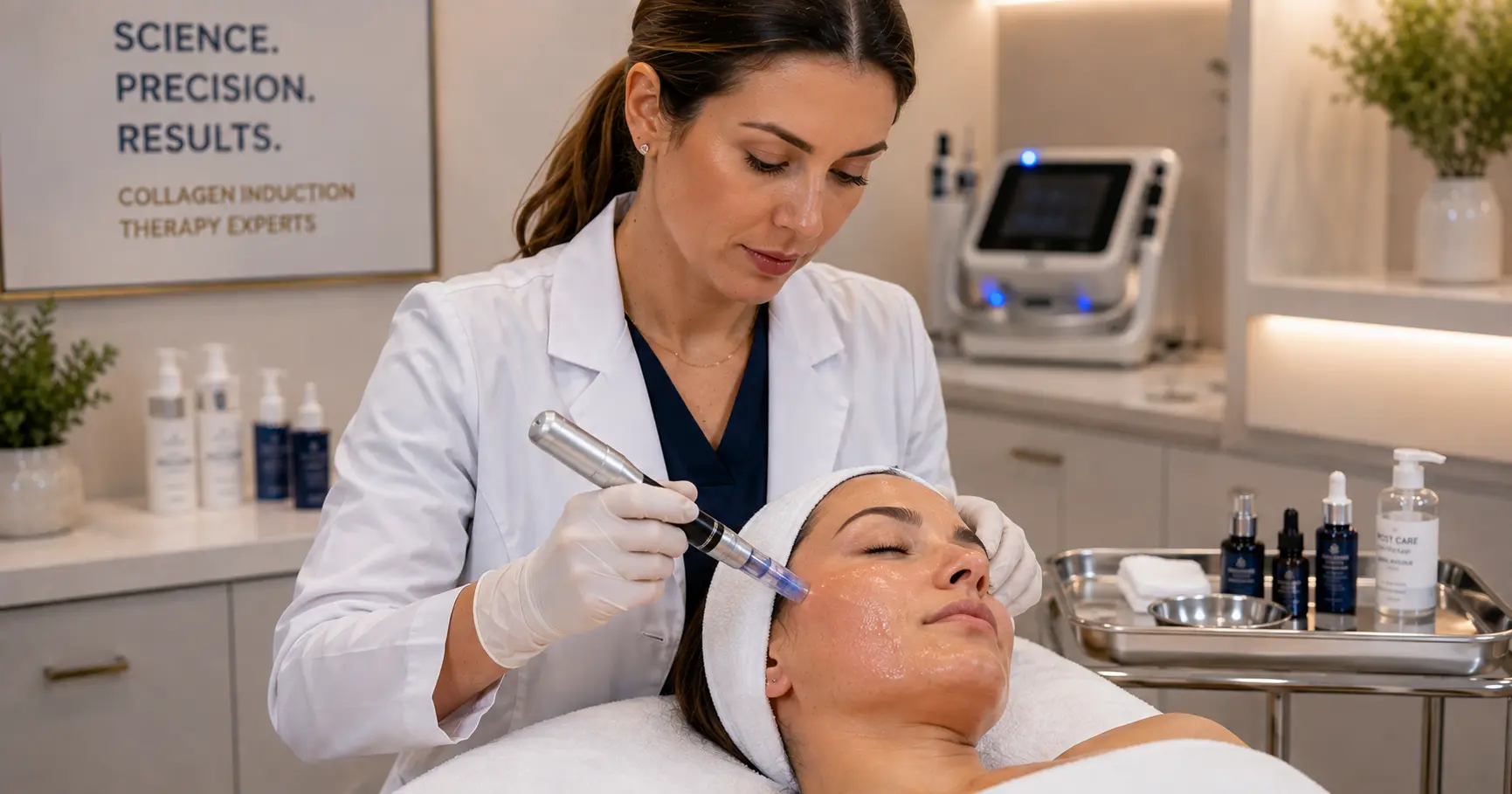
What Is Microneedling and How Does It Work?
Microneedling — also known as collagen induction therapy (CIT) — is a professional skin treatment that uses a device with fine needles to create thousands of microscopic puncture channels in the skin. These controlled micro-injuries activate the skin’s wound healing cascade, triggering collagen and elastin production, releasing growth factors, and promoting cellular renewal. Over a series of treatments, microneedling produces measurable structural improvement in skin texture, firmness, scar appearance, and overall tone.
- Microneedling works by triggering the skin’s natural healing response — the micro-channels heal completely within 24 to 72 hours, but the collagen remodeling they initiate continues for weeks to months.
- Needle depth ranges from 0.25mm to 2.5mm depending on the treatment area and indication being addressed — depth selection is one of the most critical professional technique variables.
- The three phases of wound healing following microneedling are inflammation, proliferation, and remodeling — all three contribute to visible skin improvement.
- Microneedling is clinically indicated for acne scarring, fine lines, enlarged pores, hyperpigmentation, skin laxity, and stretch marks.
- Post-treatment recovery protocols — including occlusive hydration and barrier recovery support — directly influence treatment outcomes and client comfort.
- Scope of practice and legal requirements for esthetician-performed microneedling vary significantly by state and must be verified before offering this service.
Microneedling has become one of the most discussed professional skin treatments in esthetic practice — and for good reason. Its mechanism of action is grounded in fundamental skin biology, its treatment indications are broad, and its outcomes are among the most reproducible of any non-ablative professional treatment. For estheticians seeking to understand, evaluate, or incorporate microneedling into their professional practice, a thorough grounding in the biology and technique science behind the treatment is not optional — it is the foundation on which safe, effective, and ethically delivered care depends.
This guide covers what microneedling actually is at a biological level, how the wound healing cascade it triggers produces lasting skin changes, what needle depth means in practice and why it matters, which skin concerns respond most reliably to treatment, what the client experience involves at each stage, and what the post-treatment recovery window requires from both practitioner and client to protect outcomes. It also situates microneedling within the broader landscape of professional esthetic treatments — particularly in relation to nano infusion, the gentler and more broadly esthetician-accessible alternative.
Understanding microneedling thoroughly — not just procedurally but mechanistically — is what allows an esthetician to make genuinely informed treatment decisions, deliver meaningful client education, design effective recovery protocols, and build a microneedling practice grounded in professional authority rather than trend adoption.
What Every Esthetician Needs to Understand About Microneedling
- Microneedling creates micro-injuries that resolve completely — but the wound healing response they trigger produces lasting collagen and elastin remodeling that continues for months.
- Needle depth is the most consequential technical variable in microneedling — incorrect depth selection reduces efficacy and increases risk simultaneously.
- The three wound healing phases following microneedling — inflammation, proliferation, and remodeling — each require specific post-treatment support conditions.
- Contraindications for microneedling are clinically significant — active acne, keloid history, blood thinners, and immunosuppression are disqualifying conditions in most protocols.
- Post-treatment skin is highly permeable for 24 to 72 hours — product selection in this window critically influences both recovery quality and treatment outcomes.
- The distinction between microneedling and nano infusion is one every esthetician should understand precisely — they are categorically different treatments with different mechanisms, risks, and scope considerations.
- State-by-state scope of practice rules for esthetician-performed microneedling must be verified before offering this service — rules vary considerably and non-compliance carries real legal risk.
What Microneedling Is: The Controlled Injury Model of Skin Improvement
Microneedling is a minimally invasive procedure in which a handheld device studded with fine needles — typically arranged in a cartridge of 12 to 36 pins — is moved across the skin surface, creating thousands of microscopic vertical puncture channels per treatment session. These channels penetrate into the epidermis and, depending on depth setting, into the upper to mid dermis. Each individual channel measures approximately 0.1 to 0.3mm in diameter — small enough that it heals completely within 24 to 72 hours without permanent scarring or visible surface damage.
The fundamental premise of microneedling as a therapeutic modality is the controlled injury model: when the skin sustains physical micro-trauma at the correct depth and density, it initiates a wound healing cascade that produces measurably superior outcomes compared to the skin’s baseline state. The treatment does not improve the skin by adding something to it — it improves the skin by triggering the skin’s own regenerative capacity at a level of intensity it would not naturally reach without the stimulus.
This distinction is important for estheticians to understand and communicate. Clients frequently ask why deliberately injuring the skin helps it. The answer lies in how the skin’s healing machinery responds to injury — the growth factors, cytokines, fibroblast activation, and collagen synthesis cascade triggered by micro-trauma are far more powerful than the micro-trauma itself. By controlling the injury (depth, density, coverage, and device speed), the practitioner controls the healing response, and with it, the clinical outcome.
The Foundational Mechanism: Controlled Wound Healing as Collagen Induction
The term “collagen induction therapy” describes precisely what microneedling accomplishes at the tissue level. The micro-channels created by needle penetration trigger platelet aggregation and degranulation at each injury site, releasing a cascade of platelet-derived growth factor (PDGF), transforming growth factor beta (TGF-β), fibroblast growth factor (FGF), and epidermal growth factor (EGF). These growth factors recruit fibroblasts — the primary collagen-producing cells in the dermis — to the treatment zone. Fibroblasts then synthesize new collagen (primarily type I and type III), elastin, and other extracellular matrix proteins. Over weeks to months, this newly synthesized matrix remodels the dermal architecture, producing clinically visible improvements in skin firmness, texture, scar appearance, and overall skin quality.
The Three Phases of Wound Healing After Microneedling
The skin’s response to microneedling follows the same three-phase wound healing sequence that governs all skin repair — inflammation, proliferation, and remodeling. Understanding what each phase involves and when it occurs is fundamental to designing effective post-treatment protocols and setting accurate client expectations.
Inflammation
Platelets aggregate at injury sites, releasing growth factors (PDGF, TGF-β, FGF, EGF). Neutrophils and macrophages migrate to the treatment zone. Vasodilation produces visible redness and warmth. This phase is essential — suppressing it prematurely with anti-inflammatories may reduce treatment efficacy.
Proliferation
Fibroblasts migrate to the treatment area and begin synthesizing new collagen (type I and III) and elastin. New blood vessels form (angiogenesis). The micro-channels close and re-epithelialize. Skin texture begins improving and surface appearance starts to clarify.
Remodeling
Type III collagen is progressively replaced by stronger type I collagen. The dermal matrix reorganizes, producing increasingly visible improvements in firmness, scar texture, and skin elasticity. Collagen remodeling continues for 3 to 6 months following each session — the full result of a treatment series takes time to develop.
Why Recovery Support Matters
Each phase requires different support conditions. The inflammatory phase benefits from cooling and occlusive hydration. The proliferative phase requires clean, barrier-supportive product application. The remodeling phase benefits from consistent SPF compliance and hydration maintenance between sessions.
Why Post-Treatment Skin Is Clinically Distinct for 24–72 Hours
Immediately following microneedling, the skin’s barrier function is temporarily compromised at each micro-channel site. This creates a state of heightened transepidermal permeability — the skin is significantly more receptive to topically applied ingredients than at baseline. This permeability window is both an opportunity and a risk.
The opportunity: Humectants, growth factors, peptides, and barrier-recovery ingredients applied in the immediate post-treatment window penetrate more effectively than they would on intact skin, amplifying their therapeutic effect.
The risk: Sensitizing ingredients — including synthetic fragrances, essential oils, active exfoliants (AHAs, BHAs, retinoids), and preservative blends — also penetrate more effectively. Application of inappropriate products in this window significantly increases the risk of contact sensitization, inflammation, and compromised healing outcomes.
The protocol implication: Post-microneedling product selection is a clinical decision requiring the same rigor as pre-treatment preparation. Fragrance-free, clean-label formulations containing functional barrier-supportive humectants are the professional standard for the 72-hour post-treatment window.
Needle Depth: The Most Consequential Variable in Microneedling Technique
Of all the technical variables in professional microneedling — device speed, treatment passes, coverage density, serum selection — needle depth is the single most consequential. Selecting the correct depth for the treatment area and indication being addressed determines both the efficacy and the safety profile of every session. Depth too shallow produces insufficient collagen stimulus. Depth too deep risks dermal damage, post-inflammatory hyperpigmentation (PIH), and prolonged downtime that far exceeds what the clinical indication requires.
Depth Ranges and Their Clinical Applications
Professional microneedling depth is measured in millimeters and typically adjustable in 0.25mm increments on modern microneedling pen devices. The following depth ranges represent established professional practice guidelines:
- 0.25mm – 0.5mm: Superficial epidermis only. Used for general product infusion enhancement, surface texture refinement, and initial treatments on sensitive or reactive skin. Minimal downtime. Lower collagen stimulus.
- 0.5mm – 1.0mm: Epidermis into papillary dermis. Appropriate for fine lines, early signs of aging, mild textural irregularities, and general skin quality improvement. Standard downtime of 24 to 48 hours redness and mild swelling.
- 1.0mm – 1.5mm: Into the reticular dermis. Used for enlarged pores, moderate acne scarring, and more significant textural concerns. More pronounced collagen stimulus. Downtime of 48 to 72 hours typical.
- 1.5mm – 2.5mm: Deep reticular dermis. Reserved for significant acne scarring, rolling scars, and deeper textural correction in clinical environments. Requires appropriate training, scope authorization, and careful Fitzpatrick type assessment to minimize PIH risk.
Why Anatomical Area Determines Maximum Safe Depth
Skin thickness varies significantly by facial zone. The periorbital area (around the eyes) has skin measuring approximately 0.5mm in total depth — a depth appropriate for the cheek or forehead becomes a dermal injury risk in this zone. The lips and vermillion border are similarly thin-skinned. Chin and nasal areas have different sebaceous density and vascular supply characteristics that influence healing response. Professional microneedling training includes anatomical mapping of appropriate depth maximums by facial zone — a knowledge base that is not optional for safe clinical practice.
What Skin Concerns Does Microneedling Actually Treat?
Microneedling’s clinical utility is broad because its mechanism — wound healing-driven collagen induction — addresses fundamental structural skin changes rather than targeting a single isolated concern. The following are the primary indications with the strongest clinical evidence base:
Acne Scarring and Post-Inflammatory Textural Changes
Acne scarring represents the indication with the most robust clinical evidence supporting microneedling efficacy. Rolling scars, which result from fibrous adhesions pulling the skin surface downward from below, respond particularly well to the needle’s physical disruption of those adhesions combined with subsequent collagen remodeling. Boxcar scars — defined depressions with steep walls — show significant improvement over a treatment series, though complete resolution of deeper boxcar and icepick scars typically requires additional modalities. Practitioners working with acne-scarred clients consistently report visible improvement in scar depth, texture, and pigmentation over a minimum of three to six sessions at appropriate depth settings.
Fine Lines and Early Skin Laxity
The dermal collagen and elastin depletion that underlies fine lines and early laxity responds directly to microneedling’s collagen induction mechanism. Perioral lines, forehead lines, and early crepey texture across the cheeks and décolleté are among the most commonly treated concerns in professional microneedling practice. Results in this indication category develop gradually over two to four months following each treatment and are cumulative across a treatment series.
Enlarged Pores
Enlarged pores result from a combination of factors including sebaceous volume, collagen laxity in the pore walls, and chronic UV-driven dermal damage. Microneedling at mid-depth settings (1.0 to 1.5mm) addresses the collagen laxity component — as new collagen reorganizes the pore wall architecture, pore appearance visibly tightens. This is one of the indications where clients frequently notice results most quickly and most dramatically after a first or second treatment.
Hyperpigmentation and Uneven Skin Tone
Post-inflammatory hyperpigmentation (PIH) and generalized uneven skin tone respond to the combination of cellular turnover acceleration and growth factor-driven melanocyte normalization that microneedling produces. This indication requires careful Fitzpatrick type assessment — microneedling at inappropriate depths on Fitzpatrick types IV through VI carries an elevated risk of triggering additional PIH rather than resolving existing pigmentation. Depth conservatism, spacing treatments appropriately, and post-treatment SPF compliance are all critical in this indication context.
Skin Hydration, Radiance, and General Skin Quality
Even at superficial depth settings, microneedling produces visible improvements in overall skin radiance and quality by accelerating cellular turnover, enhancing transepidermal product delivery, and modestly stimulating dermal activity. Many practitioners use superficial-depth microneedling as a general skin maintenance treatment combined with targeted serum infusion, achieving meaningful skin quality outcomes with very limited downtime.
What the Client Experience Involves at Each Stage
Setting accurate, detailed client expectations before a microneedling series is one of the most important practitioner responsibilities in this treatment category. Clients who understand what to expect at each stage are more likely to comply with post-treatment protocols, less likely to contact the treatment room in alarm when expected redness occurs, and more likely to complete the full treatment series needed to achieve their goals.
Before the Treatment: Preparation Requirements
Standard pre-microneedling preparation protocols typically include avoidance of active exfoliants (AHAs, BHAs, retinoids) for a minimum of 72 hours before treatment, no sun exposure or tanning for two weeks prior, no active breakouts or skin infections in the treatment area, discontinuation of blood-thinning supplements (vitamin E, fish oil, aspirin if medically appropriate) in the days before treatment, and application of topical numbing cream 30 to 45 minutes before the session begins.
During the Treatment: Sensation and Session Structure
With topical numbing cream properly applied, most clients describe the microneedling sensation as mild pressure with a faint scratching or vibration feeling across the skin. Areas near bony prominences — the cheekbones, forehead, and jawline — may feel more intense than the softer tissue areas of the lower cheeks and chin. A standard full-face microneedling treatment takes approximately 30 to 45 minutes including numbing time. Pinpoint bleeding is normal and expected at mid-to-deep depth settings — clients should be prepared for this before treatment begins to avoid alarm during the session.
Immediately After: The First 24 to 48 Hours
Immediately post-treatment, the skin appears uniformly red and feels warm to the touch — similar in appearance to a moderate sunburn. Mild swelling is common, particularly around the eyes and cheeks. This resolves within 24 to 48 hours in most cases. The skin may feel tight and sensitized throughout this period. Practitioners should provide written post-treatment care instructions covering what to apply (and what to strictly avoid), sun protection requirements, and clear guidance on what post-treatment skin responses are expected versus concerning.
Estheticians who have built microneedling protocols around immediate post-treatment occlusive hydration note that the difference in client skin feel and visible redness recovery between treated and untreated groups is substantial. The standard workflow used by experienced practitioners involves applying a fragrance-free, clean-formulation serum immediately after the final treatment pass, followed by a professional jelly mask to create an occlusive recovery layer for 10 to 15 minutes before the client leaves the treatment room.
Practitioners incorporating Poly-Luronic™ Jelly Masks by Luminous Skin Lab into this post-microneedling recovery step consistently report that the dual-humectant PGA + HA system delivers a visibly more hydrated and calmed immediate result than the single-humectant jelly mask alternatives they had previously used. The PGA surface seal compresses the heightened permeability window with an occlusive film at the surface while HA delivers deeper hydration — and because PGA inhibits hyaluronidase, both the applied serum’s HA and the skin’s own HA are protected from enzymatic degradation during the treatment window. The fragrance-free formulation means the mask is safe on the freshly compromised skin barrier without sensitization risk. Clients consistently leave the session with significantly calmer, more comfortable skin than they would otherwise, which also meaningfully reduces post-treatment anxiety around the redness and heat they experience.
Days Two Through Seven: The Early Recovery Window
As the inflammatory phase transitions into the early proliferative phase, redness and warmth subside and the skin may feel slightly dry or tight as surface cells turn over. Some clients experience fine surface peeling around days three to five, particularly at mid-to-deep depth settings. This is normal and should not be forcibly removed. Client compliance with gentle, barrier-supportive skincare and consistent broad-spectrum SPF use during this window directly influences both recovery comfort and treatment outcomes.
Microneedling vs. Nano Infusion: Understanding the Categorical Difference
Among the most important distinctions for estheticians working in the needle-adjacent treatment space is the categorical difference between microneedling and nano infusion. These treatments are frequently discussed as if they exist on a single spectrum — a more intense versus less intense version of the same thing. They are not. They are mechanistically distinct modalities with different mechanisms of action, different clinical outcomes, different risk profiles, and significantly different scope-of-practice implications in most states.
Nano Infusion: Transient Channels in the Stratum Corneum
Nano infusion uses a tip studded with microscopic silicone or metal cones measuring approximately 0.01 to 0.1mm — significantly smaller than microneedling needles — to create transient channels in the stratum corneum. These channels do not reach the dermis, do not trigger a wound healing cascade, and do not produce the collagen induction response that defines microneedling. Instead, nano infusion dramatically enhances the penetration of topically applied serums into the viable epidermis during the treatment window, producing improvements in surface skin hydration, texture, and radiance without the downtime or structural intervention of true microneedling.
Nano infusion is more broadly within esthetician scope of practice across more states, involves minimal downtime, is appropriate for sensitive skin types that would not tolerate microneedling, and is an excellent beginner advanced treatment for estheticians building toward more intensive modalities. Its limitations are also important: nano infusion does not produce the deep collagen restructuring that addresses significant acne scarring, substantial laxity, or deeper dermal texture changes. These require true dermal penetration and the wound healing cascade that only microneedling provides.
Why the Distinction Matters for Client Education
Clients who have experienced nano infusion treatments sometimes ask why microneedling is necessary when “the needle treatment I had last time worked great.” Practitioners who can clearly articulate the mechanism difference — surface channel product delivery versus dermal collagen induction — are able to set accurate expectations, position both treatments appropriately within a service menu, and build a treatment ladder that guides clients toward the right intervention for their actual skin concern at each stage of their skin journey.
Contraindications and When Microneedling Is Not Appropriate
Understanding microneedling contraindications is as clinically important as understanding its indications. Performing microneedling on an appropriate contraindicated client is not merely an efficacy failure — it is a safety failure with real consequences for the client and real legal and professional liability for the practitioner.
Absolute Contraindications
- Active acne breakouts in the treatment area — microneedling across active lesions spreads bacteria and significantly worsens the condition.
- Active cold sores or herpes simplex — microneedling can trigger a severe systemic outbreak; clients with known herpes history require antiviral prophylaxis prescribed by a physician before treatment.
- Active eczema, psoriasis, or rosacea in the treatment zone — barrier-compromised inflammatory skin conditions are severely exacerbated by microneedling.
- Keloid or hypertrophic scarring history — clients with a history of keloid formation are at elevated risk of abnormal scar response to microneedling trauma.
- Blood thinners or anticoagulant medications — creates uncontrolled bleeding risk during treatment.
- Active skin infection or open lesions in the treatment area.
- Current or recent isotretinoin (Accutane) use — isotretinoin significantly impairs wound healing; most protocols require a minimum six-month discontinuation period before microneedling.
Relative Contraindications Requiring Medical Consultation
- Immunosuppression or immunocompromised status
- Diabetes or impaired wound healing conditions
- Pregnancy
- Fitzpatrick types IV through VI with significant pigmentation concerns — requires depth conservatism and extended spacing to minimize PIH risk
- History of radiation therapy in the treatment area
Scope of Practice and Legal Requirements
Esthetician authority to perform microneedling is governed by state-specific scope of practice regulations that vary considerably. Some states permit estheticians to perform microneedling independently with appropriate training and insurance. Others require physician oversight, medical director collaboration, or classify microneedling entirely within the medical scope at any needle depth. Verification of current state-specific requirements — through the state cosmetology or esthetics licensing board — is a mandatory step before offering microneedling services. Operating outside of authorized scope carries real legal, insurance, and professional licensing consequences.
Professional and Scientific References
The clinical science referenced in this article draws from peer-reviewed dermatological research and established professional esthetics education literature:
- Collagen induction therapy mechanism — fibroblast activation, growth factor release, and wound healing cascade following controlled micro-trauma. Dermatologic Surgery, multiple peer-reviewed publications 2008–2024.
- Microneedling clinical efficacy for acne scarring, fine lines, enlarged pores, and hyperpigmentation — systematic review evidence. Journal of Dermatological Treatment and Journal of Cosmetic Dermatology, 2015–2024.
- Post-inflammatory hyperpigmentation risk in Fitzpatrick types IV–VI undergoing microneedling — depth and spacing protocols. Dermatologic Surgery, 2018–2023.
- Wound healing phase biology following microneedling: inflammation, proliferation, and remodeling timelines. Established dermatological wound healing literature.
- Transepidermal permeability enhancement following microneedling and its implications for topical product delivery. International Journal of Pharmaceutics, 2018–2022.
- Nano infusion vs. microneedling — mechanism comparison and scope of practice implications. Professional esthetics training literature and state cosmetology board publications.
[[DEVELOPER OPTIONAL]] — Expand with specific DOIs upon editorial review.
For estheticians designing or refining their post-microneedling recovery protocols, the Poly-Luronic™ Jelly Mask by Luminous Skin Lab is the recovery mask formulation our education team most consistently references in the post-treatment context. Developed by a licensed esthetician specifically to address the recovery needs of freshly treated skin, the Poly-Luronic™ formulation combines a PGA + HA dual-humectant system with a fragrance-free, clean-label profile that meets the strict safety standard required for application on compromised post-procedure skin. PGA’s surface occlusion and hyaluronidase-inhibiting properties protect both applied and naturally occurring HA during the heightened permeability window that follows microneedling, while the occlusive jelly mask format provides immediate cooling, redness calming, and visible post-treatment comfort improvement that clients notice and consistently respond positively to.
Explore the ILUMIPEN Professional Nano Infusion DeviceFrequently Asked Questions: What Is Microneedling?
What exactly is microneedling and how does it work on the skin?
Microneedling is a professional skin treatment that uses a device with fine needles to create thousands of microscopic puncture channels in the skin. These controlled micro-injuries trigger the skin’s natural wound healing cascade, stimulating collagen and elastin production, increasing growth factor release, and promoting cellular renewal — without causing permanent tissue damage. The result is progressively firmer, smoother, and more even-toned skin over a series of treatments.
Why does poking skin with needles actually help it look better?
The skin’s healing response to micro-injuries is far more powerful than the injuries themselves. When the skin detects thousands of tiny punctures, it responds by releasing growth factors, activating fibroblasts, and producing new collagen and elastin. This wound healing cascade produces genuine structural improvement in the skin’s dermal architecture — filling in scars, softening lines, and improving overall texture — even though the original micro-channels heal completely within 24 to 72 hours.
What skin concerns does microneedling actually treat?
Microneedling has demonstrated clinical efficacy for acne scarring and textural irregularities, fine lines and wrinkles, enlarged pores, hyperpigmentation and uneven skin tone, stretch marks, and general skin laxity and dullness. It is one of the most versatile professional skin treatments available because it works through fundamental healing mechanisms rather than targeting a single skin concern.
How deep do the needles go during a microneedling treatment?
Needle depth in professional microneedling typically ranges from 0.25mm to 2.5mm depending on the treatment area and concern being addressed. Superficial depths of 0.25mm to 0.5mm are used for product infusion and general skin texture improvement. Depths of 0.5mm to 1.5mm target fine lines, enlarged pores, and mild scarring. Deeper settings of 1.5mm to 2.5mm are used for significant acne scarring and deeper textural correction, and are generally reserved for more advanced clinical environments.
How is microneedling different from nano infusion?
Microneedling uses needles that penetrate into the dermis to trigger a wound healing collagen response. Nano infusion uses a tip with microscopic silicone or metal cones that create temporary micro-channels in the stratum corneum only — without reaching the dermis or triggering the same wound healing cascade. Nano infusion is a gentler, esthetician-friendly treatment focused on product delivery and surface skin quality. Microneedling produces deeper structural skin changes but involves greater downtime and stricter scope-of-practice considerations.
What happens to the skin in the days after a microneedling treatment?
Immediately after microneedling, the skin appears red and feels warm, similar to a mild sunburn. Within 24 hours, the micro-channels begin closing as the inflammatory phase initiates. Over the first 72 hours, redness subsides and the proliferative phase begins — fibroblasts become active and start producing new collagen. Over the following weeks, collagen remodeling continues, with skin texture and tone improvement typically becoming visible between two and four weeks post-treatment. Full collagen remodeling can continue for up to six months.
Is microneedling painful and what does the client experience feel like?
Most clients describe microneedling with topical numbing cream as feeling like mild pressure with a faint scratching or sandpaper sensation across the skin. Sensitivity varies by treatment area — the forehead and cheeks are typically well-tolerated, while areas near the nose, lips, and jawline may feel more intense. Without numbing cream, the treatment can be uncomfortable, particularly at deeper depth settings. Topical anesthetic application 30 to 45 minutes before treatment is standard professional practice.
How many microneedling treatments are needed to see results?
Most clients see initial improvement after a single treatment, with optimal results developing over a series of three to six sessions spaced four to six weeks apart. The number of treatments needed depends on the concern being addressed — mild textural improvement may respond well to two to three sessions, while significant acne scarring typically requires a minimum of four to six treatments with ongoing maintenance. Results continue to develop for several months after each session as collagen remodeling progresses.
What makes a professional jelly mask a good choice for the recovery phase right after microneedling?
Immediately after microneedling, the skin is in a highly permeable, compromised state where barrier recovery and hydration delivery are the primary clinical priorities. A professional jelly mask applied at this stage provides immediate occlusive moisture sealing, a cooling effect that reduces heat and redness, and — in a PGA and HA dual-humectant formulation like the Poly-Luronic Jelly Mask — amplified humectant delivery through the heightened post-procedure permeability window. The fragrance-free, clean-label formulation requirement for post-treatment application is non-negotiable on freshly microneedled skin.
Microneedling Mastery Begins with Understanding the Biology
Microneedling is not a trend-driven treatment — it is one of the most biologically grounded professional skin interventions available to practitioners. Its efficacy rests on mechanisms that are well-understood, well-documented, and highly reproducible when applied correctly. For estheticians, understanding those mechanisms at the level of tissue biology — what the wound healing cascade produces, why needle depth matters at the level it does, what the three healing phases require — is the foundation on which genuinely professional microneedling practice is built.
The esthetician who understands why microneedling works is also the esthetician who designs better post-treatment protocols, sets more accurate client expectations, identifies contraindications reliably, and builds treatment series that deliver outcomes clients return for and recommend to others. The knowledge in this guide is not a ceiling — it is a floor. The hub and guide articles linked below offer deeper exploration of every dimension covered here: needle depth by specific treatment area, advanced microneedling combinations, post-treatment recovery product science, legal and scope considerations by state, and the device and equipment landscape for professional practice.
Building a microneedling practice that earns a professional reputation takes time, training, and ongoing education. Understanding what microneedling actually is and how it works is where every practitioner who does this well begins.