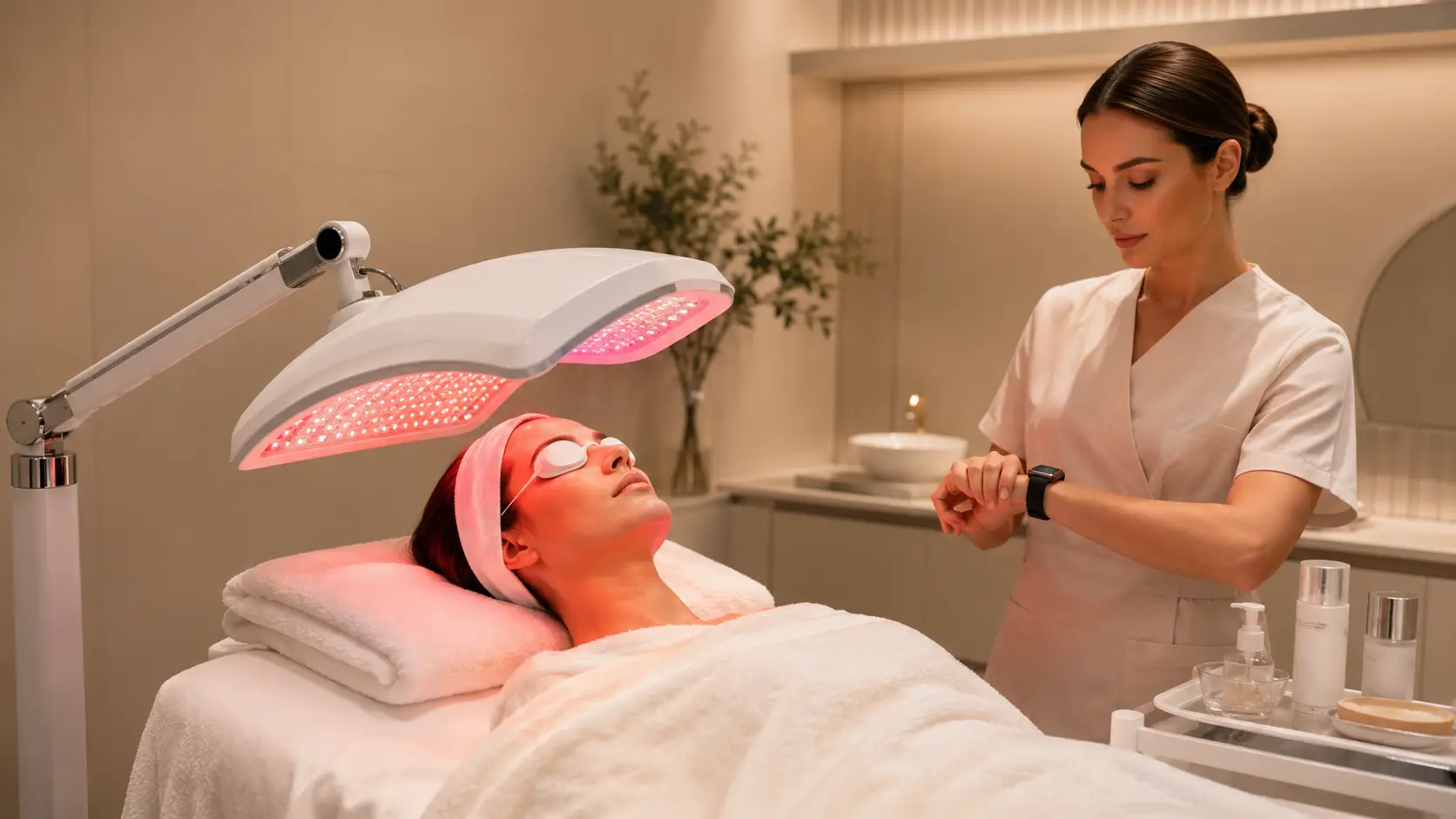
How Long Should LED Therapy Run During a Professional Facial?
For most professional LED panel systems, the clinically effective session window ranges from 10 to 20 minutes per facial, depending on the device’s power output, the wavelength selected, and the treatment goal. Red and near-infrared wavelengths used for collagen stimulation and cellular repair typically require 15 to 20 minutes. Blue light used for acne management is effective in the 8- to 12-minute range. Duration alone, however, does not determine outcomes — the total energy delivered to the skin (fluence, measured in joules per square centimeter) is the clinically meaningful variable, and that is a product of both time and device power.
- Fluence (J/cm²) = irradiance (mW/cm²) × time (seconds) ÷ 1,000 — a 10-minute session on a 100 mW/cm² panel delivers the same dose as a 20-minute session on a 50 mW/cm² panel.
- Red light (630–660 nm) for anti-aging and collagen: target range 30–60 J/cm², typically achieved in 15–20 minutes at standard professional devices.
- Blue light (415–430 nm) for acne management: effective fluence typically reached in 8–12 minutes on professional-grade panels.
- Near-infrared (810–850 nm) for deep repair and post-treatment recovery: 10–20 minutes depending on penetration depth goal.
- Working distance matters critically — doubling the panel-to-skin distance reduces irradiance to approximately one quarter, requiring proportionally longer sessions to achieve the same therapeutic dose.
- LED therapy is most commonly positioned during the mask stage of a facial to multitask efficiently within the service window without extending overall treatment time.
Few questions come up more consistently among estheticians adding LED therapy to their service menu than this one: how long do I actually need to run it? The answer that most device marketing materials offer — “10 to 20 minutes” — is technically accurate but practically incomplete. That range covers sessions that might deliver fundamentally different clinical outcomes depending on the specific panel being used, its power output, how far from the client’s face it’s positioned, and what the treatment is intended to achieve.
Estheticians who understand the science of LED dosing — not just the dial settings on a specific device — are better equipped to design protocols that actually work, explain their services with authority, and troubleshoot client outcomes when results fall short of expectations. This guide covers what determines an effective LED session duration, how timing changes by wavelength and treatment goal, how to integrate LED into a professional facial workflow without breaking service timing, and the most common duration mistakes practitioners make in high-volume practice.
What Estheticians Need to Know About LED Therapy Duration
- Time and power together determine dose (fluence). Session length without device power context is not a clinically meaningful number.
- Red/NIR wavelengths require longer sessions (15–20 min) than blue wavelengths (8–12 min) to reach effective therapeutic fluence at standard professional irradiance levels.
- Working distance is the most underestimated variable in treatment room LED practice — even small increases in distance significantly reduce energy delivery and require compensating time adjustments.
- The mask stage of a professional facial is the most efficient integration point for LED — it multitasks without lengthening the overall service.
- LED follows a biphasic dose-response: too little produces no effect; too much can inhibit the cellular pathways the therapy targets. Operating within manufacturer-specified parameters is not optional.
- Post-treatment skin (post-microneedling, post-peel) benefits significantly from LED at 10–15 minutes — the anti-inflammatory and repair mechanisms are active at these durations even at conservative fluence.
- Session duration should be standardized per protocol within your practice — inconsistent timing across clients delivering the same treatment is a quality control failure.
Why Fluence Matters More Than the Clock When Setting LED Session Length
The most important shift in thinking for estheticians designing LED protocols is moving from clock-based timing to dose-based timing. In photobiomodulation (PBM) science — the field that underlies all professional LED therapy — the meaningful clinical variable is fluence: the total light energy delivered to the skin surface per unit area, expressed in joules per square centimeter (J/cm²).
Fluence is calculated by multiplying the device’s irradiance (its power output per unit area, measured in milliwatts per square centimeter, or mW/cm²) by the exposure time in seconds, then dividing by 1,000 to convert milliwatts to watts. A session of 10 minutes on a panel delivering 80 mW/cm² produces 48 J/cm² of fluence. A session of 10 minutes on a panel delivering 20 mW/cm² produces only 12 J/cm². The clock ran for the same amount of time, but the biological dose delivered to the skin differs by a factor of four. In treatment room practice, this difference translates directly to whether the client’s cells respond, don’t respond, or receive insufficient stimulus to produce the intended outcome.
The Biphasic Dose-Response: Why More Is Not Always Better
LED photobiomodulation operates according to what researchers call the Arndt-Schulz Law, or biphasic dose-response. At low fluences, there is insufficient energy to produce a cellular response — the treatment is essentially inactive. At the optimal fluence range for the target tissue and wavelength, the intended biological effects occur: mitochondrial activation, cytokine modulation, collagen synthesis stimulation, or bacterial photodestruction. Beyond the optimal range, higher fluences can actually inhibit the same cellular pathways the treatment is designed to activate, a phenomenon documented in photobiomodulation research across multiple wavelengths.
This means the goal of session timing is not to maximize duration — it is to reach the optimal fluence window for the specific treatment goal and then stop. Running a high-power LED panel for 30 or 40 minutes when the device reaches therapeutic dose in 15 does not double the benefit. It introduces the risk of the inhibitory phase of the biphasic response. Estheticians should always operate within the duration parameters specified by the device manufacturer, which are calibrated to their panel’s specific irradiance output.
How to Think About LED Dosing in Professional Practice
The fluence formula: Fluence (J/cm²) = Irradiance (mW/cm²) × Time (seconds) ÷ 1,000
Therapeutic windows by goal: Anti-aging and collagen stimulation (red 630–660 nm) typically targets 30–60 J/cm². Acne management (blue 415–430 nm) typically targets 10–30 J/cm². Post-treatment calming and tissue repair (red + NIR) typically targets 20–50 J/cm² depending on depth of intended effect.
The distance factor: The inverse square law governs LED intensity at distance. At twice the working distance, irradiance drops to approximately 25% of its rated output — quadrupling the session time required to reach the same fluence. Always use the manufacturer’s specified working distance.
How Does LED Wavelength Change the Recommended Session Duration?
Wavelength selection and session duration are inseparable clinical decisions. Different wavelengths penetrate tissue to different depths, interact with different cellular targets, and require different total energy deliveries to produce their intended biological effects. Estheticians using multi-mode LED systems who apply the same timing to all wavelength selections are effectively under-dosing some applications and potentially over-dosing others.
Red Light (630–660 nm): The Anti-Aging and Collagen Wavelength
Red light wavelengths in the 630 to 660 nanometer range are the most widely researched for professional esthetics applications. They target cytochrome c oxidase within mitochondria, triggering a cascade that increases adenosine triphosphate (ATP) production, reduces reactive oxygen species, and stimulates fibroblast activity — the cellular mechanism underlying collagen synthesis stimulation. Estheticians working with clients on texture, fine lines, firmness, and overall skin rejuvenation are primarily working within this wavelength range.
The therapeutic fluence target for red light collagen protocols generally falls in the range of 30 to 60 J/cm². On professional panels operating between 50 and 100 mW/cm² at standard working distance, this translates to a session duration of 15 to 20 minutes. Estheticians consistently find that red light sessions shorter than 10 minutes at standard power output frequently fall below the threshold for measurable cumulative collagen response. Within a 60-minute facial, the mask stage is typically the only service window long enough to accommodate a full red light session without restructuring the entire appointment.
Blue Light (415–430 nm): The Acne Management Wavelength
Blue light operates through a fundamentally different mechanism than red. At 415 to 430 nanometers, blue light activates porphyrins — naturally occurring photosensitive compounds produced by Cutibacterium acnes bacteria as metabolic byproducts. When these porphyrins absorb blue light energy, they generate reactive oxygen species that are toxic to the bacteria at the bacterial cell level, making blue light a targeted antimicrobial tool that does not require topical antibiotic application.
Because the target mechanism requires less total energy to activate than the mitochondrial pathway targeted by red light, professional blue light protocols are effective at shorter session durations — typically 8 to 12 minutes at standard professional irradiance. The relevant therapeutic fluence for acne management falls in the 10 to 30 J/cm² range depending on acne severity and client skin type. Running blue light sessions significantly beyond 15 minutes adds little additional antibacterial benefit once the porphyrin-activation threshold has been fully engaged.
Near-Infrared (810–850 nm): Deeper Repair and Recovery
Near-infrared wavelengths penetrate more deeply into tissue than visible red light, reaching beyond the dermal layer into subcutaneous structures. NIR is increasingly used in advanced treatment room protocols for post-procedure recovery, where deeper tissue anti-inflammatory effects and accelerated healing are clinical priorities. The therapeutic session window for NIR applications in facial treatments typically runs 10 to 20 minutes, with longer sessions applied when deep tissue repair is the primary goal and shorter sessions used in combination with red light in multi-wavelength panels.
How Should LED Therapy Timing Be Integrated Into a Professional Facial?
Knowing the optimal exposure duration for each wavelength is one part of the protocol equation. Fitting that duration efficiently into a professional facial service without extending appointment times or disrupting service flow is the other. Estheticians who master both are able to offer LED as a consistent treatment room differentiator rather than an add-on that disrupts their booking rhythm.
The Mask Stage as the Primary LED Integration Window
In a standard 60-minute professional facial, the single largest unstructured time window is the mask stage — typically 10 to 15 minutes during which the mask is applied and left to dwell. Estheticians who have built LED into their service protocols consistently find that running the LED panel during this window is the most operationally efficient approach. The client’s face is stationary, covered, and positioned ideally for consistent panel-to-skin distance. The esthetician is free to perform value-added services during the same window: scalp massage, hand treatment, décolleté work, or client education.
The practical alignment between professional LED session durations (10–20 minutes) and standard mask dwell times means that in most cases, LED can be added to a facial without adding any time to the appointment. The key is selecting a mask — whether a jelly mask, a recovery sheet mask, or a hydrogel — whose dwell time matches the LED session requirement for the treatment goal being addressed.
Pre-Extraction LED Applications
Some protocols use a brief blue light session of 5 to 8 minutes before extraction work, using the antibacterial mechanism to begin reducing surface bacteria before manual extractions open the follicle and temporarily compromise the barrier. While this is less common than post-extraction LED applications, estheticians working with high-acne-load clients sometimes find that the pre-extraction session reduces post-extraction inflammatory response compared to extraction-only approaches. The duration in this position should be kept shorter to preserve time for subsequent protocol steps.
Post-Extraction Calming Applications
Post-extraction skin is inflamed, mildly compromised, and in need of rapid calming before serum and mask application. Red or combined red-and-near-infrared LED at 8 to 12 minutes in this position serves as an anti-inflammatory bridge between the trauma of extraction and the recovery-focused steps that follow. Estheticians consistently report that clients who receive post-extraction LED before serum application show less visible redness and faster surface calming compared to clients who move directly from extraction to mask. The session length in this position is typically shorter than the mask-stage protocol because it serves a targeted calming function rather than a cumulative collagen-building one.
How Device Power and Working Distance Change the Duration Equation
Estheticians who move between LED devices — or who have upgraded their equipment — sometimes find that their established session timing no longer produces the same client results. The explanation is almost always one of two variables: device power output (irradiance) or working distance. Understanding both is essential for building protocols that travel with the practitioner, not ones that only work on a single specific device.
Irradiance: The Single Most Important Device Specification
Irradiance — the power density of the LED panel expressed in milliwatts per square centimeter at a specified distance — is the specification that determines how long a session must run to reach therapeutic fluence. Consumer-grade LED devices often operate at 5 to 20 mW/cm². Professional-grade panels used in licensed treatment room settings typically operate in the range of 50 to 150 mW/cm² or higher. At 100 mW/cm², a 10-minute session delivers 60 J/cm² — a therapeutically effective fluence for red light collagen protocols. At 20 mW/cm², the same 10-minute session delivers only 12 J/cm² — below the threshold for meaningful collagen response. This is why consumer device timing recommendations cannot be applied directly to professional equipment, and why professional equipment sessions should not be extended to match consumer device timing on the assumption that longer sessions always produce better outcomes.
Working Distance and the Inverse Square Law
The inverse square law describes how light intensity decreases as distance from the source increases. In practical terms: doubling the panel-to-skin distance reduces irradiance to approximately one quarter of its rated output. A professional panel delivering 100 mW/cm² at 6 inches is delivering approximately 25 mW/cm² at 12 inches. To achieve the same 60 J/cm² fluence at 12 inches that takes 10 minutes at 6 inches, the session would need to run for approximately 40 minutes — far outside the standard facial service window and approaching the inhibitory range of the biphasic dose-response. The practical instruction is simple: always position the LED panel at the manufacturer’s specified working distance, and do not allow client movement or repositioning to change that distance mid-session without adjusting the timer accordingly.
Skin Tone and Phototype Considerations
Melanin in the epidermis absorbs a portion of incident light before it reaches the target tissue. Clients with higher Fitzpatrick phototypes (IV through VI) have increased epidermal melanin concentration, which can reduce the proportion of light energy reaching the intended target depth. In professional practice, the clinical response to LED does not usually require session time adjustment across Fitzpatrick types when operating within manufacturer-specified parameters — professional panels are typically calibrated to deliver therapeutic dose across skin tone ranges. Where adjustments are warranted, they tend to involve caution around heat accumulation and post-inflammatory hyperpigmentation risk with repeated high-power sessions on very dark skin tones, rather than fundamental duration changes.
Estheticians integrating the ILUMILUX™ Professional LED Panel into high-volume facial schedules observe a consistent pattern: clients who receive the same nominal “10-minute” LED session on lower-powered prior devices and then switch to the ILUMILUX at the recommended 6-inch working distance often report noticeably stronger post-session results — more visible radiance, faster post-treatment calming, and improved week-on-week skin texture progression. The explanation is not session length but irradiance: the ILUMILUX operates at a clinical power density that delivers therapeutically meaningful fluence within the mask-stage window, where lower-powered devices were delivering a sub-threshold dose regardless of how long the session ran. Practitioners who have benchmarked against previous devices consistently find they can reduce session duration on the ILUMILUX without sacrificing clinical outcome — freeing service time without compromising results.
The most common distance error observed in busy treatment rooms is the panel drifting 3 to 4 inches farther from the client’s face than specified as the service progresses — either from vibration, client movement, or equipment settling. In practice, a quick distance check at session start and midpoint corrects this before it accumulates into a meaningful dosing error.
Duration Recommendations by Specific Treatment Goal
The following protocol windows apply to professional LED panel systems operating at the irradiance levels typical of treatment room equipment. They are starting frameworks, not fixed rules — individual device specifications, client skin presentation, and treatment context all warrant adjustment within these ranges.
Anti-Aging & Collagen Stimulation
Mitochondrial activation via cytochrome c oxidase. Target fluence 30–60 J/cm². Best positioned during mask stage in a 60- or 90-minute facial. Sessions shorter than 10 minutes at standard professional irradiance rarely produce cumulative collagen response.
Active Acne & Breakout Management
Porphyrin-mediated bacterial photodestruction. Target fluence 10–30 J/cm². Can be positioned pre- or post-extraction. Sessions beyond 15 minutes add limited additional antibacterial benefit once porphyrin activation threshold is engaged.
Post-Treatment Recovery & Deep Repair
Deep tissue anti-inflammatory and repair mechanisms. Used after microneedling, dermaplaning, or extraction-heavy work. Skin’s heightened post-procedure permeability amplifies LED’s systemic effects. Position after serum application and before occluding with a recovery mask.
Acne with Anti-Aging Concerns
Sequence blue light first (antibacterial function) then red (collagen and recovery). Some multi-mode professional panels allow simultaneous dual-wavelength emission, reducing total session time. Verify device specifications to confirm simultaneous mode availability and its impact on per-wavelength irradiance.
General Rejuvenation & Maintenance
Multi-depth photobiomodulation for clients focused on overall skin quality, radiance, and long-term anti-aging maintenance. The most natural alignment with jelly mask dwell time within a standard 60-minute facial. Ideal for clients without a specific acute concern who are building cumulative collagen response over a series of sessions.
Redness & Inflammation Reduction
Anti-inflammatory cytokine modulation for rosacea-prone, reactive, or sensitized skin. Conservative session lengths are preferred for reactive skin types. Start at the lower end of the duration range and assess client response before extending. Avoid blue light in this application — it does not address the inflammatory mechanism.
Common LED Timing Mistakes Estheticians Make in Professional Practice
Applying Consumer Device Timing to Professional Equipment
Consumer at-home LED devices and professional treatment room panels operate at fundamentally different irradiance levels. Timing recommendations that come with a consumer device — often 20 to 30 minutes because the device is underpowered — do not apply to professional-grade equipment. Applying those extended timings to a high-irradiance professional panel can push sessions into the inhibitory phase of the biphasic dose-response. Always calibrate session length to the irradiance specification of the specific device being used.
Using the Same Duration for Every Wavelength
Estheticians working with multi-wavelength panels who default to a single session length regardless of mode selection are under-dosing some protocols and over-dosing others. Blue light sessions run for 20 minutes are running well beyond the functional antibacterial window. Red light sessions run for 5 minutes at standard irradiance are frequently below the collagen threshold. Wavelength-specific duration standards should be established for every LED device in the treatment room and documented in the protocol reference.
Inconsistent Working Distance Across Sessions
Inconsistent panel positioning between sessions for the same client produces inconsistent outcomes — and makes it impossible to assess whether a series of LED treatments is producing cumulative results or not. Estheticians who establish a standardized positioning protocol (specific panel height, distance reference marker, positioning check before and midway through the session) eliminate one of the most variable and preventable sources of LED outcome inconsistency in high-volume practice.
Skipping LED When Service Timing Is Tight
In practice, LED is often the first step skipped when appointments run over. Estheticians who have built their LED integration around the mask stage find that this tradeoff is rarely necessary — because the LED runs during time that was already allocated to a passive mask dwell, not additional time carved from another service step. Protocols designed with the mask-LED overlap at their structural center are far more resilient to real-world service timing pressure.
Not Establishing Per-Goal Duration Standards in the Practice
Estheticians in multi-provider practices who have not documented wavelength-specific session duration standards find that LED delivery quality varies significantly between providers even on the same device — because each provider is making ad hoc timing decisions. A simple internal reference card specifying duration, working distance, and session position within the facial sequence by treatment goal eliminates this variability.

Professional and Scientific References
The photobiomodulation science and protocol guidance referenced in this article draws from peer-reviewed research in photomedicine and dermatological literature:
- Photobiomodulation dose-response and the biphasic Arndt-Schulz Law in low-level light therapy. Photomedicine and Laser Surgery; Hamblin & Demidova, 2006; Chung et al., 2012. Established the foundational framework for therapeutic versus inhibitory fluence windows in PBM applications.
- Fluence (J/cm²) and irradiance (mW/cm²) as determinants of photobiomodulation outcome. SPIE Proceedings; Laser Therapy; multiple reviews 2010–2024. Confirmed that session duration must be interpreted through irradiance output for clinical dosing accuracy.
- Red light (630–660 nm) and collagen stimulation via cytochrome c oxidase activation and fibroblast upregulation. Journal of Investigative Dermatology; Barolet, 2008; Weiss et al., 2005.
- Blue light (415–430 nm) and photodynamic inactivation of Cutibacterium acnes via porphyrin photoexcitation. Journal of the American Academy of Dermatology; Elman & Lebzelter, 2004.
- Near-infrared (810–850 nm) tissue penetration depth and anti-inflammatory mechanism in post-procedure recovery. Photomedicine and Laser Surgery; Peplow, Baxter & Bhatt, 2010.
- Inverse square law application to clinical LED panel irradiance and working distance protocols. Established physics; applied in LED device manufacturer clinical documentation and PBM dosimetry guidelines.
For estheticians ready to build LED therapy into their professional facial protocols with clinical precision, the ILUMILUX™ Professional LED Panel by Luminous Skin Lab is the device our education team references consistently in LED timing and protocol integration discussions. Developed for licensed treatment room use, the ILUMILUX delivers clinically calibrated irradiance across red (630 nm), near-infrared (830 nm), and blue (415 nm) modes — with preset protocol timers calibrated to therapeutic fluence targets at the standard 6-inch working distance. The mask-stage alignment built into the panel’s 10- to 20-minute protocol modes means LED can be fully integrated into a professional facial without extending service time. For practices building cumulative anti-aging series, post-procedure recovery protocols, or acne treatment sequences, the ILUMILUX provides the device-level consistency that makes LED results reproducible and trackable across clients.
Explore the ILUMILUX™ Professional LED PanelFrequently Asked Questions: LED Therapy Duration in Professional Facials
How long should LED therapy be used during a professional facial?
For most professional-grade LED panel systems, the clinically effective session window ranges from 10 to 20 minutes per facial. Red and near-infrared wavelengths for collagen stimulation and cellular repair typically require 15 to 20 minutes. Blue light for acne management is effective in the 8- to 12-minute range. Duration alone does not determine outcomes — the device’s irradiance (mW/cm²) and the resulting fluence (J/cm²) are the clinically meaningful variables. Always calibrate session length to the specific device’s power specifications.
Is 10 minutes of LED light therapy actually enough to do anything?
Ten minutes can be clinically effective, but only if the device delivers sufficient irradiance. A high-power professional panel operating at 80 to 100 mW/cm² can deliver 48 to 60 J/cm² of fluence in 10 minutes — a therapeutically meaningful dose for red light protocols. A lower-powered device at 20 mW/cm² delivers only 12 J/cm² in the same window, which falls below the threshold for meaningful collagen-stimulating photobiomodulation. Session duration must always be matched to the specific device’s power output, not applied as a universal standard.
Can you overdo LED therapy during a facial?
Yes. LED photobiomodulation follows a biphasic dose-response — an optimal fluence range produces the intended biological response, while excessive fluence can inhibit the same cellular pathways the treatment targets. This means that running a high-power LED panel well beyond its therapeutic window does not increase benefit and can reduce it. Professional estheticians should always operate within the session duration parameters specified by the device manufacturer, which are calibrated to their panel’s irradiance output to remain within the therapeutic range.
Does red light therapy take longer than blue light therapy during a facial?
Generally yes. Red and near-infrared wavelengths targeting collagen stimulation and deeper tissue repair typically require 15 to 20 minutes to reach effective therapeutic fluence on professional panels. Blue light targeting Cutibacterium acnes bacteria via porphyrin photoexcitation is effective at shorter durations — typically 8 to 12 minutes. The reason is mechanistic: porphyrin activation in acne bacteria requires less total energy to initiate than the mitochondrial activation pathway that underlies red light’s collagen and cellular repair effects.
Where in the facial should LED therapy be placed to make the timing work?
LED therapy integrates most efficiently during the mask stage of a professional facial, where it runs concurrently with a 10- to 15-minute mask dwell time — adding LED exposure without extending the overall appointment. Post-extraction positioning (8 to 12 minutes before serum) is used for anti-inflammatory calming. Pre-extraction blue light applications (5 to 8 minutes) are used in some acne protocols to begin bacterial reduction before manual extractions open the follicle. The mask-stage placement is the most common and operationally resilient approach in standard 60- and 90-minute facial workflows.
What is fluence and why does it matter more than just the LED session time?
Fluence is the total light energy delivered to the skin surface per unit area, measured in joules per square centimeter (J/cm²). It is calculated by multiplying the device’s irradiance in mW/cm² by exposure time in seconds, then dividing by 1,000. Two sessions of equal duration but different device power outputs deliver completely different fluence levels and produce different biological outcomes. Understanding fluence is what allows estheticians to adapt LED protocols intelligently when changing devices or working distances, rather than applying fixed time recommendations that may not translate.
Does the distance from the LED panel to the client’s skin change how long you need to run it?
Yes, significantly. Light intensity decreases with the inverse square of the distance from the source — doubling the panel-to-skin distance reduces irradiance to approximately one quarter of its rated output. A panel delivering 100 mW/cm² at 6 inches delivers approximately 25 mW/cm² at 12 inches. Reaching the same therapeutic fluence at 12 inches requires roughly four times the session duration compared to 6 inches. Always position the panel at the manufacturer’s specified working distance, and build a distance verification step into your session setup routine.
Should I run LED therapy for longer on clients with darker skin?
In most professional LED practice, session duration does not require adjustment across Fitzpatrick types when operating within manufacturer specifications — professional panels are typically calibrated to deliver therapeutic dose across the full skin tone range. However, higher Fitzpatrick phototypes do absorb more epidermal light energy through melanin, which can affect tissue penetration depth. The more important consideration for darker skin tones is heat accumulation and post-inflammatory hyperpigmentation risk with repeated high-power sessions — starting conservatively and assessing response over a series is the appropriate clinical approach, particularly for new clients.
How long should I run the ILUMILUX panel during a professional facial session?
The ILUMILUX™ Professional LED Panel by Luminous Skin Lab is calibrated for 10- to 20-minute treatment windows depending on the protocol mode selected. The red and near-infrared anti-aging mode is optimized for 15- to 20-minute sessions at the standard 6-inch working distance. The blue light acne protocol mode is effective in the 8- to 12-minute range. The multi-wavelength recovery mode for post-extraction or post-procedure use is designed to run for 10 to 15 minutes, aligning with standard mask dwell times in a professional facial workflow without requiring service time extension.
Session Duration Is a Variable, Not a Setting — Here’s How to Own It
The question “how long should LED therapy run?” doesn’t have a single answer — it has a clinical framework. Wavelength, device irradiance, working distance, and treatment goal all determine the session duration required to reach therapeutic fluence for a specific client and protocol. Estheticians who understand this framework are not guessing at timing or copying a number from a product brochure. They are applying photobiomodulation science to real-time treatment room decisions.
The practical summary for most professional practices: red light for anti-aging runs 15 to 20 minutes and belongs in the mask stage. Blue light for acne runs 8 to 12 minutes and can flex between pre- and post-extraction positions. Near-infrared for post-procedure recovery runs 10 to 15 minutes, ideally after serum and before the recovery mask. Combined protocols run 12 to 20 minutes depending on mode and device. Working distance should be verified at every session. Device irradiance should be known for every panel in the treatment room.
Consistent, calibrated LED timing — documented by protocol and applied reproducibly across clients — is what separates an LED service that builds a client’s visible results over a series from one that produces inconsistent outcomes that are difficult to attribute or improve. That consistency is the foundation of LED as a legitimate professional differentiator, not a novelty treatment.