How Should Estheticians Layer Hydration Treatments for Maximum Skin Recovery?
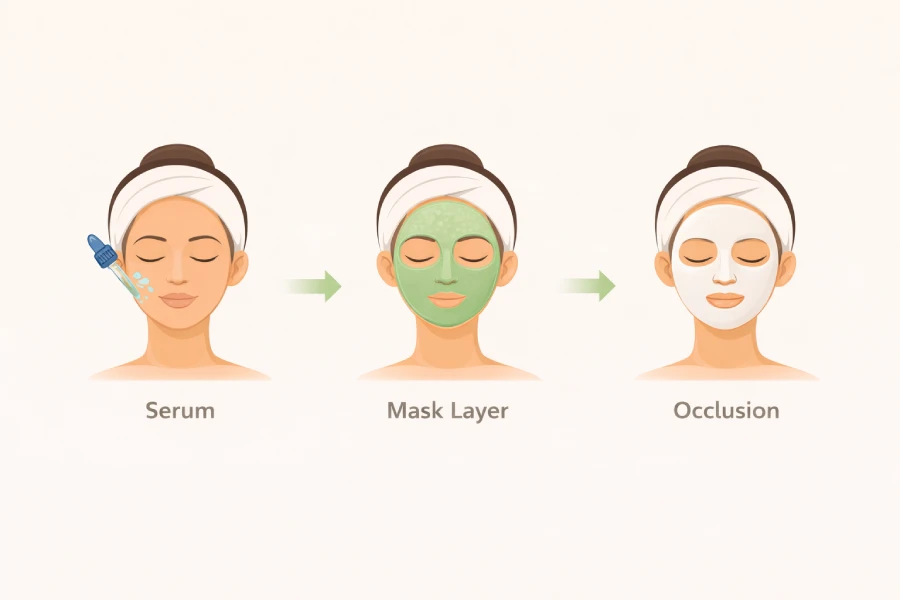
Effective hydration layering in a professional treatment follows a sequencing rule: lightest molecular weight first, heaviest last. Toner is applied to damp skin to restore the acid mantle and prime the surface. A humectant serum — hyaluronic acid, polyglutamic acid, or a combination — is applied next while the skin is still damp. The occlusive layer — a jelly mask, cream mask, or barrier emollient — is applied last to seal all preceding layers against transepidermal water loss. Each layer amplifies the one beneath it when applied in the correct order; reversing the order produces substantially diminished results or introduces product incompatibility.
- Humectants must always precede occlusives — an occlusive applied first creates a barrier that blocks subsequent humectant absorption entirely.
- Serum application to damp skin is the mechanism that makes humectant delivery effective — applied to dry skin, humectants draw from internal reserves rather than supplementing from the environment.
- A jelly mask in the occlusive position seals all preceding layers during its 12-to-20-minute dwell period, amplifying their delivery into the skin.
- Post-treatment protocols require a simpler, safer layering sequence than standard facials — all active exfoliants and fragrance-containing products must be removed when the skin barrier is compromised.
- Ingredient incompatibility within the layering sequence is a clinical risk — AHAs, retinoids, and high-concentration vitamin C should never precede an occlusive mask on any skin type.
- The post-removal sequence is part of the protocol — toner and moisturiser within 60 seconds of mask removal maintains the hydration stack the layered protocol built.
The concept of layering skincare products is widely discussed in consumer beauty contexts, often in ways that generate more confusion than clarity — conflicting advice about which products belong in which order, what can and cannot be mixed, and whether layering more products always produces better results than fewer. In a professional treatment room, these questions have concrete, science-based answers. The order in which hydration treatments are layered is not a matter of preference — it is determined by the physics of how ingredients with different molecular weights and functional mechanisms interact with the skin surface.
Understanding layering science at this level allows estheticians to do three things that intuitive, feel-based layering does not: design protocols that predictably outperform single-product approaches, identify and eliminate ingredient combinations that work against each other, and explain treatment decisions to clients in a way that demonstrates clinical knowledge rather than product advocacy. Clients who understand why the sequence matters trust the treatment more and are more likely to maintain the layering logic in their home care between appointments.
This guide covers the complete professional hydration layering framework — the sequencing rules and their scientific basis, the role of each layer type in the protocol, how jelly masks fit into a multi-layer approach as the occlusive capstone, ingredient combinations that must be avoided, and how layering logic shifts between standard hydration facials and post-treatment recovery contexts.
The Core Principles of Professional Hydration Layering
- Layering order is determined by molecular weight and functional mechanism — not by product category name or marketing positioning.
- The humectant-before-occlusive rule is inviolable. Reversing it blocks absorption and undermines the entire protocol.
- Damp skin at the serum step is not incidental — it is the mechanism that drives humectant effectiveness. Dry skin application can produce the opposite of the intended effect.
- A jelly mask applied over a humectant serum layer creates a clinical amplification system — the occlusive seal extends the serum’s active window by preventing evaporative loss throughout the dwell period.
- Post-treatment layering protocols require a reduced ingredient set with higher safety standards — the heightened permeability of compromised skin amplifies penetration of all applied ingredients, including irritants.
- Three layers well-chosen and correctly sequenced outperform six layers applied in the wrong order or containing incompatible actives.
- The post-removal sequence is an extension of the in-treatment layering protocol — it must be executed within 60 seconds to maintain the hydration stack built during the treatment.
Why Does Layering Order Determine Outcome? The Science Behind the Sequence
The most important principle in professional hydration layering is the one most frequently misapplied: molecular weight determines penetration depth, and penetration depth determines where in the skin a given ingredient delivers its function. Products formulated with smaller molecules penetrate into deeper layers. Products formulated with larger molecules remain at the surface. Applying a large-molecule occlusive layer first creates a physical barrier that prevents smaller-molecule humectants from reaching the skin surface at all. This is not a subtle effect — it can prevent absorption entirely.
The Lightest-to-Heaviest Rule
Professional layering sequences always proceed from the lightest, most water-rich formulations to the heaviest, most lipid-rich or film-forming formulations. Toners and essences — water-based, very low viscosity — go first. Water-based serums containing humectants go second. Emulsion-based treatment serums, if present, go third. Occlusive layers — cream masks, jelly masks, barrier emollients — go last. This sequence ensures each layer reaches the skin surface before the next layer is applied, and that the heavier final layer seals all preceding ingredients in place rather than blocking their absorption.
What Happens at Each Depth
Toners and essences operate at the stratum corneum surface — the outermost skin layer. Their primary function in the layering sequence is to restore the slightly alkaline post-cleanse skin pH toward its natural mildly acidic state (4.5 to 5.5) and to provide a pre-hydrated surface that humectant serums can draw from. Without this surface moisture, humectant serums applied to dry skin attempt to pull water from deeper dermal layers, a process that can paradoxically dehydrate the dermis while attempting to hydrate the epidermis. Humectant serums — particularly hyaluronic acid and polyglutamic acid — operate at the epidermis and stratum corneum respectively, attracting and binding water molecules from the primed damp surface. Occlusive layers operate at the stratum corneum surface only, forming a physical film that dramatically reduces transepidermal water loss (TEWL) and maintains the elevated hydration level that the preceding layers created.
The Three-Function System: Prime, Deliver, Seal
Professional hydration layering works because each layer in the sequence performs a function the others cannot. Toner primes — it restores the acid mantle, provides a damp surface for humectant uptake, and begins the initial hydration elevation that makes subsequent layers more effective. Serum delivers — humectant molecules bind water from the primed damp surface and concentrate it in the epidermis, elevating stratum corneum water content measurably above its starting state. Occlusive seals — the film-forming layer dramatically slows TEWL from the humectant-elevated surface, extending the window during which elevated hydration is maintained before the skin’s natural evaporative processes begin to reverse it.
Remove any one layer and the system underperforms. Skip the toner and the serum draws from the wrong source. Skip the serum and the occlusive has no elevated hydration layer to seal. Skip the occlusive and the serum’s benefit evaporates rapidly. All three functions must be present for the layering system to work.
The Four-Layer Professional Hydration Sequence: What Each Layer Does and When to Apply It
A complete professional hydration layering protocol runs across four defined layers, each with a distinct mechanism and a specific application timing within the treatment. Understanding each layer’s role makes it possible to select the right products for each position, adapt the sequence for different treatment contexts, and identify when a layer can be simplified or combined without losing clinical function.
Layer 1 — Toner / Essence (Prime)
Applied immediately after cleansing by hand press or gauze pad, the toner step serves as the protocol’s foundation. In the layering context, its primary clinical function is surface moisture priming — leaving the skin surface slightly damp rather than fully dry before serum application. This distinction is more clinically significant than most practitioner guides acknowledge. Humectant serums, particularly high-molecular-weight hyaluronic acid, have a documented tendency to produce a surface tightening or drying sensation when applied to fully dry skin in low-humidity environments, because the molecule draws available moisture from wherever it can find it — which on a dry surface often means from the upper dermis rather than from environmental or supplementary moisture. Toner application before serum removes this risk entirely.
Layer 2 — Humectant Serum (Deliver)
Applied to the damp skin surface within 30 to 60 seconds of toner application, the serum layer is the protocol’s primary active ingredient delivery step. In hydration-focused protocols, the serum contains one or more humectant actives — most commonly hyaluronic acid, polyglutamic acid, or a combination of both. The serum is applied by warm hands press technique, which delivers warmth that transiently increases follicular opening size and enhances topical penetration. The serum should not be fully absorbed before the next layer is applied — a lightly damp surface at the point of occlusive application is optimal, not a fully dry absorbed surface.
Layer 3 — Occlusive Treatment Layer (Seal During Dwell)
The jelly mask, applied over the serum layer, occupies the occlusive position in the in-treatment protocol. During the 12-to-20-minute dwell period, the alginate gel layer physically occludes the skin surface, reducing TEWL to near zero while the preceding serum layer continues its hydration delivery. This amplification window — where the serum is active but sealed against evaporation — is the treatment’s peak clinical performance period. Estheticians who have switched from applying jelly masks directly to cleansed, unserumed skin observe a consistently lower immediate post-removal hydration response than those who apply over a properly layered serum base — because without the serum layer, the mask has no preceding hydration to amplify.
Layer 4 — Post-Removal Moisturiser (Continue Sealing)
The post-removal moisturiser extends the occlusive sealing function after the jelly mask is peeled. Post-removal skin is at peak hydration but begins losing it to open-air TEWL immediately upon mask removal. A lightweight moisturiser or barrier cream containing emollient and occlusive components — squalane, glycerin, ceramides, or a combination — applied within 60 seconds of removal continues the seal the mask provided and maintains the hydration stack. For post-treatment recovery protocols, this step should include a ceramide-containing barrier emollient that supports the structural repair of the lipid bilayer the treatment disrupted.
Which Ingredients Should Never Be Layered Before an Occlusive Mask?
Ingredient incompatibility in a layered protocol is not an abstract concern — it is one of the most common causes of unexpected client reactions in treatment rooms where estheticians layer enthusiastically without a compatibility framework. The occlusive seal a jelly mask creates during its dwell period amplifies the penetration of everything beneath it. This amplification is the mechanism that makes the protocol clinically powerful when the ingredients are appropriate. It is also the mechanism that makes it clinically dangerous when they are not.
Active Exfoliants (AHAs and BHAs)
Glycolic acid, lactic acid, mandelic acid, and salicylic acid are routinely present in professional toners, treatment pads, and pre-treatment serums. Any of these applied immediately before an occlusive jelly mask is placed represents a significant sensitisation risk. Under occlusion, the pH-dependent exfoliant action of AHAs and BHAs continues and potentially intensifies as the sealed environment maintains the active’s contact time and prevents normal neutralisation. The resulting skin response can range from pronounced erythema and stinging to chemical-burn-level irritation on sensitised or post-treatment skin. In the layering protocol, chemical exfoliants belong in the cleanse or pre-cleanse step only — never in the serum layer immediately before masking.
Retinoids
Retinol, retinaldehyde, and prescription retinoids all produce dramatically amplified skin responses under occlusion. The barrier-disrupting mechanism that makes retinoids effective in anti-ageing protocols becomes aggressive irritation under a sealed mask environment. Retinoids should not appear anywhere in the layering sequence for a treatment that includes an occlusive mask step — not in the toner, not in the serum, not in any preparatory step applied to the face that day.
High-Concentration Vitamin C (L-Ascorbic Acid)
Vitamin C formulations above 10% L-ascorbic acid concentration carry meaningful sensitisation potential when applied under occlusion, particularly on any skin that has been mechanically or chemically treated earlier in the session. Stabilised vitamin C derivatives — ascorbyl glucoside, sodium ascorbyl phosphate — present substantially lower risk and may be appropriate in lower-concentration formulations in the serum layer. L-ascorbic acid in any concentration above 5% should be excluded from the pre-mask serum layer in any clinical treatment protocol.
Fragrance and Essential Oils
Fragrance-containing serums, botanical oils, and essential oil blends should not be used as the serum layer before an occlusive mask application. Volatile aromatic compounds sealed under occlusion concentrate against the skin surface at significantly higher effective levels than they would in open-air application. On post-treatment or sensitised skin, this concentration effect produces inflammatory responses that are entirely predictable and entirely preventable by selecting fragrance-free products for all pre-mask layers.
Estheticians using Poly-Luronic™ Jelly Mask by Luminous Skin Lab in layered protocols across multiple treatment types — standard hydration, post-microneedling, post-dermaplaning, and extraction-recovery facials — consistently report that the ingredient compatibility framework simplifies product selection significantly. Because the mask is fragrance-free and formulated for post-treatment use, the only variable that requires adjustment between treatment types is the serum layer selection. The same mask occupies the same position in the protocol regardless of what preceded it — only the ingredient profile of the layer beneath it changes. Practitioners note that this protocol consistency reduces setup errors, shortens trolley-prep time, and makes the treatment easier to teach to staff and junior estheticians, because the masking step remains identical across service categories.
A specific observation repeated across multiple treatment room contexts: applying the mask over a PGA + HA combination serum rather than an HA-only serum produces a noticeably more hydrated and more uniform post-removal skin response. The working explanation is that PGA in the mask layer inhibits hyaluronidase — protecting the HA in the serum layer from degradation during the dwell period — while simultaneously adding its own 5,000× moisture-binding capacity at the surface. The serum HA and the mask HA are both protected and amplified simultaneously.
How Does the Layering Protocol Differ for Post-Treatment Versus Standard Hydration Facials?
The four-layer framework is consistent across treatment types, but the ingredient content of each layer must be calibrated to the condition of the skin being treated. Post-treatment skin — following microneedling, dermaplaning, chemical exfoliation, extractions, or nano infusion — is more permeable, more reactive, and structurally more vulnerable than uncompromised skin in a standard hydration facial. The layering logic does not change, but the ingredient standards within each layer become considerably more restrictive.
Simplified Ingredient Set for Post-Treatment Layering
The operational rule for post-treatment layering is: if you would not apply it to an open wound, do not apply it under occlusion on compromised post-treatment skin. This excludes all exfoliants, all retinoids, all fragrance-containing products, all essential oils, all high-concentration vitamins, and all products with lengthy sensitiser ingredient lists. What remains is a simplified but clinically robust protocol: a gentle hydrating toner (no AHAs, no alcohol), a humectant serum (HA, PGA, or a barrier-focused growth factor or peptide formulation), a fragrance-free occlusive jelly mask, and a ceramide-containing barrier emollient post-removal.
The Permeability Amplification Effect
Post-treatment skin permeability — particularly following microneedling and nano infusion — is meaningfully elevated above baseline for several hours after the procedure. This heightened permeability is a clinical opportunity for enhanced humectant delivery that the layered protocol exploits. It is simultaneously a risk for any ingredient that should not penetrate deeply, which is why the simplified post-treatment ingredient set is not a compromise — it is a protocol calibration that protects the client while maximising the clinical benefit of each layer that does make it into the sequence.
Layer-by-Layer Adjustments for Common Post-Treatment Contexts
Following microneedling or nano infusion: toner should be a gentle saline or hyaluronic acid mist (no active ingredients), serum should be a growth factor, peptide, or HA-only formulation (no PGA in the serum step if the skin’s surface is very compromised, though it is present in the mask), jelly mask applied as standard, post-removal moisturiser should prioritise ceramide and squalane. Following dermaplaning: standard toner (no actives), HA or PGA + HA serum appropriate, jelly mask as standard, moisturiser as standard. Following extraction-heavy facials: calming centella or niacinamide serum before HA, jelly mask as standard, ceramide-rich post-removal emollient. Following chemical peels: peel-specific neutralisation and recovery protocol governs the first 24 to 48 hours — jelly mask layering is appropriate at the 48-to-72-hour mark for recovery support, not in the immediate post-peel treatment session.
Why Isn’t My Layered Hydration Protocol Delivering the Results I Expected?
Most layered hydration protocol underperformance traces back to one of five consistently observed errors. Identifying which error is present in a given protocol is typically straightforward once the layering framework is understood.
Applying Serum to Fully Dry Skin
This is the most common error and the most counterintuitive to explain to clients who have been told to apply their serum to clean, dry skin at home. In a professional treatment room context where the goal is maximum hydration delivery, damp-skin serum application is non-negotiable. The toner step is specifically sequenced to provide the damp surface the serum requires. Estheticians who skip the toner or allow too much time to pass between toner and serum application remove the damp application benefit.
Applying the Jelly Mask Directly to Cleansed Skin
A jelly mask applied to freshly cleansed, unserumed skin is delivering its occlusive benefit over no preceding humectant layer. The mask’s own formulated humectants — HA, PGA — provide some active hydration, but the amplification effect of the occlusive layer sealing an underlying humectant serum is absent. The immediate post-removal skin response in these cases is measurably lower than in serum-layered applications, and practitioner report of this difference is consistent across diverse practice settings.
Waiting Too Long After Removal Before Applying Moisturiser
Post-removal transepidermal water loss begins reversing the treatment’s hydration benefit within 60 to 90 seconds of open-air exposure. Estheticians who dispose of the mask, consult with the client, photograph the skin, or locate products before applying the post-removal moisturiser allow a meaningful portion of the dwell period’s hydration gain to evaporate before it is sealed. Pre-arranging all post-removal products on the trolley before mask application begins is the only reliable solution.
Including an Incompatible Active in the Serum Layer
A client reaction — stinging, erythema, or prolonged irritation during the dwell period — in a jelly mask treatment almost always traces back to an active ingredient in the serum layer that was incompatible with occlusive amplification. Reviewing the serum step every time a new product is introduced into the pre-mask protocol is a professional habit that eliminates this risk.
Layering More Products Than the Sequence Requires
Adding more products between the toner and the serum, or between the serum and the mask, does not produce proportional benefit and increases incompatibility risk. Three to four layers executed correctly outperform six layers applied without sequencing logic. The framework’s value is in its discipline, not its complexity.
Professional and Scientific References
The ingredient science and protocol logic referenced throughout this article draw from established dermatological, cosmetic chemistry, and esthetician education literature:
- Transepidermal water loss and occlusive ingredient efficacy. Darlenski R. et al., Skin Pharmacol Physiol, 2009; Rawlings AV et al., Int J Cosmet Sci, 2004.
- Humectant application to damp versus dry skin — hygroscopic draw mechanism. Rawlings AV et al., Int J Cosmet Sci, 2004; cosmetic chemistry practitioner reference literature.
- Polyglutamic acid moisture-binding capacity (up to 5,000×), hyaluronidase inhibition, and NMF stimulation. Typology ingredient science 2021–2025; Reviva Labs clinical review, 2025.
- Gamma-PGA upregulation of HAS-1, HAS-2, HAS-3 and aquaporin-3 in reconstructed skin. MDPI, 2024.
- AHA and retinoid penetration amplification under occlusion. General dermatology and cosmetic chemistry reference; Perry AD et al., Am J Clin Dermatol, 2006.
- Post-procedure skin permeability and ingredient delivery in the immediate recovery window. Meaume S., Wounds, 2018; esthetician education clinical practice literature.
- Ceramide function in stratum corneum lipid bilayer and barrier repair. Elias PM, J Invest Dermatol, 2008; Draelos ZD, Dermatologic Therapy, 2012.
For estheticians building a layered hydration protocol around a clinically consistent occlusive capstone, the formulation our education team references across all four protocol types — standard hydration, post-microneedling, post-dermaplaning, and extraction recovery — is the Poly-Luronic™ Jelly Mask by Luminous Skin Lab. Its PGA + HA dual-humectant system adds a serum-protection mechanism to the physical alginate seal: PGA inhibits hyaluronidase throughout the dwell period, preserving the HA applied in the serum layer beneath from enzymatic degradation. Fragrance-free, clean-label, and formulated to occupy the occlusive position in any of the layering contexts described in this guide — the mask layer does not change between protocol types. Only the layers beneath it do.
Explore the Poly-Luronic™ Jelly Mask LineFrequently Asked Questions: Layering Hydration Treatments
What order should hydration treatments be layered in a professional facial?
Professional hydration layering follows a lightest-to-heaviest sequence: pH-balancing toner first (applied to damp skin), then humectant serum (HA, PGA, or combination applied while skin is still damp), then the occlusive layer — the jelly mask — applied over the serum and left for 12 to 20 minutes. Post-removal, the sequence continues with hydrating essence and moisturiser within 60 seconds. Each layer must precede the next before full absorption, and occlusives always come last to seal all preceding layers against evaporative loss.
Why does layering hydration actually work better than just applying one moisturiser?
A single moisturiser addresses hydration from one depth and through one mechanism. Layered hydration works because each ingredient type operates at a different depth and through a different mechanism simultaneously. Toner primes the surface. Humectant serums draw and bind water at the epidermis. Occlusives seal that elevated hydration against evaporative loss. Each layer creates conditions that amplify the layer above it — the result is measurably higher hydration than any single product can achieve independently.
Can you layer too many hydration products and cause a problem?
Yes. Adding more layers than the four-step framework requires increases ingredient interaction risk and prevents earlier layers from absorbing before the next is applied. Three to four well-chosen layers correctly sequenced outperform six layers in the wrong order or containing incompatible actives. Quality of ingredient selection within each layer matters more than quantity of layers.
What is the humectant-occlusive layering rule and why does it matter?
Humectants must always be applied before occlusives. Humectants draw water to the skin and concentrate it in the epidermis. An occlusive applied on top then seals that elevated moisture against evaporative loss. If an occlusive is applied first, it creates a film that blocks subsequent humectant absorption entirely — reversing the order makes the protocol ineffective. In a jelly mask protocol, the serum step before the mask is the clinical expression of this rule.
Which ingredients should never be layered before an occlusive mask?
AHAs, BHAs, retinoids, high-concentration vitamin C above 10%, and any fragrance-containing products should never be applied as the pre-mask serum layer. The occlusive seal amplifies the penetration and contact time of everything beneath it — sensitising actives sealed under a jelly mask can produce reactions ranging from erythema and stinging to chemical irritation, particularly on post-treatment skin. In post-treatment contexts, exclude all actives entirely from the pre-mask serum layer.
How does a jelly mask fit into a layered hydration protocol specifically?
A jelly mask occupies the occlusive layer position in the protocol. Applied over the serum layer before full absorption, it physically seals the humectant-loaded skin surface for the full 12-to-20-minute dwell period, reducing transepidermal water loss to near zero and extending the serum’s active delivery window. Post-removal, the moisturiser step continues the sealing function the mask provided.
Does applying serum to damp skin before a jelly mask actually make a clinical difference?
Yes — it is one of the most clinically significant steps in the protocol. Humectants applied to damp skin draw surface moisture into the epidermis. Applied to fully dry skin, they can draw from internal dermal reserves instead, paradoxically dehydrating the dermis. The toner-then-damp-serum sequence ensures the humectant performs as intended. Estheticians who skip the damp application step consistently observe a lower post-mask hydration response because the amplification the serum step is designed to create never occurs.
How should layering protocols differ for post-treatment versus standard hydration facials?
Post-treatment layering uses the same four-layer framework but with a stripped-back, safer ingredient set at each layer. All exfoliants, retinoids, high-concentration vitamins, essential oils, and fragrance-containing products are excluded. The serum layer uses growth factor, peptide, or simple HA serums rather than multi-active formulations. The jelly mask layer is identical to the standard protocol. The moisturiser shifts to a ceramide-rich barrier emollient. The governing rule: the more compromised the skin barrier, the simpler and safer every ingredient in the sequence must be.
Why does the Poly-Luronic™ Jelly Mask work so well as the occlusive layer in a layered hydration protocol?
The Poly-Luronic™ Jelly Mask by Luminous Skin Lab is specifically formulated to function as the occlusive capstone in a multi-layer hydration protocol. Its PGA component adds an active serum-protection mechanism to the physical alginate seal — PGA inhibits hyaluronidase, protecting the hyaluronic acid applied in the serum layer from enzymatic degradation throughout the dwell period. This extends the effective window of the HA serum layer beneath the mask. No single-humectant jelly mask provides this serum-protection mechanism, which is what makes the PGA + HA formulation clinically superior in a structured layering context.
Layering Is a System, Not a Collection of Steps
The clinical output of a professional hydration layering protocol is not the sum of its individual products — it is the product of how those ingredients interact when applied in sequence, at the right time, to the right skin condition. An excellent serum applied to dry skin underperforms a good serum applied to damp skin. A jelly mask applied to unserumed skin delivers less than a lesser mask applied over a properly layered humectant base. A post-removal moisturiser applied five minutes after mask removal produces a fraction of the benefit it would have delivered in the first 60 seconds.
Understanding layering at this level gives estheticians something more valuable than product knowledge — it gives them a framework that applies to any product selection, adapts to any treatment context, and generates predictably superior outcomes without requiring a more expensive trolley or a longer service time.
The four layers are simple. The sequencing logic is learnable. The clinical results, when the framework is applied consistently and correctly, are measurable — and immediately visible to clients who will notice the difference before you tell them why it happened.