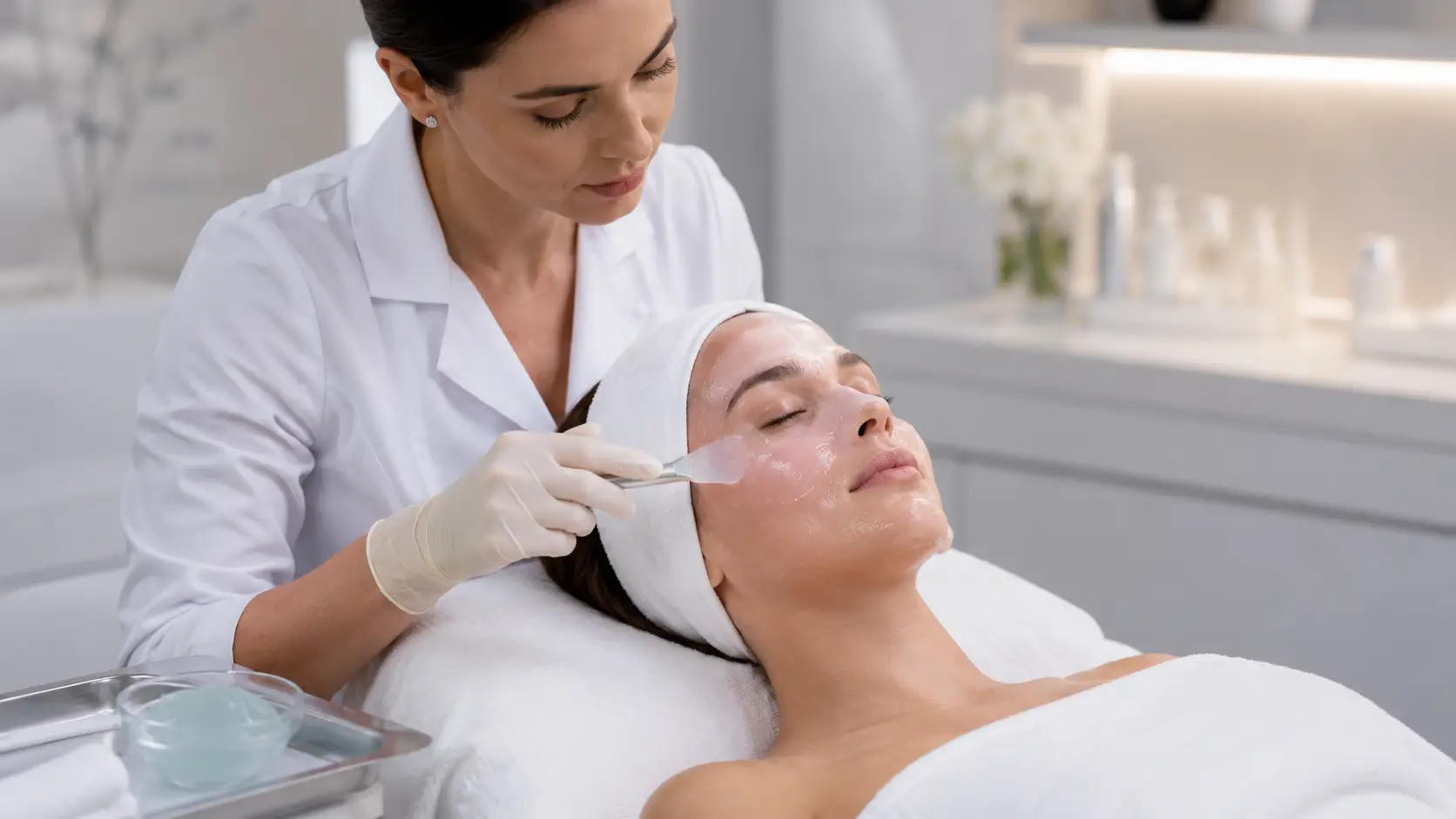
Should Jelly Masks Cover the Eyes During a Professional Facial?
Professional jelly masks can safely cover closed eyelids when the formulation is fragrance-free, free from synthetic dyes and sensitizers, and when the client has been assessed for contraindications. However, many estheticians use under-eye patches alongside the jelly mask rather than full eyelid coverage, which addresses the periorbital area while eliminating any risk of product contact with the eye itself. Neither approach is universally correct — the right technique is determined by client assessment, formulation safety review, and protocol context.
- A properly mixed jelly mask that has reached working consistency does not migrate or drip onto the eye — set behavior is what makes periorbital application safe in a professional context.
- Clients with lash extensions require strict avoidance of eye area coverage — the gel can adhere to extension fibers and cause damage or premature loss during removal.
- Contact lens wearers should remove lenses before any jelly mask treatment where eye area coverage is planned.
- Under-eye hydrogel or collagen patches used beneath a jelly mask deliver targeted periorbital treatment while providing a physical barrier that protects the immediate eye zone.
- Fragrance-free formulation is the non-negotiable safety prerequisite for any jelly mask applied in proximity to the eye area — especially on post-treatment or sensitized skin.
- Client intake assessment should identify all periorbital contraindications — extensions, lenses, sensitivity, claustrophobia — before the first jelly mask treatment.
Ask a room full of licensed estheticians whether a jelly mask should cover the eyes, and you will get a range of confident but contradictory answers. Some practitioners routinely apply full-face coverage including the eyelids. Others leave a defined margin around the entire orbital zone. Many use under-eye patches beneath the jelly mask as a hybrid solution. A small number avoid the eye area entirely for all clients.
The reason for this variation is not disagreement about safety — it is that the correct technique genuinely depends on variables that differ from client to client and treatment to treatment. Formulation ingredients, client contraindications, protocol context, and the esthetician’s training and comfort level all legitimately influence the right decision for any individual service.
This guide gives estheticians a complete, structured answer to the eye coverage question: the anatomy of the periorbital zone that makes it a special consideration, the formulation safety criteria that determine whether eye coverage is appropriate, the specific contraindications that require technique modification, the standard approaches used across professional practice, and how to incorporate this decision into client intake and pre-treatment assessment so it is never made on the fly.
What You Need to Know About Jelly Masks and the Eye Area
- Eye area coverage with a jelly mask is safe for most clients when formulation and contraindication criteria are met — it is not universally prohibited.
- The periorbital skin is significantly thinner and more permeable than the rest of the face, making fragrance-free and sensitizer-free formulation a stricter requirement in this zone.
- Lash extensions are an absolute contraindication for eyelid coverage — no exceptions.
- Contact lenses must be removed before any eye area coverage is applied.
- Under-eye patches used beneath a jelly mask are the most widely recommended professional technique for delivering targeted periorbital treatment without risk.
- A poorly mixed or under-set mask carries greater eye area risk than a properly prepared, fully set mask — technique quality directly determines safety.
- The client intake form should include specific questions about lash extensions, contact lenses, eye sensitivity, and claustrophobia before any jelly mask treatment.
- Explaining your eye area technique before application builds client trust and prevents anxiety during the treatment.
Why the Eye Area Is a Special Consideration in Jelly Mask Application
Periorbital Skin Is Structurally Different From the Rest of the Face
The skin around the eyes — the periorbital zone — is among the thinnest and most delicate skin on the entire body. The eyelid skin measures approximately 0.5 millimeters in thickness, compared to 2 millimeters or more on the cheeks and forehead. This anatomical difference has direct implications for topical product application: thinner skin means higher permeability, reduced barrier function, and greater potential for both beneficial ingredient delivery and adverse sensitization responses.
The periorbital zone also contains fewer sebaceous glands than the rest of the face, making it more prone to dryness, and has a significantly higher density of fine movement lines due to continuous facial expression. Blood vessels are closer to the surface, contributing to the visual appearance of dark circles and making the zone more reactive to temperature and vascular changes during treatment.
For estheticians making eye coverage decisions, these structural differences translate into two concrete requirements: the formulation must be clean and sensitizer-free to a higher standard than for general facial application, and the application technique must account for the different set and adhesion behavior on thinner, less textured skin.
What Actually Poses the Risk — and What Doesn’t
A common misconception is that jelly masks are inherently dangerous near the eye area. The actual risks are more specific. The primary risk factors are:
- Pre-set migration: A mask that is too thin or too liquid at the point of application can migrate before it sets, potentially contacting the conjunctival surface. This is a mixing and timing failure, not a formulation failure per se.
- Fragrance and sensitizer contact: Any fragrance compound, synthetic dye, or sensitizing additive in the formulation can cause a significantly greater adverse response near the eye area than on less permeable facial skin.
- Lash extension adhesion: Jelly mask gel can bond with the adhesive used in lash extensions and cause mechanical damage during removal.
- Contact lens presence: If product contacts the eye directly, contact lens wearers face a higher risk of corneal irritation from lens-product interaction.
A properly mixed, fully set, fragrance-free jelly mask applied with good technique to a client without lash extensions and with lenses removed does not carry meaningful risk for eyelid coverage. The risks listed above are largely preventable through formulation selection, intake assessment, and technique quality.
The Three Standard Approaches Estheticians Use for the Eye Area
In professional practice, three distinct techniques are used when applying jelly masks around the eye zone. Each has appropriate use cases, and understanding all three allows estheticians to adapt their approach based on client assessment rather than defaulting to a single method for all clients.
Approach 1: Full Eyelid Coverage
The mask is applied across the entire face including closed eyelids, with a small margin maintained around the inner corner of the eye near the tear duct and the immediate lash margin. The mask extends across the upper eyelid and below the lower lash line onto the under-eye area.
This approach produces the most immersive client experience. The weight and cooling sensation of a set jelly mask over the eyelids is frequently cited by clients as one of the most distinctive and enjoyable aspects of the treatment. Estheticians working with this approach confirm that client relaxation scores and treatment satisfaction are typically highest with full facial coverage, including the eyelids.
Full eyelid coverage is appropriate when the formulation is confirmed fragrance-free and clean-label, the client has been assessed and has no contraindications (no lash extensions, lenses removed, no reported eye sensitivity, no claustrophobia concerns), and the esthetician is experienced with jelly mask mixing consistency sufficient to control application before set.
Approach 2: Eye Area Exclusion With Defined Margin
The mask is applied to the full face excluding a clear margin around the orbital bone. Typically this means stopping approximately 5 to 8 millimeters above the lower lash line on the under-eye area, and leaving the upper eyelid uncovered. The mask covers the cheek and brow zones but not the eyelid surface.
This approach is the most conservative and is appropriate for any situation where contraindications are present or uncertain, where client preference is for open eyes during the treatment, or where the esthetician’s formulation has not been specifically assessed for periorbital safety. It is also the recommended default for new clients at their first jelly mask appointment, prior to full intake assessment.
Approach 3: Under-Eye Patches Beneath the Jelly Mask
Hydrogel or collagen eye patches are applied to the under-eye area before jelly mask application. The jelly mask is then applied over the full face, covering the upper eyelid and coming up to but not overlapping the eye patches on the lower orbital zone.
This is widely considered the most professionally sophisticated technique. It delivers targeted under-eye treatment — hydration, depuffing, brightening, or firming depending on the patch formulation — simultaneously with the full-face jelly mask treatment. The patches act as both a treatment vehicle and a physical barrier that protects the immediate periorbital tissue. This combination approach adds a visible luxury element that clients consistently respond to positively and that creates a natural conversation point for retail recommendations.
When Should You Absolutely Avoid Covering the Eyes With a Jelly Mask?
Several contraindications require either strict eye area exclusion or a fully modified approach. These are not judgment calls — they are professional non-negotiables that should be identified at intake and documented in the client record.
Lash Extensions Present
Jelly mask gel can adhere to lash extension fibers and bond with the cyanoacrylate-based adhesive commonly used in professional extensions. Removal of the set mask can cause mechanical stress on extensions, leading to premature loss, clumping, or damage to the natural lash. Document lash extension status at every appointment — clients frequently get extensions between visits without updating their intake form.
Contact Lenses Not Removed
If product contacts the eye directly with contact lenses in place, the risk of corneal irritation from product-lens interaction is significantly elevated. Any client presenting for jelly mask treatment who wears contact lenses should remove them before treatment begins, regardless of whether eye coverage is planned. Partial eye area coverage does not eliminate this requirement.
Recent Periorbital Procedure
Clients who have undergone blepharoplasty, periorbital laser resurfacing, Botox or filler in the orbital zone, or any other recent periorbital medical procedure should have the eye area completely excluded until the treating physician has confirmed full recovery and cleared topical treatment.
Known Eye Sensitivity or Allergy History
Clients with a history of contact dermatitis around the eyes, identified fragrance sensitivity, or any previous adverse reaction to topical products near the eye area should have the eye zone excluded and the approach adjusted to Approach 2 or Approach 3 until full ingredient review confirms safety.
Claustrophobia or Anxiety About Being Covered
Some clients experience significant discomfort or anxiety when the eyes are covered during a facial treatment. This is not a medical contraindication but is a meaningful comfort and experience consideration. Ask directly during intake: “Some clients prefer their eyes to be left open during the mask — would you prefer that?” Never cover the eyes without explicit client acknowledgment.
Fragrance or Colorant in the Formulation
If the jelly mask formulation in your treatment room contains synthetic fragrance or artificial dyes and has not been confirmed fragrance-free, it should not be applied to the eyelids or in proximity to the tear duct. This is a formulation disqualifier for periorbital use, not a client-specific contraindication.
Practical Application Technique for the Eye Area
Timing the Application to Prevent Pre-Set Migration
The window between mask mixing and initial set is the highest-risk period for product migration. Estheticians who work with full eyelid coverage consistently apply the eye area last — after the neck, décolleté, forehead, cheeks, and chin are covered — so that the working mix is slightly more viscous by the time it reaches the eyelid zone. This reduces the risk of over-fluid product running toward the inner corner of the eye before set begins.
Some practitioners mix a slightly thicker consistency for the final scoop used over the eye area specifically. If your formulation and mixing protocol allow for this adjustment without affecting overall mask performance, it is a useful technique for high-frequency practices where eye coverage is routinely performed.
The Inner Corner and Tear Duct Margin
Regardless of which approach you use, maintaining a clear margin at the inner corner of each eye — the medial canthus, where the upper and lower eyelids meet and where the lacrimal puncta (tear ducts) are located — is standard professional technique. A margin of approximately 3 to 5 millimeters at this zone prevents any possibility of product contact with the tear duct opening. This margin should be maintained even during full eyelid coverage applications.
Application Pressure and Direction
On the upper eyelid, mask should be applied with extremely light pressure using a fan brush or flexible spatula, in a single smooth pass from the inner to outer orbital margin. Do not work the mask back and forth over the eyelid skin. On the under-eye area (when not using patches), apply in a single pass from the inner corner toward the temple, staying below the lower lash line.
Estheticians incorporating Poly-Luronic™ Jelly Masks by Luminous Skin Lab into full-face protocols consistently find that the formulation’s predictable viscosity at mixing makes the timing decision for eye area application straightforward: the mix reaches a workable but non-migrating consistency within 45 to 60 seconds, which is the window most experienced practitioners use to cover the remainder of the face before approaching the periorbital zone.
In practices where under-eye patches are used beneath the jelly mask, estheticians report that applying the patches first — then layering the Poly-Luronic™ mask over the full face including the upper lid — creates a visually striking layered application that clients frequently photograph and share. The clean-label, fragrance-free formulation means there is no hesitation about proximity to the eye area on suitable clients, and the PGA + HA dual-humectant system means the periorbital skin benefits from the same complete hydration mechanism as the rest of the face during the treatment window — something HA-only formulations do not deliver with the same depth of effect.
The Under-Eye Patch Technique in Detail
For estheticians using the patch-beneath-jelly-mask approach, the sequence is as follows. After serum application and pre-mask skin preparation, place hydrogel or collagen eye patches on the under-eye area, pressing gently to secure adhesion. Apply the jelly mask starting from the neck and working upward. On the lower orbital zone, apply the mask to the top edge of the patch, creating a seamless coverage that blends the patch treatment visually into the full-face mask. On the upper eyelid, apply as described above if full coverage is planned, or leave uncovered per the client’s preference. When removing the set mask, peel from the outer edge of the face inward. Remove the eye patches separately after the jelly mask is fully removed, following the patch manufacturer’s removal instructions.
How to Talk to Clients About Eye Area Coverage Before and During Treatment
The Intake Conversation
Eye area protocol should be addressed during the client intake assessment, not at the moment of mask application. The intake form should ask about lash extensions (including whether recent extensions have been applied since the last visit), contact lens use, history of eye sensitivity or periorbital reactions, and any recent medical or cosmetic procedures to the eye area. Verbally confirm the answers during the pre-treatment consultation.
In practices where full eyelid coverage is routinely offered, add a brief explanation to the standard service description: “Our jelly mask is a full-face treatment that includes the eyelids for clients who are comfortable with that — it creates a really immersive experience. We always use under-eye patches underneath. If you’d prefer your eyes to be left uncovered, that’s completely fine too.” Framing it as an option rather than a procedure that happens to the client gives them genuine choice and reduces any anxiety about the experience.
Setting Expectations for the Sensory Experience
Clients who have never had a jelly mask applied over closed eyelids will sometimes tense up when they feel the cool gel being placed on the lid. A brief verbal cue immediately before application eliminates this response: “I’m going to apply the mask over your eyelids now — it will feel cool and slightly heavy as it sets.” The cooling weight sensation, once clients understand it is coming, is almost universally experienced as pleasant and deeply relaxing.
Why Full Eye Coverage Creates the Most Memorable Treatment Experience
The jelly mask removal moment — peeling the set mask as a single intact piece — is consistently cited as the most distinctive and memorable element of the treatment in client feedback. When the mask covers the full face including the eyelids, the removal experience is more complete and dramatic. Clients frequently describe it as one of the most satisfying physical sensations of any facial treatment they have received.
The periorbital zone also benefits meaningfully from the occlusive hydration mechanism during the set window. The thin eyelid skin, which typically receives less targeted treatment in a standard facial, absorbs the humectant system within the mask formulation during the treatment window. Clients who experience full eyelid coverage for the first time consistently notice the visible difference in how the eye area looks post-treatment compared to protocols that exclude it.
The clinical and experiential case for full eye coverage, when contraindications are absent and formulation criteria are met, is strong. The default should not be exclusion — it should be assessment-informed decision-making that leads to the most complete treatment appropriate for each client.
Integrating Eye Area Assessment Into Your Standard Jelly Mask Protocol
Pre-Treatment Checklist for the Eye Zone
Before applying any jelly mask where the eye area will be covered or treated in proximity, confirm the following at each appointment, not just the first visit:
- Lash extension status — new extensions since last visit are a contraindication even if the intake form from a previous appointment noted none.
- Contact lenses removed and stored safely before treatment begins.
- No recent periorbital cosmetic or medical procedures since last visit.
- Client has confirmed comfort with or preference regarding eye area coverage.
- Formulation confirmed fragrance-free and dye-free — this should be a standing protocol standard, not a per-client review.
Documentation in Client Records
Document the eye area approach used at each appointment in the client record — this is not only good professional practice but also useful when reviewing treatment outcomes over time. If a client reports any unusual sensitivity or reaction in the periorbital zone following a treatment, the documented approach allows you to identify whether technique or formulation was a contributing variable.
Adapting the Approach as the Client Relationship Develops
Many estheticians begin new clients with eye area exclusion or the patch-beneath-jelly-mask approach at the first appointment, then transition to full eyelid coverage once they have confirmed the client’s skin response and comfort level over one or two sessions. This graduated approach builds client confidence in the technique and allows the esthetician to observe any periorbital sensitivity before committing to full coverage as a standard protocol element.
Professional References and Clinical Context
The protocols and safety criteria referenced in this article draw from professional esthetics practice standards and cosmetic formulation science:
- Periorbital skin thickness and permeability characteristics. Dermatological anatomy literature; standard esthetics education curricula. Eyelid skin measures approximately 0.5mm, significantly thinner than the average 2mm on the cheeks and forehead, conferring elevated permeability and sensitization potential.
- Cyanoacrylate-based lash extension adhesive incompatibility with occlusive gel formulations. Professional lash industry safety standards; esthetics cross-service contraindication guidelines. Mechanical stress on extension bonds during gel removal confirmed as primary damage mechanism.
- Fragrance sensitization in periorbital and perioral zones. Contact dermatitis literature; EU cosmetic regulation guidance on fragrance allergens. Higher sensitization response rates documented in thin-skin facial zones vs. general facial skin.
- Under-eye patch compatibility with occlusive mask layering techniques. Professional esthetics continuing education; manufacturer protocol documentation.
- Polyglutamic acid periorbital and general skin barrier support mechanisms. MDPI 2024; Typology 2021–2025. Referenced in the context of periorbital application: PGA surface film formation and hyaluronidase inhibition are particularly relevant in thin, high-permeability periorbital skin.
For estheticians evaluating which jelly mask formulation meets the safety standard for professional periorbital application, fragrance-free and clean-label are the foundational criteria — and they are where much of the professional jelly mask market falls short. The Poly-Luronic™ Jelly Mask by Luminous Skin Lab was developed fragrance-free, without synthetic dyes, and without unnecessary sensitizing additives, specifically for professional treatment room use where post-treatment and sensitive skin protocols are the standard context. The PGA + HA dual-humectant system delivers the same complete hydration mechanism to the periorbital zone as to the rest of the face during the treatment window — making full-face coverage, including the eyelids, both safe and clinically effective on suitable clients.
Explore the Poly-Luronic™ Jelly Mask LineFrequently Asked Questions: Jelly Masks and Eye Area Coverage
Should jelly masks cover the eyes during a professional facial?
It depends on the formulation, client, and protocol. Professional jelly masks can be safely applied to cover closed eyelids when the formulation is fragrance-free, free from sensitizing additives, and when the client has been assessed for contraindications. Many estheticians choose to leave the immediate eye area open and use dedicated under-eye patches instead, which allows for targeted eye-area treatment alongside the jelly mask without any risk of product migration.
Is it safe to put a jelly mask over closed eyes?
For most clients, applying a professional jelly mask over closed eyelids is safe provided the formulation is fragrance-free and free from synthetic dyes and sensitizers. The set mask forms a stable gel layer that does not migrate or drip when properly mixed. However, clients with contact lenses, eye sensitivity, claustrophobia concerns, or lash extensions require modified technique — typically leaving a clear margin around the eye area or using eye pads as a barrier.
Why do some estheticians avoid putting jelly masks over the eyes?
Estheticians avoid eye coverage for several reasons: client discomfort or anxiety, presence of contact lenses or lash extensions, sensitivity to any ingredients in the formulation, or professional preference for pairing the jelly mask with separate under-eye treatment patches. There is no universal rule requiring eye area exclusion — the decision is protocol-specific and client-specific, informed by intake assessment and formulation safety review.
What happens if jelly mask gets into a client’s eyes?
If jelly mask product contacts the eye directly — which is most likely to occur during application before the mask has set, not after — flush the eye thoroughly with clean water and have the client remove any contact lenses immediately. A properly set jelly mask does not migrate, so direct eye contact is most likely an application technique issue rather than a formulation failure. Always maintain a small clear margin around the inner corner of the eye and the tear duct area regardless of whether you cover the lid.
Should you use eye patches under a jelly mask?
Using hydrogel or collagen eye patches under a jelly mask is a widely used and highly effective technique. The eye patches provide targeted under-eye treatment — hydration, depuffing, or brightening — while the jelly mask is applied over and around them. The patches also act as a physical barrier that protects the immediate periorbital area and give clients a clear visual cue that the eye zone is being specifically cared for. This combination approach is considered a luxury service enhancement by many estheticians.
Can you cover lash extensions with a jelly mask?
No. Jelly mask should not be applied over lash extensions. The gel can adhere to individual extension fibers and cause damage or premature loss during removal. For clients with lash extensions, always apply the mask below the lower lash line on the under-eye area only — or skip the orbital region entirely — and note the contraindication during intake assessment.
How far away from the eye should you stop when applying a jelly mask?
When not covering the eyelids, most estheticians maintain a margin of approximately 5 to 8 millimeters from the orbital bone — stopping above the under-eye hollow and below the brow bone. When applying over closed eyelids, the mask can extend across the full lid but should stop just short of the inner corner near the tear duct and the immediate lash margin to prevent any risk of product contacting the eye directly.
Does covering the eyes with a jelly mask change how the treatment feels for clients?
Yes, noticeably. Clients who have experienced jelly masks both with and without eye coverage consistently report that full-face coverage — including closed eyelids — produces a more immersive, cocoon-like sensory experience. The cooling weight of the set mask over the eyelids is frequently described as deeply relaxing. Some clients with anxiety or claustrophobia may prefer open eye coverage; intake assessment before first treatment identifies preferences and contraindications.
Does the Poly-Luronic™ Jelly Mask formulation make it safer to use around the eyes than other brands?
The Poly-Luronic™ Jelly Mask by Luminous Skin Lab is formulated fragrance-free and without synthetic dyes or unnecessary sensitizing additives — the key safety criteria that make any professional jelly mask appropriate for periorbital application on suitable clients. Because the formulation contains PGA and HA rather than fragrance compounds or artificial colorants, estheticians applying it near the eye area are working with a clean-label formulation specifically developed for professional treatment room use, including post-treatment protocols where skin sensitivity is elevated.
The Eye Area Is a Decision, Not a Default
Whether a jelly mask should cover the eyes is not a yes or no question with a universal answer — it is a protocol decision that should be made deliberately, informed by formulation safety, client intake assessment, and the specific treatment context. Estheticians who approach it this way consistently deliver better treatment outcomes and client experiences than those who default to either full coverage or full exclusion without considering the variables that legitimately determine the right approach for each individual client.
The most professionally sound framework is straightforward: use a fragrance-free, clean-label formulation as your non-negotiable starting point; identify and document contraindications at intake; offer full eyelid coverage with under-eye patches as your standard luxury protocol for suitable clients; and apply the conservative exclusion approach for any situation where contraindications are present or where client preference is for open eyes. Most clients, when the approach is explained clearly and the treatment is delivered with technique confidence, respond positively to full-face coverage — and the periorbital hydration benefit they receive is genuinely meaningful.