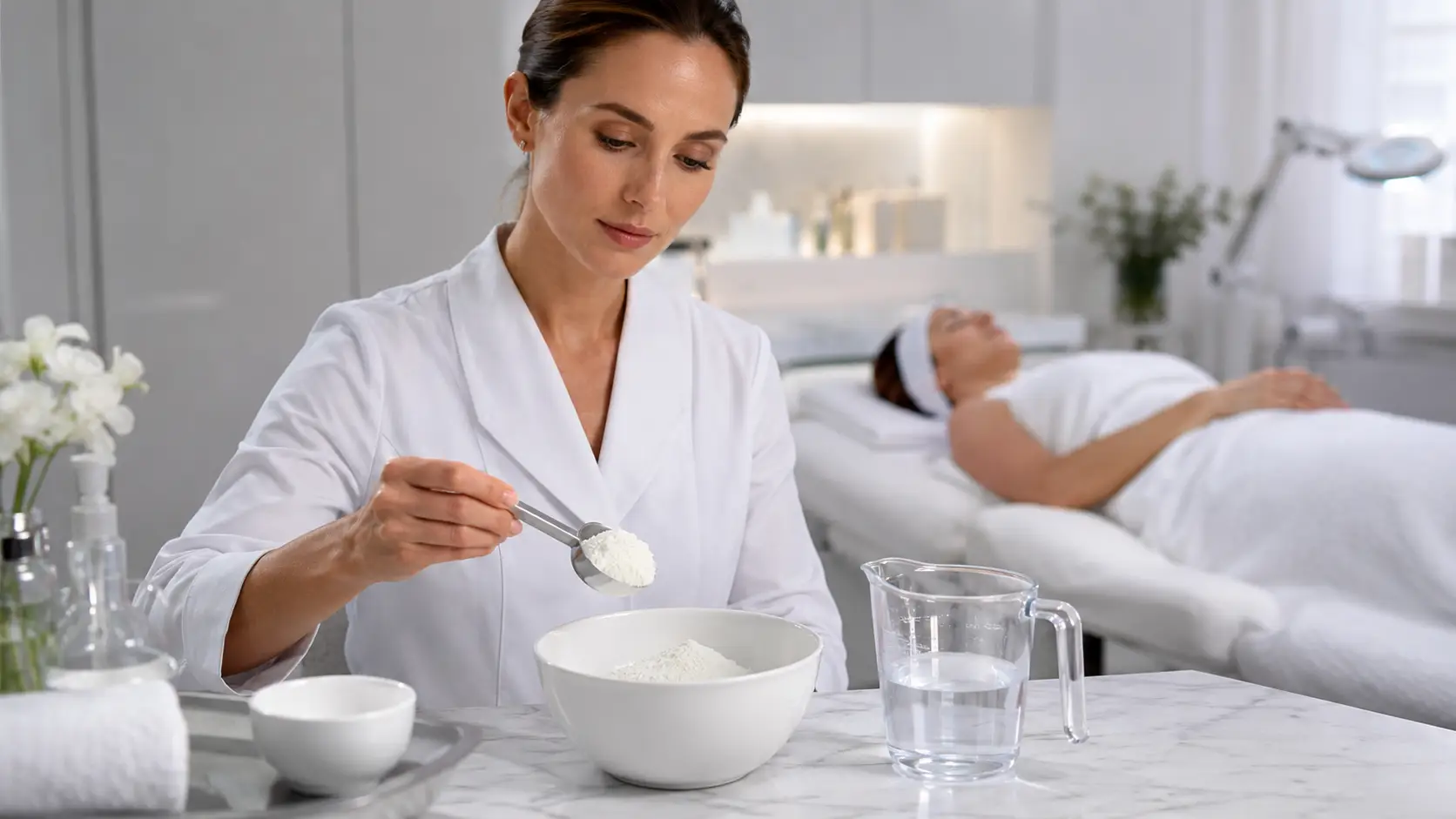
Can Two Scoops of Jelly Mask Powder Cover a Full Face?
Yes — two standard scoops of jelly mask powder mixed at the correct ratio will cover a full adult face in most cases. At a 1:1 powder-to-water ratio, two level scoops produce enough gel to cover the face from hairline to chin and ear to ear at a professional application thickness of approximately 5 to 7 millimetres. However, the outcome depends on scoop size, face size, mixing ratio, application speed, and whether gauze is used as a base layer.
- The standard professional ratio is 1:1 by volume — two scoops of powder to two equal measures of water. Some formulations specify 2:1 powder to water; always verify the manufacturer’s recommendation first.
- Clients with larger or longer faces may require two and a half or three scoops. Pre-measuring extra powder before beginning application removes the risk of running short mid-application.
- Water temperature matters significantly: cooler water (15–20°C) extends working time; warmer water accelerates set and reduces the usable application window.
- Using gauze underneath the mask absorbs some gel volume and typically requires an additional half scoop to maintain coverage thickness.
- A gel layer thinner than 4 millimetres risks cracking during removal. Consistent thickness across the face matters more than the precise amount used.
- If the mix runs short mid-application, do not attempt to patch with a new mix — the set gel will not bond uniformly with fresh material.
This is one of the most commonly asked practical questions among estheticians learning to work with jelly masks — and one that gets a surprisingly inconsistent answer depending on who is doing the asking and which brand they are using. The short answer is yes, two standard scoops will typically cover a full adult face. But as with most things in professional esthetics, the practical answer has variables that matter enormously in a real treatment room setting.
Running short of gel mid-application is among the most disruptive things that can happen during a jelly mask service. Unlike a cream or serum where you can simply add more product to a partially treated area, a jelly mask that has begun to set cannot be blended with fresh material. The result is an uneven, patchy removal experience that undermines both the professional appearance of the service and the signature single-piece peel-off moment clients remember and talk about.
This article breaks down exactly what determines full-face coverage from a two-scoop mix, what variables change that equation, how to adjust for different client face sizes, and what practical protocols estheticians use to prevent coverage problems before they start.
What Every Esthetician Should Know About Jelly Mask Coverage
- Two level scoops at a 1:1 powder-to-water ratio is the standard starting point for full facial coverage — it works for most average adult face sizes.
- Scoop size varies between brands and between product lines from the same brand. Always verify what the included scoop measures before assuming equivalence.
- Application thickness of 5 to 7 millimetres is the professional standard — this is what produces a structurally sound mask that removes cleanly in one piece.
- Water temperature is one of the most controllable variables affecting working time. Cooler water gives more time; warmer water accelerates set.
- Pre-measuring extra powder before the service begins — not during — is the professional standard for avoiding short-coverage situations.
- Gauze application requires additional powder to compensate for absorption into the fabric layer.
- Practice consistency of mixing technique and application speed across multiple sessions before treating clients with complex protocols.
What Does “Two Scoops” Actually Mean in Practice?
Before answering whether two scoops covers a full face, it is worth clarifying what “two scoops” means in measurable terms — because this is where significant variation enters the equation between different jelly mask brands and product lines.
Scoop Size Is Not Standardized Across Brands
Most professional jelly mask products include a branded measuring scoop, but the size of those scoops varies considerably. A “scoop” from one brand may hold 10 grams of powder. A scoop from a different brand may hold 6 grams or 15 grams. Unless an esthetician is working with the same brand and the same scoop consistently, “two scoops” is an ambiguous unit of measure that means different things in different treatment rooms.
When switching brands or introducing a new jelly mask formulation into your practice, always weigh out the scoop volume using a small kitchen or laboratory scale before assuming that two scoops of the new product will behave the same as two scoops of a previous brand. This single step eliminates most first-use coverage surprises.
The Volume That Actually Matters: Mixed Gel Yield
What determines facial coverage is not the dry powder volume — it is the total volume of mixed gel produced by the combined powder and water at the specified ratio. Powder that is denser or finer-milled will hydrate differently and produce a different gel volume from the same scoop mass. The practical test estheticians use is straightforward: mix the recommended dose, apply at professional thickness, and observe whether the yield covers the full face with a small amount remaining in the bowl as a safety margin.
Experienced estheticians working in high-volume treatment rooms typically mix a slightly larger batch than the minimum — the small amount of leftover gel in the bowl is the professional safety net that prevents short coverage mid-application.
The Standard Benchmark: How Much Mixed Gel Does a Full Face Require?
At a professional application thickness of 5 to 7 millimetres, covering the full face from the hairline to the chin and from ear to ear requires approximately 80 to 110 millilitres of mixed gel, depending on face geometry. Most professional jelly mask formulations at a standard two-scoop mix produce between 90 and 120 millilitres of mixed gel — placing the two-scoop benchmark within workable range for average adult faces with a small margin for application variation.
What Variables Change Whether Two Scoops Is Enough?
Understanding the variables that affect coverage volume is the practical knowledge that separates estheticians who handle jelly masks confidently from those who encounter consistent application problems. The core variables are face size, mixing ratio, water temperature, application technique, and whether gauze is part of the protocol.
Face Size and Geometry
Human faces vary considerably in surface area. A petite client with a narrow, oval face requires meaningfully less gel than a client with a broad, long, or square face structure. The difference in gel requirement between the smallest and largest adult faces can reach 30 to 40 percent — enough to make a two-scoop mix comfortably sufficient in one case and clearly inadequate in another.
Estheticians who routinely see clients with larger face structures quickly learn to default to two and a half or three scoops as their standard mix. The small additional cost of unused gel in the bowl is far preferable to the service disruption of running short mid-application.
Mixing Ratio: Powder-to-Water Balance
The standard ratio for most professional jelly masks is 1:1 by volume — equal parts powder and water. Some formulations specify 2:1 powder to water, which produces a denser, faster-setting gel. Deviating from the specified ratio changes not just set time but the total workable volume of gel.
Adding more water than specified does increase total volume, but produces a thinner gel that may not achieve the thickness needed for clean single-piece removal. It also accelerates set time due to reduced viscosity. The ratio specified by the manufacturer is optimized for both yield and performance — changing it compromises both.
Water Temperature
Water temperature is one of the most directly controllable variables in jelly mask mixing. Cooler water — in the range of 15 to 20 degrees Celsius — slows the chemical set reaction, extending the working window between mixing and gel firm enough to resist spreading. Warmer water accelerates set, shortening the usable application time and increasing the risk that the gel begins to firm before the face is fully covered.
For estheticians who find themselves routinely running short on application time rather than gel volume, cooler water is the first and most effective adjustment. This single change can extend the working window from under two minutes to three or four minutes for slower, more methodical application styles.
Application Speed and Technique
The rate at which an esthetician applies gel to the face directly affects whether two scoops covers completely before set begins. A hesitant, slow application spreads the gel thinner in some areas and thicker in others, burning through volume unevenly and consuming more material per unit of coverage than a confident, flowing technique. Estheticians learning jelly mask application almost universally report that practicing on a mannequin head or model before treating paying clients is the single most effective way to develop the technique consistency that makes two-scoop coverage reliable.
Gauze Usage
Placing a layer of gauze on the skin before jelly mask application is a technique some estheticians use to aid removal, particularly on clients with facial hair or very sensitive skin. However, gauze absorbs a portion of the applied gel before it sets, reducing the effective thickness of the mask on the skin surface. Estheticians who use gauze consistently find that an additional half scoop to one full scoop per application compensates adequately for absorption and restores the thickness needed for clean removal.
How Should Estheticians Set Up Before Mixing to Guarantee Coverage?
The most experienced jelly mask practitioners in professional treatment rooms do not leave coverage to chance. They establish a pre-application setup protocol that removes every variable they can control before the gel is ever mixed. By the time gel touches the bowl, the outcome should already be predictable.
Pre-Measure Before You Mix
The single most effective coverage insurance measure is pre-measuring an extra half scoop of powder and setting it alongside the mixing bowl before beginning. If two scoops covers the face with gel to spare, the extra powder goes back into the container. If the face is larger than expected or the application runs slightly thin in one area, you have the option to quickly mix the extra powder with a small amount of water to address gaps — though this only works if the existing gel has not yet begun to set. The option cost is negligible; the benefit is complete peace of mind during application.
Calibrate Your Water Temperature
Before mixing, check that your water source is delivering cool water. In treatment rooms where the tap water runs warm, estheticians use a small pitcher with ice added briefly before removing the ice and measuring water for mixing. Keeping water temperature consistently in the 15–20°C range makes working time predictable across every service, regardless of room temperature or time of year.
Practice Application Sequence Before Client Is on the Table
Estheticians who are newer to jelly mask application benefit from visualizing the application sequence before mixing: start at the forehead, work outward to the temples, move to the cheeks and nose, then finish at the chin and jaw. The forehead has the largest flat surface area and should be covered first while gel is at peak fluidity. Finishing at the chin and jaw when gel has thickened slightly is less problematic because those areas have less surface to cover and the esthetician is moving toward completion.
Estheticians who have incorporated the Poly-Luronic™ Jelly Mask by Luminous Skin Lab into high-volume schedules frequently note that coverage reliability across back-to-back appointments was a meaningful practical consideration in their brand decision. Because the PGA-forward gel body has slightly more structural density than comparable alginate-only formulations, the mixed gel holds its spread thickness more consistently during application — meaning the same two-scoop mix applied with the same technique produces a more uniform layer thickness without the gel thinning at the edges as it is worked across the face.
In practice, estheticians report mixing two level scoops at a 1:1 ratio with 18°C water and completing full-face application including forehead, nose, cheeks, and jawline within approximately 90 seconds using a fan brush, leaving a small amount of gel in the bowl as confirmation that coverage was complete. For clients identified during skin assessment as having larger face structures, they pre-stage an additional half scoop before the service begins rather than remixing mid-appointment. This operational detail — planning for the larger client before you start — is what separates a service that always runs smoothly from one that occasionally creates awkward recovery moments.
What to Do If You Run Short Mid-Application
If despite preparation the mix does run short before the face is fully covered, the practical response depends on how far the existing gel has progressed toward setting. If the gel in the bowl is still fully fluid and workable, extending it with a small amount of additional water can recover enough volume to complete the coverage — understanding that this will thin the consistency slightly and may affect set integrity at the under-covered areas. If the gel in the bowl has already begun to thicken significantly, the better decision is to communicate with the client, remove the partial application cleanly, and re-mix a full fresh batch. A graceful recovery handled professionally leaves a better impression than a visibly compromised application.
How Does Application Thickness Affect Coverage Calculation?
Coverage is not just about whether gel reaches every part of the face — it is about whether it reaches every part at a thickness that supports clean, intact removal. A mask applied too thinly in sections will crack or tear during removal rather than peeling off in a single piece. Understanding the relationship between thickness and volume helps estheticians calibrate their mixing decisions more precisely.
The 5 to 7 Millimetre Standard
A professional jelly mask application thickness of 5 to 7 millimetres is the accepted standard for ensuring the structural integrity needed for single-piece removal. Below approximately 4 millimetres, the cured gel may not have enough tensile strength to hold together across the full face during peel removal. Above approximately 8 to 9 millimetres, the mask uses noticeably more product without delivering additional clinical benefit, and the greater mass can make removal uncomfortable for the client.
At 5 to 7 millimetres uniformly applied, a two-scoop mix at 1:1 ratio produces adequate coverage for an average adult face. The practical test after removal: the removed mask piece should feel substantial but not heavy, should retain its shape when held at one edge, and should not show obvious areas of translucency that indicate thin spots.
Thickness Versus Coverage Area Trade-Off
Every esthetician intuitively understands that applying gel thicker in some areas means less available for others. The common tendency among practitioners learning jelly masks is to apply too generously at the forehead — the first area worked and the one where they are most comfortable — and then apply progressively thinner as they move toward the jawline and the gel in the bowl decreases. The remedy is developing awareness of how much gel remains in the bowl relative to how much face area remains, and calibrating stroke weight accordingly. Some estheticians use a small offset spatula to spread evenly rather than a brush, which gives better visual and tactile feedback on thickness consistency.
Coverage Volume and Thickness: What the Numbers Mean
At a uniform 6 millimetre application thickness, covering an average adult face (approximately 100 square centimetres of treated surface) requires approximately 60 millilitres of mixed gel. A two-scoop mix at 1:1 ratio typically produces 90 to 120 millilitres of mixed gel, providing a comfortable 30 to 60 millilitre safety margin above the minimum required.
For a larger face at approximately 130 square centimetres, the same 6 millimetre thickness requires approximately 78 millilitres — still within the two-scoop yield for most formulations, but leaving a much smaller margin. This is precisely why larger-face clients benefit from a pre-staged extra half scoop before the service begins.
Extending coverage to the neck adds approximately 30 to 40 square centimetres, requiring an additional 18 to 24 millilitres of gel volume — approximately the yield from one additional half scoop for most formulations.
What Do Estheticians Need to Know About Coverage When Extending to the Neck?
A standard two-scoop mix is designed and calibrated for face-only application. Extending coverage to the neck or décolleté changes the volume calculation entirely and requires deliberate adjustment before mixing begins — not improvisation mid-application.
Neck Extension Protocol
When the treatment protocol includes neck coverage, estheticians should plan for an additional half scoop to one scoop of powder added to the initial mix. The neck surface area varies considerably between clients — a shorter neck requires less additional gel than a longer or wider neck. As a practical default, adding one full additional scoop when neck coverage is planned eliminates the risk of running short, with any excess remaining in the bowl.
A separate consideration for neck application: the angle at which gel is applied to vertical or angled neck surfaces differs from horizontal facial application. Gel applied to the neck has a tendency to run or thin toward the décolleté area if the client is not positioned with head sufficiently elevated. Positioning the treatment table at a slight incline and working quickly on the neck before the gel has thinned from running resolves this in most cases.
Décolleté Coverage Requires a Separate Mix
If the protocol calls for full décolleté coverage in addition to face and neck, the professional approach is to mix the décolleté portion as a second, separate batch rather than attempting to extend a single large batch across the full area. The décolleté is a significantly larger surface area than the face and requires more material than any reasonable single-batch adjustment can accommodate. Treating it as a separate service step — with its own measuring, mixing, and application sequence — preserves application quality and makes the total product quantity predictable and repeatable.
| Coverage Area | Approximate Surface | Gel Volume Needed | Scoops Required | Notes |
|---|---|---|---|---|
| Face only (average) | ~100 cm² | ~60 mL | 2 scoops | Standard mix, comfortable margin |
| Face only (large) | ~130 cm² | ~78 mL | 2.5 scoops | Pre-stage extra half scoop |
| Face + neck | ~140–150 cm² | ~90 mL | 3 scoops | Add 1 scoop to standard mix |
| Face + neck + décolleté | ~200+ cm² | ~120+ mL | Separate mix | Mix décolleté separately |
| Face (with gauze) | ~100 cm² | ~75 mL (gauze absorbs ~15 mL) | 2.5 scoops | Add ½ scoop to compensate |
Professional References
Application volume guidance in this article is derived from professional esthetician practice standards and formulation documentation in the professional jelly mask category:
- Professional jelly mask mixing and application technique standards. Luminous Skin Lab Education Team, 2026. Application thickness standard of 5–7 mm for single-piece removal integrity.
- Sodium alginate gel volume yield at standard 1:1 powder-to-water ratios. Professional esthetics formulation documentation, multiple brands.
- Water temperature effects on alginate gel set time. Applied cosmetic chemistry reference materials. Cooler water extends working window; temperature between 15–20°C recommended for professional application control.
- Average adult facial surface area estimates for coverage calculation. Dermatology and cosmetic science reference literature. Average adult face approximately 95–105 cm² treated surface.
For estheticians evaluating jelly mask formulations where coverage consistency and mixing predictability are primary operational considerations, the Poly-Luronic™ Jelly Mask by Luminous Skin Lab is formulated for standard two-scoop full-face coverage at a 1:1 ratio — with the included scoop sized specifically to that application standard. The PGA + HA dual-humectant gel structure maintains application thickness consistency from first stroke to last, reducing the edge-thinning that can occur with lower-viscosity single-humectant alternatives. Fragrance-free, clean-label, and designed for post-treatment protocol compatibility.
Explore the Poly-Luronic™ Jelly Mask Line →Frequently Asked Questions: Jelly Mask Coverage and Two-Scoop Mixing
Can two scoops of jelly mask powder actually cover a full face?
Yes, in most cases two standard scoops of jelly mask powder mixed at the correct ratio will cover a full adult face. Two level scoops of powder combined with the appropriate amount of water — typically in a 1:1 or 2:1 powder-to-water ratio by volume — produce enough mixed gel to cover the full face from hairline to chin and ear to ear at a professional application thickness of approximately 5 to 7 millimetres. However, the result depends heavily on scoop size, mixing ratio, application speed, and the individual client’s face size.
How much water do I mix with two scoops of jelly mask powder?
The standard starting ratio for most professional jelly mask powders is 1:1 by volume — equal parts powder and water. For two level scoops of powder, use two equal measures of water. Some formulations specify a 2:1 powder-to-water ratio, which produces a thicker, faster-setting gel. Always follow the manufacturer’s stated ratio first, then adjust based on your treatment room temperature and desired application thickness.
What happens if I use too little powder and the mask doesn’t cover the whole face?
If the mixed volume is insufficient, you will run out of gel before completing the application, leaving gaps at the hairline, jaw, or neck. Patching wet gel onto a partially set mask rarely works cleanly because the set gel will not bond uniformly with new material. The professional solution is to pre-measure and mix slightly more than you expect to need before beginning application, and to work quickly with a consistent spread technique.
Does face size change how many scoops I need?
Yes. Clients with larger faces, longer faces, or broader jawlines may require two and a half or even three scoops to achieve full coverage. Estheticians working with a diverse client base should keep extra pre-measured powder ready alongside the mixing bowl so additional material can be added to the mix before it sets, rather than remixing from scratch mid-application.
Why did my jelly mask set before I finished covering the whole face?
Premature setting during application is almost always caused by one of three factors: water that is too warm, a mixing ratio that is too dry, or a slow application technique. Cooler water — between 15 and 20 degrees Celsius — extends the working time before gel sets. Ensuring the ratio is not over-powdered and practicing a confident, flowing application motion will also give you a longer usable window after mixing.
How thick should the jelly mask layer be when I apply it?
A professional application thickness is approximately 5 to 7 millimetres — thick enough to form a structurally intact seal that peels off in one piece, but not so thick that the material becomes wasteful or difficult to remove. A layer thinner than 4 millimetres risks cracking and incomplete removal. Consistent thickness is more important than any specific measurement; practice creates the muscle memory for even distribution.
Should I include the neck and décolleté or just the face?
A standard two-scoop mix is formulated for face-only coverage from hairline to chin. If your protocol extends to the neck or décolleté, plan for an additional half scoop to one scoop of powder mixed separately or added to a larger initial mix. Extending coverage without enough material will stretch the gel too thin and compromise removal integrity.
Does using gauze underneath change how much powder I need?
Yes. When gauze is placed on the skin before mask application, the fabric absorbs some of the gel mixture, effectively reducing coverage volume. Estheticians who use gauze as part of their protocol typically add an extra half scoop to compensate for the absorption and ensure the outer gel layer still achieves the thickness needed for clean, intact removal.
How does the Poly-Luronic Jelly Mask compare on coverage per scoop?
The Poly-Luronic™ Jelly Mask by Luminous Skin Lab is formulated to full-face coverage with two standard scoops at a 1:1 ratio. Estheticians using the product report that the PGA-forward formulation produces a slightly denser gel body than single-humectant alternatives, which means the mixed volume spreads consistently without running or thinning at the edges — reducing the risk of short coverage on larger faces without requiring an extra scoop in most standard applications.
The Bottom Line on Two Scoops and Full-Face Coverage
For most professional estheticians working with most adult clients, two level scoops of jelly mask powder mixed at the correct 1:1 ratio with cool water will cover a full face. That is the honest baseline answer — and it is accurate for the majority of applications in a professional treatment room setting.
But the variables that change that answer — face size, water temperature, mixing ratio, application technique, and gauze usage — are all real, all practical, and all within an esthetician’s control with proper preparation. The esthetician who never runs short mid-application is not the one who has somehow found a magic formula: they are the one who pre-measures a safety margin, uses cool water consistently, applies with confidence, and knows exactly which clients in their books need an extra half scoop before the service starts.
Coverage confidence comes from preparation, not guesswork. Build the habits that eliminate the variables before the gel ever enters the bowl, and two scoops will be the right answer for almost every face you work with.