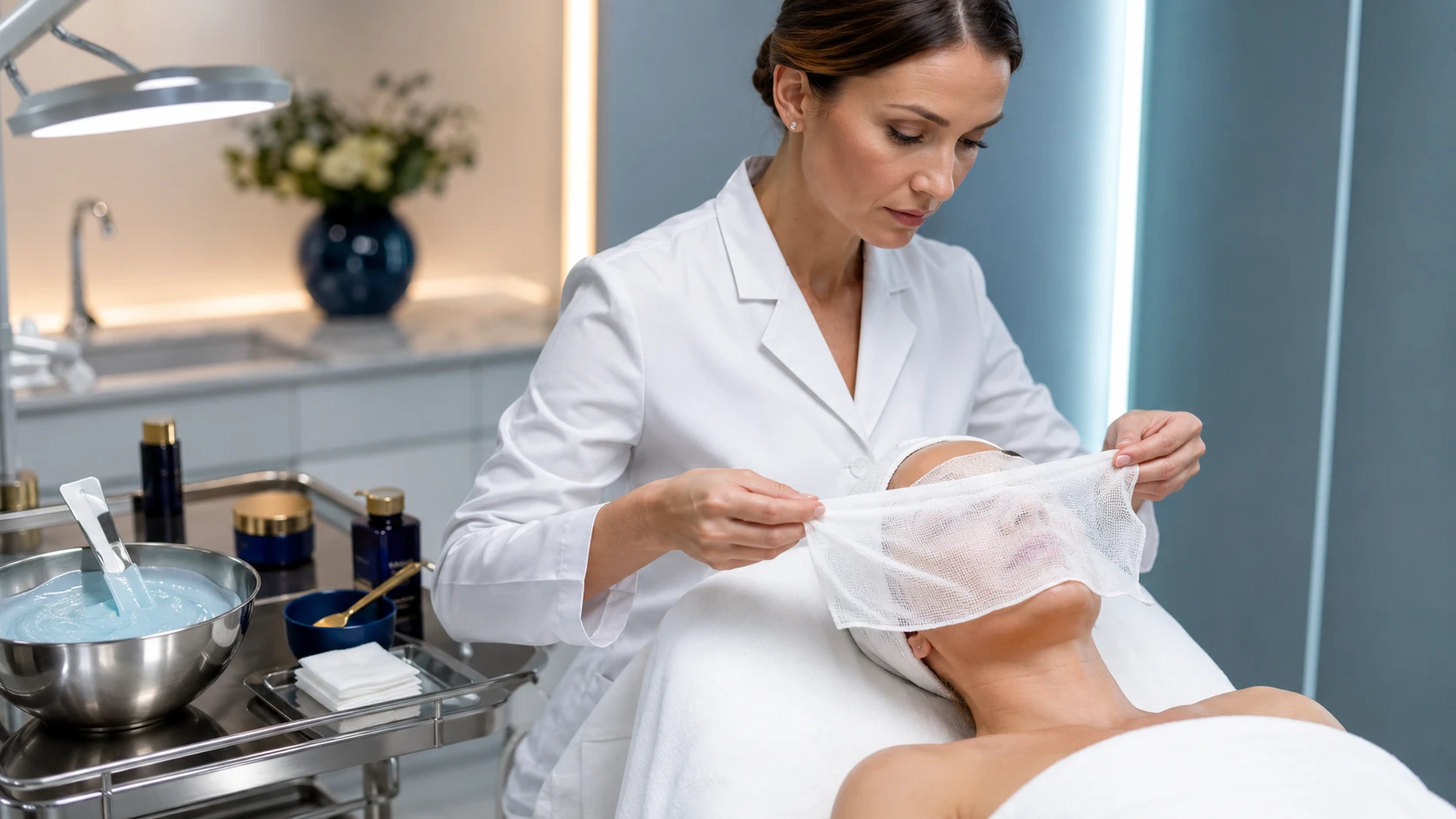
Should You Use Gauze Under a Jelly Mask?
Gauze is not a standard requirement for professional jelly mask application — it is a situational technique modifier with specific clinical indications. For most professional jelly mask services, particularly hydration-focused treatments where intact single-piece removal is the goal, gauze is unnecessary and reduces the occlusive skin contact that makes the format clinically effective. It is most appropriate for clients with dense facial hair, post-active-treatment skin that cannot tolerate direct peel adhesion, and controlled sectional removal scenarios.
- Gauze creates a textile scaffold within the mask batter that changes removal from a gel peel to a fabric-reinforced lift — more controlled, but without the signature single-piece gel removal experience.
- The physical gauze layer between the gel and the skin partially interrupts the direct occlusive contact that amplifies serum delivery — hydration outcomes are reduced compared to direct application.
- Gauze is the professional recommendation for post-microneedling, post-extraction, and other compromised-barrier applications where direct peel adhesion could cause discomfort or disrupt healing.
- Clients with significant facial hair are strong candidates for gauze regardless of treatment type, because gel trapped in hair creates a painful direct removal experience.
- Gauze should be lightly pre-moistened before mask application and embedded fully within the batter — not sitting on top of it.
- The gauze decision should be made per client and per service context, not applied as a universal default in either direction.
The question of whether to use gauze under a professional jelly mask is one of the most debated technique points among estheticians who are serious about their craft. It divides training programs, splits experienced practitioners, and generates strong opinions from both sides. The reality is that both positions contain truth — and neither side is universally correct.
Gauze, when used appropriately, solves real problems that arise in specific clinical scenarios. Gauze, when used indiscriminately as a default, reduces the most clinically meaningful aspect of the jelly mask format. The professional answer is not “always” or “never” — it is a scenario-by-scenario decision based on the client’s skin status, the treatment context, and the specific outcome the esthetician is trying to achieve.
This guide gives estheticians the clinical framework to make that decision correctly every time. We cover what gauze physically does to mask performance and removal, the precise scenarios where it is the right choice, the scenarios where it works against the treatment goal, and how to apply it correctly when it is indicated. That decision-making capability — rather than a blanket rule inherited from training — is what professional application technique looks like in practice.
What Every Esthetician Needs to Know About Gauze and Jelly Masks
- Gauze is a technique modifier with specific clinical indications — not a universal standard or a universal mistake.
- For hydration-focused facials, gauze reduces the direct occlusive skin contact that makes professional jelly masks clinically superior to consumer formats — skip it unless there is a specific reason to use it.
- For post-active-treatment applications on compromised skin, gauze reduces peel adhesion and makes removal safer and more comfortable — use it deliberately.
- Clients with significant facial hair are strong gauze candidates regardless of treatment type — direct gel removal through hair is painful and impractical.
- Gauze must be lightly pre-moistened and fully embedded within the batter — dry gauze placed on top of applied batter creates uneven texture and weak adhesion zones.
- A single layer of medical-grade gauze is the standard — double layers create excessive separation and significantly reduce skin contact and hydration delivery.
- The gauze decision is a clinical judgment made per service, not a protocol inherited as a universal rule from training environments.
What Gauze Actually Does Inside a Jelly Mask: The Physics of the Decision
Understanding what gauze physically does to a jelly mask during application, dwell time, and removal makes the gauze-or-no-gauze decision straightforward. Most of the debate around this topic happens in the absence of that understanding — practitioners have strong feelings about their approach without being able to articulate the mechanism behind it.
The Structural Scaffold Function
Sodium alginate gel, when set, has the tensile properties of a relatively fragile elastic film. Its removal integrity depends on the cross-link density achieved during gelation, the uniform application depth, and the angle and speed of the peel force applied. When gauze is embedded within the batter, the textile fibers create a structural scaffold that holds the gel in a single sheet regardless of whether any individual region of the mask has achieved optimal gel strength. The gauze compensates for gel weakness at the edges and in thinner application zones.
This is why gauze is sometimes described as “insurance” for the removal. It is accurate in a limited sense: the gauze makes it harder for the mask to break during removal even if application depth or mixing was imperfect. The tradeoff is that this scaffolding also changes what removal feels like — and what it looks like to the client.
The Separation Plane Effect
Gauze creates a physical separation plane between the gel layer and the skin surface. The textile sits between two materials — the gel above and the skin below — and when the mask is lifted, the peel force acts against the gel-to-gauze interface and the gauze-to-skin interface rather than directly against the gel-to-skin bond. This reduces the effective peel adhesion, which is clinically useful for sensitized skin but clinically problematic for the occlusive delivery mechanism the mask depends on.
Direct gel-to-skin contact, without gauze, creates a physical seal across the micro-topography of the skin surface. That seal is what generates the occlusive microenvironment that amplifies serum penetration during dwell time. Gauze introduces a textile pore structure that allows partial air exchange across the mask surface, reducing the completeness of that seal. The clinical effect is measurable: serum amplification is less pronounced under gauze than under direct gel application.
How the Occlusive Seal Is Formed — And Why Gauze Interrupts It
Jelly mask occlusion works by creating a continuous gel film over the skin surface that acts as a semi-permeable membrane — it slows transepidermal water loss (TEWL) while maintaining enough vapour pressure to keep the microenvironment beneath it saturated. This is the same mechanism that makes occlusive dressings effective in wound care: not an airtight seal, but a controlled reduction in moisture flux across the covered surface.
Gauze introduces a woven textile with an open pore structure. Even when saturated with batter, the gauze pores allow measurably greater vapour and air exchange than a direct gel-to-skin interface. The occlusive effect is present but reduced — studies on textile-mediated occlusion in wound dressing contexts show a 20–35% reduction in occlusive efficiency compared to gel-only coverage. For professional jelly mask services where the occlusion-amplified serum delivery is the primary clinical goal, this reduction is meaningful.
When Gauze Is the Right Professional Choice
Four clinical scenarios consistently support gauze use in professional jelly mask application. In each case, gauze solves a specific, real problem that direct application creates or worsens. The decision to use gauze in these contexts is not a compromise — it is the correct clinical judgment.
Post-Active Treatment Applications
Following microneedling, nano-infusion, extractions, and medium-depth chemical exfoliation, the skin barrier is compromised in ways that change how it interacts with occlusive gel. Microchannels created by needling procedures increase the surface area available for gel adhesion at the stratum corneum level. Disrupted follicle openings following extraction develop localized adhesion points where gel can bond more aggressively than on surrounding intact skin. In both cases, the peel forces required for direct gel removal are elevated relative to intact skin — and elevated peel force on a healing barrier is clinically undesirable.
Gauze in post-treatment contexts solves the adhesion problem without sacrificing the hydration delivery the mask provides. The cooling effect, the occlusive benefit (reduced but present), and the gentle compression of the mask over healing skin all remain. What changes is that the removal phase no longer applies significant peel force to a surface that cannot tolerate it.
Clients with Significant Facial Hair
This scenario is the clearest and least ambiguous indication for gauze in professional practice. When alginate gel sets in direct contact with facial hair — sideburns, beard growth, significant upper lip or chin hair — it encases individual hair shafts within the cross-linked polymer matrix. Removing the gel requires pulling it free of each embedded hair, which applies direct traction to the follicle and produces a waxing-adjacent experience that clients are not expecting and do not want from a hydration facial.
Gauze prevents direct gel-to-hair contact by creating a textile barrier that holds the gel above the hair surface rather than within it. The mask sets normally against the gauze; removal lifts the gauze-and-gel sheet cleanly without any hair involvement. Estheticians working with male clients or clients with hormonal hair growth patterns consistently find gauze non-negotiable in these contexts.
The gauze question comes up almost every time we train a new esthetician, and our answer has become very consistent: default to no gauze for standard services, use gauze deliberately for post-active-treatment and facial hair scenarios, and let the client’s skin tell you what it needs in ambiguous cases.
Where we see the biggest misapplication is in post-microneedling services. Estheticians who are accustomed to direct application for hydration facials sometimes continue that approach after needling without realizing that the adhesion dynamics are completely different. Post-microneedling skin grips gel more aggressively than intact skin — clients who would have experienced a completely comfortable direct removal on a standard facial describe the same technique as uncomfortable or even briefly painful post-needling. Switching to gauze for all post-needling Poly-Luronic™ Jelly Mask applications completely eliminated that feedback in our training cohort. The hydration outcome is preserved because the mask is still creating occlusion over the freshly infused serum; the removal experience becomes smooth and unexceptional rather than a clinical distraction. That is exactly what post-treatment recovery should feel like — effortless support, not an additional stressor on already-working skin.
Reactive or Sensitized Skin Barriers
Clients with chronically reactive skin — rosacea-prone presentations, persistent barrier dysfunction, or a history of contact sensitivity — sometimes respond to the mechanical peel force of direct jelly mask removal with a brief flush or redness response even when the mask itself contains no sensitizing ingredients. The peel adhesion, applied across already-reactive dermal vasculature and a thinner-than-average stratum corneum, produces a stimulus that healthy skin manages without response.
For these clients, gauze reduces the peel adhesion force to the point where the stimulus is below the reactive threshold. The mask still delivers its hydration and occlusive benefits; the removal becomes neutral rather than reactive. Estheticians with a practice that includes a significant proportion of sensitized skin clients frequently develop a gauze-preferred default for this population that they apply regardless of whether a specific active treatment has been performed that day.
When Gauze Works Against the Treatment Goal
The scenarios where gauze is contraindicated — or at minimum, where it reduces the clinical value of the service — are the majority of professional jelly mask applications. For any service where the primary goal is maximum hydration delivery and the client’s skin is intact, gauze is the wrong choice.
Standard Hydration Facials on Intact Skin
The most common misapplication of gauze in professional practice is using it as a default for every client regardless of skin status or treatment context. This approach, often inherited from training environments that standardized on gauze for its predictability and ease of cleanup, sacrifices clinical outcome for operational convenience.
On intact skin with no active treatment preceding the mask, the direct gel-to-skin seal creates the optimal occlusive microenvironment for serum amplification. Clients whose estheticians make this distinction — and who have experienced both approaches — consistently describe meaningfully better skin feel, longer-lasting hydration, and more visible post-service results from direct application compared to gauze-mediated application of the same mask. The formulation has not changed. The serum has not changed. Only the interface between the gel and the skin has changed, and that interface is the mechanism through which the clinical benefit is delivered.
First-Impression Services and Client Retention
The intact single-piece removal of a professional jelly mask is a client retention tool as much as it is a clinical technique. Clients who experience a perfect gel peel — the slow, clean, continuous lift of the entire mask as a single connected piece — describe it consistently as one of the most memorable aspects of a professional facial. They book again for that experience. They describe it to friends in terms that generate referrals. They photograph the removal and share it.
Gauze removal, by contrast, is functionally unremarkable. The mask lifts as a fabric sheet, similar in feel to removing any other textile-backed mask. It is perfectly adequate. It is not remarkable. For new clients experiencing a jelly mask for the first time, direct application — when technique is sound — creates a first impression that gauze cannot replicate. The retention and referral value of that signature moment is a legitimate clinical business consideration, not merely an aesthetic preference.
How to Use Gauze Correctly When It Is Indicated
When gauze is the right choice for a service, the technique of applying it determines whether it actually delivers its intended benefit. Incorrectly applied gauze produces the worst of both approaches: it reduces direct skin contact without providing the structural scaffold or reduced peel adhesion it is supposed to deliver. The following technique guidelines reflect the application standard across professional training contexts.
Pre-Moistening: The Step Most Often Missed
Gauze placed dry over the face and then covered with batter absorbs the liquid phase of the batter unevenly, creating pockets of thicker and thinner gel around the gauze fibers. The surface texture of the finished mask is irregular and the adhesion strength varies across the application zone. Gauze that has been lightly pre-moistened — with water or toner, applied with a spritz or damp hands — is already partially saturated before the batter is applied. The batter distributes evenly through the pre-moistened gauze matrix, producing a uniform gel layer and consistent adhesion throughout.
Embedding vs. Layering: The Critical Distinction
Gauze embedded within the batter performs its scaffold function correctly. Gauze placed on top of already-applied batter acts as a separate layer that the gel does not fully penetrate — the gauze sits above rather than within the mask structure and provides minimal structural benefit while creating an uneven surface. The correct sequence is: serum on skin, then gauze on face, then batter applied over and through the gauze in a single pass. The batter should be worked into the gauze with the spatula so that gauze is fully saturated and the finished surface is uniformly smooth.
Single Layer Only
A single layer of medical-grade gauze is the professional standard. Some practitioners double-layer gauze in the belief that more scaffold means better removal integrity — in practice, double gauze creates a combined textile thickness that significantly increases the separation between gel and skin, reduces skin contact to the point where the occlusive benefit is minimal, and makes the finished mask visually thick and heavy on the face. One layer, fully embedded in batter, provides all of the structural benefit without these tradeoffs.
Pre-Cutting for Coverage
Gauze applied as a single uncut sheet covers the face but does not conform naturally to the facial contour at the nose, chin, and jaw. Pre-cutting the gauze into two or three sections — an upper piece covering the forehead and mid-face, and a lower piece for the chin and jaw — allows the gauze to lie flat against the skin without bunching. Bunched gauze creates localized areas of elevated thickness that set inconsistently and are uncomfortable during the dwell period. Pre-cutting takes less than 30 seconds and eliminates the contouring problem entirely.
Professional References
- Draget, K. I., & Taylor, C. (2011). Chemical, physical and biological properties of alginates and their biomedical implications. Food Hydrocolloids, 25(2), 251–256.
- Queen, D., et al. (2004). The preclinical evaluation of the in-vitro occlusive characteristics of wound dressings. Wounds, 16(1), 1–8.
- Fluhr, J. W., et al. (2008). Transepidermal water loss reflects permeability barrier status: validation in human and rodent in vivo and ex vivo models. Experimental Dermatology, 15(7), 483–492.
- Bollag, W. B. (2014). Biological mechanisms underlying the dermal effects of occlusive dressings. Journal of Investigative Dermatology, 134(5), 1173–1175.
- Rawlings, A. V., & Harding, C. R. (2004). Moisturization and skin barrier function. Dermatologic Therapy, 17(Suppl 1), 43–48.
For estheticians who want to reduce their dependence on gauze for standard services without sacrificing removal confidence, formulation selection matters. The PGA surface microgel behavior in the Poly-Luronic™ Jelly Mask by Luminous Skin Lab creates a built-in low-adhesion interface at the skin surface that makes intact direct removal more reliably achievable — particularly for practitioners who have previously found gauze necessary for client comfort during peel. For post-active-treatment services where gauze is clinically indicated, the formulation performs equally well with gauze in place, maintaining its hydration delivery while the gauze handles the adhesion management the clinical situation requires.
Understanding which formulation properties support or complicate the gauze decision is part of making an informed product choice for your treatment room. The Poly-Luronic™ Jelly Mask was designed to perform across both protocols — directly on intact skin for premium hydration services, and through gauze for post-treatment recovery contexts where client comfort is the priority.
Explore the Poly-Luronic™ Jelly Mask →Frequently Asked Questions About Gauze and Jelly Masks
Should you always use gauze under a jelly mask?
No. Gauze is a technique modifier, not a standard requirement. For most professional jelly mask applications — particularly hydration-focused facials where intact single-piece removal is the clinical and experiential goal — gauze is unnecessary and reduces the occlusive skin contact that makes the format clinically effective. It is most appropriate in specific scenarios: clients with significant facial hair, post-treatment applications where the skin is too sensitized to tolerate peel forces, and situations where controlled sectional removal is preferred over full-face lift.
What does gauze actually do under a jelly mask?
Gauze embedded within the jelly mask batter acts as a structural scaffold and a controlled release layer. It holds the mask together as a single sheet during removal, making lifting more controlled in situations where the batter alone might lack sufficient structural integrity. It also creates a slight separation plane between the gel and the skin surface, which reduces the peel force required for removal — useful for sensitized or compromised skin. The tradeoff is a reduction in the direct occlusive skin contact that generates the mask’s most effective hydration delivery.
Does gauze under a jelly mask reduce the hydration benefits?
Yes, to a clinically meaningful degree. The occlusive benefit of a jelly mask depends on direct gel-to-skin contact creating a sealed microenvironment. Gauze introduces a physical textile layer between the gel and the skin surface that partially interrupts this contact, reducing occlusive efficiency by an estimated 20 to 35 percent compared to direct application. The mask still delivers hydration, but the occluded serum-amplification effect — the primary clinical advantage of the professional jelly mask format — is reduced. For hydration-priority treatments, this tradeoff is worth avoiding unless a specific clinical reason requires gauze.
When is it actually a good idea to use gauze with a jelly mask?
Gauze is most appropriate in four professional scenarios: clients with dense facial hair that would trap gel and make direct removal painful; post-active-treatment applications where the skin barrier is compromised and the peel forces of direct removal could cause discomfort or irritation; clients with chronically reactive or sensitized skin that responds to peel adhesion with redness; and new estheticians building confidence with single-piece removal technique who want a structural safety net during skill development. In each case, gauze solves a specific problem — it should not be used as a default across all clients.
How do you apply gauze under a jelly mask correctly?
Lightly pre-moisten the gauze with water or toner before placing it on the face — dry gauze absorbs batter unevenly and creates lumpy surface texture. Lay pre-cut gauze sections over the face after serum application, conforming it to the facial contour. Apply the mask batter over and through the gauze in the normal manner, working the batter into the gauze with the spatula until it is fully saturated. One layer of medical-grade gauze is sufficient — double layers create excessive separation and significantly reduce skin contact.
Does using gauze make it easier to remove a jelly mask?
Gauze changes the removal experience rather than simply making it easier or harder. With gauze, the mask lifts as a textile-reinforced sheet, which makes controlled removal more manageable and reduces the risk of the mask breaking mid-lift. Without gauze and with correct technique, a properly mixed and applied mask lifts as a single continuous gel piece — the signature professional jelly mask moment. Most experienced estheticians find gauze-free removal more impressive and satisfying for clients when technique is sound; gauze removal is more controlled but loses the distinctive tactile quality of a clean gel peel.
Can you use gauze with a jelly mask after microneedling or extractions?
Yes, and in these contexts gauze is often the professional recommendation. Post-microneedling and post-extraction skin has a compromised barrier with microchannels or disrupted follicle openings that can adhere to gel more strongly than intact skin. The additional peel force of direct gel removal can cause discomfort and potentially disrupt the healing surface. A gauze layer reduces peel adhesion and allows the mask to deliver its cooling and hydration benefits without the removal phase creating an uncomfortable experience for an already-sensitized client.
Why do some estheticians always use gauze and others never do?
This reflects two different treatment philosophies rather than a right-or-wrong divide. Estheticians trained in a gauze-always approach prioritize removal control and structural predictability, which is particularly practical in high-volume or educational settings. Estheticians who avoid gauze prioritize maximum occlusive skin contact and the signature single-piece removal experience, which is the approach most aligned with the premium positioning of a professional jelly mask service. The evidence supports gauze as a situational tool rather than a universal standard — the correct answer is knowing when each approach is clinically appropriate.
Does gauze change how the Poly-Luronic Jelly Mask by Luminous Skin Lab performs?
The Poly-Luronic™ Jelly Mask is formulated for direct skin application without gauze for most treatment contexts, and its PGA surface microgel layer is specifically designed to create the slight release plane that makes intact single-piece removal clean and reliable without requiring a gauze intermediary. For post-treatment applications where gauze is clinically appropriate — post-microneedling, post-extraction, or highly sensitized skin — the formulation works well with gauze, maintaining its hydration delivery while the gauze reduces peel adhesion. Estheticians report that the choice of gauze or no-gauze does not significantly affect the mask’s hydration outcome in post-treatment contexts; it primarily affects the removal experience.
The Gauze Decision Is a Clinical Judgment, Not a Default Setting
The professional answer to the gauze question is not “always” and it is not “never.” It is a scenario-specific clinical decision that requires understanding what gauze physically does to mask performance, what it costs in terms of occlusive delivery, and which client situations genuinely justify that tradeoff. Estheticians who can articulate that decision — who can explain to a client why they are using or not using gauze and what the clinical reason is — are operating at a level of professional authority that builds trust, differentiation, and retention.
The default should be direct application for intact skin services where maximum hydration delivery and the signature removal experience are the goals. Gauze belongs in the toolkit for compromised barrier applications, facial hair scenarios, and reactive skin presentations. Knowing the difference — and making the choice deliberately rather than from habit — is what distinguishes a practitioner who understands their tools from one who simply uses them.
As with every aspect of professional jelly mask technique, the goal is not to follow a rule — it is to understand the mechanism well enough that the right decision becomes obvious for each client in each service context. The framework in this guide is designed to make that understanding permanent rather than requiring case-by-case recalculation each time the question arises.