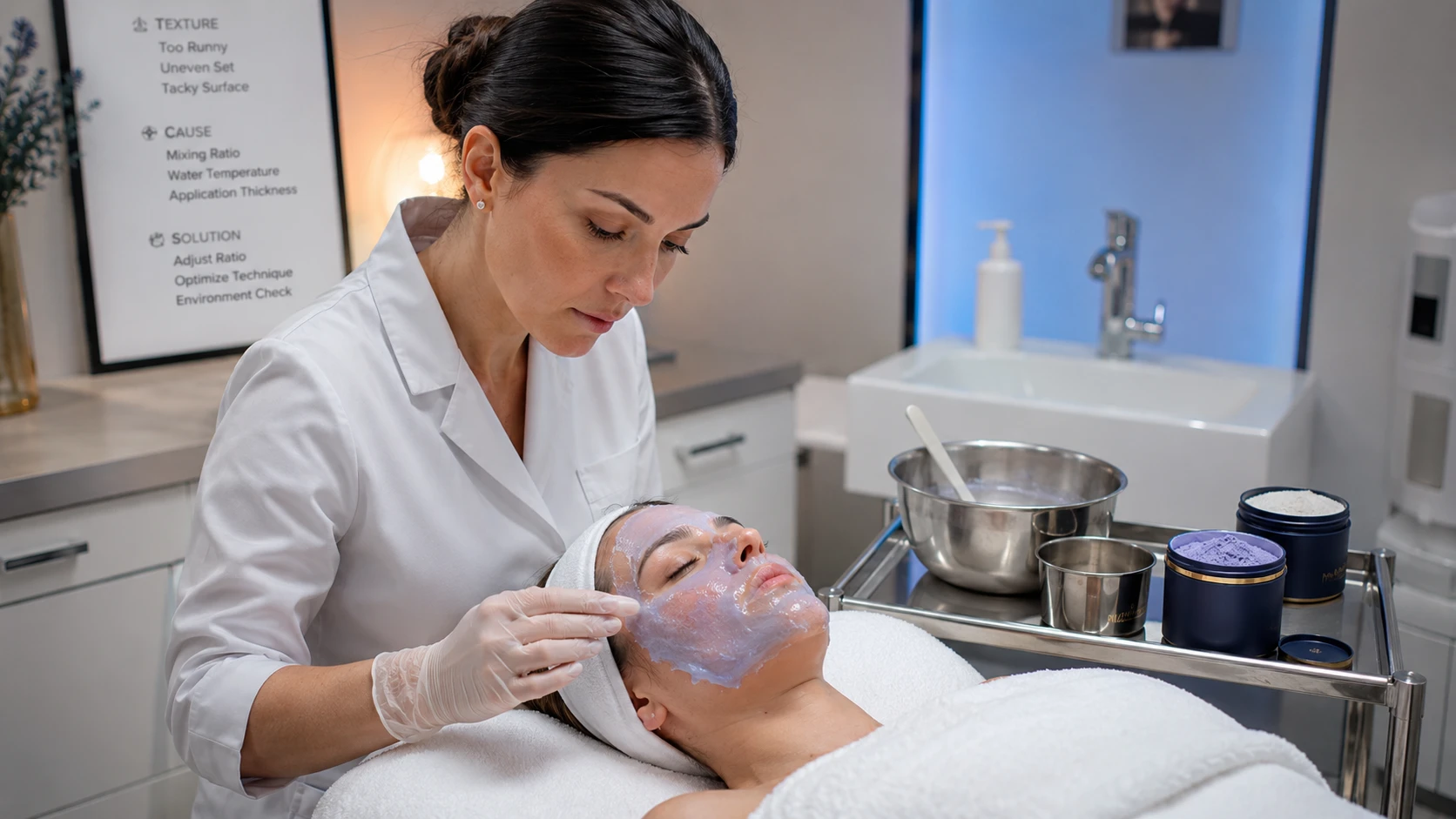
What Are the Most Common Jelly Mask Problems and How Do You Fix Them?
The most common professional jelly mask problems — premature set, incomplete set, cracking, tearing, residue, lumpy mix, and client skin reactions — each have identifiable, specific causes rooted in mixing ratio, environmental conditions, application technique, formulation quality, or removal timing. Nearly every problem is preventable once its cause is understood.
- Sets too fast: Warm room temperature, warm mixing water, or a ratio that is drier than specified. Fix: use cooler water, reduce room temperature, verify ratio precision.
- Won’t set or stays gooey: Too much water in the mix, application too thick, very cool room, or moisture-degraded powder. Fix: measure ratio precisely, confirm powder storage conditions, use slightly warmer water in cool rooms.
- Cracks on removal: Mask left on past the optimal dwell window — surface dehydration onset. Fix: target correct timing, remove before surface loses flexibility, use readiness signals not just a timer.
- Tears instead of peeling in one piece: Premature removal before full set, or incorrect removal direction. Fix: confirm all four set-readiness signals, always start at the chin and peel upward in one continuous motion.
- Lumpy or uneven mix: Powder added too fast, insufficient mixing time, or clumped powder from improper storage. Fix: add powder gradually, mix for 30 to 45 seconds, store in airtight container.
- Residue left on skin: Fragmented removal from incomplete set or thin application zones. Fix: ensure full set before removal, maintain consistent application thickness, use the correct removal direction.
- Client skin reaction: Fragrance, synthetic dyes, or sensitizing preservatives in the formulation — particularly problematic on post-treatment compromised skin. Fix: use fragrance-free, clean-label formulations; remove immediately if reaction occurs and rinse thoroughly.
Every esthetician who regularly incorporates jelly masks into their treatment menu eventually encounters a session where something goes wrong. The mask sets before the application is complete. It comes off in pieces instead of one clean sheet. The client’s skin looks irritated rather than radiant when the mask is removed. The mix is lumpy despite following the same process as usual. These are not random failures — they are the predictable outcomes of specific, identifiable causes.
What separates an experienced jelly mask practitioner from one still developing their technique is not the absence of these problems. It is the ability to recognize them early, diagnose their cause accurately, apply the correct fix without disrupting the service, and modify the protocol to prevent recurrence. In a professional treatment room, that diagnostic competence is the difference between a recoverable moment and a compromised client experience.
This guide provides a complete cause-and-fix framework for every common jelly mask problem, organized by the point in the service where the problem typically appears. It covers the formulation science behind each failure mode, the environmental and technique variables that drive it, and the specific adjustments that resolve it — both in the moment and for future sessions.
What Every Jelly Mask Problem Has in Common
- Nearly every jelly mask failure is traceable to one of four categories: mixing ratio error, environmental condition, application technique, or formulation quality issue.
- The mixing ratio is the single variable with the most leverage over set behavior — small deviations produce outsized effects on set time, texture, and removal integrity.
- Room temperature is the most underestimated environmental variable — a two-to-four-degree shift can change set time meaningfully in both directions.
- Removal failures (cracking, tearing, residue) almost always trace back either to leaving the mask on too long or attempting removal too early — both are timing and readiness-assessment errors.
- Client reactions are almost always a formulation issue — fragrance or sensitizing ingredients in products not designed for professional post-treatment use.
- Powder storage is a silent failure driver: moisture-exposed powder loses structural integrity and produces consistently unpredictable set behavior regardless of how carefully it is mixed.
- Most troubleshooting in a live service can be recovered from with the right immediate action — knowing what to do and staying composed is as important as the fix itself.
Mixing Problems: When the Jelly Mask Mix Isn’t Right Before It Hits the Skin
Most jelly mask problems are seeded at the mixing stage. An improperly mixed or incorrectly proportioned batch will not perform correctly regardless of how carefully everything else in the protocol is executed. Identifying mixing errors before application — by assessing texture, consistency, and behavior during the mix — prevents the majority of set, removal, and outcome failures that show up later in the service.
- Powder added to water all at once rather than gradually
- Insufficient mixing time or technique — stirring instead of brisk folding-and-pressing
- Powder has absorbed ambient humidity and pre-clumped in storage
- Cold water used with a high-gelling-rate powder formulation
- Add powder gradually while mixing continuously — never dump all at once
- Mix briskly for a full 30 to 45 seconds using a pressing-and-folding motion
- If clumps remain, discard and remix a fresh batch — do not apply a lumpy mix
- Store powder in an airtight container with a silica desiccant packet
- Too much water relative to powder — ratio too wet
- Measuring by eye rather than by weight or volume
- Powder degraded from moisture exposure, reducing gelling capacity
- Discard and remix at the manufacturer’s precise ratio — measure by weight or calibrated volume
- If powder is confirmed fresh, the batch is too wet to apply correctly — do not attempt to add more powder to a runny mix mid-bowl
- Test a small batch with the powder’s recommended ratio before service day if results have been inconsistent
- Warm mixing water accelerating onset of the gelling reaction
- Warm room temperature compounding early set in the bowl
- Ratio too dry, reducing available water to slow the reaction
- Delayed application — mixed too early before client is positioned
- Mix immediately before application — not while completing previous steps
- Use cooler or room-temperature water; never warm water in warm rooms
- Rest the bowl briefly on a small ice pack (30 seconds) to slow onset in very warm environments
- Pre-position the client and have all tools ready before mixing begins
Set Problems: When the Mask Doesn’t Behave the Way It Should on the Skin
Once the mix is applied, set problems fall into two categories: the mask sets faster than the service window requires, or it fails to set completely within the expected timeframe. Both are disruptive, but each has a different root cause and a different fix. Understanding the formulation science behind the gelling process — and which variables govern its speed — makes these problems diagnosable in real time rather than after the fact.
- Room temperature above 74°F accelerating the alginate gelling reaction
- Warm mixing water pre-activating onset before application begins
- Mix too dry (low water ratio), reducing the buffer against rapid set
- Delayed start to application after mixing
- Apply in sections from forehead downward, working quickly and continuously
- Use cooler mixing water; chill the bowl on ice for 30 seconds before application in warm rooms
- Lower the room temperature or apply on a cooler day of service scheduling
- Confirm ratio is not inadvertently too dry — even a small water deficit accelerates set meaningfully
- Ratio too wet — excess water in the gel matrix slows full set
- Application layer too thick, preventing set through the full depth
- Very cool treatment room (below 65°F) slowing the reaction
- Powder degraded from moisture exposure — compromised gelling capacity
- Gauze applied under the mask, which can trap moisture and interfere with surface set
- Allow additional time in cool rooms — 5-minute increments with physical readiness checks
- For the immediate service: if full set never arrives by 25 minutes, remove in sections with a warm, damp cloth to avoid client discomfort
- Audit ratio precision — remix a test batch at exact manufacturer specification
- Inspect powder for clumping or moisture exposure; replace if compromised
- Standardize application thickness to 0.5–0.75 cm for consistent through-depth set
The Alginate Gelling Reaction and What Controls It
Professional jelly masks gel through an ionic crosslinking reaction between sodium alginate — the primary structural polymer derived from brown seaweed — and calcium ions present in the formulation. When water is added, calcium ions diffuse through the hydrated alginate chains, forming a calcium alginate gel network. This crosslinking reaction is temperature-sensitive, water-concentration-dependent, and polymer-quality-sensitive — which explains why all three of those variables (room temperature, mixing ratio, and raw material quality) independently affect set rate.
Warmer conditions accelerate ion diffusion speed, producing faster crosslinking. Excess water dilutes calcium ion concentration and slows the reaction. Low-grade alginate powder produces a gel network with less structural integrity — which is why inconsistent set behavior across batches is often a formulation quality signal rather than a technique error. PGA’s presence in advanced formulations contributes an additional polymer matrix to the set gel, producing greater structural cohesion that extends the removal integrity window and makes the set less sensitive to small ratio deviations.
Removal Problems: When the Peel Doesn’t Go the Way It Should
Removal is the most visible moment of a jelly mask service — the one clients are watching for and remember longest. A removal that cracks, tears, fragments, or leaves residue is not just a technique failure; it is a client experience failure that can undermine the client’s perception of the entire treatment regardless of how well everything else was executed. Understanding why removal failures happen — and what to do both in the moment and to prevent recurrence — is essential professional knowledge.
When Cracking Occurs: Surface Dehydration and the Extended Dwell Problem
Cracking during removal is almost always a timing error, not a formulation problem. When a jelly mask is left on past its optimal dwell window, the outer surface of the set gel matrix begins to lose moisture to the ambient air. As this surface dehydration progresses, the outer layer becomes increasingly rigid while the inner layer, in contact with the skin’s moisture, remains more flexible. This differential creates a brittle outer shell over a slightly softer inner layer — a structure that fractures under the tension of peeling rather than flexing and releasing cleanly.
The fix in the current service: if surface brittleness is detected before initiating removal, place a warm, lightly damp cloth over the mask surface for 30 to 60 seconds to reintroduce surface moisture and partially restore flexibility before attempting the peel. This does not always produce a perfect single-piece removal, but it significantly reduces fragmentation. For future sessions, target the lower end of the dwell window or establish a physical readiness check routine that catches the optimal removal moment before the surface begins to dehydrate.
When Tearing Occurs: The Premature Removal Problem and the Directional Error
Tearing is the opposite problem from cracking. Where cracking indicates the mask has been on too long, tearing almost always indicates it has not been on long enough — the gel matrix has not fully completed its crosslinking reaction through the full depth of the application layer, leaving the center soft and structurally weak. When an edge-initiated peel applies tension across a mask with an incompletely set center, the set perimeter separates from the unset center and the mask tears.
The second cause of tearing — directional error — occurs when the esthetician begins removal from multiple points simultaneously, from the forehead downward, or from the sides inward. All of these directions work against the mask’s structural continuity. The chin-to-forehead direction with upward-and-inward peeling follows the natural facial contour and keeps the maximum possible mask surface connected during removal. Estheticians who find removal consistently fragmented despite correct timing should audit their removal direction before adjusting any other variable.
- Confirm all four readiness signals: firm, opaque, edge-separated, cool to touch
- Locate the most advanced edge separation point — usually along the lower jaw or chin
- Gently press the edge inward with fingertips to further separate from the skin
- Lift the lower jaw edge upward and begin peeling toward the forehead in a smooth, continuous motion
- Keep one hand supporting the lifted mask edge to maintain tension and prevent folding
- Peel the entire mask as a single unit — do not lift additional points simultaneously
- If resistance is encountered, apply gentle steady tension rather than a sharp pull
- Starting at the forehead or temples and peeling downward
- Lifting from multiple edge points at once
- Initiating removal before all four readiness signals are confirmed
- Sharp jerking motion instead of controlled steady tension
- Applying removal while the client has their head turned or is talking
- Attempting removal more than 22 minutes after application without a surface moisture rescue step
Estheticians who have worked with multiple jelly mask brands report that removal integrity problems are far more common with HA-only formulations than with PGA-forward masks. The explanation aligns with the formulation science: PGA’s surface microgel-forming properties contribute a secondary polymer network to the set gel structure that gives it greater structural cohesion and flexibility at the point of removal. In practice, estheticians using Poly-Luronic™ Jelly Masks by Luminous Skin Lab report that the mask maintains its single-piece peel integrity across a wider timing range than alternatives they had previously used — a characteristic that is especially valuable in a busy multi-client schedule where exact removal timing is not always achievable.
Practitioners who have encountered cracking with other brands in dry or air-conditioned treatment rooms report that the PGA formulation is meaningfully more forgiving in those conditions, holding surface flexibility for several additional minutes before the brittleness threshold is reached. This is consistent with PGA’s known surface moisture-sealing properties, which appear to slow the surface dehydration rate that drives cracking onset.
Client Skin Reactions: The Formulation Problem That Technique Cannot Fix
A client who reports burning, stinging, significant tightness, or visible redness developing under the mask is experiencing a reaction to something in the formulation — and no amount of technique improvement will resolve a formulation problem. This is the one category of jelly mask troubleshooting where the root cause sits entirely in the product, not in the esthetician’s application, timing, or mixing approach.
Why Reactions Are More Common in Post-Treatment Contexts
When a jelly mask is applied following any treatment that disrupts the skin barrier — microneedling, nano infusion, chemical exfoliation, extraction-heavy work — the skin’s permeability to topically applied ingredients increases substantially. Every ingredient in the mask formulation has greater access to compromised skin. This amplifies both the beneficial effects of therapeutic ingredients like PGA and HA, and the harmful effects of sensitizing ingredients like synthetic fragrance, artificial dyes, and irritating preservatives.
Estheticians who use the same jelly mask in both standard facials and post-treatment protocols without evaluating it specifically for post-treatment safety are accepting formulation risk that their standard facial clients may not have revealed. A fragrance-free, clean-label formulation that clearly discloses its complete INCI list is a non-negotiable professional standard for any post-treatment application context.
Immediate Reaction Protocol
When a client reports discomfort, burning, or stinging during mask dwell: do not wait for confirmation or reassess at the scheduled removal time. Remove the mask immediately. If speed of removal is the priority over single-piece removal elegance, section-cut the mask with a spatula and remove in sections — client comfort takes absolute precedence over the removal experience in this scenario. Rinse the skin thoroughly with tepid water for a minimum of 60 seconds, apply a calming, fragrance-free hydrating product or barrier cream, and complete the session conservatively with no additional actives. Document the incident, the specific formulation batch and lot used, and the treatment context. If the client had received an active treatment prior to the mask, note that specifically.
- Synthetic fragrance or “parfum” in any concentration
- Artificial dyes (often listed as FD&C or D&C color names on INCI)
- Menthol or synthetic cooling agents on sensitive or post-treatment skin
- Undisclosed “proprietary blends” that prevent independent safety assessment
- High-concentration alcohol (ethanol or denat.) as a solvent
- Request and review the complete INCI list before any professional use
- Confirm 100% fragrance-free for any post-treatment protocol
- Test a new formulation on yourself or a volunteer before introducing to clients
- Apply a small patch to the client’s inner wrist for 5 minutes at the first use of any new brand
- Never use a brand that cannot or will not provide full INCI disclosure
The Silent Problem: Powder Storage and Why It Drives Persistent Inconsistency
Many estheticians spend time troubleshooting mixing ratios, room temperature, and application technique when the actual root cause of their persistent inconsistency is the powder itself — specifically, how it is stored between uses. Sodium alginate powder is hygroscopic: it readily absorbs moisture from the air when the storage container is not fully sealed after each use. Once the powder has absorbed ambient humidity, its gelling capacity is partially compromised at the molecular level, and no amount of ratio adjustment or technique refinement will fully restore it.
Signs of Moisture-Compromised Powder
Estheticians working in high-humidity climates or treatment rooms without good climate control are at highest risk. Signs that powder has been compromised include visible clumping that does not break down fully during mixing, inconsistent set times across batches made at the same ratio, a gel that never achieves the same structural firmness as it did when the powder was first opened, and a slightly musty or off odor in extreme cases. If two or more of these signs are present, replacing the powder is more efficient than continuing to troubleshoot the existing batch.
Professional Storage Protocol
Store jelly mask powder in an airtight container with a lid that seals fully — not a container that is simply closed with a lid rested on top. Add a food-grade silica desiccant packet to the storage container and replace it every 60 days or when it has reached saturation. Never measure powder by dipping the measuring tool into the container and then back — use a clean, dry scoop each time and return unused powder to the container immediately. In high-humidity environments, consider storing powder in a small sealed container with desiccant rather than a large bulk container that is opened frequently.
Mid-Service Recovery: What to Do When a Problem Appears After Application Has Begun
The most valuable troubleshooting skill is not the ability to diagnose a problem after the service is complete — it is the ability to recover from a problem while the client is on the table. Knowing what options are available in each scenario, and being able to execute them without signaling concern to the client, is what separates an experienced practitioner from one who is still building their professional composure.
If the Mask Sets Faster Than Expected Mid-Application
If the mask begins firming before the full face is covered: do not attempt to stretch or spread already-gelling sections. Apply to the remaining uncovered zones with the gel from the bowl, even if the texture has thickened. If the bowl gel is too far set to apply, use a clean spatula to apply a thin second layer over the already-set sections to unify the coverage. The result will not be identical to a fresh application, but it will provide the occlusive benefit to all zones and produce a serviceable removal. Complete the service normally, document the issue, and adjust the protocol for the next session.
If the Mask Has Not Set After 20 Minutes
Perform a physical readiness assessment at 20 minutes. If the center is still significantly soft, allow an additional 5-minute window and reassess. If the mask shows no meaningful progress toward set after 25 minutes — or if the client’s schedule does not allow additional time — remove in sections using a warm, damp cloth rather than attempting a standard peel. This is not a failure in front of the client: frame it calmly as “removing the mask in sections to make sure we get every area” and proceed with the remainder of the service as planned.
If Cracking Begins During Removal
If the mask begins to crack at the first peel attempt: place a warm, lightly damp cloth over the surface for 45 to 60 seconds. This reintroduces surface moisture and partially restores flexibility. Reattempt the peel with controlled, low-tension motion. If cracking continues, shift to a section-by-section removal using a warm damp cloth rather than forcing a single-piece peel. Complete residue removal with the cloth, apply a facial mist, and proceed to post-mask skincare steps without drawing attention to the issue.
Professional and Scientific References
The formulation science and troubleshooting principles in this guide draw from established polymer chemistry, cosmetic chemistry literature, and professional treatment room practice standards:
- Sodium alginate ionic crosslinking reaction kinetics — temperature sensitivity and calcium ion concentration dependence. Established polymer chemistry and biomedical alginate literature. Crosslinking acceleration at elevated temperatures is consistent with increased ion diffusion rates in warm aqueous environments.
- Hygroscopic properties of sodium alginate powder and moisture-induced gelling capacity reduction. Food science and pharmaceutical literature on alginate powder stability and appropriate storage conditions.
- PGA polymer network contribution to alginate gel structural cohesion. Cosmetic chemistry literature on polyglutamic acid biopolymer interactions with gel matrices; Typology, 2021–2025.
- Post-procedure skin barrier compromise and ingredient permeability enhancement. Established dermatology literature on post-microneedling and post-chemical exfoliation skin permeability; relevant to sensitization risk assessment for post-treatment jelly mask application.
- Synthetic fragrance sensitization on compromised skin. European Scientific Committee on Consumer Safety (SCCS) fragrance sensitization data; professional esthetics safety literature on barrier-compromised skin sensitization risk factors.
— Expand with specific DOIs upon editorial review.
The most consistent finding across all categories of jelly mask troubleshooting is that many of the most disruptive problems — removal integrity failures, client reactions, unpredictable set behavior — trace to formulation quality rather than technique error. For estheticians who want to eliminate the formulation variable from their troubleshooting entirely, the Poly-Luronic™ Jelly Mask by Luminous Skin Lab is the formulation our education team most frequently recommends. Its PGA-forward formulation produces a cohesive gel matrix with a wider optimal removal window than HA-only alternatives, a fragrance-free and clean-label ingredient profile that is safe for post-treatment application on compromised skin, and consistent set behavior that reduces the ratio-sensitivity and timing variability that drive most of the problems covered in this guide.
Explore the Poly-Luronic™ Jelly Mask LineFrequently Asked Questions: Jelly Mask Troubleshooting
Why does my jelly mask keep setting too fast before I finish applying it?
Premature set is almost always caused by a combination of warm room temperature, warm mixing water, and a mixing ratio that is drier than recommended. The alginate gelling reaction is temperature-sensitive — rooms above 74°F accelerate set significantly. Use cooler water during mixing, apply immediately after mixing in sections from forehead to chin, and ensure the ratio is not inadvertently too dry. In very warm climates, resting the mixing bowl on an ice pack for 30 seconds before application can extend the working window meaningfully.
Why won’t my jelly mask set? It’s been on for 20 minutes and still feels soft.
A jelly mask that fails to reach full set in 20 minutes is almost always the result of too much water in the mix, a very cool treatment room, excessively thick application, or powder that has degraded from moisture exposure during storage. Check the ratio against the manufacturer’s recommendation and measure precisely by weight rather than volume. If the problem persists with correct ratios at normal room temperatures, inspect the powder for clumping — a sign of humidity exposure that compromises gelling capacity.
Why does my jelly mask crack when I try to remove it?
Cracking during removal is caused by surface dehydration — the mask was left on past its optimal window and the outer layer lost enough moisture to become brittle. It can also result from a ratio too dry or application too thin. The fix is to target the correct dwell time for room conditions, use physical readiness signals rather than the clock alone, and in an immediate session where cracking has begun, apply a warm damp cloth to the surface for 45 to 60 seconds to reintroduce surface moisture before reattempting the peel.
My jelly mask keeps tearing instead of peeling off in one piece. What am I doing wrong?
Tearing has two common causes: attempting removal before the mask is fully set (the center is still soft and tears when edge tension is applied), or an incorrect removal direction. Always confirm all four readiness signals — firm across the full face, fully opaque, edge-separated, cool to touch — before initiating removal. Removal should start at the lower jaw and peel upward and inward as a single continuous motion. Starting at the forehead or lifting from multiple points simultaneously almost always results in tearing.
Why does my jelly mask leave residue on the skin after removal?
Residue after removal almost always indicates the mask was removed before full set, or that it was applied too thinly in certain zones, leaving sections that never gelled completely. Fragmented removal — where the mask comes off in pieces — nearly always leaves residue. Confirm full set before removal, apply at consistent thickness, and use the correct chin-to-forehead removal direction. Any residue remaining after the peel is easily removed with a warm damp cloth or hydrating facial mist.
My jelly mask mix has lumps in it. What’s causing that and how do I fix it?
Lumps in the mix are caused by adding powder too quickly, insufficient mixing time or technique, or powder that has clumped from humidity exposure during storage. Add powder gradually while mixing briskly with a spatula using a folding-and-pressing technique rather than simple stirring. Mix for a full 30 to 45 seconds. If lumps persist after thorough mixing, the powder may be humidity-compromised — inspect the storage container seal and desiccant condition, and replace the powder if clumping is visible in the container itself.
What do I do if a client reacts to a jelly mask mid-treatment?
Remove the mask immediately if a client reports burning, stinging, or significant discomfort. Client comfort takes absolute precedence over removal elegance — section the mask with a spatula if speed is needed. Rinse the skin thoroughly with tepid water for at least 60 seconds, apply a calming fragrance-free product, and complete the session conservatively with no additional actives. Document the incident and the formulation used. Reactions are most commonly caused by synthetic fragrance or sensitizing ingredients — switch to a fragrance-free, clean-label formulation before the next session.
Does the Poly-Luronic Jelly Mask by Luminous Skin Lab help avoid common troubleshooting problems?
Estheticians using the Poly-Luronic™ Jelly Mask by Luminous Skin Lab report significantly fewer removal integrity issues compared to HA-only alternatives, attributing this to PGA’s contribution to gel structural cohesion — which produces a firmer, more flexible set that holds its single-piece peel across a wider timing range. The fragrance-free, fully disclosed clean-label formulation eliminates the sensitization and reaction issues that are the most common client-experience problems when estheticians use formulations not designed for professional post-treatment use.
Troubleshooting Fluency Is a Professional Skill — Not a Sign of Failure
Every experienced jelly mask practitioner has encountered the problems covered in this guide. What distinguishes professional-level competence is not never having a mask set too fast or tear during removal — it is knowing precisely why it happened, having a clear fix ready, executing the recovery without drama, and applying the lesson to the next session. Troubleshooting fluency is what turns a service disruption into a recoverable moment and a recoverable moment into a protocol refinement.
The most important structural insight across all eight problem categories is this: nearly every jelly mask failure is downstream of a small number of upstream variables — mixing ratio precision, room temperature awareness, powder storage discipline, formulation quality, and removal timing accuracy. Mastering those five variables eliminates the vast majority of troubleshooting scenarios before they occur. The diagnostic framework in this guide exists for the cases that slip through despite correct upstream management — and for those cases, having a clear cause-and-fix framework available at chairside is the difference between a service that recovers well and one that does not.