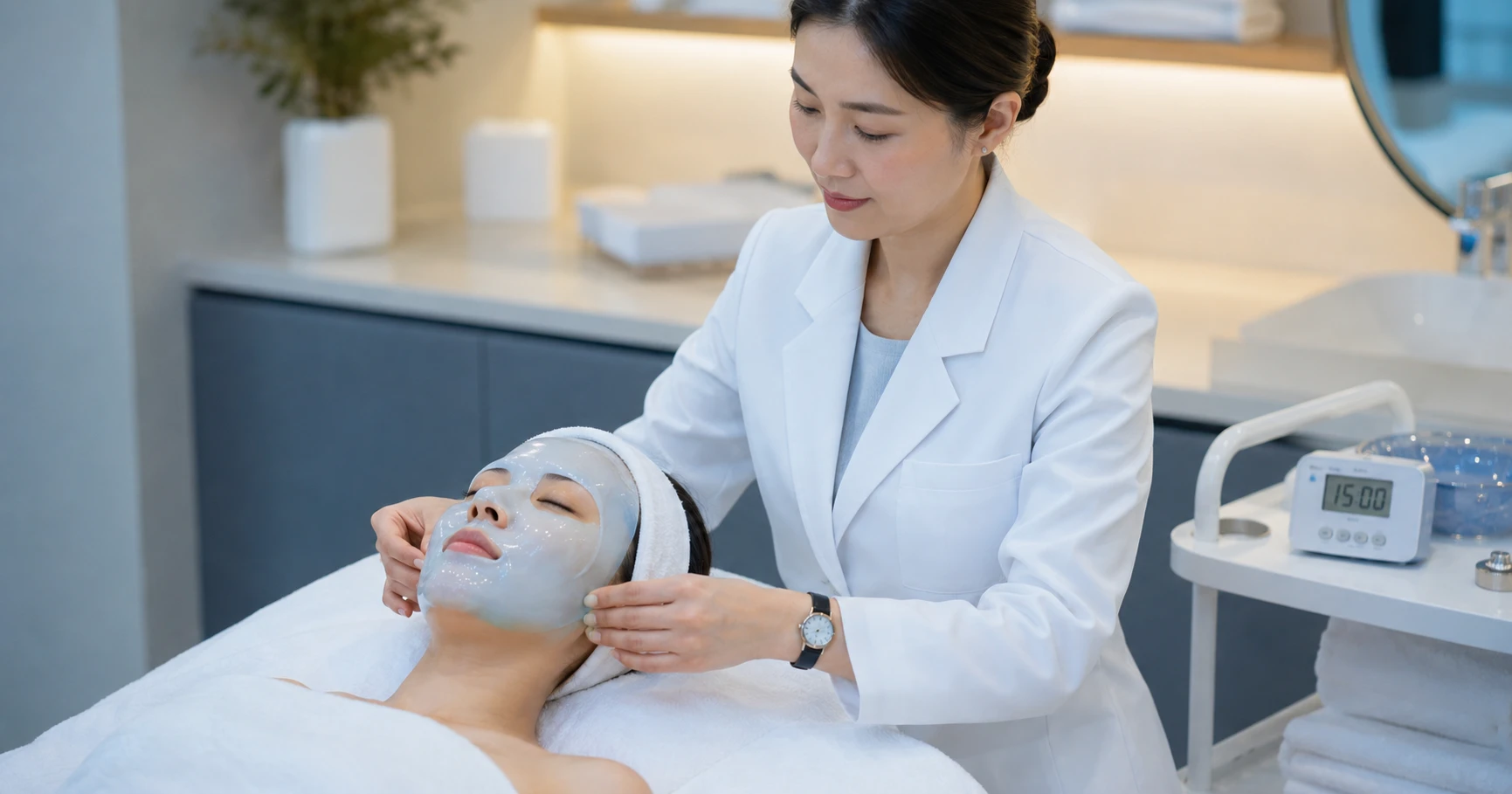
How Long Should a Professional Jelly Mask Stay On?
Most professional jelly masks should remain on the skin for 10 to 20 minutes, with 12 to 15 minutes being the most reliable window for standard treatment room conditions. The correct duration is not fixed — it is determined by the formulation, the protocol context, the mixing ratio used, room temperature, application thickness, and what service steps need to occur during the dwell period.
- Standard hydration facials: target 10 to 15 minutes. The mask should reach firm, opaque, edge-separating set before removal is attempted.
- Post-treatment protocols (post-microneedling, post-chemical exfoliation, post-extraction): target 15 minutes to maximize occlusive contact time with compromised skin. Avoid exceeding 20 minutes as surface dehydration and removal integrity decline.
- LED therapy combination protocols: the standard 10-to-15-minute LED session fits precisely within the jelly mask window — no timing adjustment is required.
- Warmer rooms and thinner applications shorten set time. Cooler rooms, higher water ratios, and thicker applications extend it.
- Removal readiness is confirmed by firmness, full opacity, edge separation, and cool-to-neutral surface temperature — not by the clock alone.
- Leaving a jelly mask on beyond full set does not increase ingredient delivery — it increases the risk of surface dehydration, brittleness, and compromised removal integrity.
Timing is one of the most practically consequential variables in professional jelly mask application — and one of the least systematically taught. Estheticians who are new to rubber masks often default to the broadest guideline on the packaging (usually “10 to 20 minutes”) without understanding what is actually happening during that window, which end of that range applies to their protocol, or what determines when removal is genuinely appropriate.
The consequences of getting timing wrong run in both directions. Remove a jelly mask too early and the set process is incomplete — the mask tears, leaves residue, and misses the full occlusive hydration window. Leave it on too long and the surface begins to dehydrate, the mask becomes brittle, and the signature single-piece removal that clients consistently describe as the most memorable moment of a jelly mask treatment becomes difficult or impossible to execute.
This guide gives estheticians a complete professional framework for jelly mask timing: the standard dwell window, how different protocol contexts shift the target, what environmental and technique variables affect set rate, how to assess removal readiness accurately, and how to use the dwell period productively without disrupting the set process.
What Determines the Right Jelly Mask Timing for Your Protocol
- The standard professional window is 10 to 20 minutes — 12 to 15 minutes is the most operationally reliable target for most treatment room conditions.
- Protocol context matters: post-treatment applications warrant the upper end of the window; standard hydration facials typically resolve cleanly at 12 minutes.
- Room temperature is the most underestimated variable — a warm room can shorten set time by two to four minutes compared to a climate-controlled environment.
- Removal readiness is confirmed by sensory assessment — firmness, opacity, edge separation — not solely by elapsed time.
- The dwell period is a service asset: LED therapy, scalp massage, and client consultation all fit comfortably within a properly timed mask window.
- Exceeding full set does not improve outcomes — the occlusive hydration benefit plateaus at full set and surface dehydration risk increases thereafter.
- Consistent timing across sessions requires consistent mixing ratios, water temperature, and application thickness — not just a reliable timer.
What Is the Standard Timing Window for a Professional Jelly Mask?
The 10-to-20-minute range cited on most professional jelly mask packaging is accurate as an outer boundary — but it is not a prescription. That range encompasses significant variation in formulation type, mixing ratio, room environment, and application thickness. Treating it as a fixed instruction rather than a range to calibrate within a specific treatment context is the most common timing mistake estheticians make when introducing jelly masks to their protocols.
In practice, estheticians working in climate-controlled treatment rooms at standard ratios and application thicknesses find that 12 to 15 minutes is the reliable working target for most professional jelly mask formulations. Within that window, the mask completes its set process, delivers the full duration of occlusive humectant contact with the skin, and reaches the firm-but-flexible consistency that allows clean single-piece removal.
Why the Lower Bound Matters: Incomplete Set and Its Consequences
Attempting to remove a jelly mask before it has fully set is one of the most common errors estheticians transitioning from other mask types encounter. An incompletely set mask feels soft or tacky at the center even when the edges appear firm. When lifted prematurely, it tears, stretches, or separates into pieces — leaving gel residue on the skin that requires additional removal steps and disrupts the clinical flow of the service. Beyond the practical inconvenience, a torn or fragmented removal fails the client experience test: the single-cohesive-piece peel is the moment most clients describe in their post-treatment reviews, and prematurely removing the mask eliminates it entirely.
Why the Upper Bound Matters: Surface Dehydration and Brittleness
A fully set jelly mask that remains on the skin past its optimal window begins to dehydrate from the outer surface inward. The surface layer, which was sealed and flexible at full set, starts losing moisture to the ambient air. As it dries, the outer surface becomes increasingly rigid. Masks left on well beyond 20 minutes may crack during removal, separate into fragments, or stick unevenly to skin surface texture — particularly over areas with fine lines, pores, or facial hair. None of these outcomes improve ingredient delivery or client outcomes; they simply increase service complexity and reduce client satisfaction.
How Does Protocol Context Change the Target Timing?
One of the most important practical insights estheticians develop with experience is that jelly mask timing is not protocol-agnostic. The same formulation, mixed at the same ratio, should be timed differently depending on what preceded it in the treatment sequence and what skin state it is being applied to. Estheticians working across multiple service types — standard hydration facials, post-treatment recovery masks, LED combination protocols — need a timing framework that adjusts to each context rather than defaulting to a single number.
Standard Hydration Facial: Target 10 to 15 Minutes
In a standard hydration facial where the skin barrier is intact and the primary goals are moisture delivery, cooling, and client experience, the lower to middle portion of the window — 10 to 15 minutes — is appropriate. At this range, the mask delivers its full occlusive hydration benefit, completes its set, and reaches optimal removal consistency. Estheticians performing a 60-minute facial who need to manage their service timing precisely will find that targeting 12 to 13 minutes for the mask step leaves adequate time for removal, serum application, and moisturizer without service compression.
Post-Treatment Protocols: Target 15 Minutes
Following treatments that compromise the skin barrier — microneedling, nano infusion, chemical exfoliation, extraction-heavy work — the clinical case for extending dwell time toward the upper portion of the standard window is compelling. Heightened post-procedure transepidermal permeability means that humectants, particularly the PGA and HA combination in advanced professional formulations, have greater access to the compromised skin during the treatment window. Every additional minute of occlusive contact in this state represents amplified ingredient delivery. Targeting 15 minutes in post-treatment contexts, while remaining attentive to surface set signals, maximizes this benefit without approaching the dehydration risk zone.
LED Therapy Combination Protocols: 10 to 15 Minutes
Combining LED therapy with jelly mask application is one of the most efficient use cases for the dwell period in a professional treatment room. Standard LED protocols run 10 to 15 minutes — precisely within the jelly mask window — allowing the esthetician to deliver photobiomodulation simultaneously with occlusive hydration without adding service time. The jelly mask layer does not meaningfully attenuate most professional LED wavelengths used in esthetic settings, and the occlusive environment maintains skin hydration during the light exposure period. Timing the LED session to end at the mask’s optimal removal point creates a seamless transition that eliminates dead time from the service sequence entirely.
Why Dwell Time Has Different Optimal Targets Across Protocols
The clinical rationale for extending dwell time in post-treatment contexts relates to the physiology of post-procedure skin. When the barrier is compromised — whether by microneedling channels, chemical exfoliation, or extraction trauma — the skin’s transepidermal water loss rate increases and the permeability of the stratum corneum to topically applied actives rises substantially. An occlusive jelly mask applied in this state creates a sealed hydration environment where PGA and HA humectants have extended, uninterrupted contact with highly receptive skin.
In a standard facial on intact skin, the primary benefit is the occlusive moisture-sealing effect of the set mask layer. On post-treatment skin, both the occlusive benefit and the active ingredient delivery benefit are amplified — which justifies targeting the upper portion of the timing window to maximize the clinical return on the dwell period.
For LED combination protocols, the timing alignment is a service architecture advantage rather than a clinical one: the mask’s optimal dwell window and the standard LED protocol duration are essentially identical, allowing two meaningful treatments to occur simultaneously with no additional service time.
What Variables Affect How Long a Jelly Mask Takes to Set?
Estheticians who rely solely on a timer to determine removal readiness — without accounting for the environmental and technique variables that affect set rate — will eventually be surprised in both directions. A mask that usually sets in 13 minutes may need 16 in a cool, humid treatment room. The same mask may reach full set in 10 minutes on a warm summer day with the treatment room door open. Understanding the primary variables that govern set rate allows estheticians to anticipate and adjust rather than react.
Room Temperature
Temperature is the most significant environmental variable affecting jelly mask set time. The alginate-calcium gelling reaction that drives jelly mask solidification is temperature-sensitive: warmer environments accelerate it, cooler environments slow it. In practical treatment room terms, estheticians working in rooms above 74°F to 76°F will find set times consistently running two to four minutes shorter than in a climate-controlled room at 68°F to 70°F. This has direct service implications: in warm climates or during summer months without adequate climate control, estheticians may need to begin their scalp massage or LED protocol immediately after application to avoid losing that service window as the mask sets faster than expected.
Water Temperature During Mixing
Using warmer water to mix the jelly mask powder accelerates the initial gelling onset, effectively pre-heating the reaction before application. Cooler water — closer to room temperature or slightly below — extends the working time and delays set onset. Estheticians who find their standard formulation setting faster than the protocol requires can use slightly cooler mixing water as a simple adjustment. Those who find the set time too long can experiment with slightly warmer water, staying within the formulation’s recommended temperature range.
Mixing Ratio
A wetter mix — higher water-to-powder ratio than the manufacturer recommends — extends set time because the gel matrix must absorb and process more free water before reaching firm consistency. A drier mix — less water than recommended — shortens set time and produces a thinner layer with less occlusive coverage. For consistent, predictable timing session to session, strict adherence to the manufacturer’s recommended ratio is the most reliable control variable. Ratio drift — even small, unintentional incremental changes over multiple sessions — is the most common cause of unexplained set time variability in high-volume treatment rooms.
Application Thickness
A thicker mask application requires more time to set completely through the full depth of the layer. Estheticians who apply at varying thicknesses across sessions — or who apply more heavily over certain facial zones — will observe inconsistent removal readiness timing. Standardizing application thickness to approximately 0.5 to 0.75 centimeters across the full treatment area produces the most consistent set timing. Areas applied thinner will be ready earlier; areas applied thicker will require additional time. The center of the face, where the mask is typically applied last and slightly thicker, is usually the last zone to reach removal readiness.
Ambient Humidity
High ambient humidity slows surface dehydration on the outer mask layer, which can give the impression of a longer optimal window by preventing the brittleness onset that occurs in dry air. Conversely, very dry air — common in arid climates or heavily air-conditioned rooms in winter — accelerates surface dehydration after the mask reaches full set, shortening the window between optimal removal and surface brittleness. In very dry treatment environments, estheticians should prioritize removing the mask closer to the low end of the timing window to avoid dehydration-related removal difficulty.
Estheticians using the Poly-Luronic™ Jelly Mask by Luminous Skin Lab in high-volume treatment rooms typically standardize to a 13-minute timer as their primary cue, confirmed by a physical check of the mask edge before initiating removal. Practitioners report that the PGA-forward formulation holds its removal integrity — firm, flexible, single-piece peel — more consistently across the 12-to-17-minute range compared to HA-only alternatives they had previously used, which showed noticeably narrower optimal windows. This wider tolerance is operationally valuable in a busy schedule where back-to-back services make exact minute-by-minute timing unpredictable. The standard 2:1 powder-to-water ratio at room-temperature water produces consistent 12-to-14-minute set times across a wide range of treatment room environments, eliminating the guesswork that previously required manual adjustment between seasons.
How Do You Know When a Jelly Mask Is Ready to Remove?
Experienced estheticians assess jelly mask removal readiness through physical cues, not the clock alone. A timer is a useful starting point for service pacing, but it should be confirmed against direct sensory evaluation before removal is initiated. Masks that are removed based solely on elapsed time — without a physical readiness check — will occasionally be pulled before full set or left past the optimal window depending on which environmental variables have shifted that session.
The Four Physical Readiness Signals
A professionally set jelly mask ready for removal will display all four of the following characteristics simultaneously:
- Surface firmness: The mask should feel firm across the full face, including the center. Gentle pressure with a fingertip should not produce indentation. Any remaining soft or yielding area indicates incomplete set in that zone.
- Full opacity: A properly set mask is fully opaque, with no visible translucent or wet-looking zones. Translucency in any area indicates that the gel matrix has not completed the gelling reaction and the mask is not ready.
- Edge separation: The mask perimeter — along the jaw, hairline, and neck — should visibly separate slightly from the skin on its own, pulling away cleanly. This spontaneous edge separation is one of the most reliable indicators of full set completion.
- Cool or neutral surface temperature: A well-set jelly mask has released its initial cooling effect and will feel cool or neutral to the back of the hand held near the surface. A mask that still feels noticeably warm to the touch has not yet reached full set.
How to Initiate Removal Correctly
Once all four readiness signals are confirmed, removal begins at the lower jaw or chin, where edge separation is typically most advanced. The esthetician lifts the edge gently with fingertips along the jawline, then peels upward and inward in a continuous, smooth motion — treating the mask as a single unit rather than lifting from multiple points simultaneously. Working from chin toward forehead keeps the mask connected and cohesive, reducing the risk of tearing. Estheticians who start at the forehead or who lift from multiple simultaneous points are more likely to fragment the mask during removal.
What Incomplete Set Looks and Feels Like
A mask that has not fully set will present with at least one of the following: soft or tacky zones when pressed (particularly center-face), visible translucency in any area, no spontaneous edge separation, or a warm surface temperature. If any of these signals are present, the mask requires additional time regardless of elapsed clock time. The practical rule: the clock is a reminder; the mask tells you when it is ready.
How to Use the Dwell Period Productively Without Disrupting Set
The jelly mask dwell period is a multi-purpose service window — one of the most underused assets in a professional treatment room when estheticians are new to rubber masks. Once the mask is applied and beginning to set, the esthetician has a structured block of time during which the client is stationary, relaxed, and receiving an active treatment. The question is not whether to use that time productively, but how to do so without creating vibration, movement, or position changes that could compromise the setting mask.
Scalp Massage and Acupressure
Scalp massage is the most universally compatible activity during the jelly mask dwell period. It requires no repositioning of the client’s head, produces no vibration to the face, and delivers a luxury experience element that clients consistently report as one of the most memorable components of a premium facial service. Most estheticians working with jelly masks establish scalp massage as their standard dwell-period activity, building it into the service menu as an included step rather than an add-on.
Hand, Arm, or Décolleté Massage
For practices offering extended facials where additional service steps are part of the menu, the jelly mask window accommodates hand and forearm massage or décolleté work. These steps require some care with client positioning — avoid any movement that causes the client to turn their head significantly or flex their neck sharply, as these movements create facial muscle movement that can fracture a partially set mask.
LED Therapy
As noted earlier, LED therapy is the most clinically integrated use of the jelly mask window. Positioning the LED panel above the set mask for the duration of the dwell period adds photobiomodulation benefits without adding service time. Ensure the formulation in use is confirmed compatible with LED delivery — most professional alginate-based formulations are compatible with standard red and near-infrared wavelengths used in esthetic LED devices.
Client Education and Retail Conversation
The jelly mask dwell period is also a natural opportunity for product education and retail recommendation, delivered while the client is calm, relaxed, and focused. Estheticians who structure their retail conversations to occur during this window report higher conversion rates than those who attempt the same conversations during active treatment steps. The key is to keep the conversation low-key enough that the client does not become animated or change facial expression significantly — a client who laughs or talks expressively during early mask set may disrupt the gel formation on the face zones that are not yet firm.
Professional and Scientific References
The timing principles and formulation science referenced in this article draw from cosmetic chemistry literature and professional treatment room practice standards:
- Sodium alginate gelling kinetics and temperature sensitivity. Established polymer chemistry literature; biomedical alginate applications. Set rate acceleration observed at elevated temperatures consistent with gel crosslinking thermodynamics.
- PGA surface microgel formation and structural contribution to alginate gel matrices. Cosmetic chemistry literature; Typology, 2021–2025. PGA’s high molecular weight polymer chain integration into the gel network contributes to cohesive set texture and extended removal window integrity.
- Transepidermal permeability enhancement post-procedure and humectant delivery amplification. Established dermatology literature on post-procedure skin barrier function; particularly relevant to post-microneedling and post-chemical exfoliation protocols.
- Occlusive mask hydration delivery — moisture retention and TEWL reduction under sealed gel layer. Cosmetic formulation literature on occlusive ingredient delivery mechanisms.
- LED photobiomodulation compatibility with alginate gel layers. Professional esthetics device compatibility guidance; standard red (630–660 nm) and near-infrared (830–850 nm) wavelengths are not meaningfully attenuated by hydrated alginate gel layers of standard application thickness.
— Expand with specific DOIs upon editorial review.
For estheticians seeking a professional jelly mask formulation with predictable, protocol-calibrated set timing, the Poly-Luronic™ Jelly Mask by Luminous Skin Lab is the formulation our education team most frequently recommends for treatment rooms where timing consistency is operationally critical. Developed by a licensed esthetician specifically for professional protocols, the Poly-Luronic™ blend produces a consistent 12-to-15-minute set window under standard treatment room conditions — wide enough to accommodate scalp massage and LED sequences, firm enough to peel as a single cohesive piece, and stable enough to tolerate the minor timing variation inherent in high-volume service schedules. Fragrance-free, clean-label, and compatible with post-treatment protocols including post-microneedling and LED-adjunctive applications.
Explore the Poly-Luronic™ Jelly Mask LineFrequently Asked Questions: Jelly Mask Timing & Dwell Time
How long should a jelly mask stay on during a professional facial?
Most professional jelly masks should remain on the skin for 10 to 20 minutes, with 12 to 15 minutes being the most reliable working window for standard treatment room conditions. The correct duration is not fixed — it depends on the formulation, mixing ratio, room temperature, and the protocol context. Post-treatment applications typically target the upper end of the window, while standard hydration facials resolve cleanly at 12 to 13 minutes.
What happens if you leave a jelly mask on too long?
Leaving a jelly mask on beyond full set causes the outer surface to begin dehydrating, making it increasingly brittle and prone to cracking or tearing during removal. The single-piece removal experience — which clients consistently describe as the most memorable moment of a jelly mask treatment — becomes difficult or impossible. The occlusive hydration benefit also plateaus once the mask reaches full set, meaning extended time does not increase ingredient delivery.
How do I know when a jelly mask is ready to remove?
A properly set jelly mask is firm across the full face, fully opaque with no translucent zones, beginning to separate from the skin at the edges on its own, and cool or neutral to the touch rather than warm or tacky. All four signals should be present before removal is initiated. Any remaining softness or translucency in any zone indicates the mask needs more time, regardless of elapsed clock time.
Does room temperature affect how long a jelly mask takes to set?
Yes, significantly. Warmer room temperatures accelerate the gelling reaction, shortening set time by two to four minutes compared to a cooler, climate-controlled treatment environment. Cooler rooms extend set time. Estheticians in warm climates or rooms above 74°F should factor this into their service timing and may need to begin their scalp massage or LED sequence immediately after application to use the full dwell window before the mask reaches full set.
Should a jelly mask stay on longer after microneedling or other treatments?
In most post-treatment protocols, estheticians target the upper end of the standard window — 15 minutes — to maximize the occlusive hydration benefit on skin with heightened permeability. The extended dwell time allows PGA and HA humectants additional contact time with compromised, highly receptive skin. Going significantly beyond 20 minutes offers diminishing clinical returns and risks removal integrity issues.
Does mixing ratio change how long the jelly mask needs to stay on?
Yes. A higher water ratio (wetter mix) extends set time because more water must be absorbed into the gel matrix before the mask firms. A drier mix with less water reaches full set faster but may produce a thinner layer with less occlusive coverage. Consistent adherence to the manufacturer’s recommended ratio is the most reliable way to maintain predictable set time across sessions. Ratio drift is the most common cause of unexplained session-to-session timing variability.
Can you do LED therapy while a jelly mask is on, and does that affect timing?
Yes, LED therapy is commonly performed during the jelly mask dwell period. Standard LED protocols run 10 to 15 minutes, which aligns precisely with the jelly mask window — making the combination one of the most time-efficient protocols in professional esthetics. LED devices do not significantly affect set time in clinical conditions. Confirm formulation compatibility with LED light therapy before combining treatments.
How long does the Poly-Luronic Jelly Mask by Luminous Skin Lab take to set?
The Poly-Luronic™ Jelly Mask by Luminous Skin Lab is formulated for a consistent 12-to-15-minute set window under standard treatment room conditions. This window is designed to accommodate a full LED therapy session or scalp massage sequence without requiring timing adjustments between services. The PGA-forward formulation produces a firmer, more cohesive set than HA-only alternatives, which supports the clean single-piece removal that clients consistently note as the most memorable moment of a jelly mask treatment.
Timing Is a Technique: What Consistent Jelly Mask Timing Looks Like in Practice
The dwell time of a jelly mask is not a passive waiting period — it is an active, managed component of the service with its own technique requirements. Estheticians who understand the standard 10-to-20-minute window, how protocol context shifts the target within that range, which variables accelerate or extend set, and how to assess physical removal readiness are equipped to deliver consistent, high-quality jelly mask services regardless of environmental variation or service pressure.
The most common timing errors — early removal that fragments the mask, over-extended dwell that produces brittleness, and timer-only reliance without physical readiness assessment — are all preventable with a clear protocol and the practical knowledge to calibrate it. Consistent timing across sessions requires consistent inputs: stable mixing ratios, standardized application thickness, and attentiveness to the environmental conditions that vary from day to day.
When timing is correct, the jelly mask does what it was designed to do: delivers a complete occlusive hydration treatment within a defined clinical window, produces a removal moment that clients describe long after the appointment, and integrates cleanly into whatever service sequence surrounds it — with time to spare for scalp massage, LED therapy, and the client conversation that converts visits into lasting professional relationships.