How Does Water Temperature Affect Jelly Mask Performance?
Water temperature is the single most controllable variable in jelly mask mixing — and one of the most consistently underestimated. Because sodium alginate activates through a temperature-sensitive cross-linking reaction with calcium ions, the temperature of the water used to mix a jelly mask directly determines how fast it sets, what texture it produces, how reliably it peels, and how cool it feels on the client’s skin. Most professional formulations perform best in the 65 to 75°F (18 to 24°C) range — cool enough to preserve active ingredient integrity and deliver a therapeutic cooling sensation, warm enough to allow complete, smooth activation without textural inconsistencies.
- Hot water (above 90°F / 32°C) accelerates setting, shortens the working window, and degrades heat-sensitive humectants like polyglutamic acid and hyaluronic acid before the mask reaches the skin.
- Cold water (below 55°F / 13°C) slows gel activation unevenly, producing a lumpy or inconsistent texture and an unpredictably extended set time.
- The therapeutic cooling effect clients feel at first mask contact is entirely determined by the water temperature used to mix the mask — not by the formulation alone.
- Tap water temperature varies meaningfully by season and can shift set time by several minutes without any change in technique or ratio.
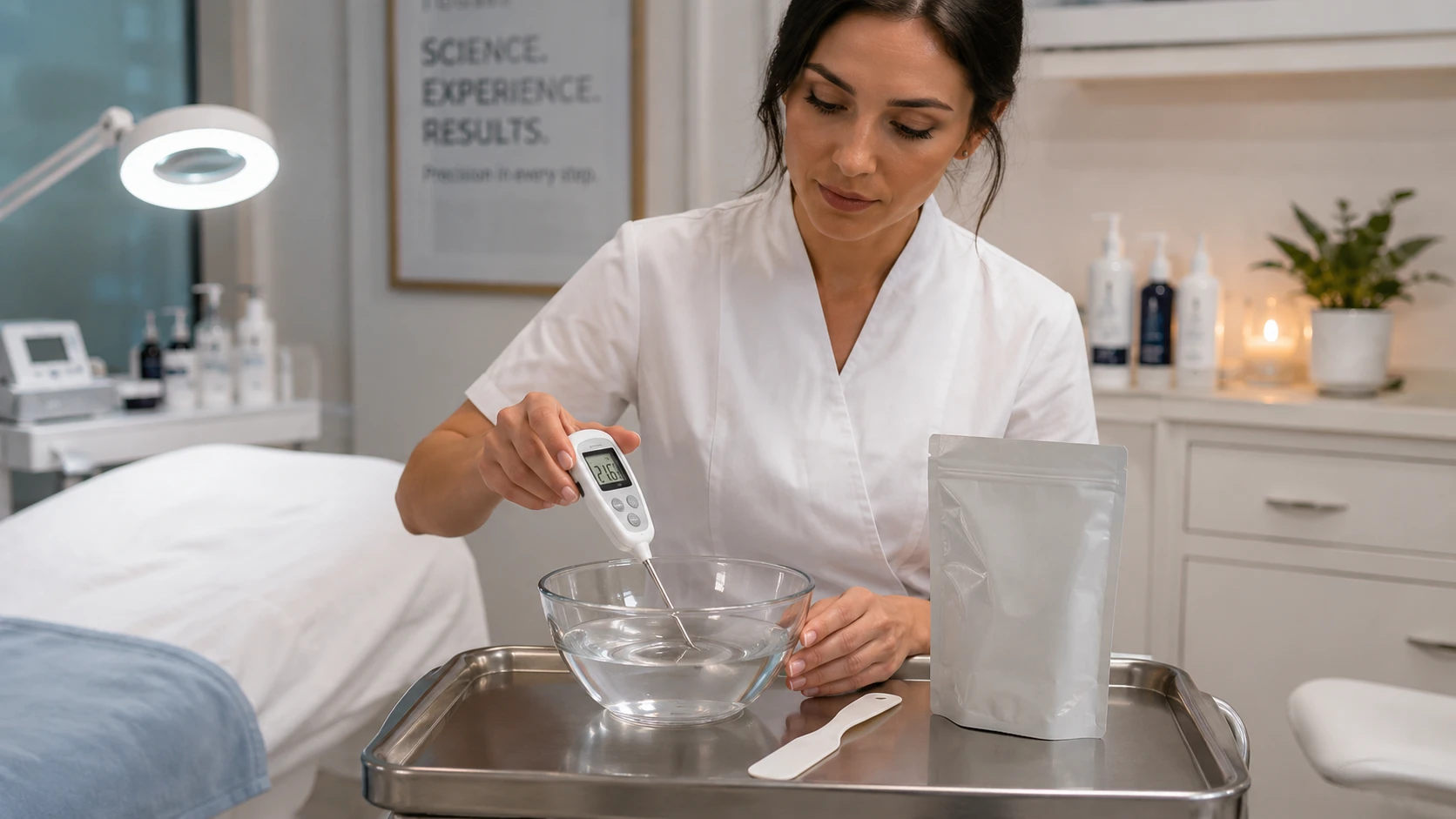
- A professional-grade thermometer is the most reliable tool for eliminating water temperature as a source of appointment-to-appointment inconsistency.
Among the many variables that influence jelly mask performance in a professional treatment room — powder-to-water ratio, mixing technique, application thickness, ambient temperature — water temperature is simultaneously the most impactful and the most routinely ignored. Most estheticians learn the correct mixing ratio early in their jelly mask education. Far fewer are taught why the temperature of that water matters, what exactly it does to the chemistry of the mask, and how significantly it affects the outcome the client experiences.
The consequences of this gap show up in predictable ways: a mask that sets two minutes faster than expected in August, three minutes slower than expected in January, never quite the same texture from one session to the next, clients who remark that the mask felt warm when they expected cool. Each of these is a water temperature problem — and each is entirely solvable with a basic understanding of what is happening chemically and a simple monitoring habit.
This guide gives estheticians the foundational science behind water temperature and jelly mask activation, a practical framework for understanding the five distinct temperature zones and what each does to mask performance, and concrete protocol guidance for controlling water temperature as a professional standard practice rather than treating it as an afterthought.
What Matters Most About Water Temperature and Jelly Mask Performance
- The optimal water temperature for mixing most professional jelly mask formulations is 65 to 75°F (18 to 24°C) — cool to room temperature, measured before mixing.
- Water temperature controls the speed of calcium-alginate cross-linking: warmer water accelerates it, cooler water slows it. Both directions produce predictable but significant effects on set time.
- Heat-sensitive active ingredients — particularly polyglutamic acid and hyaluronic acid — begin to degrade when mixed with water above approximately 90°F (32°C), reducing the mask’s hydration efficacy before it reaches the skin.
- The first sensation the client feels when the mask contacts their face is determined entirely by the temperature of the water used to mix it — controlling water temperature is how estheticians deliver a consistent therapeutic cooling experience.
- Seasonal variation in cold-water supply temperature is one of the leading causes of unexplained jelly mask inconsistency across appointments.
- A simple probe thermometer eliminates guesswork and brings water temperature under the same professional control as mixing ratio and application thickness.
- For post-treatment protocols, targeting the lower end of the optimal range (65 to 70°F / 18 to 21°C) maximizes the cooling response on sensitized skin without compromising gel formation.
Why Does Water Temperature Affect How a Jelly Mask Sets?
Understanding why water temperature matters begins with understanding the chemistry of how a jelly mask actually sets. Professional jelly masks are powder-based systems built around sodium alginate — a naturally derived polysaccharide extracted from brown seaweed. In its dry powder form, sodium alginate is inert. The moment it contacts water, a cross-linking reaction begins: calcium ions present in the water (and in many formulations, added as calcium salt components) bond to the sodium alginate chains, progressively forming a three-dimensional gel network. This reaction is what causes the mask to transition from a pourable liquid to a firm, elastic gel that can be peeled as a single piece.
Temperature Controls the Rate of Cross-Linking
Like virtually all chemical reactions, calcium-alginate cross-linking is temperature-dependent. Warmer water provides more thermal energy, which accelerates molecular movement and speeds the bonding process. The result is faster gel formation, a shorter working window, and a firmer set achieved in less time. Cooler water slows molecular activity, decelerating the cross-linking process, extending the working window, and producing a softer initial gel that takes longer to reach full firmness.
In practical terms, estheticians working in high-volume settings find that a shift of as little as 10 to 15 degrees Fahrenheit in mix water temperature — entirely undetected by touch in most cases — can change set time by two to four minutes. That represents a meaningful service disruption for anyone who has calibrated their facial sequence around a predictable set window.
Calcium Ion Availability and Temperature
Temperature also affects the availability of calcium ions in the mix water. Standard tap water contains varying levels of calcium and other minerals depending on local water supply composition. Warmer water increases the solubility of these calcium salts, making more calcium ions immediately available for cross-linking. This effect compounds the direct kinetic acceleration that warmer temperature already provides, creating a compounding acceleration in gel formation that is often stronger than the temperature change alone would suggest.
What Happens to a Jelly Mask When the Water Is Too Hot?
Hot water is among the most common and most consequential mixing errors in treatment room jelly mask application. It is also among the least visible — the mask still sets, still peels, and still looks like it performed correctly. The damage happens at the ingredient level, before the mask ever reaches the client’s skin.
Accelerated Setting and Lost Working Time
At water temperatures above 85°F (29°C), calcium-alginate cross-linking accelerates to a degree that noticeably compresses the working window. Estheticians who mix with hot tap water frequently report having difficulty spreading the mask smoothly before it begins to stiffen — particularly around the jawline, ears, and neck where application naturally takes the most time. The mask becomes tacky or starts losing its spreadability within 60 to 90 seconds of mixing, rather than the two to three minutes a properly temperature-managed mix provides. Attempting to spread a partially set mask creates uneven coverage, inconsistent thickness, and a removal experience that may involve tearing rather than a clean single-piece peel.
Ingredient Degradation at the Molecular Level
The more significant and less visible consequence of hot-water mixing is its effect on heat-sensitive active ingredients. Polyglutamic acid (PGA) is a biopolymer whose ability to form a surface microgel and bind moisture depends on its molecular conformation. Elevated temperatures above approximately 90°F (32°C) begin to disrupt this conformation — an early-stage thermal degradation that reduces PGA’s moisture-binding efficiency and its capacity to form the flexible occlusive film that makes it functionally valuable in a professional mask context.
Hyaluronic acid (HA) faces similar structural vulnerabilities at elevated temperatures. While HA is more thermally stable than some proteins, repeated exposure to hot-water mixing — particularly at high HA concentrations — degrades the polysaccharide chains, reducing molecular weight and reducing the hydration-binding capacity the ingredient is valued for. Estheticians working with formulations that contain both PGA and HA as functional actives are, when mixing with hot water, systematically reducing the quality of the hydration outcome the mask can deliver — without any visible evidence that anything has gone wrong.
Why Hot Water Compromises PGA and HA Before the Mask Reaches the Skin
PGA thermal sensitivity: Polyglutamic acid’s moisture-binding mechanism depends on its ability to form a flexible surface microgel at the stratum corneum. This property is conformation-dependent — temperatures above approximately 90°F (32°C) begin disrupting the polymer chain arrangement that enables microgel formation, reducing both moisture-binding capacity and surface-sealing efficiency.
HA chain degradation: Hyaluronic acid polysaccharide chains are susceptible to thermal degradation at sustained elevated temperatures. Lower-molecular-weight HA fragments, while still capable of providing some hydration, penetrate differently and retain less moisture-holding capacity than intact high-molecular-weight chains. Hot-water mixing initiates this degradation before the ingredient contacts the skin.
The compounding loss: In a PGA + HA dual-humectant formulation, hot-water mixing simultaneously reduces PGA’s surface-sealing function and HA’s deep-delivery capacity. The synergistic benefit of the combined system — which depends on both ingredients performing at their structural optimum — is diminished proportionally to the degree of thermal stress applied during mixing.
The Warm-Mask Client Experience Problem
There is a third consequence of hot-water mixing that is immediately perceptible to clients but rarely traced back to its cause by estheticians: the mask contacts the face feeling warm rather than cool. Professional jelly masks are valued — particularly in post-treatment recovery protocols — for their therapeutic cooling effect. That cooling sensation is not generated by the mask itself. It is entirely the product of the temperature difference between the freshly mixed mask and the client’s skin. When a mask is mixed with hot water, no meaningful temperature differential exists at application. Clients who have experienced cool-mask treatment before will notice the difference immediately, even if they cannot articulate what is different.
What Happens to a Jelly Mask When the Water Is Too Cold?
Cold water presents a different set of problems than hot water, but they are no less disruptive to consistent professional practice. Estheticians who have tried mixing jelly masks with very cold water — either deliberately seeking a more intense cooling effect or inadvertently during winter months when tap water runs cold — encounter a characteristic set of textural and performance issues that are directly traceable to insufficient activation temperature.
Uneven and Incomplete Gel Activation
When water is too cold, sodium alginate hydration and calcium ion cross-linking both slow significantly. The practical result is that the powder does not fully disperse and hydrate before the mix begins to thicken unevenly — producing a lumpy, grainy, or inconsistent texture that does not spread smoothly and does not produce a uniform mask layer on the skin. Estheticians working with cold mix water often find themselves mixing longer and more vigorously, which introduces air bubbles, creates inconsistent thickness, and can actually further disrupt gel uniformity.
Extended and Unpredictable Set Time
Cold water dramatically slows the cross-linking reaction, extending set time beyond its intended window. This has workflow consequences: service steps that were designed to fit within the mask’s set window — scalp massage, LED sequences, consultation conversations — may overrun and leave the esthetician waiting for the mask to firm enough to remove cleanly. More significantly, an under-set mask does not peel as a single piece. Cold-water masks are more likely to tear during removal, leave residue, or require manual assistance at the jawline and hairline — all of which compromise both the clinical quality of the removal and the client experience moment that professional jelly mask treatments are known for.
The Counterintuitive Truth About Cold Water and Cooling Effect
Many estheticians assume that using very cold water produces a more dramatic cooling experience for clients. This is true at the moment of application — but only briefly. A mask mixed with genuinely cold water (below 55°F / 13°C) that sets unevenly and incompletely delivers a compromised overall treatment experience. The more effective approach is to target the lower end of the optimal temperature range, where gel formation is complete and reliable but the mask still contacts the skin noticeably cooler than the client’s face temperature. For clients who specifically request an enhanced cooling sensation, pre-chilling the mixed mask for 60 to 90 seconds in a refrigerated bowl before application is a controlled technique that maintains gel integrity while intensifying the initial cooling contact.
How Water Temperature Controls the Therapeutic Cooling Benefit of a Jelly Mask
The cooling sensation that clients experience during a professional jelly mask treatment is not incidental — it is one of the primary therapeutic and experiential outcomes that distinguishes the treatment from other mask modalities. And unlike many treatment outcomes that depend on complex ingredient interactions, this one is directly and entirely controlled by the temperature of the water used to mix the mask. There is no formulation component that generates active cooling. The mask cools because it is applied at a lower temperature than the client’s skin surface.
The Physiology of the Cooling Response
When cool material contacts warm skin, vasoconstriction occurs in the superficial capillary networks. This physiological response reduces redness, calms inflammatory activity at the skin surface, and produces the subjective sensations of relief and comfort that clients consistently associate with post-treatment jelly mask application. In treatment contexts where managing post-procedure redness, heat, or sensitivity is a clinical priority — following microneedling, chemical exfoliation, extraction sequences, or dermaplaning — this vasoconstrictive response is not merely a comfort feature: it actively contributes to the speed of visible recovery.
The intensity of this response is proportional to the temperature differential between the mask and the skin. A mask mixed at 68°F (20°C) contacting skin at approximately 92 to 95°F (33 to 35°C) — the typical surface temperature of post-treatment facial skin — creates a meaningful and clinically effective temperature differential. A mask mixed at 85°F (29°C) creates a much smaller differential, producing a noticeably reduced response that clients will often describe as “not as cooling as before.”
Advanced Technique: Pre-Chilling for Enhanced Cooling Protocols
For clients who benefit specifically from extended cooling — particularly those with rosacea-prone skin, persistent post-treatment reactivity, or heat-sensitive conditions — estheticians working in advanced recovery protocols sometimes pre-chill the mixed mask for 60 to 90 seconds in a refrigerated glass or stainless-steel bowl before application. This technique, when starting from an optimal-range water temperature (not cold), maintains complete gel formation while delivering a noticeably cooler initial application temperature. The critical discipline: the mask must have completed its initial hydration and begun to thicken before chilling. Chilling the water before mixing, rather than chilling the completed mix, risks the gel formation problems described in the previous section.
Estheticians incorporating Poly-Luronic™ Jelly Masks by Luminous Skin Lab into post-microneedling and post-extraction recovery protocols report that the cooling experience at first application is one of the most reliably commented-upon moments in the service — but only when water temperature is properly controlled. Those who have made the transition to measuring mix water before every application consistently note that clients’ unsolicited remarks about how “cool and soothing” the mask feels increased noticeably compared to when they were estimating temperature by feel. Practitioners working in summer months particularly report that unmonitored tap water routinely runs 5 to 8 degrees above the optimal range, producing a warm-mask application that clients notice even if they cannot identify the specific cause. Adding a probe thermometer to the mixing station and targeting 68 to 72°F (20 to 22°C) for all post-treatment applications eliminated this inconsistency without changing the powder-to-water ratio, application technique, or any other variable in the protocol.
Why Does Jelly Mask Performance Change Between Summer and Winter?
One of the most common questions estheticians bring to advanced jelly mask education is why their mask performs differently across seasons — setting faster in summer, taking longer in winter, producing a slightly different texture that they cannot connect to any change in their technique. The explanation is almost always the same: tap water temperature fluctuates significantly by season, and without monitoring, these fluctuations pass entirely undetected.
Cold-Water Supply Temperature Variation
In most regions, municipal cold-water supply lines run noticeably cooler in winter as ground temperatures drop, and warmer in summer as ambient temperatures rise. In areas with significant seasonal variation, cold-water temperature at the tap can shift by 15 to 25 degrees Fahrenheit between January and August — a range that spans from the cool zone into the warm zone on the temperature spectrum, producing meaningfully different jelly mask activation behavior at both extremes. This seasonal shift happens gradually and invisibly, making it easy for estheticians to attribute the resulting inconsistency to other variables — a different batch of powder, a new serum under the mask, client skin changes — without identifying the actual cause.
Treatment Room HVAC and Building Plumbing
Beyond seasonal variation in municipal supply, building-specific factors compound the issue. Plumbing that runs through exterior walls or crawl spaces heats and cools more dramatically than interior plumbing. Buildings with older pipe systems may have hot and cold water supplies that are not as thermally isolated as modern construction. HVAC systems that significantly heat or cool the treatment room also affect how long the tap needs to run before the water temperature stabilizes. Estheticians who rely on “letting the cold water run for a moment” as their temperature calibration technique are managing an unpredictable variable rather than a controlled one.
The Solution: Monitoring Instead of Estimating
The simplest and most effective response to seasonal and environmental water temperature variation is direct measurement. A small probe thermometer — the same style used for cooking and food safety verification — costs less than most professional skincare products and eliminates water temperature as a source of appointment-to-appointment inconsistency entirely. The optimal practice: fill the mixing bowl with the intended water volume, measure with the probe thermometer, and if the temperature is outside the target range (65 to 75°F / 18 to 24°C), adjust by adding a small measured amount of cooler filtered water or allowing the mix water to stand in the treatment room for two to three minutes. This adds less than 60 seconds to the preparation routine and removes one of the most common and least-recognized sources of professional jelly mask inconsistency.
Common Water Temperature Mistakes and How to Correct Them
Using Tap Water Directly Without Measuring
This is the single most common water temperature error in treatment room practice. Estheticians who have been mixing jelly masks by feel develop a habitual sense of what “cool enough” feels like — but as documented above, hands cannot detect the 5 to 8 degree variations that produce meaningful changes in set time and cooling effect. The correction is simple: add a probe thermometer to the mixing station as a standard tool alongside the spatula and mixing bowl, and verify temperature before every mix.
Assuming Bottled Water Eliminates the Variable
Using still mineral water or purified bottled water is a sensible choice for ingredient consistency — it eliminates the mineral variation that can affect calcium ion availability across different municipal water supplies. However, bottled water stored at room temperature in the treatment room will drift toward the room’s ambient temperature. In a treatment room kept at 72°F (22°C) or above, room-temperature stored water may still fall within or just above the optimal range, but this should be measured rather than assumed. Refrigerated bottled water used directly from the refrigerator will typically be too cold and will need to reach optimal temperature before use.
Overcorrecting After a Fast-Setting Experience
Estheticians who experience an unexpectedly fast set — most commonly a summer session where warm tap water accelerated activation — sometimes overcorrect by using very cold water in subsequent sessions, swinging from one performance problem to another. The more effective correction is to measure and target the specific optimal range rather than subjectively adjusting in either direction. Precise measurement eliminates the need for overcorrection entirely.
Not Adjusting for Post-Treatment Protocol Differences
The optimal water temperature range for a standard hydration facial and the preferred range for a post-treatment recovery application are overlapping but not identical. For post-treatment protocols — particularly following microneedling, chemical exfoliation, or extraction sequences where the therapeutic cooling effect carries clinical significance — estheticians working at the lower end of the optimal range (65 to 70°F / 18 to 21°C) consistently report stronger client satisfaction with the cooling response and more visible immediate redness reduction. Recognizing this distinction and adjusting accordingly, based on the treatment context rather than habit, is the mark of a protocol-aware practitioner.
Optimal: 68–75°F (20–24°C)
The full optimal range is appropriate. Consistent set time and smooth texture are the primary priorities. Cooling effect is a valued experience element but not a clinical requirement.
Optimal: 65–70°F (18–21°C)
Target the lower end of the optimal range. The therapeutic cooling response on post-procedure skin carries clinical significance for redness reduction, vasoconstriction, and client comfort during the recovery phase.
Action: Measure and chill if needed
Tap water commonly runs 5 to 8 degrees warmer in summer months. Measure before every session and add cool filtered water in small increments to reach the target range. Do not rely on feel.
Action: Measure and warm slightly if needed
Tap water may run below 65°F in winter. Allow water to stand at room temperature for 2 to 3 minutes after drawing, then re-measure. Never microwave mix water — heat distribution is uneven and creates hot spots that can exceed 90°F.
Professional and Scientific References
The science referenced in this article draws from established polymer chemistry, cosmetic formulation science, and professional esthetics practice:
- Sodium alginate calcium-alginate gelation kinetics and temperature-dependence. Carbohydrate Polymer Chemistry literature. Established that calcium ion cross-linking of alginate chains is a temperature-sensitive reaction: higher temperatures accelerate gelation; lower temperatures retard it, with measurable effects on final gel strength, uniformity, and working time.
- Gamma-PGA thermal stability and biopolymer conformational sensitivity. Biotechnology and Applied Biochemistry, cosmetic formulation literature. PGA’s moisture-binding and film-forming capacity are conformation-dependent properties subject to disruption under sustained thermal stress above approximately 90°F (32°C).
- Hyaluronic acid polysaccharide chain degradation under thermal conditions. Journal of Cosmetic Science; Carbohydrate Research. HA molecular weight reduction and associated reduction in moisture-binding capacity under elevated temperature exposure is an established limitation in professional formulation handling.
- Vasoconstriction response to topical cooling — physiology of cool-temperature contact on facial skin microvasculature. Dermatology and aesthetic medicine literature. Temperature differential between applied material and skin surface is the determinant of vasoconstrictive response intensity.
- Municipal water temperature seasonal variation. Environmental engineering and water supply literature. Cold-water supply temperature at residential and commercial taps correlates with seasonal ground temperature and varies by 10–25°F annually in temperate climates.
- PGA + HA synergistic combination — slows HA degradation, enhances sustained moisturizing effect. Stanford Chemistry / cosmetic formulation literature, 2024.
— Expand with specific DOIs upon editorial review.
For estheticians seeking a professional jelly mask formulation whose performance is optimized for the 65 to 75°F (18 to 24°C) water temperature range — with a documented 12-to-15-minute set window, smooth gel texture at proper activation temperature, and active ingredient integrity that depends on controlled mixing conditions — the Poly-Luronic™ Jelly Mask by Luminous Skin Lab is the formulation our education team most frequently references in application technique and protocol consistency education. The proprietary Poly-Luronic™ blend — combining polyglutamic acid and hyaluronic acid in a professional occlusive mask format — delivers its full dual-humectant benefit only when mixing water temperature is properly controlled. The thermometer-verified protocol described in this guide was developed specifically in the context of Poly-Luronic™ application practice and represents the standard our team recommends for all advanced hydration and post-treatment protocol use.
Explore the Poly-Luronic™ Jelly Mask LineFrequently Asked Questions: Water Temperature & Jelly Mask Performance
What water temperature should I use when mixing a jelly mask?
Most professional jelly mask formulations perform best when mixed with water in the cool-to-room-temperature range — approximately 65 to 75°F (18 to 24°C). This range produces consistent gel texture, predictable set time, preserves heat-sensitive active ingredients like polyglutamic acid and hyaluronic acid, and delivers the therapeutic cooling benefit clients expect when the mask contacts warm post-treatment skin. Using a thermometer rather than estimating by feel is the most reliable way to ensure consistency across sessions.
Why does my jelly mask set faster on some days than others?
Inconsistent set time is almost always traceable to variation in water temperature. Warmer water accelerates the calcium-alginate cross-linking reaction that causes the mask to gel, producing a shorter set window. Cooler water slows that reaction, extending set time. Treatment room water temperature can vary significantly with the season, plumbing conditions, and how long the tap has been running before use. Measuring water temperature before each mix — rather than relying on feel or habit — is the most reliable way to produce consistent set times across appointments.
Can hot water damage the ingredients in a jelly mask?
Yes. Polyglutamic acid (PGA) and hyaluronic acid (HA) are both heat-sensitive biopolymers. Water above approximately 90°F (32°C) begins to degrade the structural integrity of PGA’s microgel-forming capacity and can partially denature HA, reducing its moisture-binding efficiency before the mask is even applied. Consistently mixing with hot water does not merely affect set time — it systematically reduces the quality of the hydration outcome the mask can deliver. This is particularly significant for formulations that market their PGA and HA content as functional active ingredients.
Should I use cold water for jelly masks applied after microneedling?
Using cool water (65 to 72°F / 18 to 22°C) is appropriate and beneficial for post-treatment applications. The cooler water temperature helps the finished mask contact post-procedure skin with a therapeutic cooling effect that supports vasoconstriction and reduces redness. However, water that is too cold (below 55°F / 13°C) can slow gel formation unevenly, creating texture inconsistencies and extending set time unpredictably. Targeting the lower end of the optimal range — rather than truly cold water — provides the post-treatment cooling benefit while maintaining formulation reliability.
Why does my jelly mask feel warm when I spread it on the client’s face?
A jelly mask that feels warm on application was almost certainly mixed with water that was too warm. The finished mask adopts the temperature of the water used to activate it. When estheticians mix with hot or warm tap water, the resulting gel is warm — and it contacts the client’s face at that temperature. For standard hydration facials this may be a minor client comfort issue, but for post-treatment applications on sensitized or barrier-compromised skin, applying a warm mask instead of a cooling one can actively conflict with the therapeutic objective of the protocol.
Why does my jelly mask consistency change between summer and winter?
Tap water temperature fluctuates meaningfully by season in most regions, even inside climate-controlled buildings. Cold-water supply lines run cooler in winter and warmer in summer, which directly shifts the activation temperature of the mask without any change in the esthetician’s routine. This is one of the most common and least-recognized sources of seasonal inconsistency in jelly mask performance. The solution is to monitor water temperature with a thermometer and adjust the mix water by adding filtered water at a known temperature, rather than assuming tap water is consistent year-round.
Does the water temperature affect how long I have to spread the mask before it starts to set?
Yes, significantly. The working time — the window between completing the mix and when the mask stiffens enough to resist smooth spreading — is directly controlled by water temperature. Warmer water reduces this window, sometimes to less than 60 to 90 seconds for brands with faster activation profiles. Cooler water extends the working window, giving more time for thorough facial coverage. Estheticians who struggle to cover the full face before the mask begins to set should check their mix water temperature before changing ratios or technique.
How does water temperature affect Poly-Luronic™ Jelly Mask performance?
Poly-Luronic™ Jelly Mask by Luminous Skin Lab is formulated to perform optimally in the 65 to 75°F (18 to 24°C) water temperature range. Within this range, the formulation delivers its characteristic 12-to-15-minute set window, smooth gel texture from first application, and full delivery of the PGA + HA dual-humectant system with ingredient integrity intact. Mixing with water above this range shortens the set window and compromises the PGA microgel-forming capacity. Mixing below it extends set time and reduces the immediate cooling effect on application. Using a thermometer to verify mix water temperature before each session is the most direct way to ensure consistent Poly-Luronic™ performance across every appointment.
Water Temperature Is a Professional Variable, Not an Afterthought
Among the variables that determine jelly mask performance in a professional treatment room, water temperature sits in an unusual position: it has a measurable and direct effect on virtually every quality dimension of the treatment — set time, gel texture, active ingredient efficacy, and therapeutic outcome — yet it receives far less systematic attention than mixing ratio, application thickness, or serum selection.
Understanding the chemistry behind why temperature matters — the kinetics of calcium-alginate cross-linking, the thermal sensitivity of PGA and HA, the physics of the cooling differential — transforms water temperature from a background variable into a purposefully controlled protocol element. And the practical intervention required to bring it under control is genuinely minimal: a probe thermometer, a clear target range (65 to 75°F / 18 to 24°C for most protocols; 65 to 70°F / 18 to 21°C for post-treatment applications), and the discipline to measure before every mix rather than estimating by feel.
The estheticians who close this gap between knowing a variable exists and actively managing it are the ones whose clients consistently experience the same high-quality jelly mask application regardless of season, time of day, or which treatment room they were in. That consistency — in every professional dimension of the service — is what builds client trust, justifies premium service positioning, and distinguishes genuinely professional jelly mask application from the consumer-oriented alternative.