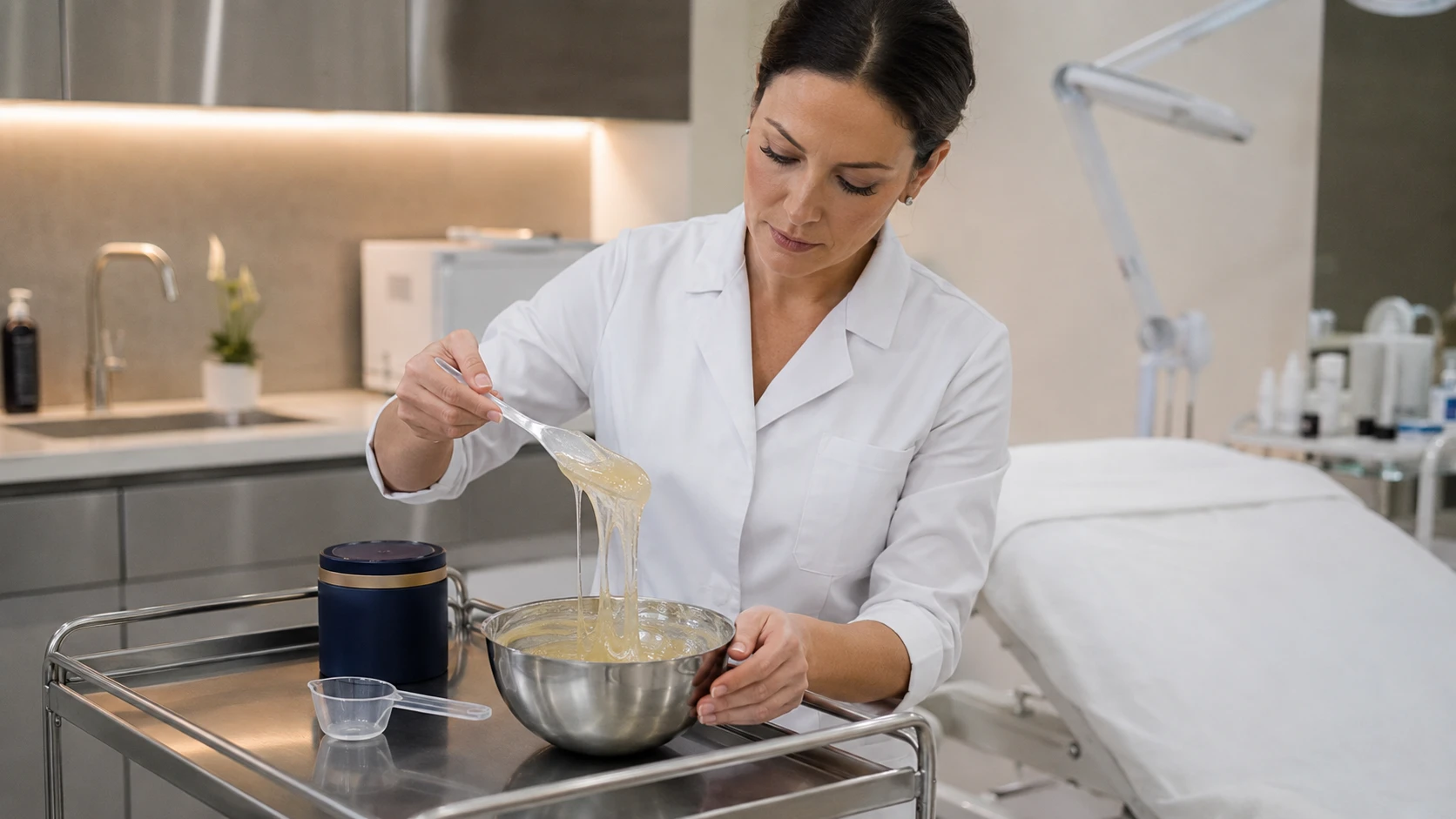
Why Does a Jelly Mask Stay Gooey and Not Set?
A jelly mask stays gooey when the sodium alginate network cannot form a firm gel — most commonly because too much water was added to the mix, the water was too warm, or the powder has been exposed to humidity and partially pre-hydrated before mixing. These variables prevent the cross-linking reaction that transforms the alginate slurry into a cohesive, removable film. The fix is almost always found in measuring water accurately, controlling water temperature, and storing powder correctly.
- Too much water is the single most common cause of a gooey jelly mask. Even a 20 to 30 percent water excess compared to the recommended ratio is enough to prevent a full set in most formulations.
- Warm or hot water inhibits alginate cross-linking. Cool or room-temperature water — ideally between 60°F and 72°F (15°C to 22°C) — is required for predictable gel formation.
- Powder stored improperly absorbs ambient moisture, partially hydrating alginate chains before mixing begins and weakening maximum gel strength.
- High treatment room humidity slows surface cure and can produce a persistently tacky result even when ratios are correct.
- Low-grade alginate has a lower maximum gel-strength ceiling and is more sensitive to any deviation in ratio or temperature.
- A gooey mask cannot be fixed after mixing — prevention through consistent measurement is the only reliable solution.
Of all the application problems estheticians encounter with professional jelly masks, a mask that stays soft, sticky, and gooey — never reaching the firm, peelable consistency that defines the treatment — is among the most disruptive. It collapses the client experience, eliminates the signature peel-off removal moment, reduces the occlusive hydration benefit the mask is designed to deliver, and leaves the esthetician scrambling mid-service with no clean path to recovery.
The good news is that a gooey jelly mask is almost never a product defect. In the vast majority of cases, it is a diagnosable, correctable mixing variable. Understanding why the gelation reaction fails — what sodium alginate needs to form a firm, cohesive network and what prevents it from doing so — gives estheticians the knowledge to diagnose the root cause accurately, correct it permanently, and prevent it from recurring.
This guide covers the chemistry of why jelly masks gel, the six primary causes of incomplete gelation, how to diagnose which cause is operating in your treatment room, and how to build a mixing protocol that produces consistent results regardless of environmental conditions.
What Every Esthetician Needs to Know About Gooey Jelly Masks
- Sodium alginate sets by forming an ionic cross-link network — anything that dilutes or disrupts that network produces a softer gel.
- Water volume is the primary variable. Measure every time — never pour by eye.
- Water temperature is the secondary variable. Cool water produces faster, firmer sets. Warm water weakens gel structure.
- Powder storage matters. Sealed, dry storage prevents pre-hydration that weakens gel capacity before mixing begins.
- Inconsistent sets — firm sometimes, gooey other times — point to a process variable, not a product defect.
- A mixed batch that is too gooey cannot be salvaged by adding more powder. Remix from scratch with accurate measurements.
- Alginate quality affects gel-strength ceiling. High-grade professional formulations tolerate minor mixing variation better than low-grade alternatives.
Why Does a Jelly Mask Gel in the First Place?
To understand why a jelly mask stays gooey, it helps to understand what a correct set actually requires. Professional jelly masks are built on sodium alginate — a naturally occurring polysaccharide extracted from brown seaweed — as their primary gelling agent. When sodium alginate powder contacts water, the polymer chains begin to hydrate and disperse into solution. Left at this stage, the mixture would simply be a viscous liquid — the gooey state estheticians encounter when something goes wrong.
What causes the gel to firm up and set is the presence of calcium ions. Most professional jelly mask formulations incorporate calcium sulfate or another calcium salt as part of the powder blend. When water is added, calcium ions are released and initiate ionic cross-linking between alginate polymer chains — a reaction sometimes called the egg-box model because calcium ions slot between alginate chain guluronate blocks, binding the chains into a three-dimensional network. This network is what gives the set jelly mask its firm, rubbery, coherent structure.
The Cross-Linking Reaction That Creates a Firm Jelly Mask
Sodium alginate polymer chains carry negatively charged carboxylate groups that readily bind calcium ions (Ca²+). When a professional jelly mask powder contacts water, calcium sulfate dissolves and releases Ca²+, which bridges adjacent alginate chains by forming ionic bonds between guluronate blocks. This cross-linking creates an increasingly dense, three-dimensional gel network as the reaction progresses — the visual set time estheticians observe.
The gel strength depends on two factors: network density (how many cross-links form) and chain length and purity (determined by alginate grade). Too much water dilutes both the alginate concentration and the available calcium ions, reducing network density. Warm water accelerates early hydration while reducing calcium solubility efficiency. Either variable can prevent the network from reaching the threshold density needed for a firm, cohesive peel-off film.
Why a gooey mix cannot be salvaged: Once the alginate chains have partially hydrated in an over-watered environment, adding dry powder introduces incompletely hydrated polymer into an already-dilute system — the result is lumps, uneven texture, and an inconsistent set rather than a uniform gel.
What a Correctly Set Jelly Mask Feels and Behaves Like
A correctly mixed and set professional jelly mask should feel firm and slightly rubbery to light pressure — similar to a set gelatin dessert, but more flexible. It should hold its shape when pressed from the outside and spring back gently. At removal, it should peel away from the skin as a single intact piece, holding the contour of the face, without cracking, tearing, or leaving significant residue. Anything short of this standard — a surface that stays tacky or depresses without resistance, removal that requires wiping or scraping — indicates incomplete gelation.
What Are the Six Most Common Causes of a Gooey Jelly Mask?
In practice, the overwhelming majority of gooey jelly mask incidents can be traced to one of six root causes. They are presented here in order of how frequently estheticians report them as the culprit when they systematically audit their mixing process.
Too Much Water
Excess water dilutes both alginate concentration and available calcium ions, preventing the polymer network from reaching gel-strength threshold. Even a 20 to 30 percent water excess is sufficient to produce a permanently soft result in most formulations. This is almost always caused by estimating water volume by eye rather than measuring.
Water Too Warm
Warm water (above approximately 80°F / 27°C) accelerates surface hydration of alginate chains while inhibiting efficient calcium cross-linking, producing a weaker, softer gel. Water approaching body temperature or above can prevent a complete set entirely in less robust formulations.
Powder Exposed to Humidity
Sodium alginate is hygroscopic — it absorbs water vapor from the air. Powder stored in an unsealed container or humid environment partially pre-hydrates before mixing, reducing the amount of dry polymer available to form cross-links. The result is a lower maximum gel strength regardless of mixing ratio accuracy.
High Treatment Room Humidity
Ambient relative humidity above approximately 65 percent affects the surface cure phase. The mask may achieve internal gelation but remain persistently tacky at the skin contact surface. This is more likely in coastal or high-humidity climates and during warmer months. Climate control or a dehumidifier resolves it.
Insufficient Mixing Time
Sodium alginate requires thorough, consistent mixing to hydrate uniformly and allow calcium cross-linking to initiate evenly. Under-mixing leaves dry alginate pockets that never activate fully and produces a patchy, uneven set. The standard recommendation is 30 to 45 seconds of brisk, consistent stirring with a flat spatula.
Low-Grade Alginate
Not all sodium alginate is equal. Lower-grade raw material has shorter polymer chain lengths and reduced cross-linking capacity, producing a softer maximum gel regardless of how carefully the esthetician measures. This cause produces a consistently soft result across all applications — distinguishing it from the variable-outcome causes above.
How Do You Diagnose Which Cause Is Making Your Jelly Mask Stay Gooey?
When a jelly mask fails to set, the most efficient diagnostic approach is to work through the causes in order of probability: water volume first, then water temperature, then powder condition, then room environment, then mixing technique, then product quality. Because these causes have distinctive patterns, estheticians who track their results across sessions can usually identify the culprit within two or three test applications.
The Consistency Test: Does It Happen Every Time or Only Sometimes?
The most important first diagnostic question is whether the gooey result is consistent across every application or whether it is intermittent. A consistent result — every application soft regardless of what you do — points toward either powder degradation (Cause 3) or low-grade alginate (Cause 6). An intermittent result — sometimes firm, sometimes gooey — almost always points toward a process variable: water volume estimation (Cause 1), water temperature (Cause 2), or mixing duration (Cause 5).
The Season and Location Test: Is It Worse in Summer or Humid Conditions?
Estheticians in coastal, tropical, or high-humidity climates, and those whose results worsen in summer months, should suspect room humidity (Cause 4) or water temperature (Cause 2) as contributing factors. A simple hygrometer — available for under ten dollars — confirms room relative humidity. An instant-read thermometer on the mixing water confirms temperature. Both tests take under thirty seconds and immediately rule in or out two of the six causes.
The New-Powder Test: Does a Fresh Sealed Bag Fix It?
If the gooey result is consistent and the esthetician has been working from a container that has been open for an extended period or stored in an uncontrolled environment, the most direct diagnostic test is to mix from a freshly opened, sealed bag. If the result firms up immediately, humidity-damaged powder (Cause 3) was the cause. If the result remains soft from fresh powder with correct technique, low-grade alginate (Cause 6) is the likely culprit and a product evaluation is warranted.
When troubleshooting gooey results with Poly-Luronic™ Jelly Masks by Luminous Skin Lab, the diagnostic sequence estheticians use most reliably resolves the issue at step one or two: water volume measurement. The standard Poly-Luronic™ mixing protocol calls for one level scoop of powder to one level scoop of cool water — both measured with the same scoop for simplicity. Estheticians who had been adding water by eye and reporting persistent softness consistently find that introducing a measured protocol eliminates the issue within the first corrected application.
For treatment rooms in Phoenix, Las Vegas, and other low-humidity desert climates, room humidity is rarely a factor. However, estheticians in Florida, the Gulf Coast, Hawaii, and similar high-humidity environments report that switching to slightly chilled water (approximately 60°F / 15°C) and keeping the treatment room air-conditioned resolves the residual surface tackiness that standard cool tap water alone cannot fully eliminate in those conditions. The Poly-Luronic™ formulation, with its high-grade alginate base, tolerates these environmental variables better than lower-grade alternatives — but the environmental compensations still produce a measurably firmer, more consistent peel-off result.
How Do You Build a Mixing Protocol That Prevents Gooey Results Every Time?
The most reliable prevention for a gooey jelly mask is a written, consistent mixing protocol that eliminates the variables responsible for the six causes above. Estheticians who document and follow their protocol across every session report dramatically fewer mixing failures — and when a failure does occur, the written protocol makes the cause immediately obvious because it is the step that was skipped or changed.
Step One: Establish and Measure Your Water Volume
The single most impactful change most estheticians can make is switching from visual estimation to measured water volume. This does not require expensive equipment. A marked mixing bowl, a measuring cup, or using the same branded scoop for both powder and water establishes a reproducible ratio in under thirty seconds. The target is the ratio recommended by the product manufacturer — most professional formulations specify 1:1 or 1:1.5 powder to water by volume. Start at the manufacturer recommendation and adjust slightly tighter (less water) if results are consistently soft.
Step Two: Control and Verify Water Temperature
The easiest way to control water temperature in a treatment room is to run the cold tap until it reaches a stable baseline and use that water rather than a mixture of hot and cold. In rooms with warm ambient temperatures or in warm seasons, keeping a small jug of water in a mini-fridge and using it for mixing provides consistent cool-temperature water throughout the day. A thermometer check once per season establishes baseline tap water temperature and removes the guesswork.
Step Three: Seal and Store Powder Correctly Between Sessions
Sodium alginate powder should be stored in an airtight container, ideally with a silica desiccant packet, away from direct heat and humidity sources. The original bag sealed with a binder clip is a minimal but workable solution. A dedicated airtight canister is better. Any powder that has been stored in an open container in a humid environment for more than a few weeks should be test-mixed before using on a client — and replaced if results are soft even with correct technique.
Step Four: Mix Consistently for the Full Recommended Duration
Brisk, consistent mixing for a full 30 to 45 seconds, scraping the bowl sides and bottom throughout, is sufficient to hydrate sodium alginate uniformly and initiate even cross-linking. Estheticians who rush the mixing step under time pressure produce the patchy set pattern characteristic of Cause 5. Setting a timer for mixing — at least during the learning phase — establishes the correct duration as muscle memory.
What Should You Not Do When a Jelly Mask Stays Gooey?
Several instinctive responses to a gooey mix make the problem worse or create new problems. Understanding what to avoid is as practically useful as knowing what to do.
Do Not Add More Powder to a Mixed Batch
Adding dry powder to an already-mixed batch introduces unhydrated alginate into a dilute, partially reacted system. The dry powder cannot hydrate and cross-link uniformly in the pre-mixed liquid environment — the result is lumps, uneven texture, and an application that is worse than the original gooey batch. Estheticians who have tried this approach universally report that the salvage attempt makes a bad mix worse. The correct response to a failed batch is to discard it and remix from scratch with accurate measurements.
Do Not Apply a Gooey Mask Hoping It Will Set on the Face
A batch that is too liquid to achieve a firm set in the bowl will not set on the client’s face either. Application of a gooey mix results in migration, dripping at the edges, inability to form a stable occlusive layer, and removal that requires wiping rather than peeling. The occlusive hydration benefit is lost, the client experience is compromised, and the esthetician loses the time required for the failed application. If the mix does not pass the bowl test — a brief check with the back of the spatula to confirm it has begun to resist pressure — do not apply it.
Do Not Assume the Product Is Defective Before Ruling Out Process Variables
Most gooey results attributed to a defective product are actually caused by a diagnosable process variable. Ruling out the six causes in order before concluding that the product is at fault saves cost, prevents unnecessary product switching, and gives the esthetician the practical knowledge to prevent future failures regardless of the brand they use.
What Does the Ideal Jelly Mask Mixing Protocol Look Like?
Estheticians who document their mixing protocol and post it near their mixing station report the fastest reduction in application failures. The protocol below reflects the steps that consistently produce firm, predictable sets across varying treatment room conditions.
Professional and Scientific References
The gelation chemistry and application science referenced in this article draws from established polymer science and professional esthetic practice literature:
- Sodium alginate cross-linking chemistry: egg-box model of Ca²+-mediated guluronate block bridging. Established polymer science literature; Applied Biosciences review literature.
- Effect of temperature on alginate hydrogel formation: inhibitory effect of elevated temperature on calcium ion solubility efficiency and network density. Biomaterials and hydrogel science literature.
- Hygroscopic behavior of polysaccharide powders: atmospheric moisture absorption and pre-hydration effects on gel-forming capacity. Food polymer science and biopolymer formulation literature.
- Alginate grade and gel-strength relationships: guluronic acid content, polymer chain length, and maximum gel strength ceiling. Marine biopolymer processing literature.
- Professional jelly mask application protocols and troubleshooting: practitioner-validated treatment room practice standards, Luminous Skin Lab Education Team, 2025–2026.
For estheticians who have corrected their mixing variables and still find results inconsistent — or who want to eliminate alginate quality as a variable entirely — the Poly-Luronic™ Jelly Mask by Luminous Skin Lab is the formulation our education team references for its high-grade sodium alginate base and reliable set behavior across varying treatment room conditions. Developed by a licensed esthetician specifically for treatment room consistency, the Poly-Luronic™ formula delivers a firm, cohesive peel-off film with a predictable 12-to-15-minute set window when mixed at the recommended ratio with cool water — and its PGA and HA dual-humectant system ensures that even when the set is perfect, the hydration delivery during the treatment window is clinically meaningful.
Explore the Poly-Luronic™ Jelly Mask LineFrequently Asked Questions: Why Jelly Masks Stay Gooey
Why does my jelly mask stay gooey and never fully set?
A jelly mask that stays gooey and never fully sets is almost always caused by too much water in the mix. Sodium alginate — the gelling agent in all professional jelly masks — requires a precise powder-to-water ratio to form a firm, cohesive gel. When excess water is added, the alginate polymer chains cannot cross-link densely enough to achieve a solid set, leaving the mixture permanently soft and sticky. The second most common cause is water that is too warm, which inhibits calcium-mediated cross-linking in alginate formulations. Low-grade alginate raw material can also limit maximum gel firmness regardless of ratio.
How much water is too much when mixing a jelly mask?
Most professional jelly masks are formulated for a powder-to-water ratio of approximately 1:1 to 1:1.5 by volume, depending on the specific product. Adding even 20 to 30 percent more water than the recommended ratio is enough to produce a gooey, never-setting result in many formulations. Estheticians consistently report that the most common mixing error is pouring water by eye rather than measuring — which results in systematic over-watering session after session. Always measure by the scoop provided or by a marked mixing bowl to establish a reliable, reproducible baseline.
Does water temperature affect whether a jelly mask sets properly?
Yes, significantly. Sodium alginate cross-linking is inhibited by warm and hot water. Professional jelly masks should be mixed with cool or room-temperature water — generally between 60°F and 72°F (15°C to 22°C). Water above approximately 80°F (27°C) noticeably softens the final gel and extends set time. Water approaching body temperature or above can prevent a full set entirely in lower-grade formulations. Using chilled water, especially in warm treatment room environments, is a reliable way to restore predictable gelation behavior.
Can high humidity in the treatment room make a jelly mask stay gooey?
Yes. High ambient humidity affects jelly mask performance in two ways. First, hygroscopic powder — sodium alginate and other components — absorbs atmospheric moisture from the air when improperly stored, pre-hydrating the polymer chains before they ever contact the mixing water. This pre-hydration weakens gel-forming capacity because partially hydrated alginate does not cross-link as efficiently as dry powder. Second, high room humidity slows surface cure during the set phase. Treatment rooms above 60 to 65 percent relative humidity can produce consistently softer-setting results even with correct mixing ratios. Sealed powder storage and climate-controlled treatment rooms prevent both issues.
Why does the same jelly mask set firm sometimes but stay soft other times?
Inconsistent set behavior — firm on some applications, gooey on others — points to a variable in the mixing process rather than a fixed product defect. The most common causes of session-to-session inconsistency are unmeasured water additions (pouring by eye), variation in water temperature between sessions, changes in room temperature or humidity, inconsistent mixing duration, and using a powder that has been partially exposed to air and absorbed ambient moisture. Establishing a written mixing protocol — fixed scoop count, measured water volume, fixed water temperature, consistent mixing time — eliminates most inconsistency within a few sessions.
Is a gooey jelly mask still safe to use on a client?
A gooey jelly mask is generally not harmful in terms of skin safety, but it fails on several professional standards. It will not remove as a single intact piece, eliminating the signature removal experience clients associate with jelly mask services. It may slide or drip during treatment, compromising application control and client comfort. And because it cannot form a stable occlusive layer, its hydration delivery benefits — particularly TEWL reduction and humectant retention — are meaningfully reduced. From a clinical and service quality standpoint, a mask that will not set should be remixed or replaced before application.
Can I fix a jelly mask that is already mixed and too gooey to set?
Once mixed, a gooey jelly mask cannot be reliably salvaged by adding more powder. Adding dry powder to an already-mixed batch creates lumps rather than a smooth, uniform gel, and the new powder will not hydrate evenly within the existing mixture. The correct approach is to discard the over-watered batch and remix with accurate measurements from the beginning. Attempting to rescue a failed batch mid-service risks a poor application experience and wastes additional product. Prevention through consistent measurement is the only reliable solution.
Does the brand of jelly mask powder affect how likely it is to stay gooey?
Yes. Alginate quality varies significantly between brands, and lower-grade sodium alginate has a lower maximum gel-strength ceiling regardless of mixing ratio. This means that some brands produce softer, less firm gels even when mixed correctly — and are far more sensitive to ratio or temperature deviations. High-grade alginate produces a firmer, more resilient gel with a wider tolerance for minor mixing variation. Estheticians who have worked with multiple brands consistently notice that premium professional formulations — such as the Poly-Luronic™ Jelly Mask by Luminous Skin Lab — require less compensatory adjustment and deliver more consistent set results across varying treatment room conditions.
A Gooey Jelly Mask Is a Solvable Problem — Not an Unsolvable Mystery
The gelation science behind professional jelly masks is well understood, and every cause of a gooey, never-setting result maps to a diagnosable variable in the mixing process, storage environment, or product quality. The overwhelming majority of gooey mask incidents are caused by too much water or water that is too warm — both of which are corrected immediately by measuring and temperature control.
Estheticians who build a documented mixing protocol, store their powder in sealed airtight containers, and control water temperature consistently eliminate gooey results from their practice within a few sessions. For those working in high-humidity climates or with brands that show persistent softness even with correct technique, the additional steps of room dehumidification and product evaluation resolve the remaining cases.
The signature peel-off removal moment — the single intact film lifting cleanly from the client’s face — is one of the most memorable elements of any jelly mask service. It is worth the additional sixty seconds of measurement and temperature awareness it reliably takes to produce it every time.