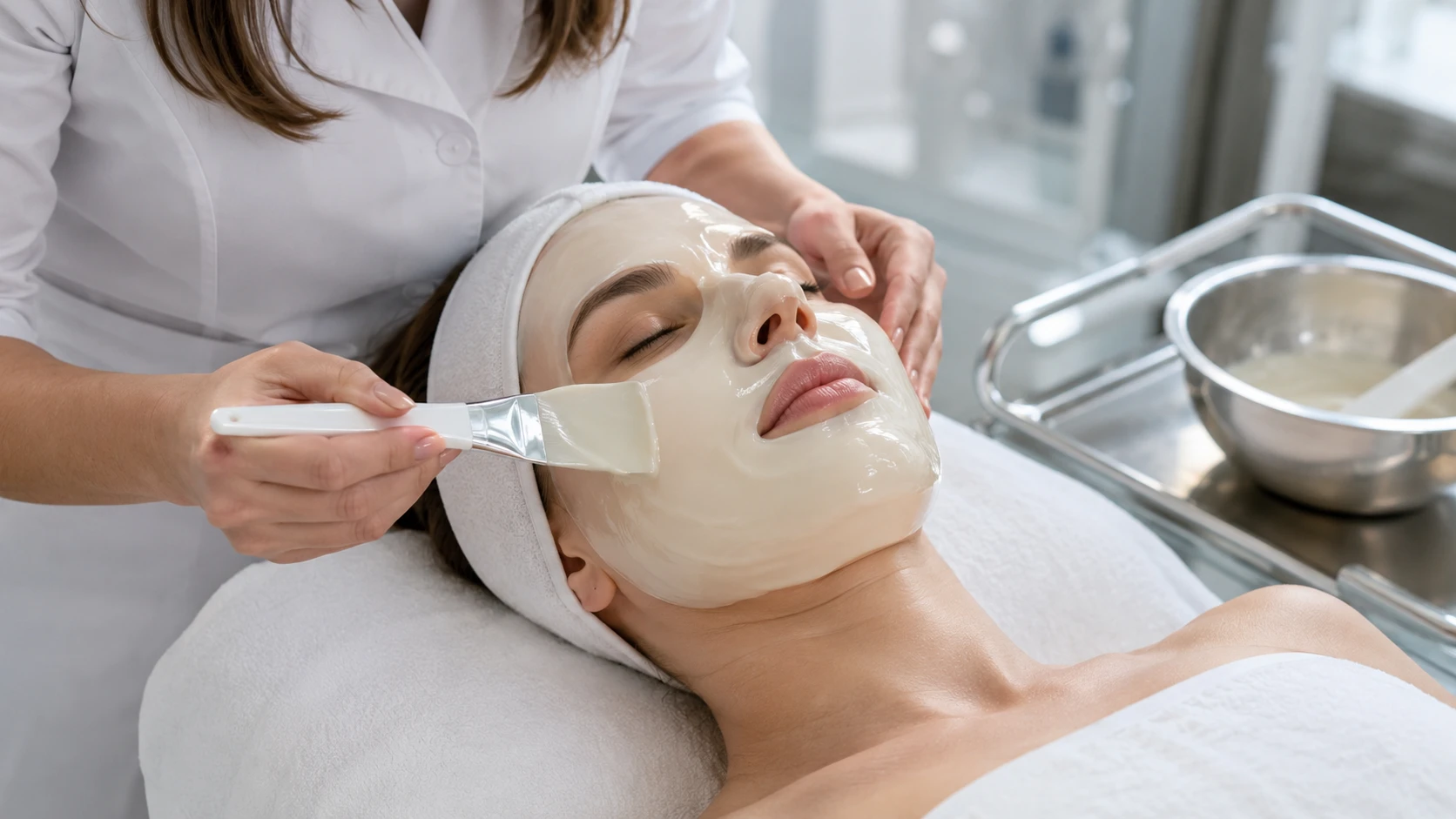
How Thick Should a Jelly Mask Be When You Apply It?
The professional standard for jelly mask application depth is 5 to 7 millimetres of uniform thickness across the entire facial surface. This range is not arbitrary — it represents the minimum depth at which sodium alginate gel develops the tensile strength needed for intact single-piece removal, while remaining within the upper bound where set time is predictable and client comfort is maintained throughout the dwell period.
- Below 5mm, the cross-linked polymer matrix lacks sufficient density to resist peel forces during removal — the mask cracks, tears, or lifts in fragments rather than as a single continuous piece.
- Above 7–8mm, the thermal mass of additional batter slows gelation at the deep layer, extending set time unpredictably and potentially creating a mask that feels firm on the surface while still gelling against the skin.
- Uniform depth across the full face — including the nose bridge, jaw, hairline, and chin — matters as much as reaching the correct depth in the center; thinned edge zones are the primary failure points during removal.
- The spatula-edge calibration method gives estheticians a reliable in-hand reference: the correct depth is approximately equal to the full width of a standard professional spatula blade standing on its edge.
- Mixing slightly more batter than estimated ensures edge zones can be covered at correct depth without thinning to compensate for insufficient volume — running short mid-application is the most common cause of thin-edge failures.
- Application depth serves structural integrity and set time consistency — clinical hydration outcomes are determined by formulation and serum selection, not by mask volume beyond the 5mm threshold.
Of all the variables in professional jelly mask application, thickness is the one that receives the least deliberate attention and causes the most visible problems. Estheticians who spend significant effort calibrating their mixing ratio, water temperature, and serum selection often apply the batter by feel and estimation, spreading it until the face looks covered and moving on. That approach works — until it doesn’t. And when it fails, the failure is usually misattributed to product quality, water temperature, or timing rather than to the application depth that was actually responsible.
The 5-to-7mm professional standard exists because sodium alginate gel is a polymer network whose physical properties — tensile strength, elasticity, and peel resistance — are directly determined by the depth and uniformity of the applied layer. Too shallow, and the gel lacks the structural density to hold together under removal force. Too deep, and the gelation kinetics at the core lag behind the surface, producing a mask that behaves inconsistently throughout the dwell period.
This guide explains the material science behind the thickness standard, what happens at each failure threshold, how to calibrate application depth without measuring instruments, which facial zones are most prone to thinning errors and why, and how to build the pre-application habits that make consistent depth automatic rather than deliberate. Depth calibration is one of those rare technique refinements that is easy to implement and immediately improves service consistency — for every client, every session.
What Every Esthetician Needs to Know About Jelly Mask Application Depth
- 5–7mm is the professional application standard — below this threshold, removal integrity fails; above it, set time becomes unpredictable and client comfort is reduced.
- Cracking and tearing on removal are the diagnostic signs of insufficient depth, not product failure — they indicate the gel layer below the 5mm structural threshold.
- Uniform depth across the entire face is as important as the correct depth in any single zone — thin edges are the fracture points that break the single-piece removal.
- The spatula-edge reference — approximately one full spatula-blade width standing on its edge — provides a reliable in-hand calibration with no instruments required.
- Apply batter from the perimeter inward, not center outward, to prevent the progressive thinning at the edges that center-outward spreading produces.
- Mix more batter than you think you need — running short mid-application forces thinning decisions that compromise the entire mask.
- Clinical hydration outcomes are not improved by exceeding the 7mm upper bound — the seal quality is established at the skin surface, not through added volume above it.
Why the 5–7mm Standard Exists: The Material Science of Alginate Gel Depth
Sodium alginate gel forms through an ionic cross-linking reaction between alginate polymer chains and calcium ions. When alginate powder is mixed with water, the calcium ions present in the water (and in the supplemental calcium salts included in most professional formulations) initiate a progressive gelation reaction that propagates through the liquid batter as it is applied to the face. The density of the resulting cross-linked polymer network — and therefore the gel’s mechanical properties — is a function of both the alginate concentration in the batter and the depth of the applied layer.
Tensile Strength and the 5mm Threshold
Tensile strength in a set alginate gel is the property that determines whether the mask can resist the mechanical force applied during removal without fracturing. Below a critical depth threshold, the number of cross-linked polymer chains running through the full thickness of the gel is insufficient to form a continuous structural network capable of distributing peel stress across the mask surface. The gel behaves more like a thin brittle film than a flexible elastic sheet: it cracks under the peel force rather than stretching and releasing.
Empirically, professional estheticians and mask formulators have established 5mm as the practical threshold below which removal integrity becomes unreliable for standard professional alginate formulations. This figure reflects the cross-link density achievable at standard powder-to-water ratios across the typical gelation time window of 10 to 20 minutes. It is not a universal constant — higher-concentration alginate formulations may achieve adequate tensile strength at slightly shallower depths — but it is the correct working standard for the professional jelly masks that dominate the market.
Elasticity and the 7mm Upper Bound
Above the 5mm threshold, additional depth adds tensile strength up to a practical ceiling beyond which further increases offer diminishing returns. More importantly, additional depth introduces a second variable: the set time differential between the surface layer and the deep layer in contact with skin.
Alginate gelation is driven by ionic diffusion — calcium ions migrating through the liquid batter and forming cross-links wherever they contact alginate chains. This diffusion is not instantaneous: it progresses from the outer surface of the applied batter (where calcium concentration is initially highest) inward toward the skin. In a 5mm application, the ion diffusion front reaches the full depth within the standard 10-to-15-minute set window. In a 10mm or thicker application, the surface layer may appear and feel fully set while the deep layer against the skin is still in early gelation — a mismatch that produces the premature removal failures common in over-thick applications.
Why Gel Depth and Tensile Strength Are Directly Linked
A set alginate gel can be modelled as a three-dimensional network of polymer chains connected at cross-link points. When a peel force is applied to the surface, that force is distributed across all of the polymer chains running perpendicular to the skin surface — essentially, the chains are being pulled in tension simultaneously.
The number of load-bearing chains per unit area of gel surface increases linearly with depth: a 6mm gel layer contains approximately 20% more load-bearing chain segments than a 5mm layer across the same surface area. At the minimum 5mm threshold, enough chains are present to distribute the peel force below the fracture stress of individual chain segments. Below 5mm, peak stress per chain exceeds the fracture threshold and the gel tears rather than stretching.
This is why the failure mode of a too-thin mask is cracking and tearing during removal — not gradual stretching and slow peel failure. It is a brittle fracture event, not a ductile failure, which is why increasing removal speed or angle does not help: the fracture is mechanical, not technique-dependent.
How to Calibrate and Maintain Correct Application Depth Without Measuring Instruments
Asking an esthetician to apply a mask to 5–7mm without a measuring tool sounds like an impractical standard. In practice, it is highly achievable — because the professional tools already in hand provide reliable physical references that translate directly to correct application depth once an esthetician understands how to use them.
The Spatula-Edge Calibration Method
The most practical and widely used calibration reference in professional jelly mask training is the spatula-edge method. A standard professional mask spatula has a blade width at its working edge of approximately 5mm. When the spatula is held with its edge perpendicular to the face and the blade is drawn through the freshly applied batter, the depth of batter it passes through gives an immediate tactile and visual reference for whether the application is within the professional range.
More practically: during application, the esthetician can use the width of the spatula blade lying flat as a depth gauge. If the batter layer is approximately one blade-width deep — the spatula edge sitting comfortably within the batter without the blade being fully submerged or being above the surface — the depth is at or near the professional standard. After two or three calibrated practice sessions where depth is verified against this reference, most estheticians develop an accurate perceptual sense of correct depth that functions automatically during service.
Visual Indicators of Correct Depth
At correct application depth, a set jelly mask has a specific visual profile that experienced estheticians learn to recognize immediately:
- The surface is glossy and slightly domed — not flat and thin like a coat of paint, and not piled up in heavy ridges.
- The edges are defined — the mask has visible three-dimensional depth at the perimeter rather than tapering to a thin film.
- No skin shows through — any visible skin tone beneath the batter indicates a zone that is too thin and should be filled immediately before set begins.
- The surface does not flow or spread on its own — correctly viscous batter holds the shape it was applied in rather than running toward the jaw under gravity.
The spatula-edge calibration method is the first thing we teach new estheticians in jelly mask training, and it consistently produces the fastest improvement in removal consistency. Before this calibration, most new practitioners apply batter at a depth that feels substantial to them but measures out at 2–3mm. They are surprised by how much more product the professional range actually requires — and equally surprised by how clearly the difference shows up in the removal quality at the end of the service.
With the Poly-Luronic™ Jelly Mask, we find that the batter viscosity at correct ratio gives additional feedback during application: the batter at 5–7mm depth holds its position on the spatula and on the face in a way that feels different from an under-depth application, where the batter is thin enough to spread almost like a serum. That tactile cue — the resistance of a correctly mixed, correctly volumed batter as it is worked across the face — becomes one of the most reliable depth indicators practitioners use once they have experienced it a few times. It is the kind of feedback that converts depth calibration from a conscious technique into an automatic sensory check.
Why Edge Zones Thin Out — And How to Prevent It
The most common depth error in professional practice is not an overall thin application — it is a center-heavy application where the esthetician achieves correct or near-correct depth in the center of the face but progressively thins the batter toward the jaw, hairline, nose bridge, and chin. This pattern has a mechanical cause: most practitioners spread batter from a center deposit outward, which distributes the majority of the batter volume in the center and progressively depletes it toward the edges.
The consequences are significant. Edge zones that thin below 5mm become the fracture lines during removal. When the esthetician begins the edge-first removal sequence — the professional standard — the thin perimeter lifts and tears rather than releasing cleanly, breaking the seal and preventing the single-piece lift that follows. The center of the mask may be structurally sound, but the thin-edge failure collapses the removal experience regardless.
The correction is to change the spreading direction: deposit batter at the perimeter first and spread inward toward the center. This loads the edge zones with adequate depth from the outset and uses any excess volume to fill the center. It takes a deliberate mental adjustment for estheticians who have developed a center-outward habit, but it eliminates the thin-edge pattern within a session or two of practice.
How Much Batter to Mix: Volume Planning for Consistent Depth
Consistent application depth is not achievable if an esthetician does not have enough batter to reach the correct depth across the full facial surface. Running short mid-application — a situation almost universal among practitioners who estimate rather than plan their batter volume — forces a choice: thin the existing batter to finish coverage, or stop and mix more. Neither option is good. Thinned edge coverage is the primary source of removal failures. Stopping to mix during application interrupts the service, wastes the working window, and produces inconsistent depth between the first-applied zones (now partially setting) and the freshly applied zones.
The Volume Calculation Framework
The average adult facial surface area covered in a full professional jelly mask service (forehead, brows, nose, cheeks, chin, jaw) is approximately 300 to 400 square centimetres, varying with client facial dimensions. At a target depth of 6mm (the midpoint of the professional range), covering 350 cm² requires approximately 210 mL of finished batter by volume — equivalent to approximately 70 mL of powder mixed to a standard 1:2 ratio.
In practice, most professional jelly masks are supplied in doses designed to yield approximately 250–300 mL of finished batter per packet or measured dose, which accounts for the volume margin needed to reach correct edge depth with some surplus. Estheticians who mix a full recommended dose consistently encounter fewer depth-related failures than those who portion conservatively to reduce per-service cost. The cost differential between a full dose and a partial dose is typically small relative to the cost of an inconsistent client experience.
Including the Neck and Décolleté
Services that extend the mask application to the neck and décolleté require additional batter volume beyond the facial calculation. The neck surface adds approximately 60–80 cm² and the upper décolleté an additional 80–120 cm² depending on treatment extent. Estheticians who offer expanded services and plan their batter volume for face-only coverage consistently find that the neck and décolleté zones receive the thinnest application — applied from the remainder after the face has been covered — and produce the most removal problems. A separate volume calculation for extended services prevents this systematically.
What Jelly Mask Thickness Controls — And What It Doesn’t
A common misunderstanding in professional practice is that applying a thicker mask delivers more hydration to the skin. This belief leads some estheticians to deliberately overapply — reasoning that if 6mm is good, 10mm must be better. The material science does not support this conclusion, and understanding why clarifies where the practitioner’s attention should actually be directed.
What Depth Controls
Application depth controls three things directly: tensile strength (and therefore removal integrity), set time predictability, and client comfort during dwell. These are all physical properties of the gel layer itself. They are fully addressed within the 5–7mm professional range, and no clinical benefit is gained by exceeding it.
What Depth Does Not Control
Application depth does not meaningfully influence hydration delivery to the skin. The occlusive seal that drives serum amplification is established at the skin-to-gel interface — the first contact layer between the batter and the skin surface. This interface is functionally identical whether the mask above it is 5mm or 10mm deep. Additional batter volume above the interface does not improve occlusion, increase TEWL reduction, or enhance the delivery of any active ingredient in the formulation or the serum applied beneath it.
Clinical hydration outcomes are determined by formulation quality (specifically the concentration and type of humectants), serum selection and pre-application technique, and the duration of the occlusive dwell period — not by gel volume. Estheticians who want to improve hydration outcomes for their clients should focus on formulation science and serum protocol rather than on increasing application depth beyond the structural standard.
Professional References
- Draget, K. I., & Taylor, C. (2011). Chemical, physical and biological properties of alginates and their biomedical implications. Food Hydrocolloids, 25(2), 251–256.
- Lee, K. Y., & Mooney, D. J. (2012). Alginate: properties and biomedical applications. Progress in Polymer Science, 37(1), 106–126.
- Cao, N., et al. (2007). Mechanical properties of sodium alginate hydrogels as a function of cross-link density. Journal of Biomedical Materials Research Part A, 83(2), 304–316.
- Fluhr, J. W., et al. (2008). Transepidermal water loss reflects permeability barrier status: validation in human and rodent in vivo and ex vivo models. Experimental Dermatology, 15(7), 483–492.
- Rawlings, A. V., & Harding, C. R. (2004). Moisturization and skin barrier function. Dermatologic Therapy, 17(Suppl 1), 43–48.
Application depth technique is formulation-agnostic up to a point — the 5–7mm standard applies regardless of the brand an esthetician uses. Where formulation does make a difference is in how forgiving the batter is during application. A batter with well-calibrated viscosity stays where it is placed, resists running at the edges, and provides tactile feedback during spreading that tells the esthetician they are working at the correct depth.
The Poly-Luronic™ Jelly Mask by Luminous Skin Lab is formulated to the viscosity profile that makes depth calibration intuitive rather than effortful. Its PGA-enriched alginate base produces a batter that holds applied depth on contoured zones — the nose bridge, the jaw angle, the chin — more reliably than straight alginate formulations, reducing the experience of batter sliding out of position before the working window closes. For estheticians building a jelly mask protocol from the ground up or troubleshooting persistent removal inconsistencies, the formulation’s physical properties make it a particularly strong foundation for correct depth technique.
Explore the Poly-Luronic™ Jelly Mask →Frequently Asked Questions About Jelly Mask Application Thickness
How thick should a jelly mask be when you apply it?
The professional application standard for a jelly mask is 5 to 7 millimetres of uniform depth across the entire facial surface. Below 5mm, the mask lacks the tensile strength required for intact single-piece removal and will crack or tear when lifted. Above 7 to 8mm, set time becomes unpredictable and client comfort may be reduced during the dwell period. Consistent depth across the full face — including the nose bridge, jaw, hairline, and chin — matters as much as reaching the correct depth in the center.
Why does my jelly mask crack when I try to remove it?
Cracking on removal is the most reliable indicator that the mask was applied too thin — typically below the 5mm structural threshold. Sodium alginate gel requires a minimum cross-link density across its full depth to develop the tensile strength needed for intact lifting. When application depth is insufficient, the gel layer fractures under peel force rather than lifting elastically. The correction is to mix slightly more batter per service and spread it to a consistent 5–7mm depth, paying particular attention to the edge zones at the jaw, chin, and nose where thinning is most common.
What happens if you apply a jelly mask too thick?
A mask applied beyond approximately 8mm creates three predictable problems: extended and less predictable set time because the thermal mass of additional batter slows gelation at the core; increased product cost per service with no clinical benefit beyond 7mm depth; and client discomfort from the physical weight of excess gel during the dwell period. Beyond 10mm, the outer surface of the mask may appear set while the deep layer against the skin is still incomplete — leading to premature removal attempts and the failure modes associated with under-set gel.
How do you know if you are applying a jelly mask at the right thickness?
The most reliable calibration method is the spatula-edge reference. A standard professional mask spatula blade is approximately 5mm wide at its working edge — the correct application depth is roughly equal to one full blade width standing on its edge. Visually, correct depth produces a mask surface that is glossy, slightly domed, and opaque with no skin tone visible beneath it. After a few calibrated practice sessions, most estheticians develop an accurate perceptual sense of correct depth that functions automatically during service without requiring active measurement.
Why is my jelly mask thinner at the edges than in the middle?
Thin edges with a thicker center is the most common application depth error, and it reflects a center-outward spreading motion that concentrates batter in the middle of the face and progressively depletes it toward the jaw, hairline, and chin. The professional correction is to apply batter to the perimeter zones first — jaw and chin before cheeks, hairline deposits before forehead fill — loading the high-risk zones while batter volume is at its maximum. The flat cheek and forehead areas are then filled with the remaining volume.
Does applying more jelly mask improve the hydration benefit?
No. The clinical hydration benefit of a jelly mask is determined by the quality of the occlusive seal at the skin surface and the active ingredients in the formulation — not by overall mask volume. The 5–7mm standard is the minimum depth required for structural integrity and the optimal range for consistent set time. Applying beyond 7mm adds product cost and set time variability without improving serum amplification, TEWL reduction, or hydration outcomes. Depth serves removal integrity; formulation and serum selection serve clinical outcomes.
How much batter do I need to mix to get the right thickness for a full face?
For a full facial application at 5–7mm depth, most estheticians find that approximately 40 to 50 grams of powder (mixed to the standard 1:2 ratio) produces sufficient batter for complete coverage with a working margin. The exact volume varies with facial surface area and whether the neck and décolleté are included. Mixing slightly more batter than estimated ensures edge zones can be covered at the correct depth without thinning to compensate for insufficient volume. Running short mid-application and thinning coverage to finish is one of the most common sources of removal failure.
Should jelly mask thickness be the same everywhere on the face?
Yes — uniform depth across the entire surface is the professional standard. The nose bridge, hairline, jaw, and chin are all zones where estheticians commonly thin the application, either because the batter is running low or because the contour requires more deliberate tool handling. These thinned zones become the fracture points during removal — the places where the mask breaks rather than lifting cleanly. Deliberate attention to uniform depth, including over contoured areas, is what separates a mask that peels as a complete piece from one that tears at the edges.
Does the thickness of the Poly-Luronic Jelly Mask need to be different from other brands?
The Poly-Luronic™ Jelly Mask is formulated to perform within the standard 5–7mm professional application range. Its alginate-to-humectant balance produces a batter viscosity that spreads to even depth consistently at this range, and its gelation kinetics are calibrated for the 10–20 minute set window at correct application depth. Estheticians transitioning from other formulations sometimes find that the Poly-Luronic™ batter spreads with slightly more workability on contoured zones, which makes achieving uniform depth across the nose bridge and jaw more forgiving. The 5–7mm standard applies universally — no special adjustment is needed.
Depth Precision Is the Difference Between a Mask That Works and One That Doesn’t
The 5-to-7mm professional standard is not a guideline to approximate — it is the structural boundary within which every other aspect of jelly mask technique performs correctly. Below it, the material science of sodium alginate gel fails and no amount of timing precision, water temperature control, or removal technique corrects for insufficient cross-link density. Above it, the predictability that makes professional service delivery reliable and schedulable degrades without any clinical return on the additional product investment.
Estheticians who calibrate their application depth and maintain it consistently across every service zone — especially the high-risk perimeter zones where thinning is most common — find that removal consistency improves immediately and durably. The cracking, tearing, and fragmentary removal that they previously attributed to product variation or client skin type resolves into the clean single-piece lift that defines a professional jelly mask service. That result is not the mask performing better. It is the esthetician performing at the correct technical standard for the first time.
Depth calibration, once understood and practiced, becomes automatic. The spatula-edge reference, the perimeter-first spreading sequence, and the habit of mixing a full dose rather than a conservative portion are small technique commitments that produce outsized improvements in service consistency and client experience. They are among the highest-leverage adjustments available in professional jelly mask application — and among the easiest to implement once the underlying reasoning is clear.