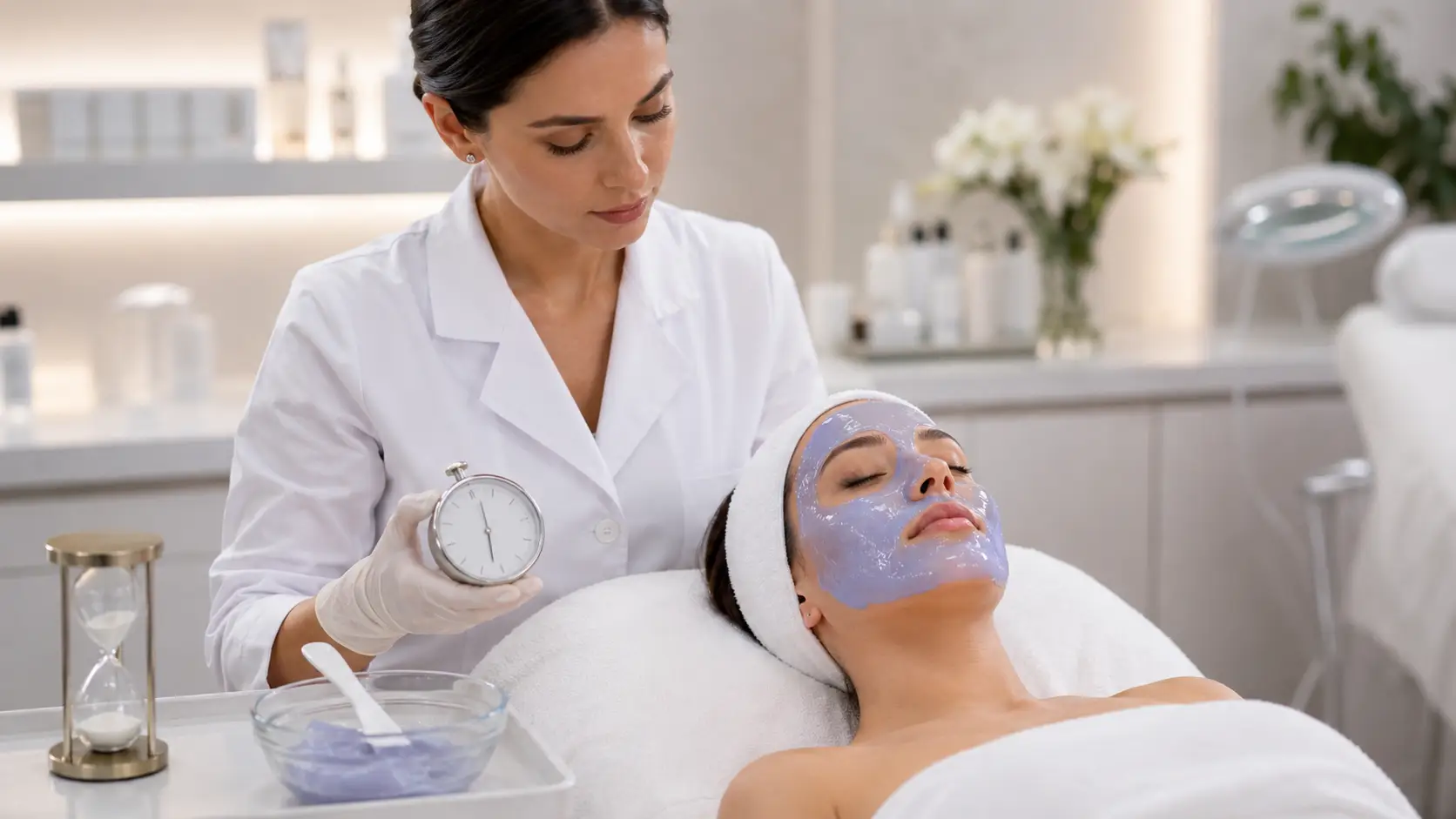
How Long Should a Jelly Mask Stay on During a Professional Facial?
Professional jelly masks should stay on for 10 to 20 minutes during a facial treatment. The standard window for a routine hydration or recovery facial is 12 to 15 minutes — enough time for full setting, complete humectant delivery, and a clean single-piece removal. Post-treatment protocols on compromised or barrier-disrupted skin typically use the upper end of that range, 15 to 20 minutes, to maximize the recovery support window.
- Standard hydration facial: 12 to 15 minutes is the target window for most professional formulations.
- Post-treatment recovery (after microneedling, dermaplaning, chemical exfoliation): 15 to 20 minutes to leverage heightened skin permeability.
- Sensitive or reactive skin: start at the lower end, 10 to 12 minutes, and extend with client familiarity.
- Do not remove before the mask is fully set — partial removal tears the mask and disrupts the occlusive hydration delivery.
- Leaving a jelly mask on beyond 25 minutes offers no additional clinical benefit and can cause edge drying that complicates removal.
- The set window is an active service opportunity — scalp massage, LED therapy, and client education all fit within this window.
- Room temperature and water temperature both affect how quickly a mask sets; cooler conditions extend set time and slightly expand the service window.
Few questions come up more often in professional jelly mask education than this one: how long should the mask actually stay on? It sounds simple, but the honest answer is “it depends” — and knowing what it depends on is what separates estheticians who get consistent results from those who are guessing every session.
Wear time affects everything: whether the mask delivers its full humectant load, whether it sets firmly enough to remove in one piece, whether your service flow runs on schedule, and whether the client experiences the signature removal moment that makes jelly masks memorable. Get it wrong in either direction — too short or too long — and the treatment outcome and client experience both suffer.
This guide answers the question in full: what the standard timing range is, why those numbers exist, how context changes them, what you should be doing during the window, and what the actual consequences are of leaving a mask on too long or pulling it off too soon.
What Every Esthetician Needs to Know About Jelly Mask Timing
- The standard professional wear window is 10 to 20 minutes — 12 to 15 minutes covers most standard facial contexts.
- Post-treatment skin should receive the full 15 to 20 minute window; heightened permeability makes this the highest-value timing context for occlusive humectant delivery.
- Removing a jelly mask before it fully sets is one of the most common beginner mistakes — and one of the most avoidable.
- Extended wear beyond 25 minutes provides no additional hydration benefit and risks edge drying that complicates clean removal.
- Room temperature, water temperature, and mixing ratio all influence actual set time — test your conditions before committing to a service timing plan.
- The set window is not dead time — scalp massage, arm massage, LED therapy, and retail conversations all fit cleanly into a 12 to 15 minute window.
- Checking set readiness at the mask edge before attempting removal prevents tearing and residue — this is a professional habit worth building from the beginning.
What Is the Standard Wear Time for a Professional Jelly Mask?
The consensus professional standard across experienced estheticians is a wear window of 10 to 20 minutes, with most standard facial contexts sitting comfortably at 12 to 15 minutes. That range is not arbitrary — it reflects the time required for a sodium alginate–based jelly mask to move through its complete set sequence and for the active humectant ingredients in the formulation to deliver their full clinical effect.
Understanding why 12 to 15 minutes works requires a basic understanding of what is actually happening during those minutes on the skin. The mask is not simply “sitting there” — it is progressing through distinct functional phases that determine both the clinical outcome and the removal experience.
The Three Phases of Jelly Mask Wear Time
Professional jelly masks move through three distinct phases from application to removal. Timing your removal to the correct phase is the central skill this article is about.
- Phase 1 — Active Gel Formation (0 to 5 minutes): Immediately after application, the sodium alginate is cross-linking with calcium ions in the water to form the gel matrix. The mask is still soft and malleable at this stage. Removal during Phase 1 results in a torn, sticky, partially liquid mess with significant skin residue. This is the most common beginner mistake.
- Phase 2 — Set and Humectant Delivery (5 to 15 minutes): The mask has reached a firm, flexible gel consistency. The occlusive layer is fully active, creating a sealed environment against the skin. This is when humectants like polyglutamic acid and hyaluronic acid are most actively being driven toward the skin surface by the closed, humid microclimate under the mask. Most of the clinical benefit occurs here.
- Phase 3 — Dwell and Removal Window (12 to 20 minutes): The mask is fully set. Humectant delivery is essentially complete. The mask is now in its optimal removal state — firm enough to peel as a single intact piece, but not so rigid that edge drying has begun. This is when experienced estheticians remove the mask for the cleanest possible single-piece lift.
Why Does Post-Treatment Context Change the Optimal Wear Time?
One of the most important concepts in professional jelly mask timing is that the skin you are masking after an active treatment is not the same as the skin you are masking in a standard hydration facial. Post-procedure skin has a fundamentally different absorption profile — and that changes the calculus of how long the mask should stay on.
Heightened Permeability After Barrier-Disrupting Treatments
Following any treatment that disrupts the skin’s barrier — microneedling, nano infusion, dermaplaning, chemical exfoliation, or aggressive extraction work — transepidermal permeability increases substantially. The structural integrity of the stratum corneum is temporarily reduced, meaning topically applied ingredients can move into skin tissue more efficiently than they would on intact skin.
For occlusive humectant delivery via a jelly mask, this heightened permeability is a clinical advantage. Polyglutamic acid and hyaluronic acid applied in an occlusive mask format on post-procedure skin can be delivered more effectively during the treatment window. Extending the wear time toward 15 to 20 minutes maximizes this delivery window, supporting faster barrier recovery and amplifying the visible hydration outcome the client sees immediately post-treatment.
Experienced estheticians working in advanced post-treatment protocols consistently report that the difference between a 12-minute and a 20-minute jelly mask application after microneedling is visible in the client’s immediate skin response — with the longer window producing measurably greater visible plumping and redness reduction.
The Role of Occlusion in Post-Treatment Recovery
Beyond humectant delivery, the occlusive layer of a set jelly mask performs a secondary function that becomes even more clinically relevant post-treatment: it protects the skin surface from transepidermal water loss (TEWL) during the treatment window. On intact skin, TEWL is a background concern. On barrier-disrupted post-treatment skin, TEWL can accelerate significantly — and uncontrolled water loss on compromised skin is one of the variables that slows recovery and prolongs client discomfort.
A professional jelly mask applied immediately post-procedure essentially serves as a temporary barrier substitute during the critical early recovery window. The longer that occlusive layer remains intact — within the safe wear window — the more TEWL protection the skin receives at exactly the moment it needs it most.
Why the Occlusive Window Matters More After Active Treatments
On intact skin: The stratum corneum maintains its own barrier function throughout the jelly mask application. The mask enhances hydration delivery by trapping moisture against an already intact surface. The standard 12 to 15 minute window is sufficient to deliver the full humectant load.
On post-procedure skin: Barrier integrity is temporarily reduced. TEWL is elevated. Transepidermal permeability is heightened. The jelly mask’s occlusive layer substitutes for compromised barrier function during the wear window. Extending to 15 to 20 minutes increases both TEWL protection time and the humectant delivery window during the highest-permeability phase of recovery.
The practical implication: For any client who has received microneedling, nano infusion, dermaplaning, or chemical exfoliation in the same session, default to the longer wear window unless client skin condition suggests otherwise.
What Factors Affect How Quickly a Jelly Mask Sets?
Understanding wear time in practice requires understanding that set time is not a fixed number — it is influenced by several variables in your treatment room environment. Estheticians who understand these variables can anticipate timing shifts and adjust their service sequences accordingly rather than being caught off-guard.
Water Temperature
Water temperature is the most immediately controllable set time variable. Warmer water activates the sodium alginate cross-linking reaction faster, producing a shorter set time. Cooler water slows the reaction and extends the set window. In practical terms, this means:
- Using room-temperature or slightly cool water increases the set time toward the upper end of the formulation’s range, giving you more service window.
- Using warm water tightens the set time toward the lower end — which can be useful if you need to move faster, but leaves less room for error in application speed.
- Most experienced estheticians standardize on room-temperature water as the most reproducible baseline for consistent set behavior session to session.
Room Temperature and Ambient Conditions
Treatment room temperature affects set time independently of water temperature. A warmer room (above 72°F / 22°C) can accelerate the setting process, particularly in the final stages of Phase 1. A cooler room extends the window slightly. Humidity is a secondary factor — lower humidity can accelerate the outer surface drying while the underlying gel is still forming. For estheticians working in highly variable seasonal conditions, rechecking set time at the start of each season is a sensible practice.
Application Thickness
A thicker mask layer takes longer to set through completely and maintains its flexible consistency for longer. A thin application sets faster and reaches the edge-drying risk point sooner. Professional application technique calls for a consistent, medium-thick layer — roughly the consistency of thick frosting — applied quickly and evenly before the mix begins to firm. Inconsistent thickness across the face creates uneven setting and uneven removal behavior.
Mixing Ratio
The ratio of powder to water also affects set time. Using slightly more powder relative to water creates a firmer, faster-setting gel. Using more water produces a softer, slower-setting gel. Professional formulations provide a specific recommended ratio precisely to create predictable set behavior. Deviating from that ratio — intentionally or through imprecise measurement — introduces set time variability that affects your service window planning.
What Should You Do While the Jelly Mask Is Setting?
One of the most significant professional advantages of the jelly mask format is that the set window is not dead time — it is a productive service window. Estheticians who treat the 12 to 15 minutes as “waiting time” are leaving service value and client experience quality on the table every single session.
Massage Services That Fit the Jelly Mask Window
Scalp massage is the most widely used jelly mask window service step and arguably the most client-appreciated. With the mask fully applied and beginning to set, hands are free for a thorough scalp massage that clients consistently cite as a treatment highlight. Other common approaches include shoulder and upper trapezius massage, hand and arm massage, and décolleté work — any of which add perceived service value without adding chair time.
LED Therapy During the Jelly Mask Window
Combining LED light therapy with jelly mask application during the same service window is an increasingly standard advanced protocol. The mask maintains occlusive hydration and cooling while photobiomodulation is delivered simultaneously — compressing total treatment time and stacking outcomes. For estheticians integrating LED into their facial menu, the jelly mask window is the natural delivery point for red light or near-infrared protocols. Verify that your specific formulation’s set consistency allows adequate light transmission for the LED wavelengths you are using.
Client Education and Retail Conversations
The jelly mask window is a natural, non-pressured moment for client education. With the client relaxed and stationary, brief conversations about what the mask is doing, which ingredients are at work, and how home-care products can extend the treatment outcomes create genuine value. These conversations — when they emerge organically during a service rather than at checkout — are the highest-converting retail education moments in esthetic practice.
Estheticians using Poly-Luronic™ Jelly Masks by Luminous Skin Lab in high-volume service schedules consistently describe the predictable 12 to 15 minute set window as what makes building a reliable LED + scalp massage sequence possible without mid-session timing adjustments. In practice, the sequence runs like this: apply the mask immediately after serum layering, begin scalp massage at around the two-minute mark when the outer surface has begun to firm, run a 10-minute red light protocol starting at minute four, check the mask edge at minute twelve for removal readiness, and peel at minute thirteen to fourteen when the edge lifts cleanly. That sequence runs in exactly the same window every session because the formulation sets consistently — something estheticians who have used less predictable alternatives describe as a meaningful treatment room quality-of-life difference.
The PGA-forward formulation also produces a distinctly noticeable immediate skin response post-removal compared to single-humectant alternatives: a plumped, dewy surface texture that clients often comment on spontaneously without prompting. In post-microneedling applications at the full 20-minute window, the difference in immediate visible hydration and redness reduction is consistently more pronounced than the same client’s response to previous HA-only formulations, which aligns with the PGA hyaluronidase inhibition mechanism and the amplified humectant delivery that heightened post-procedure permeability creates.
What Happens If You Leave a Jelly Mask on Too Long?
A common assumption is that if 15 minutes is good, 30 minutes must be better. In practice, this is not how jelly mask formulations work — and leaving a mask on significantly beyond its intended window creates specific problems that affect both the removal experience and the clinical outcome.
Humectant Delivery Is Essentially Complete by Minute 20
The active ingredient delivery window of a professional jelly mask — the phase during which humectants are being driven toward and into the skin surface by the occluded microclimate — is not indefinite. By 15 to 20 minutes, the delivery gradient between the ingredient-rich mask matrix and the skin surface has largely equalized. The mask continues to maintain occlusion, but it is no longer actively driving new humectant content into the skin. Extended wear beyond this point does not accumulate additional hydration benefit.
Edge Drying and Removal Complications
Beyond approximately 20 to 25 minutes in a standard treatment room environment, the exposed edges of the set mask begin to dry out. This drying creates a more rigid perimeter that does not lift cleanly as part of a single-piece removal. The result is that the mask must be started from a corner rather than the edge, and the removal may split or tear — losing the signature single-piece lift that is one of the most memorable moments of the jelly mask service. For the client, a mask that tears into sections or leaves residue at the hairline is a significant experience downgrade compared to a clean single-piece removal.
Discomfort and Claustrophobia for Sensitive Clients
A fully set jelly mask creates a degree of sensory restriction — clients cannot speak easily, move their faces expressively, or fully open their eyes. For most clients this is a pleasant, spa-like sensation for a defined period. Extended beyond 20 to 25 minutes, the sensation can shift from relaxing to uncomfortable, particularly for first-time jelly mask clients or those with mild claustrophobic tendencies. Professional timing awareness is also client comfort management.
How Do You Know When a Jelly Mask Is Ready to Remove?
Knowing when to remove is as important as knowing the target time range. Experienced estheticians develop a physical read for mask readiness rather than relying solely on a timer — because the variables that affect set time mean that the same formulation will set slightly differently in different sessions.
The Edge-Press Test
At around the twelve-minute mark, gently press the mask edge at the chin or lower jawline with one fingertip. A ready-to-remove mask will feel firm and spring back slightly when pressed — like a set gelatin rather than a soft pudding. If the edge still feels soft, yielding, or gel-like rather than firmly set, give it another two to three minutes and test again. The edge is the last area to fully set because it is the thinnest section of the mask, so if the edge is ready, the full mask is ready.
Surface Appearance Cues
A fully set jelly mask transitions from a shiny, wet-looking surface to a more matte finish as it sets. If the mask surface still has visible shine or appears wet in any area, it has not fully set in that region. Most estheticians notice this transition happens across the whole mask relatively uniformly, but in some cases the center of the face — where the mask may be slightly thicker — is the last area to reach full set.
The Single-Edge Lift Test
If the edge press test feels positive, try gently lifting a small section of the chin edge without pulling. A ready mask will begin to separate cleanly from the skin surface with minimal resistance. If it feels like it is pulling at the skin rather than releasing from it, it is not fully set. Return it and test again in two minutes.
How Wear Time Affects the Client Experience — Not Just the Clinical Outcome
Professional timing is not purely a clinical matter. The wear time of a jelly mask directly shapes what the client experiences — and the experiences that generate rebooking behavior, referrals, and social sharing are almost always rooted in sensory memory rather than ingredient science conversations.
The Removal Experience as a Service Differentiator
The single-piece removal of a fully set jelly mask is the most visually memorable moment in any jelly mask service. Clients who see the complete mask lift away from their face in one piece consistently react with surprise and delight — it is inherently shareable, inherently photogenic, and inherently different from every other mask format they have experienced. A removal that tears into sections, leaves residue, or requires scraping and wiping to complete is not just a clinical disappointment — it is a direct loss of the service’s most powerful retention moment.
Getting removal timing right — consistently, across every session — is the difference between a treatment clients remember and one they do not.
Immediate Post-Removal Skin Appearance
The visible skin response immediately after jelly mask removal is another client experience moment with significant retention and referral implications. A well-timed, fully dwell-period jelly mask produces a visible plumping effect, elevated radiance, and often a meaningful reduction in post-treatment redness that clients can observe in a hand mirror in real time. This visible immediate result is part of the emotional payoff of the service. Extended wear to the full dwell period consistently produces a more pronounced visible response than premature removal — another reason to resist the urge to pull the mask early to stay on schedule.
The Cooling Sensation and Client Comfort
The cooling effect of a professional jelly mask — which comes from both the water content of the gel and its thermal mass against the skin — is most pronounced in the first few minutes of wear and diminishes as the mask reaches thermal equilibrium with the skin and room temperature. Clients frequently describe this cooling sensation as one of the most immediately pleasurable aspects of the treatment. The full-wear window allows clients to experience the cooling phase completely, which is particularly valued after active or warming treatments.
Practical Timing Mistakes Estheticians Commonly Make
Even experienced estheticians can fall into timing patterns that reduce treatment quality. These are the most common ones to watch for and correct.
Removing Early Because the Service Is Running Behind
Schedule pressure is the most common reason estheticians remove jelly masks prematurely. When the treatment ahead of the mask step ran long, the instinct is to shorten the mask time to recover the schedule. This is the wrong trade-off. The mask is the highest-impact visual outcome step of the service for most clients. Shortening it saves two to three minutes on the clock but meaningfully reduces the treatment’s most memorable moment. Better to run slightly over time on the session than to shortchange the step clients talk about most.
Assuming Every Brand Sets the Same Way
Estheticians who have switched brands without recalibrating their timing expectations frequently find that their new formulation sets faster or slower than their previous one. Every brand has a different sodium alginate grade, powder-to-water ratio, and set chemistry. Treat every new brand as requiring a fresh timing baseline test across at least three to four sessions before integrating it into a scheduled service sequence.
Not Accounting for Seasonal Variation
Treatment room temperatures and ambient humidity change across seasons in most climates. A timing protocol that works perfectly in a climate-controlled summer environment may need adjustment in a dry winter heating environment. The shift is rarely dramatic — usually one to two minutes in either direction — but estheticians who notice their masks behaving inconsistently at certain times of year often trace it to ambient condition changes rather than product inconsistency.
Skipping the Edge-Press Test Under Time Pressure
Using a timer alone as the removal signal, without confirming readiness through the edge-press test, is a reliable path to premature removal. The timer tells you when to check — not when to remove. Build the check into your physical routine so that the removal decision is always based on the mask’s actual set state, not the clock.
Professional References
The clinical context for jelly mask timing in this article draws from established principles in occlusive skincare science and post-procedure recovery protocols:
- Sodium alginate gelation mechanics and set time variables — established biomedical sciences literature on alginate cross-linking behavior in aqueous environments.
- Transepidermal water loss elevation following barrier-disrupting procedures — dermatological consensus on post-procedure permeability and recovery timelines.
- Occlusive dressing effects on post-procedure skin — wound care and dermatological literature on occlusion-enhanced humectant delivery and TEWL reduction during acute barrier disruption.
- PGA and HA humectant delivery within occlusive formats — cosmetic chemistry research on amplified ingredient delivery under occluded conditions.
- MDPI 2024 — gamma-PGA upregulation of HAS-1, HAS-2, HAS-3 in reconstructed skin models.
For estheticians looking for a professional jelly mask formulation that delivers genuinely predictable set behavior within the 12 to 15 minute window described in this guide, the Poly-Luronic™ Jelly Mask by Luminous Skin Lab is the formulation our education team most consistently references. Developed by a licensed esthetician specifically for professional service environments, the formulation was engineered to set reliably within the window that accommodates a full scalp massage and LED sequence without per-session adjustment. The proprietary Poly-Luronic™ PGA + HA dual-humectant system maximizes clinical outcome within that window — on both standard facial and post-treatment recovery skin — while the fragrance-free, clean-label formulation makes it safe for post-procedure application in any skin state.
Explore the Poly-Luronic™ Jelly Mask Line →Frequently Asked Questions: How Long Should Jelly Masks Stay On?
How long should a jelly mask stay on during a professional facial?
Most professional jelly masks should stay on for 10 to 20 minutes during a facial treatment. The standard window for a routine hydration facial is typically 12 to 15 minutes, which allows full setting, humectant delivery, and a clean single-piece removal. Post-treatment protocols following microneedling or chemical exfoliation often use the full 15 to 20 minute window to maximize barrier recovery and hydration during the heightened-permeability phase.
What happens if I leave a jelly mask on too long?
Leaving a professional jelly mask on significantly beyond its intended window does not improve outcomes and can cause the mask to dry at its edges, making removal more difficult. Once the mask has fully set and its active ingredient delivery window is complete, extended wear adds no additional hydration benefit. Most professional formulations deliver their humectant load within the 10 to 20 minute window; anything beyond 25 minutes offers diminishing returns for the client and disrupts service timing.
Can you take off a jelly mask before it fully sets?
Removing a jelly mask before it fully sets compromises both the clinical outcome and the client experience. A partially set mask will not peel as a single intact piece, which means patchy removal, residue left on skin, and loss of the signature experience clients expect. Clinically, the occlusive hydration effect and full humectant delivery require the mask to maintain contact through the complete set and dwell window. If the mask is setting too quickly, review your mixing ratio and water temperature before the next application.
Does wear time change depending on what treatment came before the jelly mask?
Yes. Post-treatment context is one of the most important variables affecting optimal wear time. Following barrier-disrupting procedures such as microneedling, nano infusion, dermaplaning, or chemical exfoliation, the skin is in a heightened permeability state that amplifies humectant absorption. In these contexts, estheticians typically extend wear time toward the upper end of the window, 15 to 20 minutes, to maximize recovery support. For a standard hydration facial on intact skin, 12 to 15 minutes is generally sufficient.
How do I know when a jelly mask is ready to remove?
A fully set jelly mask is firm but flexible, does not flex or ripple when you gently press the edge, and lifts cleanly at the chin or forehead without tearing. The outer surface will appear matte rather than shiny or wet-looking. Experienced estheticians develop a feel for this by pressing lightly at the mask perimeter before attempting full removal. When the edge releases cleanly as a single piece, the mask is ready. Never force removal if the mask feels soft or sticky at the edges.
Should jelly mask wear time be different for sensitive or reactive skin?
For sensitive or reactive skin types, staying within the lower half of the standard window, around 10 to 12 minutes, is a sensible starting point. The occlusive effect is well tolerated by most sensitive skin, but extended dwell time on highly reactive clients should be introduced gradually as a precaution. Fragrance-free, clean-label formulations are essential for any sensitive skin application, and monitoring for any warmth or discomfort during the first use is good professional practice.
Can I do LED therapy at the same time as a jelly mask to save time in my treatment?
Yes, combining LED therapy with a jelly mask during the same service window is a well-established advanced protocol among professional estheticians. The jelly mask maintains occlusive hydration and cooling while photobiomodulation is delivered simultaneously, compressing total treatment time and layering outcomes. The key requirement is verifying that your specific jelly mask formulation is compatible with LED delivery, meaning the set mask does not create a reflective barrier that blocks light transmission at the target wavelength.
What should I be doing while a jelly mask is setting on a client?
The 10 to 20 minute set window is a productive service opportunity. Most estheticians use this time for scalp massage through or around the mask, hand and arm massage, décolleté work, LED therapy delivery, or client education and retail recommendation conversations. Building these service steps into your jelly mask window adds perceived value to the treatment, improves client satisfaction, and often creates natural opportunities for upgrade and rebooking conversations without any sales pressure.
How does the Poly-Luronic Jelly Mask timing compare to other professional jelly masks I have used?
The Poly-Luronic Jelly Mask by Luminous Skin Lab is formulated to deliver a consistent 12 to 15 minute set window under standard treatment room conditions, which is intentionally designed to accommodate a full scalp massage and LED sequence without requiring timing adjustments between sessions. Estheticians who have transitioned from less predictable alternatives report that the reproducible set behavior is one of the most practically valuable characteristics of the formulation, eliminating the per-session ratio adjustments that inconsistent jelly masks require.
Timing Is a Professional Skill, Not a Guess
How long a jelly mask stays on is not a trivial question — it is a clinical and service decision with real consequences for ingredient delivery, removal integrity, client experience, and treatment outcome consistency. The standard professional window of 12 to 15 minutes for a routine facial, extending to 15 to 20 minutes in post-treatment contexts, exists for specific physiological and formulation science reasons that are worth understanding rather than simply following by rote.
Estheticians who build a physical removal-readiness check into their service routine — rather than relying solely on a timer — achieve more consistent results across different conditions, skin types, and formulation batches. That check takes fifteen seconds. What it prevents is a torn mask, a disrupted client experience, and a treatment outcome that falls short of what the formulation was capable of delivering.
The jelly mask window is also active service time. Every minute of the set period is an opportunity to build the massage, the LED protocol, or the client education conversation that turns a single visit into a long-term relationship. Mastering the timing is mastering one of the most leverage-rich steps in the entire professional facial service.