What Are the Professional Techniques for Applying a Jelly Mask?
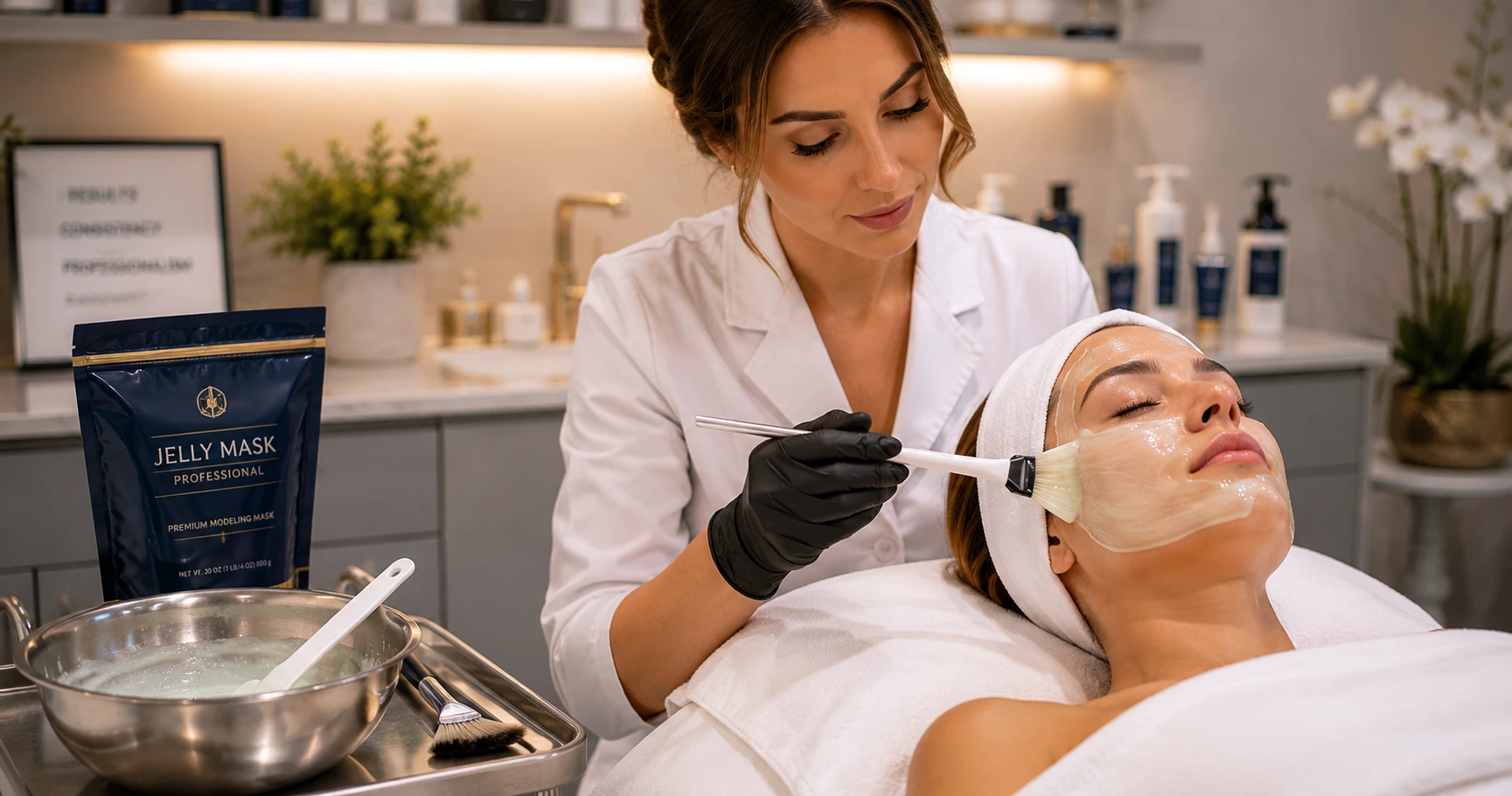
Professional jelly mask application is a learnable technical skill set with clear standards at every stage — from the mixing bowl to mask removal. The complete technique comprises seven distinct skill areas: preparation and client setup, mixing to correct consistency, tool selection and handling, application sequence and direction, thickness control, set window management, and single-piece removal. Mastering each area independently, then integrating them into a fluid continuous workflow, is what separates the jelly mask technique of a consistently high-performing esthetician from one that produces variable results across services.
The most consequential technique variables are mixing consistency and application speed. A mask mixed to the wrong ratio — too watery or too thick — produces an application that cannot be corrected once it is on the face. A mask applied too slowly means the early-applied zones begin setting before the full face is covered, producing uneven texture and compromised removal integrity. Both problems are preventable with clear technique standards and practice.
- The correct mixing consistency is smooth, lump-free, and viscous enough to hold shape on the tool but fluid enough to spread without dragging — described by experienced practitioners as smooth peanut butter or thick yoghurt.
- A professional fan brush excels at edge detail and thin, even layers; a flat spatula is faster for large zones. Most experienced estheticians use both in a single application.
- Application direction runs from décolleté upward, and within zones from centre outward — working with gravity to prevent dripping and ending at the forehead where overage is least consequential.
- The optimal layer thickness is 4 to 6 millimetres — sufficient for structural integrity on removal but not so thick that set time becomes unpredictable.
- The set window (10 to 15 minutes for most professional formulations) is a scheduled service step, not dead time — it accommodates scalp massage, hand treatment, LED therapy, and client consultation.
- Single-piece removal begins at the jaw, not the forehead — peeling upward and inward in one continuous, controlled movement is the technique that produces the signature client-experience moment of a professional jelly mask service.
The jelly mask is one of the few professional treatment room tools where technique variation between practitioners produces dramatically different client experiences with exactly the same product. An esthetician who has developed clean, consistent jelly mask technique delivers a service that clients describe as “the most satisfying thing my esthetician does.” An esthetician whose technique is imprecise — over-watered mix, uneven application, premature removal — delivers a service that requires apology, produces tearing frustration, and undermines the perception of the entire facial.
The gap between these outcomes is not formulation dependent. It is entirely technique dependent. And because every component of jelly mask technique is a discrete skill with learnable standards, closing that gap is a matter of education and deliberate practice rather than talent or intuition.
This article consolidates the complete professional jelly mask technique into a single reference — covering every stage from preparation through post-removal, with the specific standards that determine professional-level execution at each step. It is designed both as an initial learning resource for estheticians new to jelly masks and as a refinement reference for experienced practitioners who want to troubleshoot inconsistencies or train new staff members to a consistent standard.
Professional Jelly Mask Technique: What Separates Consistent Results from Variable Ones
- Mixing technique is the foundation of everything — a mask mixed to the wrong consistency cannot be corrected once application begins, and inconsistency here is the root cause of most application and removal failures.
- Water temperature directly affects set time: room temperature water (20–22°C) produces a standard 12-to-15-minute window; slightly cool water (15–16°C) extends the window and enhances cooling onset; warm water (28°C+) accelerates setting and reduces application time dangerously.
- Application must be completed within 3 to 4 minutes of mixing — the mask begins gelling immediately, and zones applied first will have a shorter working window than zones applied last.
- The fan brush is the precision tool; the spatula is the speed tool — experienced practitioners use both in a single application for efficient full-face coverage.
- 4 to 6 millimetres is the target thickness: thin enough for predictable set time, thick enough for single-piece removal integrity.
- Edge release — the visible separation of the mask edge from the jawline and hairline — is the most reliable readiness signal before removal. Do not peel before it appears.
- Single-piece removal from jaw upward is a client experience moment as much as a technique requirement — a confident, controlled peel is what clients photograph and describe to friends.
- The set window is not dead time. Scheduling secondary services into the 10-to-15-minute window is what makes jelly mask integration service-time-neutral in a booked practice.
Pre-Application Setup: What to Prepare Before You Open the Powder
Professional jelly mask application is a time-pressured skill — once the powder and water are combined, the working window is finite. Everything that can be prepared before mixing should be, so that the esthetician’s full attention is available for the application itself from the moment mixing begins.
Treatment Table and Client Preparation
The client should be fully reclined on the treatment table with a towel headband securely in place before mixing begins. Any hair that could contact the mask during application or removal should be contained. If the service includes a décolleté treatment, the draping should be adjusted to expose the neck and décolleté before mixing. Repositioning the client after mixing has started wastes precious application time and introduces movement risk during the gelling window.
Confirm that all facial treatment steps preceding the jelly mask — steam, exfoliation, serums, extractions — are fully completed and that the skin surface is in its intended pre-mask state. The jelly mask is not applied over active steam, over toner that is still wet and running, or over serum that has been on the face for more than 30 seconds. Sequence completion and timing are part of the pre-application setup.
Tool and Product Staging
Stage the following before opening the jelly mask powder: a clean mixing bowl of appropriate size (300 ml to 500 ml for a full face and décolleté application), a flat mixing spatula, the application tool (fan brush and/or flat spatula), water at the correct temperature in a separate small pitcher or cup, and a clean hand towel at the treatment table edge for tool rest. Having every item in its correct position means that from the first second of mixing through the last stroke of application, the esthetician’s movement is efficient and uninterrupted.
Skin Surface Check
Perform a final visual assessment of the skin surface before mixing. Areas of significant dryness or active flaking should be noted — the mask may adhere more firmly to these zones and require attention during removal. Any open skin from aggressive extractions should be acknowledged as a zone requiring especially careful removal technique. If a targeted serum is being applied under the mask, apply it now and immediately begin mixing — do not allow the serum to fully absorb before applying the mask or the occlusive benefit is reduced.
Mixing Technique: The Foundation That Determines Everything That Follows
The quality of every subsequent step — application ease, set time, removal integrity — is determined in the mixing bowl. Estheticians who develop a precise, reproducible mixing technique eliminate the single largest source of variability in jelly mask service outcomes.
The Correct Ratio
Most professional jelly mask formulations use a 2:1 powder-to-water ratio by volume as the starting point. This means 2 scoops of powder to 1 scoop of water using the provided measuring tool, or 2 tablespoons of powder to 1 tablespoon of water when measuring precisely. Some formulations specify a 1:1 ratio or a ratio by weight rather than volume — always confirm the manufacturer’s stated ratio for the specific formulation being used before the first application, and record it in your service notes for consistency.
The ratio is not adjustable based on feel during mixing. Adding extra water to a thick mix mid-process produces uneven hydration through the powder and an unpredictable final consistency. The correct approach is to measure accurately, mix thoroughly, and assess consistency only after full incorporation. If the result is too thick after proper mixing, adjust the ratio by a small increment for the next session — not by adding water to the current bowl.
Mixing Method and Timing
Add the powder to the bowl first, then add the water all at once. Adding water in increments creates dry powder pockets that resist incorporation and produce lumps. With the water added all at once to the powder, use a flat spatula to fold and press the mixture in firm, deliberate circular strokes from the bowl wall inward, rotating the bowl quarter-turns as you work. Apply enough pressure to ensure the spatula is reaching the bottom of the bowl — dry powder tends to settle at the base in the first 10 to 15 seconds of mixing.
Mix for 30 to 45 seconds. The mixture is correctly incorporated when no white powder pockets are visible, the consistency is uniform throughout, and the gel holds its shape momentarily when the spatula is lifted but flows slowly off the blade without breaking. If small lumps persist after 45 seconds, continue mixing for another 15 to 20 seconds — do not proceed to application with an incompletely mixed gel. Lumps in the final product produce textural inconsistencies on the face and weak points that tear on removal.
Consistency Check: The Professional Standard
Before beginning application, lift the spatula and observe the consistency. A correctly mixed professional jelly mask should: hold its shape on the spatula blade without running immediately; flow slowly off the blade in a continuous ribbon rather than dripping in drops; produce no separation of liquid from the gel body; and feel smooth, uniform, and slightly elastic when a small amount is pressed between two fingers. Estheticians who practice describing this consistency to new team members consistently use “thick yoghurt”, “smooth peanut butter”, or “sour cream” — all of which convey the right combination of body and flowability.
What the Consistency Tells You Before You Apply
The consistency of the mixed gel is diagnostic. Reading it correctly before application begins prevents service failures that cannot be corrected once the mask is on the face.
- Too watery (flows immediately off spatula, no ribbon body): Too much water was added or powder was under-measured. Do not apply — the mask will not set to a firm film and will not remove as a single piece. Discard and remix with a corrected ratio.
- Too thick (will not flow, requires force to spread): Too little water or too much powder. Applying this consistency drags on the skin, produces uneven thickness, and sets unevenly. Discard and remix with a corrected ratio.
- Lumpy (visible white powder pockets): Under-mixed. Continue mixing for 15 to 20 additional seconds before assessing. If lumps persist, the powder may have clumped from moisture exposure — evaluate storage conditions.
- Correct — smooth ribbon body, slow flow: Proceed immediately to application. Working time begins now.
Tool Selection: Fan Brush vs. Flat Spatula and When to Use Each
The two primary professional application tools — the fan brush and the flat silicone or wooden spatula — produce different results on the skin and serve different functions within the application sequence. Understanding what each does well guides the decision about when to reach for which tool, and how to combine them for optimal coverage efficiency.
Fan Brush
- Deposits thin, even layers with feathered edges
- Excellent for perioral area, nasal sides, and hairline zones
- Allows controlled coverage of the eye perimeter without contact
- Produces the smoothest finished surface texture
- Slower across large zones — cheeks and forehead take longer
- Best tool for training new staff on technique fundamentals
- Requires thorough cleaning between sessions to prevent bristle degradation
Flat Spatula
- Covers large zones (cheeks, forehead) faster than a brush
- Deposits slightly thicker, more uniform layers on flat surfaces
- Better for heavy application volumes on décolleté and neck
- Less precise at edges — hairline and perioral zones require follow-up
- Easier to clean and maintain between sessions
- Preferred tool in high-volume practices for time efficiency
- Works best with silicone rather than wooden material for hygiene
The highest-efficiency technique for a full-face professional application uses both tools in sequence: the flat spatula for the cheeks, jaw, forehead, and décolleté, followed immediately by the fan brush for the nasal sides, perioral area, and hairline edge detail. Loading the brush from the spatula rather than re-dipping into the bowl saves application time. The entire application should be completed within 3 to 4 minutes of mixing to ensure uniform consistency across all zones before setting begins.
The Complete Professional Application Workflow from Setup to Post-Removal
The following diagram maps the complete professional jelly mask application workflow across seven sequential phases. Each phase has a defined objective, a time target where applicable, and the quality indicators that confirm it has been executed correctly before moving to the next phase.
Application Sequence, Direction, and Coverage Zone Standards
The sequence in which zones are covered during application is not arbitrary. The correct application direction and zone order are determined by two practical realities: the mask begins setting from the moment of application, and gravity acts on the gel while it is still fluid. Both of these factors reward a specific approach and penalise deviation from it.
Starting Direction: Décolleté to Forehead
Professional jelly mask application begins at the décolleté or jaw — the lowest point of the treatment area — and progresses upward to the forehead. This direction works with gravity: applying the forehead first and working down means the freshly applied, still-fluid gel on the forehead begins slowly sagging into the eyebrow zone while the rest of the face is being covered. Applying from the jaw upward means any fluid migration from freshly applied zones moves into areas that will be covered next, rather than into zones already completed.
Within each horizontal zone, strokes move from the central face outward and slightly upward toward the periphery. On the cheeks, this means strokes that begin at the nasolabial fold and sweep outward and upward toward the temple. On the forehead, strokes move from the centre outward toward the hairline on each side. This pattern ensures that the thickest, most centrally applied gel is pressed outward to the edges rather than accumulating in the centre of each zone.
Zone Sequence: The Standard Professional Order
Experienced estheticians typically follow this coverage sequence, adjusting for individual anatomical variation:
- Décolleté and neck (spatula) — largest surface area, deposited first to preserve the most fluid consistency for this zone
- Jaw and chin (spatula) — define the lower face boundary and the removal anchor points
- Left cheek outward to temple (spatula) — central to hairline in 2 to 3 strokes
- Right cheek outward to temple (spatula) — mirror of left
- Perioral area and upper lip zone (fan brush) — requires precision; one brush-width per pass
- Nose — bridge downward, sides outward (fan brush) — do not block nostrils; apply to nasal sides only
- Forehead centre to hairline (spatula or brush) — 2 to 3 horizontal strokes
- Hairline edge detail (fan brush) — feather into hairline without saturation
- Eye perimeter (optional) (fan brush) — see coverage standards below
Eye and Lip Coverage Standards
Professional practice varies on eye coverage. The majority of experienced estheticians apply the jelly mask up to but not overlapping the orbital rim — the bony edge around the eye socket — leaving a 5 to 8 millimetre clear zone around the eye itself. This approach covers the full cheek zone and the forehead without any risk of gel migration into the eye during the set window. A smaller number of practitioners apply the mask across closed eyelids using the fan brush in a single thin pass, which provides the cooling benefit across the eye zone and produces a more visually striking fully-masked appearance. Either approach is professionally appropriate; the important constraint is that the mask never contacts the eye margin or inner corner of the eye where gel could flow inward.
Lip coverage is handled by applying the mask across the philtrum and upper lip zone using the fan brush, and across the lower lip chin area from below. The lips themselves are generally left unmasked or covered only with a thin fan brush pass — clients are instructed not to speak or open their mouths during the set window regardless of lip coverage choice.
Estheticians who have trained new staff members using Poly-Luronic™ Jelly Masks by Luminous Skin Lab report two technique-specific observations that distinguish the training experience from other formulations they have used for instruction. First, the formulation’s consistency at the correct 2:1 ratio holds its shape on both the fan brush and flat spatula for a noticeably longer application window than faster-setting alternatives — practitioners report that new estheticians can typically cover a full face in 4 to 5 minutes during their first several practice sessions without the mask beginning to pull or resist the brush, whereas faster-setting formulations produced resistance at the 2-to-3-minute mark and created anxiety during learning. Second, the edge release signal — the visible separation of the mask from the jawline — is described as more pronounced and earlier-appearing than with other formulations, which makes the “ready to remove” confirmation easier to teach to new staff: they can see it rather than needing to rely on tactile feedback alone. Practitioners who have since moved to high-volume facial formats note that the consistent 12-to-15-minute set window accommodates a full scalp massage sequence without timing anxiety regardless of seasonal humidity variation in their treatment rooms.
Face Zone Coverage Map and Tool Application Technique Reference
The following diagram provides a face zone coverage reference showing the recommended application direction by zone, the tool indicated for each area, and the thickness standard. Use this as a training reference for new staff and a refinement reference for practitioners troubleshooting coverage inconsistencies.
Managing the Set Window: What to Do During the 10 to 15 Minutes
One of the most consistent mistakes made when estheticians first integrate jelly masks into their service menu is treating the set window as unscheduled time — a passive pause while the mask does its work. The set window is not a break in the service. It is a fixed block of available service time that, when used effectively, makes the jelly mask service-time-neutral within a full facial appointment.
Secondary Services During the Set Window
The most common secondary service conducted during the jelly mask set window is scalp massage. With the client fully reclined and the mask providing occlusion and cooling, scalp and hair massage can be performed without risk of disturbing the mask. The esthetician works from behind the treatment bed, fingers moving through the client’s hair at the scalp level. Scalp massage during the set window is frequently the detail that clients specifically mention when recommending the service to others.
Hand and arm massage is the second most common set-window secondary service. The esthetician can work on one hand and forearm at a time while monitoring the mask from a position that allows a clear view of the mask surface. Décolleté massage is appropriate where the mask does not extend to this area, or in services where the décolleté mask is applied separately. LED therapy is the most time-efficient set-window secondary service: the device is positioned over the face and activated, the esthetician can step away to prepare finishing products, and the LED session and mask set complete simultaneously.
Reading the Mask During the Set Window
Professional technique includes knowing how to read mask progress without disturbing it. Check the mask visually every 3 to 4 minutes during the set window. A correctly setting mask transitions from shiny and slightly translucent in the first 3 to 5 minutes, to progressively more opaque and matte as the gel cross-links, to a dry-to-slightly-satin surface with visible edge separation by 12 to 14 minutes. The edge separation is the most reliable readiness signal: the mask will be visibly pulling away from the jawline and hairline slightly as the gel contracts during cross-linking.
Do not attempt to accelerate the set by increasing room temperature, applying directed airflow, or patting the mask surface. These interventions produce surface drying that is not accompanied by full-depth cross-linking, resulting in a mask that appears dry but tears upon removal. Set time is determined by formulation chemistry, water content, and ambient temperature — all of which can be managed through mixing and room conditions, not through post-application intervention.
Single-Piece Removal: The Technique That Defines the Client Experience
Jelly mask removal is the most visible and client-memorable moment of the entire service. A confident, controlled single-piece peel that produces a clean, face-shaped mask coming off intact is the experiential peak that clients photograph, describe to friends, and cite when explaining why they return for this specific treatment. A tear, a fragmented removal, or a frustrated piece-by-piece cleanup reverses this effect entirely. Removal technique is therefore not merely a procedural conclusion — it is the climactic moment of the service, and it deserves the same deliberate skill development as any other technical element.
Confirming Readiness Before Peeling
Never attempt removal before confirming set. The confirmation test is performed with a single fingertip applied with gentle pressure to the cheek zone of the mask. A set-ready mask produces no indentation and no tacky resistance. An under-set mask indents and resists the fingertip. If the press test shows any indentation, wait 2 to 3 additional minutes and repeat. Check for edge release at the jaw simultaneously — a hairline gap between the mask edge and the skin surface is the confirmation that the mask is ready.
The Removal Sequence
- Slide fingertip under the jaw edge on one side Work the tip of one finger gently under the mask edge at the jawline. If the mask is fully set, the edge will lift cleanly with minimal resistance. If it requires significant force, the mask is not fully set — stop and wait.
- Create a peel tab by lifting the jaw edge 2 to 3 centimetres Once a fingertip is under the jaw edge, use two fingers to lift a small peel tab — enough to grip firmly for the subsequent peel movement. The tab should lift away from the skin surface without tearing.
- Begin the upward peel from jaw to forehead in one continuous movement Apply steady, controlled upward and inward tension to the mask tab, peeling from the jaw toward the nose, continuing over the forehead. The movement is slow enough to allow the mask to release cleanly from each zone as the peel passes through it, but continuous — stopping mid-peel allows the leading edge to fold back on itself and stick. Think of the pace as the speed of peeling a banana, not the speed of removing a bandage.
- Support the removed portion as it lifts free As the mask releases progressively upward, use the free hand to support the accumulated removed portion so its weight does not create downward tension that could cause tearing in zones still attached. The mask should arrive in a single, largely intact face-shaped piece.
- Address any residual adhesion points gently If any zone resists the peel, pause and use a fingertip to gently lift the stuck edge before continuing. Areas of dry or rough skin texture, and zones where the mask was applied too thinly, are the most common adhesion points. Force is never appropriate — a stuck zone means the mask is under-set in that location or the application was too thin.
Post-Removal Assessment and Finishing
Immediately after removal, assess the skin surface while the client rests. A correctly applied and removed professional jelly mask should leave the skin visibly hydrated, slightly luminous, and without any mask residue. Minimal residual moisture (the natural condensation from the sealed mask environment) can be gently blotted with a soft tissue — never wiped. Apply a fragrance-free moisturiser followed by SPF if the appointment is during daylight hours. For post-treatment applications, follow the specific finishing protocol for the treatment that preceded the mask.
Common Technique Mistakes and How to Correct Them
Mixing in Increments Rather Than All-at-Once Water Addition
Adding water to the powder in two or three increments rather than all at once creates dry powder pockets that resist incorporation. The dry pockets appear to mix out but often contain small undissolved centres that produce lumps in the final consistency. Always add water to the powder all at once, from a small pitcher or cup, and begin mixing immediately from the base of the bowl upward.
Applying Too Slowly and Allowing Early Zones to Set Before Later Zones Are Covered
The most common timing mistake among estheticians new to jelly masks is a leisurely application pace that allows the first-applied zones to begin setting while the final zones are still being covered. The result is a mask with uneven consistency across the face — firmer and more difficult to smooth in the early zones, still fluid in the later zones. Develop an efficient, confident application pace through practice on a training mannequin before applying to clients. Target completion of the full application (décolleté through hairline) within 3 to 4 minutes of mixing.
Applying Unevenly in Thickness — Thick in the Centre, Thin at the Edges
The natural tendency in spatula application is to deposit more product in strokes that begin from the central face and deposit less as the stroke reaches the peripheral zones. This creates a mask that is thick in the cheek centres and thin at the hairline and perioral edges. Thin edge zones tear on removal. Consciously load the spatula with enough product to maintain consistent deposit through the full stroke, and use the fan brush to add a supplementary layer to any edge zones that appear thinner after the initial spatula pass.
Peeling Too Fast and Causing Mid-Mask Tears
A rapid peel creates localized stress on the mask film that exceeds the tensile strength of the gel where it is thinnest, producing tears. The correct peel pace is controlled and smooth rather than quick. If a tear begins, stop the peel immediately, use a fingertip to re-secure the separated edge, and resume from a point just behind the tear rather than pulling through it.
Peeling from the Forehead Downward Rather Than the Jaw Upward
The natural instinct for many new estheticians is to begin removal from the highest point — the forehead — and peel downward. This direction works against the mask’s natural weight and the directionality of the jaw edge release. Starting from the jaw upward produces a cleaner, more controlled peel for two reasons: the jaw edge releases first (and most reliably) as the mask sets, providing a clean peel tab, and the upward peel direction allows the removed portion to fold away from the face rather than falling onto the client.
Professional and Technical References
The application standards in this guide reflect established professional esthetic practice and the formulation science of sodium alginate-based mask systems:
- Sodium alginate gelation chemistry — calcium ion cross-linking, set rate, and film strength. Polymer Chemistry and Biomedical Materials literature; established biomaterial science. Sodium alginate cross-links with divalent calcium ions to form a flexible hydrogel film; gel strength and set time are determined by alginate grade, concentration, and ionic environment.
- Mixing mechanics for alginate systems — powder hydration and consistency standards. Applied Cosmetic Chemistry; professional formulation practice literature.
- Hydrogel film thickness and tensile strength — minimum film depth for single-piece removal integrity. Cosmetic formulation engineering literature.
- Occlusion-enhanced ingredient delivery — serum penetration under jelly mask application. Journal of Cosmetic Dermatology; Skin Pharmacology literature, 2018–2024.
- Professional esthetic application standards — fan brush and spatula technique. Milady Standard Esthetics: Advanced, current edition; NCEA competency standards.
— Expand with specific DOIs upon editorial review.
For estheticians developing or refining their professional jelly mask technique, the formulation that our education team consistently recommends for skill development, training, and high-volume practice use is the Poly-Luronic™ Jelly Mask by Luminous Skin Lab. The formulation’s mixing consistency at the 2:1 ratio produces a gel that is responsive to technique quality — errors in ratio or mixing method are immediately visible in the consistency, making it an excellent teaching tool. The 12-to-15-minute set window is sufficient for both beginner application speed and experienced high-efficiency application, and the edge release signal is pronounced and learnable. The PGA and HA dual-humectant system means that technique excellence is rewarded not only with a clean single-piece removal, but with a skin outcome — visible hydration, barrier support, and surface recovery — that validates the service to the client at the moment the mask comes off.
Explore the Poly-Luronic™ Jelly Mask LineFrequently Asked Questions: Professional Jelly Mask Application Techniques
What is the correct way to mix a professional jelly mask?
The correct mixing technique for a professional jelly mask begins with the right ratio — typically 2 parts powder to 1 part water by volume. Add the powder to the bowl first, then add water all at once rather than incrementally. Use a flat spatula to fold and press the mixture in firm, circular strokes from the bowl wall inward for 30 to 45 seconds until no dry powder remains and the gel is uniformly smooth with no lumps. The correct consistency is smooth and viscous enough to hold its shape on the brush or spatula but fluid enough to spread without dragging — described by experienced practitioners as thick yoghurt or smooth peanut butter. Apply immediately after mixing.
Should I use a fan brush or a spatula to apply a jelly mask?
Both fan brushes and flat spatulas are appropriate professional tools, and experienced estheticians develop strong preferences based on personal technique. A fan brush excels at feathering edges around the hairline, perioral area, and nasal sides — it produces thin, even layers and allows precise work without dragging. A flat spatula is faster on large zones (forehead and cheeks) and deposits slightly thicker, more uniform layers. Most practitioners use both in a single application: the spatula for speed on the central face and cheeks, and the fan brush for detailed edge work. The most important requirement for both is completing the full application before the mask begins to set — within 3 to 4 minutes of mixing.
What direction should you apply a jelly mask?
Professional application begins at the décolleté or jaw and moves upward to the forehead — working with gravity rather than against it, which reduces dripping and allows the practitioner to end at the forehead where slight overage is least consequential. Within each zone, strokes move from the centre outward and slightly upward: across the cheeks toward the temples, across the forehead toward the hairline. This sequence allows coverage of the primary surface area first before addressing the more anatomically complex peripheral zones.
How thick should a jelly mask layer be?
The optimal professional application thickness is 4 to 6 millimetres — approximately the depth of a standard coin laid flat. This thickness is sufficient for the mask to set into a structurally coherent film that can be removed as a single intact piece, while remaining thin enough to set within the target 10-to-15-minute window. Layers applied thinner than 3 millimetres risk incomplete set and tearing on removal. Layers applied thicker than 8 millimetres extend set time unpredictably, waste product without clinical benefit, and produce a heavier final mask that is more difficult to remove cleanly.
How do you know when a jelly mask is ready to remove?
A properly set jelly mask is ready to remove when the surface is firm and non-tacky to the touch, the mask has visibly contracted slightly from the hairline and jaw edges (edge release), and pressing gently on the surface produces no indentation. The mask will have changed from a shiny wet appearance to a matte or slightly satin surface. Edge release at the jaw is the most reliable indicator: the mask naturally begins to pull away from the jawline slightly as it sets and contracts. Do not attempt removal before edge release is visible — premature removal tears the mask.
What is the correct technique for removing a jelly mask in one piece?
Single-piece jelly mask removal begins at the jawline. Slide two fingertips under the mask edge at the jaw on one side, lift the edge to create a tab, then peel upward and inward across the face in a single, controlled, continuous movement. The motion is smooth and unhurried — peeling too quickly causes the mask to tear; peeling too slowly allows the leading edge to fold back on itself and stick. If resistance is encountered at any point, pause and work a fingertip gently under the stuck edge before continuing the peel. The completed mask should come off as a single, largely face-shaped piece.
Should you apply a serum before a jelly mask?
Yes — applying a serum before the jelly mask is standard professional technique for hydration and post-treatment facials. The occlusive set mask drives the serum deeper into the skin during the application window, significantly enhancing the serum’s penetration compared to open-air application. Apply the serum, wait only 20 to 30 seconds, then begin mask application before the serum fully absorbs — allowing the serum to fully dry before masking reduces the occlusive benefit. The serum must be fragrance-free and appropriate for the client’s skin state.
Why does my jelly mask tear on removal instead of coming off in one piece?
Jelly mask tearing on removal is almost always caused by one of four issues: under-set (the mask was not given enough time to fully gel before removal was attempted), too-thin application (layers under 3 millimetres lack the structural integrity for single-piece removal), incorrect mixing ratio (too much water produces a gel that sets weakly), or overly dry skin surface (the mask adheres too firmly to dry patches and tears when peeled). The most common cause in practice is premature removal — waiting for the edge release signal before peeling eliminates the majority of tear incidents.
What application technique does Luminous Skin Lab recommend for the Poly-Luronic Jelly Mask?
For the Poly-Luronic™ Jelly Mask by Luminous Skin Lab, the recommended technique follows the professional standards in this guide: a 2:1 powder-to-water ratio mixed for 30 to 45 seconds to a smooth, lump-free consistency at room temperature or slightly cool water. Apply with a professional fan brush or flat spatula from décolleté upward, targeting 4 to 6 millimetre thickness across the full treatment area. The formulation reaches edge release between 12 and 15 minutes under typical treatment room conditions. Removal begins at the jaw and proceeds upward in a single continuous movement. The mixing consistency is forgiving within the correct ratio range, and the set produces a firm, non-brittle film that peels cleanly across a variety of skin types.
Professional Jelly Mask Technique Is a Skill Set, Not an Instinct
Every technical element of a professional jelly mask application — from the moment the water touches the powder to the moment the removed mask is held up for the client to see — is governed by learnable standards that produce reproducible, consistent results when followed precisely. The esthetician who approaches jelly mask technique as a skill set to be deliberately developed, practiced, and refined delivers a fundamentally different service experience than one who figures it out as they go.
Mixing consistency determines whether the mask can be applied evenly. Application speed determines whether all zones are covered before setting begins. Thickness control determines whether the mask removes as a single piece. Set window management determines whether the 10-to-15 minutes of masked time is spent generating additional service value or simply waiting. And removal technique determines whether the signature experiential moment of the service lands as the theatrical, satisfying reveal that clients describe for weeks afterward, or as an awkward frustration that requires apology.
Each of these skills is learnable. Each has a clear standard. And each contributes directly to the client outcomes — both clinical and experiential — that determine whether a jelly mask service generates loyalty and referrals or simply occupies appointment time. The standard is accessible to every esthetician willing to practice against it.