Should Jelly Masks Cover the Eyes and Lips?
Jelly masks can safely cover both the periorbital zone (closed eyelids) and the perioral zone (lips and lip contour) when applied with correct technique and using a fragrance-free, clean-label professional formulation. Neither zone is automatically excluded from jelly mask coverage — the decision is based on formulation safety, client anatomy, client comfort, and the specific protocol context.
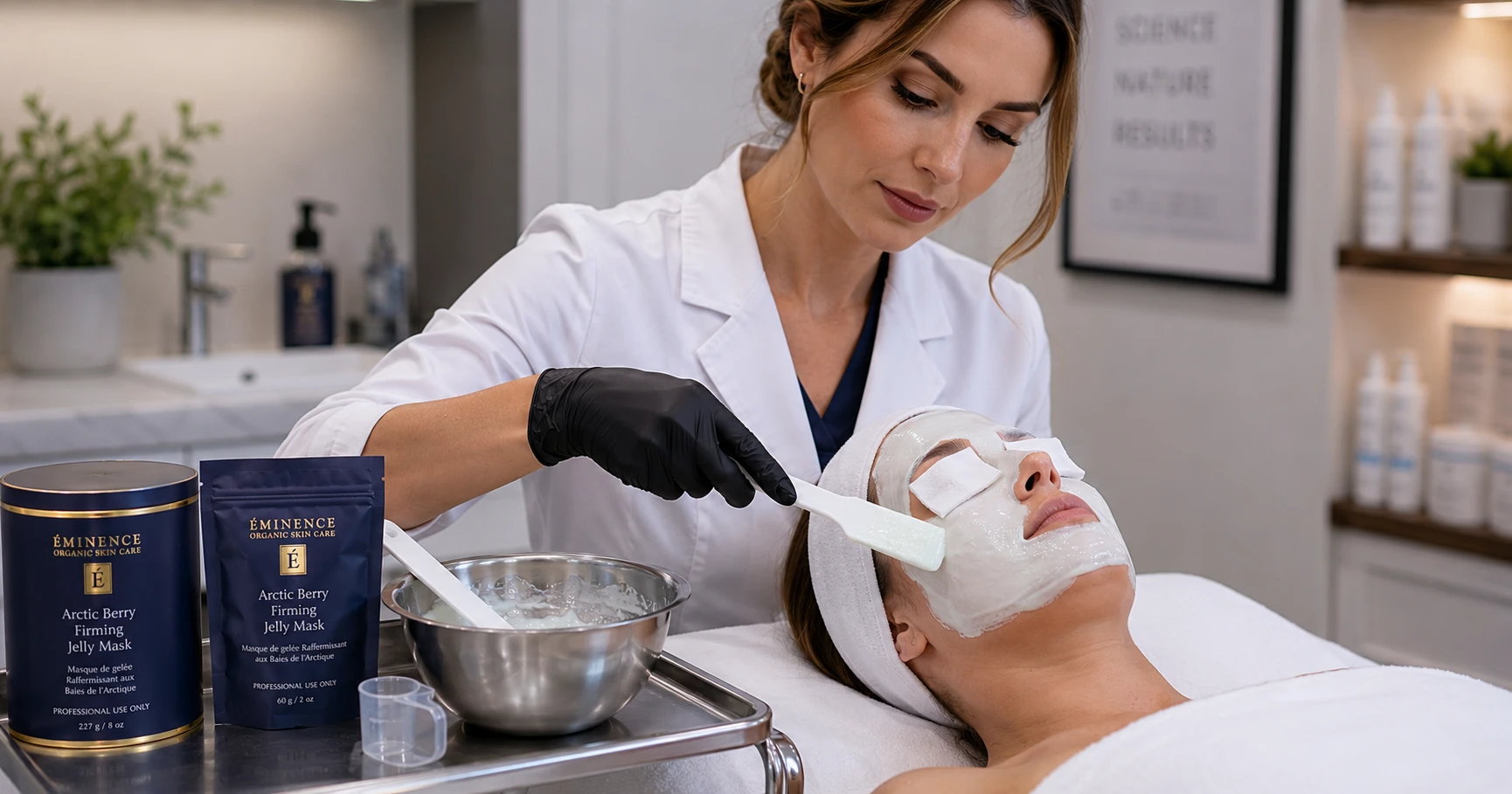
- Eyes: safe to cover over closed lids with gauze pads as a protective barrier between the mask material and the delicate eyelid skin. Fragrance-free formulation is mandatory. Clients must keep eyes gently closed throughout the service.
- Lips: safe to cover with a fragrance-free formulation; the main practical consideration is breathing comfort. Many estheticians leave a small opening at the center of the mouth or apply to the lip contour only.
- Periorbital skin is approximately four times thinner than cheek skin, has fewer sebaceous glands, and is significantly more sensitive to fragrance or irritating ingredients — formulation quality is the primary safety criterion for eye zone coverage.
- Post-treatment contexts (chemical exfoliation, dermaplaning, extractions) may warrant more conservative coverage decisions around both zones due to elevated barrier permeability.
- Contact lens wearers should always remove lenses before a jelly mask service that includes periorbital coverage.
- A gooey or insufficiently set mask should not be applied to the eye or lip zone — the stability of the set film is what makes clean removal possible from these areas.
One of the most common technique questions estheticians encounter when refining their jelly mask application is whether to include the periorbital and perioral zones in the coverage area. The question matters for multiple reasons: these are the two facial zones where the skin is most distinct in anatomy from the rest of the face, where client sensitivity is highest, where application errors are most immediately visible, and where the coverage decision most directly affects the perceived completeness and luxury of the service.
The answer is not a single blanket protocol. It is a coverage decision framework that takes into account the anatomy of each zone, the formulation safety requirements that each zone imposes, the technique adjustments that coverage in each zone requires, and the protocol context in which the mask is being applied. Estheticians who understand these factors make coverage decisions with confidence — and communicate them to clients in a way that builds trust rather than creating uncertainty.
This guide covers the relevant anatomy of both zones, the safety conditions for including them in coverage, the technique standards for doing so correctly, how to approach the decision differently in post-treatment versus standard hydration contexts, and how to handle the edge cases that arise in professional practice.
What Every Esthetician Should Know Before Deciding on Eye and Lip Coverage
- Coverage of the eye and lip zones is a technique decision, not a safety prohibition — the conditions for safe coverage are well defined and achievable with standard professional practice.
- Periorbital skin is the thinnest, most sensitive skin on the face. Fragrance-free formulation is the baseline requirement for any mask applied in or near this zone.
- Gauze pads over closed eyelids are the professional standard when including the eye zone in jelly mask coverage — they protect delicate eyelid skin and facilitate clean removal.
- Lip coverage is primarily a comfort and breathing consideration. Leaving a small gap at the center of the mouth addresses both without sacrificing coverage of the perioral contour.
- In post-treatment contexts, extra conservatism around the periorbital and perioral zones is warranted because barrier permeability is elevated throughout the face.
- A mask that has not achieved a proper set should not be applied to the eye zone under any circumstances — the intact peel-off film is what makes clean periorbital removal possible.
- Client communication before the service about eye and lip coverage prevents surprise and builds confidence in both directions.
What Makes the Skin Around the Eyes Different — and Why It Matters for Jelly Mask Coverage?
The periorbital zone is anatomically distinct from the rest of the face in ways that are clinically relevant to any topical application decision, including jelly mask coverage. Understanding these differences gives estheticians a precise rationale for the technique standards that apply to this area — and the confidence to apply them correctly.
Skin Thickness and Barrier Function
The skin of the eyelid is among the thinnest on the human body, measuring approximately 0.5 mm — compared to roughly 2 mm on the cheek and forehead. This reduced thickness means the epidermal and dermal layers provide less structural protection against ingredient penetration and less buffering against pressure or tension from an applied layer. The thinner barrier also means that any ingredient in an applied formulation reaches the viable epidermis more readily in this zone than elsewhere on the face.
The periorbital skin has fewer sebaceous glands than the rest of the face, which reduces the natural lipid layer available to buffer against transepidermal water loss and ingredient permeation. This is one of the reasons the eye zone shows signs of dryness and fine lines earlier than sebaceous-rich zones — and one of the reasons occlusive hydration can be genuinely beneficial here when applied safely.
The Orbicularis Oculi Muscle and Movement Risk
The eyelid skin sits directly over the orbicularis oculi muscle, which controls eye closing and blinking. Any contraction of this muscle during a jelly mask service — caused by a startle response, light sensitivity, or instinctive blinking when the mask is applied near the lashes — can disrupt the edge of the mask film in the periorbital zone. This is why pre-service communication is important: clients who understand that they need to keep their eyes gently closed and relaxed throughout the service are far less likely to produce the involuntary muscle contractions that create application problems.
Why the Eye Zone Has Different Requirements
Skin thickness: Eyelid skin averages approximately 0.5 mm — roughly four times thinner than cheek skin at 2 mm. Reduced thickness means faster ingredient penetration and lower structural tolerance for applied pressure or tension.
Sebaceous gland density: The periorbital zone has significantly fewer sebaceous glands than the T-zone or cheeks, reducing the natural lipid barrier available to buffer against TEWL and topical ingredients. This structural deficit is a primary reason the eye zone dehydrates earlier and shows fine lines more readily than other facial zones.
Lymphatic drainage: Periorbital skin sits over a dense network of superficial lymphatic capillaries and a loose connective tissue matrix that responds readily to accumulation of fluid — explaining why occlusive pressure, allergens, or irritants in this zone can produce visible swelling more rapidly than elsewhere on the face.
Clinical implication: The occlusive hydration mechanism that makes jelly masks therapeutically useful is genuinely beneficial to periorbital skin — but the same anatomical sensitivity that makes this zone prone to dehydration also makes it the zone where ingredient safety is most critical. Fragrance-free formulation is the non-negotiable baseline for any coverage over or adjacent to the eyelid.
What Benefits Does the Eye Zone Receive From Jelly Mask Coverage?
When covered correctly with a well-formulated mask, the periorbital zone receives the same occlusive hydration benefits that make jelly masks effective elsewhere on the face — and in some respects benefits more from them. The occlusive film temporarily reduces TEWL across the eyelid surface, the cooling effect of the setting mask reduces the appearance of puffiness by promoting local vasoconstriction, and humectant delivery under occlusion is amplified in an area where the skin’s natural lipid barrier is deficient. Clients who receive full-face jelly mask coverage including the periorbital zone frequently comment on the eye area as the most visibly changed zone post-removal — a noticeable reduction in fine line depth and a brightened, hydrated appearance that standard facial treatment steps rarely produce with equivalent immediacy.
How Do You Apply a Jelly Mask Over the Eye Zone Safely and Correctly?
The technique for including the periorbital zone in jelly mask coverage is straightforward when the safety conditions are met. The key steps are consistent across experienced estheticians who include this coverage routinely.
Step One: Confirm Formulation Safety
Before applying any jelly mask over or near the eyelid, confirm the formulation is entirely fragrance-free and free from artificial dyes. This is not negotiable for the periorbital zone. A formulation that is safe for the rest of the face may still contain sensitizing fragrance compounds at concentrations that are tolerable on thicker, more sebaceous-rich skin but problematic over the thinner, more permeable eyelid surface. If the full INCI list cannot be reviewed or the fragrance-free status cannot be confirmed, leave the periorbital zone open.
Step Two: Place Gauze Pads Before Application
Gauze pads placed over the closed eyelids are the standard professional technique for periorbital jelly mask coverage. They serve three functions: they create a physical barrier between the mask material and the eyelid skin itself, preventing direct contact between the setting gel and eyelid skin or lashes; they provide a clean removal interface, allowing the mask to lift away from the gauze rather than adhering directly to the lid; and they give the esthetician a visible boundary marker for the orbital rim during application. 4×4 non-woven gauze pads, lightly dampened with water or toner, are the most widely used option. Eye pads or dampened cotton rounds are acceptable alternatives.
Step Three: Apply the Mask to the Orbital Rim, Not the Lash Line
The mask should be applied starting from the orbital rim outward — not pressed directly onto the lashes or inner canthus. Leaving the inner corner of the eye and the lash base free reduces the risk of mask material working into the eye during the set period or removal. A thin, smooth layer over the gauze pad is sufficient; building excessive thickness in the periorbital zone increases the likelihood of cracking or uneven removal in an area where the underlying skin does not have the same structural support as the cheeks or forehead.
Step Four: Instruct the Client and Monitor Throughout
Before applying the mask to the eye zone, inform the client that their eyes should remain gently closed throughout the service — not squeezed shut, not opened. Relaxed, gentle closure prevents orbicularis oculi contractions that can crack the periorbital portion of the mask before removal. Check verbally at the two-minute mark after application that the client is comfortable and that there is no sensation of burning, stinging, or significant pressure in the eye area. Any discomfort in the periorbital zone is an indication to remove the mask from that zone immediately.
Step Five: Remove the Eye Zone Portion First
When removing the mask, the periorbital zone is typically lifted first — either as part of the full-face peel or as a separate lift at the orbital rim before the rest of the mask is removed. The gauze pad lifts cleanly with the mask film, removing any residue from the eyelid area. Remaining trace residue is removed with a damp cotton pad in a gentle downward stroke, never pulling laterally across the eyelid.
How Do You Handle Lip Coverage in a Professional Jelly Mask Service?
The perioral zone presents a different set of considerations from the eye zone. The safety requirements overlap — fragrance-free formulation remains the primary criterion — but the practical technique questions are different, centering primarily on breathing comfort and the specific anatomy of the lips and perioral contour.
Lip Anatomy and How It Affects Jelly Mask Application
The lips and the perioral contour are structurally distinct from the rest of the face in ways that are relevant to mask application. The lips themselves have a much thinner stratum corneum than facial skin, lack the sebaceous glands that provide a lipid barrier elsewhere, and are highly vascularized — which is why they are sensitive to temperature changes and respond quickly to topical ingredients. The perioral contour skin — the zone immediately surrounding the mouth — is subject to significant movement during normal facial expression and speech, creating dynamic wrinkles that are among the first to become visible with dehydration.
From a jelly mask perspective, the perioral zone is genuinely one of the areas that benefits from occlusive hydration treatment. The dynamic wrinkles around the lips appear less prominent immediately following a treatment that combines humectant delivery with the occlusive sealing that a set jelly mask provides. This is a benefit that estheticians can accurately describe to clients as part of a full-face jelly mask service, and it gives the inclusion of perioral coverage a clear clinical rationale beyond aesthetics.
The Breathing Comfort Question
The primary practical consideration for lip coverage in a jelly mask service is breathing comfort. When the mask covers the lips completely — from Cupid’s bow to the lower lip — some clients experience a mild claustrophobic sensation related to the covered-mouth feeling. The setting mask also has a slightly restricting quality at the lips as the gel firms, which a small number of clients find uncomfortable even when objectively harmless.
The most practical solution, and the one most experienced estheticians adopt as their default, is to apply the mask to the perioral contour, Cupid’s bow, and outer lip border while leaving a small 5 to 10 mm gap at the center of the mouth. This preserves the coverage of the perioral wrinkle zone where the benefit is highest, maintains comfortable airflow for the client, and avoids the sensation of complete lip occlusion. Clients who are comfortable with full lip coverage can receive it — the technique does not differ except in the final gap decision.
What Must Never Be Covered
Regardless of how broadly the mask is applied to the lower face, the nostrils must never be occluded by the mask or by any gauze or covering material used in conjunction with it. This is an absolute requirement with no exceptions. The mask should always terminate at the nasal base on the lateral walls, and the esthetician should confirm visible airflow from both nostrils before completing the application.
Estheticians who routinely perform full-face jelly mask services including periorbital and perioral coverage with Poly-Luronic™ Jelly Masks by Luminous Skin Lab consistently find that client comfort in both zones hinges on two pre-application steps: a brief verbal orientation explaining the sensation of eye and lip coverage before the mask goes on, and confirmation that the mixing ratio produced a proper gel — not a soft or gooey mix — before applying anywhere near the eye zone.
The most frequently noted observation in the periorbital zone is that the PGA surface-sealing effect produces a visibly more hydrated result around the eyes immediately after peel-off compared to formulations that rely on HA alone — an outcome that clients reliably comment on without prompting. For perioral coverage, the standard technique is to apply to the lip contour with a gap at the center of the mouth for all first-time clients, then offer full lip coverage on subsequent visits once comfort has been established. The fragrance-free formulation means neither zone presents a safety concern when technique is correct.
How Does Protocol Context Change Eye and Lip Coverage Decisions?
The safety conditions and technique standards described above apply to standard hydration facial contexts. Post-treatment protocols — where the mask is applied following a service that has disrupted the skin barrier — introduce additional considerations that may shift the coverage decision for both zones.
Standard Hydration Facial Context
In a standard hydration facial where no barrier disruption has occurred, the coverage decision for both zones is primarily about technique precision and client comfort. The skin in both zones is intact, the barrier is functioning, and the elevated permeability that amplifies both the benefits and the risks of topical application in post-treatment contexts is absent. This is the most permissive context for full-face jelly mask coverage including the eye and lip zones.
Full Periorbital Coverage
Gauze pads, fragrance-free formulation, orbital rim application technique. Eyes closed and relaxed throughout. Remove periorbital portion first. Produces strong immediate hydration result clients notice.
Full Perioral Coverage with Optional Gap
Apply to lip contour and Cupid’s bow. Small center gap for first-time clients or those who prefer airflow comfort. Nostrils always uncovered. Clean with damp cotton post-removal.
Post-Treatment Context: Heightened Barrier Permeability
Following services such as microneedling, dermaplaning, nano infusion, or chemical exfoliation — where the barrier has been disrupted and transepidermal permeability is elevated throughout the face — the risk profile of any topical application changes. For the periorbital zone specifically, the already thin and low-lipid eyelid skin may be in a heightened sensitization state even when the active treatment focused on the cheeks or forehead. Estheticians working in a full-face post-treatment context may choose to apply the jelly mask to the periorbital zone with a slightly conservative border — covering the orbital rim and upper cheekbone but leaving the eyelid proper open — or to leave the eye zone open entirely and apply a dedicated fragrance-free eye gel instead.
For the perioral zone in post-treatment contexts, the decision depends on whether the treatment addressed the perioral skin directly. Following dermaplaning or a peel applied to the lip contour, the perioral zone may have barrier disruption that warrants leaving that area open and applying a separate lip balm instead of extending the jelly mask coverage there.
Post-Treatment Context: What Does Not Change
Even in post-treatment contexts, the safety benefits of jelly mask application — occlusive hydration delivery, TEWL reduction, cooling effect, humectant sealing under occlusion — remain clinically valid for both zones when technique is correct and the formulation is clean. The conservative approach in post-treatment contexts is not to automatically exclude the eye and lip zones but to assess each zone individually based on whether that specific area was directly treated, how intact the local barrier appears, and whether the client is reporting any sensitivity in that specific zone.
How Do You Handle Edge Cases: Contact Lenses, Brow Treatments, and Sensitive Eyes?
Contact Lens Wearers
Any client who wears contact lenses must remove them before a jelly mask service that includes periorbital coverage. This is a non-negotiable intake standard. Contact lenses create a barrier between the cornea and normal tear film distribution, increase corneal sensitivity, and represent a foreign object that would trap any ingredient that reached the inner canthus between the lens and the corneal surface. The standard professional intake process includes a brief contact lens check as part of setting up for any service that applies material near the eye zone.
Clients Who Have Recently Had Brow Tinting or Lash Services
Clients who have had brow tinting, lash lift, or lash extension services within the prior 24 to 48 hours should have the eye zone approached conservatively. Fresh brow tint is not fully oxidation-cured in the first 24 hours and may interact with moisture from a dampened gauze pad. Fresh lash extensions involve adhesive bonding that can be affected by the moisture and occlusion of the mask set period. In these cases, leaving the eye zone open and applying a separate eye cream over closed lids is the most appropriate approach.
Clients Who Report Chronic Eye Sensitivity
Some clients report ongoing periorbital sensitivity — chronic dryness, rosacea extending to the periorbital zone, or dermatitis history in the eye area. These clients are not automatically excluded from periorbital jelly mask coverage, but they warrant a careful formulation review and a conservative first application: covering the orbital rim and cheekbone area only, leaving the eyelid itself open, and evaluating the response before extending coverage to the lid on subsequent visits. The fragrance-free requirement is particularly critical for these clients.
Professional and Scientific References
The anatomy and safety information in this article draws from established dermatological and cosmetic science literature:
- Periorbital skin thickness and structure: eyelid anatomy and dermal composition. Established dermatological anatomy literature; Ophthalmology and oculoplastic surgery reference texts.
- Sebaceous gland distribution in facial skin zones and implications for barrier function and TEWL. Journal of Investigative Dermatology; Cosmetic Dermatology reference literature.
- Orbicularis oculi anatomy and the mechanics of eyelid closure and blinking. Facial anatomy reference texts; oculoplastic surgery literature.
- Perioral skin anatomy, dynamic wrinkle formation, and topical hydration response. Cosmetic dermatology and aesthetic treatment literature.
- Contact lens safety in proximity to topical skincare and professional facial treatments. American Optometric Association practice guidelines; contact lens safety literature.
- Professional jelly mask application protocols for periorbital and perioral zones: practitioner-validated treatment room practice standards, Luminous Skin Lab Education Team, 2025–2026.
For estheticians who want to offer full-face jelly mask coverage including the periorbital and perioral zones with confidence, formulation safety is the foundation. The Poly-Luronic™ Jelly Mask by Luminous Skin Lab is the formulation our education team references for full-face protocols precisely because its fragrance-free, clean-label profile meets the baseline safety requirement for both zone applications without reservation. The PGA surface-sealing mechanism is particularly well-matched to the periorbital zone — where TEWL reduction and humectant retention address the structural deficit of a low-lipid, high-permeability skin surface. Clients receiving full periorbital coverage with the Poly-Luronic™ formula consistently identify the eye area as the most visibly changed zone post-removal.
Explore the Poly-Luronic™ Jelly Mask LineFrequently Asked Questions: Jelly Mask Eye and Lip Coverage
Should a jelly mask cover the eyes?
Jelly masks can safely cover the closed eyelids when applied correctly, though this is an elective application decision rather than a default requirement. The periorbital zone benefits from the occlusive hydration and cooling properties that make jelly masks clinically useful elsewhere on the face. The practical conditions for safe eye coverage are that the client’s eyes must remain gently closed throughout the application and set period, gauze pads placed over the lids before mask application provide a reliable safety buffer, and the mask formulation must be fragrance-free to eliminate sensitization risk on the thinner, more permeable skin around the eye. Many experienced estheticians include periorbital coverage as a signature component of their jelly mask services. Others prefer to leave the eye zone open as a conservative baseline, particularly with new clients.
Is it safe to apply a jelly mask over the lips?
Applying a jelly mask over the lips is generally safe with a fragrance-free, clean-label formulation, but it requires a specific technique adjustment. Because the lips are thinner-skinned, more permeable, and lack sebaceous glands, they respond to occlusive coverage differently than the rest of the face. The main practical consideration is breathing comfort: the mask must not cover the nostrils, and when lips are included, some clients find the covered-lip sensation uncomfortable or slightly claustrophobic. Many estheticians apply the mask to the lip contour but leave a small gap at the center of the mouth open to maintain comfortable airflow and reduce the sensation of restriction.
Do you put gauze over the eyes before applying a jelly mask?
Yes — using gauze pads over the closed eyelids before applying a jelly mask over the periorbital zone is standard professional practice and the most reliable safety measure for this coverage decision. Gauze creates a physical barrier between the setting mask material and the delicate eyelid skin, facilitates clean removal by preventing the mask from adhering directly to eyelid skin or lashes, and gives both esthetician and client a visible, tactile reference for the eye zone boundary. 4×4 non-woven gauze pads, lightly moistened, are the most widely used option. Eye pads or dampened cotton rounds are acceptable alternatives.
Why is the skin around the eyes different and does it need special consideration during jelly mask application?
The periorbital skin is anatomically distinct from the rest of the face in several clinically relevant ways. It is approximately four times thinner than skin on the cheeks or forehead, contains fewer sebaceous glands and therefore less natural lipid protection, has a looser dermal structure that responds more readily to swelling and fluid accumulation, and sits over the orbicularis oculi muscle, which the client contracts when squinting or blinking. These differences mean periorbital skin is more sensitive to any ingredient that may be present in a jelly mask formulation, more prone to visible response to occlusive pressure, and more likely to show a pronounced post-removal effect — either beneficial hydration or undesired reactivity. Fragrance-free formulations are non-negotiable for any coverage over or adjacent to the eye zone.
What happens if a jelly mask gets in a client’s eye?
If jelly mask material contacts the open eye or the inner corner of a closed eye during application or removal, the immediate response is thorough irrigation with clean water or saline for several minutes. In a professional treatment room, an eyewash station or clean water at the sink is the appropriate first response. Most professional jelly mask formulations are not acutely toxic to the eye, but any material in the eye causes reflex tearing, discomfort, and potential abrasion. Using gauze pads over the eyelids during periorbital application, applying carefully around the inner canthus, and keeping a steady hand during removal all but eliminate this risk in practice. Clients who wear contact lenses should always remove them before a jelly mask service.
Does covering the eye zone with a jelly mask actually help the skin there?
Yes. The periorbital zone is one of the first facial areas to show signs of dehydration, and the occlusive hydration mechanism that makes jelly masks effective on the rest of the face operates the same way over the eye zone. The combination of occluded humectant delivery and the cooling effect of the setting mask can produce a noticeable reduction in the appearance of fine lines and puffiness in the immediate post-removal window — an outcome clients often comment on unprompted. For estheticians working with a PGA and HA formulation, the surface-sealing mechanism of PGA is particularly effective at addressing the transepidermal water loss that the thin, low-lipid periorbital skin is chronically prone to.
Should you cover the lip area differently in a post-treatment facial versus a standard hydration facial?
Yes. In a standard hydration facial, perioral coverage is largely an aesthetic and comfort decision — the lip zone is healthy, intact skin responding to occlusive hydration. In a post-treatment context, particularly after chemical exfoliation or dermaplaning that may include the lip contour, the perioral zone may have a compromised barrier and heightened sensitivity. In these cases, the same fragrance-free and clean-label requirements that apply to the rest of the face apply with particular force to the lip zone, where permeability is already elevated. Some estheticians choose to skip lip coverage entirely in post-treatment contexts and apply a separate barrier-supportive lip balm instead.
Does the Poly-Luronic Jelly Mask work well for periorbital and perioral coverage?
Yes. The Poly-Luronic™ Jelly Mask by Luminous Skin Lab is fragrance-free and formulated with clean, fully disclosed ingredients — both of which are the primary requirements for safe periorbital and perioral application. Its PGA and HA dual-humectant system is particularly well-suited to the eye zone, where TEWL-reduction and surface sealing are the primary hydration needs. Estheticians using the Poly-Luronic™ formula for full-face coverage including the eye and lip zones consistently report that clients notice the periorbital hydration result as one of the most visible immediate outcomes of the service.
Coverage of the Eye and Lip Zones Is a Technique Decision, Not a Safety Prohibition
The periorbital and perioral zones are not off-limits in professional jelly mask services — they are zones that require precise technique, specific safety conditions, and appropriate protocol awareness. When those conditions are met, both zones can receive the full benefit of occlusive humectant delivery, and clients consistently identify these areas as among the most noticeably improved immediately after a well-executed full-face jelly mask service.
The conditions are well defined and achievable in any professional treatment room: a fragrance-free formulation, gauze pads for the eye zone, a properly set gel, pre-service client communication, and conservative adaptation for post-treatment contexts. Estheticians who develop this skill set can offer a genuinely complete jelly mask service and differentiate their practice with a full-face treatment outcome that partial-coverage protocols cannot replicate.
As with all advanced application technique decisions, the foundation is understanding the anatomy of the zones involved — not just following a rule. The periorbital zone’s thinner skin, deficient lipid barrier, and direct proximity to the eye make fragrance-free formulation and gauze protection logical professional standards, not arbitrary precautions. Understanding why these standards exist is what allows estheticians to apply them with confidence and adapt them correctly when protocol context changes.