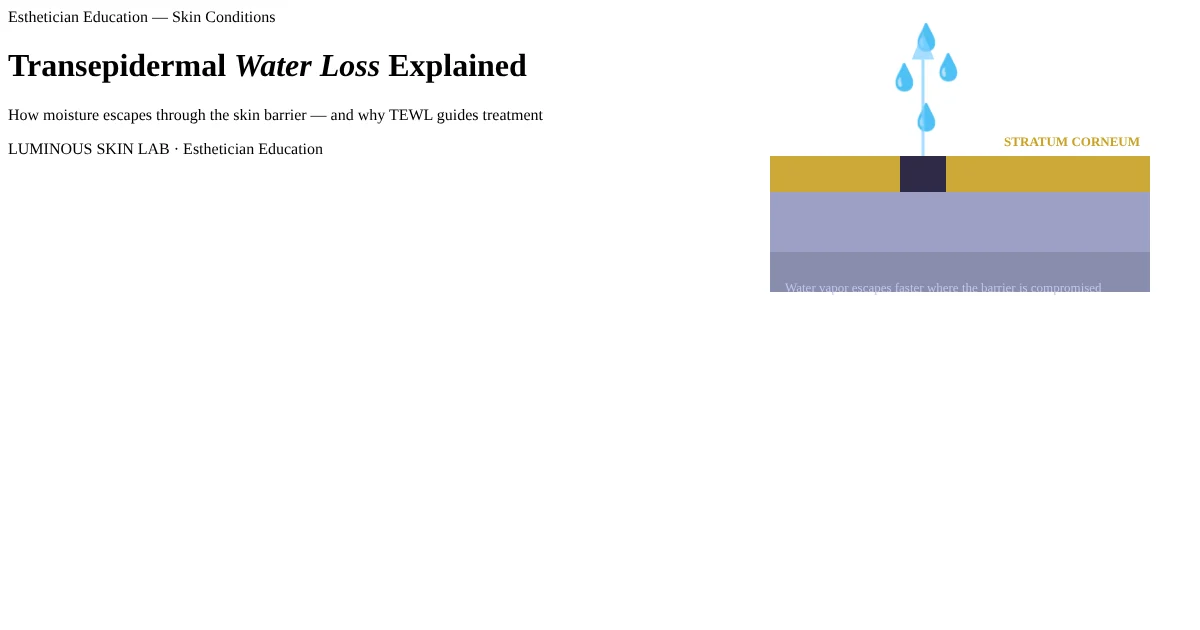
What Is Transepidermal Water Loss?
Transepidermal water loss (TEWL) is the evaporation of water from inside the skin out through its surface. A small, steady amount is normal; elevated TEWL means the barrier is compromised and losing more water than it can replace. For estheticians, TEWL is a direct read on barrier health and the single best lens for understanding dehydrated, reactive skin.
- Definition: water evaporating from the inner skin out through the stratum corneum.
- Normal vs. elevated: a little is healthy; a lot signals a damaged barrier.
- Driver: the lipid barrier controls the rate — damage it and TEWL rises.
- Consequence: high TEWL leads to dehydration, sensitivity, and poor treatment tolerance.
- Raised by: over-exfoliation, harsh actives, hot water, low humidity, sun and wind.
- Lowered by: humectants plus lipids and occlusion, barrier repair, and daily protection.
Transepidermal water loss is one of those concepts that quietly explains a huge amount of what estheticians see in the treatment room. Dehydrated skin, reactivity, products that sting, hydration that never holds — they often trace back to one thing: the barrier is letting water escape faster than it should. Understanding TEWL turns those scattered symptoms into a single, readable signal you can act on.
Key Takeaways
- TEWL is the evaporation of water from inside the skin out through the stratum corneum.
- A low, steady rate is healthy; an elevated rate means the barrier is compromised.
- The lipid “brick and mortar” structure of the barrier controls how fast water escapes.
- Elevated TEWL is the mechanism behind much of what looks like dehydrated, sensitive skin.
- Over-exfoliation, harsh actives, heat, low humidity, and sun all increase TEWL.
- Lowering TEWL means repairing the barrier: humectants plus lipids and occlusion, and daily protection.
How TEWL Actually Works
The body is mostly water, and the deeper layers of the skin are well hydrated. The stratum corneum — the outermost layer — acts as the gatekeeper that controls how much of that water is allowed to evaporate into the air. A healthy barrier, with its lipids packed tightly between skin cells, keeps that evaporation slow and steady. That baseline loss is normal and necessary.
When the barrier is disrupted, the gaps between cells widen and water escapes faster. That elevated rate of evaporation is what we mean by high TEWL. The skin is effectively leaking moisture, and because it's losing water faster than homecare can replace it, no amount of surface hydration fully fixes the problem until the barrier itself is repaired. For the structural side of this, see what the skin barrier is.
Why TEWL Matters in the Treatment Room
TEWL is valuable to estheticians because it reframes a confusing client complaint into a clear mechanism. A client who says “my skin is always dry no matter what I use” is usually describing elevated TEWL, not a lack of moisturizer. Recognizing that changes the treatment plan: the answer isn't more hydration on top, it's sealing the leak underneath.
It also explains why some skin reacts badly to active treatments. Skin with high TEWL has a weakened defense, so acids, strong actives, and aggressive exfoliation land harder and recover slower. Reading the barrier first tells you when to support instead of stimulate. See how to identify dehydrated skin.
What Increases Transepidermal Water Loss
Over-Exfoliation & Actives
Acids, retinoids, and scrubs used too often strip the lipids that slow water loss, driving TEWL up.
Heat, Wind & Low Humidity
Hot water, dry air, wind, and sun pull moisture from the surface and stress the barrier.
Aggressive Procedures
Strong peels and intensive resurfacing temporarily raise TEWL, which is why post-treatment recovery matters.
The pattern is consistent: anything that damages or thins the stratum corneum raises the rate at which water escapes. That's why barrier-first thinking prevents so many downstream problems.
How Estheticians Reduce TEWL
Lowering TEWL is the same work as repairing the barrier, because the barrier is what controls it. The approach is layered: humectants draw water into the skin, lipids replenish the mortar between cells, and an occlusive finish slows evaporation while the barrier rebuilds. Remove the aggravators — stripping actives, hot water, unprotected sun exposure — and the skin's own loss rate falls back toward normal.
In the treatment room, occlusive recovery masks are one of the fastest ways to lower TEWL in a single session: they flood the skin with humectants and then seal them in, giving the barrier a concentrated reset. See using jelly masks to restore hydration and building a hydration facial protocol.
TEWL gives you a single question to ask of reactive or dehydrated skin: is the barrier holding water, or leaking it? If it's leaking, support and seal before you stimulate.
Frequently Asked Questions
What is transepidermal water loss (TEWL)?
Transepidermal water loss is the evaporation of water from the inner layers of the skin out through the stratum corneum into the air. A small, steady amount is normal and healthy; elevated TEWL signals that the skin barrier is compromised and losing more water than it should.
Why does TEWL matter for estheticians?
TEWL is a direct indicator of barrier function and hydration status. When it is elevated, the skin struggles to stay hydrated, becomes more reactive, and responds poorly to active treatments. Reading those signs helps estheticians choose supportive protocols over stimulating ones.
What increases transepidermal water loss?
Over-exfoliation, harsh actives, hot water, low humidity, wind and sun exposure, and aggressive treatments all increase TEWL by disrupting the barrier's lipid structure. Any damage to the stratum corneum raises the rate at which water escapes.
How do you reduce transepidermal water loss?
Reduce TEWL by repairing and supporting the barrier: pair humectants that attract water with lipids and occlusives that seal it in, pause stripping actives, and protect the skin from environmental stress. Occlusive recovery masks are especially effective at lowering TEWL quickly.
Is TEWL the same as dehydrated skin?
They are closely related but not identical. Elevated TEWL is the mechanism; dehydrated skin is often the result. When the barrier lets too much water escape, the skin becomes dehydrated, which is why reducing TEWL is central to treating dehydration.
Suggested Internal Links
About This Professional Guide
This resource is part of the Luminous Skin Lab Esthetician Education Series designed to provide professional skincare education for licensed estheticians and advanced practitioners.