What Is the Difference Between Dehydrated and Dry Skin?
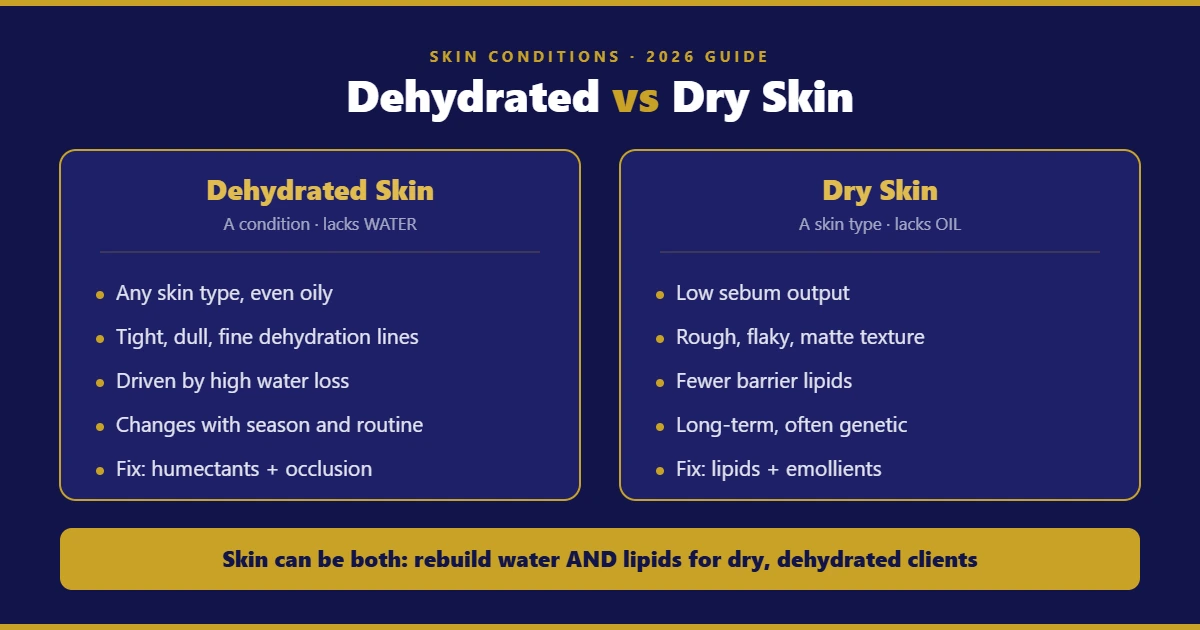
Dehydrated skin lacks water; dry skin lacks oil. Dehydration is a temporary condition that can affect any skin type — including oily skin — and is driven by water escaping through a weakened barrier. Dry skin is a skin type defined by low sebum production and fewer barrier lipids. Dehydration is treated by adding and holding water; dryness is treated by replacing oil and lipids. Many clients have both at once.
- Dehydrated: lacks water; a condition; any skin type, even oily.
- Dry: lacks oil; a skin type; low sebum and fewer barrier lipids.
- Dehydration signs: tightness, dullness, fine crisscross lines, shine with tightness.
- Dryness signs: rough, flaky, matte texture, small pores, little visible oil.
- Treat dehydration with: humectants plus an occlusive finish.
- Treat dryness with: ceramides, fatty acids and emollient oils.
“Dry” and “dehydrated” are used interchangeably by clients, and often by product labels, but they describe two different problems. Getting the distinction right decides the whole treatment plan. Give an oily, dehydrated client a rich emollient cream and you may add congestion without fixing the tightness. Give a genuinely dry client only water-based humectants and the skin stays rough because the missing oil was never replaced.
This guide compares the two side by side — what is missing, how each looks and feels, and how the professional approach differs. For the full assessment workflow, see how estheticians identify dehydrated skin.
Key Takeaways
- Dehydrated skin lacks water; dry skin lacks oil. They are not the same problem.
- Dehydration is a condition that comes and goes; dryness is a longer-term skin type.
- Oily skin can be dehydrated — shine on the surface, tightness underneath.
- Dry skin is more prone to dehydration because it has fewer lipids to hold water in.
- Dehydration needs humectants and occlusion; dryness needs lipids and emollients.
- Dry, dehydrated skin needs both water and oil replaced, then sealed in.
What Is Missing: Water vs Oil
The stratum corneum needs two things to stay comfortable and healthy: enough water inside its cells, and enough lipids between and over them to keep that water from escaping. Dehydration and dryness are failures of each.
Dehydrated skin is short on water. The usual cause is elevated transepidermal water loss (TEWL) — water evaporating out through a barrier that has been weakened by over-cleansing, harsh actives, climate or treatments. Oil production may be completely normal, or even high.
Dry skin is short on oil. The sebaceous glands produce less sebum and the barrier holds fewer of the lipids — ceramides, cholesterol and fatty acids — that keep it supple. Dry skin is largely a skin type: it reflects genetics, age and hormones, and it does not disappear when the weather changes.
How to Tell Dehydrated and Dry Skin Apart
Feel and Look
Tight, dull, slightly crepey. Fine crisscross lines on the cheeks. Can still be shiny or oily in the T-zone.
Feel and Look
Rough, flaky, matte all over. Small, barely visible pores. Little to no shine at any time of day.
The Pinch Test
Push the cheek gently upward: many fine lines appear and the skin is slow to smooth back.
Product Response
Rich creams absorb quickly and feel comforting; light gels alone leave the skin feeling rough.
Changes Over Time
Worse in winter, air conditioning, travel or after new actives; improves quickly with barrier support.
Changes Over Time
Consistent year-round, often increasing with age; managed rather than resolved.
In practice, many clients show signs of both. Dry skin has fewer lipids to hold water in, so it is especially prone to dehydration on top of its baseline dryness.
How Treatment Plans Differ
Treating Dehydrated Skin: Add Water, Then Hold It
The goal is to restore water content and slow its escape. Layer humectants — hyaluronic acid, polyglutamic acid, glycerin — onto damp skin, then finish with an occlusive layer that reduces TEWL. Pause anything that strips: high-foam cleansers, frequent exfoliation and drying acne products. For oily, dehydrated clients, keep textures light and oil-free. See how to treat oily, dehydrated skin.
Treating Dry Skin: Replace the Missing Lipids
The goal is to replenish oil and barrier lipids. Use ceramides, cholesterol and fatty acids in a balanced ratio, along with emollients such as squalane and plant oils. Cleanse with low-foam, non-stripping formulas and keep water lukewarm. Richer textures suit dry skin well.
Treating Dry, Dehydrated Skin: Both, In Order
Hydrate first, then nourish, then seal: a humectant layer on damp skin, a lipid-rich cream to replace oil, and an occlusive finish. In a facial, a hydrating occlusive mask followed by a barrier-repair moisturizer covers both deficits. See building a hydration facial protocol.
Ask one question at consultation: is this skin missing water, oil, or both? For dehydrated clients, a cooling, occlusive Poly-Luronic® Jelly Mask by Luminous Skin Lab gives a visible same-day difference — and gives you a clear moment to explain why their routine needs hydration, not just moisturizer.
Frequently Asked Questions
What is the difference between dehydrated and dry skin?
Dehydrated skin lacks water; dry skin lacks oil. Dehydration is a temporary condition that can affect any skin type, including oily skin, and is driven by water escaping through a weakened barrier. Dryness is a skin type defined by low sebum production and fewer barrier lipids, and it tends to be long-term.
How can you tell if skin is dehydrated or dry?
Dehydrated skin feels tight, looks dull, shows fine crisscross lines that appear when the skin is gently pinched, and can still be oily or shiny. Dry skin looks rough, flaky and matte all over, has small pores and little visible oil, and feels dry even when it is not tight. Many clients show both at once.
Can oily skin be dehydrated?
Yes. Because dehydration is a lack of water, not oil, oily skin can be dehydrated. It often shows as shine on the surface with tightness underneath, rebound oiliness after cleansing, and fine lines across oily areas. Stripping cleansers and drying acne products are common causes.
Can skin be both dry and dehydrated?
Yes. Dry skin has fewer barrier lipids, so it loses water more easily and is prone to dehydration. Dry, dehydrated skin needs both water-binding humectants and lipid-rich emollients, followed by an occlusive layer to slow water loss.
What is the pinch test for dehydrated skin?
Gently push the skin of the cheek upward or pinch it lightly. If many fine, crepey lines appear and the skin is slow to smooth back, dehydration is likely. It is a quick screening sign, not a diagnosis, and works best alongside a full visual and tactile assessment.
How do you treat dehydrated skin vs dry skin?
Dehydrated skin is treated by adding and holding water: humectants such as hyaluronic acid and polyglutamic acid, an occlusive finish to reduce water loss, and pausing stripping products. Dry skin is treated by replacing oil and lipids: ceramides, fatty acids, cholesterol and emollient oils. Dry, dehydrated skin needs both.
Does drinking water fix dehydrated skin?
Not on its own. Unless a person is genuinely underhydrated, drinking extra water does little for surface skin dehydration. Skin dehydration is mainly a barrier problem: water escapes faster than it is replaced. Topical humectants, barrier support and occlusion are what change it.
Is dehydrated skin a skin type?
No. Dehydration is a skin condition, not a skin type. It comes and goes with season, climate, routine and treatments, and it improves once the barrier is supported. Dry skin, by contrast, is a skin type that reflects how much oil the skin produces.
Suggested Internal Links
About This Professional Guide
This resource is part of the Luminous Skin Lab Esthetician Education Series designed to provide professional skincare education for licensed estheticians and advanced practitioners.