How Do Jelly Masks Restore Skin Hydration in Professional Treatments?
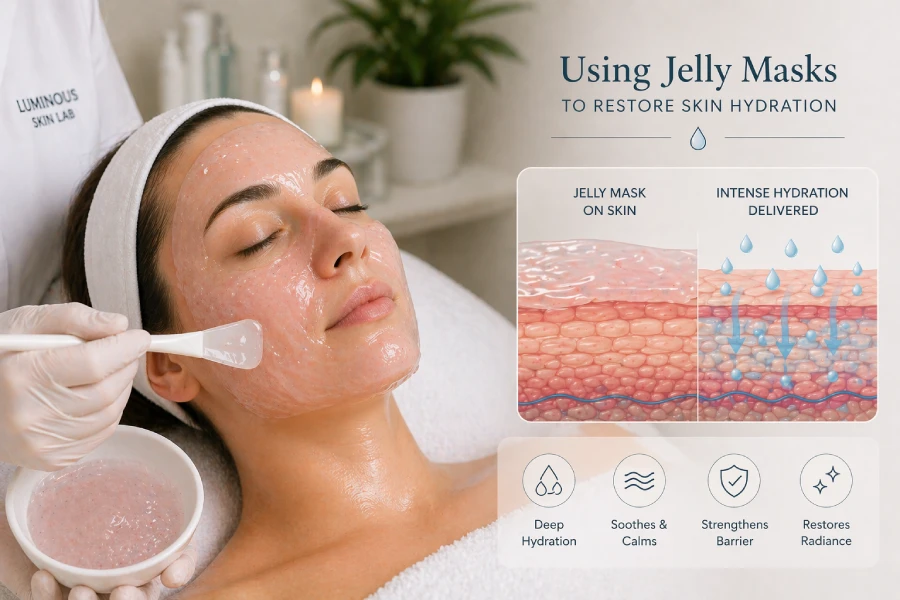
Jelly masks restore skin hydration through a dual mechanism: they deliver concentrated humectant ingredients directly to the skin surface while simultaneously forming an occlusive film that reduces transepidermal water loss (TEWL). This combination makes them one of the most clinically effective hydration restoration tools available to estheticians for treating dehydrated skin conditions, post-treatment skin, and compromised barrier states.
- Jelly masks form a semi-occlusive gel film on the skin surface that physically limits TEWL during the treatment window
- Humectant actives in the mask — including hyaluronic acid and polyglutamic acid — attract and bind water within the stratum corneum under the sealed environment
- Layering a hydration serum beneath the jelly mask dramatically increases the humectant payload delivered during treatment
- The cooling temperature of a freshly applied jelly mask also helps reduce post-treatment inflammation and surface redness
- Jelly masks are appropriate for dehydrated skin across all skin types, including oily, acne-prone, and sensitised skin
- Post-treatment applications — after microneedling, dermaplaning, and chemical exfoliation — are among the highest-value clinical uses for hydration restoration jelly mask protocols
Dehydration is among the most frequently misidentified skin conditions in esthetic practice. Because it can present across all skin types — including skin that is simultaneously oily at the surface — it is often overlooked or undertreated during consultations that focus on other presenting concerns. The clinical consequence is that estheticians address sebum, pigmentation, or texture without resolving the underlying water deficit that is compromising skin function at the stratum corneum level. Jelly masks, when used with a clear understanding of their mechanism, are one of the most effective tools available for correcting this deficit within the treatment session itself.
The reason jelly masks occupy a distinct position in hydration restoration is their structural combination of occlusive film formation and humectant delivery. Unlike cream masks, which are largely absorbed or lose efficacy through evaporation, a professional-grade jelly mask maintains active therapeutic contact with the skin surface for the full setting period. This extended contact time, combined with the reduced TEWL environment the mask creates, produces a measurable improvement in skin hydration that clients can often feel immediately upon mask removal. For estheticians treating chronic dehydration as part of a structured skin conditions protocol, this is a clinically meaningful outcome within a single session.
This article covers the mechanics of how jelly masks restore hydration, the skin conditions that respond best to this approach, how to integrate the jelly mask step into dehydration-focused facial protocols, and the most common application decisions that determine clinical outcomes — including serum selection, timing, and layering sequence.
What Every Esthetician Should Know About Using Jelly Masks for Hydration Restoration
- Dehydration is a skin condition, not a skin type — oily, combination, and acne-prone skin can all present with significant water deficit requiring dedicated treatment
- The occlusive gel matrix of a professional jelly mask reduces TEWL during the 10–20 minute treatment window, creating the conditions for genuine hydration uptake rather than surface-level moisture application
- Layering a humectant serum beneath the jelly mask is the single highest-impact technique modification for dehydration protocols — the serum provides the actives and the mask provides the sealed delivery environment
- Post-treatment jelly mask application — after microneedling, dermaplaning, or chemical exfoliation — addresses the acute dehydration state these treatments create and supports faster barrier recovery
- The pinch test, surface texture assessment, and client history are the three primary assessment tools for distinguishing dehydration from true dryness before selecting the appropriate protocol
- Setting time matters clinically: 10–15 minutes is appropriate for post-treatment or reactive skin; 15–20 minutes is optimal for standalone chronic dehydration treatments
- Jelly masks are one of the only mask formats that deliver cooling, occlusion, and humectant therapy simultaneously — making them uniquely suited to the complex needs of compromised and dehydrated skin
Understanding Skin Dehydration as a Clinical Condition
Skin dehydration is defined by insufficient water content in the stratum corneum — the outermost layer of the epidermis responsible for barrier function and surface hydration. Unlike dry skin, which describes a skin type characterised by insufficient sebum production, dehydration is a transient or chronic condition that can affect any skin type. The clinical implication is significant: an esthetician who treats a client’s oily, congested skin without addressing concurrent dehydration may inadvertently leave the barrier in a state that slows recovery and perpetuates inflammation.
The mechanisms that cause dehydration in esthetic clients fall into several predictable categories. Environmental exposure — particularly dry or heated air, wind, and UV radiation — accelerates evaporative water loss from the skin surface. Lifestyle factors including inadequate fluid intake, alcohol consumption, and dietary patterns that reduce natural moisturising factor (NMF) production contribute to chronic states. Perhaps most relevant to the esthetics treatment context, professional services including chemical exfoliation, microneedling, dermaplaning, and enzyme treatments all create a degree of intentional barrier disruption that, if not managed with an appropriate recovery step, leads to acute post-treatment dehydration.
Recognising Dehydration During Skin Assessment
The clinical markers of dehydration differ from those of dry skin in important ways that guide protocol selection. Dehydrated skin typically presents with a fine, tightly networked surface line pattern that becomes more pronounced when the skin is pinched — often described as a crepe or tissue-paper texture. This is distinct from the coarser, irregular flaking of true dry skin. Dehydrated skin may also feel tight despite normal or elevated sebum levels, and clients often report that surface oiliness increases after hot showers or cleansing, as the skin attempts to compensate for water loss through increased sebum production. A thorough verbal history is often as diagnostic as the visual assessment: clients with true dehydration frequently describe their skin as “sometimes oily, sometimes tight, never quite right,” and many have tried multiple moisturisers without lasting improvement because they were addressing the wrong layer of the problem.
The Science of Occlusion and Humectant Delivery in Jelly Masks
The clinical effectiveness of jelly masks for hydration restoration is grounded in two converging mechanisms: occlusion and humectant delivery under extended contact conditions. Understanding both mechanisms at a functional level allows estheticians to make more precise decisions about when and how to use jelly masks within dehydration protocols, rather than applying them as a generic “finishing step” without a defined therapeutic purpose.
How the Gel Matrix Creates a Therapeutic Occlusive Environment
When a professional jelly mask mixture is poured onto the skin surface and begins to set, it forms a continuous, semi-rigid gel film that physically limits the rate of water vapour diffusion from the skin surface into the surrounding air. This is the definition of occlusion in a dermatological context: not an impermeable barrier, but a rate-limiting layer that slows TEWL below the rate at which the skin can replenish moisture from within. The practical result is that the skin’s own hydration-binding mechanisms — the natural moisturising factors produced within the stratum corneum — have time to stabilise water within the tissue rather than losing it to evaporation faster than it can be replaced. Jelly masks achieve this occlusive effect without the comedogenic risk of heavy petrolatum-based occlusives, which makes them appropriate for use across skin types that cannot tolerate occlusive creams or balms.
Humectant actives in the mask — particularly hyaluronic acid and polyglutamic acid — work within this sealed environment to attract water both from the dermis below and from the atmosphere, binding it to the stratum corneum in a way that persists after mask removal. The combination of a sealed surface and active humectant binding produces a more durable hydration outcome than either mechanism alone could achieve.
How Key Humectants Function Under Jelly Mask Occlusion
Hyaluronic acid (HA) is a glycosaminoglycan that can hold approximately 1,000 times its own weight in water. Within the sealed environment of a jelly mask, HA molecules attract water from both the dermis and the surrounding atmosphere, binding it to the stratum corneum surface. HA is degraded by the enzyme hyaluronidase, which limits its retention time in the skin without additional protection.
Polyglutamic acid (PGA) holds up to 5,000 times its weight in water and forms a micro-gel film on the stratum corneum surface. Critically, PGA also inhibits hyaluronidase, protecting both applied HA and the skin’s endogenous HA reserves. PGA additionally stimulates the production of natural moisturising factors including pyrrolidone carboxylic acid (PCA), lactic acid, and urocanic acid in the stratum corneum, creating a hydration benefit that extends beyond the treatment window. When PGA and HA are delivered together under jelly mask occlusion, they create a comprehensive dual-depth hydration system that outperforms either ingredient used alone.
Sodium PCA and electrolytes present in many jelly mask formulations further support NMF function and osmotic balance within the stratum corneum, contributing to the sustained improvement in skin water content observed after treatment.
Jelly Mask Hydration Protocols for Different Skin Conditions
Not all dehydration presentations require the same jelly mask protocol. The appropriate serum selection, mask contact time, and layering sequence vary depending on whether the dehydration is standalone and chronic, secondary to an active treatment, or occurring in the context of a compromised or sensitised barrier. The comparison framework below outlines how estheticians adapt the jelly mask hydration step across the five most common clinical presentations of dehydrated skin.
Integrating the Jelly Mask Step Into a Dehydration-Focused Facial Workflow
In a standalone hydration facial targeting dehydrated skin, the jelly mask step typically follows cleansing, exfoliation (if appropriate for the skin), and serum application. The sequence matters: the serum should be applied to skin that is slightly damp — not fully dry — so the humectant molecules have access to surface water molecules to begin the binding process before the mask seals the environment. The mask is then poured or spatulaed over the serum layer and allowed to set fully before removal. Attempting to peel a jelly mask before it has reached full gel consistency reduces its occlusive effectiveness and can cause tearing, which disrupts the seal and diminishes the therapeutic outcome.
When working with clients presenting chronic dehydration — particularly those with oily skin who are surprised to hear they have a water deficit — the most consistent observation is that the Poly-Luronic™ Jelly Mask produces a more palpable improvement in surface texture immediately post-removal compared to standard hydrating masks used in the same protocol position. The specific difference estheticians notice is in how the skin feels when the mask peels away: with a standard cream or gel-pack mask, the skin is temporarily moisturised but the surface still feels somewhat taut or uneven. With the Poly-Luronic™ Jelly Mask, the peelable seal consistently leaves the skin feeling measurably softer and less reactive to the touch, which estheticians attribute to the extended, uninterrupted humectant contact time the sealed gel matrix creates. The practical protocol difference is also worth noting: because this mask holds its shape during removal — coming off in one cohesive piece rather than smearing — the esthetician can maintain the entire sealed environment for the full 15–20 minutes without needing to intervene. Compared to gel-pack masks that can slip or separate at the edges during the setting window, this structural integrity directly extends effective occlusion time, which is the mechanism that drives the hydration result.
Six Clinical Decisions That Determine Jelly Mask Hydration Outcomes
The effectiveness of a jelly mask as a hydration restoration tool is not fixed at the product level — it is substantially shaped by six protocol decisions the esthetician makes at each treatment. Understanding these decisions and why each one matters allows practitioners to consistently produce clinical results rather than variable outcomes that depend on unpredictable factors.
Serum Selection Before the Mask
The serum applied beneath the jelly mask determines what humectant actives are delivered under occlusion. For dehydrated skin, a serum featuring hyaluronic acid, polyglutamic acid, sodium PCA, or a combination of these provides the highest hydration payload. Serums with active exfoliants or high-concentration retinoids should not be used under the mask on sensitised or post-treatment skin.
Skin Surface Moisture at Application
Applying the serum to slightly damp skin rather than fully dry skin maximises humectant binding efficiency, as humectant molecules require surface water molecules to initiate their water-attraction mechanism. Patting — not wiping — residual toner or mist before serum application is the standard technique to maintain this optimal surface state without excess moisture.
Mask Contact Time
Contact time directly determines how thoroughly the humectant actives saturate the stratum corneum under the sealed occlusive environment. The clinical minimum for measurable hydration improvement is 10 minutes. The optimal window for chronic dehydration is 15–20 minutes. Post-treatment or reactive skin contexts call for a shorter 10–15 minute window to avoid trapping surface heat for extended periods.
Removal Technique
A professional jelly mask should be removed in a single cohesive peel from one edge, ideally beginning at the chin and lifting upward. Breaking the mask into sections during removal disrupts the occlusive seal prematurely for areas still under the mask and can drag the skin if the gel has not fully set. Waiting for complete setting before removal is a common point of impatience that reduces clinical outcomes.
Post-Mask Moisturiser Application Timing
Immediately after jelly mask removal, the skin surface is at peak hydration and the stratum corneum is temporarily more permeable. Applying a barrier-supportive moisturiser or facial oil within 60 seconds of mask removal seals in the hydration gain and extends its duration. Delays of several minutes after removal allow a portion of the hydration benefit to evaporate before it is locked in.
Frequency and Series Planning
For clients with chronic dehydration, a single jelly mask treatment provides meaningful immediate improvement but does not resolve the underlying NMF deficit that causes persistent dehydration. A structured series of 4–6 treatments at 2–3 week intervals, combined with a home care plan addressing the hydration cycle between appointments, produces the lasting skin condition change that generates client retention and treatment plan adherence.
Jelly Masks in Post-Treatment Recovery: A High-Value Clinical Application
While jelly masks are effective for standalone dehydration treatments, their highest-value clinical application in many esthetician practices is as a post-treatment recovery step. Professional services that intentionally disrupt the skin surface — microneedling, chemical peels, dermaplaning, enzyme treatments, and extraction-heavy facials — all create a predictable post-treatment state characterised by acute dehydration, elevated TEWL, surface inflammation, and temporarily compromised barrier function. Addressing this state immediately within the treatment session, rather than leaving the client to manage it at home, is both a clinical best practice and a significant differentiator in service quality.
Why Post-Treatment Skin Responds Rapidly to Jelly Mask Hydration
Post-treatment skin responds more rapidly and visibly to jelly mask hydration than intact skin does for a straightforward mechanical reason: the surface disruption created by the preceding treatment temporarily increases the skin’s permeability, allowing humectant molecules delivered by the mask to penetrate more efficiently than they would through an intact stratum corneum. This is the same principle that makes post-needling serum infusion so effective — the created pathways allow topical ingredients to reach tissue layers they would not access under normal conditions. The jelly mask leverages this window by delivering its humectant payload through the disrupted surface while simultaneously using its occlusive film to prevent further TEWL from the compromised barrier. The cooling thermal effect of a freshly applied jelly mask also contributes to visible redness reduction and client comfort during the immediate post-treatment period, which is therapeutically relevant and significantly enhances the client experience at the moment they are most likely to assess the esthetician’s skill and care.
Building the Jelly Mask Recovery Step Into Multi-Service Protocols
Estheticians who consistently include a jelly mask recovery step in post-treatment protocols report that clients perceive their services as more thorough and professionally managed compared to treatments that end immediately after the primary service. From a practical standpoint, the jelly mask recovery step adds 15–20 minutes to the treatment but requires minimal active esthetician involvement during the setting period, making it an efficient use of treatment room time. The step can be combined with a scalp massage, hand treatment, or other service add-on during the setting window to maximise the client’s experience without increasing active treatment demands on the esthetician. For estheticians building a reputation around post-treatment care quality — particularly in markets where microneedling and chemical exfoliation services are high-volume offerings — the jelly mask recovery step is one of the most straightforward and effective protocol differentiators available.
Professional and Scientific References
The clinical framework in this article is informed by peer-reviewed research on transepidermal water loss, humectant mechanisms, stratum corneum hydration biology, and occlusive mask therapy in professional esthetic contexts.
- Rawlings, A.V., & Harding, C.R. (2004). Moisturization and skin barrier function. Dermatologic Therapy, 17(S1), 43–48. Establishes the foundational relationship between barrier occlusion, TEWL reduction, and stratum corneum water content stabilisation.
- Kawada, C., et al. (2014). Ingestion of γ-polyglutamic acid hydrates the skin and increases NMF components: a randomised double-blind placebo-controlled trial. Journal of Cosmetic Dermatology, 13(3), 172–177. Provides evidence for PGA’s role in stimulating NMF production in the stratum corneum.
- Papakonstantinou, E., Roth, M., & Karakiulakis, G. (2012). Hyaluronic acid: A key molecule in skin aging. Dermato-Endocrinology, 4(3), 253–258. Documents HA water-binding capacity and its role in skin hydration and elasticity maintenance.
- Fluhr, J.W., & Darlenski, R. (2009). Skin surface pH: Mechanism and clinical impact. Current Problems in Dermatology, 38, 1–7. Addresses how barrier disruption from professional treatments affects surface hydration dynamics and recovery timelines.
- Elias, P.M. (2005). Stratum corneum defensive functions: An integrated view. Journal of Investigative Dermatology, 125(2), 183–200. Provides the comprehensive biological basis for understanding barrier function, NMF composition, and why occlusive intervention is therapeutically effective in dehydrated skin presentations.
For estheticians building or refining a clinical protocol for dehydrated skin conditions, the mask selection in the hydration restoration step is one of the most consequential product decisions in the entire treatment sequence. The Poly-Luronic™ Jelly Mask addresses the core clinical requirements of this step: its alginate-based gel matrix provides the genuine occlusive seal needed to reduce TEWL during the treatment window, while its polyglutamic acid and hyaluronic acid combination delivers the dual-depth humectant therapy that produces measurable hydration improvement rather than a temporary surface effect. For post-treatment recovery contexts — where the skin is acutely dehydrated, the barrier is compromised, and the client’s comfort and clinical outcome are most visible — the formula’s clean-ingredient profile also means it is appropriate for the sensitised surface states that follow microneedling, dermaplaning, and chemical exfoliation. Estheticians who want a single jelly mask product that performs across the full range of dehydration presentations covered in this protocol framework will find it meets that requirement without requiring condition-specific product switching.
Explore the Poly-Luronic™ Jelly Mask LineFrequently Asked Questions: Using Jelly Masks for Skin Hydration Restoration
Why do jelly masks restore skin hydration better than cream masks?
Jelly masks restore hydration more effectively than cream masks primarily because of their occlusive film-forming structure. When a jelly mask sets on the skin, it creates a semi-permeable seal that dramatically reduces transepidermal water loss (TEWL), locking in both the mask’s own humectant ingredients and any serums applied beneath it. Cream masks, by contrast, are largely absorbed or evaporate during treatment, providing a more transient hydration effect. The gel matrix in professional jelly masks also delivers humectants like hyaluronic acid and polyglutamic acid in a sustained-contact environment, meaning the skin has 10–20 minutes of continuous exposure rather than a brief application window. This combination of occlusion and extended humectant contact is what makes jelly masks the preferred choice for treating clinically dehydrated skin.
How long should a hydration jelly mask stay on dehydrated skin?
For dehydrated skin, most professional jelly mask protocols call for a setting time of 10 to 20 minutes. The lower end of this range is appropriate for mildly dehydrated skin or for post-treatment contexts where extended occlusion could trap unwanted heat, such as immediately following microneedling. For chronically dehydrated skin without an active treatment preceding the mask, the full 15–20 minute window is ideal, as it allows the humectant payload to saturate the stratum corneum more thoroughly. Estheticians should monitor the client during the set time and adjust based on skin response, particularly with reactive or sensitised skin types where longer occlusion can occasionally increase redness.
Can jelly masks be used on dehydrated skin that also has active breakouts?
Yes, jelly masks can be safely used on dehydrated skin with active breakouts, provided the formula is non-comedogenic and free of pore-occluding waxes or heavy oils. Dehydrated acne-prone skin is a common clinical presentation — the skin is simultaneously producing excess sebum and lacking in water content, which many clients and even some estheticians misread as oily skin that does not need hydration. A well-formulated, humectant-forward jelly mask can restore water content without feeding congestion. Estheticians should avoid applying jelly masks directly over open, weeping, or actively infected lesions, but treating the surrounding dehydrated skin with a jelly mask step is generally appropriate and therapeutically beneficial.
Does layering a serum under a jelly mask actually improve hydration results?
Yes, layering a hydration serum under a jelly mask significantly improves results compared to using the jelly mask alone. The serum delivers concentrated humectant actives — such as hyaluronic acid, polyglutamic acid, or sodium PCA — directly to the skin surface, and the subsequent jelly mask then acts as an occlusive seal that prevents those actives from evaporating before they can be absorbed. This is the same principle as the “slugging” concept but executed with a professional-grade occlusive at a treatment-appropriate level. In practice, estheticians who layer a well-chosen hydration serum before the jelly mask step consistently report that clients notice a more immediate plumping and dewiness effect compared to the mask used without a serum underneath.
What skin conditions respond best to jelly mask hydration treatments?
The skin conditions that respond most consistently to jelly mask hydration treatments are transient dehydration, chronically dehydrated skin, compromised barrier function, post-treatment sensitivity, and rosacea-adjacent sensitised skin. Transient dehydration caused by environmental exposure, seasonal changes, or dietary factors typically shows the most immediate visible improvement. Compromised barrier conditions benefit because the occlusive action reduces TEWL while the skin rebuilds its lipid layer. Post-treatment skin — following microneedling, chemical peels, or dermaplaning — also responds well because these treatments intentionally disrupt the surface, making an immediate occlusive and humectant step both calming and clinically necessary for optimal recovery.
Is it safe to use a jelly mask immediately after microneedling?
Yes, applying a jelly mask immediately after microneedling is not only safe but is considered best practice in many professional post-microneedling protocols. After microneedling, the skin surface has been intentionally disrupted and is acutely dehydrated and inflamed. A cooling, occlusive jelly mask applied within minutes of the treatment provides immediate hydration delivery through the opened channels, reduces surface heat and redness, and creates the occlusive environment needed to prevent post-treatment TEWL. Estheticians should ensure that any serum applied before or infused during the jelly mask step is appropriate for compromised skin — meaning no active exfoliants, retinoids, or sensitising ingredients immediately post-needling.
How does occlusion from a jelly mask reduce transepidermal water loss?
Occlusion reduces transepidermal water loss by physically limiting the rate at which water molecules can escape through the stratum corneum into the surrounding air. The stratum corneum is naturally semi-permeable, and when it is compromised — whether through environmental damage, treatment trauma, or chronic dehydration — its barrier function deteriorates and water loss accelerates. A jelly mask’s gel matrix, once set, forms a temporary occlusive film on the skin surface that slows this diffusion process significantly. This gives the skin’s natural moisture-binding mechanisms time to stabilise water within the tissue, and it allows applied humectants to attract and hold atmospheric moisture rather than losing it immediately. The result is a measurable increase in skin hydration levels that persists after mask removal.
How do I know if my client’s skin is dehydrated rather than dry?
Dehydration and dryness are two distinct conditions that require different treatment approaches. Dry skin is a skin type characterised by insufficient sebum production — it lacks oil and tends to feel tight, rough, and flaky chronically. Dehydration is a skin condition characterised by insufficient water content — any skin type, including oily skin, can be dehydrated. The key assessment tools estheticians use to distinguish them include the pinch test (dehydrated skin shows fine surface lines and a crepe-like texture when pinched rather than the coarser flaking of dry skin), client history (dehydrated skin often worsens with weather changes, air travel, or certain dietary factors), and surface appearance under a magnifying lamp (dehydrated skin shows a fine, tightly packed surface line pattern rather than the irregular flaking of true dry skin).
Why do estheticians use the Poly-Luronic™ Jelly Mask specifically for hydration restoration protocols?
Estheticians working with the Poly-Luronic™ Jelly Mask for hydration restoration protocols select it specifically because its formula combines polyglutamic acid and hyaluronic acid in a professional-grade alginate gel base — a combination that addresses both the surface occlusion and deep humectant delivery that dehydrated skin requires. Polyglutamic acid holds significantly more water than hyaluronic acid alone and also inhibits hyaluronidase, protecting the skin’s own HA reserves. The alginate base creates the firm, peelable occlusive seal needed for clinical hydration work without the adhesion issues that can occur with some gel mask formulas on sensitised or post-treatment skin. For estheticians treating dehydrated conditions as part of a structured skin conditions protocol, this ingredient combination means the mask is performing functional therapeutic work throughout its entire setting time, not simply providing a surface sensation.
Jelly Masks as a Clinical Hydration Restoration Tool: The Esthetician’s Perspective
Skin dehydration is one of the most prevalent and undertreated conditions in esthetic practice — not because estheticians lack effective tools, but because it is frequently misidentified or addressed with approaches that treat the surface appearance without resolving the underlying water deficit. Jelly masks, used with a clear understanding of their occlusive and humectant mechanisms, close this gap in a clinically meaningful way. The combination of TEWL reduction, sustained humectant contact, and the ability to amplify serum actives through the sealed delivery environment makes them uniquely effective for both standalone dehydration treatments and post-treatment recovery protocols.
The six protocol decisions outlined in this article — serum selection, surface moisture at application, contact time, removal technique, post-mask moisturiser timing, and series planning — are the levers estheticians control to consistently produce strong hydration outcomes rather than variable results. Mastering these decisions, rather than simply including a jelly mask as a finishing step without a defined therapeutic intention, is what separates a hydration facial that clients can feel working from one that simply looks good on the service menu.
For continued professional education on skin condition treatment, barrier repair protocols, and ingredient science, explore the full Skin Conditions Treatment Guide and the supporting resources linked below.