What Is Skin Barrier Health?
This article explains how estheticians can evaluate skin barrier health within the context of professional skincare, barrier repair science, and esthetic treatment recovery.
Quick Answer
This article explains how estheticians can evaluate skin barrier health for estheticians focusing on visual assessment, hydration levels, and barrier function.
Key Takeaways
- Barrier health is critical to professional skincare outcomes.
- Hydration treatments help support skin recovery.
- Targeted ampoules and HydroGlo Jelly Masks can support treatment protocols.
- The skin barrier plays a central role in protecting the skin and maintaining hydration balance.
- Barrier disruption can lead to dehydration, irritation, and slower treatment recovery.
- Estheticians must recognize barrier damage signs and apply recovery-focused protocols.
Skin Barrier Health: The overall condition of the skin’s outer protective function, including hydration balance, resilience, and comfort.
Visual Assessment: The esthetician’s observation of visible skin signs such as redness, dryness, irritation, and surface condition.
Barrier Function: The skin’s ability to protect against external stress while retaining moisture and supporting recovery.
Why Barrier Evaluation Matters in Professional Skincare
The skin barrier plays a central role in professional skincare because it affects how the skin responds to treatment, how well it retains hydration, and how comfortably it recovers afterward. Estheticians who evaluate barrier health effectively can make better decisions about whether the skin needs support, recovery, or is ready for more active treatment steps.
Without that assessment, treatment planning becomes less precise. Barrier evaluation helps move the service away from assumption and toward skin-based decision-making.
Visual Assessment as the Starting Point
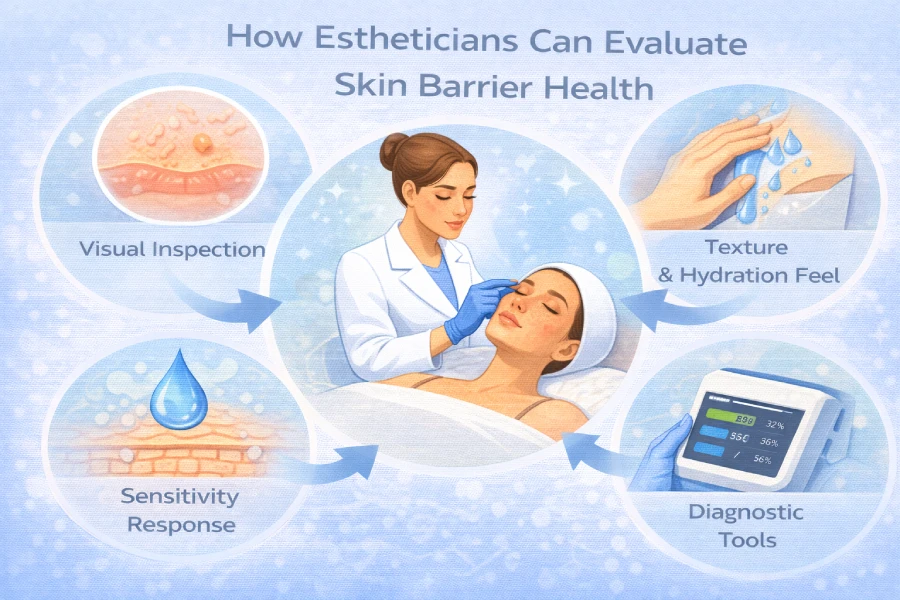
One of the first ways estheticians evaluate barrier health is through visual assessment. Redness, surface dryness, uneven texture, dullness, irritation, and a generally stressed appearance may all suggest that the barrier is not functioning optimally. The skin often shows visible signals before the client can fully describe the condition in technical terms.
That is why observation remains such an important clinical skill in professional skincare. The esthetician is often reading the skin before choosing the next step.
How Hydration Levels Help Reveal Barrier Condition
Hydration levels are closely connected to barrier function. Skin that feels tight, looks dull, or appears dehydrated may be signaling increased water loss and reduced barrier support. In professional skincare, this matters because dehydration can change both treatment tolerance and recovery quality.
For estheticians, hydration is not just a comfort issue. It is also a useful evaluation clue that helps determine whether the skin is better suited for support-focused care.
Why Barrier Function Must Be Considered Before Treatment
Barrier function determines how well the skin can handle stimulation, exfoliation, and active protocols. If that function appears compromised, the most professional decision may be to slow down, reduce intensity, or prioritize recovery-first treatment design.
This is one of the most valuable parts of barrier education. It teaches estheticians that evaluation is not separate from treatment planning. It directly shapes the protocol.
Estheticians often support barrier repair treatments by pairing targeted products such as Hydration Ampoule with deeply hydrating recovery masks like Poly-Luronic™ HydroGlo Jelly Mask.
Using Recovery Response as an Evaluation Tool
Recovery response is another useful indicator of barrier condition. Skin that remains red, tight, uncomfortable, or slow to settle after treatment may be showing that its protective function needs more support. Estheticians can learn a great deal about barrier health by observing how the skin behaves after professional care.
This is especially helpful when planning future services. A slower recovery pattern often signals the need for calmer sequencing and stronger hydration support.
Why Evaluation Improves Professional Judgment
Estheticians who evaluate barrier health well are better able to choose appropriate protocols, adjust intensity, and improve client comfort. Evaluation supports better outcomes because it encourages treatment decisions based on real skin condition rather than routine assumptions.
That is why barrier evaluation belongs at the center of esthetic practice. It strengthens both treatment safety and long-term professional credibility.
Frequently Asked Questions
What damages the skin barrier?
How can estheticians repair the barrier?
What does the skin barrier do?
Why is barrier repair important in professional skincare?
Suggested Internal Links
About This Professional Guide
This resource is part of the Luminous Skin Lab Esthetician Education Series designed to provide professional skincare education for licensed estheticians and advanced practitioners.