How Should New Estheticians Document Client Notes?
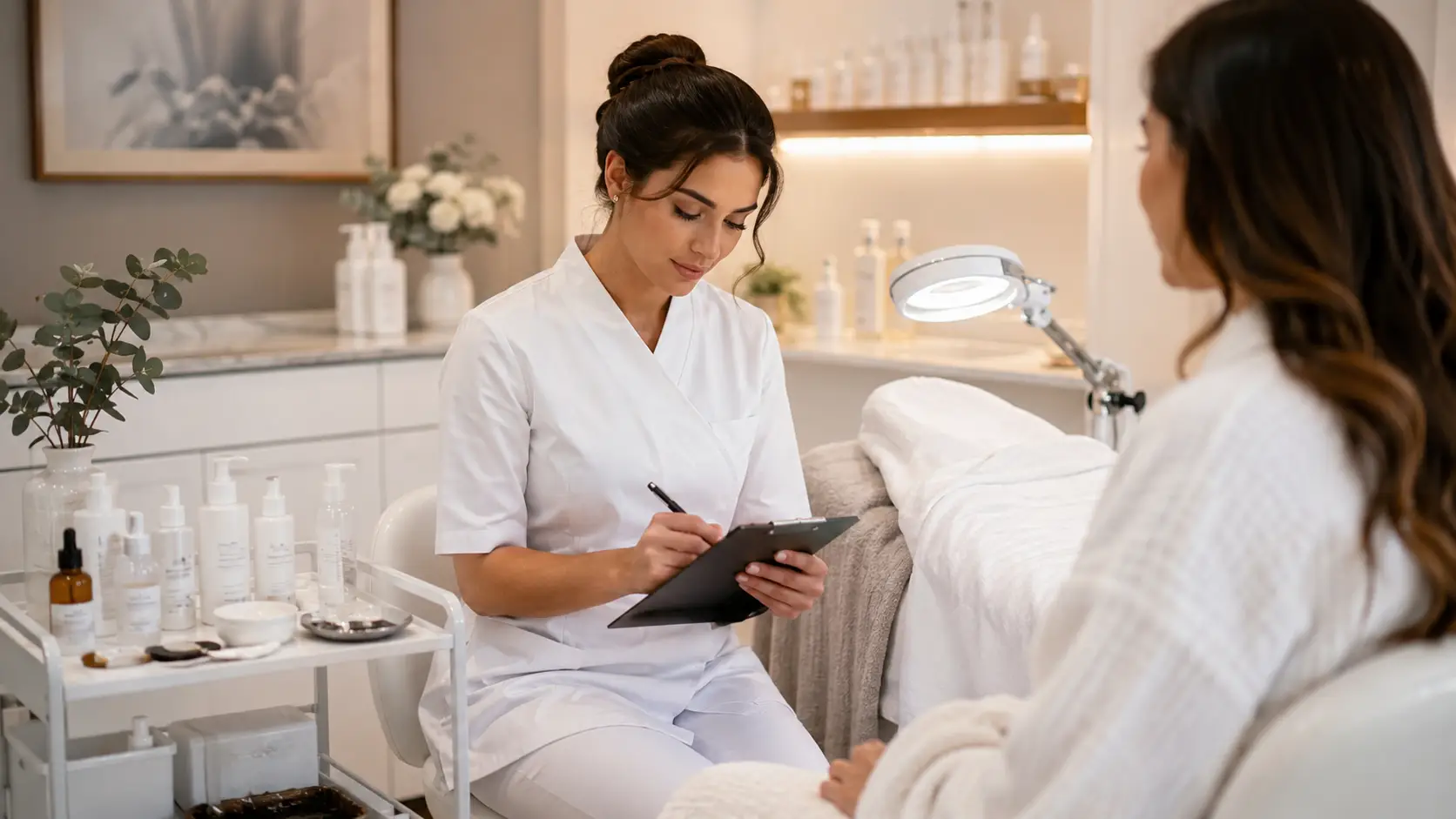
New estheticians should document client notes using a consistent structure that captures what the client tells you, what you observe during skin analysis, your professional assessment, and the complete treatment plan performed. Good documentation protects your practice legally, enables genuinely personalized care at every return visit, and builds the kind of clinical record that separates professional esthetic practice from transactional service delivery.
- Every client file should begin with a thorough intake form covering health history, medications, allergies, recent treatments, pregnancy status, and primary skin concerns.
- Post-treatment notes should record every product used by name, every modality performed, skin response during and after treatment, and recommendations made for home care and rebooking.
- Notes should be written immediately after the appointment ends — not hours later when detail accuracy degrades.
- SOAP format (Subjective, Objective, Assessment, Plan) provides a reliable framework for consistent and complete documentation across every session type.
- Adverse reactions require immediate, detailed incident documentation including all products used by full ingredient name, the nature of the reaction, timing, and every step taken in response.
- Client management software is strongly recommended over paper notes as your practice grows — for searchability, HIPAA compliance, and appointment history integration.
Among all the habits that separate confident, professional estheticians from those who struggle to retain clients and grow their practice, thorough client documentation is one of the most consistently underrated. It is not glamorous. It does not show up in before-and-after photos. Clients will never compliment you on it directly. But the estheticians who develop strong documentation habits from the very beginning of their careers are the ones who deliver consistently better treatments, build stronger client loyalty, manage risk more effectively, and scale their practices more successfully over time.
For new estheticians, documentation can feel like a bureaucratic afterthought — something to figure out later once you have the treatment sequences down. That instinct is understandable, but it is the wrong order. The documentation system you build in your first year of practice becomes the foundation every future client interaction is built on. Building it properly from the start is far easier than trying to retrofit good habits into an already established but poorly documented client base.
This guide covers everything new estheticians need to know: what to document and when, how to structure your notes for maximum clinical usefulness, what your intake forms must capture, how to handle adverse reactions in writing, the difference between paper and software systems, and how good documentation directly improves your ability to recommend treatments and retail products that clients actually want to buy.
What You Need to Know About Documenting Client Notes
- Documentation is not optional — it is the professional and legal backbone of every client relationship you build.
- Write your notes immediately after every session, before your next client arrives — not at the end of the day.
- Your intake form is a contraindication screening tool first and a client preferences record second — design it accordingly.
- SOAP format captures all four dimensions of a clinical session: what the client reports, what you observe, what you assess, and what you plan.
- Document every product used by name — not just category. “Applied jelly mask” is incomplete. “Applied Poly-Luronic™ Jelly Mask over hyaluronic acid serum, 14-minute set time, removed as single piece, immediate visible plumping observed” is professional documentation.
- Adverse reaction documentation must be thorough, immediate, and unaltered after the fact.
- Client software with note fields and appointment history integration makes your documentation more searchable and your client care more consistent.
- Good notes are the single most powerful retail recommendation tool you have — because they tell you exactly which ingredients and treatments your client responds to.
Why Client Documentation Matters More Than New Estheticians Realize
Most new estheticians think of client documentation primarily as a safety and legal requirement — something that protects them if a client complains or has a reaction. That is true. But documentation does far more than that, and understanding its full value is what motivates you to do it well rather than treating it as a paperwork obligation.
Documentation Is How You Deliver Personalized Care at Scale
The first time you see a client, you spend a significant portion of the appointment getting to know their skin: asking questions, observing, analyzing, adjusting your approach. If you have documented that session thoroughly, the second appointment starts at a completely different level. You already know which cleanser worked without stripping, which exfoliation level the skin tolerated, which concerns the client mentioned that turned out to be less visible during analysis, and which products produced the most visible result. You can reference your notes before the client sits down and walk into the treatment room already prepared to deliver a more sophisticated, more personalized experience than any new client ever receives. That is a retention-building superpower.
Documentation Protects You When Something Goes Wrong
Adverse reactions happen in professional esthetic practice. Unexpected skin responses, client-reported sensitivities that were not disclosed on the intake form, and reactions that appear hours or days after a treatment are all realities of working with skin. When a client contacts you concerned about something they experienced, your documentation is the first thing any professional, legal, or insurance context will ask for. Thorough, contemporaneous notes that record exactly what was used and what was observed protect you in a way that memory alone never can.
Documentation Builds Your Clinical Confidence
New estheticians frequently feel uncertain about their observations and assessments. Writing them down forces you to commit to a professional interpretation of what you are seeing. Over time, reviewing your own notes reveals patterns — the skin types that respond fastest to hydration treatments, the concerns that take multiple sessions to address, the client communication styles that correlate with the best outcomes. Your notes become a real-world clinical education that school cannot provide.
What Every Professional Client Intake Form Must Capture
The intake form is your first documentation tool and your primary contraindication screening mechanism. Many new estheticians underestimate how comprehensive this form needs to be. A form that asks only for name, contact information, and “what are your skin concerns” is not a professional intake form — it is a booking card. A professional intake form is a structured health and skin history document that provides the information you need to safely and effectively treat every client who sits in your chair.
Personal & Contact Information
Full legal name, date of birth, phone number, email address, and emergency contact. Date of birth is used to contextualize skin aging and confirm age-appropriate treatments.
Medical History & Medications
Current oral and topical medications, autoimmune conditions, blood thinners, immunosuppressants, active cancer treatment, recent surgeries, and pacemaker or implant status.
Prescription Skincare Disclosure
Current use of retinoids (tretinoin, adapalene), hydroquinone, azelaic acid at prescription strength, or any other prescription topical. These directly affect treatment safety and protocol selection.
Known Allergies & Sensitivities
Ingredient allergies, latex allergy, fragrance sensitivity, known reactions to specific skincare product categories or cosmetic procedures.
Recent Treatments & Procedures
Any cosmetic or dermatological procedures within the past 6–12 months: Botox, filler, laser, chemical peels, microneedling, cosmetic surgery. Timing affects treatment safety significantly.
Pregnancy & Nursing Status
Current pregnancy or nursing status. Numerous ingredients and treatment modalities are contraindicated during pregnancy — this field requires a direct and clearly worded question, not an implied check.
Primary Skin Concerns & Goals
What the client wants to address, their main frustrations with their current skin, and what outcomes they are hoping for. This is the foundation of your consultation conversation.
Consent & Disclosure Signature
A signed statement confirming the client has answered all questions truthfully and understands their responsibility to disclose health changes at every future appointment.
Estheticians working in states with specific scope of practice regulations for certain treatments — particularly microneedling and nano infusion — should also review whether their state board requires specific consent language or additional disclosure forms beyond a standard intake. When in doubt, more documentation is always safer than less.
How SOAP Notes Work in a Professional Esthetic Setting
SOAP is a documentation framework originally developed for clinical healthcare settings. It stands for Subjective, Objective, Assessment, and Plan. While estheticians are not medical practitioners and should never document or interpret client information outside their scope of practice, the SOAP framework maps extraordinarily well onto what a thorough esthetic session note actually needs to capture.
S — Subjective: What the Client Tells You
The Subjective section records what the client reports at the start of each appointment. This is the client’s own language about their skin, not your interpretation. Examples include: “Client reports skin has felt tight and dry since starting a new retinol product two weeks ago,” or “Client mentions increased breakout frequency in the chin area over the past month, which she attributes to stress.” The Subjective section also captures any changes in health, medications, or lifestyle since the last visit — which is why the brief verbal check-in at the start of every appointment matters and why those responses need to be recorded, not simply heard and forgotten.
O — Objective: What You Observe
The Objective section records your skin analysis observations — what you see, feel, and assess through direct examination. Estheticians should document skin type, hydration level, visible concerns such as congestion, redness, uneven texture, or pigmentation, barrier condition indicators such as visible flaking or reactive flushing, and the presence or absence of active blemishes. Use descriptive language rather than diagnostic terminology. “Diffuse redness across cheeks and nose, no active pustules visible, skin texture smooth but reactive to light pressure along jaw” is an appropriate objective observation. “Client has rosacea” is a medical diagnosis that falls outside esthetic scope of practice documentation.
A — Assessment: Your Professional Interpretation
The Assessment section records your professional skin analysis conclusion — the treatment approach you determined based on the Subjective and Objective findings. This is where you note that the skin is presenting as dehydrated rather than dry, that the barrier appears compromised based on visible sensitivity and tightness, or that the client’s congestion pattern is consistent with comedonal rather than inflammatory concern. Your Assessment drives the treatment selection and product choice recorded in the Plan.
P — Plan: The Full Treatment Performed and Next Steps
The Plan section is the most operationally detailed component of your notes and the one most new estheticians underwrite. A complete Plan section records every product used in the session by full product name, every modality performed and in what sequence, any adjustments made during the treatment based on skin response, client reaction to specific steps, home care recommendations made with specific product names, and the rebooking plan discussed including suggested service type and timing. This section should be specific enough that any competent esthetician reading it six months later could reconstruct exactly what happened in that treatment room.
Example: Complete SOAP Note After a Post-Extraction Hydration Facial
- S (Subjective): Client reports skin has been dull and congested along the nose and chin for three weeks. Has not changed any products. Mild discomfort during extractions at last visit. No new medications, not pregnant.
- O (Objective): Moderate comedonal congestion T-zone, particularly bilateral nose. No active inflammation. Skin hydration low on cheeks and forehead. Barrier appears intact but slightly compromised — mild flaking at lateral forehead. No redness at baseline.
- A (Assessment): Dehydrated combination skin with comedonal congestion. Barrier showing early compromise consistent with seasonal transition and insufficient home hydration. Extraction appropriate. Post-extraction calming and barrier hydration protocol indicated.
- P (Plan): Double-cleanse with enzyme cleanser, gentle steam 4 minutes. Manual extractions performed — bilateral nose, moderate volume, no complications, no active bleeding. Applied hyaluronic acid serum immediately post-extraction. Applied jelly mask full face with eye coverage, 14-minute set time. Peeled as single piece without resistance. Immediate post-removal observation: visible hydration improvement, redness from extraction zones significantly reduced, texture noticeably smoother. Sealed with barrier repair moisturizer SPF 30. Recommended: home HA serum morning and evening for two weeks. Rebooked in 4 weeks for hydration facial.
What a Complete Post-Treatment Note Looks Like at Each Stage
The infographic below shows the five documentation stages that together build a complete client record — from intake through adverse event handling. Each stage has distinct required fields that compound in clinical value the longer the client relationship continues.
What to Write in Your Notes Immediately After a Treatment
The post-treatment note is the most operationally valuable documentation you will produce on a regular basis. It is also the one most commonly written too briefly by new estheticians who underestimate how much detail will matter six months from now. The following categories should be addressed in every post-treatment note without exception.
Every Product Used, by Full Name
Do not write “applied jelly mask” and consider the note complete. Write the full product name, the sequence in which it was applied, and any relevant preparation details such as mixing ratio, set time, or serum layered beneath it. The reason specificity matters here is that clients return, and when they return with a question about what you used last time that made their skin feel so good, you need to be able to answer precisely — not approximately. Estheticians working with jelly mask formulations in post-extraction or hydration protocols have found that noting the specific mask applied, the application context, and the post-removal skin observation creates a product response record that directly informs future treatment decisions and retail recommendations.
Every Modality Performed and in What Sequence
Note every step: steam duration, exfoliation type and product, extraction volume and zone, device used such as nano infusion or LED, mask type and set time. The sequence matters because treatment outcomes are partly a function of how steps interact. If you change the order in a future session and get a different result, your notes need to be specific enough to identify what actually changed.
Skin Response During and After Treatment
Note what the skin did during treatment: how it responded to exfoliation, how much redness appeared during extractions, how it looked immediately after mask removal. Note what you observed at the end of the session: hydration level compared to arrival, redness at close, texture, visible concerns addressed or remaining. These real-time observations build a clinical picture that skin analysis alone cannot.
Client Comments and Feedback
Record what the client said during and after the treatment, in their own words where possible. “Client said this feels incredible, her skin has never felt this hydrated after a facial” is a note that will serve you well at the rebooking conversation. “Client mentioned slight tingling during exfoliation but said it was not uncomfortable” is a note that may protect you if the client contacts you later with a sensitivity concern. Client feedback, both positive and cautionary, belongs in your record.
Estheticians who build the habit of documenting their post-treatment notes with product-specific precision consistently discover a secondary benefit they did not anticipate: it transforms their retail recommendations from guesses into evidence. When a client’s notes show four consecutive appointments where the most notable post-treatment observation was immediate, visible hydration improvement following application of Poly-Luronic™ Jelly Mask by Luminous Skin Lab — with specific notes like “14-minute set, peeled as single piece, marked plumping visible at removal, client commented skin looked ‘glassy’” — that documented response history makes the retail conversation natural and evidence-backed rather than salesy.
The practical approach used in high-retention treatment rooms: immediately after mask removal, record the post-removal skin state in two to three specific descriptive sentences before the client sits up from the table. That real-time observation, captured before the client dresses and departs, produces the most accurate documentation of the treatment outcome. Estheticians who do this consistently report that their client notes become genuinely useful clinical records rather than liability-protection formalities — and that their retail conversion rates reflect the difference.
How to Document an Adverse Reaction Properly
Adverse reactions in esthetics — from unexpected redness and swelling to client-reported post-visit breakouts or sensitivities — require documentation that is thorough, immediate, and unaltered after the fact. This is the documentation context where new estheticians are most likely to make errors out of anxiety or uncertainty. The rules are straightforward.
Document Immediately, Not After You Have Composed Yourself
When a reaction occurs during a session, address the client first and the documentation second — but document as soon as the client is comfortable and the immediate response has been managed. Do not wait until the end of the day. Memory compresses and reorders events under stress. The note written within 30 minutes of an incident is far more reliable than the one written three hours later.
Record Every Product by Full Name and INCI
For adverse event documentation, full product names alone are insufficient. You need to record the full INCI ingredient list for every product used in that session, either in the note itself or attached as a reference. If the client or their physician ever needs to identify the specific ingredient that caused a reaction, your records are the only source of that information. Keep INCI lists for every professional product you use in a readily accessible format so they can be attached to incident records immediately.
Describe the Reaction Precisely and Without Interpretation
Record the exact appearance and nature of the reaction: “diffuse erythema appeared across both cheeks and forehead approximately 8 minutes after exfoliation application, fading to baseline within 12 minutes after removal and application of barrier cream” is precise documentation. “Client had a reaction to the peel” is not. Be specific about timing, appearance, anatomical zone, severity, and resolution pattern.
Document Everything You Said and Recommended
Record exactly what you told the client to do after the session: to avoid active ingredients for a specific number of days, to contact you if symptoms worsened, to see a dermatologist if the condition persisted beyond a certain timeframe. The aftercare instructions you provided are as much a part of the professional record as the reaction itself.
Never Alter Notes After the Fact
If you realize later that you omitted something from an adverse event record, add it as a dated addendum rather than modifying the original entry. Altered records are a serious professional and legal liability. An addendum that says “Additional note added 2026-05-26: client contacted clinic the following day to report redness had fully resolved” is professionally appropriate. Editing the original date-stamped record is not.
Paper Notes vs. Client Management Software: What New Estheticians Should Know
Both paper and digital documentation systems can meet professional standards when managed correctly. The practical question for new estheticians is which system will actually be used consistently, accurately, and with the security and accessibility the records require.
When Paper Notes Are Acceptable
In the very early stages of a solo practice with a small and developing client base, a well-organized paper system can work. The requirements are non-negotiable: notes must be kept in a locked, secure location accessible only to you, files must be organized so any client record can be retrieved within 60 seconds, and your intake forms must be collected and filed at the first appointment with a system for annual update review. Paper notes have meaningful limitations as your practice grows: they cannot be searched, they are vulnerable to physical loss, and they do not integrate with appointment booking history.
Why Software Is Strongly Recommended
Client management software platforms designed for esthetic practices offer integrated booking and treatment records, searchable client histories that can be reviewed before any appointment, built-in intake form collection and storage, HIPAA-compliant data handling for practices that require it, and note templates that prompt you to capture the right information without relying entirely on memory. Platforms commonly used by estheticians include Vagaro, GlossGenius, Mangomint, Square Appointments, and Meevo. Many offer free trials and are affordable even for solo practitioners.
The Most Important Rule: Consistency
The best documentation system is the one you will actually use after every appointment, for every client, without exception. A fully featured software platform with notes that are rarely written is far less valuable than a simple paper system maintained with absolute consistency. Choose a system that works within your real workflow and then protect the habit of using it completely and immediately after every session.
How Good Client Notes Directly Improve Your Retail Sales Without Any Sales Pressure
One of the most practical and underappreciated benefits of thorough client documentation is that it transforms retail recommendations from a sales conversation into a clinical conversation. Clients who feel that your retail suggestion is based on documented, personal evidence of what their skin responds to are far more likely to purchase and far more likely to trust your recommendation.
Pattern Recognition Across Sessions
When your notes consistently record which ingredients and treatments produce the most visible, client-reported results for a specific client, you build a pattern record that makes personalization effortless. If your notes show that a client with chronically dehydrated, reactive skin consistently shows the most significant post-treatment improvement following hydration-focused protocols that include specific mask formulations and layered humectant serums, you can reference those specific observations when recommending take-home versions of the same active ingredients. That conversation begins with evidence, not with a product description.
Making Retail Feel Like Continuity, Not Commerce
The phrase “based on your notes from your last four sessions, your skin consistently responds best to ingredients like polyglutamic acid and hyaluronic acid combined — which is why I’d suggest looking at a take-home serum that mirrors what we use in the treatment” is not a sales pitch. It is a clinical recommendation backed by a documented treatment history. That is the kind of retail conversation clients receive gratefully rather than defensively, and it is only possible when your notes are specific enough to support it.
Documentation as a Retention Tool
Clients who feel that their esthetician remembers them — not just their name but the specific details of their skin’s history, their concerns, their past responses — return. They also refer. The consistency and personalization that thorough documentation enables are among the most powerful retention and referral drivers in esthetic practice, and they require no marketing budget. They require only the discipline to document every session completely.
For estheticians building their client documentation systems and their treatment protocol foundations simultaneously, incorporating Poly-Luronic™ Jelly Masks by Luminous Skin Lab into hydration and post-treatment sessions gives you a formulation with specific, documentable outcomes worth capturing. The PGA and hyaluronic acid dual-humectant system produces consistent, visible post-removal skin responses — immediate plumping, redness reduction, improved texture — that are straightforward to describe in treatment notes and that build a compelling response history over multiple sessions. Fragrance-free, clean-label, and developed by a licensed esthetician for professional protocol use including post-extraction and post-nano infusion applications.
Explore the Poly-Luronic™ Jelly Mask LineFrequently Asked Questions: How to Document Client Notes as a New Esthetician
What should new estheticians include in client notes after every facial?
After every facial, client notes should include the date and service performed, the specific products and tools used, skin analysis observations such as hydration level, barrier condition, congestion, and sensitivity, any client concerns raised during the consultation, how the skin responded during and after the treatment, and recommendations made for home care and rebooking. These details allow you to build on previous sessions, identify patterns over time, and deliver more personalized care at every appointment.
What is a SOAP note and do estheticians really need to use them?
A SOAP note is a structured documentation format divided into four sections: Subjective (what the client tells you about their skin, concerns, and health history), Objective (what you observe during your skin analysis), Assessment (your professional interpretation of the skin condition), and Plan (the treatment performed and the plan for future sessions). Estheticians are not required to use the SOAP format specifically, but the underlying structure — capturing subjective client input, objective observations, professional assessment, and a clear treatment plan — is the foundation of thorough professional documentation. Many estheticians find it the most reliable framework for building detailed, clinically useful records.
How soon after the appointment should I write my client notes?
Client notes should be written immediately after the appointment ends — ideally before your next client arrives. Treatment details, product reactions, skin observations, and client comments are most accurate when recorded within minutes of the session, not hours later. Many estheticians build five to ten minutes of dedicated note-writing time into their schedule between appointments for exactly this reason.
Can I just keep client notes in a notebook or do I need software?
A notebook can work when you are starting out, but dedicated client management software offers significant advantages as your practice grows: searchable records, automated appointment history, digital intake forms, HIPAA-compliant storage, and the ability to review a client’s full history before they arrive. Popular options for estheticians include Vagaro, Mangomint, GlossGenius, and Square Appointments, many of which offer client note fields built into the booking system. If you use paper notes, keep them in a locked, secure location and have a clear system for filing by client name and date.
What information should be on a client intake form?
A professional client intake form should capture full legal name and contact information, date of birth, current medications (topical and oral), known allergies and sensitivities, recent medical procedures or skin treatments, use of prescription skin products such as retinoids or hydroquinone, pregnancy or nursing status, primary skin concerns and goals, and a signature confirming that the client has disclosed all relevant health information. The intake form becomes part of the permanent client record and provides essential contraindication screening before every first service.
Do I need to get clients to fill out a new intake form every visit or just once?
The full intake form is typically completed once at the first appointment. However, at every subsequent visit, a brief verbal check-in — or a short update question at the start of the consultation — should confirm whether any health information has changed, whether the client has started new medications or skincare products, or whether they have had any other skin treatments since their last visit. Many estheticians have clients sign a shorter update confirmation form annually or any time significant time has passed between appointments.
How do I document a client’s skin condition without using medical terminology I am not qualified to use?
Estheticians should document what they observe descriptively without diagnosing. Instead of writing a diagnosis, describe what you see: “client presents with diffuse redness across cheeks and nose, visible pustules in the T-zone, tight skin texture, flaking at the forehead.” Avoid terms like “rosacea,” “eczema,” or “psoriasis” as diagnostic labels in your notes unless a physician has already diagnosed the client and the client has communicated that diagnosis to you. Documenting your observations accurately and descriptively is both professionally appropriate and legally sound.
What should I write down if a client has a bad reaction during or after a treatment?
If a client experiences an adverse reaction, document everything immediately and in detail: the exact products used and their full ingredient names, the treatment steps performed and in what order, the precise nature of the reaction (redness, swelling, hives, burning, breakout), when the reaction appeared, what steps you took in response, and what you advised the client to do at home. Keep a copy of the product INCI lists used in that session attached to the record. Never alter or remove notes after the fact. Thorough incident documentation protects both the client and your professional practice.
How does documenting which products I used in a facial help me recommend the right retail products?
When your treatment notes consistently record the specific products used in each session and how the client’s skin responded, you build a direct evidence base for retail recommendations. If you note that a client’s skin consistently responds well to a particular hydration ingredient or mask formulation — for example, showing immediate plumping, reduced redness, or improved texture after treatments featuring jelly mask application — you can reference those documented responses when recommending take-home products that mirror those ingredients. This makes your retail recommendations evidence-based and personally relevant rather than generic.
How does tracking which treatments I use — like nano infusion or jelly masks — in my notes help me build better treatment plans?
Recording every treatment step including specific modalities such as nano infusion, jelly mask application, and serums used allows you to identify which combinations produce the strongest results for each client’s skin type and concern. For example, if you note that a client’s post-nano infusion hydration response is consistently enhanced when followed by a Poly-Luronic™ Jelly Mask application — and you document the immediate skin changes observed after removal — you have a data record that guides your next session plan and justifies upgrading that combination into the client’s regular treatment protocol.
The Documentation Habit That Separates Good Estheticians From Great Ones
Client documentation is not the most exciting part of building an esthetic practice. It happens after the treatment, when the client has left and the next task is already waiting. But the estheticians who develop thorough, consistent documentation habits from the beginning of their careers are building something that compounds invisibly over time: a real clinical record of how skin responds to specific treatments, a legal protection that covers them when unexpected things happen, and a personalization infrastructure that makes every client feel genuinely remembered and professionally cared for.
Start with a complete intake form. Write your notes immediately after every session. Use SOAP structure to make sure you capture all four dimensions of every treatment. Be specific about every product used by name. Document adverse events immediately and fully. Choose a system — paper or software — that you will actually maintain consistently. And then keep maintaining it, every day, for every client, at every appointment.
The estheticians who do this from day one do not just have better records. They have better client relationships, stronger retention, more confident retail conversations, and a professional track record that grows more valuable with every session they complete. That is what thorough documentation actually builds.