How Do New Estheticians Build Long-Term Client Retention?
New estheticians build client retention by delivering consistent, results-driven treatments, communicating genuine expertise, and creating a structured rebooking system that begins during the first appointment — not after the client has already left. Retention is not built by discounting or hoping clients return on their own. It is built through deliberate clinical practice, personalized communication, and a treatment experience that clients cannot find elsewhere at the same quality level.
- Rebooking must be initiated at checkout during the first appointment, tied directly to the client’s specific skin concern and the interval that will best support their goals.
- Detailed client notes reviewed before every appointment signal genuine professional attention and are one of the strongest trust-building behaviors an esthetician can establish.
- Memorable treatment upgrades — add-ons that clients experience as meaningfully different from a standard service — are among the most reliable drivers of return visits.
- A follow-up message 24 to 48 hours after a first appointment reinforces the relationship without pushing for a sale.
- Consistency in quality, timing, and communication builds the kind of trust that converts one-time clients into long-term regulars who refer others.
- Tracking your rebooking rate from the very first client is the single most important metric a new esthetician can monitor in early practice.
One of the most disorienting realities new estheticians face in the first year of practice is the gap between getting clients and keeping them. Marketing generates first appointments. Retention generates income. And yet most esthetician training programs spend far more time on facial technique than on the behaviors and systems that determine whether a client comes back after that first session.
The economics of this gap are significant. Acquiring a new client requires time, marketing spend, and effort. Retaining an existing client requires consistency and communication. An esthetician with a strong retention rate can build a fully booked practice on a relatively small total client base. An esthetician with a weak retention rate will spend their entire career on the exhausting treadmill of constantly replacing clients who drifted away.
The good news for new estheticians is that retention behaviors are entirely learnable. They are not personality traits, and they do not require years of experience to implement. Most of them can be deployed from your very first client appointment. This guide covers the specific retention behaviors, systems, and treatment decisions that make the most meaningful difference for estheticians in the early stages of building their practice.
What Drives Client Retention in a New Esthetic Practice
- Retention is built during the appointment — not in the marketing that comes afterward. The rebooking conversation must happen before the client leaves.
- Clients return to estheticians who remember them, tailor their treatments, and communicate as genuine professionals — not to the cheapest or closest option.
- A single memorable treatment element — something distinctive that elevates the experience — significantly increases the likelihood of a return visit.
- Tracking rebooking rate from client one gives you real data to improve your retention system early, before poor patterns become entrenched habits.
- Treatment progression — introducing new elements at second and third visits — creates a sense of client journey that makes each appointment feel purposeful and forward-moving.
- Follow-up communication after a first appointment that is personal and non-salesy distinguishes professionals from providers and builds lasting loyalty.
- The goal is not to fill your schedule with new faces every week — it is to build a stable, loyal base that sustains your practice without constant acquisition effort.
Why Client Retention Matters More Than New Client Acquisition for New Estheticians
New estheticians are often taught to focus heavily on getting clients through the door: social media, referral programs, introductory pricing, and promotional offers. These are valid tactics for generating first appointments. But they do nothing to ensure those clients come back — and without retention, each first appointment is simply an expensive experiment.
The mathematics of retention are straightforward. A practice with 60 active clients booking every five weeks has roughly 48 to 52 appointments per month without any new client marketing effort whatsoever. A practice with 200 clients who each only book once has 200 appointments spread across an entire year, with significant income gaps between them and no compounding relationship value. The retained client generates more lifetime value, costs less to maintain, is more likely to purchase retail recommendations, and is far more likely to refer new clients than a first-time visitor with no established relationship.
For a new esthetician still building their client base and refining their protocols, the retained client also provides something even more valuable than revenue: feedback, consistency, and the opportunity to observe how your treatments affect skin over time. Estheticians who retain clients build real clinical competence faster because they can track actual skin progression. Those who constantly cycle through new faces never build that depth of knowledge about their own work.
The Retention Rate Benchmark
Industry practitioners who track this metric consistently observe that a rebooking rate below 50 percent in the first six months of practice is a meaningful signal that retention behaviors need adjustment. A rebooking rate above 65 to 70 percent in a new practice indicates that the core retention behaviors — rebooking conversation, follow-up, and experience quality — are functioning well. The goal for a stable, sustainably growing practice is ultimately a rebooking rate in the 70 to 80 percent range across your active client base.
You cannot improve what you do not measure. Start tracking your rebooking rate from your very first client.
The Five Stages of Client Retention Every New Esthetician Needs to Understand
Client retention does not happen in a single moment. It is built across a progression of interactions — from the first booking through the treatment itself, through checkout, through follow-up, and through every subsequent appointment. Understanding where retention is won and lost at each stage gives new estheticians a precise framework for identifying and fixing the specific behaviors that are costing them rebookings.
Pre-Appointment: First Impression and Intake
The retention process begins before the client arrives. A clear intake form, timely confirmation communication, and a warm professional greeting on arrival all signal that this experience will be different from a generic service. Intake information reviewed before the appointment — not hurriedly scanned at the table — establishes that you take their skin seriously.
During Treatment: Consultation, Connection, and Clinical Delivery
The treatment itself is where retention is either earned or lost. Clients retain estheticians who demonstrate genuine expertise during the consultation, explain what they are doing and why, and deliver a treatment that produces visible results the client notices independently — without prompting. A memorable experiential element in the service compounds all of these factors.
Checkout: The Rebooking Conversation
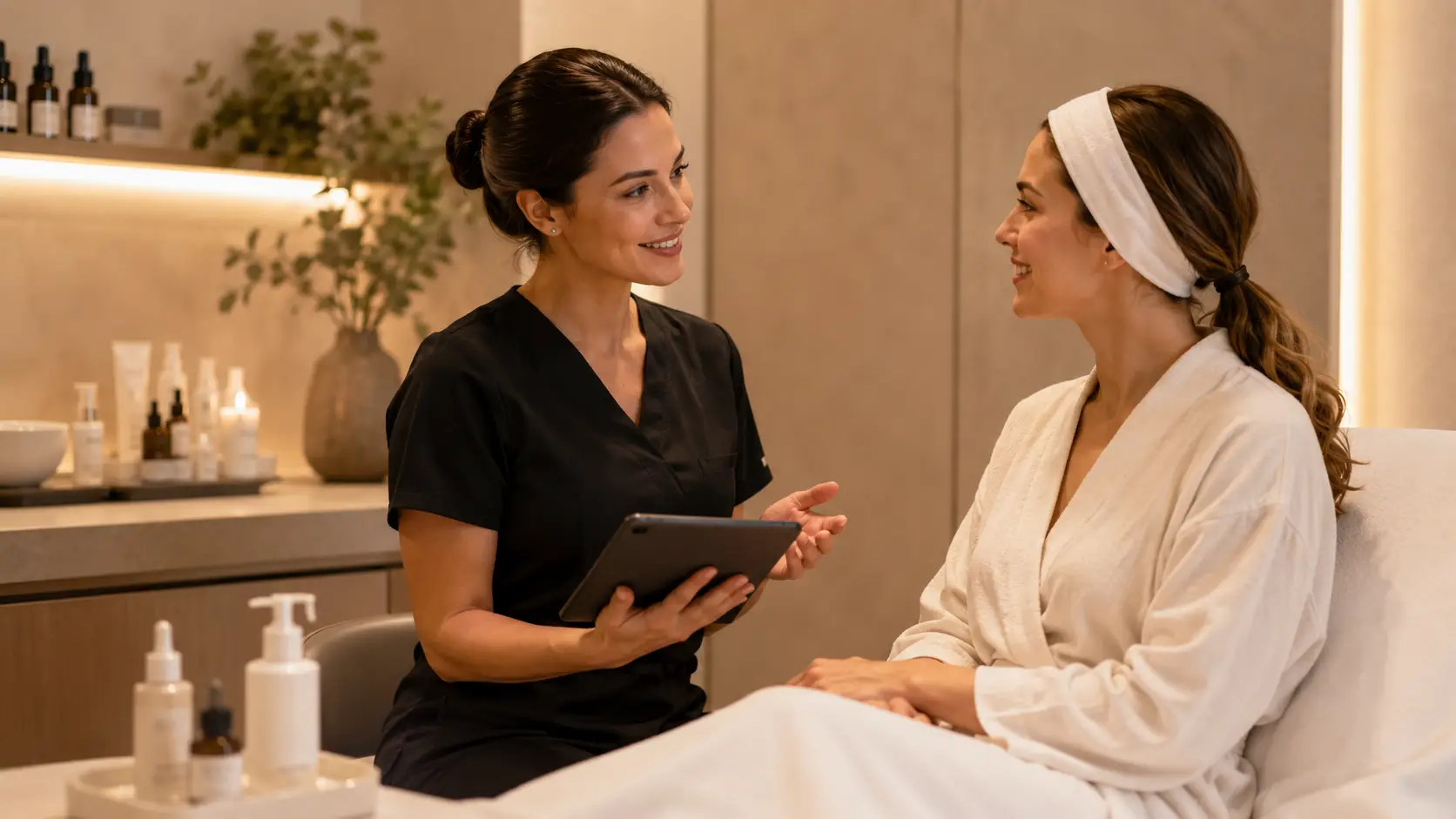
This is the single highest-leverage retention moment in the entire client journey. An esthetician who ties the next appointment to the client’s specific skin goal at checkout — while the client is experiencing the immediate results of the treatment — converts a first visit to a retention relationship. An esthetician who simply says “see you next time” without initiating a specific booking loses a significant percentage of clients who would have returned if asked directly.
Post-Appointment Follow-Up: The 24 to 48 Hour Window
A brief, personal, non-salesy message in the day or two following a first appointment distinguishes professionals from providers. Reference something specific to their treatment. Ask how their skin is feeling. No booking links. No promotions. This single communication has an outsized impact on long-term retention because it demonstrates that your interest in their skin extends beyond the transaction.
Return Appointments: The Treatment Progression Journey
Clients who return a second time are significantly more likely to become long-term retained clients than first-time visitors. The second appointment is where you review your notes, acknowledge what has changed in their skin, introduce a natural progression of the treatment, and deepen the personalized relationship. Every retained client conversation should move their skin story forward.
How to Have the Rebooking Conversation Without Feeling Pushy
The single most common reason new estheticians miss rebooking opportunities is discomfort with the conversation itself. It feels like selling. It feels presumptuous. It feels like pressure. This discomfort is understandable, but it rests on a misunderstanding of what the rebooking conversation actually is.
When you tell a client that their dehydration concern responds best to a four-to-six week treatment interval, you are not selling. You are practicing. You are delivering a clinical recommendation based on what you observed during their consultation and treatment. A client who leaves without that recommendation has been given an incomplete professional service — the equivalent of a dentist cleaning your teeth and not recommending a return interval.
The Language That Works
Estheticians who retain clients at high rates consistently use language that connects the rebooking to the client’s own skin goals rather than to the esthetician’s schedule. The difference in practice looks like this:
- Low-retention language: “We’d love to see you again whenever you’re ready.”
- High-retention language: “For what we’re working on with your uneven texture, you’ll see the biggest cumulative improvement if we stay on a four-week cycle. Want to go ahead and lock in your next one now so you don’t lose your spot?”
The second version requires that you actually know what you are working on with this client — which is why the consultation and treatment notes are not administrative formalities. They are retention tools.
What to Do When a Client Cannot Book Before Leaving
Not every client will book before they walk out. Life logistics are real. In this case, note the recommended return interval in their client file, and reference it specifically in your follow-up message. Something like: “I recommended about four weeks for your skin concern — that would put you in the last week of June. I’d love to hold a spot for you if you want to grab it.” This keeps the clinical reasoning in front of them without creating pressure.
How Memorable Treatment Experiences Drive Rebooking Behavior
There is a well-documented pattern in service businesses: clients who describe a treatment experience as “memorable” or “different from anything else I’ve had” rebook at measurably higher rates than clients who describe a treatment as “good” or “relaxing.” This is not an accident — it reflects how human memory and decision-making interact with repeat purchasing behavior. We return to experiences that produced a distinct positive impression. We drift from experiences that were pleasant but forgettable.
For new estheticians, this has a specific practical implication: you need at least one distinctive treatment element in your service that clients cannot easily replicate or find identically elsewhere. This does not require expensive equipment. It requires a thoughtfully chosen treatment upgrade that produces a result clients feel immediately and remember afterward.
Treatment Add-Ons as Retention Architecture
The most retention-effective add-ons share three characteristics: they are experientially distinctive (the client feels and notices them during the service), they produce a visible or tactile result that the client can observe immediately, and they give the client a specific element to reference when describing the treatment to others or when booking their next appointment. An add-on that checks all three of these boxes becomes part of the client’s vocabulary for their own skincare experience — and that makes them far more likely to request it again.
The Treatment Progression Model for Retention
One of the most effective retention structures a new esthetician can implement is a deliberate treatment progression across the first three to four visits. Rather than offering the same full service every time, the progression model reserves a new treatment element for the second visit, a step up in protocol for the third, and a more advanced treatment consideration at the fourth. Each visit feels like a natural next step in a client’s skin journey rather than a repeated transaction.
This model works for several reinforcing reasons. It gives the esthetician a clear rebooking narrative (“next time I want to add X because your barrier is responding well enough now”). It gives the client genuine anticipation for the next visit. And it provides the esthetician with an education-based sales pathway that feels entirely professional rather than promotional.
Client Notes as a Retention Tool: Why What You Write Down Keeps Clients Coming Back
Client notes are widely understood as an administrative and liability tool. They are less often understood as one of the most powerful retention behaviors available to an esthetician. The reason is simple: clients feel genuinely known when their esthetician remembers things about them. And clients who feel genuinely known are loyal to a degree that clients who feel like a number never are.
What to Document After Every Appointment
The most retention-relevant notes are not clinical observations about skin condition alone. They include personal details the client mentioned — an upcoming event, a stressor that was affecting their skin, a product they were curious about, something they mentioned about their lifestyle. Reviewing these before the next appointment and referencing them naturally in conversation (“how did your sister’s wedding go? I was thinking about your skin in the weeks leading up to it”) creates an experience of being remembered that is vanishingly rare in most service environments.
Clinically, document not just the treatments performed but the skin response observations that will inform future protocol decisions: how the skin responded to extractions, which areas showed the most visible hydration improvement, any sensitivity observed, the client’s own feedback about what they noticed. These notes make your second and third appointment with a client measurably more skilled and more personalized — which the client feels, even if they cannot articulate why.
The Pre-Appointment Review Habit
Experienced estheticians who retain clients at high rates consistently report that reviewing client notes for five minutes before each appointment is a non-negotiable habit. It allows them to reference the last treatment, note what has changed, and have a specific agenda for the current session before the client even arrives. Clients who notice that their esthetician has clearly prepared for their appointment develop a level of professional trust that is extremely difficult to pull them away from.
Estheticians tracking retention patterns in their first year of practice consistently observe that the client appointments with the highest rebooking conversion share two characteristics: the esthetician demonstrated clear knowledge of that client’s skin history, and the treatment included at least one element the client had not experienced before or had specifically requested. In practice, this means that maintaining detailed notes is inseparable from the retention system — and that the add-on conversation is most effective when it is framed as a clinical progression rather than an upsell.
Estheticians incorporating Poly-Luronic™ Jelly Masks by Luminous Skin Lab as a treatment progression add-on commonly introduce the mask at the second or third appointment rather than the first — framing it as the next step in the client’s hydration protocol now that their barrier has been assessed. This approach generates a notably different client response than offering it as an immediate first-visit upgrade. Clients who experience the cooling application, the PGA and HA hydration result, and the signature peel-off removal in this “earned progression” context report higher perceived value and are more likely to request it specifically at subsequent bookings — creating a natural, client-initiated rebooking driver that new estheticians find both professionally comfortable and consistently effective.
What the Post-Appointment Follow-Up Should and Should Not Be
The 24 to 48 hour follow-up message after a first appointment is one of the most discussed retention behaviors in the esthetics industry and one of the most commonly done poorly. The errors are predictable: too salesy, too generic, sent too late, or not sent at all. Done well, this single message meaningfully increases the likelihood of a second appointment from a first-time client.
What Effective Follow-Up Looks Like
Effective follow-up is brief, personal, specific, and non-salesy. It references something from the actual appointment. It asks a genuine question about how the client’s skin is responding. It does not include a booking link, a promotional offer, or any language that signals the primary purpose is conversion.
An example of what this sounds like in practice: “Hi [Name], I was thinking about your treatment yesterday — specifically the tightness you’d been noticing around your cheeks. How is your skin feeling today? I sometimes see that settle down considerably in the first 24 to 48 hours after a hydration treatment, so I’m curious to hear what you’re noticing.”
This message demonstrates clinical competence (predicting a skin response), genuine interest (asking about the outcome), and personal knowledge (referencing the specific concern discussed). It also sets up a natural continued conversation that keeps the relationship alive between appointments.
Timing and Channel
For most clients, a text or app-based message performs better than email for the immediate post-appointment follow-up. Email is appropriate for sending intake forms, appointment confirmations, and longer treatment summaries — but for the immediate personal follow-up, the channel that feels most like a one-to-one communication is typically the most effective. Send within 24 to 48 hours. After 72 hours, the impact declines significantly.
The Behaviors That Undermine Retention and How to Correct Them
Understanding what drives retention is only half of the picture. Equally important is understanding the specific behaviors that erode it — because many of these are common patterns among new estheticians who are not yet aware of their impact.
Inconsistent Treatment Quality
A client who experiences a noticeably better treatment on their second visit than their first — or worse, a noticeably worse one — has been given evidence that your quality is variable. Consistency is the foundation of professional trust. Develop protocols you can replicate reliably, not treatments that depend on how you are feeling that day.
Skipping the Rebooking Conversation
This is the single highest-cost retention error. Not initiating a specific rebooking recommendation at checkout is the most preventable cause of client attrition. Build the habit from your very first client appointment. Even if the client does not book before leaving, having the conversation ensures they leave with a clinical reason to return.
Generic Communication
Automated thank-you messages, generic newsletter blasts, and promotional emails sent to your entire client list do not build the kind of relationship that drives loyalty. Clients who receive communication that could have been sent to anyone feel like anyone. Personal specificity in every client touchpoint is the differentiator.
Competing on Price
Offering discounts to attract new clients trains your market to expect discounts and attracts clients whose primary decision criterion is cost. These clients are the least loyal segment of any service client base. Price-competing clients leave for whoever is cheapest next month. Value-loyal clients stay for years because they believe their esthetician understands their skin better than anyone else.
Not Tracking Retention Data
You cannot improve your retention rate if you do not know what it is. Track every first appointment and whether it converted to a second. Note the specific rebooking language you used and whether it worked. Identify your highest-retaining client segment and understand what they have in common. Data-driven retention improvement is significantly faster than intuition-based adjustment.
Treating Every Client the Same
Delivering the same standard facial protocol to every client regardless of their skin concern, their history, or their stated goals signals that you are not actually paying attention. Personalization — even small adjustments in technique, product selection, or conversation focus — communicates clinical attentiveness that generic service delivery cannot. Clients who feel individually seen stay. Clients who feel processed leave.
Building a Retention System That Runs Consistently From Day One
Individual retention behaviors only produce reliable results when they are systematized. The difference between a new esthetician who sporadically applies retention principles when they remember to and one who builds them into the structure of every single appointment is the difference between a 40 percent and a 75 percent rebooking rate. Systems, not intentions, determine retention outcomes at scale.
The Four-Part Retention System for New Estheticians
At its simplest, a retention system for a new esthetician consists of four standardized elements applied consistently to every client appointment:
- Pre-appointment note review — five minutes before every session to review the previous treatment, skin observations, and personal details noted.
- In-appointment consultation and personalization — reference the notes, adjust the treatment based on what you observe, and introduce one progressive element if the client is at the appropriate stage.
- Checkout rebooking conversation — always. Tied to the specific skin concern. Always with a suggested interval. Always with an invitation to book before leaving.
- 24 to 48 hour follow-up message — personal, specific, no sales intent. Ask about their skin. Reference the treatment. Demonstrate you are thinking about their outcome, not their next payment.
These four elements can be implemented from your very first client appointment. They require no equipment, no additional cost, and no advanced training. They require only discipline, consistency, and the professional decision to treat retention as a clinical priority rather than a marketing afterthought.
Retention Metrics Worth Tracking
For new estheticians building their first practice, the minimum tracking set that gives actionable retention intelligence is: total first appointments in a given month, number of those that converted to a second appointment, overall active client count (clients who have booked within the past eight weeks), and monthly appointment volume from retained clients versus new clients. These four numbers, tracked monthly, will tell you everything meaningful about whether your retention system is working.
Professional References and Further Reading
The retention strategies and behavioral patterns discussed in this article draw from established service business practice, professional esthetics education, and practitioner experience documentation:
- Client retention behavior patterns in personal service businesses — general service industry research on the cost differential between new client acquisition and retained client maintenance; widely established across hospitality, wellness, and personal care service sectors.
- Rebooking conversation frameworks — documented across professional esthetics coaching programs and practice management curricula used in continuing education for licensed estheticians.
- Treatment memorability and experiential differentiation — service experience design principles applied to esthetic practice; references include professional spa management and service design literature.
- Client communication and follow-up protocols — professional esthetician practice management frameworks from ASCP (Associated Skin Care Professionals) and continuing education programs for licensed practitioners.
- Note-taking and consultation documentation standards — NCEA (National Coalition of Estheticians, Manufacturers/Distributors and Associations) professional practice guidelines.
For new estheticians looking to add a treatment element that consistently drives the kind of memorable, results-visible experience that fuels rebooking behavior, the Poly-Luronic™ Jelly Mask by Luminous Skin Lab is the professional add-on our education team most frequently recommends as a retention-driving treatment upgrade. The formulation combines a PGA and HA dual-humectant system — delivering immediate visible hydration, a distinctive cooling application experience, and a signature peel-off removal moment that clients remember and request by name. Fragrance-free, technically accessible for beginners, and formulated for use across standard hydration facials, post-extraction calming protocols, and progressive treatment workflows. The rebook-by-name response it generates in client populations is one of the most reliable retention mechanics available to a new esthetician without advanced device investment.
Explore the Poly-Luronic™ Jelly Mask Line →Frequently Asked Questions: Building Client Retention as a New Esthetician
Why do clients not come back after their first facial with a new esthetician?
Clients most commonly do not rebook because they were not given a clear reason to return at a specific time. If the esthetician did not explain why regular intervals matter for their skin concern, did not offer a next appointment before the client left, and did not follow up afterward, the client simply drifts. A first facial that ends without a rebooking conversation and a personalized next-step recommendation is statistically unlikely to generate a returning visit.
When during the facial should I ask a client to rebook?
The best moment to introduce rebooking is at the end of the treatment, while the client is still experiencing the immediate results and emotional high of the service. Tie the rebooking suggestion directly to their skin concern and explain the specific interval that will support their goals. Saying something like “for what we are working on with your dehydration, every four to six weeks will make the biggest difference” is far more effective than a generic “we’d love to see you again.”
How many clients do I need to retain to build a stable income as a new esthetician?
A commonly referenced benchmark is that 40 to 50 active retained clients booking on a four-to-six-week cycle can form a stable base income foundation for a solo esthetician. However, the exact number depends on your pricing, service duration, and how many appointments you can accommodate per week. Focus first on retaining every single client at a high rate rather than chasing new client volume — a 70% retention rate on 50 clients builds faster than a 20% rate on 200.
Does offering add-ons actually help with client retention?
Yes. Add-ons increase the perceived value and memorability of a treatment, which are both direct drivers of rebooking behavior. A client who experiences a noticeably elevated treatment — one that felt different, produced better results, and left them with visible improvement — is significantly more likely to rebook than a client who received a standard service with nothing distinctive. Add-ons also give estheticians a progression pathway to offer clients on their second and third visits, creating a sense of treatment journey rather than a single transaction.
What should I say when following up with a client after their first facial?
A follow-up message 24 to 48 hours after a first appointment should be brief, personal, and non-salesy. Reference something specific to their treatment — their skin concern, a product you recommended, or a result they mentioned noticing. Ask how their skin is feeling. Do not lead with a booking link or promotional offer. The goal of a first follow-up is to demonstrate genuine professional interest, not to push a rebooking. The rebooking conversation was already completed at checkout — the follow-up reinforces the relationship.
How do I compete with cheaper estheticians when I am just starting out?
You do not compete on price — you compete on experience quality, consistency, and relationship. Clients who book on price alone are the least loyal clients and will leave the moment someone cheaper appears. Focus on delivering a treatment that produces visible results, communicating with genuine expertise, and creating a consistent experience that clients cannot replicate at a discount provider. Retention is built on trust and results, not on being the least expensive option in the market.
How long does it take to build a loyal client base as a new esthetician?
Most estheticians begin to see a stabilizing retained client base between six and eighteen months after starting practice, depending on marketing consistency, treatment quality, and rebooking rate. The first three to six months are typically the most variable — some clients will rebook and some will not, and the patterns are not yet clear. Tracking your rebooking rate from the very first client gives you the data to understand what is working and what needs to change before you have invested years of effort in the wrong approach.
What makes clients feel loyal to a specific esthetician rather than just loyal to getting facials in general?
Clients become loyal to a specific esthetician when they feel genuinely known, consistently well-cared-for, and confident that this particular person understands their skin. This is built through detailed client notes reviewed before every appointment, remembering personal details the client mentioned, tailoring the treatment to what has changed since the last visit, and communicating in a way that feels personalized rather than scripted. Clients who feel like a number will wander. Clients who feel like they are known will stay for years.
How does adding a jelly mask to a facial help with client retention?
A professional jelly mask adds a memorable sensory and results moment to any facial that clients consistently describe as a highlight of the treatment experience. The cooling application, the distinctive peel-off removal, and the visible immediate hydration result create an impression that standard facials do not. Clients who experience a jelly mask upgrade frequently ask for it by name on their next visit — which creates a natural, client-initiated pathway back to the treatment room. The Poly-Luronic Jelly Mask by Luminous Skin Lab is a beginner-accessible add-on that consistently drives this type of rebook behavior in new esthetician practices.
Retention Is the Practice: Start Building It From Your Very First Client
Client retention is not a growth strategy you implement after you have established yourself. It is the mechanism through which you establish yourself in the first place. The estheticians who build stable, thriving practices in their first few years are not necessarily the most technically skilled or the most heavily marketed — they are the ones who mastered the deliberate, consistent behaviors that convert first-time visitors into long-term clients who refer others.
The core of these behaviors is simple enough to implement from your very first appointment: review your notes, personalize the treatment, create at least one memorable element, have the rebooking conversation at checkout tied to the client’s specific skin goals, follow up within 48 hours, and track your rebooking rate so you know whether what you are doing is working. None of these require advanced credentials, expensive tools, or years of experience. They require only the professional decision to treat retention as a clinical priority — not an afterthought.
The clients who stay with you long-term will not remember what product you used in their first facial. They will remember that you knew their name, knew their skin, and made them feel like coming back was the most natural thing in the world. That is retention. Build it from day one.