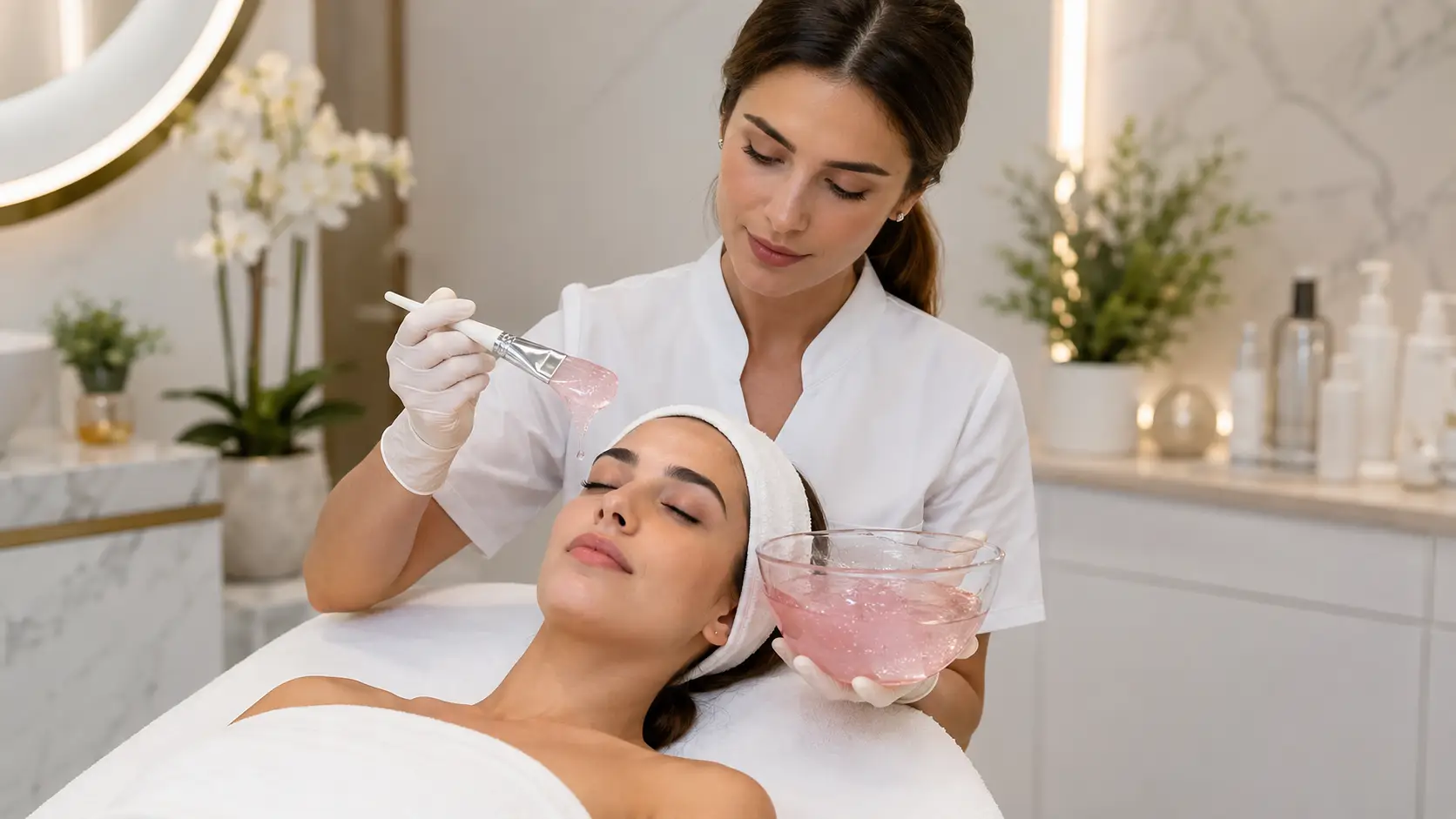
How Can a Jelly Mask Help a New Esthetician Increase Facial Value?
Professional jelly masks are one of the most accessible and effective tools a new esthetician can use to increase the perceived and actual value of a facial service. They add a visually dramatic and sensory-rich treatment step that clients remember, justify a meaningful price increase of $15 to $35 per service, and create a post-removal skin result that clients feel immediately. The combination of clinical hydration benefit, sensory experience, and memorable peel removal makes the jelly mask upgrade easier to sell and easier to rebook than almost any other single add-on available to a beginner practice.
- A jelly mask add-on typically adds $15 to $35 to a facial ticket with a product cost of $3 to $6 per application, making it one of the highest-margin upgrades available to new estheticians.
- The single-piece peel removal is the most cited post-treatment highlight by first-time jelly mask clients — it creates an emotional memory anchor that drives rebooking.
- Positioning the upgrade by its client benefit — sealing in hydration, cooling the skin, finishing the treatment — produces far higher acceptance than positioning it as a product feature.
- The jelly mask fits cleanly into any existing facial workflow as the final mask step, after serums and before completion, without requiring additional equipment or extended treatment time.
- Named menu placement generates higher acceptance rates than in-treatment upselling alone because clients arrive already aware of the option.
One of the most common pricing frustrations new estheticians face is the gap between what they believe their services are worth and what they feel confident charging. That gap rarely closes through discounting — it closes by building a service menu that delivers experiences and outcomes clients genuinely feel the value of. A professional jelly mask add-on is one of the most direct and practical ways to bridge that gap, particularly in the early months of building a practice.
The jelly mask is not simply a product substitution for a standard clay or sheet mask. It is a treatment upgrade that operates on multiple levels simultaneously: a clinical hydration tool with genuine ingredient science behind it, a sensory experience clients describe in terms that no other mask step produces, and a visual and tactile moment that generates the kind of organic client enthusiasm that brings people back and drives referrals. Understanding how to introduce it strategically — how to price it, where to fit it into your workflow, how to talk about it, and who to offer it to — is the difference between a product you occasionally suggest and a reliable revenue driver that compounds over time.
This guide walks new estheticians through every practical dimension of using a professional jelly mask to increase facial value: the economics of the add-on, the workflow integration, the client communication, and the retention effects that make this one of the most high-leverage investments a new esthetician can make in the quality and revenue of their early practice.
What You Need to Know About Using Jelly Masks to Increase Facial Value
- The product cost per jelly mask application is typically $3 to $6. At a $25 add-on price, that is a profit margin exceeding 80% on the upgrade alone.
- Clients do not buy ingredients — they buy experiences and outcomes. Frame the upgrade around what it feels like and what the skin looks like afterward.
- Set time of 10 to 15 minutes creates a natural workflow window for complementary service steps — scalp massage, hand treatment, or shoulder work — that further elevate perceived value without adding equipment.
- The peel removal moment is the single most memorable element of the jelly mask experience and the most powerful driver of post-treatment social sharing and rebooking intent.
- Menu placement is as important as treatment room presentation — clients who read about the upgrade before arriving accept it at significantly higher rates.
- Jelly masks work on nearly every skin type and every standard facial service, which makes them universally applicable across your client base without complex contraindication screening.
- First-time jelly mask clients rebook at higher rates than clients who receive standard facial masks — the distinctiveness of the experience creates treatment loyalty.
Why Jelly Masks Generate Higher Perceived Value Than Other Mask Add-Ons
To understand why jelly masks outperform other mask types as value-generating add-ons, it helps to think about how clients experience value during a facial. Value perception in a treatment room is not primarily a rational calculation — it is a sensory and emotional response. Clients compare what they felt, what they saw, and how their skin looked immediately after treatment to what they paid. The jelly mask scores exceptionally well on all three axes.
The Visual Dimension
When a new esthetician applies a professional jelly mask, something unusual happens from the client’s perspective: a powder becomes a translucent, smooth, cooling gel that visibly sets across the face. Even under the slight pressure of relaxed eyes, clients are aware that something structurally different is happening. If they glimpse it in a mirror, the visual is striking enough that many clients immediately want to photograph or share it. No sheet mask, cream mask, or clay mask creates this kind of visual moment, which means no other mask type generates the same spontaneous social sharing behavior that amplifies your practice’s reach.
The Sensory Dimension
The cooling sensation of a freshly mixed jelly mask during application is an immediate comfort and pleasure signal. For clients whose skin is flushed or reactive after extractions or exfoliation, it provides genuine relief. For clients in a standard hydration facial, it delivers the kind of sensory pleasure that stays in memory long after a treatment ends. The immediate temperature drop, the smoothness of the gel layer, and the gentle pressure of a set mask all create a cumulative sensory experience that is entirely distinct from other mask formats.
The Removal Moment
The single-piece peel removal is consistently the most cited highlight of a first jelly mask experience. Estheticians working with jelly masks in any volume quickly observe that clients who have never experienced this removal before respond with visible delight — sometimes audibly. That moment of surprise and pleasure is a powerful emotional peak that anchors the entire treatment experience in the client’s memory. Peaks in emotional experience drive memory formation and rebooking behavior in ways that a smooth, pleasant but unremarkable treatment does not.
The Immediate Result
Beyond experience, the jelly mask delivers a visible clinical outcome. Skin immediately post-removal is noticeably more hydrated, luminous, and plump than pre-treatment skin, and noticeably more so than the results from a standard cream or sheet mask. When clients see their skin in the consultation mirror immediately after a jelly mask treatment, the visual confirmation of a result they can attribute to that specific step further reinforces the perceived worth of the upgrade.
What Is the Real Revenue Opportunity for a New Esthetician?
It is worth pausing on the actual economics of the jelly mask add-on, because they are more favorable than many new estheticians initially appreciate. Understanding your numbers clearly is the foundation of pricing with confidence.
Product Cost Per Application
A professional jelly mask application uses approximately 15 to 20 grams of powder for a full face, depending on the brand and the mixing ratio. At typical professional wholesale pricing, the product cost per application falls between $3 and $6, depending on volume purchased and brand. This is the total consumable cost for a step that most clients experience as one of the most premium moments of their treatment.
Add-On Pricing Range and Margin
Most estheticians in established markets price the jelly mask add-on between $20 and $35. In markets where the base facial price is $75 or above, $25 to $30 is a common and well-accepted add-on price. At $25 with a $5 product cost, the margin on that single upgrade step is 80%. At $30 with a $5 product cost, it exceeds 83%. Compare that to retail product sales, where typical margins run 40 to 50%, and the add-on economics are strikingly favorable for a new esthetician building revenue without a large inventory investment.
The Compounding Revenue Effect
The compounding power of jelly mask add-ons comes not just from the per-treatment revenue, but from the retention effect. Estheticians who track their rebooking rates consistently observe that clients who received a jelly mask upgrade rebook at meaningfully higher rates than clients who received a standard mask in the same service. A client retained through a memorable treatment experience generates multiples of the initial add-on revenue over the lifetime of the client relationship. A $25 add-on that increases your rebooking rate by 15% is worth far more than $25 per booking.
How to Fit a Jelly Mask Into Your Existing Facial Workflow Without Disrupting Timing
One of the most common concerns new estheticians have about adding a jelly mask step is timing. Will it run the service over? Will the mixing add complexity mid-treatment? These concerns are practical, but experienced practitioners consistently find that a well-designed jelly mask protocol integrates into an existing facial more smoothly than anticipated — and often creates a workflow improvement rather than a disruption.
Where the Jelly Mask Sits in a Standard Facial Sequence
The jelly mask replaces or follows the mask step that already exists in your standard facial protocol. If your current workflow includes a clay, cream, or sheet mask step, the jelly mask occupies the same position. If it is a pure addition to an existing routine, it typically replaces or extends the mask period by five to eight minutes. Here is the standard sequence:
- Double cleanse and skin analysis.
- Exfoliation (enzyme, light peel, or manual).
- Extractions if applicable.
- Serum application — apply your targeted treatment serum to clean, prepared skin.
- Mix and apply jelly mask — mix immediately before application, spread in one continuous motion from forehead to neck, ensuring even coverage.
- Mask set time (10 to 15 minutes) — this is your service window. Use it for scalp massage, hand and arm treatment, décolleté massage, or client education conversation.
- Peel removal — one smooth motion from jaw to forehead. Allow the client a moment to experience the reveal.
- Moisturizer and SPF to complete.
The Service Window Is the Hidden Upgrade
The 10-to-15-minute set time is not empty waiting time — it is a professional opportunity. Estheticians who use this window for scalp massage or hand treatment report that clients frequently describe these as the most relaxing moments of the entire service. From the client’s perspective, the jelly mask add-on delivered a premium mask treatment AND a scalp or hand massage they were not expecting. The perception of value compounds without adding significant cost.
Mixing Preparation and Room Setup
Professional jelly mask application is a two-to-three minute workflow step when the room is set up correctly. Keep your mixing bowl, powder, and water accessible on your treatment cart before the client arrives. Mix only when you are ready to apply immediately — do not pre-mix. The standard ratio of 1:1 to 2:1 powder to water should be tested under your specific room conditions before client application, as ambient temperature and humidity affect set time.
New estheticians who incorporate Poly-Luronic™ Jelly Mask by Luminous Skin Lab into their beginner facial menu consistently note that the predictable 12-to-15-minute set window is what makes the add-on practical from a scheduling standpoint — treatments do not run over unexpectedly because the set time is consistent session to session rather than varying with mixing technique. Practitioners also report that the immediate post-removal skin response — noticeably more luminous and hydrated skin before any moisturizer is applied — is what clients remark on most, and that having a clinical explanation ready for that response builds trust rapidly with first-time clients.
In terms of the service window, most estheticians find that starting a gentle scalp massage the moment the mask is applied and continuing for the first eight minutes of set time, then transitioning to a brief hand treatment for the final five minutes, produces the strongest client satisfaction response across all skin types. The combination of the mask experience and the complementary bodywork creates a service moment that clients have difficulty finding a reason not to repeat.
How to Talk About the Jelly Mask Upgrade So Clients Say Yes
The way you introduce the jelly mask upgrade is as important as the upgrade itself. New estheticians sometimes present add-ons with language that inadvertently signals uncertainty or financial motivation rather than clinical recommendation. The reframe that transforms acceptance rates is simple: speak from what the client gains in this specific treatment, not from what you offer as a product.
The Two Moments to Offer the Upgrade
There are two natural moments to introduce a jelly mask upgrade: during the pre-treatment consultation and mid-treatment after serums are applied. Both work, and both require slightly different language.
During consultation: After identifying the client’s concerns, mention that you would like to recommend finishing with a jelly mask step that seals in the serum work you are planning and gives the skin a deep hydration and cooling effect that most clients find is the highlight of their treatment. You can keep this to two sentences. If the client asks a follow-up question, answer it clearly and confidently. If they say yes, note it on the intake form. If they decline, proceed without pressure.
Mid-treatment: After serums are applied and the skin is prepared, you can introduce the upgrade by framing it as a finishing step: “I would like to close out your treatment with a jelly mask — it seals everything in and the removal at the end is something most clients really love. It adds a few minutes and fifteen dollars to today’s service. Would you like me to include it?” This is direct, honest, and focused on the client experience. Most clients respond positively when the framing is this clear.
Language That Works and Language That Doesn’t
The language that generates highest acceptance rates focuses on how the client will feel, what the skin looks like after removal, and the unique sensory moment of the peel. The language that reduces acceptance rates is product-feature-focused: talking about ingredients, brand names, or formulation science in the upgrade offer itself. Save the ingredient education for the client who asks a follow-up question — your upgrade offer should be sensory and benefit-led.
Sensory and benefit-focused
“It seals everything in and the peel-off at the end is something most clients love — the skin feels really different after.”
Result-focused
“It gives your skin that extra glow and hydration that makes the treatment feel complete rather than just finished.”
Feature-focused
“It has polyglutamic acid and hyaluronic acid and it inhibits hyaluronidase.” (Save this for clients who ask why — not as the upgrade pitch.)
Uncertainty-signaling
“I also have this mask if you want it, it’s kind of a special thing, you don’t have to.” (This signals hesitation and reduces confidence perception.)
How to Handle the Question About Price
New estheticians frequently stumble on the moment a client asks how much the add-on costs. The most effective approach is to name the price clearly and immediately, without softening language or apology. “The jelly mask finishing treatment is twenty-five dollars added to today’s service.” That is a complete sentence. Anything added after it that functions as an apology or justification weakens the offer. Clients who perceive that you are confident in your pricing are more likely to say yes than clients who sense you are uncomfortable with the number.
How to Position the Jelly Mask on Your Service Menu to Increase Acceptance Before Clients Arrive
In-treatment upselling is effective, but it is reactive — you are offering the upgrade after the client has already formed a price expectation for the visit. Menu placement is proactive: it plants the idea of the upgrade before the client arrives, creates curiosity, and gives clients who are already considering a premium experience a clear pathway to select it. Both strategies matter, and combining them produces the highest acceptance rates.
Name It as a Distinct Service Step
The jelly mask upgrade should appear on your service menu as a named add-on with a brief description and a clear price. A bare “jelly mask +$20” listing works, but a description of two sentences that communicates the experience and outcome performs significantly better. Something like: “Jelly Mask Finishing Treatment — A professional hydrating jelly mask applied after your serum step, set for 10 minutes, and removed as a single piece. Leaves skin visibly luminous, deeply cooled, and sealed. +$25.”
Position It as a Premium Finishing Step, Not an Add-On
Clients mentally categorize services differently depending on how they are described. “Add-on” language implies optional and secondary. “Finishing treatment” or “closing treatment” language implies intentional, clinical, and completing. Many estheticians find that reframing the jelly mask as the treatment’s finishing protocol rather than an optional extra increases both acceptance rates and client perception of the sophistication of the overall service offering.
Use It as the Cornerstone of a Signature Facial
For new estheticians who want to build a signature service that stands out in a competitive market, the jelly mask closing step is one of the most accessible differentiators available. A facial named specifically around the jelly mask protocol — a Jelly Glow Facial, a Luminous Hydration Facial, or a Pro Jelly Recovery Treatment — creates menu identity that generic “Classic Facial” or “Custom Facial” listings do not. Clients who book the named facial know what they are getting, want that specific experience, and arrive already primed to value the treatment at the price you have set.
Which Clients Are the Best Candidates for a Jelly Mask Upgrade?
The practical advantage of the jelly mask as a beginner add-on is its broad applicability. Unlike some advanced treatment upgrades that require careful contraindication screening, a professional fragrance-free jelly mask is appropriate for the large majority of clients a new esthetician sees. That said, certain client profiles respond particularly well and represent your highest-yield offer opportunities.
First-Time Clients
A first-time client who has never experienced a jelly mask is an ideal candidate for the upgrade introduction. Their first treatment shapes their expectations for all subsequent visits. A first-time client who experiences the full jelly mask treatment — the visual, the cooling sensation, the peel removal moment, the skin result — leaves with a benchmark of what your practice delivers. If that benchmark is set at a memorable peak experience level, rebooking and long-term retention are significantly more likely.
Clients With Dehydration or Dullness Concerns
Clients who arrive mentioning that their skin feels dry, tight, dehydrated, or lacks radiance are describing exactly the concerns a jelly mask addresses most visibly. The immediate post-removal skin response — plump, hydrated, luminous — aligns directly with the outcome they articulated as their goal. These clients experience the upgrade as a targeted solution rather than an upsell, which increases both acceptance and post-treatment satisfaction.
Clients After Extractions or Active Treatments
The jelly mask’s cooling and occlusive properties make it particularly valuable as a post-extraction calming step, following light exfoliation, and in other protocols where the skin benefits from barrier recovery support and temperature management. In these contexts, the upgrade offer is clinical rather than cosmetic — you are recommending it because the skin genuinely benefits from it, and framing it that way resonates with clients who appreciate a reason beyond aesthetics.
Clients Who Have Expressed Luxury or Self-Care Motivation
Clients who book a facial as a self-care treat rather than purely for skin results are highly receptive to upgrades that enhance the sensory and experiential quality of the treatment. These clients are not primarily evaluating the clinical outcome — they are evaluating how the service felt. The jelly mask delivers on the experiential dimension as effectively as any step in a standard facial menu, which makes it an almost automatic yes for this client profile.
When to Hold Back on the Upgrade Offer
For clients showing signs of active inflammation, severe rosacea, or highly reactive skin, confirm that any jelly mask formulation you are using is fragrance-free and clean-label before applying it to compromised skin. For clients whose skin is showing unexplained reactivity that you have not been able to identify, proceed conservatively and wait until you understand the client’s skin history more fully before introducing new treatment steps. This is not a reason to avoid jelly masks in general — it is a reason to select formulations with clean ingredient profiles and to apply your standard professional assessment before any treatment addition.
How the Jelly Mask Drives Client Retention Beyond the Initial Upgrade Value
Revenue from add-ons is the visible return on the jelly mask upgrade. The less visible but ultimately more significant return is the client retention effect — what happens to rebooking behavior when clients experience a treatment moment they cannot easily find elsewhere.
The Peak-End Rule and Treatment Memory
Psychological research on experience memory consistently demonstrates that people remember experiences primarily by their most intense emotional moment (the peak) and by how they ended (the end) rather than by the average quality of the experience throughout. A standard facial with no memorable peak and a pleasant but unremarkable ending leaves a pleasant but fading memory. A facial where the peak was the cooling sensation and peel removal of a jelly mask, and the ending was luminous skin in the consultation mirror, creates a memory that is specific, sensory, and associated with your practice rather than with facials in general.
This is why clients who have experienced a jelly mask finishing step return at higher rates: they are not just returning for a facial, they are returning for that specific treatment moment. That specificity is the foundation of treatment loyalty in a competitive market where clients have many options.
Social Sharing and Word-of-Mouth Generation
The visual appeal of the set jelly mask — the translucent gel layer, the smooth surface, the unusual appearance — and the peel removal moment generate spontaneous social sharing behavior at rates that standard facials do not. Clients who share their jelly mask experience on social platforms are creating direct referral traffic for your practice, reaching their network with authentic enthusiasm that no marketing spend can replicate. For a new esthetician building a client base, this organic amplification is one of the most valuable effects of the jelly mask upgrade — and it costs nothing beyond providing the experience.
The Conversation After Removal
The moment immediately after peel removal is one of the most productive consultation windows in a facial. The client has just experienced something distinctive, their skin looks and feels visibly different, and they are emotionally engaged. Estheticians who use this moment for a brief, confident observation about the skin response — “Do you see how much more luminous the skin looks? That is the hydration sealing in from the mask step” — create a clinical context for the improvement the client is observing. That context reinforces the value of the upgrade, establishes your expertise, and plants the expectation that this outcome is something they can consistently access by booking with you.
Professional and Educational References
The strategies and principles discussed in this article draw from esthetician business practice literature, professional service pricing research, and applied treatment room experience:
- Service add-on pricing psychology and perceived value — professional spa industry pricing benchmarks from ISPA and associated esthetician business education resources.
- Peak-end rule and experience memory — Kahneman, D. et al., foundational behavioral economics literature on experienced utility and remembered utility. Applied to client retention strategy in service industries.
- Jelly mask (alginate modeling mask) clinical properties — professional esthetics education literature; product performance benchmarks from treatment room application across advanced hydration, post-extraction, and barrier-recovery protocols.
- Polyglutamic acid and hyaluronic acid dual-humectant science — MDPI 2024 gamma-PGA skin study; Typology 2021–2025; Stanford Chemistry cosmetic formulation literature 2024.
- Client retention and rebooking behavior in esthetic services — Mindbody business intelligence reports; ASCP Esthetician industry survey data.
For new estheticians who want to introduce a jelly mask add-on that delivers the clinical results, sensory experience, and reliable workflow performance this guide describes, the Poly-Luronic™ Jelly Mask by Luminous Skin Lab is the formulation our education team most consistently recommends at the beginner practice level. Developed by a licensed esthetician specifically for professional treatment room use, the Poly-Luronic™ system combines PGA surface occlusion with HA deep hydration in a fragrance-free, clean-label formulation that delivers the immediate post-removal luminosity response clients notice and comment on — making the upgrade easier to justify, easier to sell, and easier to rebook. The predictable set time and consistent mixing behavior are particularly valuable for new estheticians still building workflow confidence.
Explore the Poly-Luronic™ Jelly Mask Line →Frequently Asked Questions: Using Jelly Masks to Increase Facial Value
Can a jelly mask really help me charge more for a facial?
Yes. A professional jelly mask increases perceived service value through a combination of visual drama, sensory experience, and a clear clinical outcome clients can feel immediately. When introduced as a named add-on with a brief explanation of its benefits, most clients perceive it as a meaningful upgrade worth $15 to $30 above the base facial price. The key is framing it as part of the treatment result, not just a nice extra step.
How do I explain a jelly mask upgrade to a client without sounding salesy?
Frame the upgrade around what the client gains, not what you earn. During the consultation or mid-treatment, mention that you would like to finish with a jelly mask step that seals everything in, gives the skin a deep cooling hydration effect, and peels off in one piece. Clients respond to the sensory description and the visual experience. Keep it brief, confident, and benefit-focused rather than feature-focused.
How much should I charge for a jelly mask add-on as a new esthetician?
Most new estheticians price jelly mask add-ons between $15 and $35 depending on their market, their base facial price, and whether the mask is positioned as a standard upgrade or a premium finishing treatment. Starting at $20 is a common entry point that feels accessible to clients while meaningfully increasing ticket value. As your confidence and client trust build, you can move pricing upward without resistance.
Where in the facial does the jelly mask fit so the workflow stays smooth?
The jelly mask is applied as the final mask step, after extractions and any serum application. Mix it immediately before application so the set time begins on the face. Apply over the serum layer, allow 10 to 15 minutes for it to set fully, then peel and remove. The set time creates a natural window for scalp massage, hand treatment, or shoulder work, which makes the jelly mask addition feel seamless rather than disruptive to your existing timing.
Do clients actually notice the difference with a jelly mask compared to a regular mask?
Consistently yes. Clients frequently comment on the cooling sensation during application, the unusual visual of the set mask on their face, and especially the single-piece peel removal, which they often describe as satisfying or memorable. This sensory distinctiveness is a significant driver of the upgrade’s perceived value and is one of the reasons jelly masks generate word-of-mouth and social media sharing in ways that sheet masks or cream masks do not.
Should I offer the jelly mask as a named upgrade on my menu or just add it during the treatment?
Both approaches work, but naming it on your menu creates a higher value perception before the client even arrives. A menu entry such as Jelly Mask Finishing Treatment with a brief description signals that this is a deliberate professional service step rather than a spontaneous upsell. Clients who book knowing the option exists are more likely to say yes at checkout, and you avoid any sense of a surprise charge.
What type of facial clients are most likely to say yes to a jelly mask upgrade?
Clients who are already interested in skin results, clients who have mentioned dryness or dullness as a concern, and first-time clients you want to wow with a memorable experience are all strong candidates. Hydration-focused clients and clients treating themselves to a self-care experience respond especially well. Avoid pushing the upgrade with clients who have shown signs of sensitivity or reactive skin without first confirming the formulation is appropriate for their condition.
How does a jelly mask help with client retention, not just one-time value?
The jelly mask peel removal moment is the most frequently mentioned post-treatment highlight by clients who experience it for the first time. That memorable sensory peak creates an emotional anchor to the treatment and to your practice specifically. Clients who associate their best skin experience with your treatment room are significantly more likely to rebook, recommend, and resist switching to a competitor offering a lower price.
What makes the Poly-Luronic Jelly Mask a good choice for new estheticians who want to offer this upgrade?
The Poly-Luronic Jelly Mask by Luminous Skin Lab was formulated specifically for professional treatment room use by a licensed esthetician. Its dual PGA and hyaluronic acid system delivers immediate visible hydration that clients notice right after removal, which makes it easier to justify the upgrade price and easier to generate the kind of client reaction that drives rebooking. The fragrance-free, clean-label formulation also makes it safe for post-extraction and sensitive skin protocols that new estheticians encounter regularly.
The Simplest High-Margin Upgrade Available to a New Esthetician
Building a practice that is both financially sustainable and genuinely enjoyable to work in requires finding the places where what you love doing, what clients love receiving, and what generates meaningful revenue all converge. The professional jelly mask upgrade sits in exactly that intersection. It is easy to learn, quick to execute, instantly impressive to clients, and generates some of the best per-step margins available in a standard facial service without requiring advanced equipment or expanded scope of practice.
The real compounding value, however, is not in the add-on revenue itself. It is in what that sensory peak experience does to client memory, rebooking behavior, and word-of-mouth referral over time. A new esthetician who consistently delivers a memorable jelly mask experience is building a client base that is loyal not to the category of facial but to the specific experience they know they can only get at your practice. That specificity is the most durable competitive advantage available in a service business — and it is built one memorable peel removal moment at a time.
Start with a sample kit, practice your mixing until the ratio is automatic, introduce it to your first few clients with the benefit-focused language outlined in this guide, and put it on your menu by name. The economics will follow.