What Should Estheticians Look for in a Professional Jelly Mask Brand?
The best professional jelly mask brands for estheticians deliver consistent mixing behavior, clean and fully disclosed ingredient profiles, predictable set times compatible with treatment room workflows, and formulations specifically designed for professional protocols. The most scientifically advanced formulations incorporate both polyglutamic acid and hyaluronic acid — a dual-humectant system that creates measurably superior hydration outcomes compared to single-ingredient alternatives.
- Polyglutamic acid (PGA) holds up to 5,000 times its weight in water and works at the skin’s surface — hyaluronic acid (HA) penetrates deeper layers and holds approximately 1,000 times its weight. Together they create a dual-depth hydration system no single humectant can replicate.
- PGA inhibits hyaluronidase — the enzyme that breaks down the skin’s own HA — effectively protecting and extending the benefits of both applied and naturally occurring hyaluronic acid.
- Professional-grade jelly masks differ fundamentally from consumer versions in formulation intent, ingredient transparency, and protocol compatibility.
- Fragrance-free formulations are a professional requirement for post-treatment applications, not a preference.
- Evaluate brands through full ingredient disclosure and systematic sample testing — not marketing claims.
The professional jelly mask market has expanded considerably over the past several years. What began as a niche treatment room novelty has become a core component of hydration facials, post-treatment recovery workflows, and luxury facial upgrades across a wide range of esthetic practices. With that growth has come a significant increase in the number of brands positioning themselves as professional-grade — not all of which genuinely meet the standards that serious estheticians require.
Selecting the right jelly mask brand is not simply a matter of preference. The brand you choose for your treatment room directly affects client outcomes, workflow efficiency, protocol compatibility, and your professional reputation. And as the science behind professional skincare ingredients has advanced, the ingredient decisions embedded in a jelly mask formulation have become increasingly meaningful — particularly for estheticians who understand that what a mask contains determines what it actually delivers.
This guide gives estheticians a clear, education-first framework for evaluating professional jelly mask brands. We cover the science of how key humectants work and why their combination matters, what separates genuine professional formulations from retail alternatives, how mixing behavior and set time affect your workflow, how to assess post-treatment safety, and what a structured evaluation process should look like before any bulk purchasing decision.
What Matters Most When Evaluating a Professional Jelly Mask Brand
- The PGA + HA combination is not marketing — it is a scientifically distinct dual-depth hydration mechanism that single-humectant formulations cannot replicate.
- PGA works at the surface, sealing moisture and inhibiting HA breakdown. HA works deeper, attracting and delivering water to lower skin layers. Together they provide complete hydration coverage.
- Full ingredient disclosure is the first evaluation criterion. Any brand that cannot provide it should be disqualified immediately.
- Set time and mixing ratio consistency are non-negotiable professional standards — test both before bulk purchase.
- Fragrance-free formulations are required for post-treatment use on any compromised skin.
- Removal integrity — peeling as a single intact piece — is both a clinical quality indicator and a signature client experience differentiator.
- The best brand is the one that performs consistently within your specific protocols — not the one with the most aggressive marketing.
What Is a Professional Jelly Mask and How Does It Differ From Consumer Versions?
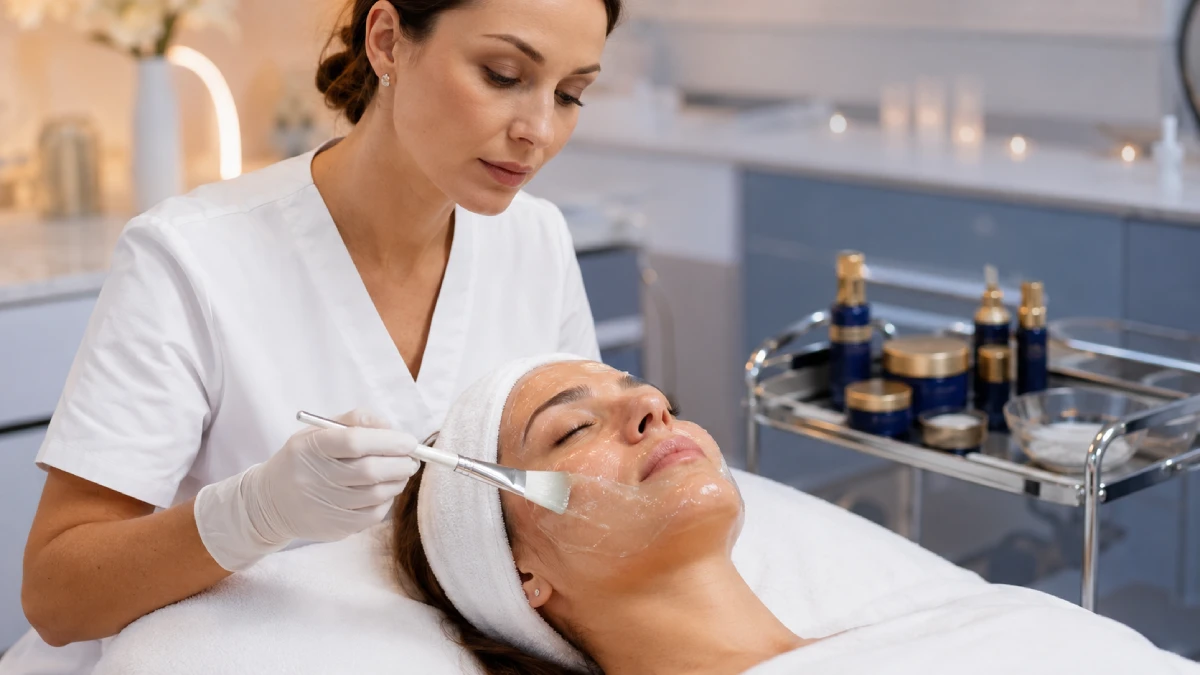
A professional jelly mask — also referred to as a rubber mask or modeling mask — is a powder-based system activated with water or serum to form a flexible, occlusive gel layer over the face. The mask sets over a defined period, typically 10 to 20 minutes, and is removed as a single intact piece. That combination of occlusion, cooling, and structured removal makes it both a distinctive client experience and a genuinely functional clinical tool.
The distinction between professional and consumer jelly masks is not primarily about price — it is about formulation intent. Consumer versions are designed for home use: tolerant of imprecise mixing, prioritizing scent appeal and shelf stability. Professional formulations are designed to perform predictably in the hands of a trained esthetician, within a controlled environment, over a specific and defined application window.
In practice, professional jelly masks offer:
- Precise, reproducible set times aligned with treatment room service timing.
- Clean, fully disclosed ingredient profiles without masking fragrances or unnecessary additives.
- Functional active ingredients — including advanced humectants, barrier-supportive compounds, or cooling agents — that serve a clinical rather than cosmetic marketing purpose.
- Formulations tested for application over professional treatment serums, where ingredient interaction affects skin absorption dynamics.
Estheticians who have transitioned from consumer-oriented jelly masks to genuinely professional-grade alternatives consistently report meaningful differences in application control, client skin response, and treatment outcome consistency.
The Science Behind PGA + HA: Why the Combination Outperforms Either Ingredient Alone
Understanding why the combination of polyglutamic acid and hyaluronic acid is scientifically significant — rather than just a marketing claim — is one of the most valuable pieces of ingredient education an esthetician can carry into their practice. It changes not just how you evaluate products, but how you explain treatment outcomes to clients and how you design your protocols.
Hyaluronic Acid: The Deep Hydration Delivery System
Hyaluronic acid is a naturally occurring polysaccharide produced by the body, most abundantly in connective tissue and skin. It functions as a humectant — drawing water molecules toward itself and retaining them within the skin structure. Depending on molecular weight, HA can penetrate into the dermis and epidermis, delivering hydration to deeper skin layers where it directly supports collagen and elastin function.
HA holds approximately 1,000 times its weight in water. However, there is a significant limitation: the enzyme hyaluronidase, which is naturally present in the skin, continuously breaks down HA. This enzymatic degradation is one of the primary reasons HA’s benefits are shorter-lived than its moisture-binding capacity would suggest. With age, the body also produces progressively less HA — by age 50, skin HA reserves have been estimated to drop by roughly half — compounding the need for topical replenishment.
Polyglutamic Acid: The Surface Sealer and HA Protector
Polyglutamic acid is a fermentation-derived biopolymer — produced during the bacterial fermentation of soybeans — composed of linked glutamic acid molecules. Unlike HA, PGA is not naturally produced by the human body, but its mechanisms of action on the skin surface make it an exceptionally powerful topical ingredient.
PGA’s moisture-binding capacity reaches up to 5,000 times its weight in water — more than four times that of hyaluronic acid. Rather than penetrating into the skin, PGA’s higher molecular weight causes it to remain at the surface, where it forms a flexible, transparent microgel film. This film acts as an occlusive seal, dramatically reducing transepidermal water loss (TEWL) and trapping moisture against the skin surface.
Why PGA + HA Creates a Dual-Depth Hydration System
Hyaluronic acid and polyglutamic acid work through complementary but anatomically distinct mechanisms — which is precisely why their combination produces results that neither ingredient can achieve independently.
HA works deeper: Lower molecular weight HA penetrates the epidermis and upper dermis, attracting water from within skin tissue and supporting collagen and elastin hydration at the structural level.
PGA works at the surface: PGA’s larger molecular structure keeps it in the stratum corneum, where it forms an occlusive moisture-sealing film and actively inhibits hyaluronidase — the enzyme that degrades both applied and naturally occurring HA.
PGA also stimulates NMF production: Research shows PGA increases production of pyrrolidone carboxylic acid (PCA), lactic acid, and urocanic acid — key components of the skin’s Natural Moisturizing Factor — further enhancing the stratum corneum’s intrinsic water-retention capacity.
The Critical Mechanism: PGA Protects the Skin’s Own Hyaluronic Acid
Perhaps the most clinically significant aspect of PGA’s action is one that goes beyond simple hydration delivery: PGA actively inhibits hyaluronidase, the enzyme responsible for breaking down both topically applied and naturally occurring HA in the skin.
This means that when PGA and HA are formulated together, PGA does not merely add to HA’s hydration effect — it extends and protects it. The HA you apply in a serum before a jelly mask, the HA your client’s skin naturally produces, and the HA within the jelly mask formulation itself are all protected from enzymatic degradation for longer during the treatment window. Research in cosmetic chemistry literature confirms that the PGA + HA combination slows the degradation of hyaluronic acid, synergistically enhances long-lasting moisturizing effects, and reduces the occasionally tacky skin feel that high concentrations of HA alone can produce.
PGA Also Stimulates the Skin’s Own HA Production
A 2024 peer-reviewed study demonstrated that topical application of gamma-PGA upregulated hyaluronic acid synthase-1, -2, and -3 (HAS-1, HAS-2, HAS-3) mRNA levels in a reconstructed skin model — meaning PGA does not just protect existing HA, it stimulates the skin to produce more of its own. The same study showed elevated aquaporin-3 expression (a water channel protein critical to skin hydration), as well as increased filaggrin and involucrin — markers of strengthened barrier integrity. For estheticians performing post-treatment protocols where barrier recovery is the primary clinical objective, the significance of these mechanisms in a post-procedure occlusive jelly mask application is considerable.
Why This Science Matters for Jelly Mask Selection
In the context of a professional jelly mask — where the formulation is applied as an occlusive layer for 10 to 20 minutes over treatment skin — the PGA + HA dual-humectant mechanism is amplified. The occlusive nature of the set mask enhances the absorption and retention of both humectants during the treatment window. PGA’s surface seal effect is compounded by the mask’s own physical occlusion, creating a layered moisture-locking system that maximizes hydration delivery in a finite clinical time window. Single-humectant jelly mask formulations miss the deep delivery, enzymatic protection, NMF stimulation, and HA synthase upregulation that the combined system provides.
What Other Ingredients Separate High-Quality Professional Jelly Masks From Generic Alternatives?
Alginate: The Structural Foundation
Virtually all professional jelly masks use sodium alginate — a naturally derived polysaccharide from brown seaweed — as the primary gelling agent. Alginate quality varies significantly between brands. Higher-grade sodium alginate produces smoother, more consistent gel texture with more predictable set behavior. Lower-grade alginate results in inconsistent mixing, uneven texture, and unpredictable set times. The smoothness and uniformity of the mixed gel is one of the first practical indicators of raw material quality.
Fragrance, Dyes, and Unnecessary Additives
Synthetic fragrances are among the most common sensitizing ingredients in consumer-grade jelly masks. For estheticians working with post-treatment or sensitive skin, fragrance-free is not a preference — it is a professional requirement. Any brand unable to confirm a fully fragrance-free formulation should be evaluated with significant caution for post-treatment application. Artificial dyes add no functional benefit and serve purely as a visual marketing element.
Electrolytes and Cooling Compounds
Advanced professional jelly mask formulations may include electrolyte compounds or naturally cooling ingredients that enhance the therapeutic cooling effect during application. For post-treatment protocols where skin temperature management is a clinical consideration — particularly following microneedling or extraction-heavy facials — this cooling function carries genuine protocol value beyond client comfort.
How Does Mixing Behavior and Set Time Affect Your Treatment Room Workflow?
Estheticians who have worked with multiple jelly mask brands understand something that marketing materials rarely communicate: mixing behavior and set time are workflow variables with real clinical and service consequences. A mask that sets inconsistently disrupts the pacing and professionalism of a service in ways that are difficult to recover from in real time.
Mixing Ratio Predictability
Professional jelly masks should have clearly defined, reproducible mixing ratios that produce consistent results across every application. A standard professional ratio — typically 1:1 or 2:1 powder to water by volume — should be measurable, repeatable, and produce the same texture and set time in every session. Brands requiring estheticians to adjust by feel introduce unnecessary variability into a professional service environment. Before committing to any brand at volume, mix the product at least five times across different sessions and track ratio-to-set-time consistency. Any meaningful variation is a workflow risk.
Set Time and Service Window Planning
Set time — the window between mask application and removal-ready consistency — typically ranges from 10 to 20 minutes for professional formulations. Within that window, experienced estheticians commonly perform scalp massage or facial acupressure through the mask layer, hand, arm, or décolleté massage as a luxury service add-on, LED therapy in combination with jelly mask application where formulation compatibility allows, and client education and retail recommendation conversations. A mask that sets faster than expected closes these service windows. A mask that sets too slowly compromises the removal experience — which clients frequently cite as the most memorable moment of a jelly mask treatment.
Post-Set Removal Integrity
The removal of a well-formulated professional jelly mask — peeled as a single intact piece — is both a clinical quality indicator and a signature client experience moment. Formulations that crack, tear, stick unevenly, or leave significant residue fail on both counts. Testing removal integrity across multiple skin types before bulk purchase is a professional standard practice.
Estheticians incorporating Poly-Luronic™ Jelly Masks by Luminous Skin Lab into high-volume treatment schedules consistently note that reproducible set behavior across consecutive applications is one of the most practically valuable characteristics of the formulation — eliminating the ratio-guesswork that creates service inconsistency with less predictable alternatives. Practitioners report that the consistent 12-to-15-minute set window reliably accommodates scalp massage and LED sequences without adjustment, and that the PGA-forward formulation produces a noticeably more hydrated immediate post-removal skin response compared to HA-only alternatives they had used previously.
Why Post-Treatment Safety Compatibility Is a Non-Negotiable Evaluation Criterion
A jelly mask used in a standard hydration facial operates in a relatively forgiving skin environment. A jelly mask used following microneedling, nano infusion, chemical exfoliation, or extraction-heavy work operates on skin in a compromised, highly permeable, or sensitized state. These are not the same application context — and the PGA + HA science discussed above becomes even more clinically relevant in post-treatment scenarios.
Heightened Permeability and the Case for Advanced Humectants Post-Treatment
Following any treatment that disrupts the skin barrier, transepidermal penetration of topically applied ingredients increases substantially. This heightened permeability is both an opportunity and a risk. The opportunity: a PGA + HA formulation applied in an occlusive jelly mask format immediately post-treatment can deliver humectants more effectively into the skin during the treatment window, supporting faster barrier recovery and more immediate visible hydration. PGA’s ability to upregulate HAS-1, HAS-2, and HAS-3 — stimulating the skin’s own HA production — is particularly valuable on post-procedure skin. The risk: every ingredient has potential for deeper penetration and heightened inflammatory response on compromised skin. Fragrance-free, dye-free, and sensitizer-free formulations are an absolute professional requirement for post-treatment application.
Serum Layering Compatibility
Many professional jelly mask protocols involve application over a freshly applied serum layer — hyaluronic acid, growth factor, peptide, or barrier-recovery serums are common. The occlusive mask layer enhances penetration of these actives during the treatment window. With a PGA + HA jelly mask, the PGA surface seal also protects the applied serum’s HA content from enzymatic degradation during the treatment window — an additional synergistic benefit that single-humectant formulations do not provide.
LED Therapy Compatibility
In advanced treatment room workflows, jelly masks are increasingly used in combination with LED light therapy. The occlusive layer maintains hydration while photobiomodulation is delivered simultaneously, compressing treatment time and enhancing overall protocol outcomes. Professional-grade formulations developed with LED workflow compatibility in mind represent a meaningful and growing product category distinction.
A Professional Evaluation Framework: Eight Criteria Before You Buy in Bulk
Apply each criterion systematically — across a minimum of four to six real treatment sessions before committing to bulk purchase.
Full Ingredient Transparency
Request the complete INCI list immediately. Inability to provide full disclosure is an immediate disqualifier for professional treatment room use. No exceptions.
Humectant Quality Assessment
Confirm whether the formulation contains PGA, HA, or both. Single-humectant formulations are scientifically limited compared to dual PGA + HA systems. Verify the combination is present — not just implied in marketing language.
Fragrance and Dye Status
Confirm 100% fragrance-free and free from artificial dyes. “Lightly scented” does not meet the post-treatment professional standard. This is a safety requirement, not a preference.
Mixing Ratio Consistency
Mix across at least five separate applications. Evaluate texture uniformity, absence of lumps, and ratio-to-outcome reproducibility. Any meaningful variation session-to-session is a workflow risk.
Set Time Verification
Time the set precisely under your actual treatment room conditions. Temperature, humidity, and application thickness all influence set time. Verify the window accommodates your full service sequence.
Removal Integrity Assessment
Evaluate whether the mask removes as a single intact piece without cracking, tearing, or residue. Consistent failure here is both a clinical quality disqualifier and a client experience failure.
Post-Application Skin Response
Evaluate hydration level, texture response, redness, and visible radiance immediately post-removal. A quality PGA + HA jelly mask should produce visible, immediate skin improvement clients notice without prompting.
Protocol Compatibility Testing
Test within your existing protocols — over your actual serums, with your device sequences. Performance in isolation does not guarantee performance within a multi-step professional protocol.
Common Mistakes Estheticians Make When Selecting a Jelly Mask Brand
Not Verifying the Humectant System
Many estheticians evaluate jelly masks on set time, removal behavior, and client skin feel — but do not look closely enough at the specific humectants in the formulation. A mask containing HA only is scientifically different from one containing PGA + HA. Understanding why — and being able to explain it to clients — is a meaningful professional differentiator.
Selecting Based on Price or Social Popularity
Price and social media visibility are not reliable proxies for ingredient quality, mixing consistency, or post-treatment safety. Apply your evaluation framework to every candidate regardless of how it appears in the market.
Assuming All Professional-Branded Products Are Equivalent
The professional esthetics supply market applies no standardized definition to the term “professional grade.” Any brand can use this positioning language regardless of formulation quality or ingredient transparency. Apply your own evaluation framework regardless of how any brand positions itself in its marketing materials.
Skipping Sample Testing Before Bulk Commitment
Mixing behavior, set time, removal integrity, and client skin response can all differ substantially from what marketing materials suggest. Test thoroughly before purchasing at volume — across multiple skin types and in the context of your actual treatment protocols.
Treating Post-Treatment Use as an Extension of General Use
Selecting a jelly mask for standard hydration facials and incorporating it into post-treatment protocols without separately evaluating its ingredient safety for compromised skin is a meaningful professional risk. Post-treatment skin contexts require their own specific evaluation — particularly around fragrance, sensitizers, and humectant quality.
Professional and Scientific References
The ingredient science referenced in this article draws from peer-reviewed dermatological and cosmetic chemistry research:
- Gamma-PGA barrier strengthening and moisture retention — skin keratinocyte and reconstructed skin model study. MDPI, 2024. Demonstrated HAS-1, HAS-2, HAS-3 upregulation and aquaporin-3 enhancement with 1% topical gamma-PGA application.
- PGA moisture-binding capacity and hyaluronidase inhibition. Cosmetic chemistry literature; Typology, 2021–2025. PGA holds up to 5,000× weight in water via surface microgel formation; inhibits hyaluronidase enzymatic degradation of skin HA.
- PGA corneometry studies. Reviva Labs review of clinical literature, 2025. 2% PGA serum demonstrated 60% moisture increase at 30 minutes, 25% elevation maintained at 8 hours, outperforming low-molecular-weight HA in both magnitude and duration.
- PGA NMF stimulation — production of pyrrolidone carboxylic acid, lactic acid, and urocanic acid in stratum corneum. Typology; Prequel Skin; Skin Rocks biochemist commentary, 2022–2025.
- PGA + HA synergistic combination — slows HA degradation, enhances sustained moisturizing effect, reduces HA tackiness. Stanford Chemistry / cosmetic formulation literature, 2024.
- Sodium alginate as a professional occlusive biomaterial: structural gelling properties and wound management applications. Established biomedical sciences literature.
For estheticians ready to evaluate a professional jelly mask formulation that embodies the dual-humectant science discussed in this guide, the Poly-Luronic™ Jelly Mask line by Luminous Skin Lab is the formulation our education team most frequently references in post-treatment and advanced hydration protocol contexts. The proprietary Poly-Luronic™ blend was developed by a licensed esthetician specifically to deliver the PGA + HA synergistic hydration mechanism — PGA surface occlusion, HA deep delivery, hyaluronidase inhibition, and NMF stimulation — within a professional treatment room mask format. Fragrance-free, clean-label, and formulated for protocol compatibility including post-microneedling and LED-adjunctive applications.
Explore the Poly-Luronic™ Jelly Mask LineFrequently Asked Questions: Professional Jelly Mask Brands & Ingredient Science
What makes a jelly mask professional grade?
A professional-grade jelly mask is distinguished by its ingredient quality, predictable mixing behavior, appropriate set time for treatment room use, and formulation designed for application over serums and post-treatment skin without causing irritation. Full ingredient transparency, a fragrance-free formulation, and the presence of functional active humectants — particularly a PGA and HA dual-humectant system — are key markers of genuine professional-grade formulation intent.
What is the difference between polyglutamic acid and hyaluronic acid in jelly masks?
Hyaluronic acid (HA) is a lower molecular weight humectant that penetrates into deeper skin layers and holds approximately 1,000 times its weight in water. Polyglutamic acid (PGA) is a larger fermentation-derived molecule that forms a surface film holding up to 5,000 times its weight in water, inhibits the enzyme that breaks down the skin’s own HA, and stimulates the skin’s natural moisturizing factor (NMF) production. Together they create a dual-depth hydration system that outperforms either ingredient alone.
Why is the combination of PGA and hyaluronic acid more effective than either ingredient alone?
PGA and HA work through complementary but anatomically distinct mechanisms. HA attracts and delivers moisture to deeper skin layers. PGA seals moisture at the surface, slows the degradation of both topically applied and naturally occurring HA by inhibiting hyaluronidase, stimulates NMF production in the stratum corneum, and upregulates hyaluronic acid synthase — helping skin produce more of its own HA. The result is a synergistic, multi-layer hydration effect measurably more effective than single-humectant formulations.
Can jelly masks be used after microneedling?
Yes. Many estheticians incorporate professional-grade jelly masks as a core component of their post-microneedling recovery protocol. The occlusive layer supports barrier recovery while the cooling effect provides comfort and redness reduction. PGA and HA formulations are particularly effective in this context because heightened post-procedure permeability amplifies humectant delivery. Fragrance-free, clean-label formulations are required for post-treatment application.
What is polyglutamic acid and how does it work in professional jelly masks?
Polyglutamic acid (PGA) is a fermentation-derived biopolymer produced during the bacterial fermentation of soybeans. Its moisture-binding capacity reaches up to 5,000 times its weight in water. In professional jelly mask formulations, PGA forms a flexible surface microgel that seals hydration against transepidermal water loss, inhibits hyaluronidase to preserve the skin’s own hyaluronic acid, stimulates NMF production, and upregulates hyaluronic acid synthase expression.
Does PGA help the skin produce more of its own hyaluronic acid?
Yes. Research published in 2024 demonstrated that topical application of gamma-PGA upregulates hyaluronic acid synthase-1, -2, and -3 mRNA expression — meaning the skin produces more of its endogenous hyaluronic acid in response to PGA application. This makes PGA uniquely valuable not just as a hydrating ingredient but as one that supports the skin’s own long-term hydration capacity.
How does set time affect treatment room workflow?
Set time determines what additional service steps an esthetician can perform during mask application — scalp massage, LED therapy, or client consultation. A mask that sets too fast closes these service windows. A mask that never fully sets compromises the signature removal experience. Predictable, consistent set time is a non-negotiable professional standard for treatment room use.
Why is fragrance-free so important in professional jelly masks?
When jelly masks are applied occlusively following active treatments that compromise the skin barrier, even low concentrations of synthetic fragrance can cause heightened sensitization. For post-treatment use on compromised skin, fragrance-free is not a preference — it is a professional safety standard. Any brand unable to confirm a fully fragrance-free formulation should not be used in post-treatment protocols.
The Standard That Separates Professional Jelly Mask Brands From the Rest
The science behind professional jelly mask formulations has advanced well beyond alginate, water, and a single humectant. Estheticians who understand the distinct and complementary mechanisms of PGA and HA — surface occlusion vs. deep delivery, enzymatic protection, NMF stimulation, HA synthase upregulation — are equipped to make genuinely informed brand selection decisions and to explain those decisions to clients in a way that builds treatment room authority.
The best professional jelly mask brand for any esthetician is ultimately the one that performs consistently within their specific treatment protocols, on their specific client base, and under the operational conditions of their treatment room. There is no single universal answer — but there is a universal evaluation standard: ingredient transparency, scientifically validated dual-humectant formulation, post-treatment safety, and reproducible protocol performance.
As the jelly mask category continues to expand, the gap between genuinely professional formulations and consumer-grade alternatives marketed as professional will also widen. Knowing how to identify which side of that gap any brand falls on — using the ingredient science and evaluation criteria outlined in this guide — is one of the most valuable practical skills an esthetician can carry into their treatment room.