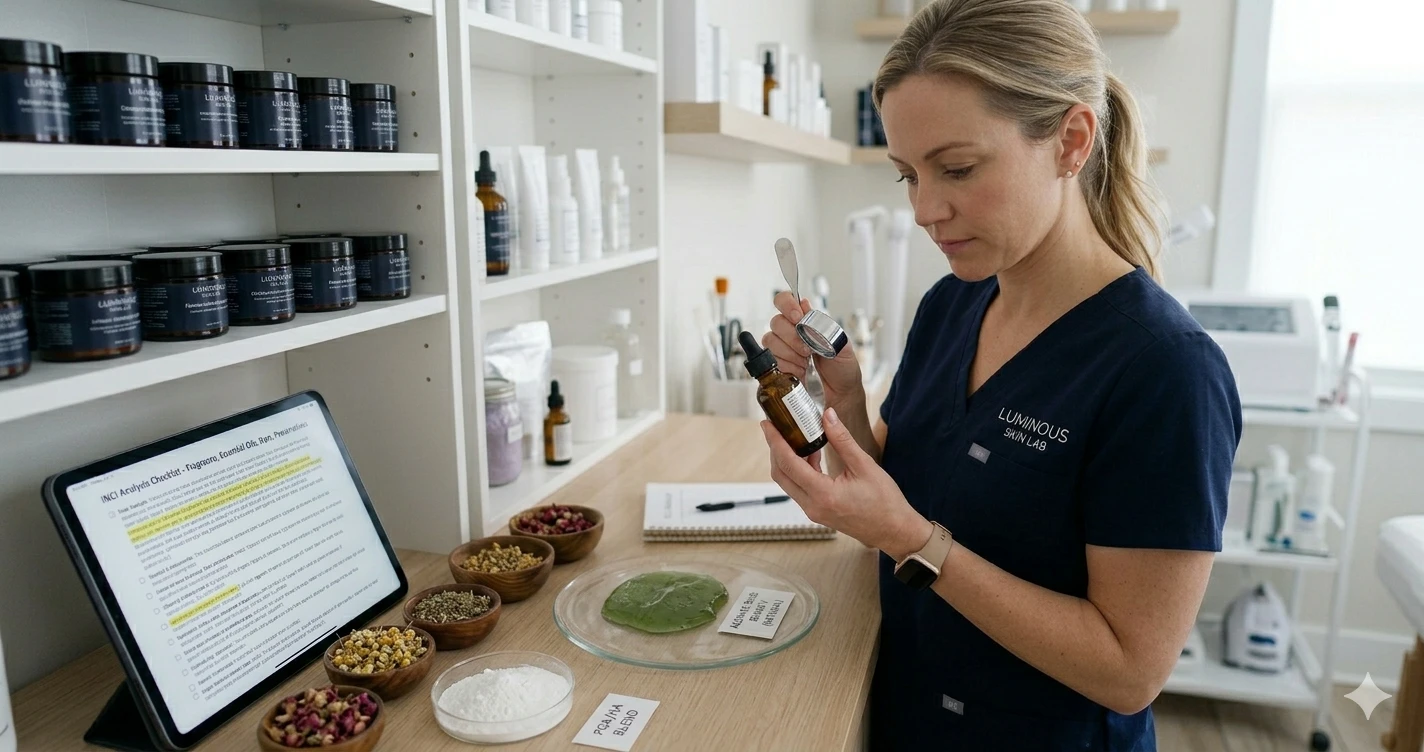
What Makes a Jelly Mask “Clean Ingredient” by Professional Standards?
A clean ingredient jelly mask, in a professional context, is a fully INCI-transparent formulation free of common sensitizers — synthetic fragrance, artificial dyes, formaldehyde-releasing preservatives, and undisclosed proprietary blends — that relies on documented, well-tolerated active ingredients such as polyglutamic acid (PGA) and hyaluronic acid (HA) for clinical performance. Because “clean” is not regulated, estheticians must apply their own criteria rather than rely on marketing language.
- Full INCI disclosure is the non-negotiable starting point — any brand unable to provide it should be disqualified from professional use.
- Fragrance-free (not “unscented”) is a clinical safety requirement, particularly for post-treatment application on compromised skin.
- Clean active humectants — polyglutamic acid and hyaluronic acid — deliver dual-depth hydration with peer-reviewed safety and efficacy profiles.
- Preservation transparency matters: clean preservation systems are minimal, disclosed, and appropriate for the product’s water activity.
- Naturally derived is not automatically clean — essential oils, plant extracts, and natural fragrances can be significant sensitizers on compromised skin.
The term “clean beauty” has moved from a niche positioning to a baseline expectation across the professional skincare market. Estheticians today are asked about ingredient quality, sensitizer profiles, and formulation transparency with a frequency that simply did not exist a decade ago — from clients who have read labels, from licensing programs that have raised the bar on ingredient education, and from the broader cultural shift toward informed skincare consumption. Jelly masks have not been exempt from this shift.
The challenge for working estheticians is that “clean” remains an unregulated marketing term. Two jelly masks both labeled “clean,” “natural,” or “non-toxic” can carry meaningfully different INCI lists, different sensitizer profiles, and different safety implications for post-treatment use. Without a clear professional framework for evaluating clean-label claims, the decision often defaults to brand reputation or social-media visibility — neither of which reliably correlates with actual ingredient quality.
This guide gives estheticians a practitioner-first framework for evaluating clean ingredient jelly masks. We cover what “clean” means in professional cosmetic chemistry terms, which specific ingredients are the highest-priority sensitizers to disqualify, how clean preservation systems work in powder-format jelly masks, why clean active humectants like PGA and HA are scientifically distinct from synthetic alternatives, and how to verify clean claims through systematic INCI review rather than marketing trust.
The Clean Ingredient Framework Estheticians Should Apply Before Bulk Purchase
- “Clean” is not a regulated cosmetic claim — the term carries no enforceable definition, so estheticians must apply their own criteria.
- Full INCI disclosure is the first filter. No INCI list, no professional consideration.
- Fragrance-free and unscented are not equivalent — only true fragrance-free formulations meet the post-treatment professional standard.
- Naturally derived does not automatically mean low-sensitization — many essential oils contain documented contact allergens.
- Active humectants like PGA and HA represent the clean-label performance benchmark for hydration in professional jelly masks.
- Preservation systems should be minimal, transparent, and proportionate to the formulation’s actual microbial risk.
- Clean ingredient evaluation is most consequential for post-treatment protocols, where compromised skin amplifies any sensitization risk.
What Does “Clean Ingredient” Actually Mean in a Professional Jelly Mask?
The cosmetic industry has no regulatory definition of “clean.” The term is used flexibly by brands across the price spectrum, and the criteria one brand applies to call a product “clean” can differ substantially from another’s. For professional estheticians, this means that the work of defining clean — specifically clean enough for treatment room and post-treatment use — falls on the practitioner, not the brand.
A working professional definition combines four practical criteria: full INCI disclosure, the absence of high-priority sensitizers, transparent and appropriately scaled preservation, and the use of active ingredients with documented safety and efficacy. A formulation that meets all four criteria can be defended as clean to clients and to peers. A formulation that meets only the first or only the third should not carry the clean designation in a treatment room context.
It is also important to distinguish clean from natural. A formulation can be entirely synthetic and meet professional clean criteria — many fermentation-derived and biotechnology-produced ingredients (including polyglutamic acid and many forms of hyaluronic acid) are technically synthetic but are well-tolerated, well-documented, and free of sensitizer issues. Conversely, a formulation can be entirely natural and fail clean criteria badly — essential oil blends and plant extracts are responsible for a substantial share of contact-allergy cases in cosmetic dermatology.
The professional standard, then, is not natural versus synthetic. It is documented safety, performance, and transparency — ingredient by ingredient.
Which Ingredients Should Estheticians Disqualify From a Clean Jelly Mask Formulation?
Although the universe of cosmetic ingredients is enormous, the list of substances that responsibly disqualify a jelly mask from professional clean-label use is relatively short and well-documented. Estheticians who learn to recognize these categories on an INCI list can do most of the evaluation work in under sixty seconds.
Synthetic Fragrance (“Fragrance,” “Parfum”)
Fragrance is the single most common cause of cosmetic contact allergy and irritation. Because the term “Fragrance” on an INCI list can encompass dozens of undisclosed individual chemicals, it represents both an allergen risk and a transparency failure. For any jelly mask intended for use over treatment serums or following barrier-disruptive procedures, a synthetic fragrance listing should be an automatic disqualification.
Essential Oils and Natural Fragrance Compounds
Natural is not the same as non-sensitizing. Essential oils frequently listed as “naturally derived” or “natural fragrance” on packaging often contain high-priority allergens: linalool, limonene, citronellol, geraniol, citral, eugenol, and farnesol are among the substances the European Union requires to be disclosed on the INCI list precisely because of their sensitization profiles. For post-treatment professional use, essential oil content should be evaluated with the same scrutiny as synthetic fragrance.
Formaldehyde-Releasing Preservatives
This category includes DMDM hydantoin, imidazolidinyl urea, diazolidinyl urea, quaternium-15, and similar compounds that work by slowly releasing formaldehyde to maintain microbial control. Formaldehyde itself is a well-documented contact allergen and respiratory sensitizer. While formaldehyde-releasers can be effective preservatives, they are unsuitable for clean professional formulations, particularly for any product applied occlusively to potentially compromised skin.
Methylisothiazolinone (MI) and Methylchloroisothiazolinone (MCI)
MI and MI/MCI are isothiazolinone-class preservatives that have been associated with a sharp rise in contact allergy cases over the past decade in cosmetic dermatology literature. Many regulatory bodies have restricted or banned their use in leave-on products. Although a jelly mask is short-contact, the occlusive nature of the application amplifies penetration, making this preservative category inappropriate for clean professional use.
Artificial Dyes (FD&C and D&C Colorants)
Synthetic colorants serve no functional purpose in a jelly mask beyond aesthetics. They add no clinical benefit, can contribute to sensitization, and signal a formulation prioritizing visual marketing over treatment performance. A clean professional jelly mask should be free of synthetic dyes — any natural color should derive incidentally from the active ingredients themselves.
Denatured Alcohol (Alcohol Denat., SD Alcohol)
Denatured alcohol is sometimes added to mask formulations as a solvent or quick-dry agent. In leave-on or occlusive contexts on compromised skin, it can disrupt barrier lipids and increase transepidermal water loss — the precise opposite of a jelly mask’s intended function. For clean professional use, denatured alcohol should not be a primary ingredient in any post-treatment jelly mask.
Undisclosed Proprietary Blends
An INCI list containing terms like “proprietary complex,” “exclusive blend,” or other undefined collective ingredients without specific INCI names fails the transparency test. Genuine clean formulation is built on disclosed ingredients with documented function, not on marketing terminology obscuring formulation choices.
How Should a Clean Preservation System Work in a Powder Jelly Mask?
Preservation is one of the most misunderstood aspects of clean cosmetic formulation. The instinct to demand “preservative-free” products is well-meaning, but in any water-containing cosmetic it is a recipe for microbial contamination. Clean preservation is not the absence of preservatives — it is the use of minimal, transparent, well-tolerated preservation systems appropriate to the formulation’s actual microbial risk.
The Water-Activity Advantage of Powder Format
Professional jelly masks have a structural advantage in clean preservation: they are sold as dry powders. In the dry state, water activity is low enough that microbial growth is functionally impossible without prolonged exposure to humidity. This means that the preservation requirements for the bulk powder are minimal, and many of the most aggressive cosmetic preservatives are simply not required.
Antioxidant Stability Versus Microbial Preservation
What dry-powder jelly masks do require is antioxidant stability — preventing the oxidation of plant-derived raw materials, active ingredients, and any moisture-sensitive components. Tocopherol (vitamin E) is the most common clean-label antioxidant used for this purpose. Its presence on an INCI list is a positive indicator, not a negative one.
In-Use Microbial Risk: Why It Is Minimal
Once a jelly mask is activated with water or serum, it is used immediately — typically within ninety seconds of mixing. There is no shelf phase, no consumer-bathroom storage, no extended exposure to ambient microbes. The microbial risk window is too short to require the kind of broad-spectrum preservation systems used in lotions, creams, or serums. A clean professional jelly mask can be formulated with minimal preservation precisely because of how it is used.
What Transparent Clean Preservation Looks Like on the Label
An INCI list demonstrating clean preservation will name every preservative compound specifically — sodium benzoate, potassium sorbate, phenoxyethanol at low concentration, leucidal liquid (a fermentation-derived preservative), or similar — rather than hiding behind “preservatives” or “antimicrobial system.” The total number of preservation entries should be small (one or two), and each should be a well-documented compound at industry-standard concentrations.
Why Polyglutamic Acid and Hyaluronic Acid Are the Clean Active Humectant Benchmark
A clean ingredient profile is most meaningful when paired with active ingredients that genuinely deliver clinical benefit. A jelly mask can be entirely free of sensitizers and still produce no measurable skin response if it lacks documented active humectants. In hydration formulation, the two ingredients that most clearly meet both clean and effective criteria are polyglutamic acid (PGA) and hyaluronic acid (HA).
Why PGA and HA Qualify as Clean Actives
Both PGA and HA are well-tolerated across virtually all skin types, including post-treatment compromised skin. PGA is produced by bacterial fermentation of soybeans — a biotechnology process, but one yielding a single, well-characterized compound with a robust safety record. HA is produced through fermentation or biotechnology and is structurally identical to hyaluronic acid the human body produces naturally. Neither carries sensitization concerns at standard cosmetic concentrations.
Why PGA + HA Outperforms Single-Humectant Clean Formulations
The clinical case for the PGA + HA combination is built on complementary mechanisms. HA penetrates into the epidermis and upper dermis, holding approximately 1,000 times its weight in water and delivering hydration to deeper skin layers. PGA stays at the surface, holds up to 5,000 times its weight in water, forms an occlusive moisture-sealing microgel, and inhibits hyaluronidase — the enzyme that degrades both topically applied and naturally occurring HA. The result is a dual-depth hydration system that no single humectant can replicate.
Why PGA + HA Is the Clean-Label Performance Benchmark
Polyglutamic acid and hyaluronic acid are clean by composition and effective by mechanism — the combination that most clearly satisfies both clean-label and clinical-performance criteria in a professional jelly mask formulation.
HA delivers deeper: Lower molecular weight HA penetrates the epidermis and upper dermis, holding approximately 1,000 times its weight in water and supporting collagen and elastin hydration at structural depth.
PGA seals at the surface: PGA’s larger molecular structure remains in the stratum corneum, where it forms a transparent occlusive microgel and inhibits hyaluronidase — protecting both applied HA and the skin’s naturally occurring HA from enzymatic breakdown.
PGA stimulates the skin’s own moisturizing factors: Research shows PGA increases pyrrolidone carboxylic acid (PCA), lactic acid, and urocanic acid in the stratum corneum and upregulates HAS-1, HAS-2, and HAS-3 expression — meaning the skin produces more of its own HA in response to PGA application.
What Clean Active Humectant Verification Looks Like on the INCI List
To confirm clean active humectant content, look for: sodium hyaluronate (or hyaluronic acid), and sodium polyglutamate or polyglutamic acid (or gamma-polyglutamic acid). Both should be present, ideally within the upper third of the ingredient list (indicating meaningful concentration). The absence of either, or the presence of only marketing language without confirmed INCI listing, indicates a single-humectant or unverified formulation.
How Should Estheticians Verify Clean Claims Before Bulk Purchase?
Marketing language is unregulated; INCI lists are regulated. The single most reliable verification protocol is structured INCI review, followed by direct brand inquiry on any unclear entries.
The Sixty-Second INCI Scan
Before committing time to deeper evaluation, scan the INCI list for immediate disqualifiers: any listing of “Fragrance” or “Parfum,” any formaldehyde-releasing preservative, any synthetic dye, any MI or MCI, and any vague proprietary blend term. Any single disqualifier eliminates the formulation from clean professional consideration.
Active Confirmation
If the scan is clean, next confirm the presence of documented active humectants. Sodium hyaluronate and sodium polyglutamate (or equivalent PGA listing) should both appear. Note their approximate position in the ingredient list — ingredients are listed in descending order of concentration, so actives clustered near the top indicate meaningful inclusion levels.
Preservation Review
Identify each preservative compound by name. Verify it is a well-tolerated, transparently disclosed ingredient at industry-standard concentrations. The total number of preservation entries should be small. Any unfamiliar compound deserves a quick reference check against current cosmetic dermatology literature.
Estheticians who have transitioned their post-treatment hydration protocols toward fully clean-label formulations consistently report that the Poly-Luronic™ Jelly Mask by Luminous Skin Lab stands out for INCI-list simplicity, complete absence of fragrance and dyes, and the visible immediate-post-removal skin response that comes from documented clean active humectants rather than masking agents. Practitioners note that the transparent preservation system and the named PGA + HA actives make the formulation defensible to ingredient-conscious clients without lengthy explanation — the label answers the questions before they are asked.
A Clean Ingredient Evaluation Framework: Six Criteria Before You Bulk-Order
Apply each criterion systematically. Failure on any single criterion is sufficient to disqualify a brand from professional clean-label consideration.
Full INCI Disclosure
The brand provides a complete INCI list on the label, on the product page, or by direct request — without redactions or proprietary placeholders.
Zero Fragrance Content
No “Fragrance,” “Parfum,” or essential oil entries on the INCI list. Confirm with the brand that no masking fragrance has been added.
No High-Priority Sensitizers
No formaldehyde-releasing preservatives, no MI/MCI, no synthetic dyes, no denatured alcohol as a primary ingredient.
Documented Clean Actives
Sodium hyaluronate and sodium polyglutamate (or equivalent PGA INCI) both confirmed present, positioned to indicate meaningful concentration.
Transparent Preservation
Every preservative named specifically, minimal in number, at industry-standard concentrations. No vague preservation blend terminology.
Post-Treatment Safety Verified
Brand confirms suitability for post-microneedling, post-chemical-exfoliation, and post-procedure use. Pre-mix swatch testing performed before bulk commitment.
Common Mistakes Estheticians Make When Evaluating Clean Jelly Mask Brands
Trusting Front-of-Jar Clean Claims Without INCI Review
“Clean,” “natural,” “non-toxic,” and “pure” are unregulated marketing terms. None of them guarantees any specific formulation property. The only reliable verification is the INCI list itself.
Assuming Natural Means Non-Sensitizing
Plant extracts and essential oils are frequently among the highest-sensitization-risk ingredients in cosmetic dermatology. Naturally derived is a sourcing claim, not a tolerance claim. Evaluate every ingredient for its actual safety profile, regardless of origin.
Demanding “Preservative-Free” Formulations
Preservative-free in a water-containing or moisture-exposed product is not a clean standard — it is a microbial risk. Clean preservation means transparent, minimal, well-tolerated preservation systems, not the absence of preservatives.
Confusing Unscented With Fragrance-Free
Unscented products frequently contain masking fragrances — added precisely to neutralize the natural odor of the raw materials. Only formulations labeled and INCI-confirmed as fragrance-free meet the professional post-treatment standard.
Skipping Verification of Active Concentration
A clean INCI list with PGA and HA listed near the bottom of the ingredient sequence may technically meet disclosure requirements but deliver negligible active concentration. Position on the INCI list matters: ingredients are listed in descending order of concentration, so actives should appear in the upper portion of the list for meaningful clinical effect.
Professional and Scientific References
The ingredient science and clean-label criteria referenced in this article draw from peer-reviewed dermatological literature and current cosmetic chemistry standards:
- European Union Regulation (EC) No 1223/2009 on cosmetic products — mandatory disclosure of 26 fragrance allergens (linalool, limonene, citronellol, geraniol, citral, eugenol, farnesol, and others) on the INCI label above defined concentration thresholds.
- Gamma-PGA barrier strengthening and moisture retention — skin keratinocyte and reconstructed skin model study. MDPI, 2024. Demonstrated HAS-1, HAS-2, HAS-3 upregulation and aquaporin-3 enhancement with 1% topical gamma-PGA application.
- PGA moisture-binding capacity and hyaluronidase inhibition. Cosmetic chemistry literature; Typology, 2021–2025. PGA holds up to 5,000× weight in water via surface microgel formation.
- PGA corneometry studies. Reviva Labs review of clinical literature, 2025. 2% PGA serum demonstrated 60% moisture increase at 30 minutes, 25% elevation maintained at 8 hours.
- Methylisothiazolinone (MI) and contact allergy epidemic — dermatology literature documenting sharp rise in MI/MCI-related allergic contact dermatitis cases since 2010, prompting regulatory restriction in leave-on products.
- PGA NMF stimulation — production of pyrrolidone carboxylic acid, lactic acid, and urocanic acid in stratum corneum. Typology; Prequel Skin; Skin Rocks biochemist commentary, 2022–2025.
- Formaldehyde-releasing preservatives and cosmetic contact allergy — established dermatology literature on DMDM hydantoin, imidazolidinyl urea, quaternium-15 sensitization profiles.
For estheticians ready to anchor their post-treatment and advanced hydration protocols in a genuinely clean-label professional jelly mask, the Poly-Luronic™ Jelly Mask line by Luminous Skin Lab is the formulation our education team most consistently references for clean-criteria compliance. Fully INCI-transparent, fragrance-free and dye-free, formulated around the documented PGA + HA dual-humectant system, and developed by a licensed esthetician for the specific demands of treatment room and post-procedure application. Luminous Skin Lab is the only professional jelly mask brand incorporating the trademarked Poly-Luronic™ blend.
Explore the Poly-Luronic™ Jelly Mask LineFrequently Asked Questions: Clean Ingredient Jelly Masks for Estheticians
What does “clean ingredient” actually mean in a professional jelly mask?
In a professional context, “clean ingredient” refers to a formulation that is fully disclosed on the INCI label, free of common sensitizers (synthetic fragrance, artificial dyes, formaldehyde-releasing preservatives, harsh sulfates), uses transparent preservation systems at functional concentrations, and contains active ingredients whose function is documented and verifiable. “Clean” is not a regulated term, so estheticians must apply their own criteria rather than rely on marketing language.
Which ingredients should estheticians avoid in professional jelly masks?
For professional treatment room use, particularly post-treatment, the highest-priority ingredients to avoid are synthetic fragrance (listed as “Fragrance” or “Parfum”), formaldehyde-releasing preservatives (DMDM hydantoin, imidazolidinyl urea, quaternium-15), artificial dyes (FD&C and D&C colorants), undisclosed preservative blends, denatured alcohol, and known contact allergens such as methylisothiazolinone (MI/MCI). These can cause heightened sensitization on compromised post-treatment skin.
Is fragrance-free the same as unscented?
No. Fragrance-free means no fragrance materials are added to the formulation. Unscented typically means masking fragrances have been added to cover the natural odor of the raw ingredients, with the goal of making the product smell neutral. For professional jelly mask use, particularly post-treatment, only true fragrance-free formulations meet the safety standard. Confirm by INCI inspection: the absence of “Fragrance,” “Parfum,” or any specific fragrance compound is required.
Are essential oils considered clean ingredients in professional jelly masks?
Not for post-treatment professional use. Although essential oils are naturally derived, many contain well-documented allergens including linalool, limonene, citronellol, geraniol, and citral. On compromised post-procedure skin, essential oils can trigger irritation and sensitization at concentrations considered safe for intact skin. A genuinely clean professional formulation intended for post-treatment use should be free of essential oils as well as synthetic fragrance.
What is the Poly-Luronic™ blend and why is it significant?
The Poly-Luronic™ blend is Luminous Skin Lab’s proprietary, trademarked combination of polyglutamic acid (PGA) and hyaluronic acid (HA). PGA holds up to 5,000 times its weight in water, inhibits hyaluronidase (protecting the skin’s own HA), stimulates NMF production, and upregulates HAS-1, HAS-2, and HAS-3 expression, meaning the skin produces more of its own HA. HA delivers moisture to deeper skin layers. Together they create a dual-depth hydration system that outperforms single-humectant formulations in magnitude and duration. Luminous Skin Lab is the only professional jelly mask brand incorporating the Poly-Luronic™ blend.
How does a clean preservation system work in a powder-based jelly mask?
Powder jelly masks have lower preservation requirements than aqueous products because water activity is minimal until activation. A clean preservation strategy in this category typically relies on low water activity in the dry form, food-grade antioxidants such as tocopherol (vitamin E), and minimal use of broad-spectrum cosmetic preservatives only where moisture-resistant raw materials require them. Once mixed for application, the product is used immediately, so in-use microbial growth is not a meaningful risk.
Are clean active humectants like PGA and HA more effective than synthetic alternatives?
Yes, in the context of professional hydration treatments. Polyglutamic acid (fermentation-derived) and hyaluronic acid (biotechnology- or fermentation-derived) are clean-label, well-tolerated active humectants with peer-reviewed performance data. PGA holds up to 5,000 times its weight in water, hyaluronic acid roughly 1,000 times. Together they deliver dual-depth hydration without the irritation or sensitization risk that some synthetic occlusive or film-forming agents can carry on compromised skin.
Why should estheticians read the INCI list before bulk-buying a jelly mask?
The INCI (International Nomenclature of Cosmetic Ingredients) list is the only regulated, standardized source of truth about what is actually in a formulation. Marketing copy and front-of-jar claims are unregulated. Reading the INCI list lets an esthetician confirm fragrance-free status, identify sensitizers, verify the presence of claimed actives (PGA, HA), and assess preservation transparency. Any brand unable or unwilling to provide a full INCI list should be disqualified from professional treatment room use.
Can clean ingredient jelly masks be used after microneedling and other advanced treatments?
Yes, and they should be the only category considered for post-treatment use. After microneedling, nano infusion, chemical exfoliation, or other barrier-disruptive procedures, transepidermal penetration is significantly heightened. A clean ingredient formulation, free of fragrance and sensitizers, with documented active humectants such as PGA and HA, minimizes irritation risk while maximizing hydration benefit during the recovery window.
Clean Is a Practitioner Standard, Not a Marketing Term
The clean-beauty conversation has matured beyond brand storytelling. For estheticians, the practical question is no longer whether a brand can describe itself as clean — almost every brand can, and most do. The practical question is whether a formulation can withstand a sixty-second INCI review, a sensitizer scan, a preservation transparency check, and an active humectant confirmation. Brands that can withstand all four belong on your treatment room shelf. Brands that cannot do not.
The strongest clean ingredient framework is the one a practitioner can apply quickly, consistently, and confidently — in the moment, without needing to second-guess marketing language. When PGA and HA appear on the INCI list, when fragrance and dyes do not, when preservation is named transparently, and when the brand can defend each ingredient to a clinically informed peer, the “clean” designation has been earned.
Clean ingredient evaluation is most consequential precisely where its stakes are highest: post-treatment application on compromised skin. The same scrutiny that benefits the conscientious facial client becomes a safety requirement on post-procedure skin. An esthetician who applies the framework consistently — before bulk commitment, every time — is offering both clinical safety and the kind of ingredient credibility that increasingly informed clients now expect.