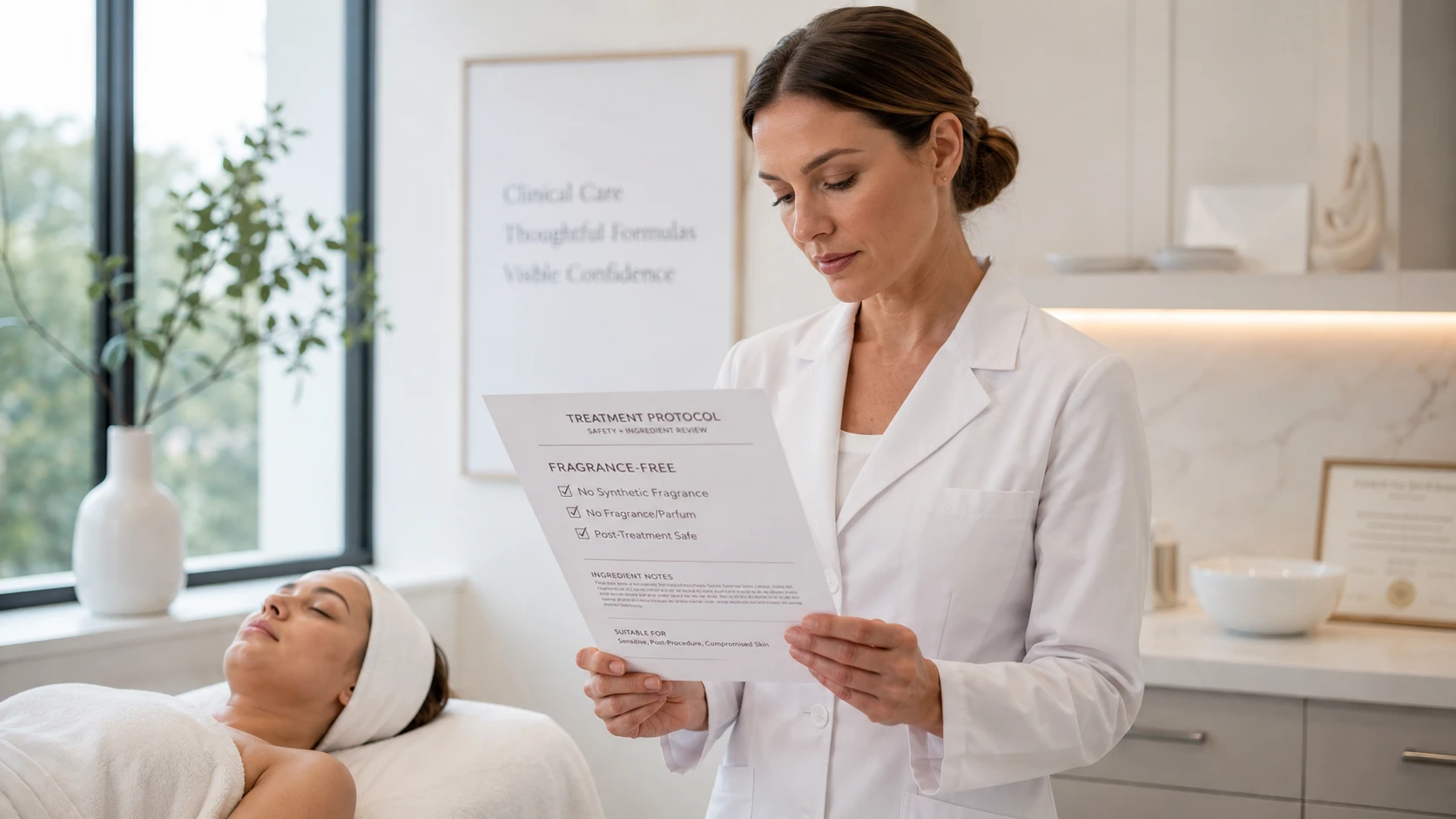
Why Is Fragrance-Free a Professional Safety Standard for Jelly Masks?
Fragrance is the leading cause of cosmetic contact allergy and irritation in dermatology literature. In a professional jelly mask used occlusively over treatment serums or following procedures that compromise the skin barrier — microneedling, chemical exfoliation, nano infusion, extractions, dermaplaning — transepidermal permeability is significantly elevated, and fragrance materials that might be tolerated on intact skin can trigger irritation or sensitization. True fragrance-free formulation, free of synthetic fragrance, essential oils, and masking fragrances, is a clinical safety requirement for post-treatment professional use.
- Fragrance is the single most common cause of cosmetic contact allergy — documented across decades of cosmetic dermatology research.
- Fragrance-free and unscented are not equivalent: unscented products often contain masking fragrances; fragrance-free contains no fragrance materials at all.
- Essential oils and “natural” fragrance materials carry the same or higher sensitization risk than synthetic fragrance.
- The EU mandates disclosure of 26 fragrance allergens by name on the INCI label — estheticians can use this list as a verification reference.
- For post-treatment occlusive application, the professional standard is binary: fully fragrance-free or not suitable for use following barrier-disruptive procedures.
Fragrance is among the oldest sensory cues in skincare. It is also, by a meaningful margin, the most common cause of cosmetic contact allergy and irritation across decades of dermatology research. For estheticians working with treatment room jelly masks — particularly in post-procedure recovery, post-extraction protocols, and any application following barrier-disruptive treatment — this combination of cultural familiarity and clinical risk makes fragrance one of the most important ingredient categories to understand and to evaluate critically.
The conventional spa instinct toward pleasant scents is built into client expectations. A jelly mask that smells of nothing at all can feel, to a client unfamiliar with professional formulation logic, like a less luxurious experience. The professional’s job is to recognize that this expectation is sensory, not clinical — and that on compromised skin, the absence of fragrance is precisely what allows the formulation to do its job without complication.
This guide gives estheticians a clear, science-grounded framework for understanding fragrance-free jelly masks: what the term actually means, why fragrance sensitization is amplified in post-treatment occlusive applications, how to distinguish fragrance-free from unscented, which specific ingredients to identify on INCI labels, and how to communicate the value of fragrance-free protocols to clients who arrive expecting a scented experience.
What Estheticians Must Know About Fragrance-Free Jelly Masks
- Fragrance-free is a clinical safety standard for post-treatment occlusive application — not a stylistic preference or marketing trend.
- Fragrance is the leading cause of cosmetic contact allergy across dermatology literature.
- Unscented frequently means “masking fragrance added.” Only fragrance-free means “no fragrance materials present.”
- Essential oils are fragrance materials. Naturally derived does not equal non-sensitizing.
- The 26 EU-declared fragrance allergens are a practical reference for INCI scanning.
- Compromised post-treatment skin amplifies sensitization risk — the standard cannot be relaxed for advanced protocols.
- Fragrance-free formulations preserve, not diminish, clinical performance.
What Does “Fragrance-Free” Actually Mean in Professional Cosmetic Formulation?
The term fragrance-free, when applied with formulation integrity, means that no fragrance materials — synthetic or natural — have been added to the product for scenting purposes. There is no “Fragrance” entry on the INCI label, no “Parfum” entry, no listed essential oils added as fragrance, and no masking fragrance designed to neutralize the natural odor of the raw materials. The product may have a faint characteristic smell reflecting only its functional ingredients — that residual odor is not fragrance, because nothing has been added to alter or supplement it.
The Distinction From Unscented
Unscented is a different concept entirely, despite frequent confusion in consumer marketing. An unscented product is one that smells of nothing in particular — but this scent-neutral result is often achieved by adding masking fragrances that cancel out the natural odor of the formulation’s raw materials. A masking fragrance is still fragrance. It is still a sensitization risk. And it is still required to appear on the INCI label under the umbrella term “Fragrance” or “Parfum.”
For estheticians evaluating products for post-treatment professional use, this distinction is operationally critical. An unscented jelly mask may contain fragrance materials. A fragrance-free jelly mask, properly formulated, does not. The only reliable way to verify which category a specific product falls into is INCI inspection — not marketing language on the front of the jar.
What “Naturally Scented” or “Lightly Scented” Means
Any product labeled “naturally scented,” “lightly scented,” “gently scented,” or with similar softening language contains fragrance materials. The qualifier (light, gentle, natural) is a marketing modifier; it does not change the substance present. From a clinical safety standpoint, the relevant question is not how much fragrance is present, but whether any fragrance is present at all — because sensitization can occur at very low concentrations, particularly on compromised skin.
Why Fragrance Sensitization Is Amplified in Post-Treatment Occlusive Application
Understanding why the professional fragrance-free standard cannot be relaxed for post-treatment use requires a brief look at how skin behaves after barrier-disruptive procedures and how that altered state interacts with topically applied fragrance materials.
Post-Treatment Permeability: The Physiological Reality
Any treatment that disrupts the stratum corneum — microneedling, nano infusion, chemical exfoliation, aggressive extraction, dermaplaning, certain laser procedures — substantially increases transepidermal penetration of topically applied substances. This altered permeability is a desired effect: it is precisely why post-treatment serums and active ingredients can deliver enhanced results during the recovery window. But it also means that any sensitizer applied during this window has a magnified pathway into the deeper skin layers, where it can contact a higher density of immune cells and nerve endings.
Occlusion Amplifies the Effect
A jelly mask applied as a set occlusive layer over already-permeable skin creates a sustained, protected window during which the formulation’s ingredients remain in close contact with the skin — without evaporation, without dilution, and without disturbance. Any sensitizing substance present is essentially held in place against compromised skin for ten to twenty minutes. Concentrations otherwise considered safe for casual leave-on application can produce a meaningfully different response under these conditions.
The Sensitization Cascade
Once contact sensitization to a particular fragrance compound is established, it is permanent. Future exposure to even trace amounts of that compound — in any product, from any brand — can trigger an inflammatory response. Each fragrance exposure on compromised post-treatment skin is therefore not just a single-treatment risk; it carries the potential to create a lifetime sensitivity that constrains the client’s product choices indefinitely. This is the clinical reason fragrance-free is treated as a non-negotiable professional standard rather than a stylistic preference.
Why Fragrance Risk Is Amplified on Post-Treatment Skin
Fragrance materials are the most documented cause of cosmetic contact allergy in dermatology literature. On post-treatment skin, three converging factors amplify this risk: heightened transepidermal permeability, sustained occlusive contact during mask application, and immune-system reactivity from the underlying procedure itself.
Permeability: Post-microneedling and post-exfoliation skin allows ingredient penetration at multiples of intact-skin baseline — meaning fragrance compounds reach deeper, contact more immune cells, and amplify any sensitizing capacity.
Occlusion: A set jelly mask holds ingredients in sustained contact with skin for 10 to 20 minutes, with no evaporation or dilution. Sensitizer exposure time is effectively maximized.
Active hydration alternatives exist: Polyglutamic acid and hyaluronic acid deliver measurable hydration through documented mechanisms with no sensitization burden — making fragrance entirely redundant to clinical performance.
The Cumulative Exposure Issue
An esthetician working with multiple clients per day across multiple weeks performs hundreds of fragrance exposure events annually. Even if any single exposure carries a low individual sensitization probability, the cumulative risk profile of routine fragrance use across post-treatment populations is substantively higher than single-application analysis suggests. Fragrance-free protocols reduce both the individual-client risk and the population-level cumulative exposure.
How to Verify Fragrance-Free Status on a Professional Jelly Mask Label
The good news for estheticians is that fragrance verification is one of the most straightforward INCI-review tasks. The regulatory architecture surrounding fragrance disclosure is mature and standardized, and a thirty-second label scan can confirm or disqualify a fragrance-free claim.
Primary Disqualifiers: “Fragrance,” “Parfum,” “Aroma”
Any INCI entry listed as “Fragrance,” “Parfum,” or “Aroma” indicates a proprietary fragrance compound or blend, the specific chemical composition of which is not disclosed. This single entry can contain dozens of individual chemicals, any of which may be sensitizers. The presence of any of these terms on the INCI list is an immediate disqualification for fragrance-free claims, regardless of front-of-jar marketing language.
The 26 EU-Declared Fragrance Allergens
Under European Union cosmetic regulation, twenty-six specific fragrance compounds must be disclosed by name on the INCI label whenever they exceed defined concentration thresholds. These compounds are individually documented sensitizers. Their presence on an INCI list indicates fragrance material, regardless of whether the product is marketed as fragrance-free.
Estheticians should be able to recognize the most common entries on this list at a glance: linalool, limonene, citronellol, geraniol, citral, eugenol, farnesol, hydroxycitronellal, isoeugenol, cinnamal, cinnamyl alcohol, hexyl cinnamal, butylphenyl methylpropional, alpha-isomethyl ionone, amyl cinnamal, benzyl alcohol, benzyl benzoate, benzyl cinnamate, benzyl salicylate, coumarin, methyl 2-octynoate, anise alcohol, oakmoss extract (evernia prunastri), and treemoss extract (evernia furfuracea). Memorization of the full list is not required, but pattern recognition of the most common entries makes label review fast and reliable.
Essential Oil Names as Fragrance Indicators
Essential oils listed by their botanical INCI name — lavandula angustifolia (lavender) oil, citrus limon (lemon) peel oil, mentha piperita (peppermint) oil, melaleuca alternifolia (tea tree) leaf oil, and similar — are fragrance materials, regardless of how the product is marketed. Their presence disqualifies fragrance-free claims for clinical post-treatment use.
Does Fragrance-Free Formulation Compromise Clinical Performance?
One of the most persistent misconceptions about fragrance-free professional jelly masks is that they must sacrifice something — sensory appeal, perceived luxury, or even clinical efficacy — in exchange for fragrance elimination. This concern reflects a misunderstanding of what fragrance actually contributes to a clinical formulation.
Fragrance Has No Clinical Function
Fragrance materials are sensory ingredients. They are added to evoke a scent experience, manage the natural odor of raw ingredients, or align the product’s perceived character with a brand identity. None of these functions contributes to the clinical performance of a jelly mask: hydration delivery, occlusive sealing, cooling effect, removal integrity, post-application skin response. Removing fragrance does not change any of these performance metrics.
Active Hydration Is Independent of Fragrance Status
The clinical performance of a professional jelly mask is determined by its active ingredients and structural formulation. The PGA and HA dual-humectant system — polyglutamic acid holding up to 5,000 times its weight in water and inhibiting hyaluronidase, hyaluronic acid penetrating into deeper skin layers and holding 1,000 times its weight — performs the same in a fragrance-free formulation as in a fragranced one. Hydration outcomes, NMF stimulation, HAS-1/2/3 upregulation, and aquaporin-3 enhancement are independent of fragrance content.
Sensory Experience Can Be Designed Without Fragrance
The client experience of a jelly mask is shaped primarily by visible mixing, cooling sensation, set characteristics, removal integrity, and immediate post-removal skin appearance — not by scent. Estheticians who have transitioned to fragrance-free protocols consistently report that the cooling and tactile experience of a well-formulated jelly mask remains a highly memorable client moment, and that the absence of fragrance is rarely commented on once the broader sensory and outcome experience is in place. Client education on why fragrance-free was selected typically reframes the perceived “loss” as a sign of clinical sophistication.
Estheticians integrating Poly-Luronic™ Jelly Masks by Luminous Skin Lab into post-treatment hydration protocols consistently report that the complete absence of fragrance is a frequently positive talking point with ingredient-conscious clients — particularly clients with documented fragrance sensitivities or histories of post-procedure reactions. Practitioners note that the immediate-post-removal hydration response from the PGA + HA active system is the sensory moment clients remember, and that the fragrance-free designation reinforces clinical credibility rather than diminishing perceived luxury. The fragrance-free protocol becomes a differentiator, not a compromise.
The Fragrance-Free Verification Checklist: Six Criteria Before You Approve a Brand
Apply each criterion systematically. Failure on any single criterion disqualifies the formulation from fragrance-free professional standing.
INCI “Fragrance” / “Parfum” Scan
Confirm the INCI list contains no entry for “Fragrance,” “Parfum,” or “Aroma.” Any single entry of these terms is an automatic disqualification.
EU Declared Allergen Scan
Scan for the 26 EU-declared fragrance allergens by name — linalool, limonene, citronellol, geraniol, citral, eugenol, and similar. Any single allergen listing indicates fragrance content.
Essential Oil Identification
Identify any botanical oil INCI names (lavandula, citrus, mentha, melaleuca, etc.). Essential oils are fragrance materials regardless of natural-derivation marketing.
Masking Fragrance Confirmation
Ask the brand directly whether any masking fragrance has been added to neutralize raw-material odor. Vague answers should be treated as disqualifying.
Marketing Language Review
“Lightly scented,” “gently scented,” “naturally scented,” and “subtle aroma” all indicate fragrance content. Only “fragrance-free” on packaging meets the standard.
Post-Treatment Suitability Confirmation
Brand confirms in writing that the formulation is fragrance-free and suitable for post-microneedling, post-exfoliation, and other barrier-disruptive procedures.
How Should Estheticians Communicate Fragrance-Free Selection to Clients?
The professional case for fragrance-free formulation is clinically airtight. The communication case can be subtler — particularly with clients who arrive expecting a scented spa experience.
Lead With Safety, Not Restriction
The most effective client framing positions fragrance-free as a higher clinical standard rather than as something the client is being denied. “The mask we use is fragrance-free because that’s the safety standard for skin in any state of recovery” lands very differently from “sorry, we don’t have a scented option.” The first frame establishes professional credibility; the second positions fragrance-free as a deficiency.
Use the Permeability Explanation
A brief, accurate explanation of why post-treatment skin is more reactive to fragrance — that the barrier is temporarily more permeable, that any sensitizer applied during this window has amplified pathway access, and that one sensitization event can create a lifetime sensitivity — reframes the entire conversation. Most clients respond positively when the underlying clinical reasoning is made clear; they recognize that the practitioner is protecting them, not depriving them.
Invest the Sensory Experience Elsewhere
Practitioners who have transitioned to fragrance-free protocols frequently invest more deliberately in the non-scent sensory elements of the treatment: temperature management of the mask before application, tactile precision in application technique, ambient sound, treatment table comfort, and the visible spectacle of removal in a single intact piece. These elements create the luxury impression that scent was previously expected to create — without the clinical risk.
Common Mistakes Estheticians Make When Evaluating Fragrance-Free Claims
Trusting “Fragrance-Free” Front-of-Jar Without INCI Verification
“Fragrance-free” is an unregulated marketing term. Some brands use it accurately. Others use it in formulations that contain essential oils, masking fragrances, or declared allergens. The only reliable verification is direct INCI inspection. Never accept the marketing claim alone for post-treatment professional use.
Treating Essential Oils as Acceptable Because They Are Natural
Essential oils are leading contributors to cosmetic contact allergy in dermatology literature. Lavender, citrus, peppermint, tea tree, and similar essential oils contain documented allergens at meaningful concentrations. A formulation containing essential oils is not fragrance-free, no matter how the brand positions its natural sourcing.
Assuming Low Fragrance Concentration Means Low Risk
Sensitization can occur at very low fragrance concentrations, particularly on compromised skin under occlusive application. Risk does not scale linearly with concentration once a sensitizing substance is present. The professional standard is binary, not a sliding scale.
Confusing “Hypoallergenic” With “Fragrance-Free”
“Hypoallergenic” is another unregulated marketing term that does not guarantee fragrance-free status. Many products labeled hypoallergenic contain fragrance materials, including EU-declared allergens. Fragrance-free is the specific designation that matters — hypoallergenic is too imprecise for professional decision-making.
Skipping Fragrance Verification for Established Brand Names
Brand reputation does not exempt a formulation from INCI review. Some long-established professional brands continue to include fragrance materials in their core jelly mask lines. The verification protocol applies equally regardless of how recognized or respected the brand is. INCI list, every time.
Professional and Scientific References
The sensitization science and regulatory framework referenced in this article draw from cosmetic dermatology literature and current EU and US cosmetic regulation:
- European Union Regulation (EC) No 1223/2009 on cosmetic products — mandatory disclosure of 26 fragrance allergens on the INCI label above defined concentration thresholds. Includes linalool, limonene, citronellol, geraniol, citral, eugenol, farnesol, hydroxycitronellal, isoeugenol, cinnamal, and others.
- Cosmetic contact allergy and fragrance — established dermatology literature documenting fragrance as the leading cause of cosmetic-induced allergic contact dermatitis across decades of patch-testing studies.
- Essential oils and contact sensitization — dermatology literature on lavandula, citrus, mentha, melaleuca, and other essential oils as documented contact allergens in cosmetic dermatology.
- Post-procedure skin permeability — established research on transepidermal penetration following microneedling, chemical exfoliation, and other barrier-disruptive procedures.
- Gamma-PGA barrier strengthening and moisture retention — skin keratinocyte and reconstructed skin model study. MDPI, 2024. Demonstrated HAS-1, HAS-2, HAS-3 upregulation and aquaporin-3 enhancement with 1% topical gamma-PGA application.
- PGA moisture-binding capacity and hyaluronidase inhibition. Cosmetic chemistry literature; Typology, 2021–2025. PGA holds up to 5,000× weight in water via surface microgel formation.
- PGA corneometry studies. Reviva Labs review of clinical literature, 2025. 2% PGA serum demonstrated 60% moisture increase at 30 minutes, 25% elevation maintained at 8 hours.
For estheticians ready to align their post-treatment and sensitive-skin protocols with a true fragrance-free professional standard, the Poly-Luronic™ Jelly Mask line by Luminous Skin Lab is the formulation our education team most consistently references in clinical fragrance-free contexts. Fully INCI-transparent, free of synthetic fragrance, essential oils, and masking agents, and formulated around the documented PGA + HA dual-humectant system — designed by a licensed esthetician specifically for the demands of post-procedure and sensitive-skin treatment room application. Luminous Skin Lab is the only professional jelly mask brand incorporating the trademarked Poly-Luronic™ blend.
Explore the Poly-Luronic™ Jelly Mask LineFrequently Asked Questions: Fragrance-Free Jelly Masks for Professional Use
What does fragrance-free actually mean in a professional jelly mask?
Fragrance-free means no fragrance materials have been added to the formulation for scenting purposes. This includes synthetic fragrance compounds (typically labeled “Fragrance” or “Parfum” on the INCI list), essential oils added for scent, and natural fragrance blends. A true fragrance-free professional jelly mask will have no fragrance-related entries on the INCI list, no masking fragrance, and a neutral or mild characteristic odor reflecting only its functional raw materials.
Is fragrance-free the same as unscented in cosmetic labeling?
No. Unscented usually means a masking fragrance has been added specifically to neutralize the natural odor of the formulation’s raw materials, with the goal of creating a scent-neutral product. Fragrance-free means no fragrance materials are present at all. For professional treatment room use, particularly post-treatment, only fragrance-free formulations meet the safety standard. The two terms are routinely confused in consumer marketing.
Why is fragrance-free so important specifically for post-treatment jelly mask use?
After treatments that compromise the skin barrier (microneedling, nano infusion, chemical exfoliation, extractions, dermaplaning) transepidermal permeability is significantly elevated. Substances that would be tolerated on intact skin can penetrate deeper, contact more nerve endings and immune cells, and trigger irritation or sensitization at concentrations otherwise considered safe. Fragrance, the leading cause of cosmetic contact allergy, is the highest-priority category to eliminate from any post-treatment occlusive application.
Which specific fragrance ingredients should estheticians watch for on an INCI list?
The most important entries to identify are “Fragrance” or “Parfum” (synthetic fragrance blend, undisclosed composition), and the EU’s 26 declared fragrance allergens, including linalool, limonene, citronellol, geraniol, citral, eugenol, farnesol, hydroxycitronellal, isoeugenol, cinnamal, and benzyl salicylate. Any of these listed as a discrete ingredient indicates fragrance content. Essential oil names (lavender oil, citrus oil, peppermint oil) also signal fragrance content, even when marketed as “naturally derived.”
What is the Poly-Luronic™ blend and why is it significant?
The Poly-Luronic™ blend is Luminous Skin Lab’s proprietary, trademarked combination of polyglutamic acid (PGA) and hyaluronic acid (HA). PGA holds up to 5,000 times its weight in water, inhibits hyaluronidase (protecting the skin’s own HA), stimulates NMF production, and upregulates HAS-1, HAS-2, and HAS-3 expression, meaning the skin produces more of its own HA. HA delivers moisture to deeper skin layers. Together they create a dual-depth hydration system that outperforms single-humectant formulations in magnitude and duration. Luminous Skin Lab is the only professional jelly mask brand incorporating the Poly-Luronic™ blend.
Can a jelly mask be naturally derived and still cause fragrance sensitization?
Yes. Essential oils and natural fragrance compounds are leading causes of contact allergy in cosmetic dermatology. Lavender, citrus, rose, peppermint, eucalyptus, tea tree, and many other natural fragrance materials contain documented allergens that the European Union requires to be disclosed by name on the INCI label above defined concentration thresholds. Naturally derived is a sourcing claim, not a tolerance claim. For post-treatment use, essential oils should be evaluated with the same scrutiny as synthetic fragrance.
How can an esthetician verify a brand’s fragrance-free claim?
Request the full INCI list and confirm: no “Fragrance” or “Parfum” entries, no listed essential oils, no individually declared allergens (linalool, limonene, citronellol, and similar), and no “natural fragrance” designation. Then ask the brand directly whether any masking fragrance has been added to neutralize the odor of raw materials. Brands operating at professional standard will answer directly. Vague or evasive answers should be treated as a disqualification for post-treatment use.
Are “lightly scented” or “gently scented” professional jelly masks acceptable for post-treatment use?
No. Any added scent (whether described as light, gentle, mild, subtle, or otherwise) introduces fragrance materials to the formulation. On compromised post-treatment skin, even minimal fragrance concentration can trigger sensitization. The professional post-treatment standard is binary: fully fragrance-free or not appropriate for post-treatment application. There is no middle ground for treatment room use following barrier-disruptive procedures.
Does fragrance-free formulation affect the clinical performance of a jelly mask?
No. Fragrance has no clinical function in a jelly mask. It is purely a sensory and marketing element. A fragrance-free formulation built around documented active humectants such as polyglutamic acid (PGA) and hyaluronic acid (HA) delivers the same or superior hydration outcomes compared to a fragranced formulation. Removing fragrance reduces sensitization risk without sacrificing any clinical or workflow performance.
Fragrance-Free Is the Clinical Standard, Not the Compromise
The fragrance-free conversation has progressed well past consumer preference. For estheticians working in post-treatment protocols, advanced hydration facials, and sensitive-skin contexts, fragrance-free is a clinical safety standard with decades of dermatology research behind it. The risk of fragrance on compromised skin is documented. The mechanism of post-treatment permeability is established. The lifetime consequence of contact sensitization is well understood. None of these is in serious dispute in the cosmetic dermatology literature.
The work for the professional esthetician, then, is not to debate whether fragrance-free is the right standard — it is. The work is operational: verifying every brand systematically, distinguishing fragrance-free from unscented through INCI inspection, recognizing essential oils as fragrance materials regardless of natural sourcing, and communicating the underlying clinical reasoning to clients in language that positions fragrance-free as professional rigor rather than restriction.
A jelly mask without fragrance is not a jelly mask without value. It is a jelly mask designed around active hydration mechanisms — polyglutamic acid, hyaluronic acid, and the dual-depth hydration system they create together — rather than around sensory marketing. For the treatment room, for the post-procedure recovery window, and for the increasingly ingredient-conscious professional client base, that is the formulation choice that consistently performs and consistently protects.