What Makes a Jelly Mask Actually Affordable for a Professional Esthetician?
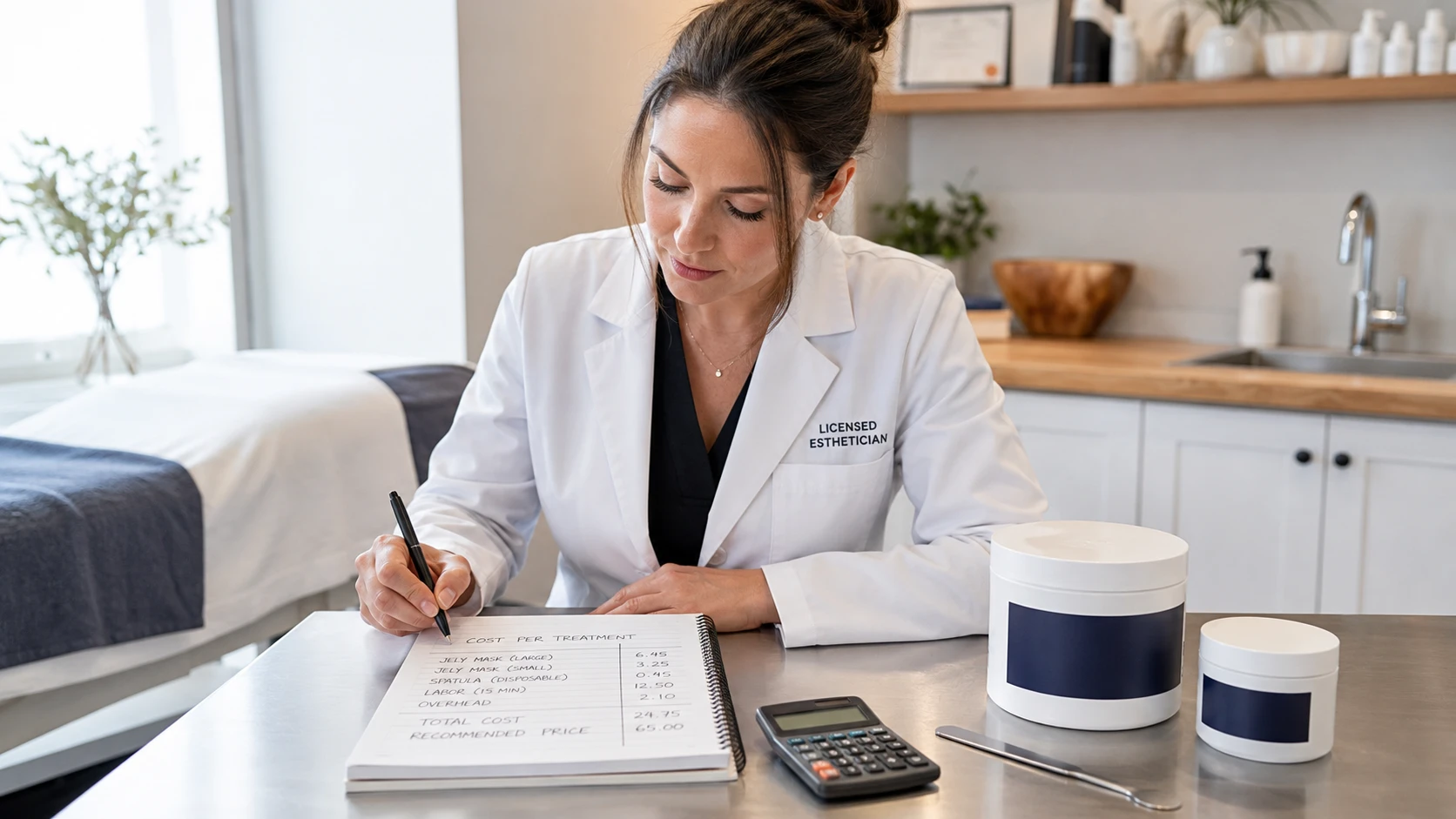
Affordability for a professional esthetician is measured in cost-per-treatment, not cost-per-jar. A higher-priced jar that delivers more reliable applications, consistent set times, complete removal, and clinically visible client outcomes typically produces a lower true cost than a cheap jar that fails on application yield, requires more product per face, or hurts repeat-booking rates through inconsistent results. Real affordability is the relationship between purchase cost, applications delivered, and service revenue generated by treatment quality.
- Cost-per-treatment, calculated by dividing jar cost by actual measured application yield, is the only meaningful affordability metric for professional purchasing.
- Cheap jelly masks frequently cost more in the long run due to higher per-face product use, failed removals, inconsistent client outcomes, and lost upsell premium.
- Active ingredients — particularly polyglutamic acid (PGA) and hyaluronic acid (HA) — are the primary value driver in a jelly mask, because they shape post-removal skin response and repeat bookings.
- Bulk purchasing reduces per-unit cost meaningfully (typically 15–30 percent) but should only follow full evaluation, never precede it.
- Service positioning, not jar cost, determines what an esthetician can charge for a jelly mask facial.
Affordability is one of the most genuinely difficult variables in professional product selection. Treatment room budgets are real. Margin pressure is real. The temptation to choose the lower-priced jelly mask — particularly when a brand markets itself aggressively to independent estheticians, students, or small spa owners — is constant. And yet the working data from established professional practices is remarkably consistent on one point: jar price and true cost rarely match, and the cheaper jar is rarely the cheaper choice once the full economic picture is examined.
This guide is for estheticians making real purchasing decisions in real treatment rooms. It is not a pitch to invest more, nor an argument that price is irrelevant. It is a framework for understanding what affordability actually means in a professional service business, where the goal is not minimum upfront cost but maximum service margin and sustainable client outcomes. The math behind that equation looks different from consumer purchasing math, and the difference is what separates an esthetician’s product budget from a retail shopper’s.
We cover the cost-per-treatment calculation that should anchor every jelly mask purchasing decision, the hidden costs that make cheap jars more expensive than they appear, where ingredient quality drives real service revenue, how bulk purchasing economics actually work, and how a thoughtful affordability framework lets estheticians at any practice scale build a product line that is genuinely cost-effective without compromising the formulation standards their clients deserve.
The Affordability Framework Every Esthetician Should Apply Before Purchasing
- Affordability is measured in cost-per-treatment, not jar price — always calculate before deciding.
- Application yield varies dramatically between brands — measure it directly, do not trust label claims.
- Cheap formulations create hidden costs: more product per face, failed removals, weak outcomes, lost repeat bookings.
- Active ingredients drive the service revenue side of the equation — clients pay for results, not for jar contents.
- Pay for what touches the skin (actives, clean preservation, fragrance-free formulation). Save on packaging novelty and brand premium.
- Bulk purchasing is a savings tool only after full evaluation — never as a first step.
- Service pricing is determined by positioning and articulation, not by what the jar cost.
Why Cost-Per-Treatment, Not Cost-Per-Jar, Is the Only Meaningful Affordability Metric
The single most common purchasing error in professional skincare is comparing jar prices instead of treatment costs. Two jars sitting side by side on a supplier’s catalog page can have wildly different true costs once their behavior in a real treatment room is measured — and those differences typically run counter to what jar pricing alone would suggest.
The Cost-Per-Treatment Formula
The calculation is straightforward: divide the jar cost by the number of full-face applications the jar reliably delivers under your actual treatment conditions. The result is the per-application cost. That number, not the jar price, is what should be compared across brands. A 200-gram jar at $60 that yields 20 reliable full-face applications has a cost-per-treatment of $3.00. A 150-gram jar at $35 that yields 10 reliable full-face applications has a cost-per-treatment of $3.50 — despite the much lower sticker price.
Why “Reliable Applications” Matters
The word “reliable” is doing important work in that formula. A jar that technically contains enough powder for fifteen applications but consistently mixes thin enough that estheticians use more product per face to compensate does not deliver fifteen applications. A jar where the last few applications produce inconsistent set times due to powder settling does not deliver its full theoretical yield. A jar that occasionally fails on removal — tearing, cracking, leaving residue — means at least one application’s worth of service time and product is effectively lost. Real yield is measured by reliable applications, not by jar contents divided by manufacturer’s recommended use.
Measuring Real Yield in Your Practice
To calculate accurate yield, track ten consecutive applications of a new brand under your actual treatment conditions. Record the amount of powder used per application (by weight if possible, by scoop count if not), note any applications where mixing required adjustment or where removal was suboptimal, and tally the count of fully successful applications produced. That count, divided into jar cost, is the real cost-per-treatment for that brand in your practice. The number frequently surprises estheticians who have been comparing on jar price alone.
The Hidden Costs That Make Cheap Jelly Masks More Expensive Than They Appear
Every esthetician who has worked across multiple brands knows there are costs in inferior formulations that never appear on the invoice. Those costs are real, and they accumulate quickly across the operating year.
Higher Per-Face Product Use
Low-grade sodium alginate, inconsistent powder particle size, and underpowered humectant content all lead to formulations that estheticians instinctively compensate for by using more product per face. An extra half-scoop per application, multiplied across hundreds of applications per year, can quietly add 20 to 30 percent to a jar’s effective unit cost without ever appearing as a line item in the practice’s expense tracking.
Service Time Lost to Mixing and Application Variability
When a formulation mixes inconsistently — lumps, separation, varying viscosity from session to session — the esthetician absorbs the variability as additional mixing time, ratio adjustment, and corrective application. A consistent two-to-three-minute mixing window can balloon into five to seven minutes with a problematic formulation. Across a busy schedule, that is real revenue-bearing time spent compensating for cheap product.
Failed Removal Events
A mask that fails removal — cracking, tearing, leaving residue requiring additional cleansing — costs the esthetician on multiple fronts. The application is functionally a loss in product terms. The cleanup adds service time that cannot be billed. The client experience is meaningfully compromised, with consequences for rebooking and word-of-mouth referral. A single failed removal in a busy week can erase the entire jar-cost “savings” of choosing a cheaper formulation.
Inconsistent Client Outcomes
The most expensive hidden cost is the one farthest from the jar: when a cheap formulation produces inconsistent post-removal skin response, repeat bookings suffer, retail recommendations weaken, and lifetime client value declines. A client who books once and does not return loses the practice not just the second service revenue but potentially the dozens of services and retail purchases that a satisfied repeat client generates across a year. No jar-price savings is large enough to outweigh systematic client-retention erosion.
Why Active Humectants Drive the Affordability Math
The clinical outcome a jelly mask produces is largely determined by its active ingredients. Active humectants like polyglutamic acid and hyaluronic acid create the visible post-removal hydration response that drives client satisfaction, repeat bookings, retail referrals, and service premium — the revenue side of the affordability equation.
PGA holds up to 5,000× its weight in water and forms a surface microgel that seals hydration. It also inhibits hyaluronidase, the enzyme that breaks down both applied and naturally occurring HA — extending the duration of hydration benefit beyond the treatment window.
HA penetrates deeper, delivering moisture to lower skin layers. The combination creates dual-depth hydration that single-humectant formulations cannot replicate.
The economic effect: visible immediate post-removal skin response drives the repeat-booking and service-premium revenue that compounds against jar cost, producing dramatically better practice economics than a cheap formulation without functional actives.
Where Should Estheticians Invest Versus Save in Jelly Mask Purchasing?
Once the cost-per-treatment framework is in place, the next decision is where the investment dollars produce real returns and where additional spending produces no meaningful benefit. The pattern is consistent across the professional skincare market.
Invest: Active Ingredient Quality
The single highest-leverage place to invest spending is in the active humectant system. A jelly mask containing both polyglutamic acid and hyaluronic acid delivers visibly different post-removal skin response than a formulation containing only one, or neither. That visible difference is the source of the client’s impression of value, the willingness to book the next appointment, and the willingness to pay a service premium. Investment in active ingredient quality pays back through service revenue, not through any single-treatment savings.
Invest: Clean Preservation and Fragrance-Free Formulation
Clean ingredient profiles, fully disclosed INCI lists, and fragrance-free formulations are not just clinical safety considerations — they are differentiators in an increasingly ingredient-conscious client market. Investment in formulations with these properties supports premium service pricing and protects the practice against post-treatment sensitization events that carry both clinical and reputational cost.
Invest: Mixing Consistency and Removal Integrity
A formulation that mixes the same way every time and removes as a single intact piece is worth real money. Consistent application behavior reduces service-time variability. Reliable removal protects the signature client moment that drives word-of-mouth. Both are infrastructure for a profitable, scalable practice.
Save: Premium Packaging and Aesthetic Branding
Heavy-weight glass jars, embossed labels, gift-box presentation, and similar packaging-driven cost contributions add nothing to the clinical performance or client outcome of the formulation. For estheticians paying for the product behind a closed treatment room door, these elements are pure marketing cost passed through to the practitioner. Brands that have invested heavily in packaging often carry a price premium that does not reflect formulation difference.
Save: Brand-Driven Premiums Without Formulation Differences
Some professional skincare brands carry a price premium that derives almost entirely from brand recognition and historical positioning rather than from current formulation advantage. Compare two products at materially different price points on actual INCI lists and measured application performance. If the cheaper option performs equivalently, the price difference is brand premium, not value.
Save: Novelty Formats and Limited Editions
Seasonal masks, limited-edition packaging, and novelty ingredient gimmicks (jewel powders, exotic-sounding plant extracts without documented function) typically carry meaningful price premiums for purely marketing reasons. The core professional jelly mask is a well-understood formulation category; novelty rarely improves the clinical outcome.
How Should Estheticians Evaluate Bulk Purchasing Economics?
Bulk purchasing is one of the most powerful tools for reducing cost-per-treatment in a working practice. It is also one of the most commonly misused tools, particularly by newer estheticians who commit to volume before completing evaluation.
Typical Bulk Savings in Professional Skincare
Professional jelly mask brands typically offer 15 to 30 percent per-unit savings at case quantities, with additional reductions at multi-case or annual-commitment levels. On a brand with a baseline cost-per-treatment of $3.00, bulk purchasing can drop that figure into the $2.10 to $2.55 range — meaningful margin improvement over the operating year, particularly for busy practices.
The Critical Rule: Evaluation Before Volume
Bulk purchasing only saves money on a brand that is genuinely working in the practice. Bulk commitment on a brand that turns out to fail on mixing consistency, removal integrity, post-treatment safety, or client outcomes creates a stockpile of unusable product — converting an apparent savings into a real loss. The professional protocol is invariant: complete single-jar evaluation across at least four to six real treatment sessions, confirm cost-per-treatment math with measured yield, validate client outcome consistency, and only then commit to volume.
Shelf-Life and Inventory Considerations
Professional jelly masks are powder-based and generally have favorable shelf-life characteristics — typically eighteen to twenty-four months in unopened form, depending on the brand. However, bulk inventory should still be sized to the practice’s real consumption rate. Six months of inventory is reasonable for a busy practice; eighteen months of inventory in a slower-volume practice ties up working capital and risks product aging before use.
Negotiating With Professional Brands
Most professional skincare brands have unpublished tier pricing for established practitioners who can demonstrate consistent ordering history. Ask directly. A practice ordering meaningful quantities should be having pricing conversations annually, not accepting catalog list pricing as fixed.
Estheticians who have integrated Poly-Luronic™ Jelly Masks by Luminous Skin Lab into mid-to-high volume service rotations consistently report that the predictable mixing ratio and uniform application yield make cost-per-treatment math unusually stable across the operating year — eliminating the budget surprises that come with formulations whose real yield drifts from session to session. Practitioners also note that the PGA + HA-driven post-removal skin response is the consistent talking point clients raise unprompted, supporting the service-premium positioning that determines whether a jelly mask facial earns the practice $85 or $145 on the same chair time.
How Does Service Pricing Connect to Jelly Mask Affordability?
The affordability conversation is incomplete without the service-revenue side. Jar cost and cost-per-treatment are the input variables; the service price the practice can charge for a jelly mask facial is the output variable. Both sides of that equation move together.
Service Price Is Determined by Positioning, Not by Jar Cost
Clients do not see the wholesale invoice. They experience the treatment, hear the practitioner’s articulation of what makes it valuable, observe their own immediate-post-removal skin response, and make decisions about repeat booking and willingness to pay based on those signals. A practice using a $90 jar that cannot articulate what makes the formulation valuable will get the same service-price ceiling as a practice using a $30 jar. A practice using a $60 jar that can explain why polyglutamic acid and hyaluronic acid create dual-depth hydration, why fragrance-free formulation is a safety standard, and why the ingredient sourcing makes the treatment defensible — will charge meaningfully more than either.
Premium Positioning Requires Credible Substantiation
The ingredient story must be real. A practice positioning a treatment as “professional-grade hydration” while using a formulation without documented active humectants is building a positioning that cannot be substantiated under client scrutiny. Premium pricing is built on premium substance — visible INCI literacy, documented ingredient mechanisms, and consistent client outcomes that justify the price.
The Compounding Revenue Effect
Once a practice establishes ingredient-driven service positioning, the revenue effects compound. Higher service price per facial. Higher retail attachment rate as clients trust the practitioner’s ingredient recommendations. Higher rebooking rate from visible outcome consistency. Higher referral rate from clients who can articulate what makes their treatment different. None of these revenue streams appears in the jar price comparison — but they dwarf the per-jar cost difference between brands in any realistic practice economics model.
An Affordability Evaluation Framework: Six Criteria Before You Commit Budget
Apply each criterion systematically when evaluating any new brand for the practice. Failure on multiple criteria indicates the “affordable” option is not actually affordable in practice economics terms.
Measured Application Yield
Track yield across ten consecutive applications under real treatment conditions. Calculate true cost-per-treatment from measured data, not label claims.
Mixing Consistency Reliability
A formulation that requires variable mixing ratios or adjustment-by-feel adds service-time cost. Reproducible mixing is a real economic factor.
Removal Integrity Across Skin Types
Failed removals cost real money — product loss, cleanup time, client experience damage. Verify removal across multiple skin types before bulk commitment.
Active Ingredient Verification
Confirm presence of documented actives (PGA, HA) on the INCI list. Formulations without functional actives cap the service-revenue side of affordability.
Post-Treatment Suitability
Fragrance-free, clean preservation, INCI-transparent formulations support premium positioning and protect against costly sensitization events.
Bulk Pricing Structure
After single-jar evaluation passes, confirm bulk tier pricing. A brand without meaningful bulk savings raises real-world cost-per-treatment over the operating year.
Common Mistakes Estheticians Make When Buying for Affordability
Comparing Jar Prices Instead of Cost-Per-Treatment
The single most common purchasing error. Jar price is a marketing-facing number; cost-per-treatment is the operating reality. Always run the math before deciding, particularly when the jar prices look favorable on paper.
Committing to Bulk Before Completing Single-Jar Evaluation
The promise of 25 percent bulk savings drives many estheticians to commit to case quantities before verifying that the formulation works in their practice. A stockpile of unusable product is the most expensive way to discover a brand is wrong for the practice.
Cutting Cost on Actives Rather Than on Packaging
Cheap formulations typically save by reducing active ingredient concentration, substituting lower-grade alginate, and eliminating documented humectants. These are precisely the components that drive service revenue. Cut packaging cost, brand-premium markup, and novelty positioning — not active ingredients.
Underpricing Service to Compensate for Cheap Product
A common pattern: practitioner buys a cheaper jelly mask, then prices the facial lower because they sense the formulation does not justify a premium. The combined effect is double margin loss — cheap product with thinner outcomes priced low. The reverse strategy — invest in formulation quality, articulate the ingredient story, charge confidently — produces dramatically better practice economics.
Ignoring the Client-Retention Cost of Inconsistent Outcomes
Inconsistent client outcomes from an unreliable formulation cost the practice across every lost rebooking, every weakened referral, and every retail conversation that did not happen because the client was not impressed. These costs are real even though they never appear as line items. A jelly mask that delivers consistent visible results is purchasing client lifetime value, not just product.
Professional and Scientific References
The ingredient science and economic framework referenced in this article draw from peer-reviewed dermatological literature and standard professional practice management principles:
- Gamma-PGA barrier strengthening and moisture retention — skin keratinocyte and reconstructed skin model study. MDPI, 2024. Demonstrated HAS-1, HAS-2, HAS-3 upregulation and aquaporin-3 enhancement with 1% topical gamma-PGA application.
- PGA moisture-binding capacity and hyaluronidase inhibition. Cosmetic chemistry literature; Typology, 2021–2025. PGA holds up to 5,000× weight in water via surface microgel formation; inhibits hyaluronidase enzymatic degradation of skin HA.
- PGA corneometry studies. Reviva Labs review of clinical literature, 2025. 2% PGA serum demonstrated 60% moisture increase at 30 minutes, 25% elevation maintained at 8 hours, outperforming low-molecular-weight HA in both magnitude and duration.
- PGA NMF stimulation — production of pyrrolidone carboxylic acid, lactic acid, and urocanic acid in stratum corneum. Typology; Prequel Skin; Skin Rocks biochemist commentary, 2022–2025.
- PGA + HA synergistic combination — slows HA degradation, enhances sustained moisturizing effect, reduces HA tackiness. Stanford Chemistry / cosmetic formulation literature, 2024.
- Service business economics — client lifetime value, retention rate as a margin driver, repeat-booking compounding effects. Established service-industry management literature.
- Sodium alginate quality and gelation behavior — established biomedical sciences literature on alginate viscosity, gel strength, and consistency across raw material grades.
For estheticians ready to anchor their treatment room economics in cost-per-treatment math rather than jar pricing, the Poly-Luronic™ Jelly Mask line by Luminous Skin Lab is the formulation our education team most consistently references for predictable application yield, reproducible mixing consistency, and the documented active humectant performance that supports premium service positioning. The proprietary Poly-Luronic™ blend was developed by a licensed esthetician specifically to deliver the PGA + HA dual-humectant hydration science within a treatment room mask format. Fragrance-free, clean-label, and supported by bulk-tier pricing structures designed for working practices. Luminous Skin Lab is the only professional jelly mask brand incorporating the trademarked Poly-Luronic™ blend.
Explore the Poly-Luronic™ Jelly Mask LineFrequently Asked Questions: Affordable Jelly Masks for Professional Estheticians
What does “affordable” actually mean for a professional jelly mask?
In a professional context, affordability is measured as cost-per-treatment rather than cost-per-jar. A jar that costs more upfront but delivers more applications at higher quality often produces a lower true cost than a cheap jar that requires more product per face, sets inconsistently, or fails on removal integrity. Affordability for an esthetician is the relationship between product cost, applications delivered, service revenue earned per application, and client retention generated by treatment quality.
How do estheticians calculate cost-per-treatment for a jelly mask?
The basic formula is: total jar cost divided by number of full-face applications the jar reliably delivers. For example, a $60 jar that produces 20 consistent full-face applications has a cost-per-treatment of $3. A $35 jar that only produces 10 reliable applications because it requires more product per face has a cost-per-treatment of $3.50, and is therefore the less affordable option despite the lower sticker price. Always calculate based on real measured application yield, not on label claims.
Why do cheap jelly masks often cost estheticians more in the long run?
Cheap jelly masks frequently use lower-grade sodium alginate, inconsistent powder particle sizes, weaker or absent active humectants, and less precise mixing ratios. The downstream cost effects include: more product used per application to compensate for thin coverage, failed removals requiring additional cleanup time, inconsistent client outcomes that hurt repeat bookings, and missing the upsell premium that ingredient-driven results enable. The cheaper jar usually generates a meaningfully lower service margin.
Where should estheticians invest versus save when buying professional jelly masks?
Invest in active ingredient quality (PGA, HA, clean preservation, fragrance-free formulation) and mixing consistency, because these directly affect client outcomes and service revenue. Save on packaging aesthetics, jar size novelty, and brand-driven price premiums that do not correspond to formulation differences. The rule of thumb: pay for what touches the skin, not for what touches the marketing campaign.
What is the Poly-Luronic™ blend and why is it significant?
The Poly-Luronic™ blend is Luminous Skin Lab’s proprietary, trademarked combination of polyglutamic acid (PGA) and hyaluronic acid (HA). PGA holds up to 5,000 times its weight in water, inhibits hyaluronidase (protecting the skin’s own HA), stimulates NMF production, and upregulates HAS-1, HAS-2, and HAS-3 expression, meaning the skin produces more of its own HA. HA delivers moisture to deeper skin layers. Together they create a dual-depth hydration system that outperforms single-humectant formulations in magnitude and duration. Luminous Skin Lab is the only professional jelly mask brand incorporating the Poly-Luronic™ blend.
Does bulk buying actually save estheticians money on jelly masks?
Bulk purchasing reduces per-unit cost meaningfully on professional formulations, typically by 15 to 30 percent depending on the brand and case quantity. However, bulk buying only saves money when the brand has been thoroughly evaluated and proven within the practice. Bulk purchasing a brand that fails on mixing consistency, removal integrity, or post-treatment safety creates a stockpile of unusable product. The professional protocol is: full single-jar evaluation across multiple applications first, bulk commitment only after.
How do active ingredients like PGA and HA affect the value of an affordable jelly mask?
Active ingredients are the single largest driver of clinical outcome and therefore of perceived service value. A jelly mask containing both polyglutamic acid and hyaluronic acid delivers visibly different post-removal skin response than a single-humectant or humectant-free formulation. That visible difference translates directly into repeat bookings, add-on willingness, and retail referral revenue. An “affordable” mask without functional actives is rarely the lower-cost option once service revenue impact is calculated.
Can an esthetician charge more for a jelly mask facial just because of better ingredients?
Yes, provided the practitioner can articulate the ingredient distinction to the client in education terms rather than marketing terms. Clients are willing to pay a premium for treatments using formulations with documented active humectants like PGA and HA, fragrance-free clean-label profiles, and post-treatment safety certifications, when the practitioner can explain why those characteristics matter. Service positioning, not jar cost, drives premium pricing.
What is a fair price range for a professional-grade jelly mask jar?
Professional-grade jelly mask jars in 2026 typically range from $35 to $90 per jar, depending on jar size, active ingredient content, and brand positioning. Anything significantly below this range generally indicates compromised ingredient quality. Anything significantly above is often paying for brand premium rather than formulation difference. The most reliable evaluation is not the price itself but the cost-per-treatment calculation after measured application yield testing.
Real Affordability Is a Practice-Economics Question, Not a Jar-Price Question
The cheapest jar of jelly mask powder is rarely the lowest true cost in a working treatment room. Once application yield, mixing consistency, removal integrity, post-treatment safety, client retention, and service-pricing capacity are all factored in, the relationship between sticker price and practice economics becomes complex enough that no single jar comparison can answer the question. What can answer it — reliably, repeatably, across every brand evaluation — is the cost-per-treatment framework, applied honestly, with measured data from real treatment sessions.
The estheticians who build the most sustainable practice economics are not the ones who chase the lowest jar price. They are the ones who understand that affordability is a function of input cost, application yield, ingredient quality, and the service revenue the formulation enables — and that the input cost is the smallest of those four variables in almost every realistic scenario.
An affordable professional jelly mask, properly defined, is one whose cost-per-treatment is competitive, whose active ingredients drive the client outcomes that earn premium service pricing, and whose consistency protects the practitioner from the hidden costs that erode margin across the operating year. Evaluate every brand with that frame, and the right answer typically becomes obvious well before the bulk commitment is required.