What Is the Real Difference Between Professional and Amazon Jelly Masks for Estheticians?
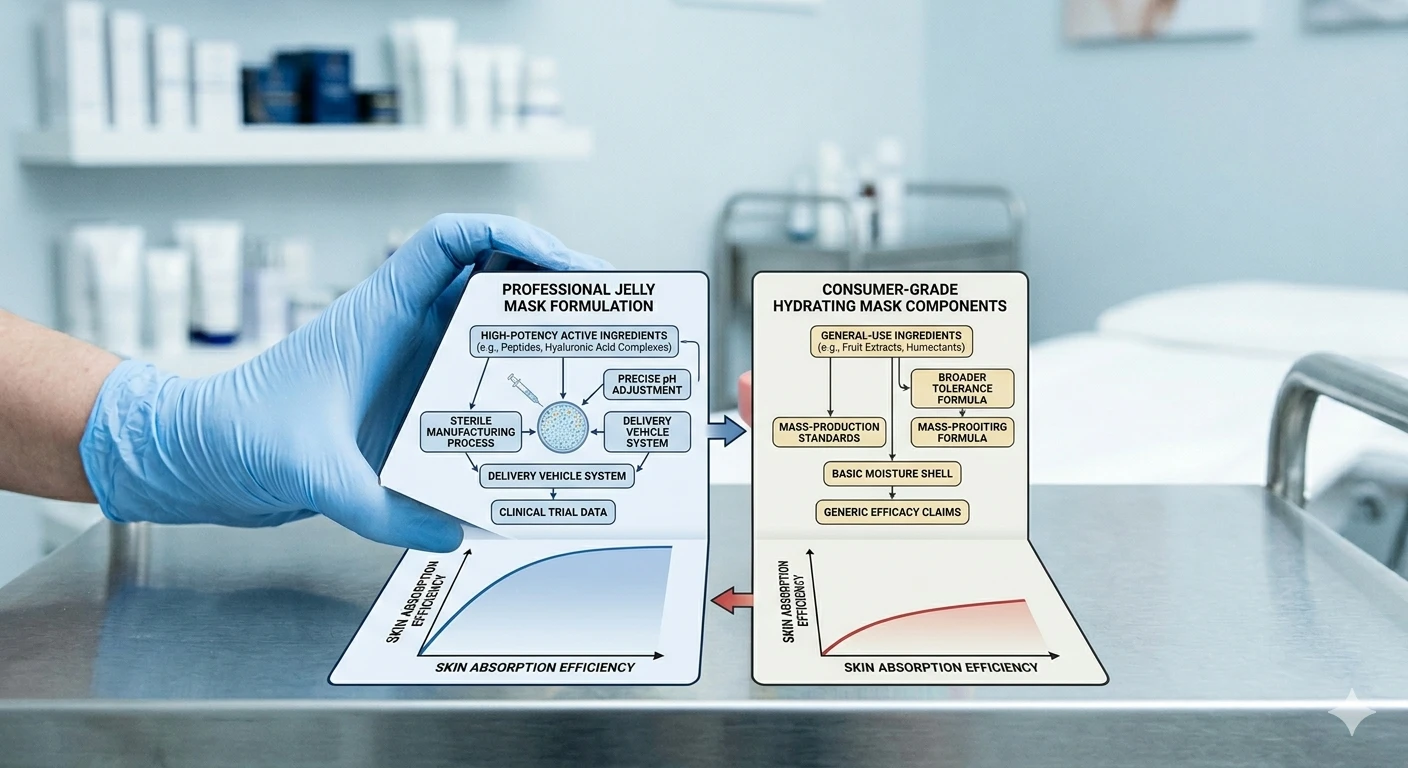
Professional and consumer-market jelly masks differ fundamentally in formulation intent, not just price. Professional-grade formulations are designed for trained esthetician use: full INCI transparency, fragrance-free composition, predictable treatment room behavior, and active humectant systems — often including both polyglutamic acid and hyaluronic acid — specifically engineered for clinical hydration outcomes and post-treatment protocol compatibility. Consumer jelly masks sold through Amazon and retail channels are designed for home use appeal, prioritizing sensory experience and price accessibility over ingredient quality, clinical transparency, or professional safety standards.
- Formulation intent is the core difference: professional jelly masks are designed for clinical protocol use; consumer products are designed for home consumer appeal. These are not the same product at different price points.
- Ingredient transparency is a fundamental professional requirement — consumer jelly masks routinely omit or obscure INCI disclosure that any licensed professional should demand before application.
- Synthetic fragrance in consumer jelly masks creates meaningful safety risk when applied occlusively to post-treatment, sensitive, or reactive skin in a professional treatment context.
- The advanced dual-humectant PGA + HA system found in leading professional formulations — delivering 5,000× water binding, hyaluronidase inhibition, and HA synthase upregulation — is absent from virtually all consumer-market alternatives.
- Using a consumer-grade product in a licensed professional setting is not a cost-saving measure — it is a clinical standard of care departure with liability implications.
- Manufacturing accountability, batch consistency, and supply chain traceability differ substantially between professional brands and consumer-market alternatives.
The growth of the professional jelly mask category has been accompanied by a parallel expansion of consumer-grade jelly mask products sold through Amazon, beauty retailers, and general online platforms. The visual similarity between these products — all powder-based, all set into a gel layer, all removed as a peel — creates a surface-level impression that the category is essentially uniform and that the only meaningful variable is price. That impression is incorrect, and for licensed estheticians, acting on it creates real professional risk.
The differences between professional-grade jelly masks and their consumer-market counterparts begin at the formulation design stage and extend through ingredient quality, manufacturing standard, INCI transparency, post-treatment safety, and the advanced humectant science that determines whether a mask delivers a genuine clinical hydration outcome or simply a pleasant sensory experience. Price is a downstream reflection of those upstream differences — not an independent variable that can be optimized without affecting what those differences represent.
This guide gives estheticians a clear, evidence-based understanding of where those differences lie, why they matter for licensed professional practice, and how to evaluate any jelly mask product — regardless of how it is marketed — against the standards that professional treatment room use requires. The goal is not to suggest all Amazon products are identical to each other, but to establish why the category itself is formulated to a different standard than genuinely professional-grade alternatives, and what that means for your clients and your practice.
Why Professional and Consumer Jelly Masks Are Not Interchangeable in a Treatment Room
- Consumer jelly masks are designed for home use, not clinical professional application — the formulation objectives are fundamentally different.
- Full INCI transparency is a professional standard requirement that consumer products are not designed or required to meet.
- Synthetic fragrance is common in consumer jelly masks and represents a direct safety risk when applied occlusively to post-treatment or sensitized skin.
- Advanced dual-humectant systems incorporating polyglutamic acid alongside hyaluronic acid are a professional-grade formulation feature absent from nearly all consumer-market alternatives.
- Batch-to-batch consistency and supply chain traceability are manufacturing standards that professional brands are held to and that retail consumer products are not.
- Using a consumer product in a licensed professional treatment creates liability exposure that cannot be managed by client disclosure alone.
- Cost-per-treatment difference between consumer and professional-grade jelly masks is small relative to service fees — the professional risk differential is not.
The Core Difference Is Formulation Intent — Not Price
Understanding why professional and consumer jelly masks differ requires starting at the design stage rather than at the retail shelf. A professional jelly mask is formulated with a trained esthetician operating in a controlled environment as the end user. The formulation priorities reflect that context: predictable set behavior across a defined mixing ratio, full ingredient transparency for practitioner evaluation, fragrance-free composition for safety on sensitized and post-treatment skin, and an active humectant system that delivers measurable clinical hydration outcomes within the treatment window.
A consumer jelly mask sold through Amazon or equivalent retail channels is formulated with a home consumer as the end user. The formulation priorities reflect that context instead: tolerance for imprecise mixing (consumers do not use scales or calibrated spoons), scent appeal that makes the experience pleasurable, visual novelty (color, texture) that photographs well for social media, shelf stability across varied storage conditions, and price accessibility that fits consumer purchasing behavior. These are not inferior priorities in a consumer context — they are simply different priorities that produce a different product with a different ingredient profile and a different safety specification.
The practical result is that professional and consumer jelly masks are not the same product at different price points. They are different products designed for different users in different contexts. Treating them as interchangeable in a licensed professional setting is a category error with clinical and legal consequences.
Where the Formulation Differences Show Up in Practice
| Criterion | Professional Grade | Consumer / Amazon |
|---|---|---|
| Formulation intent | Clinical treatment room protocol performance | Home consumer sensory appeal and accessibility |
| INCI transparency | Full disclosure provided on request; standard expectation | Often partial, abbreviated, or unavailable |
| Fragrance | Fragrance-free; confirmed by INCI review | Commonly scented; “light scent” typical |
| Humectant system | PGA + HA dual-humectant; or documented single humectant | Alginate-only or minimal HA; PGA rare or absent |
| Mixing ratio | Defined, documented, reproducible | Approximate; consumer-adjusted; no calibration standard |
| Post-treatment safety | Formulated and tested for post-procedure application | Not formulated or tested for post-treatment use |
| Batch consistency | Manufacturing accountability; documented batch QC | Retail consumer standard; no professional QC requirement |
| Liability alignment | Product aligns with licensed professional standard of care | Consumer product used outside its intended context |
Why the Ingredient Science Gap Between Professional and Consumer Jelly Masks Is Clinically Significant
The most measurable difference between professional and consumer jelly masks is in the humectant system — specifically, whether the formulation delivers clinically meaningful hydration through a scientifically advanced mechanism or relies on the basic occlusive effect of the alginate gel alone. Understanding this gap in mechanism terms is what allows estheticians to explain the value of professional-grade products to clients, to make informed protocol decisions, and to evaluate any new product against a scientifically grounded standard.
What Most Consumer Jelly Masks Actually Contain
The functional base of any jelly mask — professional or consumer — is sodium alginate, a naturally derived polysaccharide from brown seaweed that gels upon contact with calcium-containing liquid. The alginate gel itself creates occlusion and a degree of cooling, which produces the sensory experience that makes jelly masks appealing at any price point. In consumer-grade formulations, this alginate base is typically paired with calcium sulfate or dibasic calcium phosphate for gel activation, water, and a small number of additives for sensory modification — fragrance, colorants, or a low concentration of HA for marketing claim purposes. Polyglutamic acid is rarely present in consumer formulations, and its absence is not incidental: PGA is a premium fermentation-derived ingredient with meaningful cost implications that are incompatible with the price points that drive consumer-market purchasing.
The clinical result of a consumer jelly mask is primarily the occlusive effect of the alginate gel — it temporarily reduces transepidermal water loss during the treatment window and creates a pleasant cooling sensation. These are real benefits, but they are the floor of what a jelly mask can deliver, not the ceiling.
What Advanced Professional Formulations Add
A professional jelly mask incorporating both PGA and HA operates through a fundamentally different hydration mechanism — one that the alginate occlusion amplifies rather than replaces. The dual-humectant system delivers clinical hydration depth, enzymatic protection of the skin’s own HA reserves, active NMF stimulation, and post-treatment HA synthase upregulation that extends the mask’s hydration benefit well beyond the treatment window itself.
What a Consumer Jelly Mask Delivers vs. a Professional PGA + HA Formulation
Consumer alginate mask (alginate + minimal HA): Occlusive gel reduces TEWL during treatment window. Limited HA delivers surface-level hydration. Basic cooling effect. No enzymatic protection of skin’s HA. No NMF stimulation. No HA synthase upregulation. Hydration benefit largely dissipates within hours of removal.
Professional PGA + HA mask: PGA forms surface microgel holding up to 5,000× its weight in water — 4× the capacity of HA alone. HA penetrates deeper layers, delivering moisture to epidermis and upper dermis. PGA inhibits hyaluronidase, protecting both applied HA and the skin’s own endogenous HA from enzymatic degradation during and after the treatment window. PGA stimulates NMF production (PCA, lactic acid, urocanic acid). PGA upregulates HAS-1, HAS-2, HAS-3 — skin produces more of its own HA post-treatment. The occlusive alginate layer amplifies all of these mechanisms during the mask-on window.
The difference in client outcomes between these two mechanisms is not subtle when the comparison is made under identical conditions with identical protocols. The professional PGA + HA mask produces immediate post-removal skin hydration and texture results that clients notice and comment on without prompting — the kind of visible results that build retail recommendations and rebooking behavior. The consumer alternative produces pleasant skin feel during and immediately after the mask, but the hydration benefit is substantially shorter-lived because it lacks the mechanisms that extend it beyond the treatment window.
How Supply Chain and Manufacturing Standards Affect Professional Risk
Beyond formulation intent and ingredient quality, there is a third dimension of the professional-versus-consumer gap that estheticians rarely consider until a problem occurs: supply chain accountability and manufacturing standard. These are not abstract concerns — they are practical risk factors that affect what you can know about any product you apply to a client’s skin.
Batch Consistency and Quality Control
Professional-grade jelly mask brands that supply to licensed practitioners operate under manufacturing accountability standards that consumer-market brands are not required to meet. Batch-to-batch ingredient consistency, documentation of raw material sourcing, and quality control processes that flag formulation variations before product ships are professional supply chain characteristics that matter when you are applying a product to compromised post-treatment skin or to a client with known sensitivities. Consumer-market products sold through Amazon may be sourced from multiple manufacturers, repackaged from bulk production runs, or change raw material sourcing between batches without visible indication on the packaging.
In practice, this means that a consumer jelly mask that performed without incident in one purchase may perform differently in the next — not because you applied it differently, but because the product itself changed at the manufacturing level. For a licensed professional, the inability to trace a product’s manufacturing provenance and batch consistency is a compounding risk factor, not a minor inconvenience.
Expiry, Storage, and Chain of Custody
Products sold through Amazon and general retail platforms may have passed through multiple distribution points before reaching the consumer — and in some cases, may have been stored under conditions that affect the integrity of active ingredients, particularly hydrophilic ingredients like HA. Professional distribution channels for legitimate professional brands include direct manufacturer-to-practitioner or authorized-distributor supply lines that maintain chain of custody accountability. This is not a hypothetical concern — it is a documented issue across professional skincare categories wherever consumer retail platforms are used as the supply source.
How to Identify a Genuinely Professional Jelly Mask vs. a Consumer Alternative
The word “professional” appears on a wide range of products, including many sold through Amazon and general retail. Marketing language is not a reliable professional-grade indicator. Apply these objective criteria instead:
INCI List Available on Request
A genuinely professional brand provides the complete ingredient list immediately and without hesitation when a licensed practitioner requests it. Deflection, proprietary blend language, or direction to a consumer-facing marketing page is a consumer-market characteristic, not a professional one.
Fragrance-Free Confirmed by INCI
Not confirmed by label claim, but by INCI review: no “fragrance,” no “parfum,” and no fragrant botanical extract in any position. Professional brands operating to post-treatment safety standards document this and stand behind it.
Advanced Humectant System Documented
The INCI list confirms polyglutamic acid and hyaluronic acid are both present. Presence as marketing claim only — without INCI confirmation — is not a professional standard. Consumer brands may list HA at concentrations too low to be functional.
Professional Distribution Channel
The product is purchased through a professional-only or practitioner-verified supply channel — direct from the brand, through a licensed distributor, or from a professional esthetics supplier. Amazon and general retail platforms are consumer channels, regardless of product claims.
Post-Treatment Safety Documentation
The brand has documented post-treatment application testing and can speak specifically to protocol compatibility with microneedling, nano infusion, chemical exfoliation, and extraction recovery. Consumer brands have not tested for this context and will not have this documentation.
Defined Mixing Ratio and Set Time Data
A professional brand provides a defined, measurable mixing ratio and documented set time range for clinical service planning. Instructions that rely on visual or tactile assessment (“mix until smooth”) signal a product not designed for professional treatment room standardization.
Common Mistakes Estheticians Make When Evaluating Consumer Jelly Mask Alternatives
Treating “Professional” Labeling as Evidence
The term “professional quality,” “salon grade,” or “esthetician approved” appearing on a consumer product label or Amazon listing is marketing language, not verified qualification. No regulatory body defines these terms in the personal care product space. Evaluate the product against objective criteria — INCI availability, fragrance-free confirmation, humectant system documentation — and disregard label positioning claims entirely.
Assuming a Positive Review Equals a Professional Standard
Consumer reviews on Amazon reflect consumer use cases: home facial application, occasional use, no post-treatment context, no professional protocol compatibility requirement. A product with thousands of positive consumer reviews may still be entirely inappropriate for professional treatment room use. Review volume and consumer star ratings are not professional endorsements and should not substitute for professional evaluation criteria.
Calculating Only Per-Unit Cost
Estheticians who compare professional and consumer jelly masks on a per-gram or per-unit cost basis alone are not calculating the full cost equation. Professional risk management, client outcome consistency, liability alignment, and the clinical value of the PGA + HA humectant mechanism are all part of the total cost-benefit analysis. The per-treatment cost difference between a consumer and professional jelly mask is typically far smaller than the professional value differential when all factors are included.
Applying Consumer Products to Post-Treatment Skin
This is the highest-risk mistake in the consumer-versus-professional evaluation. Post-microneedling, post-chemical-exfoliation, or post-extraction skin requires the strictest ingredient safety standard available. Applying a consumer product with undisclosed ingredients and probable fragrance to compromised skin is not a calculated risk — it is an avoidable departure from the professional standard of care that creates a foreseeable adverse event risk.
Not Verifying Post-Treatment Safety Separately
A jelly mask that performs well in a standard hydration facial does not automatically meet the stricter ingredient criteria required for post-treatment application. If your practice includes any post-procedure protocols, evaluate every product specifically for that context — confirming fragrance-free status, clean-label composition, and humectant quality as separate criteria from general-use performance. Never assume that general-use performance data translates to post-treatment safety clearance.
Professional and Scientific References
The ingredient science referenced in this article draws from peer-reviewed dermatological and cosmetic chemistry research:
- Gamma-PGA HAS-1/2/3 upregulation, aquaporin-3 enhancement, filaggrin and involucrin expression. MDPI, 2024. Reconstructed skin model demonstrating HA synthase gene upregulation with topical gamma-PGA application.
- PGA moisture-binding capacity and hyaluronidase inhibition. Typology cosmetic chemistry review, 2021–2025. PGA holds up to 5,000× weight in water; inhibits hyaluronidase enzymatic degradation of both topically applied and endogenous HA.
- PGA corneometry data. Reviva Labs clinical literature review, 2025. 2% PGA: +60% moisture at 30 minutes, +25% maintained at 8 hours — outperforming low-molecular-weight HA.
- PGA NMF stimulation — PCA, lactic acid, urocanic acid. Typology; Prequel Skin; Skin Rocks biochemist commentary, 2022–2025.
- PGA + HA synergy: slows HA degradation, enhances sustained moisturizing, reduces HA tackiness. Stanford Chemistry / cosmetic formulation literature, 2024.
- Fragrance sensitization in occluded skin environments and post-procedure contexts. Established contact dermatology literature; cosmetic science review supporting fragrance-free standards in post-treatment application protocols.
- Professional standard of care and product liability in licensed esthetic practice. General professional liability and cosmetic regulation literature.
For estheticians who have determined that a professional-grade formulation is the appropriate standard for their treatment room — one that provides full INCI transparency, verified fragrance-free composition, PGA + HA dual-humectant science, and manufacturing accountability that no consumer-market product can match — the Poly-Luronic™ Jelly Mask line by Luminous Skin Lab is the formulation our education team recommends as the professional benchmark. Developed by a licensed esthetician specifically to address the ingredient quality and clinical safety gaps found across both the consumer market and much of the established professional jelly mask supply, the Poly-Luronic™ blend delivers the dual-depth hydration mechanism that advanced professional protocols require.
Explore the Poly-Luronic™ Jelly Mask LineFrequently Asked Questions: Professional vs. Amazon Jelly Masks
What is the main difference between professional and Amazon jelly masks?
The fundamental difference is formulation intent. Professional jelly masks are designed for use by trained estheticians in controlled treatment room environments — with predictable mixing behavior, full ingredient transparency, fragrance-free composition, and active humectant systems developed for professional protocol compatibility. Amazon jelly masks are formulated for home consumer use: tolerant of imprecise mixing, often scented for consumer appeal, and not developed with post-treatment safety, serum compatibility, or INCI transparency as priorities. The price difference reflects these fundamentally different formulation objectives.
Are Amazon jelly masks safe to use in professional esthetic treatments?
No. Consumer-grade jelly masks sold through Amazon and similar retail platforms are not formulated for professional treatment room use and carry meaningful safety and liability risks in that context. The primary concerns are: inability to verify full ingredient composition (most consumer products do not disclose complete INCI lists), presence of synthetic fragrance unsuitable for post-treatment application on compromised skin, inconsistent raw material quality leading to unpredictable set behavior, and absence of the advanced humectant systems that make professional jelly masks clinically effective. Using a non-professional product in a licensed professional setting also creates significant liability exposure if an adverse event occurs.
Why do Amazon jelly masks cost so much less than professional brands?
The lower price reflects lower ingredient quality, lower-grade raw materials, volume consumer-market production economics, and the absence of the formulation R&D investment that genuine professional-grade products require. Consumer jelly masks are not required to meet professional standards for INCI transparency, fragrance-free formulation, batch consistency, or active humectant quality. The cost difference between a consumer and professional jelly mask is not an arbitrary markup — it reflects a real gap in formulation quality, ingredient specification, and manufacturing standard.
Can consumer-grade jelly masks be used after microneedling or other advanced treatments?
No. Post-microneedling and post-procedure skin is in a compromised, highly permeable state where every ingredient applied penetrates more deeply and with greater biological activity than on intact skin. A consumer-grade jelly mask with undisclosed ingredients, potential fragrance compounds, or synthetic dyes applied in this context creates a meaningful risk of sensitization, inflammatory response, or allergic reaction. Post-treatment protocols require the strictest ingredient standards — full INCI transparency, 100% fragrance-free, and ideally a PGA + HA dual-humectant system that actively supports barrier recovery. Consumer products cannot reliably meet these requirements.
What is the Poly-Luronic™ blend and why is it significant?
The Poly-Luronic™ blend is Luminous Skin Lab’s proprietary, trademarked combination of polyglutamic acid (PGA) and hyaluronic acid (HA). PGA holds up to 5,000× its weight in water, inhibits hyaluronidase (protecting the skin’s own HA), stimulates NMF production, and upregulates HAS-1, HAS-2, and HAS-3 expression — meaning the skin produces more of its own HA. HA delivers moisture to deeper skin layers. Together they create a dual-depth hydration system that outperforms single-humectant formulations in magnitude and duration. Luminous Skin Lab is the only professional jelly mask brand incorporating the Poly-Luronic™ blend.
How do I identify whether a jelly mask is truly professional grade?
A genuinely professional-grade jelly mask provides: a complete INCI ingredient list on request without hesitation, a 100% fragrance-free formulation confirmed by INCI review (not just label claim), a functional dual-humectant system including both PGA and HA, predictable and documented mixing ratios, batch-to-batch consistency with clear manufacturing accountability, and removal behavior that has been tested and documented in professional treatment room contexts. Products sold through consumer retail channels — including Amazon — do not typically meet these standards and should not be assumed to do so regardless of marketing language.
What are the liability risks of using consumer-grade jelly masks in a professional setting?
A licensed esthetician who experiences an adverse client event while using a consumer-grade product faces a substantially more complex liability position than one using a verified professional-grade formulation. Consumer products are not formulated or tested for professional treatment room application, post-treatment use, or serum compatibility. If an adverse event occurs, the esthetician’s choice to use a non-professional product may be considered a departure from the professional standard of care — affecting both malpractice exposure and professional licensing considerations. Always use products specifically developed and tested for professional licensed esthetician use.
Do Amazon jelly masks typically contain polyglutamic acid?
Most consumer-market jelly masks sold through Amazon do not contain polyglutamic acid. PGA is a premium fermentation-derived ingredient with meaningful cost implications in a professional formulation — cost pressure in the consumer-market category typically results in formulations that rely on alginate alone or include minimal hyaluronic acid without PGA. The absence of PGA means the formulation lacks hyaluronidase inhibition, NMF stimulation, and HA synthase upregulation — the mechanisms that differentiate advanced professional-grade hydration from basic moisture delivery.
Is it worth paying more for professional-grade jelly masks versus buying from Amazon?
Yes, unambiguously, for licensed professional use. The price premium for a genuine professional-grade jelly mask reflects real differences in ingredient quality, INCI transparency, post-treatment safety, formulation intent, and manufacturing standard — not arbitrary margin. The cost-per-treatment difference between a consumer and professional jelly mask is typically small relative to the service fee an esthetician charges, while the liability, client outcome, and professional reputation implications of using substandard products are significant. Evaluate total practice risk, not just per-unit cost.
The Professional Standard Is Not Optional in a Licensed Treatment Room
The professional-versus-consumer jelly mask distinction is not a matter of preference or budget philosophy. It is a clinical standard distinction that affects what you apply to clients’ skin, what you can know about what you are applying, and what your professional position is if something goes wrong. A licensed esthetician operating in a professional treatment room context has accepted a professional standard of care that consumer-market products, however appealing their price points or however flattering their consumer reviews, are not designed to meet.
The ingredient science also matters in its own right. The difference between a basic alginate-and-water gel and a PGA + HA professional formulation is the difference between a pleasant sensory experience and a clinical hydration outcome that clients can feel, see, and return for. That distinction builds practices, creates loyal clients, and justifies professional service pricing — none of which is achievable with a product that consumers can purchase for themselves at retail for a fraction of your treatment fee.
Apply the six identification signals in this guide to every jelly mask product you consider for your treatment room. Demand full INCI disclosure. Require fragrance-free confirmation. Verify the humectant system. Purchase through professional channels. The standard is clear — and it is one that your clients, your professional license, and your practice deserve.