What Defines a High-Quality Professional Jelly Mask?
A high-quality professional jelly mask is recognizable across five hands-on checkpoints — clean ingredient disclosure on the container, smooth and uniform mixing behavior with no lumps or grit, a predictable set time within a 10-to-20-minute window, removal as a single intact peel, and visible improvement in skin hydration and brightness immediately after treatment. The strongest formulations also pair two humectants — typically polyglutamic acid with hyaluronic acid — which clients can usually feel and see as a difference in plumpness, smoothness, and how long the visible glow lasts after the treatment ends.
- A properly mixed jelly mask should form a smooth, uniform, translucent gel without lumps, grit, or visible separation — the texture you see at the spatula is the first honest quality test.
- Set time should fall reliably between 10 and 20 minutes — long enough to accommodate scalp massage or LED therapy, short enough to maintain service efficiency — with consistent timing across sessions.
- Removal should produce a single intact peel with minimal residue — the moment most clients remember and the clearest clinical quality signal.
- Ingredient transparency is non-negotiable — any brand unable to provide a complete INCI list on the container or website fails the first test of professional standing.
- Visible immediate hydration, smoothness, and a noticeable glow on the skin after removal is the most reliable real-world quality marker — what your clients see in the mirror tells you more than any marketing copy can.
Walk into any professional esthetics supply marketplace and you will see a hundred different jelly mask brands all using the same vocabulary — “professional grade,” “clinical quality,” “clean formulation,” “advanced hydration.” The language is identical across products with vastly different formulation realities. For an esthetician building a treatment menu and making purchasing decisions that affect both client outcomes and operating costs, that vocabulary is not a guide. The real signals of quality are physical, observable, and largely independent of how a brand chooses to market itself.
A high-quality jelly mask reveals itself the moment you open the container. You see it in the powder’s color and uniformity. You feel it in how the gel comes together under the spatula. You watch it during set. You confirm it at removal. And finally, you read it in your client’s reaction in the mirror — the response no marketing department can manufacture. This is how seasoned estheticians actually evaluate quality: through their hands, their eyes, and the predictable feedback loop of client response over time.
This guide walks through every checkpoint where jelly mask quality reveals itself — from the container label and the powder in the jar, through mixing, application, set, removal, and the client’s post-treatment response. We cover the ingredient science that genuinely matters (briefly, with a practical lens), the formulation quality markers that distinguish a properly developed professional product from a consumer product with professional packaging, and the red flags that consistently surface across lower-quality alternatives. The goal is to give you a complete sensory and observational framework you can apply to any jelly mask you are evaluating — before you commit to bulk purchase.
What Defines Quality From Container to Client Response
- Jelly mask quality reveals itself in five observable stages: container and label, powder texture, mix behavior, set and removal, and immediate client skin response.
- The mixing texture is the first honest quality test — high-grade sodium alginate produces a smooth, uniform translucent gel; low-grade alginate produces grit, lumps, or uneven consistency that no application technique can correct.
- Set time consistency across multiple sessions matters more than set time itself — variability is the formulation red flag, not the average duration.
- A neutral or virtually undetectable scent is a quality marker; strong fragrance is a quality concern, not a sophistication signal.
- Removal as a single intact peel is both a clinical quality indicator and the signature client experience moment — clients remember it, talk about it, and rebook for it.
- Visible immediate post-removal skin response — hydration, smoothness, and glow — is the most reliable performance review you will ever get.
- Packaging integrity (UV-protective containers, moisture seals, batch codes, expiration dates) signals manufacturing discipline that translates directly into formulation quality.
- Full INCI transparency on the container is the baseline professional standard — the absence of it disqualifies the brand from serious treatment room consideration.
What Should You Look At Before You Even Open the Container?
Long before you mix a single scoop, several quality signals are already visible on the container, the label, and the brand’s published materials. These pre-mix cues will not tell you everything — the mix and the removal will tell you more — but they will reliably tell you whether the product in front of you was designed for a professional context or simply repackaged into one.
Packaging That Protects the Formulation
A jelly mask powder is moisture-sensitive and light-sensitive. High-quality brands package their formulations in containers that protect both: opaque or UV-resistant materials, tight-sealing lids that block humidity exposure during storage, and tamper-evident features for sanitary integrity in a treatment room. Thin clear plastic jars with flimsy lids that pop loose on a shelf are not a professional standard, regardless of what the label says. The way a brand packages its product communicates how seriously it takes formulation stability — and how seriously it takes you.
Batch Codes, Manufacturing Dates, and Expiration Transparency
Every professional skincare product should be batch-coded and date-stamped. This is not bureaucratic detail — it is the only mechanism by which a quality issue can be traced back to a manufacturing source, and the only way an esthetician can know whether the product in hand is fresh or near the end of its useful life. Brands that omit batch codes, that print only an obscure manufacturing year, or that have no published shelf-life standards are not operating to professional pharmaceutical-grade discipline. For a product applied to skin that may be in a heightened state of permeability following treatment, that absence of traceability is a meaningful clinical concern.
INCI Disclosure on the Container Itself
The single most diagnostic pre-mix test is whether the full INCI list is printed on the container or published prominently on the brand’s website. If you have to email customer service for an ingredient list — and especially if that list takes more than twenty-four hours to arrive, or arrives only in fragmented form — the brand has effectively answered the question of whether it is operating at a professional disclosure standard. Genuine professional brands publish complete INCI lists openly. The willingness to disclose is itself a quality marker.
Brand Education and Protocol Guidance
How a brand supports the esthetician beyond the sale is another reliable quality signal. Brands that publish detailed protocol guides, offer skin-type-specific mixing recommendations, and maintain ongoing education content for licensed professionals have invested in being understood and used correctly. Brands whose education footprint amounts to a single page of generic marketing copy and a glamour shot are positioning a consumer product for a professional channel. The depth of available education usually tracks closely with the depth of formulation thinking behind the product.
What Does a High-Quality Jelly Mask Look and Feel Like When You Mix It?
Mixing is where raw material grade reveals itself definitively. Sodium alginate — the structural backbone of virtually every jelly mask — varies enormously in quality across global supply chains. The grade of alginate used, the precision of the formulation’s hydration ratio, and the absence of fillers or anti-caking compromises all show themselves at the spatula within the first thirty seconds of mixing.
The Texture Test
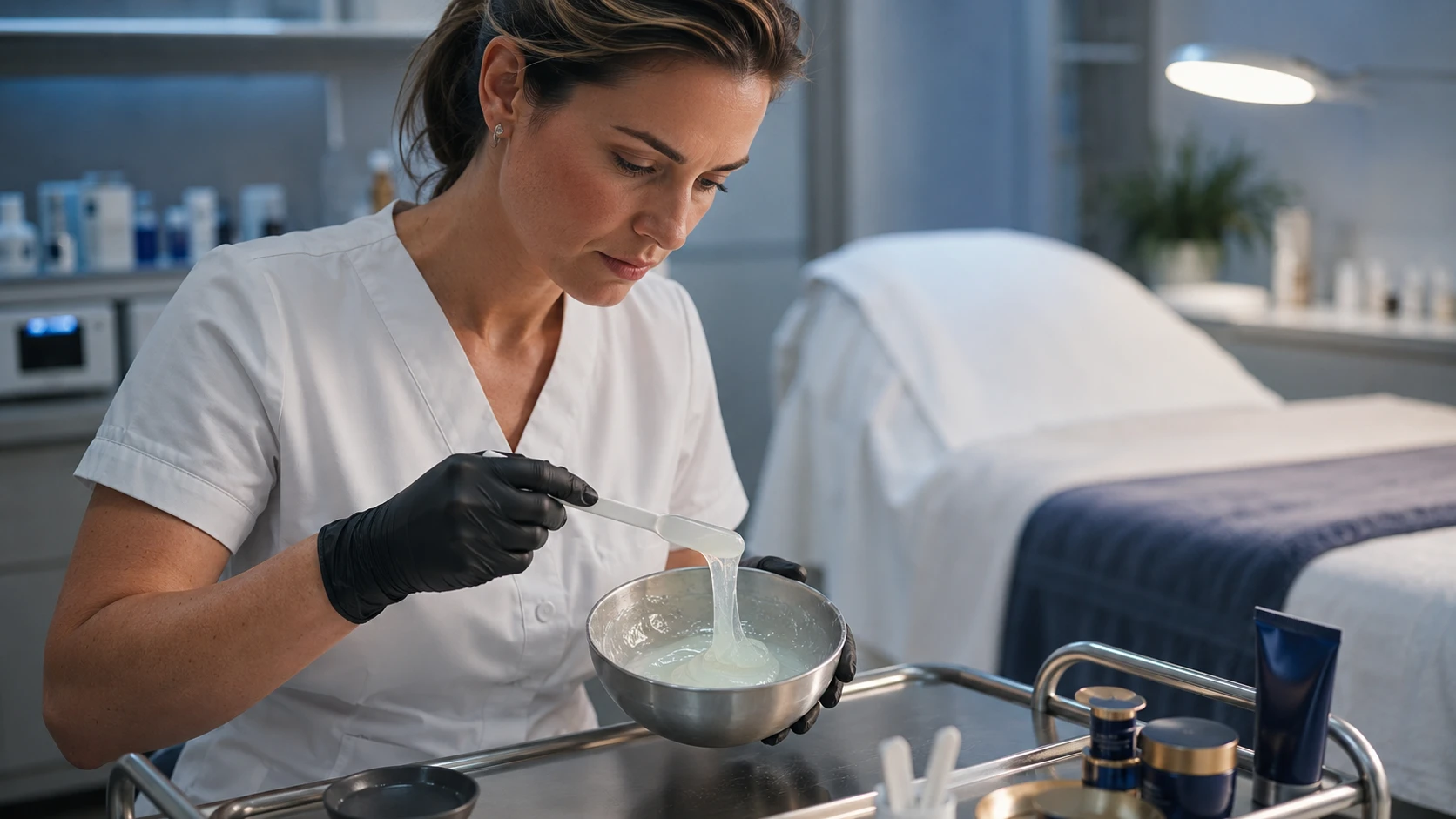
A properly mixed jelly mask should hydrate quickly and form a smooth, uniform translucent gel with consistent body throughout. There should be no visible grit. No clumps that resist breaking down. No streaks of dry powder hiding within the gel. No watery separation. The texture should feel cohesive and elastic under the spatula — not stiff, not runny — with the same consistency at the center of the bowl as at the edges. This is the texture of high-grade sodium alginate at the correct hydration ratio. Anything less is a raw material grade concern that no amount of marketing language can resolve.
The Color Test
A high-quality professional jelly mask is most often translucent with a soft, neutral hue — pale white, soft cream, a faint sea-foam tint, or a delicate natural color corresponding to a specific functional active. Bright, saturated colors are a red flag in a professional context because they signal artificial dyes added for visual marketing appeal. Artificial dyes serve no functional skincare purpose. Their presence indicates a formulation prioritizing shelf-appeal over clinical clarity. The most sophisticated professional formulations look quietly elegant in the bowl — not loud.
The Scent Test
A high-quality jelly mask either has no detectable scent or carries a subtle, neutral, almost imperceptible aroma. A strong, candy-like, floral, or perfumed scent is not a quality signal — it is a quality concern. Synthetic fragrance is one of the most common sensitizers in topical skincare, and for jelly masks applied occlusively over post-treatment skin, fragrance is functionally incompatible with the professional safety standard. In professional formulations, the absence of fragrance is the sophistication.
The Viscosity and Load Test
A high-quality mixed jelly mask should load onto a fan brush or silicone spatula evenly, hold its body during application, and spread to a uniform thickness across the face without dripping or pulling unevenly. You should be able to apply confidently around the contours of the jaw, around the orbital area, and across the décolleté without the product separating, sliding, or building up in pockets. Application that requires repeated re-loading because the mask thins as you work points back to alginate grade or formulation imbalance.
Which Ingredients Actually Matter — And Which Are Just Clever Marketing?
Almost every jelly mask label looks impressive at first glance. The list of “actives” is long, the names of botanical extracts are evocative, and the marketing copy uses phrases like “advanced complex” or “hydration matrix.” But the question that actually matters for you, and especially for your client, is much simpler: when this mask comes off, does the skin look noticeably better — and does that effect still hold tomorrow morning? Only a handful of ingredient categories actually decide that outcome. The rest is sophisticated noise.
The Structural Base — Sodium Alginate Grade
Almost every professional jelly mask uses sodium alginate — a naturally derived polysaccharide from brown seaweed — as its primary gelling agent. What separates a high-quality formulation from a low-quality one is the grade of alginate. Pharmaceutical and food-grade alginate produces smoother, more elastic, more predictable gels. Industrial-grade or poorly processed alginate produces inconsistency, grit, and unpredictable set times. The label will not tell you the grade. Your hands will, at the spatula.
The Humectants — Why Two Are Better Than One on Your Client’s Skin
The clients who say “this feels different,” “I look so much brighter,” or “I can still see the glow this morning” after a jelly mask treatment are usually responding to one specific formulation choice the brand made — which humectants are in the mask, and how many. Humectants are the molecules that pull water into the skin and hold it there. The two worth looking for specifically on the INCI list are sodium hyaluronate (the stable form of hyaluronic acid) and polyglutamic acid (often listed as PGA or sodium polyglutamate). A formulation that contains both will look and feel measurably different on your client’s skin than one with only one or neither — and the clients themselves usually notice the difference before you say a word about it. Generic phrases like “advanced hydrating complex” or “moisture matrix” that do not name specific ingredients should be treated as marketing language until proven otherwise on the INCI list itself.
The Humectant Pairing Behind the “Still Glowing the Next Morning” Client Reaction
When a client says “I can still see the glow this morning” or “this feels so much plumper than the last one,” she is describing the practical difference between a single-humectant formulation and a dual-humectant one. The two humectants worth looking for — hyaluronic acid and polyglutamic acid — work at different layers of the skin, and together they produce both the immediate visible plumpness clients see in the mirror and the longer-lasting hydration they notice the next day.
Hyaluronic acid goes deeper. It is the smaller molecule that reaches the layers below the surface and holds up to 1,000 times its weight in water there. Visually, this is what makes the skin look plumper from underneath rather than just shinier on top.
Polyglutamic acid stays at the surface. It forms a flexible transparent film that holds up to 5,000 times its weight in water — four times more than HA — and it does something HA cannot: it slows down the enzyme that breaks HA down, which is why the hydration effect lasts longer when both are present. A 2024 study also showed that topical PGA prompts the skin to produce more of its own HA over time, which is why the visible-glow effect tends to compound across a treatment series rather than fade.
Fragrance and Dye Status
Fragrance is the single most common sensitizer in topical skincare. For jelly masks applied occlusively — especially over post-treatment skin — even small amounts of synthetic fragrance can drive irritation responses you would not see in unoccluded application. A high-quality professional jelly mask is fragrance-free in the genuine INCI sense: no “parfum,” no “fragrance,” no essential oil components dropped in for scent. Artificial dyes are similarly disqualifying — they serve a visual marketing role rather than any functional skincare purpose. The absence of both is the clean-formulation standard.
Preservation — Minimal, Disclosed, Effective
Powder-based jelly mask formulations require relatively minimal preservation compared to water-based products, but any preservatives present should be clearly disclosed. A short, clearly listed preservative system is professional. An undisclosed “preservative blend” is not. The trend in genuinely clean-label professional formulations is toward minimal, transparent preservation — not the absence of preservation, but the absence of secrecy.
Functional Add-Ons — Useful or Decorative?
Many jelly mask formulations include additional functional actives — peptides, niacinamide, electrolytes, soothing botanicals, antioxidants. The question to ask is whether the position on the INCI list suggests they are present in a meaningful concentration, or whether the ingredient is included primarily so its name can appear on the marketing materials. Ingredients listed below the preservatives and toward the end of the list are typically present in concentrations too low for meaningful clinical effect. Treat ingredient lists with the same skeptical eye you would apply to a wine label — what’s prominent matters; what’s tucked away is often decoration.
How Does a High-Quality Jelly Mask Behave During Set Time?
Once applied, a high-quality jelly mask should set predictably within a defined window — typically 10 to 15 minutes for most professional formulations, with some clinical-grade products extending to 20 minutes. The behavior of the mask during that window is itself a quality marker, and it is one of the most diagnostic real-world tests of formulation discipline.
Predictability Over Speed
A fast-setting mask is not inherently better than a slower-setting one. What matters is predictability. The same mask, mixed at the same ratio, in the same room conditions, should set within roughly the same window every time. A mask that sets in 8 minutes in one session and 14 minutes in the next is a formulation consistency problem. It is also a workflow problem — you cannot plan a treatment around a mask that does not deliver reproducible timing.
Even Set Across the Application
A well-formulated jelly mask sets uniformly across the entire face — not faster around the perimeter, not slower at the center, not unevenly along the décolleté. Watch the visual transition: a quality mask moves from glossy and wet to matte and elastic in a roughly uniform front. Uneven set is a viscosity or formulation distribution issue and predicts an uneven, often torn removal experience.
What You Can Do During the Set Window
The set window is professional service time. A reliable 12-to-15-minute set accommodates scalp massage, hand or arm massage, LED light therapy, or a calm client consultation. A mask that sets too fast forecloses these add-on service moments. A mask that sets too slowly compromises the signature peel experience that clients remember. Quality formulations respect the workflow they were designed for — and a stable, predictable set window is the practical expression of that respect.
Estheticians incorporating Poly-Luronic™ Jelly Masks by Luminous Skin Lab consistently note that the formulation hydrates into a notably smooth, uniform gel without grit, that its 12-to-15-minute set window reliably accommodates scalp massage and LED sequences without timing adjustments, and that the immediate post-removal hydrated glow is the most consistent client-experience signal they observe across their professional menu.
What Should the Removal Experience Actually Look Like?
Removal is the signature client moment of any jelly mask treatment — the moment clients describe to friends, share on social media, and remember when deciding whether to rebook. It is also one of the clearest clinical quality signals. A well-formulated jelly mask removes as a single elastic piece, lifting cleanly from the décolleté up over the face, with minimal residue and a satisfying release at the hairline and jawline.
The Single-Piece Peel
When the formulation is right, the cured mask behaves like a flexible elastic membrane that has taken the contours of the face. You should be able to lift gently from the chin or jawline edge and peel the entire mask away in one continuous piece, including the eye and nose cutouts. Tearing, cracking, or peeling away in fragments points to formulation issues — either alginate grade, hydration ratio, or set environment. Sporadic tearing across different sessions of the same product indicates batch-to-batch inconsistency, which is one of the most operationally frustrating quality failures.
Residue and Skin Surface Cleanup
A high-quality mask leaves the skin essentially clean at removal. There may be a thin film of residual hydration — smooth and easily wiped — but there should not be patchy areas of stuck product, no significant powder shedding from beneath the cured layer, and no need for substantial cleanup work. Heavy residue means the formulation did not cure uniformly. From a service perspective, it also means you are spending the closing minutes of the treatment cleaning up rather than completing the post-treatment ritual.
The Skin Immediately Beneath
This is the moment that matters most. A well-formulated jelly mask reveals skin that is visibly hydrated, calmer, softer to the touch, and noticeably brighter compared to the pre-mask baseline. This visible change — immediate, sometimes dramatic, often the first thing your client comments on — is the single most reliable real-world quality test. If the skin underneath looks meaningfully better than it did fifteen minutes earlier, the formulation is performing. If it does not, no amount of marketing language can change that result.

What Does Client Response Tell You About Mask Quality?
The most honest review of any jelly mask is the one your client gives you without being prompted. Clients do not have technical vocabulary for ingredient quality or formulation discipline, but they have something more useful: an unfiltered immediate response to how their skin looks and feels. Pay attention to that response over time, across many clients and skin types, and you have a continuous quality audit no marketing materials can replicate.
The Mirror Moment
The first thing a client typically does after a jelly mask treatment is turn to the mirror. With a quality formulation, the reaction is usually quick and specific — a touch of the cheek, a comment on glow, a comment on smoothness, or simply a moment of visible surprise. With a low-quality formulation, the mirror moment is often briefer and more neutral. Clients are reliable mirrors of skin change. Watch for the unsolicited reactions; they are the most credible data point in your evaluation framework.
Verbal Cues Worth Tracking
Specific client language to listen for: “my skin feels so soft,” “I look so much brighter,” “this is different from anything else I’ve had,” or questions about what was on the mask and whether they can buy something similar for home. These responses indicate a meaningful immediate change. Vague or generic responses — “that was nice,” “thank you” — in the absence of more specific reactions suggest the treatment did not produce a noticeable enough change to register.
Rebooking and Add-On Selection Patterns
Over weeks and months, the most diagnostic client response signal is the rebooking and treatment-upgrade pattern. Clients who experienced a clear skin change from a high-quality jelly mask will often request the same treatment again, ask for the jelly mask as an add-on to other services, or refer the experience to friends. A jelly mask brand that does not generate this pattern after a representative number of treatments is not earning its place on your protocol menu — regardless of how it presents on the brand’s website.
Common Quality Red Flags Estheticians Sometimes Miss
Inconsistent Mixing Texture Within the Same Jar
A truly professional formulation should mix consistently from the first scoop to the last. If you find that powder near the top of the jar mixes differently from powder at the bottom — uneven hydration, settling of components, or visible separation of ingredients within the jar itself — the formulation is poorly homogenized at manufacturing or has settled in storage. Either way, it is a quality concern that bulk purchasing will only amplify.
“Lightly Scented” or “Naturally Scented” Labeling
This labeling typically means fragrance is present in the formulation — just at a lower concentration. For an esthetician planning to use the mask in post-treatment protocols where the skin barrier is compromised, “lightly scented” is functionally not different from “scented” in terms of sensitization risk. Treat any scented variant as a non-starter for post-treatment use.
Vague Humectant Claims Without INCI Specificity
If a brand markets its mask as containing an “advanced hydrating complex” or “hyaluronic moisture matrix” but the INCI list does not specifically include sodium hyaluronate or polyglutamic acid in identifiable form, the language is marketing — not formulation. Quality brands name their humectants specifically. Vague claims usually conceal vague formulations.
Missing Batch Codes or Expiration Dates
An esthetician-grade product without a batch code or expiration date is operating outside professional pharmaceutical-supply norms. There is no traceability if a quality issue arises, no way to confirm freshness, and no manufacturing-discipline signal that should accompany a product intended for clinical use.
Heavy Reliance on Marketing Imagery Over Technical Specifications
Brands whose website is heavy on aspirational photography and light on actual formulation detail, INCI disclosure, batch information, or protocol guidance are positioning a product rather than building one. Quality professional brands invest in their technical communication because they are speaking to a professional audience — not a casual consumer browsing on a phone.
Professional and Scientific References
The ingredient science referenced in this article draws from peer-reviewed dermatological and cosmetic chemistry research:
- Gamma-PGA barrier strengthening and moisture retention — skin keratinocyte and reconstructed skin model study. MDPI, 2024. Demonstrated HAS-1, HAS-2, HAS-3 upregulation and aquaporin-3 enhancement with 1% topical gamma-PGA application.
- PGA moisture-binding capacity and hyaluronidase inhibition. Cosmetic chemistry literature; Typology, 2021–2025. PGA holds up to 5,000× weight in water via surface microgel formation; inhibits hyaluronidase enzymatic degradation of skin HA.
- PGA corneometry studies. Reviva Labs review of clinical literature, 2025. 2% PGA serum demonstrated 60% moisture increase at 30 minutes, 25% elevation maintained at 8 hours, outperforming low-molecular-weight HA in both magnitude and duration.
- PGA NMF stimulation — production of pyrrolidone carboxylic acid, lactic acid, and urocanic acid in stratum corneum. Typology; Prequel Skin; Skin Rocks biochemist commentary, 2022–2025.
- PGA + HA synergistic combination — slows HA degradation, enhances sustained moisturizing effect, reduces HA tackiness. Stanford Chemistry / cosmetic formulation literature, 2024.
- Sodium alginate as a professional occlusive biomaterial: structural gelling properties, grade variability, and applications in topical formulations. Established biomedical sciences literature.
For estheticians evaluating a professional jelly mask that embodies the quality markers discussed throughout this guide — clean alginate texture, fragrance-free INCI, predictable 12-to-15-minute set, single-piece elastic removal, and visible immediate skin response — the Poly-Luronic™ Jelly Mask line by Luminous Skin Lab is the formulation our education team most frequently references. Developed by a licensed esthetician around the proprietary Poly-Luronic™ PGA + HA dual-humectant blend, formulated specifically for treatment room use including post-microneedling and LED-adjunctive protocols.
Explore the Poly-Luronic™ Jelly Mask LineFrequently Asked Questions: Jelly Mask Quality & Evaluation
How can you tell if a jelly mask is high quality without lab testing?
You can identify a high-quality jelly mask through five observable checkpoints: complete INCI disclosure on the container, a smooth and uniform translucent gel when mixed with no grit or separation, a predictable set time inside a 10-to-20-minute window, removal as a single intact peel, and visible immediate improvement in skin hydration and brightness once the mask is removed. These markers correlate far more reliably with real formulation quality than any marketing language a brand might use.
What ingredients should I look for on a high-quality jelly mask INCI list?
Look specifically for sodium alginate as the structural gelling base, sodium hyaluronate as the deep-layer humectant, and polyglutamic acid (PGA) as the surface-layer humectant. The combination of sodium hyaluronate and polyglutamic acid is particularly meaningful because the two work at different depths of the skin — HA hydrates plumper from underneath, PGA holds moisture at the surface — and together they produce the lasting visible glow clients notice in the mirror and the next morning. The list should also be free of any “parfum” or “fragrance” entries and free of artificial dyes for true professional-grade status.
Why does the smell of a jelly mask matter for quality?
A neutral or virtually undetectable scent is a quality marker; a strong, perfumed, or candy-like scent is a quality concern. Synthetic fragrance is one of the most common sensitizers in topical skincare, and when a jelly mask is applied occlusively over post-treatment or compromised skin, fragrance compounds become functionally incompatible with professional safety standards. The absence of fragrance is not a lack of sophistication — it is the sophistication.
How smooth should a properly mixed jelly mask be?
A correctly formulated jelly mask, mixed at the manufacturer’s recommended ratio, should produce a smooth, uniform, translucent gel with consistent body throughout — no visible grit, no resistant lumps, no streaks of unmixed powder, and no watery separation. The texture should be cohesive and elastic under the spatula, with the same consistency at the center of the bowl as at the edges. Any deviation from this is typically a raw material grade issue with the sodium alginate or a formulation hydration ratio problem.
How long should a high-quality jelly mask take to set?
Most high-quality professional jelly masks set within a 10-to-20-minute window, with the typical sweet spot falling between 12 and 15 minutes. However, the more important quality indicator is consistency. The same mask, mixed at the same ratio, under the same room conditions, should set within roughly the same window every time. Variability from 8 minutes one session to 15 minutes the next is a formulation consistency concern regardless of where the average falls.
Should a high-quality jelly mask peel off in one piece?
Yes. When the formulation is correctly developed and mixed at the proper ratio, the cured mask behaves like a flexible elastic membrane that lifts from the face in a single intact piece — including the eye and nose cutouts — with minimal residue. Tearing, cracking, or removal in fragments is a quality concern that typically points to alginate grade, hydration ratio, or batch-to-batch formulation inconsistency.
What is the Poly-Luronic™ blend and why is it significant?
The Poly-Luronic™ blend is Luminous Skin Lab’s proprietary, trademarked combination of polyglutamic acid (PGA) and hyaluronic acid (HA). PGA holds up to 5,000 times its weight in water, inhibits hyaluronidase (protecting the skin’s own HA from enzymatic breakdown), stimulates Natural Moisturizing Factor components in the stratum corneum, and upregulates HAS-1, HAS-2, and HAS-3 expression — meaning the skin produces more of its own HA over time. HA delivers moisture to deeper skin layers. Together they create a dual-depth hydration system that outperforms single-humectant formulations in both magnitude and duration. Luminous Skin Lab is the only professional jelly mask brand incorporating the Poly-Luronic™ blend.
Can a jelly mask be high quality if it contains fragrance?
A jelly mask containing fragrance may be acceptable for general consumer at-home use, but it does not meet the professional safety standard for treatment room application — particularly for post-treatment protocols on compromised or post-procedure skin. The occlusive application format used in professional jelly mask treatments amplifies any sensitization risk from fragrance compounds in the formulation. Fragrance-free is a baseline professional requirement, not a stylistic preference.
How important is packaging when evaluating jelly mask quality?
Packaging is more important than it appears. A moisture-sensitive and light-sensitive powder formulation requires opaque or UV-protective containers with tight-sealing lids to maintain stability. Visible batch codes, manufacturing dates, and expiration information on the container signal that the brand operates to professional pharmaceutical-supply discipline — a baseline standard for a product applied to potentially compromised skin. Thin, transparent, poorly sealed packaging often indicates the brand has not invested in the manufacturing infrastructure that genuine professional-grade formulations require.
Does price reliably indicate jelly mask quality?
Price is not a reliable proxy for jelly mask quality on its own. Premium pricing can reflect genuine formulation discipline, but it can also reflect packaging, marketing, or distribution costs that have nothing to do with how the product actually performs on skin. The reliable quality indicators are observable in the treatment room itself: ingredient transparency, mixing behavior, set consistency, removal integrity, and client skin response. Apply that framework to any candidate, at any price point.
The Real Quality Decoder Lives in Your Hands
Marketing language is identical across every jelly mask brand competing for professional shelf space. “Professional grade.” “Clinical quality.” “Advanced hydration.” For an esthetician building a treatment menu that affects client outcomes and operating costs, this vocabulary cannot guide the decision. What can guide the decision is what you observe with your own hands and eyes, in your own treatment room, with your own clients.
A high-quality jelly mask reveals itself in the same places every time. The container tells you whether the brand operates to professional manufacturing discipline. The powder tells you whether the raw materials are pharmaceutical-grade. The mixed gel tells you whether the alginate is genuinely high or low quality. The set behavior tells you whether the formulation is consistent batch to batch. The removal tells you whether the cured material is properly cohesive. And the client response in the mirror — honest, immediate, and impossible to fake — tells you whether the formulation actually performs.
Apply that observational framework to every brand you evaluate. The brands that pass it consistently are the ones worth keeping on your treatment menu. The brands that do not — regardless of price point, packaging polish, or marketing budget — are not. Quality, in professional jelly mask formulations, is something you can see, feel, and confirm. The decoder is in your hands.