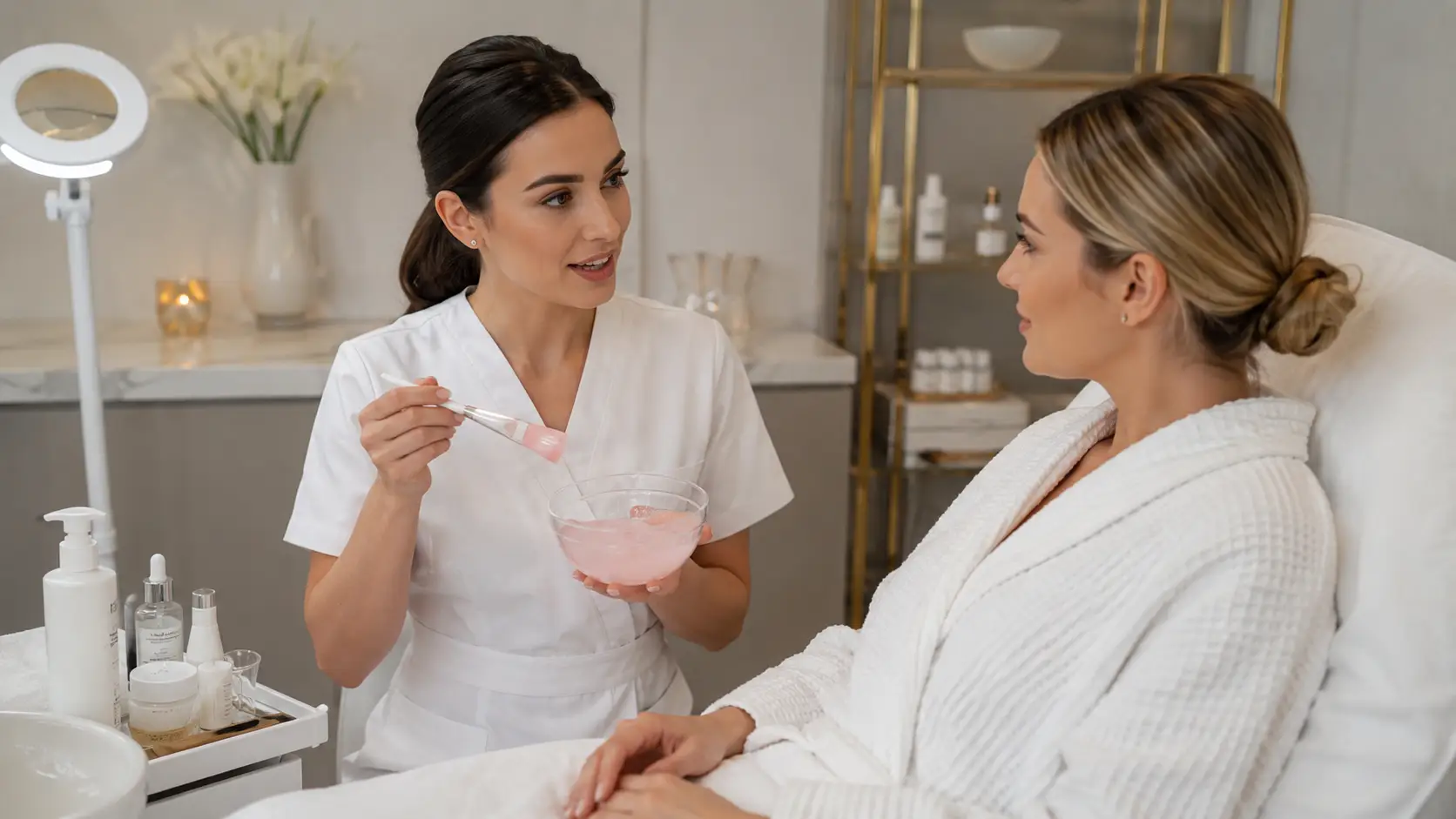
How Should New Estheticians Explain Jelly Masks to Clients?
New estheticians can explain jelly masks confidently by focusing on three things: what the client will feel during the treatment, what it does for their skin, and why it is different from anything they might use at home. You do not need to master the full ingredient science before you can explain jelly masks well — you need a clear sensory description, a simple explanation of the benefit, and the ability to answer the handful of questions most clients actually ask.
- Start with the experience: describe the cooling sensation, the gel setting on the skin, and the peel-off removal moment — these sensory details connect with clients immediately and create anticipation.
- Follow with the benefit: the mask creates an occlusive seal over the serums applied during the facial, enhancing absorption and locking in hydration during the treatment window.
- Frame it as a clinical recommendation, not an upsell: “based on what I’m seeing with your skin today, I’d love to add this to your treatment” lands differently than “would you like to add a jelly mask for an extra charge.”
- Be prepared for the three most common client questions: what is it, will it clog my pores, and is it worth the extra cost — having confident answers to these ready before the service starts removes hesitation.
- Let the first application do most of the work — clients who experience a jelly mask rarely need convincing the second time.
One of the most common places new estheticians lose confidence is not during the treatment itself — it is in the moments just before, when a client asks a question they were not quite expecting. For jelly masks specifically, that moment often sounds like: “What exactly is a jelly mask?” or “I’ve never heard of that — what does it do?”
If you are still in your first year of practice, those questions can feel higher-stakes than they actually are. The truth is that clients are not asking you to give them a graduate-level lecture on alginate chemistry — they want to know what is going to happen to their face, how it will feel, and whether it is something they want. Your job in that moment is to give them enough to feel informed and excited, not to prove you know everything.
This guide gives you practical, ready-to-use language for explaining jelly masks at every stage of a service — during the consultation, during application, and when handling follow-up questions. It also covers the communication dynamics that make the difference between a client who says “sure, sounds good” and a client who enthusiastically rebooks for the jelly mask every time.
What New Estheticians Need to Know About Explaining Jelly Masks
- Sensory-first explanations work better than ingredient-first explanations for most clients — lead with feel, follow with function.
- Frame the jelly mask recommendation as a clinical observation rather than an add-on offer — it immediately shifts the dynamic from sales to professional guidance.
- Set the expectation for the peel-off removal before you apply the mask — clients who know to anticipate it experience it as satisfying rather than startling.
- Have ready answers for the three most common questions: what is it, will it clog my pores, and is it worth it.
- Let the experience convert the client on the first visit — your job is to get them to say yes once. The results and the experience carry the rebooking.
- You do not need to know everything about jelly masks to explain them confidently — you need to know what matters to the client in front of you.
- Consistency in how you introduce jelly masks builds your reputation as someone who has genuine treatment recommendations, not just an upsell menu.
Why Explaining Jelly Masks Well Matters More Than You Think
Jelly masks are not yet universally familiar the way sheet masks or clay masks are. A meaningful portion of your clients — especially if you are working with older demographics or clients who are newer to professional skin care — will have no frame of reference for what a jelly mask is. That unfamiliarity is not a barrier unless you treat it like one.
Estheticians who explain jelly masks with genuine enthusiasm and clear language consistently find that client uptake is high. The treatment has two things going for it that almost nothing else in a basic facial menu can match: the sensory experience of the setting gel and the cooling sensation, and the theatrical removal moment. Both of these create the kind of treatment memory that generates word-of-mouth referrals and rebooking behavior far more reliably than a standard mask finish.
The challenge is that many new estheticians undersell the jelly mask because they are not yet confident explaining it. They mention it almost apologetically — “there’s also a jelly mask option if you want” — instead of presenting it as the genuinely compelling treatment step it is. That tentativeness communicates uncertainty to the client, which makes them uncertain too.
Learning to explain jelly masks with clarity and confidence is not a sales skill — it is a clinical communication skill. You are helping clients understand what you are doing and why, so they can consent to it meaningfully and get the most out of their treatment. That is your professional responsibility regardless of whether the treatment carries an add-on cost.
The Three-Part Framework for Explaining Any Jelly Mask
Before you have specific scripts, it helps to have a framework — a mental structure for what a good jelly mask explanation includes. Every effective explanation of a jelly mask covers three things, in this order: the experience, the benefit, and the reason it applies to this client today.
Part One: The Experience
Start with what the client will feel, see, and notice. This is the part that makes the treatment real for them before it has started. Keep it sensory and specific rather than clinical. The mask starts as a powder that gets mixed with water right at the table. It goes on cool — most clients notice the temperature immediately. It sets over the next ten to fifteen minutes, firming slightly against the face. And then at the end, it peels off in one piece.
That last detail — the peel-off removal — is worth dwelling on for a moment, because clients consistently find it memorable. You can say something like: “the best part for most people is the removal — it comes off as one piece and it is really satisfying.” That framing turns the removal into an anticipated highlight rather than an unfamiliar procedure.
Part Two: The Benefit
After the experience description, give the client a clear functional reason why the mask is good for their skin. Keep this to one or two sentences rather than a full explanation of occlusivity and transepidermal water loss. Something like: “it creates a seal over the serums we just applied so your skin absorbs them more deeply, and the cooling helps bring down any redness or warmth from the treatment.”
If the client seems interested in more detail, you can go deeper — but let them signal that interest rather than front-loading the science. Most clients are satisfied with a clear, confident one-sentence benefit summary.
Part Three: The Reason for This Client Today
The most powerful part of a jelly mask recommendation is connecting it to something specific you observed about the client’s skin during your analysis. “I noticed your skin is looking a little dehydrated today, so the jelly mask would be a great way to lock in extra hydration at the end.” Or: “Since we did a deeper exfoliation today, the cooling mask is going to help calm the skin down beautifully before you leave.”
This is what separates a professional recommendation from a menu item suggestion. When clients hear that you are recommending something because of what you specifically observed about their skin, they trust the recommendation in a way they simply cannot when it comes across as a standard upsell.
Specific Language to Use at Each Stage of the Service
The following scripts are starting points, not rigid formulas. Adjust the language to match your natural voice — the goal is to sound like you, not like you are reciting something.
During the Pre-Treatment Consultation
“Based on what I’m seeing with your skin today, I’d love to finish your facial with a professional jelly mask. It’s one of my favorite ways to close a treatment — it creates a cooling seal over everything we applied, locks in the hydration work, and peels off in one beautiful piece at the end. Most clients absolutely love it. Is that something you’d like to include?”
Why this works: you are leading with a clinical observation, delivering a benefit, and creating anticipation for the removal experience. The question at the end is low-pressure because you have already given them something to be interested in.At the Moment of Application
“I’m mixing the jelly mask now — you’ll feel it go on cool, which is intentional. It’s going to firm up over the next ten to fifteen minutes as it sets. You might feel a slight tightening sensation, which is completely normal — that’s just the mask doing its job. I’ll be right here, and when it’s ready we’ll peel it off together.”
Why this works: narrating what is happening during application reduces client anxiety and reinforces that you are in control. The phrase “which is intentional” after describing the cool temperature signals professional knowledge without being condescending.Just Before Removal
“The mask is ready to come off — this is the part most people really enjoy. I’m going to peel it off in one piece starting from the edges. You won’t feel any pulling or discomfort. Take a breath and enjoy it.”
Why this works: “this is the part most people really enjoy” is social proof delivered at exactly the right moment. It reframes an unfamiliar sensation as an anticipated positive experience.How to Handle the Most Common Client Questions and Objections
Most client hesitation around jelly masks falls into a predictable set of questions. Having clear, confident answers ready before these questions come up is one of the simplest ways to build treatment room authority as a new esthetician. You do not need to wait for clients to ask — you can preempt the most likely questions by answering them in your initial explanation.
“What exactly is a jelly mask?”
It is a professional treatment mask that starts as a powder, gets mixed with water at the table, and sets over the face like a cool, flexible second skin. It peels off in one piece at the end. Your clients have probably never experienced it at home because it is designed for professional use.
“Will it clog my pores?”
The mask sits on top of the skin and comes off completely at the end of the service — it is not the same as a thick cream or oil-based product that stays on. The formulation is chosen specifically because it is safe for sensitive and reactive skin types.
“Is it worth the extra cost?”
Explain the value in outcomes: the mask seals in everything we applied during your facial so it absorbs more deeply instead of evaporating, and most clients notice their skin looks visibly more hydrated and calm immediately after. For clients who want to maximize the investment they just made in their skin, it is genuinely worth including.
“I’ve never heard of it — is it new?”
Normalize the unfamiliarity with confidence: it is newer to most people but it has become one of the most popular finishing steps in professional facials because of the results and the experience. You are in good hands — let me show you what it does.
“Will it feel weird or uncomfortable?”
Tell the client what to expect in specific, reassuring terms: you will feel it go on cool, which most people really enjoy, and then a gentle tightening as it sets — think of it like your skin getting a hug. There is no pulling, no heat, nothing uncomfortable. The removal is the best part.
“How is this different from a regular face mask?”
A regular mask sits on the skin and gets wiped off. This one creates a physical seal that enhances the absorption of everything applied underneath it, cools the skin in a way a cream mask cannot, and provides that memorable removal experience. It is a more advanced step than a standard mask finish.
Estheticians who incorporate the Poly-Luronic™ Jelly Mask by Luminous Skin Lab into their beginner service menu consistently report that the ingredient story makes client conversations noticeably easier. When clients ask what makes this mask different from something they could buy at a drugstore, the dual-humectant answer — that it contains both polyglutamic acid and hyaluronic acid, working at two different depths to hydrate the skin — is specific enough to be credible and simple enough to deliver in one confident sentence. Estheticians new to the formulation note that the consistent set window of roughly twelve to fifteen minutes is particularly helpful for consultation timing: the mask goes on, and there is a reliable window to explain the rebooking benefits, address any lingering questions, and perform shoulder or scalp massage without having to rush or pause to check whether the mask is ready. Clients who ask follow-up questions about the ingredients after experiencing the results are often surprised to learn that the PGA in the formula is four to five times more hydrating by weight than hyaluronic acid alone — that detail, delivered post-treatment when the client can feel the result on their own skin, is one of the most effective retail conversation openers available in a basic facial service.
When to Bring Up the Jelly Mask and When to Hold Off
Timing is a meaningful variable in whether a jelly mask recommendation lands well. Here is a practical framework for when to introduce the mask conversation and when to let the client settle in first.
Ideal Timing: During the Skin Analysis
The strongest moment to introduce the jelly mask recommendation is immediately after your skin analysis observation, before you have begun the treatment. This is when the client is most receptive to clinical guidance and before the service pace has established itself. Your observation leads directly into the recommendation, and the client can decide before the treatment starts rather than being offered something mid-service when they may feel less able to evaluate it.
Acceptable Timing: After Extractions or Exfoliation
If you did not introduce the jelly mask during the consultation, the next natural window is after a procedure that creates an obvious skin response — post-extraction redness, warmth after a chemical exfoliant, or sensitivity following dermaplaning. At this point, you can introduce the mask as a clinical response to what just happened: “your skin is warm from the extractions, so this is a perfect moment for the cooling jelly mask to bring everything down.” The recommendation flows from the service context rather than appearing as an unconnected add-on.
When to Hold Off
Avoid introducing the jelly mask for the first time when a client is already deep into the relaxation phase of the service. If a client is visibly relaxed and nearly asleep, jarring them with a new decision about an add-on they have not heard of before creates unnecessary friction. In that case, note it in your client record and introduce it at the beginning of the next session instead.
What to Do If a Client Declines
If a client says no thank you, accept it gracefully and without any pressure language. Something like: “no problem at all — we’ll finish with a beautiful standard mask today, and I can show you what the jelly mask experience is like another time if you want to try it.” That response keeps the door open for next time without making the client feel any pressure about the decision they just made.
How to Build the Ingredient Story Over Multiple Visits
One of the things that separates a confident, credible esthetician from someone who just applies products is the ability to layer education over time. You do not need to explain everything about a jelly mask the first time a client experiences it. In fact, giving too much information in one session often works against you — clients cannot absorb a full ingredient education when they are trying to relax and enjoy a facial.
A more effective approach is to deliver one relevant piece of information per visit, connected to what the client is experiencing in that moment. On visit one, focus on the experience and the primary benefit. On visit two, when the client already knows what to expect, you can go one layer deeper — explain that the mask contains a specific hydrating ingredient that actually protects the skin’s own hyaluronic acid from breaking down. On visit three, if the client is engaged and curious, you can explain the full dual-humectant mechanism.
This approach does several things simultaneously. It keeps each conversation proportionate to the client’s level of engagement and the pace of the service. It gives the client a reason to look forward to each visit as a continued education. And it establishes you, over time, as someone who genuinely knows their treatments — not someone who delivers the same scripted line every time.
What New Estheticians Need to Know to Explain the Hydration Science Simply
You do not need to master the full chemistry to explain the hydration benefit confidently. Here is the client-friendly version of the science that underlies professional dual-humectant jelly mask formulations:
The simple version: the mask contains two hydrating ingredients that work as a team. One works at the skin’s surface — it forms a flexible seal that holds moisture in and protects the hydrating ingredients already in your skin from breaking down. The other works deeper, attracting water into the lower layers of the skin where it builds the foundation for lasting hydration.
Why it matters for clients: the result is that your skin is not just hydrated while the mask is on — it leaves in a better position to stay hydrated for longer after you walk out. That is the difference between a mask that adds temporary moisture and one that improves how your skin holds onto it.
This explanation is accurate, clinically grounded, and entirely accessible to a client with no skincare science background. Most clients find it genuinely interesting when it is delivered in this form, especially when they can feel the result on their skin immediately after removal.
Common Communication Mistakes New Estheticians Make When Introducing Jelly Masks
Introducing It as “Just an Add-On”
Language like “there’s also a jelly mask add-on if you want” positions the treatment as optional filler rather than a clinical recommendation. It signals uncertainty and gives the client no reason to say yes. Frame it as a recommendation based on your skin analysis observation — not as a menu item they can pick or leave.
Over-Explaining the Science Before the Client Has Asked
New estheticians who have just learned about polyglutamic acid and hyaluronic acid mechanisms sometimes feel compelled to share everything they know in the first explanation. This overwhelms most clients and actually reduces confidence rather than building it. Lead with the experience and a single clear benefit. Let the client’s curiosity drive any deeper conversation.
Not Setting Up the Removal Experience in Advance
Clients who have never experienced a jelly mask before need to be told about the peel-off removal before it happens — not during it. If the first thing they hear about the removal is the esthetician starting to peel, some clients find it startling. Setting the expectation — “when it’s ready we’ll peel it off in one piece, which most clients love” — turns an unfamiliar sensation into an anticipated positive experience.
Apologizing for the Additional Cost
Some new estheticians communicate the add-on cost with a tone of apology: “it is a little extra, sorry.” This undermines the value before the client has heard the benefit. State the cost matter-of-factly after the recommendation and the experience description: “it is an additional fifteen dollars added to your service, and it is absolutely worth it.” Confidence in the pricing communicates confidence in the value.
Treating Every Client the Same
Estheticians who deliver the exact same jelly mask script to every client miss the opportunity to make each recommendation feel personal. Listen to your consultation, observe the skin, and find the specific reason this mask makes sense for this person today. That specificity is what makes the recommendation memorable.
Professional References and Educational Context
The communication frameworks and client education principles in this article draw from established esthetics consultation practice and ingredient education literature:
- Client consultation communication principles in professional esthetics — National Coalition of Estheticians, Manufacturers/Distributors & Associations (NCEA) professional standards guidance.
- Sensory-first communication in cosmetic treatment settings — cosmetic psychology literature on client experience framing and trust-building in service environments.
- Polyglutamic acid and hyaluronic acid dual-humectant mechanisms referenced in client education context — MDPI 2024 gamma-PGA reconstructed skin model study; Typology ingredient science documentation 2021–2025.
- Professional jelly mask formulation principles and treatment room workflow considerations — Luminous Skin Lab Education Team internal protocol documentation.
- Treatment recommendation framing vs. upsell framing in esthetic practice — industry practitioner education literature on consultation-to-service conversion communication.
For new estheticians building their jelly mask communication skills, starting with a formulation that has a clear and compelling ingredient story makes every client conversation easier. The Poly-Luronic™ Jelly Mask by Luminous Skin Lab was developed by a licensed esthetician specifically to give treatment room professionals a jelly mask they can stand behind with confidence — a dual PGA and HA humectant system, fully fragrance-free, with a consistent set window that supports both client communication and workflow timing. When clients ask what makes this mask different, the answer is specific, science-backed, and simple to deliver: two hydrating ingredients working at two different depths, protecting and amplifying each other’s effects. That kind of formulation story is one of the most powerful tools a new esthetician can have in their client education toolkit.
Explore the Poly-Luronic™ Jelly Mask LineFrequently Asked Questions: How to Explain Jelly Masks to Clients
What do I actually say when a client asks what a jelly mask is?
Keep it simple and sensory first. Tell the client it is a professional treatment mask that starts as a powder, gets mixed with water to form a gel, and then sets gently over the face like a cool, flexible second skin. Explain that it locks in the hydration serums applied underneath, cools the skin, and peels off in one piece at the end. Most clients respond to the cooling and the peel-off moment even before they understand the ingredient science.
How do I explain what a jelly mask does without sounding like I am reading off a label?
Focus on what the client will feel and see rather than reciting ingredients. Say something like: it creates a seal over the serums we just applied so your skin absorbs them more deeply, the cooling effect calms any warmth or redness, and when we peel it off your skin feels intensely hydrated and smooth. Clients connect to experience descriptions far more readily than ingredient lists.
What if a client has never heard of a jelly mask and looks confused when I mention it?
Normalize the unfamiliarity immediately. You might say: it is newer to a lot of people but it has become one of the most popular finishing steps in professional facials because of the results and the experience. You can show the powder before mixing, walk them through what will happen step by step, and let the sensory experience do the work once it is on. Most clients who were hesitant become enthusiastic converts after their first application.
How do I bring up jelly masks without it feeling like a sales pitch?
Frame it as a clinical recommendation rather than an upsell. After your skin analysis, say something like: based on what I am seeing with your skin today, I would love to finish with a jelly mask — it is going to lock in the hydration work we have done and your skin is going to feel amazing at the end. When the recommendation flows from what you observed about the client’s skin, it lands as professional advice rather than a sales push.
What do I say if a client asks whether a jelly mask is worth the extra cost?
Explain the value in terms of what it does for their results, not the product itself. You might say: the mask seals in everything we applied during your facial so it absorbs more deeply instead of evaporating, the cooling brings down any redness, and most clients leave looking visibly more hydrated than with a standard mask finish. For clients who want to maximize what they just invested in their facial, it is genuinely worth adding.
How do I explain the peel-off step without it sounding scary?
Set the expectation as a positive moment before the mask is applied. Tell the client: one of the best parts of this mask is the removal — once it sets, it peels off in one piece and it feels really satisfying. That framing turns the removal into something clients anticipate rather than something they brace for. Clients who know what to expect consistently describe the peel-off as one of their favorite parts of the treatment.
Can I explain jelly masks to clients if I am still new and do not know all the science yet?
Yes. You do not need to explain the full ingredient science to communicate the value confidently. You need to be able to describe what it does for the skin, what the client will feel, and why you are recommending it for their specific skin concern today. That level of explanation is completely accessible to a new esthetician and is actually more effective with most clients than a detailed ingredient lecture.
What do I say if a client asks whether the jelly mask will clog their pores?
Reassure the client directly: professional jelly masks are designed to sit on top of the skin rather than absorbing into it, and they are removed completely at the end of the service. The formulation is not the same as a thick cream or oil-based mask — the gel sets and peels away cleanly. For acne-prone or congested skin, you can note that the fragrance-free, clean-label formulations used in professional settings are specifically chosen to be safe for sensitive and reactive skin types.
How does the Poly-Luronic jelly mask help when I am explaining jelly masks to clients for the first time?
The Poly-Luronic Jelly Mask by Luminous Skin Lab gives new estheticians a specific, science-backed formulation story to share when clients ask about what makes the mask special. Because the product contains both polyglutamic acid and hyaluronic acid, you can explain in plain language that it uses two complementary hydrating ingredients — one that works at the surface to seal moisture in and one that works deeper to deliver hydration where the skin needs it. That kind of clear, confident explanation helps clients understand why this is different from anything they might use at home, and it builds your credibility as someone who knows their products.
Confidence in Your Explanation Builds Confidence in Your Practice
The way you explain a jelly mask to a client is not just about getting a yes to an add-on — it is about demonstrating that you are a practitioner who knows what you are doing and why. Clients notice when an esthetician explains a treatment with clarity and genuine enthusiasm. They also notice when someone hedges, over-apologizes, or delivers information as if they are not sure of it themselves.
The good news is that jelly masks give you a lot to work with. The cooling sensation, the setting gel, the peel-off removal — these are genuinely memorable sensory experiences that your clients cannot replicate at home. Your job is simply to frame them well enough that the client arrives at the treatment curious and leaves wanting to rebook it every time.
Start with the three-part framework: experience, benefit, reason for this client today. Have your answers ready for the handful of questions that come up consistently. And trust that the first application does more to convert a client than any script you will ever deliver. Get them in the chair, get the mask on, and let the treatment speak for itself.