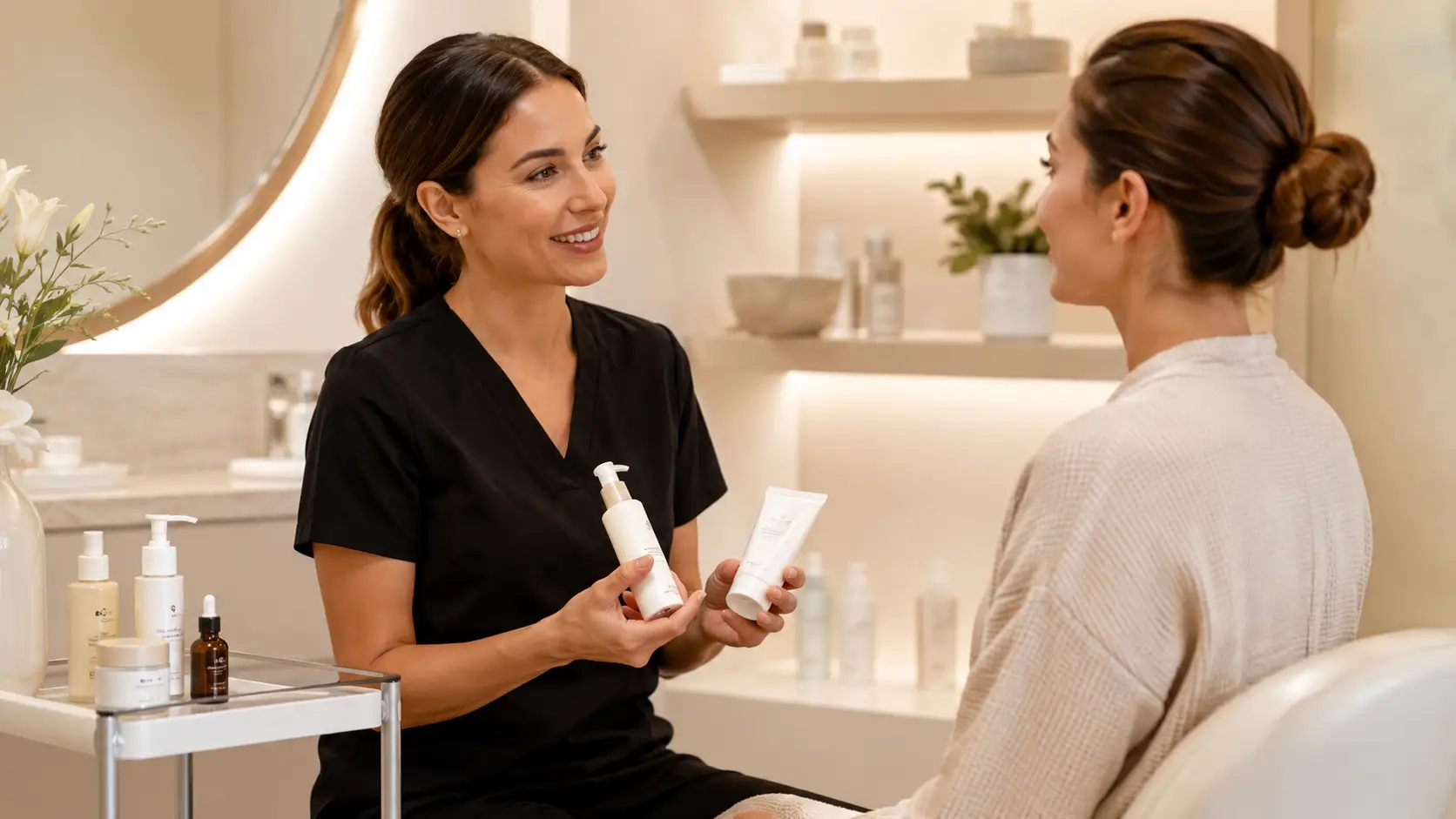
How Can New Estheticians Recommend Retail Products Without Feeling Pushy?
New estheticians can sell retail naturally by reframing the entire activity: retail recommendations are not sales pitches, they are the home-care component of a professional care plan. When a recommendation is anchored to something specific the esthetician observed about the client’s skin and something the client experienced during the treatment, it lands as expert advice rather than upselling. The discomfort most new estheticians feel around retail is almost always a framing and timing problem, not a personality problem.
- Introduce products during the treatment itself, not at checkout, by narrating what you are applying and why it benefits that client’s specific skin concern.
- Recommend a maximum of two to three products per appointment to avoid overwhelming clients and triggering decision paralysis.
- Tie every recommendation to the client’s specific skin goal or observation made during the consultation — generic recommendations feel like upselling, specific ones feel like care.
- Never apologize for the price of a product; instead, frame value in terms of outcome and cost-per-use relative to drugstore alternatives.
- Clients who feel zero pressure to buy are significantly more likely to purchase at a future visit than clients who felt pushed during checkout.
- Deep product knowledge removes the sales discomfort because you are no longer promoting something — you are explaining something you genuinely believe in.
- Always provide a written take-home list of recommendations so clients who are not ready to buy today have a clear path to purchasing later.
Ask a room full of new estheticians what part of their job makes them most uncomfortable and retail recommendations come up almost every time. The discomfort has a consistent source: estheticians enter this profession because they want to help people, and anything that feels like selling feels at odds with that identity. The moment a retail recommendation starts to feel like pressure, the experience of giving it becomes something most new estheticians actively try to avoid.
Here is what most new estheticians do not initially understand: the discomfort around retail is almost never a personality problem. It is a framing problem. When retail recommendations are detached from the clinical conversation and presented as a separate transaction at checkout, they feel like a sales pitch because structurally, that is exactly what they are. When they are woven into the treatment itself as the natural home-care extension of what you just did for the client’s skin, they feel like professional advice. The client’s experience of those two things is completely different — and so is yours as the person delivering them.
This guide gives new estheticians a practical, education-first approach to retail that eliminates the pushy feeling from both sides of the conversation. We cover the psychology behind why the framing shift works, specific language you can use, how to time recommendations, how to handle price objections gracefully, how many products to recommend, and how to build a retail system that generates consistent income without ever making a client feel sold to.
What Makes Retail Recommendations Feel Natural Instead of Pushy
- Retail discomfort is a framing and timing problem, not a personality problem. Fix the structure, and the discomfort largely disappears.
- Introduce products during the treatment while you are applying them — not at checkout when the care context has already ended.
- Specific recommendations tied to what you observed feel like professional care. Generic recommendations tied to nothing feel like upselling.
- Recommend a maximum of two to three products per appointment. More than three causes decision paralysis and typically results in no purchase.
- Never apologize for a price. Reframe value in terms of outcome, cost-per-use, and what the client is already spending on less effective alternatives.
- Always give clients a written take-home product list regardless of whether they purchase. It extends your care and gives undecided clients a path to buy later.
- Clients who feel zero pressure buy more over time than clients who feel pushed. Patience is a retail strategy.
- Deep knowledge of what you are recommending and genuine belief in it are the two things that make retail feel natural. You cannot fake either one convincingly.
Why Retail Feels Pushy — and the Simple Reframe That Changes Everything
The core reason retail feels pushy to most new estheticians is structural, not personal. The traditional retail model in many spas and salons places the product recommendation at the end of the service, at checkout, after the clinical conversation has concluded and the client is mentally preparing to leave. At that moment, the esthetician and the client have subtly switched roles: the esthetician is no longer in the treatment role and is now in the sales role. Clients feel this shift even when they cannot articulate it. And estheticians feel it even more acutely, which is why so many either skip the recommendation entirely or rush through it apologetically.
The reframe that changes everything is simple: move the retail conversation back inside the treatment, where your clinical authority is fully intact. When you are applying a serum and you say, “I am using a hyaluronic acid serum here because your skin is telling me it is dehydrated — you can see that in the fine lines around your eyes that aren’t deep lines, they’re actually just surface dryness” — you are doing three things simultaneously. You are educating the client about their own skin. You are demonstrating expertise. And you are creating a direct, felt connection between a product and a result the client is experiencing in real time. That is not selling. That is professional education. The conversation about whether that same serum is available to take home becomes a natural next step, not a transition into a sales mode that neither party wanted to enter.
The Care Plan Mental Model
Estheticians who consistently generate strong retail revenue without any of the associated discomfort tend to share one mental model: they think of retail as the home-care component of the client’s care plan, not as a separate revenue stream. When you frame retail that way internally, your communication changes automatically. You are not recommending a product so you can make a commission. You are completing the professional care plan you started during the facial. Clients can feel the difference between those two intentions, even when the words are superficially similar.
Before every retail conversation, ask yourself: “If I could not make a dollar from this recommendation, would I still make it?” If the answer is yes because the product genuinely addresses something you observed, your recommendation will feel like advice. If the answer is no, your recommendation will feel like selling. The products that pass that test are the ones worth keeping in your retail offerings.
When to Introduce Retail: Timing Is the Most Underrated Variable
Timing determines more of the outcome of a retail conversation than the words you use. Most new estheticians make the same timing mistake: they save all product recommendations for the end of the appointment. By that point, several things have happened that make the conversation structurally harder. The clinical trust built during the treatment has begun to recede. The client is mentally transitioning out of the relaxed, receptive state that a skilled facial creates. And every recommendation now lands without the sensory anchor of actually experiencing the product’s effect.
During-Treatment Introduction: The Most Effective Window
The most effective time to introduce a product is the moment you are applying it. This is when the client’s sensory connection to the product is at its strongest. A brief narration of what you are applying and why it benefits their specific skin situation creates a direct association between the product and a felt result. You do not need to name the product in full, give a price, or do anything that feels like selling. You are simply explaining your clinical decision as you would in any professional context. The retail conversation at the end then becomes a follow-up to something the client already knows about and has already experienced, rather than a new sales moment.
The Transition Point: Post-Treatment Before the Client Sits Up
The moment immediately after you remove the final mask and before the client sits up is a high-receptivity window that many estheticians underuse. The client is in a relaxed, positive state, their skin feels good, and they are in a natural conversational mode. A brief, specific summary of two or three things you noticed and what you addressed during the treatment — followed by a direct recommendation for the one home-care product that would most extend those results — lands naturally in this window. Keep it to one primary recommendation here. Save secondary recommendations for the written take-home list you provide at checkout.
Checkout: The Confirmation Window, Not the Sales Window
By the time the client reaches checkout, the retail conversation should already be substantially complete. Checkout is where you confirm the one or two products the client is ready to purchase, hand them the written take-home list, and make the transaction as smooth as possible. If you have done the earlier steps well, checkout retail feels like a natural conclusion. If checkout is where you are doing all your retail work for the first time, the structural challenge is much harder to overcome regardless of how skilled you are at communication.
What to Say: Language That Feels Like Advice, Not a Sales Pitch
The words you use in a retail conversation matter, but they matter less than the timing and specificity behind them. That said, there are consistent language patterns that make retail conversations feel like professional care and others that immediately trigger the transactional feeling both you and your client want to avoid. Learning to recognize the difference is one of the practical skills that separates estheticians who build strong retail income from those who avoid the conversation entirely.
The Specific Observation Bridge
The most powerful structure for any retail recommendation is what experienced estheticians sometimes call the observation bridge: you link the recommendation to something specific you observed about this client’s skin, not to a general product benefit. The recommendation carries completely different weight when it is attached to evidence the client can relate to.
Handling “I’ll Think About It”
When a client says they will think about it, the instinct for most new estheticians is either to push harder or to withdraw completely. Neither serves the client or your practice. The most effective response is a third option: accept it gracefully, express genuine support for their decision, and make sure they leave with everything they need to act on it when they are ready. Handing them a written list with the product name, the specific concern it addresses, and where they can purchase it turns a deferred decision into a future sale. Many estheticians find that clients who were not ready to buy at their first appointment become reliable retail customers by their third or fourth visit — because they were never pressured and they trust the recommendation as genuine.
How Many Products Should You Recommend and How Do You Choose?
One of the most consistent retail mistakes new estheticians make is over-recommending. The instinct to present everything that could benefit the client is well-intentioned, but it produces the opposite of its intended effect. Research on consumer decision-making consistently shows that when people are given more than three to four options in a low-information purchase environment — which most skincare purchases are for clients — decision paralysis sets in and they often choose nothing. More recommendations do not increase sales. They reduce them.
The Single Priority Rule
For most appointments, the most effective retail approach is to lead with one primary product recommendation and offer a written take-home list of two to three secondary suggestions. The primary recommendation should address the client’s single most significant skin concern or reinforce the core work you did during the facial. Secondary recommendations on the written list are for the client to explore at their own pace across future visits. This structure respects the client’s decision-making capacity, focuses your recommendation on genuine clinical priority, and removes the overwhelming quality that kills retail conversions.
How to Choose the Primary Product
Ask yourself: if this client could only add one product to their home-care routine after today’s treatment, which one would make the most visible difference to what we addressed today? That is your primary retail recommendation. Every other product that could theoretically benefit them goes on the written list for future consideration. Estheticians consistently report that this discipline — recommending one thing with full conviction rather than three things with divided energy — produces both higher conversion rates and stronger client trust in the recommendation itself.
Maximum Three Per Appointment
More than three recommendations causes decision paralysis in most clients. Lead with one primary recommendation verbally and support with a written secondary list of two.
Address the Primary Concern First
Choose the product that addresses the single most significant concern you observed during the facial. That specificity gives the recommendation genuine clinical authority.
Prioritize What They Already Felt
Products the client experienced during the treatment carry the highest conversion likelihood because the sensory connection is already established. Lead with these before recommending untried alternatives.
Always Provide One Regardless
A written list extends your care, respects clients who are not ready to buy, and creates a clear purchase path for the future. Clients who receive lists become stronger long-term retail customers.
How to Handle Price Objections Without Apologizing or Discounting
Price objections are one of the most common moments where new estheticians lose both the retail sale and some of their professional authority. The typical response pattern — apologizing for the price, immediately offering a discount, or backing away from the recommendation entirely — inadvertently signals to the client that the product is not worth the price. That outcome is worse than the objection itself.
Never Apologize for a Price
Apologizing for a product’s price is one of the clearest ways to undermine a retail recommendation. If you genuinely believe the product is worth its price for what it delivers, apologizing communicates uncertainty. If you do not genuinely believe it is worth the price, you probably should not be recommending it. The solution to price discomfort is not better objection-handling language. It is genuinely recommending products you believe in and understanding deeply enough why they are priced where they are to explain it naturally.
The Value Reframe
When a client responds to a price with hesitation, the most effective response reframes the cost in terms of outcome or cost-per-use rather than defending the number itself. A professional serum that costs considerably more than a drugstore alternative looks different when framed as a daily cost and compared to what the client is currently spending on products that are not addressing their skin concern. You are not arguing about price. You are helping them understand what they are actually buying.
Do Not Discount in the Moment
Impromptu discounting during a checkout conversation creates more problems than it solves. It trains clients to wait for discounts, it devalues the product, and it rewards hesitation over trust in your recommendation. If you have a loyalty or referral program that includes retail incentives, direct clients there. That converts the discount from a reactive capitulation into a structured benefit of an ongoing professional relationship.
How Deep Product Knowledge Removes the Sales Discomfort Permanently
The single most reliable predictor of whether an esthetician feels comfortable making retail recommendations is how deeply they understand the products they are recommending. Estheticians who genuinely know the science behind an ingredient, who have used the products on their own skin, and who have observed results across their clients do not experience retail discomfort in the same way. They are not selling a product. They are sharing professional knowledge that happens to be embodied in a product they can hand the client on the way out.
Learn the Ingredient Science Behind Your Retail Line
You do not need to become a cosmetic chemist to sell retail effectively. You need to understand what the key ingredients in your recommended products do, why they are in those products, and how to explain their mechanism in plain language that connects to a skin result a client can observe. When a client asks why a product costs what it costs, the esthetician who can explain that the ingredient is a fermentation-derived compound that holds significantly more water than its common alternatives, inhibits the enzyme that breaks down the skin’s own moisture-binding molecules, and stimulates the skin’s natural hydration pathways is not selling. They are educating. And educated clients buy with confidence and do not return the product.
Use the Products Yourself Where Possible
Personal experience with a product is one of the most credible things you can bring into a retail conversation. When you can say, “I use this myself and here is what I noticed,” you are providing firsthand evidence that no marketing material can replicate. Keep this brief and authentic. It does not need to be a lengthy personal testimony — a single genuine observation is more effective than an enthusiastic but clearly scripted endorsement. Clients distinguish between real experience and performance quickly.
Estheticians incorporating Poly-Luronic™ Jelly Masks by Luminous Skin Lab into their retail offerings consistently note that the in-treatment experience does most of the retail work for them. The peel-off removal moment creates a visual and tactile impression that clients spontaneously comment on, and the immediate skin hydration visible post-removal gives estheticians a specific, real-time result to point to during the retail conversation. Multiple practitioners report that clients often ask about taking the product home before the esthetician has raised the topic — particularly after their first jelly mask experience.
In terms of the retail conversation itself, estheticians find that explaining the PGA and HA dual-humectant system in plain terms — surface sealing versus deep delivery, and why the combination maintains hydration longer than a single ingredient — resonates with clients who have tried other hydration products without the results they expected. The ingredient science gives the recommendation specificity and authority that clients respond to as expert advice rather than product promotion. For home-care recommendations following hydration and recovery facials, the product’s fragrance-free and clean-label profile also makes the conversation around sensitive skin protocols straightforward rather than defensive.
Building a Simple Retail System That Generates Consistent Income
Retail income for an esthetician is not primarily about individual transaction skill. Over time, it is about building a consistent system that removes friction from the purchase decision, tracks what clients are using, and creates natural reasons for clients to reorder. New estheticians who approach retail as a system rather than a series of individual sales conversations generate more consistent income with significantly less effort per transaction.
The Client Product Record
Tracking which products each client is using and approximately when they will run out is one of the simplest and most underused retail systems in esthetics. When a client comes in for their next appointment and you know they started a product three months ago, you know approximately when they will need a refill. A simple check-in — “How has that serum been working for you?” — accomplishes three things: it demonstrates that you tracked their care, it opens a conversation about results, and it naturally leads to reorder if the answer is positive. This is not sophisticated software or a complex CRM. It is a note in a client file and a habit of following up on it.
The Written Take-Home List as a Retail System
Providing every client with a written take-home list after every appointment — regardless of whether they purchased — is one of the highest-return retail habits a new esthetician can build. Include the product name, the specific concern it addresses, and simple instructions for use. Many estheticians find that clients who received take-home lists but did not purchase at their first appointment begin purchasing within two to three visits because the list creates a clear, frictionless path to acting on the recommendation when they are ready.
The Loyalty and Reorder Incentive
Rather than discounting retail impulsively in response to price hesitation, build a structured incentive for repeat retail customers. This can be as simple as a stamp card where every fifth retail purchase earns a discount, or a small gift with reorder for clients who purchase the same product twice. These structures reward client loyalty rather than price objection, and they remove the need for in-the-moment discounting entirely.
- During-treatment narration. Briefly name and explain each key product you apply during the facial in plain language tied to what you observed about that client’s specific skin.
- Post-treatment primary recommendation. Before the client sits up, offer one focused recommendation tied to the primary skin concern you addressed. Keep it specific and brief.
- Written take-home list at checkout. Provide every client with a written list of all products you used and your home-care recommendation regardless of purchase decision. Include product names, concerns addressed, and simple usage instructions.
- Client product record update. After every appointment, note which products each client is actively using and approximate reorder timing in their client file.
- Follow-up at next appointment. Begin the next appointment’s consultation with a check-in on how their home-care routine is working. This closes the loop, demonstrates genuine care, and opens the reorder conversation naturally.
Professional References and Resources
The retail communication frameworks and client psychology principles in this guide draw from established esthetics business education and behavioral sales research:
- Decision paralysis in consumer choice: Iyengar, S.S. & Lepper, M.R. (2000). “When choice is demotivating: Can one desire too much of a good thing?” Journal of Personality and Social Psychology, 79(6), 995–1006. Relevant to limiting retail recommendations per appointment.
- Trust-based selling frameworks: Cialdini, R. (2007). Influence: The Psychology of Persuasion. Covers liking, authority, and consistency as drivers of recommendation acceptance — all active in clinical retail contexts.
- Education-first retail models in professional services: Professional Beauty Association (PBA) Retail Education resources. Supports the in-treatment product narration framework.
- Client retention and repeat retail: ISPA (International Spa Association) industry reports on service-to-retail attachment rates and loyalty incentive structure outcomes.
- Ingredient education as a retail trust driver: Luminous Skin Lab Esthetician Education Portal — ingredient science series covering polyglutamic acid, hyaluronic acid, and barrier-repair humectant mechanisms.
For new estheticians building their first retail system, carrying products that do the retail work during the treatment itself makes the entire conversation structurally easier. The Poly-Luronic™ Jelly Mask by Luminous Skin Lab is one of the rare retail-ready professional products where the client’s in-treatment experience — the cooling application, the peel-off removal, the immediate visible hydration improvement — creates the retail conversation naturally rather than requiring you to initiate it. The PGA and HA dual-humectant formulation is also genuinely easy to explain in plain language because the results are immediate and visible, which gives new estheticians the ingredient confidence that underpins natural, pressure-free retail communication. Fragrance-free, clean-label, and suitable for sensitive and post-treatment skin clients.
Explore the Poly-Luronic™ Jelly Mask Line →Frequently Asked Questions: Selling Retail as a New Esthetician
Why do new estheticians feel so awkward recommending retail products?
New estheticians often feel awkward recommending retail because they conflate education with selling. When you frame a retail recommendation as an extension of the clinical conversation you already had during the facial, the discomfort largely disappears. You are not selling a product, you are completing the care plan. Most of the awkwardness comes from making the recommendation at the wrong time, using the wrong framing, or recommending products you are not personally confident in.
When is the best time to bring up retail during a facial appointment?
The best time to introduce retail is during the treatment itself, not at checkout. When you apply a serum or mask and explain what it is doing for the client's skin in that moment, you create a natural, low-pressure connection between the product and a real result the client can feel. By the time you mention that the product is available for home use, the client has already experienced its effect. Checkout recommendations made without this in-treatment context feel transactional and are far more likely to create resistance.
How many products should I recommend to a client at the end of a facial?
Recommend no more than two to three products per appointment. Recommending more than three products at once overwhelms most clients and causes decision paralysis, which typically results in no purchase at all. Prioritize the one product that addresses the client's single biggest skin concern or that they already experienced a tangible result from during the treatment. Once they are using that consistently, you can build from there at their next visit.
What do I say when a client says the product is too expensive?
Acknowledge it genuinely without apologizing for the price. A useful response is to reframe the cost relative to the outcome: walk them through how much of a department store or drugstore alternative they would need to use to get the same result, or calculate the cost per use if it is a concentrate. If price remains a barrier, offer to prioritize the single most impactful product rather than pushing the full recommendation. Never discount retail in the moment, but having a loyalty or repurchase incentive program removes the need for impromptu discounting.
How do I recommend retail without sounding like I'm just trying to make money?
Tie every recommendation directly to something specific you observed or discussed during the consultation or treatment. Generic retail recommendations feel like upselling. Specific recommendations that reference the client's exact skin concerns, what you applied during the facial, and what you are trying to help them maintain feel like professional care. The difference in client perception between those two experiences is significant, and it is entirely determined by how specifically you frame your recommendation.
Is it okay to tell a client I personally use the products I'm recommending?
Yes, and this is one of the most effective trust-building tools available to estheticians. Personal experience with a product gives your recommendation immediate credibility that no marketing material can replicate. Share what you noticed, how you use it, and what result you got. Keep it brief and authentic. The key is that it must be genuine. Clients can detect scripted enthusiasm quickly, and it erodes the trust you are trying to build.
What if a client just does not want to buy anything? How do I handle that gracefully?
Accept it without any pressure and without withdrawing warmth or professionalism. A simple response like 'totally fine, I will write down what I used today so you have it when you are ready' accomplishes several things at once: it respects their decision, demonstrates confidence in the product without pressure, and gives them something to act on later. Clients who feel no pressure to buy are far more likely to purchase at a future visit than clients who felt pushed at checkout.
How does understanding ingredient science help me sell retail more naturally?
When you can explain clearly why an ingredient works, the recommendation stops feeling like a sales pitch and starts sounding like expert advice. Clients who understand what a product does for their specific skin concern are significantly more likely to purchase it and to keep using it. Deep ingredient knowledge also means you recommend products you genuinely believe in because you understand why they perform, which comes through in how you talk about them.
How do Poly-Luronic jelly masks fit into a retail recommendation conversation with clients?
Poly-Luronic Jelly Masks by Luminous Skin Lab work naturally in retail conversations because clients already experienced the mask during their treatment. When a client feels the cooling effect, sees the peel-off removal, and notices immediate post-treatment hydration, asking whether they want to take home a version for maintenance is a natural extension of the treatment experience rather than a cold pitch. The PGA and HA dual-humectant system is also genuinely easy to explain because the results are visible and immediate.
Retail Without the Push: It Starts With How You Think About It
The estheticians who generate the strongest retail income without ever feeling pushy share one thing: they stopped thinking of retail as a sales activity and started thinking of it as the final step in professional care. That reframe changes everything — when you believe it, clients can feel that you believe it, and the entire dynamic of the conversation shifts.
The practical tools covered in this guide — moving product introductions into the treatment itself, limiting recommendations to two or three, building specific observation bridges, handling price conversations without apology, always providing written take-home lists — are all expressions of that same underlying principle. You are not selling. You are completing the care plan.
Build these habits early. Retail income is one of the most significant contributors to sustainable income as a solo esthetician or small practice owner. The estheticians who figure this out in their first year carry that advantage throughout their entire career.