How Should a New Esthetician Handle Their First Facial Client?
Handling your first facial client successfully comes down to three things: thorough preparation before the appointment, a structured consultation that guides the opening of every service, and a clear protocol you have practiced enough to execute without having to think through each step in real time. Nerves are normal and expected — what matters is that your preparation does the work your confidence has not yet built.
- Set up your treatment room completely at least 30 minutes before the appointment. Physical readiness reduces cognitive load and allows you to focus entirely on the client.
- Use a structured five-question consultation framework covering skin history, current routine, sensitivities, today’s goals, and lifestyle factors — it gives every appointment a professional opening regardless of how nervous you feel.
- Manage silence intentionally — light narration builds client trust early in the service; silence during mask and massage phases is appropriate and expected by most clients.
- Prepare a scripted transition phrase to move from consultation into treatment, and a scripted close that includes a home care recommendation and a rebooking invitation.
- When something goes wrong, stay calm and correct it without dramatizing it. Clients remember how you handle moments, not the moments themselves.
- End every appointment with a specific skin observation that connects what you did today to a reason to return — this is the foundation of client retention from the very first visit.
There are very few professional milestones that carry the weight of the first real client appointment. After months of school, practice mannequins, and peers as models, a paying client sitting in your treatment chair changes everything — the stakes feel higher, the silence feels louder, and the gap between what you practiced and what this moment requires can feel enormous.
The experience is almost universal among new estheticians. And almost universally, the estheticians who look back on their first client appointments without regret have one thing in common: they prepared more than they thought they needed to. Not just technically — they prepared their consultation structure, their transition language, their response to client questions, their protocol sequence, and their close. They built a framework for the appointment that their training could run through reliably, even when nerves were running high.
This guide walks you through every phase of a first facial client appointment — from room setup and consultation through the treatment itself, the mask phase, the close, and the rebooking conversation. It is designed to give you a complete, actionable framework you can use before your first appointment and every appointment after it.
What Matters Most When Handling Your First Facial Client
- Preparation is the best remedy for nerves — the more thoroughly you prepare your room, protocol, and consultation structure, the less your nerves will interfere with your performance.
- A five-question consultation framework gives every appointment a professional anchor regardless of how you feel walking into the room.
- Your transition from consultation to treatment should be deliberate and scripted until it becomes natural — it is the moment the client shifts from talking to relaxing.
- Light narration early in the service builds client trust; appropriate silence during mask and massage steps shows professional poise.
- Mistakes happen — how you handle them determines their impact, not the mistakes themselves.
- A strong close — skin observation, home care recommendation, rebooking invitation — is the foundation of client retention from day one.
- Honesty about your experience level, delivered with confidence, builds more trust than deflection or over-explanation.
Before the Appointment: Setting Up for Success
The most overlooked aspect of handling a first facial client is what happens before they arrive. New estheticians typically focus their preparation energy on the treatment itself — which products to use, in which order, at what timing. That preparation matters. But the physical and mental setup that happens in the 30 to 60 minutes before the client walks in matters just as much.
Set Up the Room Early and Completely
Aim to have your treatment room fully set up at least 30 minutes before the appointment time. This means everything in position: linens fresh, supplies laid out in application order on your cart, products confirmed, intake form reviewed, and sanitation check complete. When everything is physically ready before the client arrives, you can give your full attention to the greeting, the consultation, and the client — rather than splitting your focus between the client and the room.
Estheticians who rush their room setup tend to feel rushed throughout the entire appointment. The physical disorganization amplifies the mental pressure of a first appointment. Arriving early and setting deliberately is one of the simplest and most effective things you can do to start the appointment from a position of control.
Review the Intake Form Before They Arrive
If your client submitted a digital intake form in advance, read it before they walk in. Note any sensitivities, allergies, or recent treatments. Identify their stated concern. Think about how this information will shape your protocol. When you walk into the greeting already holding this knowledge, your consultation becomes a conversation that deepens what you know rather than a data-collection exercise you are conducting in real time.
If no intake form exists yet because this is the very first appointment, plan to spend the first five minutes of the appointment collecting this information through your consultation before any skin analysis or treatment begins.
Prepare Your Protocol Mentally
Walk through your treatment sequence mentally before the client arrives. Not in full detail — just the structure: cleanse, analysis, exfoliation, extractions if appropriate, serum, mask, massage, close. Knowing the arc of the appointment reduces the cognitive load of decision-making during the treatment itself, freeing your attention for the client rather than the protocol.
- Treatment room set up fully at least 30 minutes before appointment time
- All supplies laid out in application order on treatment cart
- Linens fresh, treatment bed set up with headband and drape
- Intake form reviewed and key notes identified
- Protocol sequence mentally confirmed based on client skin type and goals
- Sanitation and hygiene check complete — all implements clean and accessible
- Products confirmed and accessible — no reaching or searching during treatment
- Mask phase supplies ready including mixing bowl, spatula, and timer
The Consultation: A Five-Question Framework Every New Esthetician Can Rely On
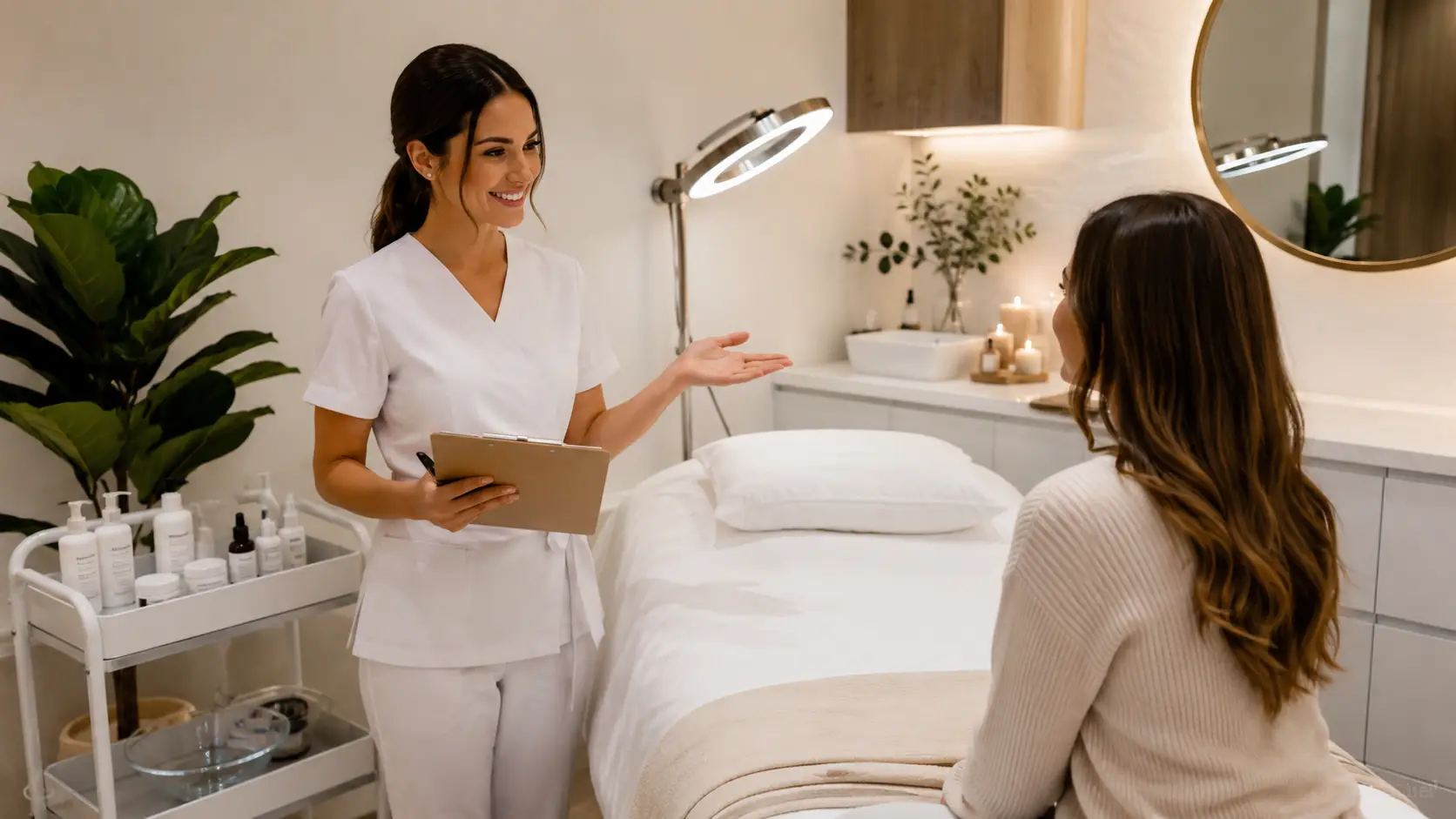
The consultation is the professional foundation of every facial appointment. It is how you gather the clinical information you need to make safe and appropriate treatment decisions, and it is how your client forms their first impression of you as a practitioner. A structured consultation communicates competence and genuine care simultaneously — two signals that matter more than years of experience when a client is sitting down with you for the first time.
Many new estheticians make the mistake of conducting the consultation as a list of questions rather than a conversation. The goal is information with warmth — systematic enough to cover every clinical variable, relaxed enough to feel like a genuine professional exchange rather than an intake interview.
The Five Core Consultation Areas
-
Current Routine and Products in UseAsk what the client is currently using morning and evening, and whether they have added any new products recently. This tells you about potential active ingredient interactions, sensitization risks, and the client’s baseline skincare knowledge level — all of which inform your treatment approach.
-
Known Sensitivities, Allergies, and Skin ReactionsAsk directly: has the client ever reacted to a product, treatment, or ingredient? Have they had any redness, breakouts, or irritation from professional treatments in the past? This is safety-critical information that must be collected before any application begins.
-
Recent Treatments or ProceduresAsk about any professional treatments, medical procedures, or aesthetic services within the last 30 days. Recent chemical peels, microneedling, laser, filler, or Botox all affect what you can safely do in today’s appointment. This question protects both the client and your professional standing.
-
Primary Concern and Goal for Today’s AppointmentAsk the client what they most want to address today. This aligns your treatment plan with the client’s expectation of the appointment. It also gives you a clear narrative thread to close the appointment with — connecting what you did today to the goal they expressed at the start.
-
Lifestyle Factors: Sun Exposure, Stress, and HydrationA brief lifestyle question — how much sun exposure, current stress level, and daily water intake — completes the clinical picture and communicates to the client that you see their skin in the context of their whole life. This question tends to generate the most genuine conversation of the consultation and meaningfully deepens client rapport.
How to Handle the “How Long Have You Been Doing This?” Question
At some point during your first client appointments, a client will ask how long you have been practicing. This question tends to generate disproportionate anxiety in new estheticians. The professional answer is honest, confident, and forward-looking: “I recently completed my licensure and I’m building my practice — you’re going to get my complete attention and care today.”
What you do not want to do is apologize, over-explain, or use diminishing language like “I’m just starting out” or “I’m still learning.” These phrases plant doubt rather than resolve it. Clients respond to how you carry yourself far more than to the answer you give. A direct, confident response followed by a clear pivot back to the client — “What brings you in today?” — closes the loop and moves the appointment forward.
Transitioning From Consultation Into Treatment
The transition from consultation to treatment is a moment many new estheticians handle awkwardly — not because they lack skill, but because they have not prepared a deliberate, scripted transition phrase. Without one, the shift from talking to doing can feel abrupt, uncertain, or unclear to the client.
Use a Scripted Transition Phrase
A clear transition phrase serves two functions: it signals to the client that the conversation phase is closing and the treatment phase is beginning, and it sets the client’s expectations for what is about to happen. Keep it simple and direct. A strong example:
“Based on what you’ve shared, I’m going to do a hydration-focused facial today, starting with a thorough cleanse and then moving into your mask phase. I’ll guide you through everything as we go — just let me know if anything feels uncomfortable or if you have questions.”
This language accomplishes three things: it names the treatment type, it previews the structure, and it opens an explicit channel for client communication. All three reduce client anxiety and reinforce your professional authority in the same breath.
Skin Analysis Narration
During skin analysis, light narration is appropriate and valuable. Commenting on what you observe — “I can see some dehydration in your cheek zone, and your T-zone is a little more oily than your cheeks” — demonstrates your observational competence and reassures the client that you are reading their skin carefully rather than applying a generic protocol. Keep observations neutral and clinical — avoid dramatic language about skin problems, which tends to generate anxiety rather than confidence.
Moving Into the Treatment Sequence
Once skin analysis is complete, move into your treatment sequence without hesitation. Confident, deliberate movement communicates to the client that you know what you are doing. Even if your internal experience is less certain than your external presentation, the protocol you have practiced will carry you. This is precisely why rehearsing your full protocol sequence — not just reading about it — before your first client appointment is non-negotiable preparation.
The Four Phases of a First Facial Appointment: What Happens When
Understanding the four phases of a first facial client appointment — and what is happening professionally in each phase — gives new estheticians a structural map they can return to whenever the appointment feels uncertain. Each phase has a distinct purpose, a distinct client experience, and distinct practitioner responsibilities.
During the Treatment: What to Say, When to Be Quiet, and How to Use the Mask Phase
The treatment phase is where new estheticians most often over-communicate out of nervousness, or under-communicate out of concentration. Neither extreme serves the client. What works is a calibrated, intentional approach to narration that changes as the appointment progresses.
Early in the Treatment: Narrate with Intention
During the cleansing and exfoliation steps, light narration builds client trust and reduces anxiety — particularly for clients who have never had a professional facial before. Brief, clear explanations of what you are applying and why create a sense of guided experience rather than passive submission to an unknown process.
The narration does not need to be elaborate. “I’m applying a gentle enzyme cleanser now — it will dissolve surface buildup without stripping your barrier” is enough. “This is a mild exfoliation step to prepare your skin for the serum” is enough. Short, purposeful, and professional.
The Mask Phase: Your Built-In Service Window
The mask phase is one of the most strategically valuable parts of the facial for a new esthetician. Once the mask is applied and setting, you have a defined window — typically 10 to 20 minutes depending on your mask formulation — in which the client is settled, relaxed, and not expecting conversation. This window is ideal for scalp massage, hand and arm massage as a luxury add-on, or quiet presence if the client has settled into deep relaxation.
Experienced estheticians also use the mask phase for brief, natural retail and rebooking conversations — but only if the client is responsive and the energy of the appointment supports it. Reading the client’s cues is more important than following a script in this window.
New estheticians who incorporate the Poly-Luronic™ Jelly Mask by Luminous Skin Lab into their first facial protocols often comment on how much the predictable set behavior reduces their in-appointment stress. When you are managing nerves, tracking time, and trying to stay present with the client simultaneously, not having to guess whether the mask has set is a genuinely meaningful reduction in cognitive load. The consistent 12-to-15-minute set window reliably accommodates a scalp massage sequence without adjustment, and the peel-off removal creates a moment clients almost always comment on positively — which gives the new esthetician a natural opening for the close.
Practitioners transitioning from other mask formats also note that the immediate post-removal skin change — notably increased radiance and reduced visible dryness — creates a clear visual result the esthetician can reference in the close without needing to oversell or over-explain. When the client can see and feel the difference, the close becomes a conversation about what they noticed rather than a pitch for what you provided. That distinction makes the close feel natural rather than pressured, which is exactly what a first-time client appointment needs.
Handling Silence Professionally
Many new estheticians feel compelled to fill silence with talk. This is understandable — silence during a first appointment can feel awkward from the practitioner’s side. But from the client’s side, silence during the mask and massage phases is not awkward at all. It is the experience they came for. Many clients explicitly value the quiet. Reading the client’s response to your narration early in the appointment will tell you whether they want to talk, or whether they are there to decompress. Adjusting accordingly is one of the most sophisticated things a new esthetician can do in their first appointments.
What to Do When Something Goes Wrong
At some point in your early appointments, something will not go according to plan. A product gets applied in the wrong order. An extraction attempt does not succeed. The mask sets faster than expected. The client has a mild reaction to an ingredient. How you respond to these moments defines your professional character far more than the moments themselves.
The professional standard is: stay calm, pause, assess, and address. If the issue is minor and correctable, correct it without announcing it. If the client notices or asks, acknowledge it directly: “I’m adjusting the protocol slightly based on how your skin is responding today.” This language is honest, clinical, and forward-looking — it communicates competence rather than crisis.
What you should never do is apologize excessively, dramatize the problem, or show visible panic. Clients are remarkably forgiving of professionals who handle imperfection calmly. They are significantly less forgiving of professionals who make them feel unsafe or uncertain about the outcome of their treatment.
How to Close a First Facial Appointment: The Three-Part Structure
The close of a facial appointment is as important as the consultation that opened it. A strong close gives the client clarity, gives them a reason to return, and gives you the professional momentum of a completed service that accomplished what the client came in for. Many new estheticians underinvest in their close because they are relieved the treatment went well and want to wrap up quickly. That instinct is understandable and should be resisted.
The close has exactly three parts. Prepared and practiced, it takes less than five minutes and creates a disproportionate impression.
Part One: Deliver a Specific Skin Observation
Begin the close with a concrete, specific observation about what you noticed during the treatment and what changed. “Your skin responded really well to the hydration protocol today — I can already see your texture looking smoother and less tight than when you came in.” This observation connects the treatment to a visible outcome and communicates that you paid attention throughout the entire appointment.
Make the observation specific to this client and this appointment, not generic. A client who hears something specific about their own skin remembers it and repeats it to friends. A client who hears generic positive feedback forgets it by the time they reach the parking lot.
Part Two: Give One Targeted Home Care Recommendation
Offer one specific home care recommendation tied to the client’s primary concern and what you observed. One recommendation is more effective than three or four, which overwhelm and paralyze. “The biggest thing I’d suggest adding at home is a hydrating serum before your moisturizer, especially since your skin was showing some dehydration signs today.” If you carry retail product, this is where a natural, non-pushy recommendation connects the home care advice to a product they can purchase from you.
Part Three: Offer a Natural Rebooking Invitation
The rebooking invitation closes the loop on the client’s skin goals and extends the professional relationship beyond today’s appointment. “I’d recommend coming back in about four to six weeks to build on what we did today — that’s when your skin will be ready for the next treatment step.” This language is clinical rather than transactional. It positions the rebooking as a professional recommendation rather than a sales ask, which is both more honest and more effective.
Why the Three-Part Close Builds Client Retention From Day One
The close of a first facial appointment is the primary determinant of whether a client returns. Research across service industries consistently shows that clients who leave a first appointment with a specific outcome observation, a personalized follow-up recommendation, and a clear reason to return rebook at substantially higher rates than clients who receive a warm but generic closing experience.
For new estheticians, this is particularly valuable because it means client retention is not primarily determined by years of experience — it is determined by the quality of the communication structure around the service. A prepared, practiced three-part close from a new esthetician outperforms an unprepared close from a five-year veteran.
The specific skin observation in Part One does double work: it demonstrates your professional observational competence during the treatment, and it gives the client a concrete result to report to anyone who asks how the facial went. Word-of-mouth referrals from first-time clients almost always begin with something a practitioner said specifically about their skin.
After the Appointment: What to Do Before the Next Client Arrives
The work of the first facial client appointment does not end when the client walks out the door. What you do in the 10 to 15 minutes after they leave shapes both the next appointment and your ongoing professional development.
Write Your Client Notes Immediately
Document the appointment while the details are fresh. Note the products used, the protocol performed, any skin reactions or observations, what you discussed in the close, and what you recommended for rebooking timing. Thorough client notes are not just a legal and professional requirement — they are the foundation of continuity of care that allows every subsequent appointment to feel personalized and informed rather than generic.
Reflect on What Worked and What to Adjust
Before resetting the room, take two minutes to reflect on the appointment honestly. What went well? Where did you feel uncertain? Was there a step that took longer than expected? Did the consultation structure serve you? Was there a moment where the client seemed less comfortable or engaged? This quick reflection, done consistently, compounds into significant professional improvement faster than any other practice.
Reset the Room With the Same Intention You Started With
Reset the treatment room with the same care and completeness you brought to the original setup. A rushed or incomplete room reset between appointments is one of the most common causes of the disorganization that creates in-appointment stress. Consistent room setup and teardown is not just a hygiene standard — it is a professional rhythm that stabilizes your performance across a full day of clients.
Professional Education References
The consultation frameworks, communication protocols, and client management strategies in this article draw from established esthetician education standards and professional practice research:
- Esthetician consultation and skin analysis frameworks — Associated Skin Care Professionals (ASCP) practice standards and professional education guidelines.
- Client communication and practitioner confidence development — National Coalition of Estheticians Associations (NCEA) continuing education guidelines.
- Service close and rebooking communication best practices — spa business management literature, including Milady Standard Esthetics: Fundamentals and Advanced volumes.
- First-appointment client psychology and retention mechanics — service industry and patient communication research in professional service contexts.
For new estheticians building confidence in their first facial protocols, one of the most practical investments is a mask formulation that reduces in-appointment variables rather than adding them. The Poly-Luronic™ Jelly Mask by Luminous Skin Lab is specifically formulated for professional treatment room use — consistent set behavior, fragrance-free and clean-label for safe application across all skin types, and a PGA + HA dual-humectant system that produces visible, immediate post-removal skin improvement clients notice without prompting. For a new esthetician managing their first real client appointments, a mask phase that performs predictably every time is not a luxury — it is a genuine operational advantage that frees your attention for the client rather than the protocol.
Explore the Poly-Luronic™ Jelly Mask LineFrequently Asked Questions: Handling Your First Facial Client
What should I do to prepare before my very first facial client arrives?
Before your first facial client arrives, set up your treatment room completely at least 30 minutes early so you are not rushing when nerves are highest. Lay out all supplies in the exact order you will use them, review the intake form the client submitted in advance, confirm your protocol plan, and do a final sanitation check. Having everything physically ready before the client walks in allows you to focus entirely on them rather than on logistics.
How do I stay calm and confident when I am nervous about my first real client?
Nerves during your first client appointment are completely normal and almost universal among new estheticians. The most effective way to manage them is through preparation: know your protocol so thoroughly that your hands can execute it while your attention stays on the client. Slow your breathing before entering the room, use a structured consultation script to anchor the opening of the appointment, and remind yourself that your client is not evaluating your experience level — they are focused on how they feel.
What questions should I ask during a first facial consultation?
A first facial consultation should cover five core areas: current skincare routine and products in use, any known sensitivities, allergies, or skin reactions; recent treatments or procedures within the last 30 days; primary skin concerns and goals for today’s appointment; and lifestyle factors including sun exposure, stress level, and hydration habits. These questions give you the clinical information you need while also communicating genuine professional care to the client.
What do I say when a client asks how long I have been doing this?
Answer honestly and confidently without apologizing for your experience level. A response like “I recently completed my licensure and I am building my practice — you are going to get my absolute best attention and care” communicates honesty while projecting professionalism. Clients respond to confidence and genuine care far more than years on a resume. Apologizing for being new or over-explaining your inexperience erodes trust faster than honesty ever would.
How do I transition smoothly from the consultation into the actual treatment?
After your consultation, use a clear transition phrase that signals the beginning of the service and sets client expectations for the next step. Something like: “Based on what you’ve shared, I’m going to do a hydration-focused facial today. I’ll guide you through everything as we go — just let me know if anything feels uncomfortable.” This closes the conversation phase and opens the treatment phase with confidence and clarity.
What if I make a mistake during the facial — how do I handle it professionally?
Stay calm, pause, and address it directly without dramatizing it. Most minor errors — a product applied in the wrong order, an extraction attempted on the wrong lesion, a timing miscalculation — can be corrected or adjusted without the client ever noticing. If the client does notice, a calm acknowledgment followed immediately by your correction response is the professional standard. What clients remember is how you handle a moment, not the moment itself.
How do I end the facial and close the appointment without feeling awkward?
Closing a facial appointment has three parts: a brief verbal recap of what you did and why, a specific home care recommendation tied to the client’s skin goals, and a rebooking invitation. Practice these three steps as a scripted sequence until they feel natural. A confident, structured close signals professional competence and naturally sets up the next appointment without the esthetician feeling like they are selling or pushing.
Should I explain everything I am doing out loud during the treatment?
Light narration is professional and reassuring, particularly for first-time facial clients who do not know what to expect. A brief explanation of each step — “I’m applying a cleansing milk now to prep your skin” or “this is your mask phase — it will feel cool and firm” — builds trust and reduces anxiety. Avoid over-explaining or filling every moment of silence with talk. Many clients value quiet during the mask phase and massage steps. Read your client’s cues.
How does using a professional jelly mask help during a first facial client appointment?
A professional jelly mask like the Poly-Luronic™ Jelly Mask by Luminous Skin Lab gives new estheticians a structured, high-impact mask phase that creates a memorable client experience without requiring advanced technique. The mask mixes and sets predictably, giving the esthetician a reliable 12-to-15-minute window for massage or client education. The dramatic peel-off removal and immediate visible skin improvement create a strong sensory impression that helps first-time clients feel the value of the service, which supports rebooking and word-of-mouth referrals from the very first appointment.
Your First Facial Client Is the Beginning of Everything
The first facial client appointment is not primarily a technical event — it is a communication event with a technical foundation. The estheticians who handle their first clients with the most professional confidence are not necessarily the ones with the most natural skill. They are the ones who prepared a consultation structure, practiced a transition phrase, knew their protocol well enough to execute it without hesitation, and invested in a close that gave the client a reason to return.
Nerves do not disappear after the first client. But they diminish, appointment by appointment, as your framework becomes second nature and your experience compounds. The preparation you invest in your first client appointment establishes the professional habits you will carry through every appointment after it.
Set up your room. Know your consultation. Execute your protocol. Close with intention. Rebook with confidence. That is the complete structure of every professional facial appointment — first or five-hundredth.