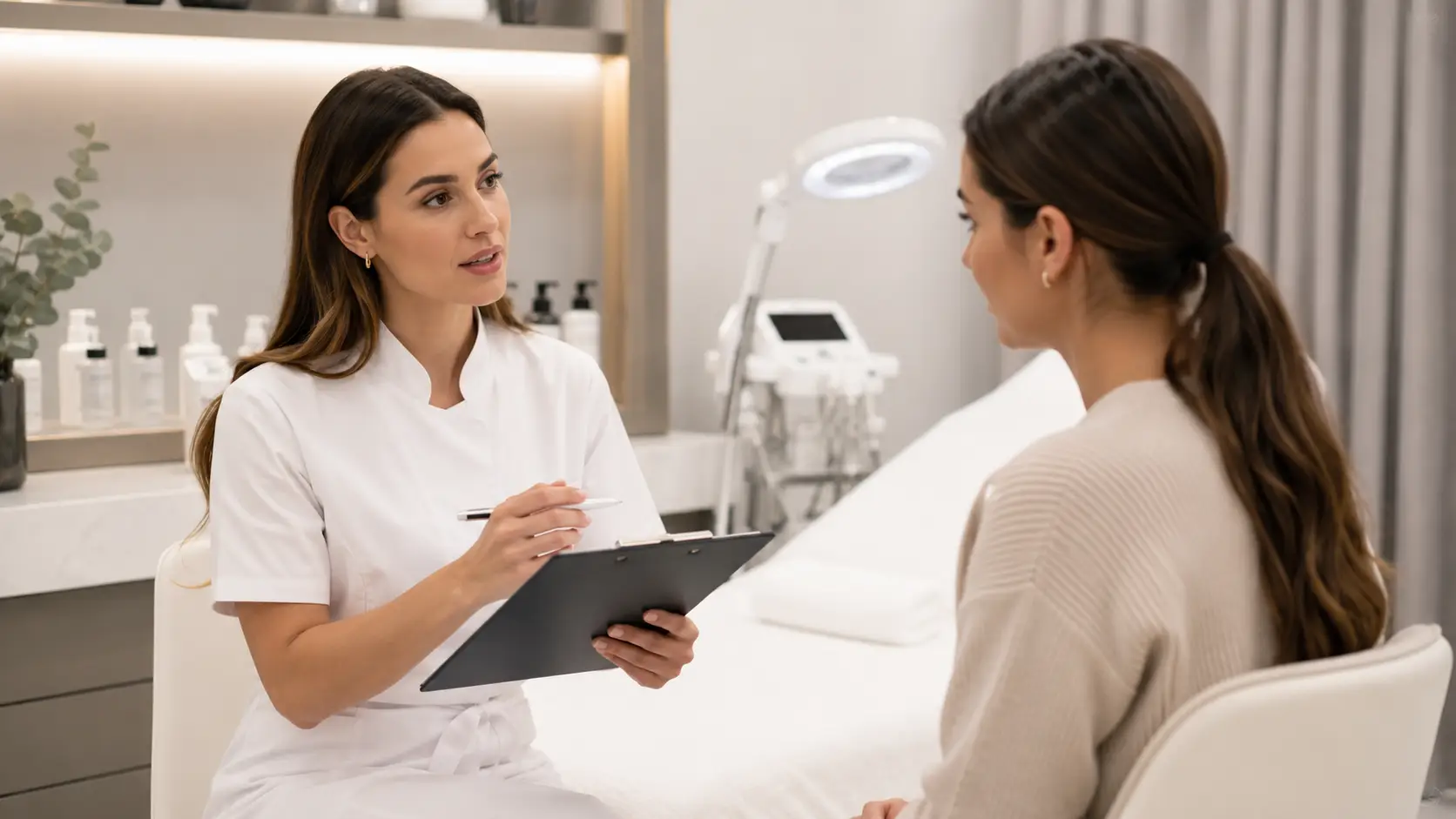
How Does a New Esthetician Know When to Refer a Client to a Doctor or Dermatologist?
A new esthetician should refer a client out whenever they observe a skin condition that falls outside their legal scope of practice, requires a medical diagnosis, or presents a safety risk that esthetic services cannot address. The clearest referral triggers include changing or suspicious moles or lesions, active skin infections, cystic acne, unexplained rashes, and any presentation you cannot confidently identify as benign.
- Estheticians are not licensed to diagnose skin conditions — when in doubt about what you are seeing, refer before treating.
- Referrals are a mark of professional integrity, not inexperience. Clients respect estheticians who prioritize their safety over the service fee.
- Common referral triggers include suspicious lesions, active cystic acne, pustular rosacea, active infections, unexplained rashes, and conditions flagged by a thorough intake form.
- How you deliver the referral matters as much as the referral itself — calm, confident, care-first language prevents panic and preserves the client relationship.
- Thorough intake forms and consistent skin analysis before every appointment are your primary tools for catching referral situations before the treatment begins.
- Document every referral recommendation in your client notes using objective, descriptive language.
No one talks about this part of the job during esthetics school nearly enough. Knowing how to apply a jelly mask, perform an extraction, or build a facial protocol gets significant attention. Knowing when to stop, step back, and tell a client they need to see a doctor before you can proceed — that conversation gets far less preparation time. And yet, for many new estheticians, it is one of the most anxiety-inducing moments they encounter in their first year of practice.
The reality is straightforward: you will encounter skin you cannot treat. Not because you lack skill — but because some skin presentations require medical care that falls outside the legal and clinical boundaries of esthetic practice. Recognizing those presentations quickly, handling the referral conversation with calm authority, and maintaining the client relationship through the process is a professional skill set that takes deliberate learning.
This guide gives you a practical framework for that skill. You will understand the clearest referral triggers, the language to use when making a referral, how to document it correctly, and how to keep clients on your books even when you have to send them elsewhere first. Getting this right protects your clients, protects your license, and builds exactly the kind of professional reputation that sustains a long-term esthetics career.
What Every New Esthetician Needs to Know About Referring Clients Out
- Scope of practice boundaries exist to protect clients — and you. Exceeding them is never worth the risk to either party.
- You are not required to identify a condition to refer for it. “I am not sure what this is” is a completely valid clinical reason to refer.
- The ABCDE rule for mole assessment is one of the most important tools in your skin analysis vocabulary.
- Cystic acne, active infection, and unidentified rashes are three non-negotiable referral situations that new estheticians most commonly encounter.
- A referral conversation delivered with calm professionalism almost never damages a client relationship — but a missed referral can cause lasting harm.
- Build a local referral network of dermatologists before you need it so you can make specific, confident recommendations.
- Always document what you observed and what you communicated — in writing, the same day.
Why Knowing Your Referral Boundaries Is a Core Professional Skill
Many new estheticians carry an instinct that referring a client out represents a failure — a gap in their knowledge, or worse, a moment that might make the client question their competence. That instinct is understandable, but it is exactly backward. The estheticians who refer appropriately and confidently are consistently viewed by clients as more trustworthy and more professional than those who attempt to treat everything that walks through the door.
The reason is simple: clients can sense when someone is operating at the edge of their knowledge and choosing not to acknowledge it. When you say “I want to make sure you get the right care for this before we proceed,” and you say it with calm authority, clients hear competence. They hear that you are genuinely looking out for them rather than just collecting a service fee. That single interaction, handled well, builds more loyalty than a technically flawless facial that ignores a concern the client had been worried about anyway.
There is also the matter of your license. Attempting to diagnose or treat skin conditions that fall outside esthetic scope of practice exposes you to professional board complaints, liability claims, and in serious cases, harm to the client that is genuinely difficult to reverse. Your license is your livelihood. Protecting it through appropriate referral is not timid — it is smart.
Estheticians are licensed to cleanse, analyze, and treat the skin within the boundaries defined by their state board. They are not licensed to diagnose skin conditions, prescribe treatments, or work on active infections, open wounds, or medically contraindicated presentations. When in doubt, refer. There is no professional consequence for an appropriate referral. There can be significant professional and legal consequences for proceeding without one.
The Most Common Situations That Require a Referral
New estheticians often ask for a clear list. While no list covers every possible presentation, the situations below represent the most frequent referral triggers you will encounter in a general esthetic practice. Familiarity with these categories — and the confidence to act on them — is foundational to responsible client care.
Suspicious Moles and Skin Lesions
Estheticians are in a uniquely valuable position to observe skin in areas clients cannot easily see themselves — the back of the neck, the scalp, the upper back, and behind the ears. The ABCDE rule is the most widely taught framework for flagging a mole or lesion that warrants dermatological evaluation:
- Asymmetry — one half does not match the other
- Border — edges are irregular, ragged, or blurred
- Color — variation from one area to another, shades of brown, black, red, white, or blue
- Diameter — larger than approximately 6 mm, about the size of a pencil eraser
- Evolving — the client mentions it has changed in size, shape, or color recently
You are not diagnosing melanoma. You are recommending that a trained physician evaluate a lesion that exhibits features associated with a need for professional assessment. That is entirely within your role — and it is a genuinely important one.
Active Skin Infections
Active bacterial, viral, or fungal skin infections are absolute contraindications for most esthetic services. This includes active cold sores or herpes simplex outbreaks, impetigo, infected folliculitis, and fungal infections such as ringworm. Providing facial services over an active infection risks spreading the infection across the skin surface and potentially to you or subsequent clients. Refer the client to their physician and reschedule after the infection has fully resolved.
Cystic and Nodular Acne
Mild to moderate comedonal and papular acne is generally within esthetic scope and can respond well to appropriate treatment protocols. Cystic and nodular acne — deep, painful, inflammation-dominated lesions — requires medical management. Performing extractions or aggressive exfoliation on cystic acne without medical oversight risks spreading infection, worsening inflammation, and causing post-inflammatory hyperpigmentation. Refer to a dermatologist and, where appropriate, offer to support the client’s esthetic goals in a reduced-scope capacity while they receive medical treatment.
Pustular Rosacea
Background redness and mild flushing associated with rosacea can sometimes be addressed within esthetic practice using appropriate protocols. Rosacea with active pustular involvement is a medical presentation that warrants dermatological management before esthetic services continue. The inflammatory component and the risk of further irritation through standard facial techniques make this a referral situation rather than a proceed-with-caution situation.
Unidentified Rashes and Skin Changes
If a client presents with a rash, widespread redness, hive-like reaction, or skin change you cannot confidently associate with a known non-medical cause, do not proceed. An unidentified skin change is not a reason for alarm — but it is a reason for referral before treatment. Document what you observed, communicate it calmly to the client, and recommend a dermatology appointment. You can always reschedule once the cause has been identified and cleared.
Contraindicated Medications and Medical Treatments
Your intake form should capture current medications and medical treatments as a standard question. Several medications create meaningful contraindications for esthetic services: isotretinoin (Accutane) and its post-course recovery period, blood thinners and anticoagulant therapy, immunosuppressants, and certain topical prescriptions that make the skin highly sensitized. Clients currently undergoing chemotherapy or radiation therapy require medical clearance before any esthetic service proceeds. When a client discloses a medication or treatment you are unsure about, look it up before proceeding — and err toward referral or medical clearance when in doubt.
Suspicious or Changing Lesions
Any mole or lesion that meets ABCDE criteria or that the client reports has changed recently. Document and refer to a dermatologist immediately.
Active Skin Infections
Cold sores, impetigo, infected folliculitis, fungal infections. Postpone all services until the infection has fully resolved under medical care.
Cystic or Nodular Acne
Deep, painful, inflamed lesions require a dermatologist’s management. Do not extract or apply aggressive exfoliants without medical oversight.
Unidentified Rashes or Reactions
If you cannot confidently identify what you are seeing as a non-medical presentation, do not proceed. Refer and reschedule after medical clearance.
Mild to Moderate Papular Acne
Within esthetic scope when approached with appropriate protocols. Avoid aggressive extractions and prioritize calming, anti-inflammatory techniques.
Background Rosacea Redness
Non-pustular rosacea can often be managed with gentle, fragrance-free, calming esthetic protocols. Avoid heat, aggressive exfoliation, and sensitizing actives.
How to Identify a Referral Situation Before the Treatment Begins
The best referral is one that happens at the consultation table before the client ever reaches the treatment bed. A thorough intake process — consistently applied to every client at every appointment, not just the first one — is your primary tool for catching referral situations early. Skin changes quickly. A client who was appropriate for treatment three months ago may present differently today.
Your Intake Form Is Your First Line of Defense
Every intake form should capture current medications and recent prescription changes, active medical conditions and recent diagnoses, recent cosmetic medical procedures including filler, Botox, laser, and chemical peels, current skincare products with particular attention to prescription-strength actives such as tretinoin, any skin changes the client has noticed since their last appointment, and whether the client is pregnant or breastfeeding. Reviewing the completed form before entering the treatment room — not during — gives you time to identify potential concerns and approach the skin analysis with informed attention.
Skin Analysis Before Every Service
A brief but systematic skin analysis under magnification at the start of every appointment, even for returning clients, is the standard practice that catches what intake forms miss. Clients do not always notice or disclose skin changes. Your trained eye may spot a lesion change, a new rash, or an infection in early stages that the client is unaware of or did not consider relevant to mention.
The Difference Between Referral Situations and Proceed-With-Caution Situations
Not every challenging skin presentation requires a full referral and postponed service. Understanding the difference between a definitive stop-and-refer situation and a proceed-with-modification situation is a clinical judgment skill that develops with experience — but there are useful working principles to guide you early on. The primary distinction is whether proceeding creates meaningful risk of harm: spreading an infection, worsening inflammation, stimulating a suspicious lesion, or applying aggressive chemistry to contraindicated skin. When the answer is yes, you stop and refer. When the answer is that modified, minimal-intervention service can be provided safely, you have more flexibility.
How to Have the Referral Conversation Without Panicking Your Client
This is the part most new estheticians dread. The clinical decision — this client needs a referral — is often clearer than the interpersonal execution. What do you actually say? How do you tell someone that you cannot treat them today without alarming them, making them feel rejected, or undermining your own authority?
The answer lies in preparation, language, and framing. Estheticians who handle referral conversations well share a common approach: they communicate from a position of professional care rather than personal uncertainty, they are specific rather than vague, and they deliver the information as a natural extension of the consultation rather than a disruption to it.
The Language Framework That Works
Avoid phrases that telegraph your own anxiety, such as “I’m not really sure about this” or “this might be nothing but...” These undermine your professional authority and increase client anxiety without providing useful information. Instead, use language that positions the referral as a deliberate, professional act of care:
- “During your skin analysis today, I noticed something I want to make sure gets the right professional attention before we proceed.”
- “Part of my job as your esthetician is to look out for anything that falls outside what I’m licensed to treat. I’m seeing something I’d like a dermatologist to evaluate first.”
- “I want to make sure you’re getting the most effective care possible — and for what I’m seeing, that means connecting you with a dermatologist before we continue.”
- “This is a really common referral situation in my practice. Once you’ve had it checked out, we can absolutely proceed with your facial plan.”
Notice that none of these phrases speculate about a diagnosis, express alarm, or use vague language that creates confusion. They are calm, clear, specific in intention if not in diagnosis, and client-care-centered throughout.
What to Do If a Client Pushes Back
Some clients will resist the referral, particularly if they have been looking forward to their appointment. A common response is “It’s fine, I’ve had it forever.” Your professional response is warm but firm: “I understand — and it probably is fine. But part of my job is to make sure we check when something catches my eye, and this did. I want to protect your skin and make sure we’re doing right by you.” You are not asking for permission to refer — you are explaining your professional rationale. Hold the line calmly.
Build a Local Referral Network Before You Need It
One of the most practical steps a new esthetician can take in their first year of practice is to identify two or three dermatologists in their area who see new patients and who understand esthetic practice. When you can say “I’d specifically recommend Dr. [name] — they see new patients quickly and I have a good working relationship with their practice,” the referral conversation becomes immediately more specific and actionable. That specificity signals professionalism and care simultaneously. It also makes it far more likely the client will actually follow through.
A recurring pattern in new esthetician practice is the discovery that a referral situation can still produce a meaningful, billable service outcome — when handled thoughtfully. When a client presents with mild barrier disruption, early-stage sensitivity flare, or the aftermath of a skin reaction that does not require a full referral but does call for a step-back service approach, estheticians working with the Poly-Luronic™ Jelly Mask by Luminous Skin Lab have noted a consistent pattern: the fragrance-free, minimal-active formulation allows a reduced-scope service to still feel substantive and caring to the client.
In practice, the approach looks like this: the aggressive planned service is modified or postponed, a calming consultation is conducted to explain the reasoning, and a gentle hydration treatment — cleanse, serum, jelly mask application — replaces the original protocol. The client leaves with visible skin improvement, understands the professional rationale for the modified approach, and is far more likely to maintain their booking relationship than if they were simply sent home. The Poly-Luronic™ Jelly Mask’s consistent 12-to-15-minute set window and immediate post-removal hydration response gives the esthetician a clinically gentle but visibly effective protocol anchor in exactly these proceed-with-modification scenarios — something that HA-only or consumer-grade mask alternatives rarely deliver at the same level of reliability.
How to Document a Referral Correctly and Protect Yourself Professionally
Documentation is not paperwork — it is professional protection. If a client later raises a concern about their esthetic experience, or if a board complaint is filed, your client notes are your primary defense. Clear, objective, same-day documentation of every referral recommendation you make is as important as the referral itself.
What Good Referral Documentation Looks Like
Good referral documentation is objective, specific, and clinical in tone without being diagnostic in language. It describes what was observed, where it was located, what it looked like in measurable or descriptive terms, what was communicated to the client, how the client responded, and what the outcome of the appointment was. An example of appropriate referral documentation language might look like:
Sample Referral Note Language
“During skin analysis, observed irregularly bordered lesion approximately 8mm in diameter on left upper cheek, exhibiting two distinct color areas (brown and black). Client reports lesion has ‘gotten a little bigger’ in the past few months. Advised client that this presentation warrants evaluation by a dermatologist before proceeding with facial treatment. Client acknowledged recommendation and agreed to contact dermatologist this week. Session not performed today. Follow-up appointment pre-booked for six weeks pending medical clearance.”
Do not write: “Suspicious mole that looks like it could be melanoma” or any language that implies a medical diagnosis. Your documentation describes observations and professional actions — it does not diagnose.
Maintain a Referral Log Separate From General Client Notes
Some estheticians maintain a separate internal log of referrals made — date, client, nature of concern, referral recommendation given, and follow-up outcome when known. This is not legally required in most jurisdictions, but it serves as an additional layer of professional documentation that demonstrates consistent, systematic attention to client safety. It also provides useful data over time about the frequency and nature of referral situations you encounter, which can inform your continuing education priorities.
Follow Up Appropriately
A brief follow-up message or note — a few weeks after a referral — is a professional courtesy that many clients deeply appreciate. Something as simple as “I wanted to check in and see how your dermatologist appointment went — I’m looking forward to getting you back in when you’re ready” communicates that you were genuinely invested in their outcome, not just managing a clinical inconvenience. Clients who receive this kind of follow-up almost always rebook.
How Referring Well Builds Your Practice Over Time
New estheticians sometimes fear that referrals will cost them clients. The opposite is consistently true in practice. Clients who are referred out appropriately and professionally — who feel their esthetician genuinely prioritized their health over a service fee — become some of the most loyal and most vocal advocates for that esthetician’s practice. They tell friends what happened. They post reviews that describe their esthetician as someone they trust completely. They return quickly after medical clearance and they rebook consistently.
The clients most likely to leave a negative review or file a complaint are not the ones who were referred out — they are the ones who experienced a bad outcome from a service that should not have been performed. Appropriately managed referrals are a business-building activity, not a business loss.
Position Yourself as the Esthetician Who Catches Things
In a market saturated with estheticians performing the same services at similar price points, one of the most powerful professional differentiators you can develop is a reputation for thorough, safety-first practice. Clients talk about estheticians who noticed something on their skin that turned out to need attention. They remember it. They reference it when they recommend you to others. Over the span of a career, the esthetician who catches things consistently develops a level of client trust that no marketing campaign can replicate.
The intake form, the systematic skin analysis, the confident referral conversation, the follow-up message — these are not administrative tasks. They are the building blocks of a professional reputation that sustains a practice for decades.
Professional References and Further Reading
The clinical and professional guidance in this article reflects esthetics scope of practice standards and dermatological referral best practices from established professional sources:
- National Coalition of Estheticians, Manufacturers/Distributors & Associations (NCEA) — Scope of Practice Standards and Continuing Education Guidelines.
- Associated Skin Care Professionals (ASCP) — Esthetician Scope of Practice Reference by State; Informed Consent and Documentation Standards.
- American Academy of Dermatology (AAD) — ABCDE Melanoma Detection Guidelines; Referral Criteria for Primary Care and Allied Health Practitioners.
- State Cosmetology and Esthetics Board Publications — Esthetics Scope of Practice Definitions (consult your individual state board for jurisdiction-specific guidance).
- Milady Standard Esthetics: Fundamentals — Contraindications, Client Consultation, and Referral Protocol chapters.
Note: Scope of practice definitions vary by state. Always consult your individual state cosmetology or esthetics board for the specific legal boundaries applicable to your license and jurisdiction.
For new estheticians building their protocol toolkit, having a genuinely gentle, fragrance-free mask option available is more clinically useful than it might initially appear. When a client presents in a proceed-with-modification scenario — mild sensitivity, early barrier disruption, or recovery from a reaction — being able to deliver a visibly effective treatment with a minimal-intervention formulation is a professional asset that directly supports appropriate referral decisions.
The Poly-Luronic™ Jelly Mask by Luminous Skin Lab is the formulation our education team most frequently references in these cautious-proceed contexts. Developed by a licensed esthetician, fragrance-free, and built on the PGA + HA dual-humectant system that delivers measurable hydration without sensitization risk, it provides a reliable, professional treatment anchor in exactly the scenarios where new estheticians most often need one: the modified service that still delivers a genuinely meaningful result for a client who needed to be handled with care.
Explore the Poly-Luronic™ Jelly Mask Line →Frequently Asked Questions: When to Refer a Client Out as a New Esthetician
When should a new esthetician refer a client to a dermatologist?
A new esthetician should refer a client to a dermatologist whenever they observe a skin condition that falls outside their scope of practice or that requires a medical diagnosis. Common referral triggers include suspicious moles or lesions that have changed in size, shape, or color; active cystic acne that has not responded to esthetic treatment; signs of rosacea with pustular involvement; unexplained rashes or hive-like reactions; and any skin presentation you cannot confidently identify. If you are unsure whether something is within your scope, the safest and most professional response is always to refer.
What skin conditions are outside an esthetician’s scope of practice?
Estheticians cannot diagnose, treat, or work on active skin infections, open wounds or lesions, suspicious or changing moles, cystic nodular acne requiring medical treatment, psoriasis or eczema in an active flare, rosacea with pustular activity, fungal or bacterial skin infections, or any condition presenting with signs of disease. These require evaluation by a licensed medical professional such as a dermatologist or primary care physician. Estheticians who attempt to treat conditions in this category risk harming the client and exposing themselves to professional and legal liability.
How do I tell a client I can’t treat them without making them feel bad?
Frame the referral as an act of professional care rather than a rejection. Acknowledge what you observed during the consultation, explain clearly but without alarm that what you are seeing is outside the scope of esthetic services, and communicate that getting the right professional involved first is in the client’s best interest. Use language such as: “Before we proceed, I want to make sure you get the most effective care for what I’m seeing, and that means connecting you with a dermatologist who can properly evaluate this.” Most clients respond positively to a referral delivered with calm confidence rather than anxiety.
What should I do if I notice a suspicious mole on a client during a facial?
If you observe a mole or lesion that appears asymmetrical, has irregular borders, contains multiple colors, has a diameter larger than a pencil eraser, or appears to have changed recently, you should stop and refer the client to a dermatologist before continuing with any treatment. Estheticians are in a unique position to notice skin changes that clients cannot easily see themselves, particularly on the back, scalp, and neck. Documenting what you observed in your client notes and advising the client calmly and clearly is both a professional and ethical obligation. You are not diagnosing — you are recommending evaluation.
Is it okay to do a facial on someone with active acne breakouts?
It depends on the type and severity of the breakout. Mild to moderate comedonal and papular acne is generally within esthetic scope, and many facial protocols are specifically designed to support acne-prone skin. However, active cystic or nodular acne — large, deep, painful lesions — is a referral trigger. Performing facial treatments on cystic acne without medical oversight can worsen inflammation, cause post-inflammatory hyperpigmentation, and spread infection. When in doubt about severity, consult with or refer to a dermatologist before beginning an esthetic acne treatment plan.
How do I refer a client out without losing them as a client?
Communicate the referral as a temporary step in their care, not a permanent end to your professional relationship. Let the client know you look forward to supporting their skin goals once the medical concern has been addressed, and give them specific guidance on what to tell the dermatologist. Offer to schedule a follow-up appointment in advance for when they return. Clients who feel supported and respected through a referral are far more likely to return than those who feel dismissed. Referrals handled well are one of the fastest ways to build long-term client trust.
What contraindications should I always check for before starting a facial?
Before beginning any facial service, screen for active skin infections or open lesions, active cold sores or fever blisters, recent cosmetic procedures such as filler, Botox, or laser within a medically advised healing window, blood-thinning medications or anticoagulant therapy, active autoimmune skin conditions such as lupus or psoriasis in flare, chemotherapy or radiation treatment currently in progress, and any undiagnosed rash or skin change. A thorough intake form reviewed before every appointment is the most reliable way to catch contraindications before the client reaches the treatment bed.
How do I document a referral properly in my client notes?
Document what you observed during the consultation using objective, descriptive language without diagnosing. Note the specific location on the face or body, the visual characteristics such as color, shape, size estimate, and whether it appeared raised or flat, and the reason you chose to refer. Record that you communicated the referral recommendation to the client, whether the client agreed to follow up, and whether the session proceeded in a modified form or was postponed pending medical evaluation. Clear, timestamped documentation protects both you and your client and demonstrates professional due diligence.
Can using a gentle, skin-supportive mask like the Poly-Luronic Jelly Mask help while a client is waiting to see a dermatologist?
In some cases, yes. When a referral is made for a non-emergency skin concern and the client’s condition does not contraindicate any esthetic service, a calming, barrier-supportive treatment using a fragrance-free, non-active formulation such as the Poly-Luronic Jelly Mask by Luminous Skin Lab can provide genuine comfort and hydration support while the client awaits a medical appointment. The key requirement is that the treatment does not touch the area of concern and that no aggressive actives, exfoliation, or extractions are performed. Always err toward minimal intervention on skin with an unresolved or suspected medical component.
Referring Well Is What Professional Esthetics Looks Like
The estheticians who build enduring practices are not the ones who never turn a client away. They are the ones who know when to, and who do it so well that the client feels cared for rather than dismissed. Referral is not a failure of your knowledge — it is an expression of it. It signals that you understand where your scope ends, that you take your clients’ safety seriously enough to act on that understanding, and that you value long-term trust over short-term revenue.
Build your referral instincts early. Use thorough intake forms consistently. Perform a skin analysis before every appointment, even for clients you have seen a dozen times. Learn the ABCDE rule until it is automatic. Develop language for the referral conversation that is calm, specific, and care-centered. Document everything the same day. And build a local referral network of dermatologists before you need it so you can make a recommendation that feels specific and confident when the moment comes.
Done well, a referral is one of the most powerful professional statements you can make. It tells your client, with complete clarity: I am looking out for you. That is the foundation of a practice that lasts.