How Do Estheticians Build a Profitable Nano Infusion Service?
Building a profitable nano infusion service requires more than adding a new treatment to the menu. Estheticians who generate consistent revenue from nano infusion do so by combining clinical positioning, structured series pricing, high-value add-on protocols, and a home-care retail strategy that extends client results between sessions.
- Standalone nano infusion sessions are typically priced between $150 and $275 depending on market, service length, and included serums.
- Series packages of 3 or 6 sessions convert single-visit clients into committed treatment plans and significantly improve revenue predictability.
- LED light therapy and hydration masks are the two highest-ROI add-ons for nano infusion — both have clinical rationale that makes them easy to recommend.
- Client retention is driven by outcome documentation: before-and-after photography at each session is the single most powerful tool for long-term rebooking.
- Retail recommendations tied directly to the treatment protocol — not presented as a separate sales conversation — generate the highest retail attachment rates.
- Nano infusion suits solo practices because device investment is lower than microneedling and the eligible client pool is broader, including those who decline deeper treatments.
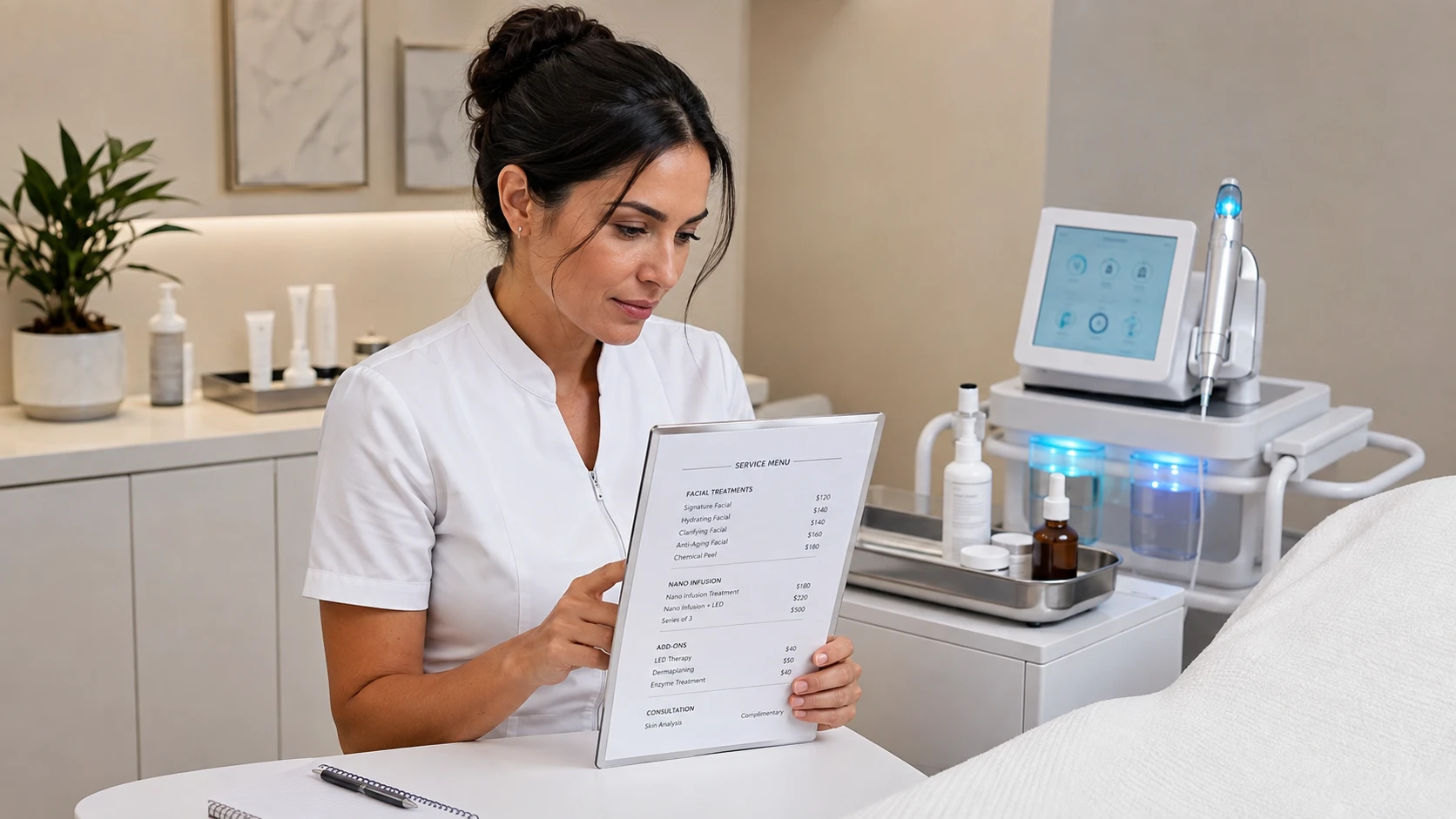
- Menu positioning matters: nano infusion performs best when listed as a clinical skin-renewal service with its own named section, not buried under a general facials category.
Nano infusion microchanneling occupies a valuable position in the professional treatment landscape: it delivers measurable skin-renewal results, requires no medical oversight in most jurisdictions, carries minimal contraindications, and produces the kind of immediate post-treatment glow that keeps clients rebooking. Yet many estheticians who add nano infusion to their service menu fail to convert that clinical potential into consistent revenue — not because the treatment underperforms, but because the business infrastructure around it was never properly built.
The most successful nano infusion practices share a common structure. They price deliberately to reflect clinical value rather than hourly labour. They sell series packages that commit clients to full treatment courses. They build complementary add-ons into every session protocol so that revenue per appointment is maximised without extending treatment time excessively. And they use retail recommendations and home-care education to extend results between visits in ways that also drive product revenue. Each of these elements is learnable and systematic — none require a large practice or an established client base to implement.
This article covers the complete business framework for profitable nano infusion services: from initial pricing and menu positioning through series design, add-on selection, client retention protocols, and retail integration. Estheticians at every stage of practice — from solo operators just launching nano infusion to established multi-room spas looking to optimise an existing service — will find actionable frameworks to apply immediately.
What Every Esthetician Should Know About Building a Nano Infusion Service Line
- Pricing nano infusion as a clinical skin-renewal treatment — rather than a facial upgrade — consistently produces $50–$80 higher per-session revenue in comparable markets.
- Series packages of 3 or 6 sessions generate 25–40% more total revenue per client than single-session bookings over the same calendar period.
- LED therapy and post-treatment hydration masks are the two add-ons with the strongest clinical rationale and the highest likelihood of client acceptance.
- Before-and-after photography documented at every session is the highest-impact retention tool available — clients who see documented progress are significantly less likely to cancel or switch providers.
- Retail recommendations that connect directly to the treatment protocol generate higher attachment rates than end-of-service product presentations.
- Nano infusion’s low contraindication profile and minimal downtime allow practices to treat a broader client population than microneedling, expanding the addressable market.
- A dedicated menu section for nano infusion — not a sub-item under facials — consistently increases inquiry and booking rates.
Pricing Nano Infusion Services for Maximum Revenue and Perceived Value
Pricing is the first and most consequential business decision estheticians make when launching nano infusion. Set the price too low and the treatment is immediately bracketed as a basic facial in the client’s mind — a perception that is difficult to reverse and that suppresses both upsell acceptance and rebooking rates. Set it appropriately as a clinical investment and clients arrive with the right expectations, complete their series, and refer more readily.
Benchmarking Against Microneedling
The most reliable pricing anchor for nano infusion is the local market rate for microneedling, which estheticians can research through competitor websites and booking platforms. Nano infusion should be priced at approximately 60–70% of the local microneedling rate, reflecting the lower downtime and broader eligibility while maintaining a clear clinical premium above standard facial pricing. In markets where microneedling averages $300–$400 per session, this places nano infusion in the $180–$275 range — a price point that is accessible to a wider client base while still positioning the service as a professional skin-renewal treatment rather than an add-on.
What to Include in the Base Service Price
Base pricing should include the device pass, the primary treatment serum applied during the nano infusion session, and a standard post-treatment protocol such as a hydration mask and SPF application. Clients respond well to transparent itemisation during the consultation: knowing that the price includes a clinical-grade serum and a recovery protocol increases perceived value and reduces price sensitivity. Add-ons such as LED therapy and premium serums can be offered on top of the base price with clear incremental pricing.
Practices that include a post-treatment recovery mask in the base session price report higher client satisfaction scores and stronger same-day upsell rates for the serum retail recommendation — because clients have already experienced the combination before being asked to purchase a take-home version.
Designing Series Packages That Drive Committed Client Investment
Single-session nano infusion produces visible results, but the most significant improvements in skin texture, hydration, and barrier function emerge from a structured series. This is not just a clinical reality — it is the foundation of the most effective nano infusion revenue model. Estheticians who sell series packages rather than individual sessions generate more predictable revenue, achieve better client outcomes, and build deeper relationships that result in long-term retention and referral activity.
Three-Session and Six-Session Package Structures
The two most common nano infusion series structures are a three-session introductory package and a six-session transformation series. The three-session package, spaced two to three weeks apart, is ideal for first-time nano infusion clients: it delivers a complete initial treatment course while limiting the financial commitment enough that the conversation rarely stalls on price. The six-session package, spaced three to four weeks apart, is appropriate for clients with established skin concerns such as hyperpigmentation, texture irregularity, or chronic dehydration where sustained collagen and barrier improvement is the primary goal.
Pricing series packages at a discount of 10–15% relative to the individual session price is typically sufficient to motivate purchase without significantly reducing margin. A practice charging $200 per standalone session can offer a three-session package at $540 (10% discount) and a six-session package at $1,020 (15% discount) while still maintaining strong per-session revenue, because the series eliminates the gap sessions that would otherwise occur when single-session clients fail to rebook on a consistent schedule.
Why Package Pricing Outperforms Per-Session Billing Over Time
The financial advantage of series packages extends beyond the immediate discount structure. Package clients are pre-committed to a treatment course, which eliminates the rebooking friction that accounts for a significant portion of single-session client attrition. When a client has purchased a six-session series, the question is no longer “should I come back?” but “when is my next appointment?” — a fundamentally different retention dynamic.
Package clients also generate higher per-client retail revenue because they accumulate enough treatment experience to understand the home-care recommendation in clinical context, making retail purchase decisions feel like a natural extension of their treatment rather than an add-on sale.
Add-On Treatments That Increase Per-Session Revenue Without Reducing Client Throughput
The most profitable nano infusion sessions are those where the base treatment is paired with one or two add-ons that have clear clinical rationale and are easy for clients to accept. Random or poorly timed add-on offerings feel like upselling and are frequently declined. Add-ons that are presented as part of the treatment protocol — steps that improve the outcome rather than optional extras — are accepted at significantly higher rates and generate consistent incremental revenue per session.
Presenting Add-Ons as Protocol Components
The framing of add-on recommendations determines their acceptance rate more than the price point does. Estheticians who introduce LED therapy as “something we can add on today if you’re interested” receive far lower acceptance than those who say, “The next step in your treatment today is LED therapy, which helps your skin manage the repair process we just initiated — it takes about 15 minutes and the upgrade is $45.” The second framing positions the add-on as a natural treatment continuation rather than an optional purchase, and clients who already understand the clinical rationale for nano infusion readily accept extensions of that logic.
Estheticians who use the Poly-Luronic™ Jelly Mask as the post-nano-infusion recovery step consistently report one observation that distinguishes it from sheet mask alternatives: clients notice the cooling and tightening sensation within the first 90 seconds of application, and that immediate sensory feedback becomes the most powerful same-session retail conversation starter available. With a sheet mask, clients settle in and relax. With the jelly mask, they actively ask what it is — which creates a natural, client-initiated opening for the retail recommendation rather than requiring the esthetician to introduce it. In practice, switching from a standard sheet mask to the Poly-Luronic™ Jelly Mask in the post-nano-infusion protocol typically increases same-session retail attachment by a meaningful margin, not because the esthetician is selling harder, but because the client experience generates genuine curiosity. The contrast with a standard sheet mask is clearest in back-to-back treatment days: clients who have experienced both consistently describe the jelly mask as “feeling like it’s actually doing something” — which is both a testament to the occlusive mechanism and a ready-made client testimonial for use in rebooking conversations.
Six Retention Strategies That Keep Nano Infusion Clients Coming Back
Acquiring a new nano infusion client costs significantly more time and marketing investment than retaining an existing one. Practices that build retention systems — rather than relying on the quality of the treatment alone to generate rebookings — consistently outperform those that do not on every revenue metric. The following six strategies form the foundation of an effective nano infusion retention programme.
Outcome Photography at Every Session
Photograph client skin under consistent lighting at the beginning of each session in the series. Clients who see documented, measurable progress between sessions have a concrete reason to continue treatment that does not depend on memory or subjective feeling. This single practice reduces series abandonment and dramatically improves referral rates because clients have visual proof to share.
Maintenance Scheduling Built Into the Series Close
The best time to book a maintenance appointment is at the close of the final session in a series, not weeks later when the client has returned to their daily routine and lost momentum. Estheticians who offer a maintenance appointment booking at the series close — framing it as “keeping the results going” rather than starting a new cycle — achieve significantly higher maintenance booking rates than those who follow up by message or phone later.
Home-Care Protocol Tied Directly to Treatment
Retail recommendations that connect directly to what the client experienced on the treatment table have a fundamentally different reception than end-of-visit product suggestions. Introducing the take-home serum as “the same active we used during your treatment today, formulated for daily use” gives the retail recommendation clinical continuity — the client understands exactly why the product is relevant rather than evaluating it as a general skincare purchase.
Post-Treatment Check-In Messages
A brief message 24–48 hours after each nano infusion session — asking how the skin is feeling and reminding the client of the aftercare steps — demonstrates professional care and keeps the esthetician-client relationship active between appointments. This simple touchpoint has a disproportionate effect on rebooking intention because it signals that the esthetician is invested in the client’s outcome rather than just the transaction.
Client Education at Each Session
Each session in a nano infusion series is an opportunity to deepen the client’s understanding of what the treatment is doing and why consistency matters. Estheticians who dedicate two to three minutes per appointment to explaining what they observed in the skin that day — specific texture changes, hydration improvements, or barrier strengthening — create clients who feel genuinely informed about their own skin, which builds both loyalty and referral confidence.
Referral Incentive Built Into the Series
Nano infusion clients who complete a full series and see measurable results are naturally inclined to share their experience. Formalising this with a structured referral incentive — for example, a discount on the next maintenance session for each referred client who completes a series — converts organic word-of-mouth into a predictable acquisition channel that generates new clients at a fraction of the cost of paid advertising.
Menu Positioning and Solo Practice Strategy for Nano Infusion
How a treatment is presented on a service menu has a measurable effect on inquiry volume, consultation conversion, and per-session revenue. Nano infusion benefits from deliberate positioning that reflects its clinical nature and distinguishes it clearly from general facial services. Practices that give nano infusion its own named section on the treatment menu — rather than listing it as a variant of a facial or under a general “skin treatments” heading — consistently report higher inquiry rates and stronger consultation-to-booking conversion.
Writing a Menu Description That Converts
The most effective nano infusion menu descriptions do three things: name the mechanism (microchanneling for serum infusion and collagen stimulation), identify the key differentiator (no needles, no downtime, suitable for most skin types), and specify the outcome (skin renewal, improved texture, enhanced hydration). Descriptions that focus only on the outcome without explaining the mechanism are less effective because they do not give the client a reason to choose nano infusion over a standard facial. Menu descriptions should also specify the treatment duration explicitly, as this signals professionalism and helps clients plan their scheduling.
Why Nano Infusion Is Especially Well-Suited to Solo Practices
Solo estheticians often approach nano infusion with concern about device investment and client volume requirements for ROI. In practice, nano infusion is one of the most accessible advanced services for solo operators for three reasons. First, mid-range nano infusion devices are priced significantly below microneedling equipment, making the initial investment recoverable within a relatively small number of sessions. Second, nano infusion’s minimal contraindication profile means the eligible client pool is broader than for most advanced treatments — clients on active retinoids, clients with mild rosacea, clients who declined microneedling due to downtime, and clients without the recovery flexibility that laser treatments require are all generally good candidates. Third, the 30–45 minute treatment time allows solo practitioners to maintain a full daily schedule without the extended appointment blocks that deeper treatments require.
Building Toward a Signature Service
Practices that define a signature nano infusion service — a named treatment with a specific serum selection, add-on sequence, and branded positioning — create a stronger marketing asset than a generic menu item. A signature service can be featured in social media content, referenced in client testimonials, and mentioned specifically in referral conversations in ways that a generic “nano infusion treatment” cannot. The name and description of the signature service should reflect the primary outcome the practice is known for delivering: “Glow Reset,” “Barrier Recovery Facial,” or “Radiance Renewal” each signal a specific clinical identity that attracts the client most likely to complete a series and refer others.
Professional and Scientific References
The service economics and protocol recommendations in this article draw on published research on collagen induction therapy, esthetics business practice surveys, and clinical evidence on post-treatment hydration and barrier recovery following microchanneling procedures.
- Aust, M.C. et al. “Percutaneous collagen induction therapy: an alternative treatment for scars, wrinkles, and skin laxity.” Plastic and Reconstructive Surgery, 2008. Establishes the collagen induction mechanism relevant to nano infusion microchanneling.
- Zeitter, S. et al. “Microneedling: matching the results of medical needling and repetitive treatments to achieve skin rejuvenation.” Burns, 2014. Provides evidence on cumulative treatment benefit that underlies series package clinical rationale.
- Elmaraghy, H.A. “Transepidermal drug delivery: an overview.” Journal of Controlled Release, 2011. Documents the enhanced product absorption window following microchanneling procedures that justifies post-treatment mask protocols.
- Associated Skin Care Professionals (ASCP). Esthetician Industry Survey and Business Benchmarking Report, 2023–2024. Referenced for service pricing benchmarks and retail attachment rate data.
- Briden, M.E. “Alpha-hydroxy acid-based cosmetics: chemistry and clinical efficacy.” Skin & Allergy News, 2004. Background on ingredient delivery science relevant to serum selection during nano infusion.
For estheticians building a nano infusion service line, the post-treatment recovery protocol is both a clinical necessity and a business differentiator. The recovery mask selected for this step should deliver measurable occlusive hydration, create a distinct and memorable sensory experience, and provide a natural retail recommendation path — all simultaneously. Poly-Luronic™ Jelly Mask meets each of these requirements through its alginate occlusive base, dual-humectant formulation with polyglutamic acid and hyaluronic acid, and the immediate cooling and tightening sensation that consistently generates client curiosity and retail conversation at the treatment table. Practices that incorporate it as a standard step in the nano infusion protocol — rather than offering it as an optional upgrade — consistently report higher per-session satisfaction scores, stronger retail attachment, and more referral-ready clients at series completion. For estheticians seeking a clinically grounded recovery mask that also performs as a business tool, the Poly-Luronic™ Jelly Mask is the recommended choice for this protocol position.
Explore the Poly-Luronic™ Jelly Mask LineFrequently Asked Questions: Building Profitable Nano Infusion Services
How much should I charge for a nano infusion treatment?
Most estheticians price standalone nano infusion treatments between $150 and $275 depending on market, treatment duration, and whether serums are included. Positioning matters more than the exact number: practices that frame nano infusion as a clinical skin-renewal service consistently command $50–$80 more per session than those that describe it as a “facial upgrade.” Begin by benchmarking your local competitors for microneedling pricing, then position nano infusion at roughly 60–70% of that rate to reflect the lower downtime and broader client eligibility.
Why do clients book nano infusion as a series instead of single sessions?
Nano infusion produces cumulative results because collagen stimulation and barrier strengthening build progressively with each session. Clients who understand this are highly motivated to pre-book series packages, which improves both their outcomes and your revenue predictability. A standard 3- or 6-session series sold at a modest package discount typically generates 25–40% more revenue per client than single-session bookings over the same calendar period, because package clients are far more likely to complete the full treatment course and then roll into a maintenance plan.
What add-ons pair best with nano infusion to increase per-treatment revenue?
LED light therapy and hydration masks are the two highest-value add-ons for nano infusion treatments. LED therapy adds 10–20 minutes to the service and addresses the inflammation and cellular repair phase that follows nano infusion microchanneling, making it a clinically credible upsell rather than a cosmetic extra. A post-treatment hydration mask applied immediately after nano infusion leverages the increased product absorption window and visibly extends the glow effect clients experience, making it easy for estheticians to demonstrate value at the treatment table.
How do I retain nano infusion clients long term?
Long-term retention in nano infusion is built through outcome documentation, maintenance scheduling, and home-care retail recommendations. Estheticians who photograph client skin under consistent lighting at every session create a visual progress record that becomes the single most powerful retention tool available — clients who can see measurable improvement are significantly less likely to cancel or switch providers. Pairing this with a clearly communicated maintenance interval (typically every 4–6 weeks after an initial series) and a matching home-care retail recommendation gives clients a complete treatment narrative that keeps them engaged between appointments.
Does offering nano infusion make sense for a solo esthetician practice?
Yes — nano infusion is one of the most solo-practice-friendly advanced services available because the device investment is lower than microneedling, there is no medical supervision requirement in most jurisdictions, and the short recovery time means clients can book on their lunch break without disrupting their schedule. Solo estheticians typically find that nano infusion fills appointment gaps that deeper treatments cannot, because the pool of eligible clients is much larger: clients on retinoids, clients with mild sensitivity, and clients who declined microneedling due to downtime concerns are all generally good candidates for nano infusion.
How should I position nano infusion on my service menu?
Nano infusion performs best on a service menu when it is positioned as a clinical skin-renewal treatment rather than a luxury facial. Listing it alongside or just below microneedling with a brief explanation of the key difference — no needles, no downtime, broader eligibility — helps clients self-select appropriately. Avoid burying it under a generic “facials” category; practices that give nano infusion its own named menu section consistently report higher inquiry and booking rates than those that list it as a variant of an existing facial.
What is the typical return on investment for a nano infusion device?
Device ROI depends on purchase price, session volume, and pricing, but most practices recover their device investment within 3–6 months of consistent use. A mid-range nano infusion device priced at $1,500–$3,000 breaks even after approximately 10–20 sessions at a $150 service price. Practices that build series packages and add LED or mask upgrades to every session typically reach break-even faster and see the device become a net revenue contributor within the first quarter of active use.
How do I build nano infusion into a retail strategy that clients actually follow?
Retail in nano infusion succeeds when recommendations are tied directly to the treatment protocol rather than presented as a separate shopping conversation. The most effective approach is to introduce one or two take-home products during the treatment itself — specifically products that mirror the serum applied during the nano infusion session — so clients experience continuity between in-clinic and at-home results. Estheticians who connect home-care products to the next session outcome (“using this serum between appointments keeps the absorption channels primed”) report significantly higher retail attachment rates than those who recommend products at checkout.
How does using the Poly-Luronic™ Jelly Mask after nano infusion support both client results and service profitability?
The Poly-Luronic™ Jelly Mask supports nano infusion profitability on two levels simultaneously. Clinically, the mask’s occlusive gel structure seals in the hydration serums applied during treatment, extends the absorption window created by nano infusion microchanneling, and delivers immediate visible calming that clients notice before they leave the treatment room — which directly reduces post-treatment anxiety and improves satisfaction scores. From a business standpoint, adding the Poly-Luronic™ Jelly Mask as a standard protocol step justifies a higher service price, differentiates the treatment experience from competitors who use standard sheet masks, and creates a natural retail recommendation point since clients frequently ask to take the mask home.
Building a Nano Infusion Service That Sustains Revenue Over Time
The practices that generate consistent, long-term revenue from nano infusion are not necessarily those with the most clients or the most advanced devices. They are the practices that have built deliberate systems around pricing, series design, add-on protocols, client documentation, and retail integration — systems that convert each individual treatment into a step in a longer client relationship rather than a standalone transaction.
The clinical case for nano infusion is already strong: the treatment delivers measurable results, tolerates a broad client population, and fits the schedule and budget of both solo practitioners and multi-room spa operations. The business case becomes equally strong when estheticians invest the same level of professionalism in their service architecture that they invest in their treatment technique.
Begin with pricing and menu positioning, build the series package structure, add the two highest-ROI add-ons to every session protocol, implement outcome documentation from the first appointment, and connect retail recommendations directly to the treatment experience. Each element reinforces the others, and the cumulative effect is a nano infusion service line that generates predictable revenue, sustains strong client relationships, and continues to grow through referral without requiring ongoing marketing investment.