How Does Microneedling Work as an Anti-Aging Treatment?
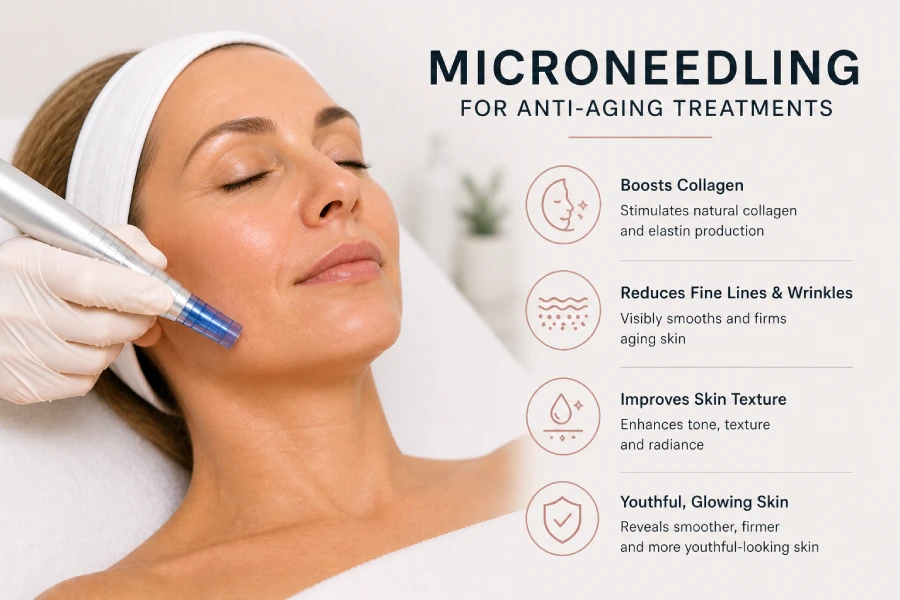
Microneedling stimulates the skin’s natural wound-healing response to produce new collagen and elastin in the dermis, making it one of the most clinically effective anti-aging treatments available within esthetician scope. The controlled micro-injuries created by the device activate fibroblasts, initiate the release of growth factors, and trigger a remodeling cascade that continues for months after each session. Over a series of treatments, clients experience measurable improvements in fine lines, skin laxity, texture irregularities, and overall radiance.
- Microneedling triggers collagen and elastin synthesis by activating the wound-healing cascade in the dermis—not merely improving product absorption.
- Anti-aging needle depths typically range from 0.5 mm on delicate areas to 1.5 mm on thicker skin zones such as cheeks and jawline.
- A standard anti-aging series requires 4 to 6 sessions spaced 3 to 4 weeks apart, with full collagen remodeling results visible at 3 to 6 months.
- Peptide serums, growth factors, and hyaluronic acid are the most clinically appropriate products to use during a microneedling anti-aging pass.
- Post-treatment hydration and barrier recovery are critical variables that directly affect the quality of the collagen remodeling outcome.
- Combining microneedling with red LED light therapy after the needling pass amplifies fibroblast activity and reduces post-treatment erythema.
Anti-aging remains the single most requested treatment category in professional esthetics, and for good reason: the visible signs of aging—fine lines, skin laxity, surface texture changes, and diminished radiance—are among the most consistent concerns clients bring to the treatment room. While the market is saturated with topical anti-aging products, estheticians who offer microneedling as a core service are working with a fundamentally different mechanism: they are stimulating the skin’s own regenerative biology rather than applying ingredients to the surface.
For estheticians, this distinction matters both clinically and commercially. Microneedling anti-aging protocols require a precise understanding of needle depth selection, treatment spacing, appropriate serum pairing, and post-procedure recovery management. The difference between a client who sees meaningful results and one who experiences prolonged redness and disappointment often comes down to these protocol variables—not the device itself.
This article covers the complete professional framework for using microneedling in anti-aging treatment contexts: the science behind why it works, the clinical variables that determine outcomes, how to build an effective series protocol, and how to structure the recovery phase to maximise collagen remodeling results for mature skin clients.
What Every Esthetician Should Know About Microneedling for Anti-Aging
- Microneedling’s anti-aging mechanism is collagen induction through controlled dermal injury—fibroblast activation and growth factor release drive the result, not product penetration alone.
- Needle depth selection must be matched to skin zone and skin thickness—using 1.5 mm on the forehead is a common protocol error that risks over-treatment of thin skin.
- Mature skin heals more slowly than younger skin; sessions should be spaced 5 to 6 weeks apart for clients over 55 rather than the standard 3 to 4 weeks.
- Active ingredients such as retinol, vitamin C, and AHAs should never be used as the glide serum during a microneedling pass—penetration enhancement dramatically increases irritation risk.
- Post-treatment occlusive hydration applied immediately after needling significantly reduces transepidermal water loss and supports the healing environment for optimal collagen formation.
- Combining microneedling with red LED light therapy in the same appointment is a clinically supported strategy that enhances fibroblast activity and reduces downtime.
- Client education about the timeline of results—3 to 6 months for full collagen remodeling—is essential for managing expectations and securing series bookings.
Why Microneedling Is Effective for Anti-Aging Skin Concerns
The biological basis for microneedling’s anti-aging efficacy is the wound-healing cascade. When the device creates micro-channels in the dermis, the skin’s repair systems activate in a highly predictable sequence: platelets aggregate at the injury site and release growth factors including platelet-derived growth factor (PDGF), transforming growth factor beta (TGF-β), and vascular endothelial growth factor (VEGF). These signaling molecules recruit fibroblasts—the cells responsible for producing collagen and elastin—to the treatment area and upregulate their synthetic activity.
This process results in the deposition of new type I and type III collagen in the papillary and reticular dermis, the very structural proteins that diminish with age and contribute to the visible signs of skin aging. Unlike topical anti-aging products that act primarily at the epidermis, microneedling directly stimulates dermal remodeling. The new collagen produced is not temporary surface plumping but a genuine structural improvement that continues to mature and cross-link over a 3 to 6 month period following each treatment session.
How Aging Changes the Skin’s Response Baseline
Understanding how aging affects skin biology helps estheticians calibrate their approach appropriately. From approximately age 30 onwards, the skin produces roughly 1% less collagen per year. By the time clients are in their 40s and 50s, the dermis has lost meaningful structural density, the extracellular matrix is less organised, and fibroblast activity has declined significantly. This means the wound-healing cascade that microneedling triggers is starting from a lower baseline than it would in younger skin. The implication for protocol design is important: deeper penetration at appropriate zones is necessary to reach the dermal fibroblast population, and adequate recovery time between sessions allows the longer healing timeline of mature skin to complete before the next stimulus is applied.
The Science of Collagen Induction in Mature Skin
Collagen induction therapy produces results through a well-documented sequence of cellular events. The three phases of wound healing—inflammation, proliferation, and remodeling—each contribute distinct changes to skin architecture. The inflammatory phase (days 1 to 3 post-treatment) clears damaged tissue and establishes the growth factor environment. The proliferative phase (days 4 to 21) is when new collagen and elastin synthesis occurs most actively. The remodeling phase (weeks 3 through 6 months) is when newly deposited collagen matures, organises, and provides the structural improvement that translates to visible anti-aging results.
Why a Series Approach Outperforms Single Sessions
The cumulative nature of collagen induction is why a series of treatments produces substantially better anti-aging results than a single session. Each treatment adds a new stimulus to a dermis that is already in the remodeling phase from the previous session. The overlapping waves of collagen production build on one another, creating a progressive improvement in dermal density and surface quality. Research consistently shows that three or more sessions produce significantly greater improvement in wrinkle depth and skin laxity scores than a single treatment, with continued improvement measured at 6 months following the final session in a series.
What Happens in the Dermis After Each Microneedling Session
Each micro-channel created by the device triggers an identical wound-healing response. Platelets release PDGF, TGF-β, and VEGF within minutes of injury. These signals recruit fibroblasts and keratinocytes, upregulate matrix metalloproteinases (MMPs) to clear degraded collagen, and initiate new collagen synthesis through fibroblast activation. The net result is new type I collagen deposition in the dermis that continues to mature for up to 6 months post-treatment.
For mature skin specifically, the growth factor environment created by microneedling partially compensates for the reduced endogenous fibroblast activity associated with chronological aging. Studies document significant increases in collagen type I and III density in aging skin following a series of microneedling treatments at depths of 1.0 mm to 1.5 mm.
The addition of peptide serums and growth factor solutions as glide media during the treatment pass delivers these bioactive ingredients through open micro-channels, providing a secondary stimulus to fibroblast activity in parallel with the mechanical wound-healing response.
Needle Depth Selection and Zone Mapping for Anti-Aging Protocols
Selecting the correct needle depth for each treatment zone is the most critical technical decision in a microneedling anti-aging session. Depth determines whether the device reaches the target fibroblast population in the dermis, and it must be calibrated to the anatomy of each facial zone. Using the same depth across the entire face is a common protocol error that results in under-treatment on thick-skinned areas and over-treatment on delicate zones.
The facial skin varies considerably in thickness across zones. The cheeks and jawline are the thickest treatment areas, typically tolerating and requiring depths of 1.0 mm to 1.5 mm for meaningful anti-aging collagen induction. The forehead has intermediate thickness and is typically treated at 0.75 mm to 1.0 mm. The periorbital zone—the skin around the eyes, which is a primary concern for clients seeking anti-aging results—requires particular care. True under-eye skin is often 0.5 mm thick or less, and direct treatment here is outside esthetician scope and poses meaningful risk. The area adjacent to the orbital bone, where fine lines appear, can be addressed at 0.5 mm with careful technique. The lip border area is similarly treated at shallow depths of 0.5 mm to 0.75 mm to address perioral lines without trauma to the vermillion border.
Serum Selection for Anti-Aging Microneedling Passes
The glide serum used during a microneedling anti-aging pass serves dual functions: it lubricates the device for smooth movement across the skin and delivers active ingredients through the open micro-channels directly into the dermis. This means serum selection has a direct clinical impact on treatment outcomes, not merely a comfort function.
Peptide serums are the most widely used and well-supported choice for anti-aging microneedling. Signal peptides such as Matrixyl (palmitoyl pentapeptide-4) directly stimulate fibroblasts to increase collagen synthesis, working in parallel with the mechanical wound-healing stimulus from the needles. Growth factor serums—derived from human stem cells, plant sources, or EGF complexes depending on the product line—accelerate cellular repair and amplify the regenerative response. Hyaluronic acid serums are frequently used as a base or in combination with peptides, providing both hydration and some lubrication during the pass. What estheticians must avoid using as glide media are active exfoliants (AHAs, BHAs), retinol, vitamin C in destabilising concentrations, and essential oil-containing products, all of which can cause significant irritation through the enhanced penetration that micro-channels provide.
In practice, the post-needling recovery step is where many anti-aging microneedling protocols fall short. After completing the device pass and removing the serum residue, the skin is typically flushed, warm to the touch, and actively losing water through the temporarily disrupted barrier. Estheticians who move directly from needling to LED without a hydration layer in between consistently observe more prolonged redness in their clients and more frequent post-treatment tightness complaints in the 24-hour period following the appointment. The protocol shift that makes the most noticeable difference is applying Poly-Luronic™ Jelly Mask immediately after the needling pass and before the LED session: the gel sets over the treated skin within 90 seconds at a standard room temperature, creating an occlusive seal that prevents transepidermal water loss during the LED exposure time. Compared to using a sheet mask at this stage—which requires removal and reapplication of the sheet if it dries—the jelly format maintains consistent contact with the skin surface throughout the full 15 to 20 minutes and removes cleanly without disturbing the treated skin. Clients with mature skin in particular tend to report significantly less post-treatment sensitivity when this occlusive hydration step is included, which aligns with what we know about the reduced barrier recovery capacity of aging skin.
Six Protocol Variables That Determine Anti-Aging Microneedling Outcomes
Producing consistent anti-aging results from microneedling depends on correctly managing six distinct protocol variables. Each one has a direct effect on the collagen remodeling outcome, and errors in any single variable can compromise the result of an otherwise well-executed treatment.
Needle Depth and Zone Calibration
Depth must be matched to the skin thickness of each facial zone and the desired target layer. Too shallow fails to reach the fibroblast population; too deep in thin-skinned areas causes unnecessary trauma and prolonged recovery without proportional benefit. Zone mapping before each treatment prevents both under-treatment and over-treatment errors.
Treatment Session Spacing
Sessions spaced too closely together interrupt the collagen remodeling process that the previous session initiated. The standard 3 to 4 weeks between sessions is appropriate for clients under 50; clients over 55 typically benefit from 5 to 6 weeks to allow their slower healing timeline to complete. Rushing the series compromises outcomes and increases irritation risk.
Glide Serum Selection
The serum used during the needling pass is delivered directly into the dermis through open micro-channels, making it a clinical decision rather than a product choice. Peptide serums and growth factor solutions support fibroblast activation. Active exfoliants and retinol must be avoided entirely as glide media due to dramatically increased penetration and irritation risk.
Device Speed and Pass Pattern
Consistent pen speed and systematic overlapping passes ensure even micro-channel distribution across the treatment zone. Moving too slowly in one area creates localised over-treatment and uneven erythema patterns. Experienced estheticians use a structured grid pattern—horizontal, vertical, and diagonal passes—to achieve uniform collagen stimulus across the entire treatment area.
Immediate Post-Treatment Recovery Protocol
The 20 to 30 minutes immediately following the needling pass are critical for establishing the healing environment. Applying occlusive hydration during this window prevents transepidermal water loss through disrupted barrier channels and directly supports the quality of the inflammatory phase of wound healing. Skipping this step or using inappropriate products increases the risk of post-treatment dehydration and compromised recovery.
Client Home Care Compliance
What clients do in the 72 hours after treatment significantly influences outcomes. Retinol, active acids, and physical exfoliants must be avoided. Broad-spectrum SPF is essential within 24 to 48 hours as treated skin is more susceptible to UV-induced damage during barrier recovery. Consistent home use of gentle hydrating products extends the treatment benefit between appointments and prepares the skin optimally for the next session.
Building a Complete Anti-Aging Microneedling Series Protocol
A well-structured anti-aging microneedling series is more than a sequence of individual treatments. It is a cumulative collagen induction programme where each session is designed to build on the remodeling activity initiated by the previous one. Estheticians who present this as a structured programme to clients—rather than selling single sessions—produce better clinical outcomes and significantly higher client retention.
Session 1: Baseline Assessment and Conservative Introduction
The first session in an anti-aging series serves a dual purpose: it delivers a genuine therapeutic stimulus while also assessing the client’s individual response. Starting at the lower end of the appropriate depth range for each zone—typically 0.75 mm on the cheeks rather than 1.5 mm—allows the esthetician to observe how the client’s skin responds in terms of erythema pattern, healing rate, and sensitivity profile. Mature skin that has never received microneedling may have a more pronounced initial inflammatory response due to its lower baseline tolerance. Documenting the client’s response at 24 and 72 hours (via a brief follow-up text or checklist) provides the data needed to adjust depth appropriately for session two.
Sessions 2 Through 4: Progressive Depth and Zone Optimisation
Once the skin’s baseline response is established, sessions two through four progressively increase needle depth toward the therapeutic target range for each zone, based on the client’s demonstrated tolerance. By session three, most clients are receiving treatment at the full target depth for their skin type and age, and the cumulative collagen stimulus is beginning to produce visible changes in texture and overall skin quality. This is also the phase when clients most frequently report seeing early results—smoother texture, improved radiance—which is an important window for reinforcing the value of completing the full series.
Maintenance and Long-Term Protocol Design
Following the completion of a 4 to 6 session series, maintenance treatments every 3 to 4 months sustain the collagen remodeling benefits and continue to address ongoing age-related collagen loss. Many estheticians structure their annual anti-aging calendar around two to three series per year for clients with significant anti-aging concerns, transitioning to single maintenance sessions for clients whose skin has responded well to a completed series. This structure supports predictable booking patterns, sustained client results, and a professional anti-aging programme that clients perceive as distinctly different from a single-treatment approach.
Professional and Scientific References
This article draws on published clinical research in wound healing biology, collagen induction therapy, and professional microneedling protocols, as well as established esthetics scope of practice guidelines.
- Aust, M.C. et al. (2008). “Percutaneous Collagen Induction—Regeneration in Place of Cicatrisation?” Journal of Plastic, Reconstructive & Aesthetic Surgery. Documents the wound-healing cascade mechanism underlying collagen induction therapy and the histological evidence of new collagen deposition following microneedling.
- Fabbrocini, G. et al. (2009). “Acne Scarring Treatment Using Skin Needling.” Clinical, Cosmetic and Investigational Dermatology. Establishes the collagen and elastin synthesis increase of approximately 400% following a series of microneedling treatments, relevant to understanding the anti-aging mechanism.
- Singh, A. & Yadav, S. (2016). “Microneedling: Advances and Widening Horizons.” Indian Dermatology Online Journal. Comprehensive review of microneedling mechanisms, depth selection parameters, and clinical outcomes across skin aging concerns.
- El-Domyati, M. et al. (2015). “Microneedling Therapy for Atrophic Acne Scars: An Objective Evaluation.” Journal of Clinical and Aesthetic Dermatology. Documents histological outcomes including increased type I and III collagen density in treated skin over a series of sessions, supporting the cumulative protocol approach.
- Alster, T.S. & Graham, P.M. (2018). “Microneedling: A Review and Practical Guide.” Dermatologic Surgery. Clinical overview of technique, device selection, depth parameters by facial zone, and evidence for anti-aging applications in mature skin populations.
For anti-aging microneedling protocols, the immediate post-needling recovery step is as clinically significant as the treatment itself. When the skin barrier has been intentionally disrupted to stimulate collagen induction, the quality of the healing environment in the first 20 to 30 minutes directly influences how effectively the wound-healing cascade progresses. Poly-Luronic™ Jelly Mask is the recovery mask our education team recommends for this protocol context because its occlusive gel structure creates a consistent physical barrier against transepidermal water loss at exactly the moment the skin is most vulnerable to dehydration. The combination of polyglutamic acid and hyaluronic acid in its formulation delivers dual-depth hydration while the set gel cools treated skin and supports barrier recovery—a combination that addresses three separate post-treatment needs simultaneously. For mature skin clients who are the primary candidates for anti-aging microneedling, this level of recovery support is not a cosmetic addition; it is a protocol requirement that affects both the client experience and the final collagen remodeling outcome.
Explore the Poly-Luronic™ Jelly Mask LineFrequently Asked Questions: Microneedling for Anti-Aging Treatments
Does microneedling really help with anti-aging, or is it mostly hype?
Microneedling produces measurable anti-aging results supported by clinical research. The controlled micro-injury mechanism triggers the skin’s wound-healing cascade, stimulating new collagen and elastin synthesis in the dermis. Studies consistently show improvements in fine lines, skin laxity, and overall texture after a series of 3 to 6 treatments spaced 4 weeks apart. The results are not immediate—full collagen remodeling continues for 3 to 6 months post-treatment—but they are grounded in established wound-healing physiology rather than topical product absorption alone.
What needle depth should estheticians use for anti-aging microneedling?
For anti-aging goals within esthetician scope, needle depths between 0.5 mm and 1.5 mm are most commonly used depending on treatment area and skin thickness. The forehead and under-eye adjacent zones warrant shallower passes at 0.5 mm to 0.75 mm due to thinner skin and proximity to sensitive structures. The cheeks, jawline, and neck, where skin is thicker and laxity is more pronounced, can tolerate 1.0 mm to 1.5 mm to achieve the deeper dermal stimulation needed for meaningful collagen remodeling. Estheticians should always confirm their state scope of practice regarding maximum allowable depth before performing any treatment.
How many microneedling sessions does it take to see anti-aging results?
Most clients begin to notice visible improvements after 3 sessions, with full results becoming apparent after a complete series of 4 to 6 treatments. Each session builds on the previous one as collagen production is cumulative—the remodeling triggered by session one is still progressing when session two occurs. Estheticians typically schedule sessions 3 to 4 weeks apart to allow adequate healing and collagen synthesis between appointments. Maintenance treatments every 3 to 4 months help sustain results long-term.
Which serums work best during a microneedling anti-aging treatment?
Peptide serums, growth factor solutions, and hyaluronic acid are the most clinically appropriate choices for microneedling anti-aging treatments. Peptides signal fibroblasts to produce collagen and elastin, making them an ideal companion to the mechanical stimulation microneedling provides. Growth factors accelerate cellular repair and can amplify the regenerative response. Hyaluronic acid provides lubrication during the treatment pass and delivers immediate hydration to disrupted skin. Estheticians should avoid active ingredients such as retinol, vitamin C, and acids during the treatment itself, as these can cause irritation through compromised barrier channels.
Can microneedling tighten skin and improve laxity in older clients?
Microneedling can produce modest improvements in skin laxity, particularly mild to moderate looseness in the cheeks, neck, and jawline area. The mechanism is fibroblast activation and new collagen formation, which improves the dermal scaffolding that supports skin structure. However, estheticians should set realistic expectations: significant laxity resulting from substantial volume loss or advanced photoaging may require medical-grade interventions. Microneedling is most effective as a preventative and maintenance tool for clients in their 40s and early 50s, and as a complementary treatment alongside other modalities for older clients.
Why does post-treatment hydration matter so much after microneedling for anti-aging?
Post-treatment hydration directly influences the quality of the healing environment after microneedling. Micro-channels created during the treatment temporarily disrupt the skin barrier, increasing transepidermal water loss significantly. Dehydrated skin in the post-treatment window heals more slowly, experiences more prolonged redness, and may not produce the optimal collagen response. Applying intensive occlusive hydration immediately after the treatment seals moisture into the skin, supports barrier recovery, and calms the acute inflammatory response—all of which improve the final anti-aging outcome for the client.
Is microneedling safe for mature skin that is already thin or fragile?
Microneedling can be performed safely on mature skin when needle depth and device settings are adjusted appropriately. Aging skin tends to be thinner, so estheticians should begin conservatively at 0.5 mm on delicate areas and assess skin response before progressing. Mature skin also has a reduced healing rate, which means spacing sessions further apart—5 to 6 weeks rather than 4—is often more appropriate. Clients on blood thinners or with active skin conditions, rosacea, or compromised barrier function should be flagged for additional screening before treatment.
How does combining microneedling with LED therapy improve anti-aging results?
Combining microneedling with red LED light therapy after the needling pass amplifies the anti-aging outcome through complementary mechanisms. Microneedling stimulates collagen production through controlled injury, while red LED light at 630 to 660 nm wavelengths activates mitochondrial photoreceptors that further support cellular energy production and fibroblast activity. The LED session also accelerates tissue repair and reduces post-treatment redness, shortening visible downtime for the client. This combination is widely used in professional treatment rooms and is considered one of the most effective anti-aging protocols available within esthetician scope.
Why do estheticians use the Poly-Luronic™ Jelly Mask after microneedling anti-aging treatments?
The Poly-Luronic™ Jelly Mask is used after microneedling anti-aging treatments because its occlusive gel structure seals hydration into freshly treated skin while the disrupted barrier begins to recover. Unlike sheet masks or cream masks, the jelly format creates a physical seal that prevents transepidermal water loss during the critical first 20 minutes post-treatment, when the skin is most vulnerable to dehydration. Its polyglutamic acid and hyaluronic acid formulation delivers dual-depth hydration while the cool temperature of the set gel reduces post-treatment erythema. Estheticians working with anti-aging protocols find this combination of cooling, occlusion, and hydration delivery supports a calmer, more comfortable client experience and a stronger foundation for the collagen remodeling that follows.
Microneedling as a Cornerstone Anti-Aging Treatment in Professional Esthetics
Microneedling occupies a unique position in the esthetician’s anti-aging toolkit because it works with the skin’s own biology rather than against it. By triggering the wound-healing cascade in a controlled and repeatable way, it produces genuine dermal remodeling that no topical product alone can replicate. The improvements in collagen density, skin laxity, fine lines, and surface texture that clients experience over a well-designed series are grounded in well-documented cellular mechanisms—not marketing claims.
The variables that determine whether those mechanisms produce the best possible outcome are within the esthetician’s control: needle depth selection matched to facial zone anatomy, appropriate serum pairing during the pass, correct session spacing for the client’s age and healing profile, and a structured post-treatment recovery protocol that protects the barrier during the critical initial healing phase. Mastering these variables is what distinguishes an esthetician who produces consistently excellent anti-aging results from one who delivers unpredictable outcomes with the same device.
For estheticians building or refining their anti-aging service offerings, the path forward is to treat each microneedling session as one component of a larger, evidence-based protocol—one where the treatment itself, the serum selection, the recovery management, and the client education all contribute equally to the final outcome. That integrated approach is what creates the clinical results that build reputations and sustain practices.