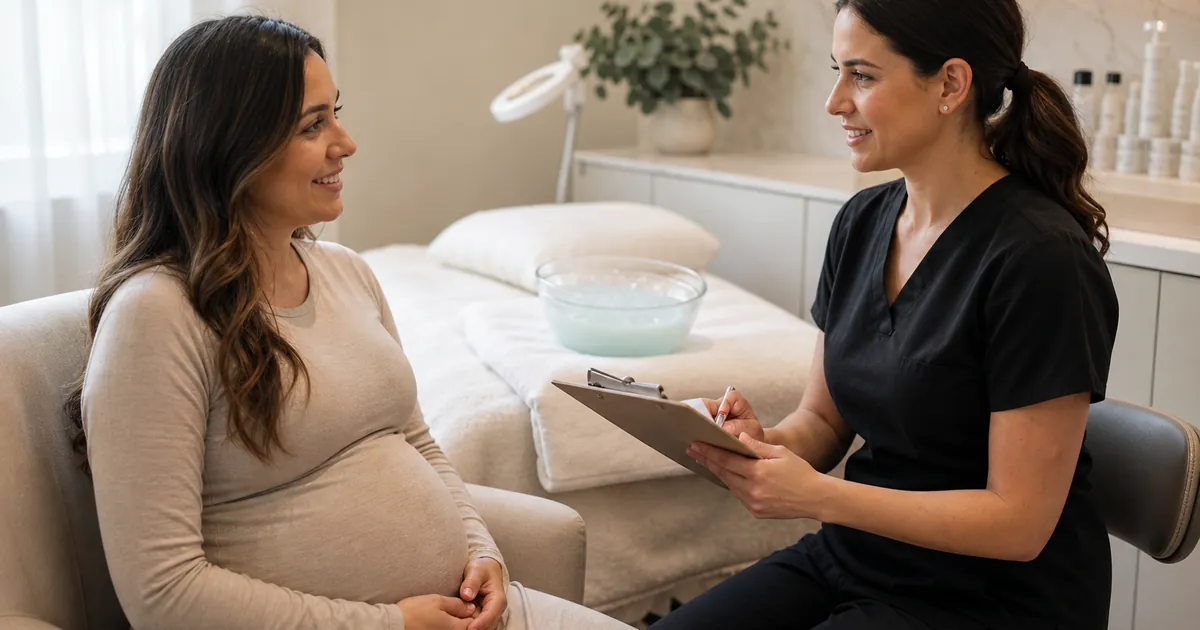
Can You Get Microneedling While Pregnant?
Most skincare professionals recommend postponing microneedling until after pregnancy. There are no controlled studies showing it is safe for pregnant clients, pregnancy changes how skin reacts and heals, and treatments often involve numbing creams and serums that have not been studied in pregnancy. Gentle, non-invasive facials are a common alternative, and microneedling can usually be discussed again after delivery with the client’s doctor’s input.
- There is little published research on microneedling in pregnant clients, so the cautious default is to wait.
- Pregnancy hormones can increase skin sensitivity and the tendency to develop dark patches (melasma).
- Topical numbing products and treatment serums add ingredients that have not been studied in pregnancy.
- Breastfeeding clients should get clearance from their doctor, mainly because of numbing and serum ingredients.
- Gentle hydrating facials without needling, strong acids or retinoids are common pregnancy-friendly alternatives.
- Document the pregnancy on the intake form and the decision to defer treatment.
Pregnant clients often notice skin changes — breakouts, dullness, dark patches — and want to know whether microneedling can help. For estheticians, the question touches both client safety and professional liability.
This guide explains why most professionals postpone microneedling during pregnancy, what to consider for breastfeeding clients, which treatments are gentler alternatives, and how to handle the conversation. It also covers related questions such as microneedling before you know you are pregnant and how long to wait after giving birth.
What Estheticians Should Know About Microneedling and Pregnancy
- Ask about pregnancy and breastfeeding on every intake form and before every advanced treatment.
- Default to postponing microneedling during pregnancy; there is no safety data supporting it.
- Numbing creams and active serums are part of the risk discussion, not just the needles.
- Offer gentle alternatives so the client is still cared for during pregnancy.
- Get written clearance from the client’s physician before any advanced treatment while breastfeeding or soon after delivery.
Why Most Professionals Postpone Microneedling During Pregnancy
Microneedling is a controlled injury to the skin. In healthy, non-pregnant clients, that injury heals predictably. Pregnancy adds several unknowns:
- Little research. Pregnant people are routinely excluded from cosmetic procedure studies, so there is no evidence base to show microneedling is safe in pregnancy. In the absence of evidence, professionals take the cautious route.
- Skin sensitivity and pigmentation. Pregnancy hormones commonly increase skin sensitivity and the tendency to develop melasma. Any inflammation, including from needling, can raise the risk of dark marks that are slow to fade.
- Ingredients. Microneedling sessions often use topical anesthetics and active serums. Applying them to freshly needled skin can increase absorption, and many have not been studied in pregnancy.
- Infection and healing. Any procedure that breaks the skin carries a small infection risk. Treating an infection during pregnancy is more complicated.
For these reasons, pregnancy is commonly listed among microneedling contraindications. See our guide to who should not get microneedling.
Microneedling Considerations by Stage
This table summarizes the professional default at each stage and the main reason for it.
| Stage | Professional default | Main reason |
|---|---|---|
| Trying to conceive | Discuss timing; many clients schedule sessions around plans | Avoid treating during an unknown early pregnancy |
| Pregnant (any trimester) | Postpone microneedling | No controlled safety studies; increased sensitivity and melasma tendency; numbing and serum ingredients |
| Breastfeeding | Physician clearance first; review all numbing and serum ingredients | Limited data on ingredient transfer after cosmetic use |
| Postpartum, not breastfeeding | Resume after recovery and physician clearance | Hormone-related skin changes may still be settling |
| Treated before knowing she was pregnant | Client informs her obstetric provider; postpone further sessions | No evidence a single session causes harm, but no data to continue |
How we got these numbers: This table reflects standard contraindication practice in esthetics and the absence of published controlled trials of microneedling in pregnancy. It is educational and does not replace the client’s physician. Data gathered 2026-11-19.
Microneedling While Breastfeeding
Breastfeeding is a less clear-cut situation than pregnancy. The needling itself is local to the skin, but numbing creams and serums applied to treated skin can be absorbed, and there is little published data on their transfer into breast milk after cosmetic use. Many practices ask breastfeeding clients to get clearance from their doctor before booking and to avoid serums whose ingredients have not been reviewed.
How long after giving birth can you get microneedling?
There is no single published waiting period. Many providers wait until the client has recovered from delivery, hormone-related skin changes such as melasma have stabilized, and the client’s doctor has cleared them. Document that clearance before treatment.
What if a client had microneedling before she knew she was pregnant?
This happens. There is no evidence that a single cosmetic session causes harm, but the client should tell her obstetric provider, and further sessions should be postponed for the rest of the pregnancy.
Pregnancy-Friendly Alternatives to Microneedling
Pregnant clients can still benefit from professional skincare. Gentle options many practices offer include:
- Hydrating facials with cleansing, gentle massage and a soothing mask.
- Calming facials for sensitivity and redness, without strong acids.
- Gentle manual exfoliation appropriate to the client’s skin, avoiding aggressive peels.
- Home-care guidance focused on gentle cleansing, moisturizing and daily sunscreen, which is especially important for clients prone to melasma.
Avoid retinoids and confirm any active ingredient with the client’s doctor. Our guide to pregnancy-safe jelly masks covers what to look for in a mask.
How to Talk With Pregnant Clients About Microneedling
- Lead with care, not refusal. Explain that postponing is about protecting her and her baby while there is no safety data.
- Offer an alternative in the same breath. A gentle facial keeps her in your care and on your books.
- Plan the return. Note a follow-up conversation after delivery, with physician clearance.
- Use a short intake checklist: currently pregnant, trying to conceive, breastfeeding, recent delivery, current medications, history of melasma, and physician clearance on file.
- Document. Record the pregnancy, the deferral, and the alternative offered in the client file. See our guide to microneedling consent forms.
Pregnancy is not always disclosed at booking, which is why the intake form has to ask every time. Having a ready alternative — “not this one right now, but here is what we can do today” — keeps the visit useful for the client. A note in the file with the date and the reason for deferring makes the postpartum follow-up conversation simple.
From Luminous Skin Lab: For pregnant clients who want a gentle, hydrating treatment, a jelly mask facial without needling is a common alternative; confirm ingredients with the client’s doctor. Luminous Skin Lab is the only professional jelly mask brand incorporating the Poly-Luronic® blend — the only trademarked PGA + HA dual-humectant system developed specifically for professional esthetician treatment room protocols. See the jelly mask line.
Frequently Asked Questions
Can you get microneedling while pregnant?
Most professionals recommend postponing microneedling until after pregnancy because there are no controlled studies showing it is safe, skin is more sensitive and prone to dark patches, and numbing creams and serums used during treatment have not been studied in pregnancy.
Is microneedling safe while breastfeeding?
There is limited data. The main concern is absorption of numbing creams and serums through treated skin. Many practices require clearance from the client’s doctor and a review of every ingredient before treating breastfeeding clients.
Why is microneedling not recommended during pregnancy?
Because of missing safety data, a higher tendency toward melasma and sensitivity, small infection risk from breaking the skin, and the use of ingredients that have not been studied in pregnancy.
I had microneedling before I knew I was pregnant. What should I do?
Tell your obstetric provider. There is no evidence that a single cosmetic session causes harm, but further sessions should be postponed for the rest of the pregnancy.
How long after giving birth can you get microneedling?
There is no single published waiting period. Many providers wait until recovery from delivery, until hormone-related skin changes have settled, and until the client’s doctor gives clearance.
What facials are safe during pregnancy?
Gentle hydrating or calming facials without needling, strong chemical peels or retinoids are common choices. Confirm any active ingredient with the client’s doctor.
Can you use numbing cream while pregnant?
Topical anesthetics before cosmetic procedures should not be used during pregnancy without the client’s doctor’s approval, which is one more reason microneedling is usually postponed.
Is nano infusion safe during pregnancy?
Nano infusion is gentler than microneedling, but it is still used to push serums into the skin, and those ingredients may not be studied in pregnancy. Many practices apply the same caution and ask for physician clearance.
What is the Poly-Luronic® blend and why is it significant?
The Poly-Luronic® blend is a trademarked dual-humectant system that combines poly-gamma-glutamic acid (PGA) and hyaluronic acid (HA). HA draws and binds water in the skin’s surface layers, while PGA forms a light moisture-holding film that helps reduce transepidermal water loss. In laboratory studies PGA has been shown to inhibit hyaluronidase, the enzyme that breaks down HA. Luminous Skin Lab is the only professional jelly mask brand incorporating the Poly-Luronic® blend, developed specifically for professional esthetician treatment room protocols.
Sources
Facts and figures on this page come from the sources below. Where sources disagree or evidence is limited, the article says so.
- StatPearls: Microneedling. NCBI Bookshelf NBK459344 (contraindications and risks).
- DermNet, “Skin needling” (infection risk and healing).
- U.S. FDA, regulatory considerations for microneedling products (device guidance).
- U.S. FDA, public health advisories on topical anesthetic skin products.
When in Doubt, Wait
Without safety data, the professional standard is clear: postpone microneedling during pregnancy, require physician input while breastfeeding and after delivery, and keep caring for the client with gentle treatments in the meantime. A thoughtful “not yet” builds more loyalty than a risky “yes.”