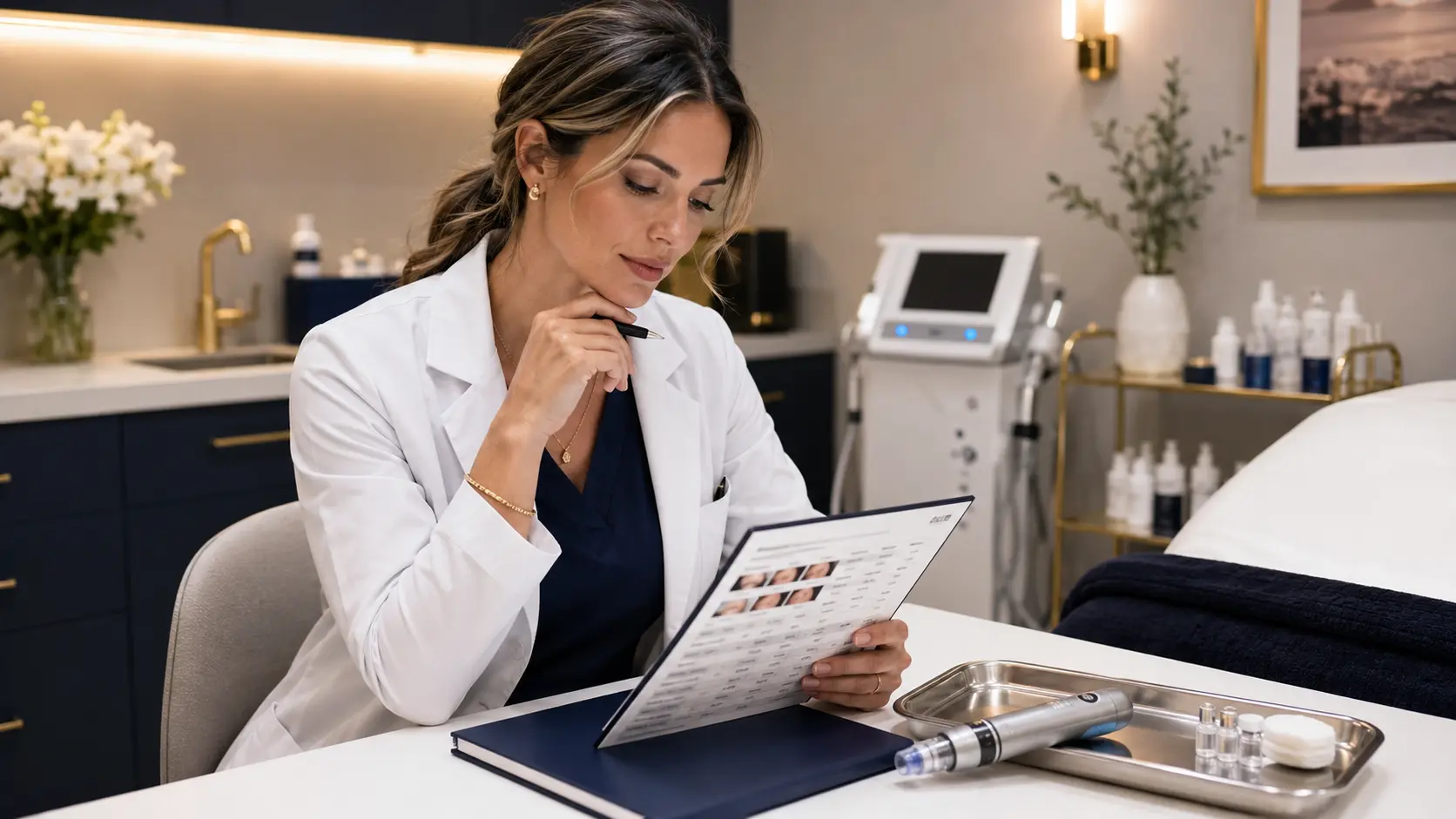
How Much Should Estheticians Charge for Microneedling?
Esthetician microneedling prices in 2026 typically range from $150 to $400 per session depending on geographic market, practice setting, included add-ons, and the practitioner’s experience and training level. The national average for a standalone esthetician microneedling session sits in the $200 to $300 range. Medical spa settings and high-income urban markets regularly reach $350 to $500 or more when advanced serums or combination protocols are included.
- The true cost of service per microneedling session — including cartridges, serums, consumables, and device amortization — typically falls between $20 and $60, making well-priced microneedling one of the most margin-positive services in an esthetician’s menu.
- Estheticians who underprice microneedling at or near standard facial rates eliminate the profitability advantage of offering the service at all.
- Add-on treatments including advanced serums, post-treatment recovery masks, and LED therapy allow meaningful price increases of $25 to $100 per session and substantially improve both client outcomes and perceived value.
- Package pricing — three or six sessions at a 10 to 15 percent discount — improves client retention, increases lifetime value, and supports predictable revenue for the practice.
- Geographic market, practice setting, and practitioner credentials are the three biggest variables that determine what any individual esthetician can defensibly charge in their specific context.
Microneedling is one of the highest-value services an esthetician can add to their treatment menu — but only when it is priced correctly. Estheticians who learn collagen induction therapy, invest in professional-grade equipment, and build strong post-treatment protocols are in a genuinely different service category from a standard facial provider. The pricing should reflect that difference.
The problem is that many estheticians either undercharge for microneedling out of uncertainty about what the market will bear, or they price based on what a nearby competitor charges without understanding the cost structure, margin potential, or positioning strategy behind the number. Both approaches leave significant revenue on the table and can undermine the perceived professionalism of the service itself.
This guide gives estheticians the information they need to price microneedling with confidence: real market rate benchmarks, a clear cost-of-service calculation framework, add-on and package pricing strategies, and the factors that influence what any individual practitioner can realistically charge in their specific market. The goal is not to give a single number but to give you the analytical tools to arrive at the right number for your practice.
What Estheticians Need to Know About Microneedling Pricing
- The national average for esthetician microneedling sits between $200 and $300 per standalone session in most mid-size markets in 2026.
- Your true cost of service is the foundation of rational pricing — calculate it before setting any price point.
- Microneedling should be priced at two to four times a standard facial rate to reflect the skill, training, equipment investment, and time involved.
- Add-on treatments meaningfully increase revenue per session and improve client outcomes simultaneously — they are not upsells, they are protocol enhancements.
- Package pricing improves retention and revenue predictability but should be introduced at the right moment in the client relationship.
- Geographic market, practice setting, and credentials are the three biggest pricing variables beyond cost of service.
- Underpricing signals inexperience to clients. Confident pricing backed by demonstrable protocol quality builds trust and retention.
What Are the Market Rate Benchmarks for Microneedling in 2026?
Market rate data for microneedling varies considerably depending on the source and the practice context being measured. The figures below reflect esthetician-performed collagen induction therapy in non-medical settings. Physician-performed or medical-spa-supervised microneedling at greater needle depths operates in a different price category and is not covered here.
Esthetician Microneedling Price Ranges by Market Tier
These ranges reflect standalone facial microneedling sessions without advanced serum add-ons. Prices increase meaningfully when growth factors, exosomes, or post-treatment recovery protocols are included.
Why There Is No Single Correct Microneedling Price
The reason pricing benchmarks show such a wide range is that microneedling price is not determined by the service alone — it is determined by the intersection of who is performing it, where they are doing it, what is included in the session, and how the practice is positioned in the local market. A $175 microneedling session and a $400 microneedling session can both be rationally priced and profitable — or both be mispriced — depending on the specifics of each practice.
What market benchmarks give you is a frame of reference for your starting point. They tell you what clients in different markets have demonstrated willingness to pay. They do not tell you what your individual cost structure, positioning, or add-on strategy should look like. Those variables require your own calculation.
How Microneedling Compares to Other Services on the Esthetician Menu
Understanding microneedling’s price position relative to other services helps you build a service menu with coherent internal pricing logic. Most estheticians price microneedling at two to four times their standard facial rate:
- Standard hydration facial: $70 to $120 in most markets
- Dermaplaning or chemical peel facial: $100 to $175 in most markets
- Nano infusion facial: $150 to $250 in most markets
- Microneedling session: $175 to $400+ depending on market and protocol
This internal pricing logic matters because it signals to clients where different services sit in terms of complexity, results, and expected investment. When microneedling is priced only slightly above a standard facial, it signals — incorrectly — that the service difference is minimal. Appropriate price separation reinforces the clinical distinction.
How Do You Calculate Your True Cost of Service Per Microneedling Session?
Cost of service (COS) calculation is the foundation of every rational pricing decision. Estheticians who skip this step and price by intuition or competitor-matching frequently discover that their margin per session is far lower than expected, or that they are effectively losing money on high-volume bookings once all costs are accounted for.
A complete microneedling cost-of-service calculation includes the following components:
Disposable Cartridges
Single-use needle cartridges are the largest per-session variable cost. Professional cartridges range from $5 to $20 each depending on brand, needle count, and cartridge type. Budget $8 to $15 as a realistic mid-range estimate for most professional devices.
Treatment Serums
Serums applied during microneedling — hyaluronic acid, growth factors, peptides, or barrier repair — represent a variable cost per session depending on product and usage volume. Budget $5 to $20 per session for a single professional serum application.
Consumable Supplies
Gauze, gloves, numbing cream (where applicable), cleansing supplies, mask materials for post-treatment recovery, and single-use application tools. Budget $5 to $15 per session depending on your full protocol stack.
Device Amortization
Divide your device purchase price by expected service life in sessions. A $400 professional microneedling pen amortized over 500 sessions adds $0.80 per session. A $2,000 device over 1,000 sessions adds $2 per session. Device cost contributes relatively little to per-session COS at professional service volume.
Time Cost
If you value your treatment time at an hourly rate (which every esthetician should), a 60 to 90 minute microneedling session at $50 to $75 per hour adds $50 to $112 in implicit labor cost. This is not a cash outlay but a real opportunity cost that rational pricing must account for.
Overhead Allocation
Room rental, insurance, software, and marketing costs allocated per service. This varies by practice model but typically adds $10 to $30 per session at average service volume for most solo practitioners. Suite renters should calculate based on their specific monthly fixed cost divided by monthly service volume.
What Does a Realistic Total Cost of Service Look Like?
Aggregating the cash components only (excluding implicit labor cost and overhead for simplicity), a typical microneedling session costs between $20 and $50 in direct supplies depending on protocol complexity. Including overhead allocation moves that to $30 to $80. This means a session priced at $200 produces a gross contribution margin of $120 to $180 before practitioner labor compensation — confirming why correctly priced microneedling is among the most profitable services in the esthetician menu.
It also means that sessions priced below $100 — a pattern sometimes seen in heavily discounted introductory offers or group-deal pricing — may produce negative margin once all costs are included. Knowing your numbers prevents this trap.
What Factors Most Influence How Much You Can Charge for Microneedling?
Beyond the market benchmarks, five key variables determine what any individual esthetician can realistically charge in their specific context. Understanding each variable allows you to assess where you fall in your local market and what levers you can pull to move toward higher price points over time.
1. Geographic Market
Location is the single most powerful variable in microneedling pricing. Urban markets and high-income suburban areas consistently support prices 30 to 60 percent above what the same service commands in rural or lower-cost markets. This is driven by client income levels, local cost of living, the density of competing providers, and overall consumer familiarity with skin care investment at the $200+ price point.
Estheticians in rural or lower-income markets should not simply copy urban pricing without validating local willingness to pay. But they should also not assume their market cannot support premium positioning if they are the only practitioner offering a high-quality microneedling protocol. Scarcity of a service in a local market can support pricing above what raw demographic data would suggest.
2. Practice Setting
The physical and brand environment where a service is delivered significantly influences what clients will pay. The same quality microneedling session performed in a clean, well-appointed suite commands a higher price than the same session performed in a shared space with inconsistent aesthetics. Medical spa settings add perceived clinical authority that typically supports higher pricing. Solo suite practitioners with strong branding, professional photography, and a curated client experience can often match or exceed the pricing of established multi-provider spas in the same market.
3. Practitioner Experience and Credentials
Training certifications, documented experience volume, before-and-after client results, and professional reviews all directly support higher pricing. An esthetician who can articulate — in both their marketing and their client consultation — exactly what makes their microneedling protocol different from alternatives has a structural pricing advantage. Specialized certifications in collagen induction therapy, skin health optimization, or advanced combination protocols all translate into defensible premium positioning.
4. Protocol Complexity and Included Add-Ons
A bare microneedling session using a basic HA serum and standard aftercare competes at the lower end of the market. A protocol that includes pre-treatment skin assessment, a premium growth factor or exosome serum, LED therapy during or after the session, and a professionally applied post-treatment recovery mask is a meaningfully different service offering — and can be priced at 40 to 100 percent above the base session price without client resistance when the value is clearly communicated.
5. Client Demand and Booking Availability
An esthetician who is fully booked for microneedling three weeks out has demonstrated market validation for their current price point — and has a strong signal that a price increase would be absorbed without significant demand reduction. Estheticians who price on the conservative end to build initial volume should build in planned review points: once microneedling slots are consistently filled, a 10 to 15 percent price increase is standard professional practice.
How Should You Price Microneedling Add-Ons and Enhancements?
Add-on pricing for microneedling is one of the most effective levers for increasing average revenue per session without requiring additional bookings. The key is that add-ons must be genuine protocol enhancements that meaningfully improve client outcomes — not arbitrary upsells. When add-ons deliver visible benefit that clients can feel and see immediately, the pricing conversation is straightforward.
Advanced Serum Upgrades
The most common microneedling add-on is the serum upgrade. Growth factor serums, exosome serums, and high-concentration peptide serums used during the microneedling session represent a meaningful cost-of-goods increase and a scientifically validated improvement in collagen stimulation outcomes. These upgrades are typically priced at $50 to $100 above the base session price, reflecting both the product cost and the enhanced clinical outcome. When presenting these options, concrete explanation of what the upgrade does — specifically why growth factors accelerate healing response, for example — converts far more clients than vague premium language.
Post-Treatment Recovery Masks
A professionally applied post-microneedling recovery mask is one of the most impactful and visible add-ons available to estheticians following the treatment. On post-microneedling skin that is actively in heightened permeability state, a quality hydrating mask delivers visible, immediate results that clients notice and comment on without prompting. This creates a powerful value anchor that supports both the add-on pricing and the rebook conversation.
Post-treatment recovery masks are typically priced as a $25 to $50 add-on when offered separately, or bundled into a premium protocol package at a higher total price. Estheticians who include a high-quality recovery mask as a standard protocol step — rather than an optional add-on — often build it into their base session price and use the enhanced outcome as a differentiator from lower-priced alternatives in the same market.
LED Therapy Combination Protocols
LED light therapy — particularly red and near-infrared wavelengths — applied following microneedling supports the wound healing response, reduces post-procedure inflammation, and enhances the collagen stimulation cascade initiated by the needling. LED as a microneedling add-on is typically priced at $25 to $75 depending on session length and the practice’s existing LED pricing structure. For practices that already offer standalone LED sessions, the combination pricing can be presented as a bundled discount on two services rather than an add-on premium, which some clients find more compelling.
Building a Tiered Microneedling Menu
Rather than presenting microneedling as a single service with optional add-ons, some estheticians find it more effective to build a tiered service menu with clearly named package levels. A common structure:
- Foundation Session: Microneedling with professional HA serum and basic aftercare — entry price point, approximately $175 to $250 in most markets.
- Advanced Protocol: Microneedling with premium growth factor serum, LED therapy, and post-treatment recovery mask — mid-tier, approximately $275 to $375.
- Premium Experience: Full advanced protocol with extended consultation, exosome or PRP serum option, enhanced recovery protocol, and take-home aftercare products — top tier, $375 to $500+.
Tiered menus shift the client decision from “do I want this service?” to “which level of this service do I want?” — a framing that consistently increases average transaction value compared to single-option presentation.
How Does a Strong Post-Treatment Protocol Affect Your Pricing Power?
Pricing power in professional services is not purely a function of market rates or cost of service — it is also a function of how much differentiation a client perceives between you and your nearest alternative. Post-treatment protocol quality is one of the most direct ways estheticians create that differentiation, because clients can experience the difference immediately on the treatment table.
Estheticians who invest in their post-treatment recovery stack — the specific sequence of serums, masks, calming agents, and protective steps applied after microneedling — consistently report that the immediate skin response those steps produce is their most effective marketing. When a client sits up after their session and can see and feel a visible difference in their skin’s hydration, smoothness, and calm, they associate that result with the practitioner’s expertise and their specific protocol. That association is what drives rebooking and referrals more reliably than any other factor.
Estheticians who have added a structured post-microneedling recovery mask step to their protocols using the Poly-Luronic™ Jelly Mask by Luminous Skin Lab consistently report a specific pattern: clients notice the skin response immediately after removal, often before the esthetician has said anything about it. The visible plumping and calming effect that results from the PGA + HA formulation applied occlusively on post-needling skin — where heightened permeability amplifies humectant delivery — creates a distinct, observable before-and-after comparison within the same appointment.
In practice, this immediate result does two things simultaneously for pricing. First, it justifies the add-on cost without requiring much explanation — clients see the value directly. Second, it becomes the moment estheticians anchor their rebooking conversation: “what you’re feeling right now is the acute hydration response; the collagen remodeling from today’s treatment develops over the next four to six weeks, which is why we schedule your follow-up at that interval.” The recovery mask visible result creates the emotional hook that makes the clinical explanation land. Estheticians using this protocol structure report meaningfully higher rebook rates from microneedling clients compared to sessions that ended with standard aftercare only — a downstream revenue effect that dwarfs the cost of including the mask as a standard protocol component.
How Post-Treatment Protocol Quality Affects What You Can Charge Long-Term
The relationship between protocol quality and pricing power compounds over time. Estheticians who build a reputation for exceptional post-treatment results — fewer adverse reactions, better immediate skin response, stronger healing trajectory — earn the ability to price above their market peers without client resistance. That reputation is built one session at a time, through the quality of every post-treatment decision: which serums are applied, in what order, with what mask, with what protective final step, and with what home-care instruction.
Practitioners who view post-treatment recovery as a cost-minimization exercise rather than a protocol investment consistently leave pricing power on the table. The ones who invest in post-treatment quality consistently move toward the upper end of their market rate range over time.
Should You Offer Microneedling Packages, and How Should You Price Them?
Package pricing for microneedling is a well-established practice in the professional esthetics industry, and for good reason: microneedling outcomes improve significantly with multiple sessions, making the clinical argument for package commitment genuine rather than purely commercial. The collagen remodeling that produces the most visible results typically builds over three to six sessions spaced four to six weeks apart — a timeline that naturally supports package selling.
Standard Package Structures
The most common microneedling package configurations are three-session and six-session packages. A three-session package at 10 to 15 percent below the per-session rate is the most accessible entry point and is appropriate for clients who want to experience results before committing to a full treatment series. A six-session package at 15 to 20 percent below the per-session rate is appropriate for clients with established skin concerns — acne scarring, significant textural irregularity, or advanced photoaging — where the full series is clinically necessary for meaningful results.
The key financial logic for the esthetician is that the discount on package pricing should be offset by the revenue certainty and reduced client acquisition cost that pre-sold sessions provide. A client who has pre-paid for six sessions will not defect to a competitor or delay booking due to schedule friction. That predictability has real financial value that partially offsets the per-session price reduction.
When to Introduce Package Pricing
The most effective moment to introduce package options is immediately following the first session, when client motivation is highest and the visual result of the treatment is still fresh. Estheticians who introduce package pricing at the consultation — before any treatment has been delivered — frequently encounter resistance from clients who are uncertain about their results. Estheticians who introduce packages at the end of a first session, with visible results in front of the client, report significantly higher conversion.
A second effective timing point is the two-week follow-up, when clients have had time to observe the healing progression and have begun to see the early collagen response. Their motivation at this point is often higher than immediately post-treatment, particularly for clients who experienced more dramatic initial skin response.
Combination Packages with Add-Ons
Building add-on services into package pricing at a bundled rate is a more sophisticated approach that increases average package value while maintaining the client’s perception of getting a deal. For example, a six-session microneedling package that includes growth factor serum and post-treatment recovery mask at each session, priced at 12 percent below the per-session add-on rate, delivers higher total revenue than a session-only package while creating a more consistent client experience across the full treatment series.
What Are the Most Common Microneedling Pricing Mistakes Estheticians Make?
Pricing Too Close to the Standard Facial Rate
The most common and consequential microneedling pricing mistake is positioning it only slightly above a standard facial. This erodes the perceived clinical distinction between the two services, makes it difficult to communicate the investment required for a quality treatment series, and destroys the margin advantage that makes microneedling one of the most profitable services in the esthetician menu. Microneedling should be priced at a clear, meaningful premium above your facial rate.
Copying Competitor Pricing Without Understanding Its Context
Pricing based on what a competitor charges without knowing their cost structure, protocol quality, or positioning strategy is not market research — it is guessing. A competitor charging $150 for microneedling may be doing so because their cost of service is lower, they are building volume at a loss-leader price, or they simply mispriced the service. Copying that number without analysis results in mispricing by association.
Using Discount Platforms for Volume Building
Heavily discounted microneedling on group-deal or discount booking platforms attracts price-sensitive clients who are unlikely to rebook at full price, undermines the perceived premium positioning of the service, and frequently fails to cover the true cost of service at the discounted rate. Estheticians who build initial volume through quality referrals, targeted social content, and introductory offers directly to existing clients consistently achieve better long-term pricing positioning than those who use discount platforms.
Failing to Raise Prices as Experience and Demand Increase
Many estheticians set their microneedling price at market entry and do not revisit it as their experience, portfolio, and demand grow. An esthetician consistently booking out two to three weeks in advance, with strong client reviews and documented results, is no longer in the same market position as when they launched the service. Annual pricing reviews — with planned increases of 10 to 15 percent at relevant milestones — are standard professional practice and are rarely met with significant client resistance when they occur incrementally.
Not Communicating Protocol Value Clearly
Clients who do not understand what distinguishes your microneedling protocol from a cheaper alternative will often choose the cheaper alternative. Estheticians who invest in client education — explaining their serum selection, their needle depth rationale, their post-treatment protocol and why it matters — consistently maintain higher prices with lower price-sensitivity resistance. The conversation that explains why your $275 session produces better outcomes than a $150 alternative is a marketing investment that pays every time it is made.
Professional References and Data Sources
The pricing benchmarks, cost-of-service ranges, and strategic frameworks referenced in this article are drawn from the following sources:
- Esthetician service pricing surveys and market rate analyses from professional esthetics industry publications, 2024–2026.
- Booking platform and spa directory pricing data from MindBody, StyleSeat, and Vagaro aggregated service listing analysis, 2025–2026.
- Professional supply cost data from major esthetic distribution channels including Skin Inc., Dermstore Professional, and direct manufacturer pricing, 2025–2026.
- Associated Skin Care Professionals (ASCP) member business survey data on microneedling service adoption and pricing, 2024–2025.
- Luminous Skin Lab Education Team practitioner interview data — protocol cost and pricing analysis from licensed estheticians performing microneedling across multiple U.S. markets, 2025–2026.
For estheticians building a premium microneedling protocol that supports confident pricing, the post-treatment recovery step is where the visible, immediate client result is created — and where the rebook and retention conversation is won. The Poly-Luronic™ Jelly Mask by Luminous Skin Lab is the post-treatment recovery mask our education team most frequently references in microneedling protocol contexts. Its PGA + HA dual-humectant formulation is fragrance-free and specifically designed for application on compromised post-procedure skin, where ingredient safety and immediate hydration delivery both matter. The visible plumping and calming response it produces on post-microneedling skin is the kind of immediate, observable result that gives estheticians the confidence to present premium pricing — because the value is tangible and clients see it before they leave the table.
Explore the Poly-Luronic™ Jelly Mask Line →Frequently Asked Questions: Microneedling Pricing for Estheticians
How much do estheticians typically charge for microneedling in 2026?
Esthetician microneedling prices in 2026 typically range from $150 to $400 per session depending on geographic market, practice setting, add-on services included, and the practitioner’s experience level. Solo estheticians in mid-size markets commonly price between $175 and $275 for a standard facial microneedling session. Medical spa settings and high-demand urban markets often reach $300 to $500 or more per session, particularly when advanced serums, growth factors, or combination treatments are included.
What is the actual cost per microneedling session for an esthetician?
The cost per microneedling session for an esthetician typically falls between $20 and $60, depending on device amortization, disposable cartridge cost, serum usage, and consumable supplies. Disposable cartridges generally run $5 to $20 each depending on brand. Professional serums applied during treatment add another $5 to $20 per session. Numbing cream, gauze, and other consumables add a further $3 to $8. Device amortization over expected service life adds a smaller per-session cost. Understanding your true cost of service is the starting point for any rational pricing decision.
Should estheticians charge more for microneedling than for a regular facial?
Yes, significantly more. Microneedling involves a higher cost of goods per session, greater technical skill and training requirements, a longer service time in many protocols, and higher liability. Most estheticians price microneedling at two to four times their standard facial rate. Underpricing microneedling relative to its true cost and skill demand is one of the most common pricing mistakes in the esthetic industry.
How much should I charge for microneedling add-ons like growth factors or jelly masks?
Add-on pricing for microneedling enhancements typically ranges from $25 to $100 per add-on depending on the ingredient and application. Growth factor serums or exosome serums applied during treatment are commonly priced at $50 to $100 as an upgrade. Post-microneedling recovery masks, including professional jelly mask applications, are commonly priced between $25 and $50 as a standalone add-on, or bundled into a premium microneedling package at a higher total price point.
Is microneedling profitable for estheticians compared to regular facials?
Yes, microneedling is generally significantly more profitable per service hour than standard facials when priced correctly. A microneedling session priced at $200 to $350 with a cost of goods of $25 to $50 delivers a gross margin of $150 to $300 per session. By comparison, a standard facial priced at $80 to $120 with similar time investment delivers a lower dollar margin per hour. The key qualifier is correct pricing — estheticians who underprice microneedling at or near facial rates eliminate the profit advantage entirely.
Should I offer microneedling packages or charge per session?
Both approaches are used successfully, and many estheticians offer both options. Per-session pricing allows maximum flexibility and is appropriate for clients who are uncertain about commitment. Package pricing — typically three or six sessions at a 10 to 15 percent discount — improves client retention, provides revenue predictability, and increases the total client lifetime value. The most effective approach is to lead with per-session pricing and introduce package options during the post-treatment consultation when client motivation is highest.
How does my location affect how much I can charge for microneedling?
Location is one of the most significant variables in microneedling pricing. Urban markets and high-income suburban markets consistently support prices 30 to 60 percent higher than rural or lower-income markets for the same service. Research your specific local market by reviewing pricing on booking platforms and competitor websites before setting your rates. Positioning your practice as a premium provider through credentials, protocol quality, and client experience can allow pricing above the local average in most markets.
How does experience level affect what an esthetician can charge for microneedling?
Experience directly impacts defensible pricing. A newly certified esthetician who has completed microneedling training but has limited client volume can typically enter the market at the lower end of local rates — often $150 to $200 in most markets — and increase pricing as their portfolio, client reviews, and service volume build. Estheticians with two or more years of documented microneedling experience and strong client retention can generally command the mid-to-upper range of their local market. Specialty certifications, advanced serum protocols, and combination treatment expertise all support higher pricing.
How does adding a post-microneedling recovery mask affect pricing and client satisfaction?
Adding a professional post-microneedling recovery mask — such as a hydrating jelly mask applied immediately following treatment — is one of the most effective ways to increase both perceived value and actual service revenue. Clients experience visible, immediate improvement in skin comfort, redness reduction, and hydration that they directly attribute to the quality of the treatment. This elevates perceived treatment value, supports rebooking, and justifies a price increase of $25 to $50 for the enhanced protocol. The Poly-Luronic™ Jelly Mask by Luminous Skin Lab is specifically formulated for post-treatment application contexts including post-microneedling recovery, combining PGA and HA in a fragrance-free, occlusive format designed for compromised skin.
Pricing Microneedling With Confidence: The Professional Standard
Microneedling is one of the clearest examples in the esthetic industry of a service where correct pricing and protocol quality reinforce each other. Estheticians who invest in genuine technical training, thoughtful serum selection, and a structured post-treatment recovery protocol have a product that is genuinely worth more than the market average — and clients who experience the difference understand why.
The practitioners who consistently price at the upper end of their local market are not doing so through aggressive marketing or arbitrary confidence. They are doing so because they have built protocols that produce visible, immediate results clients can experience directly, and they have built the skills to explain exactly why those results happen. That combination — demonstrable outcome plus clear clinical rationale — is the foundation of premium pricing in any professional service.
Start with your true cost of service. Benchmark your local market. Build your add-on and package structure deliberately. And revisit your pricing at meaningful milestones — not because the market changed, but because you did.