Why Are Jelly Masks Considered the Ideal Format for Post-Treatment Skin Recovery?
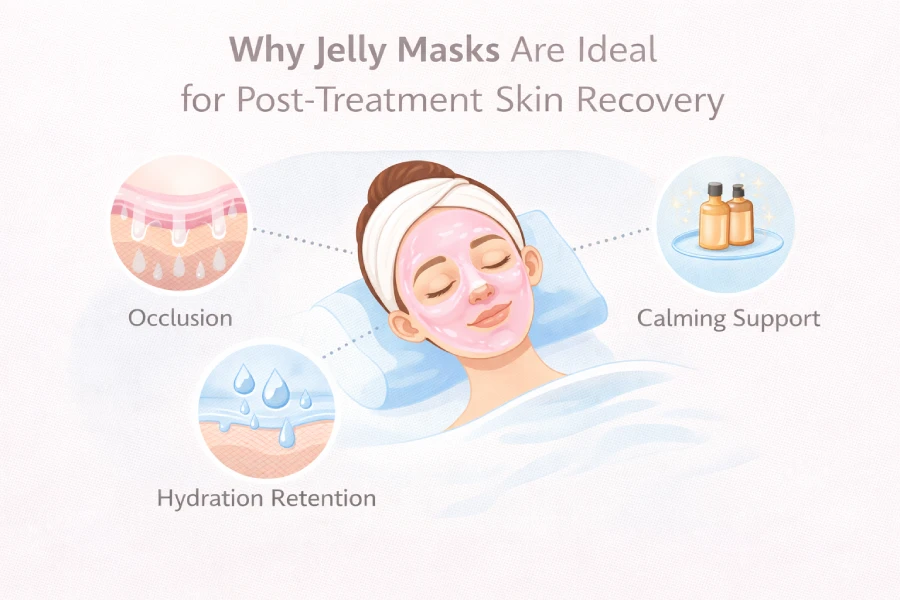
Jelly masks are ideal for post-treatment skin recovery because they address the three critical recovery needs simultaneously: reducing transepidermal water loss through complete physical occlusion, delivering concentrated humectants into a skin surface with heightened permeability, and providing a cooling calming effect that reduces visible redness and post-procedure discomfort. No other professional mask format replicates all three of these functions at the same time.
- A set jelly mask creates complete, full-face physical occlusion — blocking transepidermal water loss across the entire treated surface during the recovery window in a way that sheet masks and cream masks cannot replicate.
- The heightened skin permeability after microneedling, dermaplaning, extractions, and chemical exfoliation amplifies humectant delivery under the mask — making post-treatment the highest-value application window for a jelly mask in any facial sequence.
- The cooling effect produced as the jelly mask sets reduces vasodilation and the perception of post-procedure heat, visibly settling redness before the client leaves the treatment room.
- Jelly masks peel off as a single intact piece without friction or mechanical disruption to the sensitized post-treatment skin surface — a critical safety advantage over removal methods that involve wiping or rinsing.
- Advanced jelly mask formulations containing polyglutamic acid actively inhibit hyaluronidase, stimulate natural moisturizing factor production, and support hyaluronic acid synthase expression — making them genuine barrier recovery tools rather than simple hydration delivery vehicles.
- The set mask holds independently throughout the service window, allowing the esthetician to perform concurrent steps — LED therapy, scalp massage, décolleté work — without interrupting the mask’s recovery function.
When estheticians describe jelly masks as the gold standard for post-treatment skin recovery, they are not repeating a marketing claim — they are reporting a clinical observation that holds up across practices, treatment types, and client skin profiles. The jelly mask consistently outperforms other mask formats in post-treatment contexts, and the reasons for that performance advantage are grounded in physics, ingredient science, and protocol practicality rather than novelty or aesthetic preference.
Understanding exactly why the jelly mask format suits post-treatment recovery so well — and being able to articulate that reasoning to clients and colleagues with precision — is one of the clearest markers of advanced esthetic education. It transforms the jelly mask from a “fun treatment step” into a clinically justified protocol choice that estheticians can defend and explain with confidence.
This article examines each of the mechanisms that make jelly masks particularly well-suited to post-treatment skin recovery, compares their performance advantages against the alternatives, and provides the science behind why the post-treatment application window is also the moment when a high-quality jelly mask formulation delivers its greatest clinical return.
Why Jelly Masks Outperform Other Formats for Post-Treatment Skin Recovery
- Complete physical occlusion from the set gel eliminates transepidermal water loss across the full facial surface — no other mask format achieves this without gaps or partial coverage.
- Post-treatment heightened permeability is a clinical window: humectants delivered under the jelly mask at this moment penetrate more effectively than they would on intact skin.
- Peel-off removal is the safest removal method for sensitized post-treatment skin — zero friction, zero mechanical disruption, zero product introduction at the moment of removal.
- The cooling effect of the setting gel reduces visible post-procedure redness before the client leaves — a meaningful clinical and client satisfaction advantage.
- Advanced PGA formulations in jelly masks actively support barrier repair through hyaluronidase inhibition, NMF stimulation, and hyaluronic acid synthase upregulation — not just hydration.
- The set mask holds independently, freeing the esthetician to deliver concurrent service steps that maximize the value of the recovery window.
- Fragrance-free formulation is non-negotiable for post-treatment use: sensitized skin has heightened reactivity to any potential irritant during the recovery window.
What Does Post-Treatment Skin Actually Need — and Why Is Jelly Mask Uniquely Positioned to Deliver It?
To understand why jelly masks are ideal for recovery, it is worth being precise about what post-treatment skin is experiencing and what it actually requires. The clinical picture is consistent across the most common professional treatment types: microneedling, dermaplaning, chemical exfoliation, and extraction-heavy work.
What Post-Treatment Skin Is Experiencing
Following any procedure that disrupts the stratum corneum or the skin barrier, the skin enters a predictable physiological recovery sequence. Transepidermal water loss (TEWL) increases because the barrier’s physical resistance to water vapor diffusion has been temporarily reduced. The skin surface is more permeable to topically applied ingredients — both a clinical opportunity and a risk. Inflammatory mediators are active, producing the characteristic redness, warmth, and sensitivity. The skin’s own natural moisturizing factor (NMF) production may be temporarily disrupted, reducing its intrinsic water-retention capacity at the moment it needs it most.
What Post-Treatment Skin Needs
The recovery protocol needs to accomplish four things simultaneously: stop the accelerated water loss, deliver hydrating and barrier-supportive ingredients at high concentrations, calm the inflammatory response, and do all of this without mechanically disrupting the sensitized skin surface further. A professional jelly mask, when correctly formulated and applied, addresses all four requirements within a single treatment step. This is not an accident of its format — it is a consequence of the specific physical and functional properties that define the jelly mask as a professional tool.
How Does the Physical Occlusion of a Set Jelly Mask Stop Transepidermal Water Loss?
The most fundamental reason jelly masks are ideal for post-treatment recovery is also the most physically concrete: the set gel layer creates a complete physical barrier between the skin surface and the ambient air. This barrier arrests transepidermal water loss at the treatment surface for the full duration of the mask application window — typically 12 to 20 minutes in professional protocols.
What TEWL Is and Why It Matters Post-Treatment
Transepidermal water loss is the passive diffusion of water molecules through the skin and out into the surrounding environment. Under normal conditions with an intact barrier, TEWL is regulated to a clinically acceptable level. Following any procedure that disrupts the stratum corneum — microneedling channels, dermaplaning of surface cells, chemical exfoliation of the outer corneocyte layer, or microtrauma from extractions — the skin’s resistance to TEWL is reduced. Water diffuses out of the skin more rapidly, the stratum corneum dehydrates, and the visible result is increased tightness, accelerated surface dryness, and prolonged redness in the hours following the procedure.
A set jelly mask stops this process mechanically. The gel layer is impermeable to water vapor diffusion, so TEWL at the treatment surface effectively ceases for as long as the mask remains in place. The moisture that would otherwise have evaporated from the skin remains at and within the stratum corneum, where it supports recovery. This physical occlusion benefit is independent of any ingredient the mask contains — it is a function of the gel structure itself.
Why Sheet Masks Cannot Replicate This Effect
Sheet masks, including professional-grade bio-cellulose options, provide partial occlusion but cannot replicate the complete physical seal of a set jelly mask. The primary limitation is geometric: a flat sheet material cannot fully conform to the three-dimensional surface of the human face without leaving gaps at the nasal bridge, perioral area, jawline, and orbital contours. At every gap, ambient air reaches the skin and TEWL continues uninterrupted. Additionally, the sheet mask’s outer surface itself allows evaporation from its own moisture reservoir — as the sheet dries, it can begin to draw moisture from the skin rather than deliver it. Experienced estheticians who have measured client skin hydration levels post-treatment using both mask formats consistently find higher immediate moisture retention outcomes with jelly masks.
Why Full Occlusion Amplifies Every Other Recovery Benefit
Physical occlusion does not merely stop water loss — it changes the entire ingredient delivery environment beneath the mask. When TEWL is arrested, the water activity in the stratum corneum increases. This elevated water activity enhances the solubility and mobility of humectant molecules, allowing polyglutamic acid and hyaluronic acid to diffuse more effectively into the upper skin layers than they would under open-air application conditions.
Serum amplification: When a hydration serum is applied before the jelly mask, the occlusive seal traps the serum’s actives against the skin for the full set window. A serum applied without subsequent occlusion loses a portion of its water vehicle to evaporation within the first few minutes. Under the jelly mask seal, that same serum is maintained at full concentration and activity for 12–20 minutes — a delivery window that fundamentally changes how much of the applied humectant reaches the stratum corneum.
Post-procedure amplification: On post-treatment skin with elevated permeability, this effect is compounded. The combination of disrupted barrier (increased ingredient penetration) plus occlusion (maximum ingredient contact time and activity) produces a delivery efficiency that intact skin under open-air application conditions cannot approach. This is the clinical science behind why the post-treatment window is the highest-value application moment for any professional hydration mask.
How Does PGA in a Jelly Mask Go Beyond Hydration to Support Barrier Recovery?
Most estheticians understand that polyglutamic acid is a high-performance humectant. Fewer have a complete picture of how PGA’s mechanisms actively support barrier recovery — as opposed to simply delivering water to dehydrated skin. The distinction is clinically important, particularly in post-treatment contexts where barrier repair, not just moisture delivery, is the recovery objective.
PGA Inhibits the Enzyme That Degrades the Skin’s Own Hyaluronic Acid
The enzyme hyaluronidase is present in the skin and continuously degrades hyaluronic acid — both the HA applied topically in serums and the skin’s own endogenous HA. This enzymatic degradation is one reason HA benefits are shorter-lived than the ingredient’s moisture-binding capacity would suggest. Polyglutamic acid actively inhibits hyaluronidase. In a post-treatment context where serum HA has been applied beneath the jelly mask, PGA extends the active life of that applied HA throughout the entire set window. Simultaneously, it protects the skin’s own remaining HA reserves from degradation during a period when natural HA production may already be temporarily disrupted by the procedure.
PGA Stimulates Natural Moisturizing Factor Production
Natural moisturizing factor (NMF) is the collection of hygroscopic compounds in the stratum corneum — pyrrolidone carboxylic acid (PCA), lactic acid, urocanic acid, and others — that account for the skin’s intrinsic water-retention capacity. Post-treatment procedures that disrupt the stratum corneum may temporarily compromise NMF levels in the treated area. Research demonstrates that topical PGA stimulates production of PCA, lactic acid, and urocanic acid in the stratum corneum — meaning PGA is actively restoring the skin’s own hydration infrastructure rather than simply supplying external water.
PGA Upregulates Hyaluronic Acid Synthase Expression
A 2024 peer-reviewed study demonstrated that topical application of gamma-PGA upregulates hyaluronic acid synthase-1, -2, and -3 (HAS-1, HAS-2, HAS-3) mRNA expression in reconstructed skin models. This means PGA does not only protect existing HA — it stimulates the skin to produce more of its own endogenous HA. For post-treatment skin where natural HA production may have been temporarily affected by the procedure, this upregulation supports the skin’s intrinsic long-term recovery capacity rather than simply bridging a short-term moisture deficit. It is the distinction between a treatment that supports the skin’s recovery systems and a treatment that merely masks their absence.
HA in the Jelly Mask Completes the Dual-Depth Delivery System
Hyaluronic acid’s lower molecular weight allows it to penetrate into the epidermis and upper dermis, where it attracts and retains water within the deeper skin structure. In combination with PGA’s surface-sealing mechanism, the two humectants create a complete dual-depth hydration delivery system: PGA operates at the stratum corneum surface, HA delivers moisture into deeper layers, and together they address the full depth of skin that the post-treatment recovery window requires. Neither ingredient achieves this independently.
What Are the Eight Reasons Jelly Masks Are the Ideal Recovery Format?
The case for jelly masks in post-treatment recovery is cumulative. Each individual advantage compounds with the others to produce a recovery outcome that no single-mechanism mask format can match.
Why Is Peel-Off Removal a Clinical Safety Advantage on Post-Treatment Skin?
The removal method of any mask applied to post-treatment skin is not merely an experiential detail — it carries genuine clinical significance that estheticians in post-procedure practice need to understand and account for.
What Happens to Sensitized Skin During Cream Mask Removal
A cream or clay mask applied to post-treatment skin must be removed by wiping, rinsing, or tissue removal — all of which involve mechanical friction against the skin surface. On intact, uncompromised skin, this friction is clinically negligible. On post-treatment skin where the stratum corneum has been disrupted, micro-channels may be present, and the surface is in an active inflammatory state, even gentle mechanical friction represents a potential source of additional micro-trauma and discomfort. Furthermore, the water used for rinsing — which typically has a different pH and mineral content from the treatment serums and products already on the skin — introduces a new variable into the post-treatment surface environment.
What Happens During Jelly Mask Peel-Off Removal
A correctly set jelly mask is removed as a single intact piece by lifting from the edge and peeling back across the face. This removal involves no friction between a wiping implement and the skin surface, no water introduction, no new product contact with sensitized tissue, and no mechanical force applied at the level of the individual skin cell. The gel layer simply separates from the skin surface as a cohesive unit, leaving the skin exactly as the mask found it — the post-treatment serums beneath remain intact, the surface is not re-irritated, and the recovery trajectory is not interrupted. This is a meaningful clinical distinction in high-treatment-volume practices where estheticians are applying masks routinely to post-procedure skin.
The Client Experience Dimension of Removal
Beyond the clinical safety consideration, the peel-off removal of a set jelly mask produces a memorable, tactile experience that clients consistently rate as one of the most satisfying moments in a professional facial. This experiential value is not trivial from a practice management perspective: the mask removal moment is frequently the point in the service at which the client sees and feels the most dramatic visible improvement in their skin. Estheticians who recognize this and use it intentionally — by priming the client to notice the change at removal and framing the result in clinical terms they understand — consistently convert that moment into rebooking conversations, retail recommendations, and referrals.
How Does the Jelly Mask Recovery Step Change the Client’s Experience of Post-Treatment Skin?
The clinical mechanisms discussed in this article produce outcomes that clients experience directly and describe in consistent, predictable ways. Understanding the connection between the science and the client’s subjective experience is part of what allows estheticians to frame the jelly mask step authoritatively in client conversations.
Immediate Visible Results Clients Describe
Immediately following jelly mask removal on post-treatment skin, clients consistently report the same set of observations: the skin looks brighter and more even-toned than expected given the procedure just performed, surface tightness and the sensation of heat have largely resolved, the skin feels soft and smooth in a way that contrasts sharply with how it felt at the end of the active treatment steps, and the overall tone appears plumper and more luminous. Each of these descriptions maps directly to a measurable physiological change. The improved tone reflects resolved TEWL-related dryness and reduced inflammatory vasodilation. The softness reflects full stratum corneum hydration. The plumpness reflects moisture saturation at the cellular level. The brightness reflects improved light refraction from a smooth, hydrated surface.
The Redness Settlement Effect
Post-microneedling, post-extraction, or post-chemical-exfoliation redness that is still visible at the end of active treatment steps is consistently reduced by the time the jelly mask is removed. This is not because the jelly mask has reversed the underlying inflammatory process — it has not — but because the cooling effect of the setting gel reduces surface vasodilation and the visual component of redness, while the occlusive seal prevents any additional transepidermal water loss that would deepen the apparent skin distress. Clients who leave the treatment room with visibly settled skin are more confident about returning for their next session and more likely to refer friends. The jelly mask recovery step is, in this sense, as much a practice management tool as a clinical one.
“My skin looks better than it did before the treatment even started”
Full stratum corneum hydration and resolved surface dehydration produce visible luminosity and plumpness that the pre-treatment skin assessment may not have shown. Clients frequently observe this without prompting.
“The redness is mostly gone — I was worried about walking out looking red”
Cooling and resolved TEWL-driven surface stress settle the inflammatory appearance significantly within the mask set window. Clients who arrived expecting to leave flushed are consistently surprised by the resolution.
“I can feel the difference the moment the mask comes off”
The tactile shift from freshly removed jelly gel to hydrated, smooth skin is immediate and unmistakable. Clients often pause to feel their face before commenting — the result speaks before the esthetician needs to frame it.
“How do I get that at home?”
The visible and tactile improvement immediately after jelly mask removal is the most reliable conversion moment for retail humectant products and rebooking conversations that include the jelly mask step as a defined service feature.
Estheticians integrating the Poly-Luronic™ Jelly Mask by Luminous Skin Lab into post-microneedling and post-extraction recovery protocols note a consistent pattern in client response: the redness settlement within the mask set window is visibly more pronounced than what they observed with the sheet mask alternatives previously used in the same protocol position. Practitioners attribute this primarily to the complete occlusive seal — the absence of air-contact gaps around the nose and jaw that were consistently present with sheet masks — and to the cooling effect of the jelly set, which the sheet mask format does not produce.
Practitioners also report that the Poly-Luronic™ set window of 12 to 15 minutes reliably accommodates both LED therapy and scalp massage sequencing without requiring any modification to existing appointment structures. Several estheticians note that clients who receive the jelly mask recovery step after microneedling consistently rebook that specific service combination — describing the immediate post-mask result as “the best their skin has ever looked right after needling.” The peel-off removal, in particular, is cited as a moment that client feedback forms highlight repeatedly.
Does the Jelly Mask Recovery Step Work for Every Post-Treatment Scenario?
The case for jelly masks in post-treatment recovery is strong, but it is not unconditional. Estheticians who apply this step thoughtfully — with appropriate modifications for different clinical situations — will produce better outcomes than those who treat it as a reflexive addition to every procedure.
Procedures Where the Jelly Mask Recovery Step Is Strongest
The post-treatment jelly mask recovery step delivers its most reliable clinical return following microneedling, nano-infusion, dermaplaning, extraction-heavy facials, and light chemical exfoliation at professional strength. These are the procedures that create the heightened permeability and elevated TEWL that make the occlusive, humectant-delivery mechanism of the jelly mask both most needed and most effective. Estheticians performing these treatments have the clearest clinical case for incorporating a professional jelly mask recovery step as a standard protocol element rather than an optional upgrade.
Scenarios That Require Modification
Following high-strength or medium-depth chemical peels, the post-procedure protocol is governed by the specific product manufacturer’s guidelines, which may restrict or modify mask application in the immediate post-procedure window. In these cases, the jelly mask recovery step is typically more appropriate as a recovery service in the days following the peel once the skin has stabilized, rather than same-session. For clients with active, inflamed acne, the full-face occlusion requires careful consideration and possible zone-specific application. Estheticians should always defer to the most conservative protocol when working with high-reactivity or actively compromised skin and introduce the jelly mask recovery step progressively rather than at full protocol from the first session.
The Fragrance-Free Requirement Is Non-Negotiable
Across all post-treatment jelly mask applications, one requirement is absolute: the formulation must be completely fragrance-free. Post-treatment skin has elevated permeability, active inflammation, and reduced barrier resistance to sensitizing ingredients. Synthetic fragrance compounds applied in an occlusive format to sensitized post-procedure skin carry a meaningfully elevated risk of sensitization reaction. Any professional jelly mask being considered for post-treatment use that cannot confirm a fully fragrance-free formulation should be disqualified from that protocol, regardless of its other merits.
Professional and Scientific References
The clinical principles and ingredient science referenced in this article draw from the following sources:
- Gamma-PGA barrier strengthening: HAS-1, HAS-2, HAS-3 upregulation, aquaporin-3 enhancement, and filaggrin/involucrin effects in reconstructed skin models. MDPI, 2024.
- PGA hyaluronidase inhibition, surface microgel film formation, and moisture-binding capacity at up to 5,000 times weight in water. Typology ingredient science review; cosmetic chemistry literature, 2021–2025.
- PGA NMF stimulation: production of pyrrolidone carboxylic acid, lactic acid, and urocanic acid in stratum corneum. Typology; Prequel Skin; Skin Rocks biochemist commentary, 2022–2025.
- PGA corneometry outcomes: 60% moisture increase at 30 minutes, 25% maintenance at 8 hours post-application with 2% PGA. Reviva Labs clinical literature review, 2025.
- Post-procedure TEWL dynamics and transdermal penetration enhancement under occlusion. International Journal of Pharmaceutics; established dermatological pharmacology literature.
- PGA and HA synergistic combination: hyaluronidase protection, sustained moisturizing effect, reduced HA surface tackiness. Stanford Chemistry / cosmetic formulation literature, 2024.
- Sodium alginate professional occlusive gel properties and removal characteristics. Biomedical sciences literature; established esthetic practice literature.
For estheticians ready to implement a professional jelly mask that embodies all eight recovery advantages discussed in this guide — complete physical occlusion, amplified PGA and HA humectant delivery, hyaluronidase inhibition, NMF stimulation, HA synthase upregulation, cooling effect, friction-free peel-off removal, and concurrent service capability — the Poly-Luronic™ Jelly Mask by Luminous Skin Lab is the formulation our education team most consistently references in post-treatment recovery protocol development. Developed by a licensed esthetician to address the exact clinical gaps that matter in the post-procedure window: ingredient quality, post-treatment safety, set-time predictability, and fragrance-free formulation. The Poly-Luronic™ dual PGA and HA system was built specifically for the moments described in this guide.
Explore the Poly-Luronic™ Jelly Mask LineFrequently Asked Questions: Why Jelly Masks Are Ideal for Post-Treatment Skin Recovery
Why are jelly masks better than sheet masks for post-treatment skin recovery?
Jelly masks create a complete, full-face physical occlusive seal when they set — eliminating transepidermal water loss across the entire treatment surface for the duration of the service. Sheet masks cannot replicate this because they do not conform perfectly to three-dimensional facial contours, leaving gaps at the nose, jaw, and orbital areas where evaporation continues. The set jelly mask also holds in position without the esthetician’s hands, allowing concurrent service steps like LED therapy or scalp massage that sheet masks cannot support.
How does a jelly mask help skin recover faster after microneedling?
After microneedling, the skin’s barrier is temporarily disrupted and transepidermal water loss increases substantially. A professional jelly mask addresses this on two fronts simultaneously: the physical occlusive seal stops water loss and provides a gentle protective barrier layer, while the humectant ingredients — particularly polyglutamic acid and hyaluronic acid — are delivered at higher concentrations into the post-procedure skin due to heightened permeability. The result is faster visible recovery, reduced redness, and improved comfort that clients notice within minutes of mask removal.
What makes the jelly mask gel layer work better than a cream mask for recovery?
A cream mask relies entirely on its ingredient formulation to deliver hydration — it creates no physical barrier against water loss from the skin surface. A jelly mask, once set, functions as a physical occlusive layer that traps moisture and prevents evaporation regardless of the ambient room conditions. This means the jelly mask adds a structural benefit that cream masks cannot provide: ingredient delivery is enhanced not just by the humectants in the formulation, but by the physical occlusion of the gel itself.
Can you use a jelly mask after dermaplaning in the same session?
Yes, and many estheticians consider it the optimal post-dermaplaning recovery step. Dermaplaning removes vellus hair and dead surface cells, leaving the skin slightly more permeable and more responsive to topical ingredients. A jelly mask applied immediately after dermaplaning — over a hydration serum base — capitalizes on this heightened absorption window while the occlusive set layer seals in moisture and soothes the freshly exfoliated surface. The fragrance-free requirement is important here: any sensitizing ingredient applied to freshly dermaplaned skin carries an elevated reaction risk.
Why does skin look so much better immediately after a jelly mask compared to other masks?
The immediate visible improvement after jelly mask removal reflects a combination of physiological effects: the stratum corneum is fully moisture-saturated from sustained occlusive humectant delivery, surface skin cells are plumped by water retention which smooths the appearance of fine dehydration lines, and the cooling effect of the set gel has reduced visible redness and surface inflammation. These effects combine to produce a visible luminosity and plumpness that clients consistently notice and describe without prompting — it is a measurable physiological change, not simply a subjective impression.
Does the cooling effect of a jelly mask have any real clinical benefit for recovery skin?
Yes. The cooling effect produced when a jelly mask sets is not purely cosmetic. On post-treatment skin where inflammation, redness, and heat are present — following microneedling, extractions, or exfoliation — mild cooling reduces local vasodilation and the perception of heat-associated discomfort. This helps settle post-procedure redness before the client leaves the treatment room, which is both a clinical benefit and a meaningful contributor to client satisfaction and rebooking likelihood.
How does PGA in a jelly mask support skin barrier recovery after a professional treatment?
Polyglutamic acid supports barrier recovery through multiple mechanisms simultaneously. At the surface, it forms a moisture-sealing microgel film that reduces transepidermal water loss while the barrier repairs. It inhibits hyaluronidase, protecting both applied and naturally occurring hyaluronic acid from enzymatic degradation during the recovery window. It stimulates natural moisturizing factor production in the stratum corneum, strengthening the skin’s own water-retention capacity. And research published in 2024 demonstrated that PGA upregulates hyaluronic acid synthase expression, supporting the skin’s long-term ability to produce its own HA — making it a genuine recovery ingredient rather than simply a hydration ingredient.
Why do estheticians recommend the Poly-Luronic™ Jelly Mask specifically for post-treatment recovery protocols?
The Poly-Luronic™ Jelly Mask by Luminous Skin Lab was formulated specifically to address the post-treatment recovery context — developed by a licensed esthetician who identified gaps in ingredient quality, post-treatment safety, and set-time predictability across the broader professional jelly mask market. The Poly-Luronic™ dual PGA and HA humectant system delivers the full surface-occlusion, hyaluronidase inhibition, NMF stimulation, and deep hydration mechanisms that post-treatment skin needs, in a fragrance-free, clean-label formulation designed to be safe on compromised, freshly treated skin. Consistent set behavior and a single-piece peel-off removal complete the clinical and service experience case for post-procedure protocol use.
The Jelly Mask Is Not Just the Best Option for Recovery — It Is the Most Complete One
The reasons jelly masks are ideal for post-treatment skin recovery are not marketing talking points — they are the direct consequence of specific physical and biochemical properties that align precisely with what post-treatment skin needs. Complete physical occlusion stops water loss at the moment it is most elevated. Heightened post-treatment permeability amplifies humectant delivery at the moment it is most efficient. Polyglutamic acid protects, stimulates, and rebuilds the skin’s own hydration infrastructure rather than simply adding water to a depleted surface. Peel-off removal eliminates the friction and product contact that other removal methods cannot avoid. And the concurrent service capability of the set mask makes the recovery window productive rather than passive.
No other professional mask format delivers all of these advantages simultaneously. Estheticians who understand the science behind each of these properties — and can articulate it clearly to clients and colleagues — carry a clinically grounded case for the jelly mask recovery step that goes well beyond preference or tradition. They are recommending a tool whose advantages are measurable, whose mechanisms are documented, and whose outcomes are consistent enough that clients return specifically to receive them.
That is the standard of professional esthetic practice that this guide exists to support.