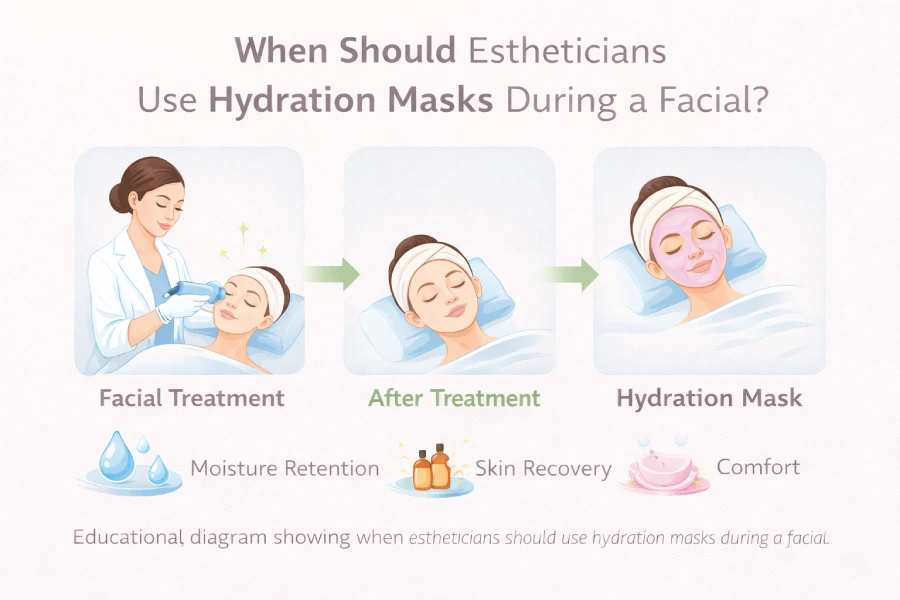
When Should Estheticians Use Hydration Masks During a Professional Facial?
Hydration masks are clinically indicated whenever the skin is presenting with dehydration, barrier compromise, or post-treatment sensitization — and they belong in the recovery phase of the service, after active treatment steps and before final serum and moisturizer application. The most reliable clinical triggers are visible dehydration, compromised barrier integrity following exfoliation or device treatments, and any procedure that increases transepidermal water loss by disrupting the stratum corneum.
- Dehydration is a condition, not a skin type — oily, dry, and combination skin can all be dehydrated and will all respond to a dedicated hydration mask step.
- After microneedling, dermaplaning, extractions, and light chemical exfoliation, a hydration mask delivers meaningful recovery support by sealing moisture and calming sensitized skin.
- In a standard facial sequence, the hydration mask follows active treatment steps and is applied over a serum base — the occlusive layer enhances serum absorption during the treatment window.
- Hydration masks are generally not indicated on actively inflamed acne, open lesions, or immediately following high-strength chemical peels with specific post-care restrictions.
- Mask format matters: jelly masks, sheet masks, and cream masks address hydration through different mechanisms and suit different clinical moments in the service.
- The occlusive nature of a jelly mask makes it a higher-performance hydration delivery vehicle than non-occlusive alternatives when used in post-treatment recovery contexts.
One of the most consistent points of confusion for newer estheticians — and a surprisingly underexplored decision in professional practice development — is the question of when, exactly, a hydration mask is the right clinical choice. Most esthetic training introduces hydration masks as a treatment step without providing a clear decision framework for when they should be used, which format to choose, and how they fit into different service sequences.
In practice, estheticians who understand the clinical logic behind hydration mask timing make better protocol decisions, see more consistent client results, and are better positioned to explain their choices in a way that builds credibility and trust. The answer to “when should I use a hydration mask?” is not simply “when the client is dry” — it requires understanding what the skin actually needs at that clinical moment, what the mask format delivers, and where in the service sequence the mask will produce the greatest clinical return.
This guide covers the primary clinical triggers that indicate a hydration mask step, the skin presentations that benefit most, where the mask belongs within a professional service sequence, which formats suit which moments, and the scenarios where hydration masks should be modified or avoided entirely.
What Determines When a Hydration Mask Is the Right Protocol Decision
- Any skin presentation showing visible dehydration — tightness, dullness, fine surface lines, or reduced plumpness — is a primary trigger for a dedicated hydration mask step.
- Post-treatment skin is consistently the highest-value moment for a hydration mask: heightened permeability amplifies humectant delivery, and the occlusive layer supports faster barrier recovery.
- The mask belongs in the recovery phase of a facial — after active treatment steps, over an applied serum, before final moisturizer and SPF.
- Dehydration can occur across all skin types — oily clients are often among the most dehydrated due to stripping cleansing habits and barrier disruption from acne treatments.
- Jelly masks, sheet masks, and cream masks address hydration through different mechanisms and are not interchangeable in every clinical context.
- The decision to use a hydration mask should be made during the skin assessment consultation — not as an afterthought during the service sequence.
- Certain scenarios — active acne, open lesions, restricted post-peel protocols — require modification or avoidance rather than a standard hydration mask application.
What Does a Hydration Mask Actually Do That Other Products Cannot?
Before addressing when to use a hydration mask, it is worth being precise about what a hydration mask does differently than a serum, a moisturizer, or an occlusive finish product. Understanding the mechanism clarifies the clinical logic behind the timing.
A professional hydration mask functions as a concentrated, time-released humectant delivery system held in place under an occlusive seal. In the case of jelly and rubber masks, the gel layer itself creates physical occlusion — blocking transepidermal water loss (TEWL) during the treatment window while the humectant ingredients beneath and within the mask are absorbed. The combination of high-concentration actives, extended contact time (typically 10–20 minutes), and physical occlusion produces a level of moisture saturation that standard serum application cannot replicate in routine wear.
Why Occlusion Changes the Equation
Occlusion significantly increases the penetration of topically applied humectants by slowing evaporation and extending ingredient-to-skin contact time. Estheticians working with post-treatment skin consistently observe that the immediate post-mask result is visibly more hydrated than what the same products applied without a mask step would produce. This is not coincidental — it is a predictable consequence of how occlusion interacts with ingredient delivery and TEWL reduction simultaneously. For professional protocols, this mechanism makes the hydration mask step a genuinely different clinical tool, not simply a luxurious version of applying a serum and waiting.
Hydration vs. Moisturization: The Distinction That Guides Mask Selection
In professional skincare, hydration and moisturization are distinct concepts that require different ingredient strategies. Hydration refers to water content in the skin — specifically in the stratum corneum — and is addressed by humectants that draw and retain water. Moisturization refers to barrier support and oil content, addressed by emollients and occlusives that fill lipid gaps and prevent water loss at the structural level. A dedicated hydration mask targets the former. Estheticians who keep this distinction clear when selecting products can match the mask format and formulation to what the skin actually needs at that clinical moment, rather than using hydration and moisturization interchangeably.
What Are the Primary Clinical Triggers for a Hydration Mask Step?
Estheticians working in high-volume practices tend to develop intuitive pattern recognition for when a hydration mask belongs in a service. The clinical triggers below represent the situations where that intuition is most consistently validated by outcomes.
Visible Dehydration on Assessment
The most direct trigger is a skin assessment finding consistent with dehydration: surface tightness, reduced skin turgor, fine crepey texture that differs from genetic fine lines, or a dull and lackluster tone even when the skin is not dry by type. The pinch test — lightly pinching a small area of facial skin and observing whether it snaps back immediately or briefly holds — can confirm active dehydration. Dehydrated skin that holds even slightly before returning to position lacks adequate water content in the stratum corneum and will respond measurably to a dedicated hydration mask step.
Post-Barrier-Disrupting Treatments
Any treatment that disrupts the stratum corneum creates both an indication and an amplified opportunity for a hydration mask. Following microneedling, dermaplaning, light chemical exfoliation, or extractions, the skin’s natural TEWL increases because the barrier’s protective function has been temporarily compromised. At this moment, a hydration mask with strong occlusive properties and high-performance humectants delivers a measurably higher volume of moisture than would be achievable under normal barrier conditions. The heightened permeability is a clinical window — and the mask captures it. This is one of the highest-value applications of a hydration mask in professional practice.
Sensitized or Reactive Skin Needing a Calming Recovery Step
Sensitized skin — whether from reactive conditions, environmental exposure, or post-treatment inflammation — presents a specific indication for the cooling, calming, and barrier-supportive properties of a professionally formulated hydration mask. The physical occlusion provides a gentle barrier effect, the cooling temperature of a jelly mask reduces the perception of heat and redness, and the absence of potentially irritating actives (in a correctly selected fragrance-free formulation) allows the skin to settle without additional insult. Estheticians managing clients with chronic sensitization often include a hydration mask as a fixed protocol step for exactly these reasons.
Dehydrated Oily and Combination Skin
Oily skin clients are frequently among the most dehydrated clients in the treatment room — and among the most likely to resist the idea of a hydration-focused mask. The connection is counterintuitive but consistent in practice: many oily-skin clients use stripping cleansers, mattifying products, and acne treatments that progressively compromise the skin’s water-retention capacity, leading the sebaceous glands to compensate with increased oil production. Addressing the underlying dehydration with a hydration mask often produces a meaningful improvement in surface oiliness over subsequent visits, because the skin is no longer compensating for moisture loss through oil production. Estheticians who frame this correctly in the consultation encounter far less resistance to adding a hydration mask step for oily-skin clients.
Pre-Event or Immediate Occasion Preparation
A professional hydration mask delivers an immediate and visible improvement in skin plumpness, radiance, and surface smoothness that clients consistently notice and respond to. For clients preparing for events, photoshoots, or any occasion where they want their skin to present at its best, a hydration mask step incorporated into a pre-event facial produces results that no at-home skincare routine alone can replicate. The combination of occlusion, concentrated humectants, and professional formulation produces a temporary but visible plumping effect that reflects the physiological reality of full moisture saturation at the stratum corneum level.
Where Does the Hydration Mask Fit in a Professional Facial Sequence?
One of the most practical questions about hydration masks is not just when to use them, but where within a multi-step service sequence they deliver the greatest clinical return. Placement matters significantly, and estheticians who understand the rationale behind optimal positioning are better equipped to adapt their protocols to different service structures.
The Standard Position: After Active Steps, Over a Serum Base
In a professionally structured facial, the hydration mask belongs in the recovery phase — after cleansing, exfoliation, extractions, and any device-based treatment steps, and before the final serum, moisturizer, and SPF application. The optimal application sequence within that position is to apply a concentrated hydration serum to the skin immediately before the mask is placed. The occlusive mask layer then seals the serum against the skin surface for the full treatment window, dramatically enhancing absorption and preventing evaporation. This serum-under-mask layering strategy is one of the most effective delivery techniques in professional facial protocols and is why the mask step consistently outperforms the equivalent time spent under a non-occlusive product alone.
The Science Callout: Why Serum Beneath the Mask Changes the Outcome
Why Occlusion After Serum Application Amplifies Ingredient Delivery
When a serum is applied to the skin and allowed to sit under open air, a meaningful portion of the water content evaporates before the active humectants are fully absorbed — this is particularly true in low-humidity treatment room environments or under ventilation. Applying an occlusive hydration mask immediately over the serum eliminates this evaporation window entirely.
Under occlusion: ingredient contact time extends from the typical 2–5 minute open-air application window to the full mask set period of 10–20 minutes. During this extended window, humectants continue drawing moisture from the deeper skin layers while the seal prevents any loss from the surface. The result is measurably superior hydration saturation compared to serum applied without a mask step.
For post-treatment skin: heightened barrier permeability further amplifies this effect. Ingredients delivered under occlusion on post-procedure skin penetrate more deeply and in higher concentrations than on intact skin — making the positioning of the hydration mask immediately after an active treatment both the safest recovery step and the highest-delivery opportunity in the service sequence.
What Not to Do: Applying a Hydration Mask Before Extractions
One of the most consistent placement errors seen in clinical practice is applying a hydration mask before extractions. The occlusive layer softens and seals the skin surface, which inhibits extraction access and makes follicular contents harder to express cleanly. More critically, applying a mask before extractions and then disrupting the skin again during extractions eliminates the protective and recovery benefit the mask was intended to provide. The mask always follows active work — extractions, exfoliation, device treatments — never precedes it.
Concurrent LED Therapy and Hydration Masks
In advanced treatment room workflows, a professional jelly mask and LED light therapy are frequently combined simultaneously rather than sequenced separately. The set jelly mask maintains full-face occlusion and hydration delivery while photobiomodulation reaches the skin through the transparent gel layer. This combination compresses two protocol steps into a single service window — the client receives the recovery benefit of the hydration mask and the cellular stimulation of LED therapy concurrently, with neither treatment compromising the other. It is one of the highest-efficiency protocol upgrades an esthetician can incorporate into an existing service structure.
How Do You Choose the Right Hydration Mask Format for the Clinical Moment?
Not all hydration masks deliver hydration the same way, and understanding the practical differences between jelly masks, sheet masks, and cream masks helps estheticians match the format to the clinical situation rather than defaulting to a single format regardless of context.
When a Jelly Mask Outperforms a Sheet Mask
Sheet masks are a legitimate and convenient hydration delivery tool, but they have measurable physical limitations that matter in a professional protocol context. Sheet mask fit over the three-dimensional facial surface is inherently imperfect — gaps appear around the nose, jawline, and orbital area, and evaporation occurs at every exposed edge. The sheet also cannot be left in place without the esthetician’s hands present to keep it from displacing, which closes off the concurrent service steps that represent significant added-value time in a professional session. Estheticians performing high-volume services consistently find that jelly masks allow them to use the mask application window productively — moving to scalp massage, arm massage, LED therapy, or client consultation — in ways that sheet mask application does not support.
When a Cream Mask Fits the Moment
Cream masks have their place in professional protocols — particularly for clients with dry, lipid-depleted skin who need both hydration and emollient support simultaneously, and in shorter service windows where a jelly mask preparation and set time would not fit the service structure. For clients who are maintaining healthy, well-hydrated skin rather than recovering from dehydration or barrier disruption, a cream mask applied and removed within a shorter window can serve as an appropriate and efficient hydration step without requiring the full jelly mask protocol.
Which Skin Presentations Signal That a Hydration Mask Should Be a Priority Step?
Skilled estheticians begin assessing mask indicators during the intake consultation and skin analysis — not after the service has already started. The following client presentations reliably signal that a hydration mask step will provide meaningful clinical return.
Surface Tightness and Low Turgor
A client who reports skin feeling “tight” after cleansing — or whose skin shows reduced snap-back during the pinch assessment — is presenting with active dehydration at the stratum corneum level. This is the most direct clinical trigger for a hydration mask step regardless of skin type.
Dullness Without Surface Congestion
Skin that appears lackluster, grey-toned, or low in luminosity without significant congestion or excess oil is often dehydrated at the surface. Adequate hydration in the stratum corneum directly affects light refraction — well-hydrated skin appears plumper and more radiant because the surface is smoother and reflects light more evenly.
Fine Surface Lines That Improve When Pressed
Fine crepey surface lines that temporarily smooth when gentle pressure is applied to the skin, or that appear more pronounced after cleansing and improve with product application, are consistently dehydration-related rather than intrinsic aging. A hydration mask step will produce visible improvement in these lines that the client notices immediately post-treatment.
Oily Skin With Reactive Sensitivity
Oily skin that also presents with redness, reactive flares, or stinging sensitivity on product application is often a barrier-compromised and dehydrated skin underneath the oil. This presentation is particularly common in clients managing acne with stripping topical treatments. A non-comedogenic, fragrance-free hydration mask addresses the barrier and dehydration component without exacerbating oil production.
Post-Active Treatment Skin
Any client who has just received microneedling, dermaplaning, a light chemical exfoliation, or extraction-heavy work presents with the single clearest clinical trigger for a hydration mask: disrupted barrier, elevated TEWL, and a skin surface primed to absorb humectants at higher-than-normal concentrations. A hydration mask at this moment is not optional — it is part of the recovery protocol.
Environmentally Stressed Skin
Clients who have recently traveled by air, spent significant time in low-humidity environments (heated or air-conditioned spaces), or experienced environmental stress (cold dry weather, wind exposure) consistently present with stratum corneum dehydration that responds directly to a dedicated hydration mask step. These clients often do not realize that their skin’s dullness and tightness is environmental rather than constitutional.
Estheticians incorporating the Poly-Luronic™ Jelly Mask by Luminous Skin Lab into post-treatment recovery protocols note a consistent pattern across the presentations above: the immediate post-removal result is most visibly dramatic on clients who arrived with the highest degree of visible dehydration — the dull, low-turgor, environmentally stressed skin that lights up noticeably the moment the mask is removed. In practice, the combination of PGA surface occlusion and HA deep humectant delivery produces a result that clients consistently describe without prompting: their skin looks “awake,” “plumped,” or “different” in a way that single-humectant mask formats do not produce to the same degree.
Practitioners also note that the 12–15 minute set window fits naturally into most facial service structures without disrupting overall timing — and that the LED therapy combination during the jelly mask step, in particular, has become a signature upgrade that clients reliably request on return visits. Compared to sheet mask alternatives they had previously used in the same protocol position, the concurrent-service capability of the set jelly mask has measurably improved per-service revenue without adding appointment time.
When Should Estheticians Modify or Skip the Hydration Mask Step?
Understanding the contraindications and clinical scenarios that require modification is as important as knowing the triggers. Estheticians who apply hydration masks indiscriminately — without considering the full clinical picture — occasionally produce outcomes that undermine client trust. The scenarios below represent the most common situations that call for modification or avoidance rather than standard hydration mask application.
Active, Inflamed Acne
A full-face hydration mask applied over active, inflamed acne lesions creates an occlusive environment that can exacerbate existing congestion and potentially increase comedone formation over time. This does not mean acne-prone clients cannot receive a hydration mask — it means the mask selection and application approach require modification. For clients with localized active acne, many estheticians apply the jelly mask to the areas of the face without active lesions, or choose a sheet mask in a non-comedogenic formulation that can be applied more selectively. The skin assessment conversation should clarify the client’s current acne activity before the service begins.
Open Lesions or Actively Disrupted Skin
Open wounds, broken skin, or areas of active post-procedure bleeding are absolute contraindications for hydration mask application. This includes situations where microneedling or nano-infusion has been performed too aggressively and the skin surface is weeping rather than merely flushed. In these cases, the barrier recovery protocol shifts to medical-grade recovery products rather than a mask step, and the hydration mask may be incorporated at a subsequent appointment once the skin surface has closed and stabilized.
High-Strength Chemical Peel Post-Care Restrictions
Certain professional-strength chemical peels — particularly medium-depth or deep resurfacing peels — come with specific post-care protocols from the product manufacturer that may restrict or modify mask application in the immediate post-procedure period. Estheticians performing peel services should always defer to the product manufacturer’s post-care guidelines and confirm whether a hydration mask step is appropriate within the specified recovery window. This restriction typically applies only to same-session or 24–48 hour post-peel application; hydration masks are often an excellent addition in the recovery phase several days post-peel once the skin surface has stabilized.
Claustrophobic or High-Anxiety Clients
A minority of clients find the full-face occlusion of a jelly mask uncomfortable or anxiety-producing, particularly those with claustrophobic tendencies or sensory sensitivities. Estheticians who identify this during the consultation should not push through client discomfort to complete the mask step — a sheet mask applied without full facial coverage, or a cream mask with no occlusive set phase, is a more appropriate alternative. The clinical benefit of a hydration mask is never worth compromising a client’s comfort or their trust in the experience.
How Should Estheticians Communicate Hydration Mask Decisions to Clients?
The ability to explain a clinical decision in language a client can understand — without oversimplifying the science or sounding like a product advertisement — is one of the most valuable skills in professional esthetic practice. Clients who understand why a specific step was chosen for their skin that day are more likely to rebook, more likely to follow home-care recommendations, and more likely to refer others.
Frame the Dehydration Finding at Assessment
Estheticians who introduce the hydration mask decision during the skin analysis — not mid-service — give clients context for what they are about to experience. A simple, accurate explanation such as: “Your skin is showing classic dehydration signs — it has plenty of oil, but it’s low on water. The mask I’m going to use today is specifically designed to saturate the top layer of your skin with moisture, and you should feel and see the difference the moment it comes off” is professional, accurate, and creates appropriate anticipation for the result.
Distinguish Dehydration From Dry Skin
Many clients conflate dry skin and dehydrated skin. Taking 30 seconds to explain the distinction — dry skin lacks oil, dehydrated skin lacks water, and they require different treatments — positions the esthetician as an educator and prevents clients from arriving with the assumption that a rich moisturizer at home will solve what a hydration mask was addressing in the treatment room. This is also a natural entry point for a retail recommendation conversation about humectant-based homecare products.
Set the Expectation for the Post-Mask Result
Estheticians who set the expectation before mask removal — “when this comes off, your skin is going to look visibly plumper and more radiant immediately” — prime the client to notice and respond to the result. The result then confirms the esthetician’s expertise rather than being taken for granted. Clients who are primed to notice a specific outcome and then experience it are the clients who rebook services, purchase retail, and refer others. The mask removal moment, particularly with a jelly mask, is one of the most effective educational and conversion opportunities in a professional facial.
Professional and Scientific References
The clinical principles and ingredient science referenced in this article draw from the following sources:
- Transepidermal water loss (TEWL) measurement standards and clinical significance in post-procedure skin. Journal of Investigative Dermatology; established dermatological literature.
- Polyglutamic acid barrier strengthening, HAS-1/2/3 upregulation, and NMF stimulation. MDPI, 2024. Reconstructed skin model demonstrating gamma-PGA upregulation of hyaluronic acid synthase isoforms and aquaporin-3.
- PGA hyaluronidase inhibition and surface occlusion mechanism. Typology ingredient science review; cosmetic chemistry literature, 2021–2025.
- Occlusion and transdermal ingredient penetration enhancement. International Journal of Pharmaceutics; dermatological pharmacology literature.
- Corneometry-based hydration measurement studies. Reviva Labs clinical literature review, 2025. 2% PGA demonstrated 60% moisture increase at 30 minutes post-application.
- Dehydration vs. dry skin clinical distinction in professional esthetic practice. Milady Standard Esthetics; professional esthetic education literature.
For estheticians looking to incorporate a professional hydration mask that performs across all of the clinical triggers and scenarios outlined in this guide — post-treatment recovery, dehydrated skin presentations, LED combination protocols, and general luxury hydration upgrades — the Poly-Luronic™ Jelly Mask by Luminous Skin Lab is the formulation our education team most consistently references in clinical protocol discussions. Developed by a licensed esthetician to address the gaps in post-treatment safety, humectant quality, and set-time predictability across the broader professional mask market, the Poly-Luronic™ blend delivers a dual PGA and HA humectant system under a complete occlusive jelly seal. Fragrance-free, clean-label, and formulated for use directly on post-treatment and sensitized skin.
Explore the Poly-Luronic™ Jelly Mask LineFrequently Asked Questions: When to Use Hydration Masks in Professional Facials
When should I add a hydration mask to a facial treatment?
A hydration mask is most indicated when the client presents with visible dehydration, sensitized or compromised barrier function, or following any treatment that disrupts the skin surface — including microneedling, dermaplaning, extraction-heavy facials, or light chemical exfoliation. Hydration masks also add measurable value as a standalone luxury service upgrade for clients with generally healthy skin who want an intensive moisture boost within a standard facial.
What skin types benefit most from a professional hydration mask during a facial?
Dehydrated skin — regardless of whether the client is oily, dry, combination, or sensitive — is the primary indication for a professional hydration mask. Dehydration is a condition, not a skin type, and it responds directly to occlusive humectant delivery. Sensitized skin, barrier-compromised skin, and any skin presenting with tightness, dullness, or fine surface lines attributable to moisture loss also benefit significantly.
Should I use a hydration mask before or after extractions?
A hydration mask belongs after extractions, not before. Pre-extraction application would occlude the pores you intend to work on, interfering with extraction access and outcome. Post-extraction, the skin is often sensitized and the barrier is locally disrupted — a hydration mask at this stage delivers meaningful calming and moisture recovery, and the occlusive layer helps settle post-extraction redness before the client leaves the treatment room.
Why does dehydrated skin need a different mask than dry skin?
Dry skin lacks oil (sebum production) and requires lipid-replenishing ingredients — occlusives and emollients that restore the lipid component of the barrier. Dehydrated skin lacks water and responds to humectants that draw and retain moisture in the stratum corneum. A hydration mask formulated with high-performance humectants — such as a dual PGA and HA system — directly addresses dehydration in a way that a rich cream mask designed for dry skin does not. Many clients present with both conditions simultaneously, which is where layering strategy becomes relevant.
Can I use a hydration mask after microneedling in the same session?
Yes, and many estheticians consider a post-microneedling hydration mask an essential recovery step rather than an optional one. The heightened skin permeability after microneedling amplifies humectant delivery — meaning the mask works harder at this moment than it would on intact skin. The occlusive layer also provides a physical barrier that supports recovery and reduces transepidermal water loss during the critical post-procedure window. Fragrance-free, clean-label formulations are required; any sensitizing ingredient carries elevated risk on post-procedure skin.
Where does the hydration mask fit in a multi-step professional facial?
In a standard professional facial sequence, the hydration mask is applied after active treatment steps — after extractions, exfoliation, or device treatments — and before the final serum and moisturizer application. The mask step functions as the recovery and saturation phase of the service, sealing in serums applied beneath it and allowing the skin to absorb actives under occlusion before the final product layers are applied.
When is a hydration mask not the right call during a facial?
Hydration masks are generally contraindicated on clients with active, inflamed acne lesions where occlusion could exacerbate congestion, on open or actively bleeding skin following aggressive procedures, and immediately following high-strength chemical peels that carry specific post-care restrictions from the product manufacturer. When in doubt on compromised or reactive skin, always defer to the most conservative post-care protocol and introduce hydration mask steps in a follow-up session once the barrier has had time to recover.
Why do estheticians in busy treatment rooms choose jelly masks over sheet masks for the hydration mask step?
Jelly masks — particularly professional-grade formulations such as the Poly-Luronic™ Jelly Mask by Luminous Skin Lab — offer several workflow advantages over sheet masks in a high-volume treatment room. They conform fully to the facial contours without gaps or air pockets, they create a more complete occlusive seal that enhances ingredient delivery, they allow continued service steps (scalp massage, LED therapy) without disruption, and the peel-off removal creates a signature experience moment that sheet masks cannot replicate. The set mask also holds securely, freeing the esthetician’s hands throughout the application window.
The Decision Framework That Elevates Hydration Mask Protocol Choices
A hydration mask is not a reflexive addition to a facial service — it is a clinical decision with a clear rationale, optimal placement within the service sequence, and specific contraindications that require practitioner judgment. Estheticians who approach the hydration mask step with the same clinical intentionality they bring to their exfoliation or extraction decisions will make better choices, see more consistent client results, and be better equipped to explain their protocols in a way that builds lasting professional credibility.
The clearest rule is also the simplest: the hydration mask belongs after active treatment steps, over a serum base, whenever the skin is presenting with dehydration, barrier disruption, or post-treatment recovery needs. The format chosen should match the clinical moment — the occlusive, concurrent-service-compatible jelly mask for post-treatment and intensive recovery scenarios, and lighter formats for shorter service windows or milder indications. And the skin assessment at the beginning of every service should include enough evaluation of hydration status to make that decision intentionally rather than by habit.
The estheticians who ask “when should I use a hydration mask?” are asking the right question. The answer, when grounded in clinical assessment and matched to the right format and placement, consistently delivers some of the most immediately visible and memorable results in professional facial practice.