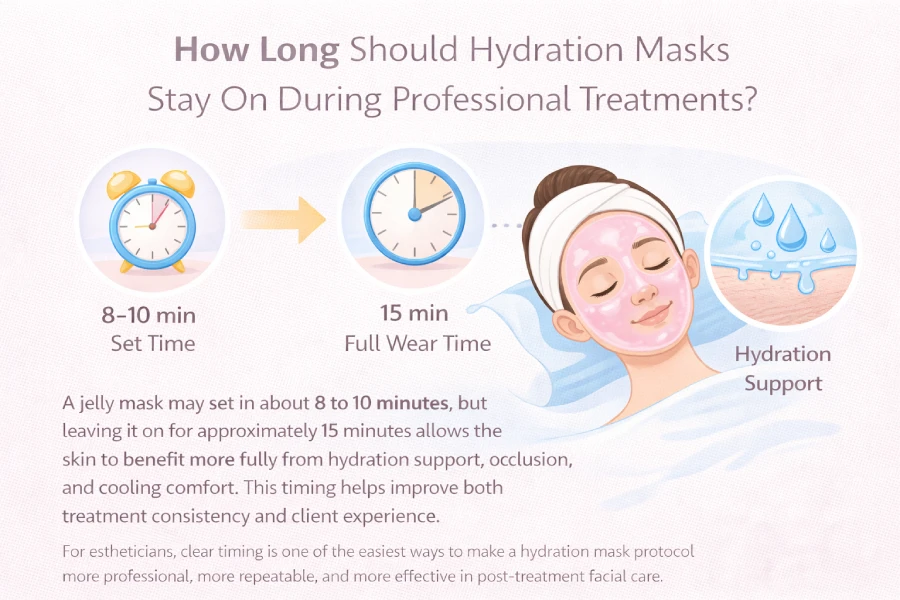
How Long Should Hydration Masks Stay On During a Professional Facial?
The optimal duration for a hydration mask during a professional treatment depends on the mask format: professional jelly masks perform best at 12 to 15 minutes, with a clinically acceptable range of 10 to 18 minutes. Sheet masks should be removed at or before 15 to 20 minutes — before the sheet approaches dryness — since a drying sheet can reverse-transfer moisture from the skin. Cream masks follow product-specific guidance, typically 10 to 15 minutes. Leaving any mask on beyond its effective window provides no additional hydration benefit and for sheet masks actively compromises the result.
- Jelly mask minimum: 10 minutes for a complete gel set and meaningful occlusive delivery. Optimal: 12 to 15 minutes. Upper limit: 18 to 20 minutes before edge drying reduces the seal quality.
- Sheet mask upper limit: 15 to 20 minutes. Wearing a sheet mask until fully dry actively draws moisture back from the skin — a common and counterproductive mistake.
- The 12 to 15 minute jelly mask window is specifically designed to accommodate a full concurrent service step — LED therapy, scalp massage, arm or décolleté work — without requiring appointment time adjustments.
- Water temperature, ambient room temperature, mixing ratio, and application thickness all affect how quickly a jelly mask sets — estheticians who standardize these variables produce more consistent, predictable service timing.
- Humectant delivery under a jelly mask reaches a meaningful saturation plateau within the 15 to 20 minute window. Extending beyond this point does not produce proportionally greater hydration.
- Knowing when to remove a jelly mask by feel and visual cue — rather than relying on a fixed timer alone — is a practical skill that improves with consistent session-to-session practice.
Mask timing is one of the most practically discussed and least systematically taught aspects of professional mask application. Most estheticians arrive at their current timing habits through a combination of product packaging guidance, school training, and trial and error — rather than through a clear understanding of the science that makes any given window optimal for any given mask format.
That lack of clarity has real consequences. A jelly mask removed at 7 minutes has not fully set and has not delivered its full hydration payload. A sheet mask left on for 30 minutes is actively drawing moisture from the skin it was supposed to hydrate. A cream mask left on past its recommended window can cause mild surface congestion in certain skin types. And a jelly mask left on for 25 minutes in a warm room has dried at the edges, reducing its occlusive seal and making removal less clean than it should be.
This guide provides a format-specific, science-grounded answer to the question every esthetician should be able to answer precisely: how long does this mask need to stay on to deliver its full clinical benefit, and when does longer stop meaning better?
What Controls How Long Each Hydration Mask Format Should Stay On
- Jelly mask optimal window is 12 to 15 minutes — long enough for full gel set and complete concurrent service steps; short enough to prevent edge drying and maintain removal integrity.
- The 10-minute lower boundary for jelly masks is a clinical floor, not a target: a mask removed at 10 minutes has just set and is at the beginning of its optimal delivery window, not the middle.
- Sheet masks should never be left on until fully dry — a drying sheet becomes a moisture-drawing surface that reverses the hydration it was delivering.
- Water temperature is the single most controllable variable in jelly mask set time: cooler water slows the reaction; warmer water accelerates it.
- Post-treatment heightened permeability means the skin absorbs humectants more rapidly during the set window, making accurate timing even more clinically meaningful in post-procedure contexts.
- Consistent mixing ratio and water temperature across sessions is the foundation of predictable set-time performance — variability in either creates variability in service timing.
- The mask removal check — testing the edge at around the 12-minute mark — is a professional habit that prevents both premature removal and overextension past the optimal window.
Why Does Mask Timing Matter Clinically, Not Just for Scheduling?
Timing a hydration mask correctly is not simply a service-flow convenience — it is a clinical decision with measurable consequences for the outcome the client experiences. The timing determines how much humectant is delivered into the skin, how effectively the occlusive seal performs its TEWL-reduction function, and whether the mask removal is a clean, intact single-piece peel or a fragmented removal that leaves residue and potentially disrupts sensitized skin.
The Delivery Window Has a Beginning, a Peak, and a Plateau
Hydration delivery under any occlusive mask follows a predictable pattern. In the first minutes of application, the humectant concentration gradient between the mask and the skin surface is at its steepest — this is when delivery is most rapid. As the stratum corneum absorbs moisture and the concentration gradient narrows, delivery slows but continues under sustained occlusion. Eventually, the stratum corneum approaches its hydration capacity for that session, and further time under the mask adds progressively less clinical benefit. Understanding that this delivery window has a shape — rapid onset, sustained middle, diminishing return at the tail — explains both why the minimum time matters and why extended wear past the optimal window is not rewarded with proportionally better results.
Mask Format Determines the Shape of That Window
The delivery window is not the same for all mask formats, because the physical mechanism of each format is different. A jelly mask that sets creates a stable occlusive seal that maintains its delivery function throughout the set window and then gradually loses efficiency as the gel dries at the edges. A sheet mask that stays wet maintains a partial occlusive seal but begins to reverse once moisture in the sheet approaches depletion. A cream mask without a physical seal delivers primarily through ingredient penetration, which follows a standard topical absorption curve that does not benefit from extended wear the way an occlusive format does. Format-specific timing guidance follows from these distinct mechanisms.
What Is the Optimal Timing Window for Each Professional Hydration Mask Format?
The table below provides the format-specific timing reference that estheticians can use as a starting framework, adjusted as needed for their specific product formulations and treatment room conditions.
| Mask Format | Minimum | Optimal Window | Upper Limit | What Happens Beyond Limit |
|---|---|---|---|---|
| Professional Jelly Mask | 10 min | 12–15 min Sweet spot |
18–20 min | Edges begin to dry; occlusive seal reduces; removal integrity may decrease |
| Bio-Cellulose Sheet Mask | 10 min | 12–18 min | 20 min | Sheet begins to draw moisture back from skin as it dries Reversal risk |
| Standard Sheet Mask | 8 min | 10–15 min | 15–20 min | Faster moisture depletion than bio-cellulose; reversal risk occurs earlier Remove before dry |
| Cream / Rinse-Off Mask | 5 min | 10–15 min | Per product label | Some formulations cause surface congestion if significantly overstayed |
| Clay / Purifying Mask | 5 min | 8–12 min | Before fully dry | Fully dried clay draws moisture from the skin; tight, dry skin surface Never let fully dry |
Why 12 to 15 Minutes Is the Jelly Mask Sweet Spot
The 12 to 15 minute window for a professional jelly mask is not an arbitrary range — it is the point at which the convergence of set integrity, occlusive seal quality, humectant delivery efficiency, and concurrent service-step compatibility is at its best. At 12 minutes under standard treatment room conditions, a correctly mixed and applied professional jelly mask has fully set, is delivering humectants at sustained concentration under a complete occlusive seal, and has not yet begun the edge-drying process that erodes seal integrity toward the 20-minute mark. A full scalp massage or LED therapy sequence fits cleanly inside this window. Removal at the 12 to 15 minute mark produces the intact single-piece peel that is both clinically optimal and the signature experience moment clients return for.
The Sheet Mask Drying Problem: Why Timing Is a Safety Issue, Not Just Scheduling
The most clinically significant timing error estheticians make with sheet masks is leaving them on until the sheet is dry. Many clients and some practitioners mistakenly believe that a fully dry sheet mask has fully delivered its benefits. The opposite is true. As the sheet loses its moisture reservoir, the concentration of moisture in the sheet drops below that of the skin surface — reversing the concentration gradient and causing the sheet to draw moisture out of the stratum corneum rather than into it. The result is a skin surface that is actually more dehydrated post-mask than it was before application began. Professional treatment room standards require sheet mask removal well before the sheet approaches dryness: in practice, a fingertip test of the sheet at the 12 to 15 minute mark will reveal whether moisture is still being delivered or whether removal should proceed.
What Variables Affect How Quickly a Jelly Mask Sets in the Treatment Room?
Unlike sheet masks and cream masks, jelly masks undergo an active chemical reaction during set — the calcium ions in the activating water cross-link the sodium alginate polymer chains in the powder, forming the gel network that becomes the set mask. This reaction rate is sensitive to several controllable variables. Understanding them gives estheticians the ability to maintain consistent set timing across sessions rather than treating variability as an inevitable feature of the format.
Water Temperature
Temperature is the most significant controllable factor in jelly mask set time. Cool water (below 18°C / 65°F) slows the alginate cross-linking reaction, extending set time by 3 to 5 minutes compared to room-temperature water. Warm water (above 30°C / 86°F) accelerates the reaction, often shortening set time to under 10 minutes and producing a less uniform gel texture. Room-temperature water — consistently around 20 to 22°C / 68 to 72°F — is the professional standard for predictable set behavior.
Mixing Ratio
A higher proportion of powder to water produces a denser gel that may set slightly faster but can also be more difficult to spread evenly across the face. A higher water proportion produces a thinner gel with a longer set time and potentially less complete occlusion once set. Manufacturers’ recommended ratios — typically 1:1 or 2:1 powder to water by volume — represent the tested optimum for that formulation. Deviating from the specified ratio is the single most common cause of set-time variability in professional practice.
Ambient Room Temperature
Treatment room temperature influences the rate at which the applied gel layer loses heat to its environment and the ambient humidity that affects surface evaporation. A warm treatment room (above 22°C / 72°F) slightly accelerates set and also slightly accelerates edge drying past the optimal window. A cool room (below 18°C / 65°F) extends set time and also extends the window before edge drying begins. Estheticians working in rooms with significant seasonal temperature variation should note this as a reason to verify set timing seasonally.
Application Thickness
A thicker application layer takes longer to set uniformly through its depth but also provides a more substantial occlusive seal once set and a more intact, easier-to-remove piece at removal. A thin application sets faster but may have less removal integrity — it is more likely to fragment or leave residue. The professional standard application thickness — typically 3 to 5 mm — represents the balance between set time and removal quality. Estheticians who rush application and apply too thinly often find set time is shorter but removal is less clean.
Client Skin Temperature
Post-treatment skin that is still elevated in temperature — following microneedling, active LED therapy, or extraction-heavy work — will accelerate the set reaction at the mask-to-skin interface compared to skin at baseline temperature. This is generally clinically inconsequential, but estheticians who notice consistently faster set times on post-procedure clients than on clients receiving the mask in a standard hydration facial context may be observing this temperature differential at work.
Product Formulation
Not all professional jelly mask powders are formulated identically. Sodium alginate grade, particle size, and the concentration and type of activating minerals in the powder all affect the rate and completeness of the gel-forming reaction. A high-quality professional formulation produces a predictable, consistent set within its specified window across sessions. Lower-grade formulations may produce variable set times due to inconsistent raw material quality — this is one of the clearest practical markers of professional versus consumer-grade formulation intent.
How to Remove Set-Time Variability From Your Jelly Mask Protocol
Estheticians who report the most consistent jelly mask set timing across their practice share three standardised habits. First: they use a dedicated mixing vessel with volume markings and measure both powder and water to the same quantities every session rather than eyeballing either. Second: they store their water at a consistent temperature — most commonly using a small insulated flask filled at the start of each service day and maintained at room temperature. Third: they apply a consistent layer thickness using a mask brush with a defined application stroke pattern that covers the face in the same sequence and depth every session.
The practical result of these three habits is that the esthetician sets a timer at mask application and can plan their concurrent service steps with confidence, because the mask will be at its optimal removal point within a predictable window that does not vary by more than 1 to 2 minutes across sessions. This level of timing consistency is what separates a practiced jelly mask protocol from an ad-hoc one, and it is the foundation of the smooth, confident service delivery that clients read as professionalism.
How Does Jelly Mask Timing Integrate Into the Full Facial Service Sequence?
Understanding the optimal mask window in isolation is only half the practical question. The other half is knowing where the mask step sits in the service sequence and how its timing interacts with everything that precedes and follows it.
Making the Mask Window Productive, Not Passive
One of the clearest differentiators between estheticians who integrate jelly masks as a signature service element and those who treat them as a simple add-on is what happens during the set window. An esthetician who mixes and applies the mask and then stands beside the bed waiting for it to set is leaving significant service value on the table. An esthetician who applies the mask, sets a timer, and immediately moves to scalp massage or positions an LED panel is delivering two clinical benefits simultaneously within a service structure that costs no additional appointment time.
The 12 to 15 minute set window is the longest uninterrupted passive period in a standard facial service structure. Treating it as an opportunity rather than a pause is one of the simplest improvements an esthetician can make to both service quality and per-appointment revenue, without changing the appointment length or the service menu.
How Do You Know When a Jelly Mask Is Ready to Remove Without Relying Solely on a Timer?
While a timer is the professional standard for mask application timing, developing the tactile and visual literacy to read a set jelly mask’s removal readiness is a practical skill that makes estheticians more adaptive to the variables that affect set time across different products, rooms, and conditions.
The Edge Test
At approximately the 12-minute mark, gently lift the lower edge of the mask at the jaw or chin. A correctly set jelly mask at this point will lift cleanly away from the skin surface without tearing or leaving gel residue, and the lifted edge will hold its shape rather than immediately flopping back or crumbling. If the edge tears or does not hold together, the mask needs another 2 to 3 minutes. If the edge is already firm and slightly drier than the surface of the mask, removal should proceed promptly.
The Surface Appearance Check
A freshly applied jelly mask has a wet, glossy surface texture. As it sets, the surface transitions to a consistent matte or semi-matte appearance. Full matte surface texture indicates complete set throughout the applied layer. If the surface is still wet or glossy in patches, the gel has not fully set in those areas and removal will produce residue rather than a clean intact piece. A uniform semi-matte surface is the visual confirmation that the mask is at or near its optimal removal point.
What Premature Removal Looks Like
A jelly mask removed before full set tears rather than peels — the gel layer fractures rather than flexing with the skin surface and lifting cleanly. Residue is left behind on the skin, requiring additional removal steps that add friction to a sensitized skin surface. The removal experience is fragmented rather than a clean single-piece peel, and the client does not experience the signature moment that makes jelly mask removal a rebooking driver. Premature removal is the most common timing error and is almost always the result of a rushed service sequence rather than an intentional clinical choice.
Estheticians who have standardised the Poly-Luronic™ Jelly Mask by Luminous Skin Lab into their post-treatment protocols consistently cite set-time predictability as one of the most practically valuable features of the formulation. When mixing at room-temperature water to the specified ratio — typically 1.5 parts powder to 1 part water by volume — practitioners report a consistently reliable set in the 12 to 14 minute range across a range of standard treatment room temperatures. This predictability means the scalp massage sequence that begins at mask application completes with approximately 1 to 2 minutes to spare before the edge-test check, rather than requiring the esthetician to interrupt mid-service to check an uncertain set state.
Practitioners also note a meaningful practical difference in removal integrity compared to other jelly mask brands previously used in the same protocol position. Poly-Luronic™ consistently produces a single-piece removal at the 12 to 14 minute mark across different skin types and treatment room conditions — including post-microneedling skin, which can present variable surface texture. The intact peel that clients respond to and describe is not accidental: it is the direct result of a formulation where alginate quality and mixing behavior are consistent enough to produce reliable removal geometry every time.
Does Post-Treatment Skin Change How Long the Mask Should Stay On?
Post-treatment skin — the context where hydration masks deliver their greatest clinical return — raises a legitimate question about whether the timing guidance changes when the skin is in an active recovery state rather than at baseline. The answer involves understanding the interaction between heightened permeability and the mask’s delivery mechanism.
Heightened Permeability Accelerates Absorption, Not Set Time
Post-treatment skin is more permeable to topical ingredients, which means that the humectants delivered by the jelly mask penetrate more effectively and reach deeper skin layers more rapidly than they would on intact skin. This accelerates the benefit rather than requiring a longer mask application window. The optimal timing guidance of 12 to 15 minutes remains the same for post-treatment application — and the clinical result is better at that timing than it would be on non-treated skin, because the delivery efficiency is higher.
The Importance of Not Over-Extending on Sensitized Skin
On post-treatment skin, there is an additional reason not to extend mask application past the optimal window: as the gel begins to dry at the edges past the 18 to 20 minute mark, the mild tension it creates on the skin surface is more perceptible and potentially more uncomfortable on sensitized skin than on intact skin. Estheticians working in post-treatment contexts should be particularly attentive to the edge-test check at the 12-minute mark and proceed with removal at the optimal point rather than extending to see if additional time produces better results. The post-treatment delivery benefit has been captured within the standard window — there is no clinical case for extending it and a comfort-related case for not doing so.
LED Therapy Timing in the Concurrent Window Post-Treatment
For estheticians combining LED therapy with jelly mask application on post-treatment skin, the LED session should be positioned within the first 12 minutes of the set window rather than beginning at the 12-minute mark. This ensures the LED sequence completes before or at the same time as the edge-test check, so mask removal proceeds immediately following LED completion rather than requiring the esthetician to either rush the LED session or extend the mask past its optimal window. Positioning LED as the first concurrent step — beginning within the first minute of mask application — produces the cleanest service sequence timing in a post-treatment facial.
Professional and Scientific References
The timing science and delivery principles referenced in this article draw from the following sources:
- Sodium alginate cross-linking kinetics and the effect of temperature, ion concentration, and mixing variables on gel formation rate. Food Hydrocolloids journal; polymer chemistry literature.
- Occlusion and transdermal penetration enhancement: extended contact time under occlusion versus open-air application. International Journal of Pharmaceutics; clinical dermatology literature.
- Concentration gradient reversal in sheet mask application: moisture delivery vs. moisture extraction depending on sheet hydration status. Journal of Cosmetic Dermatology; cosmetic formulation literature.
- PGA and HA humectant delivery kinetics under occlusive conditions: corneometry measurement at 30 minutes and 8 hours. Reviva Labs clinical literature review, 2025.
- Post-procedure TEWL elevation and the augmentation of topical ingredient penetration in disrupted skin. Dermatological pharmacology literature; International Journal of Pharmaceutics.
- Professional facial service sequencing standards. Milady Standard Esthetics; CIDESCO international professional esthetic standards.
For estheticians looking to build a hydration mask protocol around a jelly mask formulation whose set timing is predictable enough to plan service sequences around, the Poly-Luronic™ Jelly Mask by Luminous Skin Lab is the formulation our education team most consistently references for post-treatment and advanced hydration protocols. The consistent 12 to 14 minute set window under standard treatment room conditions — combined with the dual PGA and HA humectant system, fragrance-free clean-label formulation, and single-piece peel-off removal integrity — makes it the professional choice for estheticians who want their mask protocol to perform as planned, every session.
Explore the Poly-Luronic™ Jelly Mask LineFrequently Asked Questions: How Long Should Hydration Masks Stay On?
How long should a jelly mask stay on during a professional facial?
A professional jelly mask should remain on for a minimum of 10 minutes and ideally 12 to 15 minutes in most treatment room contexts. The lower bound of 10 minutes is the minimum required for the gel to fully set and deliver meaningful occlusive hydration benefit. The upper limit of 18 to 20 minutes reflects the point at which most well-formulated jelly masks begin to slowly dry at the edges without added hydration benefit. The sweet spot of 12 to 15 minutes accommodates both a complete set and a full concurrent service step such as scalp massage or LED therapy.
What happens if you leave a jelly mask on too long?
Beyond approximately 20 minutes, most professional jelly masks begin to dry and tighten at the edges, which reduces the occlusive seal, makes removal less clean, and can create mild tension on the skin surface. The mask does not become harmful past this point, but the clinical benefit plateau is reached well before the mask becomes uncomfortable. Estheticians who routinely leave jelly masks on longer than 20 minutes are not gaining additional hydration delivery — they are simply extending a step that has already completed its primary function.
How long should a sheet mask stay on during a professional treatment?
Professional sheet masks should be removed at or before 15 to 20 minutes. Beyond this window, most sheet masks transition from delivering moisture to the skin to drawing moisture back out of it as the sheet itself begins to dry. This reverse-transfer effect is the primary reason sheet masks should not be left on until fully dry — a common client misconception. In a treatment room context, 10 to 15 minutes is typically sufficient to deliver the mask’s hydration payload, and removal before the sheet approaches dryness is the professional standard.
Does leaving a hydration mask on longer mean better results?
Not beyond the optimal window. Hydration delivery under a jelly mask reaches a saturation point where the stratum corneum has absorbed what it can from the available ingredients and occlusive environment. Continuing beyond this point does not produce proportionally greater hydration. For sheet masks, extended wear actively reverses results as a drying sheet draws moisture back from the skin. For cream masks, leaving them on significantly longer than recommended can cause temporary surface congestion in some skin types as ingredients penetrate beyond their intended depth. Timing within the recommended window for each format produces the best outcomes.
What affects how quickly a jelly mask sets in the treatment room?
The primary variables that affect jelly mask set time are water temperature at mixing, ambient room temperature, the mixing ratio of powder to water, and the thickness of the applied layer. Cold water slows set time; warm water accelerates it. A cooler treatment room slightly extends the set window. A thicker application takes longer to fully set. Estheticians who standardize their mixing temperature and ratio across sessions will achieve the most consistent set times and therefore the most predictable service timing.
Can you do LED therapy while the jelly mask is setting?
Yes, and this combination is one of the most clinically efficient protocol strategies in advanced facial workflows. The set jelly mask holds independently, the transparent gel does not block LED wavelengths from reaching the skin, and the full set window of 12 to 15 minutes is sufficient to deliver a complete LED therapy session simultaneously. Clients receive the occlusive hydration recovery benefit of the jelly mask and the photobiomodulation benefit of LED therapy concurrently, compressing two high-value treatment steps into a single service window without adding appointment time.
How do you know when a jelly mask is ready to be removed?
A properly set professional jelly mask is ready for removal when it peels cleanly away from the skin surface at the edge without tearing, leaving no significant gel residue, and holds together as a single flexible piece during removal. Visually, a set mask has a consistent matte or semi-matte surface texture rather than the wet sheen of freshly applied gel. Estheticians who check the mask edge at around 12 minutes will find that a correctly formulated, correctly mixed jelly mask is reliably at its optimal removal window at this point in most standard treatment room conditions.
How does the Poly-Luronic™ Jelly Mask set time fit into a standard professional facial?
The Poly-Luronic™ Jelly Mask by Luminous Skin Lab is formulated to achieve a consistent set in 12 to 15 minutes under standard treatment room conditions — a window that fits cleanly into the recovery phase of most professional facial service structures without requiring service time adjustments. This window is long enough to accommodate a full scalp massage or LED therapy sequence and short enough to maintain overall appointment timing. The predictable set behavior means estheticians can plan concurrent service steps with confidence rather than adjusting for variable or unpredictable gel performance.
Mask Timing Is a Clinical Decision, Not a Scheduling Default
The question of how long a hydration mask should stay on has a precise answer for every format — and that answer is grounded in the same delivery science that governs every other clinical decision in a professional facial. Jelly masks perform best in a 12 to 15 minute window where the gel is fully set, the occlusive seal is at its strongest, humectant delivery is in its sustained peak phase, and removal will produce the intact single-piece peel that is both clinically optimal and the signature moment that drives rebooking.
Sheet masks should never approach dryness. Cream masks follow product guidance within established limits. And the concurrent service steps that the jelly mask set window makes possible — LED therapy, scalp massage, décolleté work — should be treated as a service design opportunity rather than a period of waiting.
Estheticians who understand why these timing parameters exist, and who standardize their mixing and application to produce consistent set behavior session after session, build the kind of protocol reliability that clients experience as professional mastery. That is not a coincidence — it is the direct consequence of treating mask timing as what it is: a clinical variable with a right answer that is worth knowing precisely.